
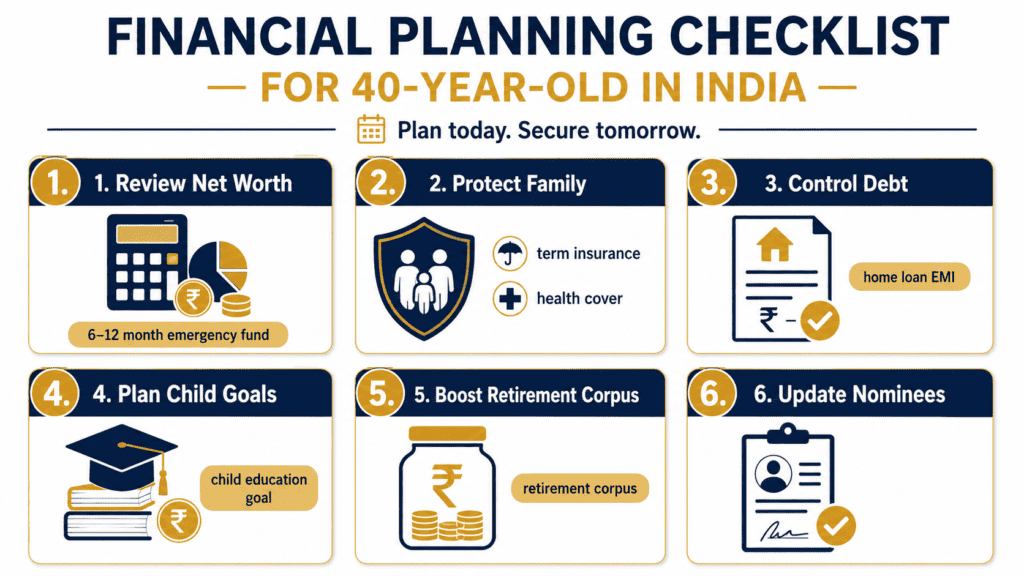
At 40, your salary is probably the highest it has ever been. So are your responsibilities. You have a home loan, a child in school, ageing parents to think about, an EPF account you last checked three years ago, and a folder of insurance policies you bought without quite understanding them. The income is there. The plan — not always. Most 40-year-old salaried professionals in India are not under-earning. They are under-organised. This checklist gives you a structured way to check six critical areas of your financial life: net worth, emergency fund, insurance, debt, child goals and retirement. Not one at a time — all at once.
Quick Answer: Financial Planning Checklist for 40 Year Old India
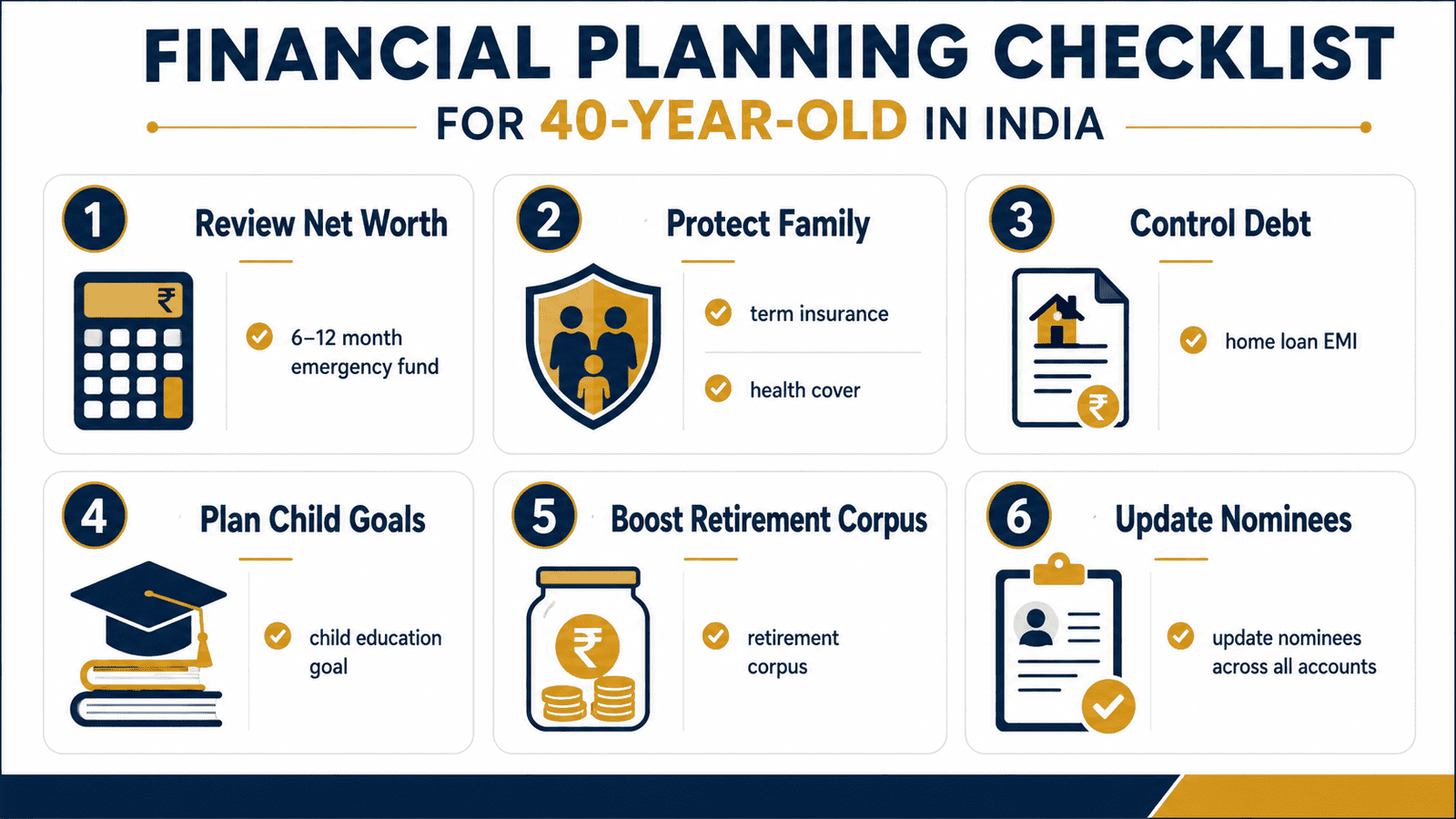
A financial planning checklist for 40 year old India should cover six areas: net worth, emergency fund, insurance, debt, child goals and retirement. Start by building 6–12 months of expenses, such as ₹6 lakh for ₹50,000 monthly spending, then review term cover, health cover, SIPs, EPF/NPS, loans and nominees annually.
Key Takeaways
- At 40, priority shifts from only growing wealth to also protecting it — insurance gaps and nomination blanks are just as costly as low investment returns.
- Your emergency fund should cover 6–12 months of household expenses; for a family spending ₹80,000 a month, that means ₹4.8 lakh to ₹9.6 lakh in liquid savings.
- Depending only on employer health insurance is a serious risk — group cover typically ends the day you resign or are retrenched, and buying individual cover at 45 costs significantly more than at 40.
- If you have high-interest personal loans or credit card debt, clearing them gives a guaranteed return equal to the interest rate — often 14–36% — which no investment reliably matches.
- Retirement at 60 is 20 years away from today; that runway shrinks every year you delay increasing your SIP or NPS contribution.
- Review all six checklist areas at least once a year — after your appraisal increment is the ideal moment, before lifestyle inflation absorbs the increase.
- Tax rules, EPF/NPS contribution limits, insurance premium rates and product terms change; always verify current figures from official sources before making any financial decision.
Key Facts at a Glance
| Checklist Area | What to Review | Where to Verify |
|---|---|---|
| Net Worth | Total assets minus all liabilities; update annually | Loan statements, EPF passbook, SEBI-registered investment accounts |
| Emergency Fund | 6–12 months of essential household expenses in liquid savings | Bank statements; no official body — personal target |
| Term Insurance | Cover = 10–15× annual income or outstanding liabilities + future family needs | IRDAI — irdai.gov.in; insurer policy documents |
| Health Insurance | Personal family floater separate from employer group cover | IRDAI — irdai.gov.in; insurer documents |
| Home Loan / Debt | Outstanding balance, remaining tenure, EMI-to-income ratio | Lender statements; RBI guidelines — rbi.org.in |
| Retirement Corpus | EPF balance, NPS Tier 1, SIPs mapped to retirement | EPFO — epfindia.gov.in; PFRDA — pfrda.org.in; SEBI — sebi.gov.in |
| Child Education Goal | Target corpus, time horizon, current savings rate and shortfall | SEBI-registered fund house documents |
| Nominees and Documents | Nominations updated on EPF, bank accounts, insurance, mutual funds | EPFO; bank; insurer; RTA for mutual funds |
The Complete Financial Planning Checklist for a 40-Year-Old in India
Age 40 is a natural midpoint — old enough to have built some assets, young enough to correct course. The checklist below works in order. Start with protection and clarity before you add more investments. If you want to understand the wider personal finance framework before diving in, start with basics before working through each step.
Step 1 — Calculate Your Net Worth
A net worth statement is the single most useful financial document you can create. It is straightforward: total assets minus total liabilities. Assets include your EPF balance, NPS corpus, mutual fund investments, fixed deposits, gold, property market value and any other savings. Liabilities include your home loan outstanding, car loan, personal loans and credit card dues.
Most 40-year-olds find that their net worth looks strong on paper — but most of it is locked in illiquid property. If your liquid net worth (investments, bank balances, EPF) is less than five times your annual take-home salary, that is a gap worth addressing. To calculate real wealth, use the assets-minus-liabilities method and update the number every year.
Step 2 — Build or Validate Your Emergency Fund
An emergency fund is not an investment. It is a financial buffer — separate from SIPs, FDs and EPF — that keeps you from selling long-term investments at the worst possible time. At 40, with a family, the target is 6–12 months of essential household expenses held in liquid instruments: a savings account, liquid mutual fund or a short-term FD you can break without penalty.
If your household spends ₹80,000 a month on essentials — rent or EMI, utilities, groceries, school fees, insurance premiums — your emergency fund target is ₹4.8 lakh to ₹9.6 lakh. Most Indian families have this money in a mix of accounts without ever naming it as the emergency buffer. Consolidate and name it. According to SEBI’s investor awareness guidelines, liquidity planning is a foundational step before committing to higher-risk investments.
Step 3 — Review Term Insurance and Health Cover
Insurance at 40 is a protection decision, not a tax-saving decision. Review three things. First, your term insurance sum assured: is it enough to replace your income for the remaining years your family would need support? A basic thumb rule is 10–15 times annual income, adjusted for outstanding loans. Second, is your health cover adequate? Employer group cover lapses the moment you leave the job. Buying an individual or family floater policy at 45 will cost noticeably more than at 40. According to IRDAI guidelines, policyholders have the right to port their health policy to a new insurer without losing accrued waiting period benefits — a fact many employed Indians never use. Third, review your existing life insurance policies. Traditional endowment or money-back policies with low cover are not substitutes for term insurance.
Step 4 — Control Debt and Review Home Loan Affordability
Not all debt is equal. A home loan at 8–9% per annum, with a tax deduction on interest, is very different from a personal loan at 14–18% or revolving credit card debt at 36–42%. If you carry any high-cost debt, prioritise it over additional market investments — clearing ₹1 lakh of credit card debt at 36% is a guaranteed ₹36,000 saving, which no investment reliably matches. For your home loan, the question at 40 is not only “Can I afford the EMI?” but also “Does my outstanding tenure extend beyond my earning years?” As per RBI guidelines, borrowers can make partial prepayments to reduce tenure or EMI — use any bonus or increment for this if your loan rate is high. Total EMIs should ideally stay at or below 40% of gross monthly income.
Step 5 — Align Investments with Actual Goals
Many 40-year-olds have SIPs running but cannot clearly say which SIP is for retirement, which is for the child’s college fees and which is just leftover from an old conversation with a distributor. Goal clarity matters at this stage. Map each investment to a purpose: retirement corpus, child’s higher education, home loan prepayment reserve, or medium-term family goals. SEBI encourages investors to review fund performance and goal alignment annually rather than switching funds based on short-term returns.
For EPF, check your balance on the EPFO member portal at epfindia.gov.in. For NPS, check your PRAN statement on the PFRDA portal at pfrda.org.in. These are your two largest retirement vehicles — knowing the numbers takes ten minutes and gives you a clearer picture of how much retirement gap remains.
Step 6 — Update Nominees, Documents and Family Awareness
This step is skipped more often than any other. Check nominations on every financial account: EPF, NPS, mutual funds, bank accounts, insurance policies, PPF. Outdated or missing nominees are one of the most common causes of family financial disputes after an unexpected death. Store a simple one-page summary of all accounts, policy numbers, login credentials and emergency contacts in a place your spouse or trusted family member can access. This is not estate planning — it is basic family financial hygiene.
Real Example: Rajesh, 40, Senior IT Manager in Pune
Rajesh earns ₹28 lakh per year, takes home roughly ₹2 lakh a month after tax and EPF deductions. His household spends ₹80,000 a month on essentials, and he pays a ₹55,000 home loan EMI. His wife manages household finances and has some fixed deposits in her name. His daughter is in Class 6.
When Rajesh ran through this checklist, he found four gaps. His term cover was ₹50 lakh — too low given ₹35 lakh outstanding home loan and seven years of family income support needed. He had no personal health insurance, only his employer’s group cover. His SIPs totalled ₹25,000 per month but were split across six funds with no clear goal label. And his EPF nomination still showed his mother, not his wife.
His review order: first, port or buy a family health floater independently before any job change becomes a risk. Second, increase term cover adequacy. Third, label existing SIPs — two for retirement, one for his daughter’s college corpus. Fourth, update EPF and bank nominations in one sitting. To understand how families can divide income between needs, goals and EMIs, build a family budget as a practical next step. Actual requirements vary by city, number of dependents, outstanding loans and individual risk profile.
How to Calculate Your Key Numbers at 40
Emergency Fund Target = Monthly Essential Expenses × 6 (minimum) to 12 (recommended)
Net Worth = Total Assets (EPF + NPS + MFs + FDs + Gold + Property) − Total Liabilities (Home Loan + Car Loan + Personal Loans + Credit Card Dues)
Retirement Gap (simplified) = Estimated Annual Expenses in Retirement × Corpus Multiple − Current Retirement Savings
For a more detailed retirement corpus estimate, use the estimate retirement corpus guide, which walks through inflation-adjusted goal planning step by step. EPF and NPS contribution limits and tax treatment should be verified from epfindia.gov.in and pfrda.org.in before making contribution decisions. SEBI-registered investment advisers can help with investment goal mapping.
| Calculation | Example Inputs (Rajesh) | Result |
|---|---|---|
| Emergency Fund Target | ₹80,000/month × 9 months | ₹7.2 lakh target |
| Net Worth (simplified) | EPF ₹18L + MFs ₹12L + Property ₹90L − Home Loan ₹35L | ₹85 lakh (mostly illiquid) |
| Retirement Corpus Gap | Monthly expenses ₹80K, 20 years to retire, current retirement savings ₹30L | Significant gap — detailed modelling needed |
Comparison: Financial Priorities at 40 — Urgent vs Important vs Avoid
| Priority Level | What It Includes | Why It Matters Now |
|---|---|---|
| Urgent | Emergency fund gap, insurance gap, high-interest debt | A single job loss, health event or debt spiral can unwind years of savings |
| Important | Retirement catch-up, child education goal, tax planning, asset allocation review | Every year delayed costs compounding time you cannot recover |
| Optional | Second home purchase, luxury vehicle upgrade, alternative investments | Fine to consider after urgent and important areas are covered |
| Avoid | Buying insurance only for tax saving, ignoring nominees, relying only on employer cover | These create the illusion of planning without the protection |
To decide whether to prioritise your emergency fund or start new investments, read emergency fund first for a practical framework.
How to Decide What’s Right for You
You have dependents — spouse, children, ageing parents — and your family relies on your income — THEN protection planning must come before any new investment commitment. Review term cover and health cover first.
You carry personal loans, credit card debt or any high-interest borrowing above 12% per annum — THEN consider clearing that before increasing equity SIP contributions. The guaranteed return on debt repayment often exceeds expected market returns.
Your emergency fund is below three months of essential expenses — THEN build liquidity before redirecting money into long-term illiquid products like NPS or ELSS lock-in instruments.
Your retirement savings feel significantly behind relative to your target — THEN increase your SIP or NPS contribution with each annual salary increment rather than in a single large move. Even a ₹5,000 monthly increase compounded over 20 years makes a meaningful difference.
Your child’s higher education is 5–7 years away — THEN review whether the education corpus is in appropriately lower-risk instruments rather than high-equity funds, given the shorter time horizon.
Your income is stable, emergency fund is healthy and insurance is adequate — THEN focus attention on goal-mapped investing: separate SIPs for retirement and education, with annual rebalancing.
You have not yet reviewed your insurance, emergency fund and nominations — do not start optimising tax or chasing higher investment returns first. The foundation must come before the top floor. If you need to revisit first principles, start with basics before building your full checklist.
Common Mistakes to Avoid
Depending Entirely on Employer Health Insurance
Many salaried Indians assume their employer’s group health policy is sufficient coverage for the family.
Group cover typically lapses immediately when you resign, are retrenched or retire. Buying an individual family floater at 45 or 50 comes with higher premiums and potentially stricter underwriting — a policy bought at 40 is considerably cheaper. An uninsured hospitalisation can cost ₹2–5 lakh or more for a single procedure at a private hospital.
Buy a personal family floater now, even if the sum insured is modest. You can increase it at renewal. According to IRDAI guidelines, premiums and terms vary significantly by insurer and age at entry.
Buying Traditional Insurance Policies for Tax Saving
Endowment and money-back plans give you both insurance and investment — but rarely do either well.
The sum assured is typically 5–10 times annual premium, which is far too low for meaningful family protection. The effective return after years of premium payments is often below 5–6%. Many 40-year-olds are still paying premiums on policies bought in their 20s that provide minimal cover relative to current income and liabilities.
Review existing policies. If a policy is underperforming and you can afford to surrender or reduce paid-up value, consider redirecting premium amounts toward term insurance and proper investments. To review term cover adequacy, use the income-replacement method before buying anything new.
Delaying Retirement Planning Until Children Are Done with Education
The instinct is understandable: child’s education feels urgent, retirement feels distant.
But education costs typically peak for 4–6 years; retirement can last 25–30 years. Reducing retirement contributions now means less compounding time when your retirement horizon is already under 20 years. Treat retirement savings as non-negotiable, even if the amount is modest, and let it grow undisturbed while you also fund education.
Run both goals simultaneously, even at a lower monthly amount for each, rather than pausing one entirely.
Keeping Investments Unorganised and Unlabelled
Many Indian professionals at 40 have five to eight SIPs, two or three FDs, a PPF account and an EPF balance — none clearly linked to a goal.
Without goal labels, you are likely to redeem long-term retirement money for a short-term need, miss a child education deadline or over-invest in one category and under-invest in another. Map each investment to a purpose: retirement, education, emergency buffer or medium-term goal.
A simple spreadsheet updated annually is enough. Goal clarity is more valuable than an additional fund.
Ignoring Nominations, Wills and Spouse Awareness
Outdated nominations are one of the most common causes of family financial difficulty after an unexpected death or incapacitation.
If your EPF nomination shows a deceased relative, or if your spouse does not know where your insurance documents, mutual fund folios and bank accounts are, a single crisis can become a prolonged legal and financial ordeal. Update nominations across all accounts in one session. Store a simple summary document in a shared, accessible location.
This takes two to three hours and protects everything you have spent decades building.
Ignoring Inflation in Long-Term Goal Estimates
A child’s college fee of ₹10 lakh today might cost ₹20–22 lakh in ten years at a 7–8% education inflation rate.
Planning to save a corpus based on today’s cost, without adjusting for inflation, leads to a systematic underfunding of future goals. Build inflation assumptions into every long-term goal estimate — especially for education and retirement.
SEBI and AMFI investor education resources explain how inflation erodes purchasing power over time in the context of long-term investing.
When This May Not Be the Right Choice
A generic financial planning checklist works well for most salaried households. However, some situations need more than a checklist.
If you have complex income — business income, rental income, RSUs from a foreign employer, freelance income or an inheritance — your tax planning, investment eligibility and compliance requirements may differ significantly from a standard salaried scenario.
If you are dealing with serious debt stress, missed EMIs or a debt restructuring situation, a general checklist is not the right starting point. Financial counselling or professional debt advice is more appropriate.
If a major health condition affects your insurability, standard term or health insurance products may not be available or affordable, and specialist advice is needed to plan alternative protection strategies.
If your household involves divorce, remarriage, a special-needs dependent, a family business or an estate dispute, nomination and succession planning requires qualified legal and financial professionals — not a general checklist.
If any of these apply to your situation, it may be worth exploring alternatives before committing.
Official Rules and Where to Verify
Rules, limits, and rates on this topic can change with each Budget or regulatory update. Always verify current figures directly from the official source before making any financial decision.
- Income tax rules and filing: Income Tax Department — incometax.gov.in
- EPF balance, contribution rules and nominations: EPFO — epfindia.gov.in
- NPS contribution limits and withdrawal rules: PFRDA — pfrda.org.in
- Insurance policy terms, insurer details and portability: IRDAI — irdai.gov.in
- Mutual fund disclosures and investment registration: SEBI — sebi.gov.in
- Home loan terms, prepayment charges and borrower rights: Lender documents and RBI — rbi.org.in
Expert Tips
- Create a one-page family financial dashboard every April: list all accounts, balances, policy numbers, maturity dates and nominees in a single document. Update it after your appraisal increment each year — that is the moment when you have new money to allocate before habits absorb it.
- Keep goal money in separate instruments from your monthly spending account. When retirement money and monthly expenses share the same account, the retirement money tends to get spent. Label each FD, liquid fund or SIP with a goal name in your tracking sheet.
- Review every existing insurance policy before buying a new one. Many 40-year-olds buy additional cover without checking whether existing policies are active, whether premiums are being paid from the right account and what the current sum assured actually is.
- Capture salary increments for investments before lifestyle inflation absorbs them. When your CTC increases by ₹1.5 lakh annually — say, after an appraisal — increase your SIP by ₹5,000–₹8,000 a month before you notice the extra money in your account. This is called automatic escalation and it is the most practical way to increase retirement savings without feeling the pinch.
- Discuss financial basics with your spouse or a trusted family member once a year: where the policies are, what the EPF UAN number is, what to do if something happens to you. This conversation takes 30 minutes and removes one of the most avoidable financial risks Indian families carry.
- If you have not started NPS, the 40s are still a viable window. Twenty years of contributions to NPS Tier 1, with employer co-contribution if available, and the additional tax deduction under Section 80CCD(1B) — subject to current rules verified at pfrda.org.in — can add meaningfully to retirement corpus alongside EPF.
- Do not rebalance investments in panic after market falls. Set an annual rebalancing date — 1 April or 1 January — and review asset allocation against your goal timeline on that date only. Reactive rebalancing often destroys more value than it protects.
Frequently Asked Questions
Is 40 too late to start financial planning in India?
No — 40 is not too late, but it is a turning point. You have roughly 20 years to retirement if you plan to stop working at 60. That is still enough time for meaningful compounding, but it is no longer enough time to ignore gaps. The key shift at 40 is urgency: act on insurance, emergency fund and retirement savings now rather than in another five years.
How much emergency fund should a 40-year-old keep?
The standard guidance is 6–12 months of essential household expenses. At 40, with a family and an EMI, lean toward the higher end — 9 to 12 months — because a single job loss, medical event or family emergency is more financially consequential than it was at 25. Keep this money in a savings account, liquid fund or short-duration FD, not in equity or locked instruments.
Should I repay my home loan faster or invest more at 40?
It depends on your loan interest rate versus your expected investment returns, your tax situation and your psychological comfort with debt. If your home loan rate is 8.5–9% and you can claim the interest deduction under Section 24(b), partial prepayment may not always beat long-term equity returns — but carrying a large loan into your 50s increases financial fragility. A balanced approach: make one to two additional EMI payments per year from increments while also maintaining investment contributions. Verify current tax deduction limits at incometax.gov.in.
How much term insurance does a 40-year-old need?
A widely used starting estimate is 10–15 times your annual income, adjusted upward if you have a large outstanding home loan, young children or financially dependent parents. For example, if you earn ₹28 lakh per year and have ₹35 lakh in home loan outstanding, a ₹1.5–2 crore term cover is a reasonable starting point. Actual needs vary by family structure, liabilities and existing assets. Premium rates increase with age and health status — verify current rates from IRDAI-registered insurers at irdai.gov.in.
Is NPS useful after 40?
Yes. NPS Tier 1 still gives you tax-advantaged retirement savings, and if your employer offers NPS co-contribution, the benefit is considerable. The limitation at 40 is that the lock-in extends to age 60 — you cannot withdraw freely before that. But for money specifically earmarked for retirement, this structure is exactly what you want. Check current contribution limits, withdrawal rules and tax treatment at pfrda.org.in before deciding how much to contribute.
Should I reduce equity exposure at 40?
Not necessarily — it depends on your goal timeline. If your retirement is 20 years away, maintaining significant equity exposure still makes sense for that goal. Where you should reduce equity is for goals that are 3–7 years away, like your child’s college admission. A common approach: keep long-horizon goals (retirement) in equity-heavy allocations, and shift medium-term goals (education, home loan prepayment reserve) toward balanced or debt-heavy instruments as the deadline approaches.
How often should I review my financial plan?
At minimum, once a year — ideally after your appraisal, when your salary changes. Key moments for a mid-year review: a job change, a major salary increment, a new loan, a family change (new child, parent’s health event), or a significant market movement that alters your asset allocation. Insurance policies should be checked at renewal. Nominations should be verified whenever there is a family event that could affect beneficiaries.
Can I switch health insurance policies if I am unhappy with my insurer?
Yes. IRDAI guidelines allow portability of health insurance policies, meaning you can move to a new insurer at renewal without losing waiting period benefits that have already been served in your existing policy. This applies to individual and family floater policies. The porting request must typically be made before the renewal date. Verify current portability rules and procedures at irdai.gov.in.
What happens if I have not updated nominees on my investments?
If a nominee is missing or outdated and you pass away or are incapacitated, your family may face a lengthy legal process to claim the assets. For EPF, the claim goes through succession laws if no nominee is registered. For mutual funds and insurance, claims can be delayed significantly without a valid nominee. Updating nominees takes 10–15 minutes per account online — it is the highest-impact, lowest-effort task on this checklist.
What is a reasonable savings rate at 40 for retirement?
There is no single universal answer — it depends on your current corpus, years to retirement and expected lifestyle. As a broad reference, financial planners often suggest that by age 40, you should ideally have saved roughly 3 times your annual salary in retirement-specific instruments, and continue saving 15–20% of your income toward retirement from that point forward. These are directional benchmarks, not guarantees. Actual requirements depend on inflation, investment returns, tax rules and retirement age — all of which must be verified from current official and provider sources.
Final Verdict
The best financial plan at 40 is not the most aggressive one — it is the most complete and resilient one. Start with protection: fix insurance gaps and emergency fund shortfalls before chasing higher investment returns. Then organise debt: clear high-cost borrowings and review your home loan structure. Then invest with clarity: label every SIP, track every EPF balance and align each investment to a specific goal. The financial planning checklist for 40 year old India is not a one-time exercise — it is an annual review that becomes more valuable every year you practise it. Review your numbers, verify current rules from official sources and update the checklist every year. Always verify the latest rules from official sources or consult a qualified professional before making any financial decision.
This article is for educational purposes only and should not be treated as personalised financial, tax, investment, insurance, or legal advice. Tax rules, interest rates, regulatory limits, and product features can change with each Budget or policy update. Please verify current rules from official government sources or consult a qualified and registered professional before making any financial decision.

Ishita Sharma writes about goal-based financial planning for Indian families and individuals. Her content connects saving, budgeting, investing, insurance, and debt decisions to real-life goals such as child education, marriage, retirement, home buying, emergency funds, family protection, and long-term wealth building.
She covers topics such as child education planning, marriage goal planning, retirement planning, home-buying goals, inflation-based goal estimation, monthly investment planning, savings timelines, emergency buffers, asset allocation basics, family financial milestones, and goal calculators.
Ishita’s writing is structured, thoughtful, and decision-oriented. She helps readers move from vague goals like “save more” to clearer questions such as how much may be needed, by when, what assumptions matter, and what trade-offs exist. Her articles use Indian examples, timelines, ₹ amounts, and simple planning frameworks. Her content is educational and should not be treated as personalised investment, tax, loan, or insurance advice. Since future costs, inflation, returns, product rules, and tax treatment can change, readers should verify current information before acting.