

You raised an invoice for ₹1,00,000. Your client paid ₹90,000. The missing ₹10,000 wasn’t a shortpayment — your client deducted TDS before transferring the amount. For many freelancers, this is where the confusion begins. Is that money gone? Can you get it back? Do you report ₹90,000 or ₹1,00,000 in your income tax return?
TDS on freelance payments works differently from salary TDS, and most clients won’t explain the mechanics to you. This article covers how client-side TDS deduction works under Indian income tax law, how to track it in Form 26AS and AIS, how to report it correctly in your ITR, and how to claim a refund if the tax deducted exceeds your final liability. It is written for Indian resident freelancers and consultants receiving professional or technical fee payments from Indian clients.
All rates, thresholds, and form rules mentioned here must be verified for the current financial year before you file. Tax rules can and do change with each Budget.
Quick Answer: TDS on Freelance Payments
TDS on freelance payments is tax deducted by a client before paying professional or technical fees. For many professional services, clients may deduct 10% TDS under Section 194J [CONFIRM — verify current rate before publishing]. Freelancers can claim this as credit or refund by matching Form 26AS/AIS and filing the correct ITR.
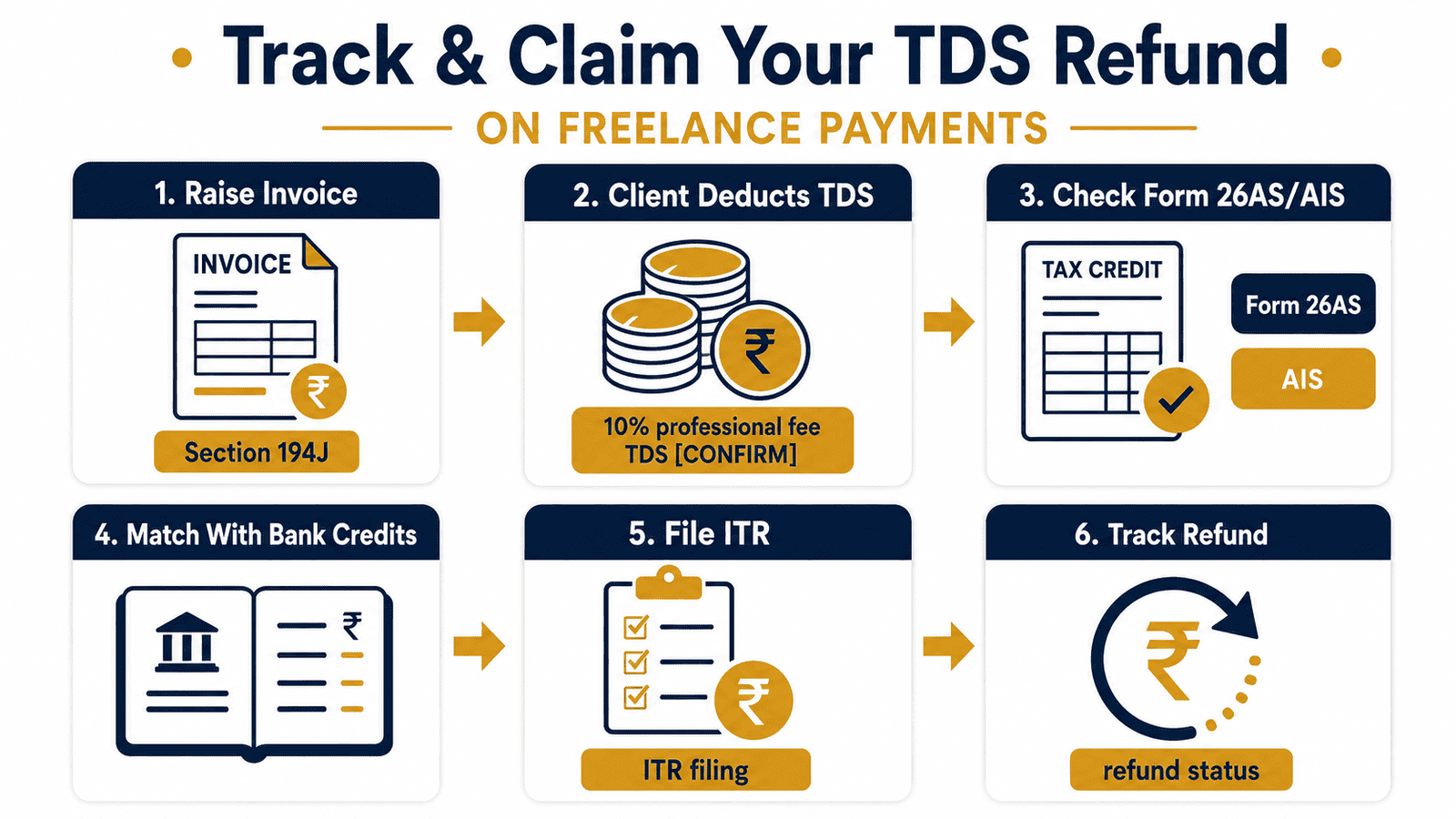
Key Takeaways
- TDS deducted by your client is not lost money — it becomes a tax credit against your PAN once the client deposits it with the government.
- Always report your gross invoice amount as income, not the lower net amount received in your bank account.
- Download Form 26AS and AIS from the Income Tax portal before filing and match every TDS entry against your invoice records.
- A refund arises only when your total TDS plus advance tax paid exceeds your final income tax liability — it is not automatic or guaranteed.
- If TDS deducted by a client is not visible in Form 26AS, collect Form 16A from the client and follow up for correction before you file, where time permits.
- Freelancers with income above the advance tax threshold must pay advance tax quarterly — TDS alone may not cover the full liability.
- AIS may show higher amounts than Form 26AS because it aggregates data from multiple sources — reconcile both before filing.
Key Facts at a Glance
| Field | Detail | Verify Before Filing |
|---|---|---|
| Common section for professional/technical fees | Section 194J | incometax.gov.in |
| Common TDS rate for professional fees | 10% of payment [CONFIRM] | incometax.gov.in |
| TDS threshold (no deduction below this) | ₹30,000 per year per payer [CONFIRM] | incometax.gov.in |
| Key documents to collect | Invoice, bank statement, Form 16A, Form 26AS, AIS | — |
| Where to track TDS credit | Form 26AS and AIS on Income Tax portal | incometax.gov.in |
| Refund route | File correct ITR and validate pre-validated bank account | incometax.gov.in |
| ITR forms commonly used | ITR-3 (regular books) or ITR-4 Sugam (44ADA) | incometax.gov.in |
How TDS on Freelance Payments Works
TDS stands for Tax Deducted at Source. It is not an extra charge your client is imposing — it is the government’s mechanism for collecting income tax in advance, at the point of payment, rather than waiting for you to pay at the end of the year. When your client deducts TDS from your invoice, they are essentially paying a portion of your estimated tax liability on your behalf and depositing it with the Income Tax Department against your PAN.
For a full picture of how freelance income is taxed from the ground up, read our guide on freelancer tax basics. This section focuses specifically on the TDS mechanics after an invoice is raised.
Why Your Client Deducts TDS
Under the Income Tax Act, entities that make payments for professional or technical services above the prescribed threshold are required to deduct TDS before releasing payment. Section 194J is the provision most commonly applicable to payments made to freelancers and independent consultants for professional services, technical services, royalty, and non-compete fees. The applicable rate and the exact definition of which services fall under which sub-clause of Section 194J can vary — always verify the current rate and applicability for your type of work before filing.
Not every client is required to deduct TDS. Individual clients and Hindu Undivided Families (HUFs) who are not subject to tax audit generally do not have to deduct TDS on professional payments. Larger companies, firms, and entities subject to audit almost always must.
Gross Invoice vs Net Bank Credit vs TDS Credit
This is the single most important distinction for any freelancer dealing with TDS. When a client deducts TDS:
- Gross invoice value — the full amount you billed, say ₹1,00,000. This is your income for tax purposes.
- TDS deducted — say ₹10,000 at 10%. This goes to the government against your PAN.
- Net bank credit — ₹90,000. This is what reaches your account.
You must report ₹1,00,000 as income in your ITR, not ₹90,000. The ₹10,000 TDS is then claimed as a tax credit against your final computed tax liability. If your actual tax liability is ₹7,000, you are entitled to a refund of ₹3,000. If your liability is ₹14,000, you owe the balance ₹4,000.
Understanding Form 16A, Form 26AS, and AIS
Three documents matter most for freelancer TDS reconciliation:
Form 16A is the TDS certificate your client must issue to you. It shows the gross amount paid, TDS deducted, deposit challan details, and the PAN of both parties. It is issued quarterly — or on request — and is your primary proof of TDS deducted.
Form 26AS is a consolidated tax credit statement available on the Income Tax portal. It aggregates TDS deposited by all payers against your PAN. If your client has deposited TDS correctly and quoted your PAN accurately, it will appear here. According to the Income Tax Department, Form 26AS is your authoritative record of taxes paid on your behalf.
AIS (Annual Information Statement) is a broader document introduced more recently. It captures not just TDS but also interest income, dividend, securities transactions, and other financial information sourced from multiple reporting entities. AIS may show a higher aggregate figure than Form 26AS, particularly if your clients report amounts differently. Always reconcile both before filing.
What Happens if TDS Is Not Deposited Against Your PAN
If your client deducts TDS but quotes the wrong PAN, or fails to deposit it, the credit will not appear in your Form 26AS. You cannot claim a credit for TDS that is not reflected in the portal — at least not without going through a correction or grievance process. This is why collecting Form 16A from each client is essential, and why checking Form 26AS well before the filing deadline matters.
Real Example: Rohan’s Invoice, TDS, and Refund Walkthrough
Rohan, 29, is a freelance UI designer based in Bengaluru earning around ₹9 lakh a year from Indian startup clients. One client — a Bengaluru-based SaaS company — engages him for a project and he raises an invoice for ₹1,00,000 for design services.
The client’s accounts team deducts TDS and transfers ₹90,000 to Rohan’s bank account. The ₹10,000 TDS is deposited with the Income Tax Department against Rohan’s PAN. Three weeks later, Rohan downloads his Form 26AS and sees the ₹10,000 credit reflected against that client’s TAN.
Rohan’s invoice includes GST at 18% on the professional service fee. The client deducts TDS on the base fee amount, not on the GST component — GST and income tax TDS operate separately. For a clean breakdown of how to structure your invoice correctly, refer to our article on freelance invoice rules.
When Rohan files his ITR, he reports ₹1,00,000 as income from this client — not ₹90,000. He claims the ₹10,000 TDS as a credit. If his total tax liability after deductions and regime choice is ₹8,000, he will receive a ₹2,000 refund after ITR processing. The key insight: the bank credit does not equal taxable income, and TDS credit does not equal final tax settled.
How to Calculate Your TDS Credit and Refund
Refund or Balance Due = Final Tax Liability − TDS Credit − Advance Tax Paid − Self-Assessment Tax Paid
Let’s work through two scenarios using approximate figures. Verify all slab rates, thresholds, and limits for the relevant assessment year at incometax.gov.in before applying to your own filing.
| Scenario | Key Figures [CONFIRM all before filing] | Result |
|---|---|---|
| TDS less than tax payable | Gross income ₹9L, eligible expenses ₹1.2L (if not using 44ADA), taxable profit ₹7.8L, estimated tax ₹78,000 [CONFIRM slab], TDS credit ₹60,000, advance tax paid ₹0 | Balance of ₹18,000 due — pay as self-assessment tax before or at filing |
| TDS more than tax payable | Gross income ₹9L, presumptive income under 44ADA ₹4.5L [CONFIRM threshold], tax on ₹4.5L approx ₹13,000 [CONFIRM slab], TDS credit ₹60,000 | Refund of approximately ₹47,000 after ITR processing [CONFIRM] |
If you claim business expenses rather than using the presumptive scheme under Section 44ADA, your deductible expenses — software subscriptions, equipment, home office costs — reduce taxable profit and can push the balance toward a refund. Read our guide on freelancer expense deductions to understand which costs qualify.
Also note: if your total tax liability for the year exceeds ₹10,000 [CONFIRM threshold] after adjusting TDS, advance tax instalments are required. Missing advance tax deadlines can attract interest under Sections 234B and 234C — verify current interest rates and deadlines before filing.
Comparison: Common TDS Tracking Situations and What to Do
| Situation | What It Means | What to Do |
|---|---|---|
| TDS deducted and visible in Form 26AS | Client has deposited correctly with your PAN | Report gross income, claim TDS credit in ITR — straightforward |
| TDS deducted but NOT in Form 26AS | Client may have quoted wrong PAN or not yet deposited | Request Form 16A from client; ask them to verify and correct TDS return if needed |
| AIS amount differs from your invoice total | AIS may aggregate differently or client may have reported a different amount | Reconcile your invoice records with AIS and Form 26AS; document the difference |
| TDS credit higher than final tax liability | You have overpaid tax via client TDS | File ITR correctly — refund may arise after processing Refund Possible |
| No TDS deducted by client | Client is not required to deduct, or payment was below threshold | You must calculate and pay advance tax or self-assessment tax yourself Action Required |
How to Decide What’s Right for You
TDS from all clients appears correctly in Form 26AS and matches your invoices — THEN file your ITR reporting gross income and claim TDS credit. The workflow is clean.
Some TDS entries are missing from Form 26AS but you have received net payments — THEN contact each client, collect Form 16A, and ask them to verify the deposit and correct their TDS return before you file where time permits. If correction is not possible before the deadline, file with what is reflected and consider a revised return later.
You have multiple clients and expect more than ₹10,000 [CONFIRM] in total tax liability after TDS — THEN estimate and pay advance tax quarterly rather than waiting until filing. Failing to pay on time attracts interest.
Your freelance income is under the 44ADA presumptive taxation threshold [CONFIRM] and your clients’ TDS credits already exceed your estimated tax — THEN ITR-4 Sugam may be the simpler filing route; confirm the correct form for your income type and year.
Your income is high, you have multiple income heads (salary plus freelance), or you are uncertain which ITR form applies — THEN use a qualified tax professional rather than guessing. Filing incorrectly can delay refunds and invite notices. See our step-by-step guide on how to file ITR correctly as a freelancer.
You are not maintaining even basic records of invoices, bank credits, and client-wise TDS — this workflow will be impossible to execute correctly. Start a simple spreadsheet now, before the filing season, not the night before the deadline.
Common Mistakes to Avoid
Reporting Net Bank Credit Instead of Gross Invoice Amount
This is the most common mistake. You received ₹90,000 in your bank, so you report ₹90,000 as income.
Doing this understates your income and also means you forfeit the TDS credit for the ₹10,000 your client already deposited on your behalf. The mismatch between your ITR and Form 26AS can trigger a scrutiny notice from the Income Tax Department.
Always report ₹1,00,000 as income and separately claim ₹10,000 as TDS credit. The numbers must match Form 26AS.
Ignoring Form 26AS and AIS Before Filing
Filing without checking these documents means you may miss TDS entries, double-count income, or claim credits that do not exist in the portal.
A mismatch between your ITR and the portal’s records is one of the leading reasons for delayed refunds and demand notices. Reviewing the portal before filing takes 20 minutes — not doing it can take months to resolve. Our guide on checking Form 26AS and AIS walks through exactly what to look for.
Download both documents, compare them against your invoice tracker, and resolve discrepancies before submitting.
Not Collecting Form 16A from Clients
You cannot prove TDS was correctly deducted and deposited without Form 16A.
If a TDS entry later goes missing from Form 26AS or contains an error, Form 16A is your starting point for raising a correction with the client. Without it, you have no documentary trail.
After each quarter where a client has deducted TDS, request Form 16A in writing. File it with your tax records.
Assuming TDS Deduction Means No Further Tax Is Payable
TDS is an advance — not a full settlement of your income tax liability.
If your total tax liability exceeds the TDS already deducted, you owe the difference. Freelancers with ₹9–12 lakh income and limited eligible deductions often find that TDS covers only part of their liability, and self-assessment tax or advance tax is still required.
Always compute your estimated liability before filing and pay any balance tax before the due date to avoid interest.
Forgetting Advance Tax When TDS Is Insufficient
If your net tax liability after TDS credit exceeds ₹10,000 [CONFIRM] for the year, advance tax instalments are required by the Income Tax Act.
Missing quarterly advance tax deadlines attracts interest under Sections 234B and 234C. This is an unnecessary cost that a quick mid-year tax estimate would prevent.
Estimate your income by July or August of the financial year and calculate whether advance tax is required.
Filing Too Early Before TDS Data Is Fully Updated in the Portal
Form 26AS is updated only after your client files their quarterly TDS return and the data propagates to the portal. Q4 TDS data can take several weeks to reflect after the financial year ends.
If you file your ITR immediately on April 1, some TDS credits may not yet be visible. Claiming credits that are not in Form 26AS can cause a mismatch and delay your refund.
Wait until AIS and Form 26AS are stable and reflect all expected credits before filing, unless you have a specific reason to file early.
When This May Not Be the Right Choice
Foreign clients: If you receive payments from overseas clients, Indian TDS under Section 194J is generally not applicable. Your income may still be taxable in India as a resident, but the TDS tracking and refund workflow described here does not apply to foreign income. Foreign currency receipts involve additional compliance considerations.
Salary plus freelance income: If you earn both salary (where employer deducts TDS under Section 192) and freelance income, you have multiple income heads. The reconciliation becomes more complex, and ITR form selection requires care. Using ITR-1 or ITR-2 when ITR-3 or ITR-4 is required is a common and serious error.
High-value professional income requiring audit: If your gross professional receipts exceed the threshold requiring a tax audit under Section 44AB [CONFIRM threshold], the standard self-filing workflow changes significantly. An audited return involves additional forms, timelines, and professional support.
Wrong PAN in TDS records: If a client has deducted TDS but quoted the wrong PAN, the credit does not reach your account. This requires the client to file a TDS correction return — a process that can take time and is outside your direct control.
If any of these apply to your situation, it may be worth exploring alternatives before committing.
Official Rules and Where to Verify
All rates, thresholds, ITR form applicability, due dates, and refund processes described in this article are subject to change through Budget announcements and CBDT notifications. Do not rely solely on this article or any other blog for filing decisions. Verify directly from the official source.
- Income Tax Department — incometax.gov.in (Form 26AS, AIS, TDS credit status, ITR filing, refund status, official circulars)
Specifically, before filing, verify: the current Section 194J TDS rate and threshold for the relevant assessment year; which ITR form is correct for your income type; your advance tax obligation based on current slabs; the status of your pre-validated bank account for refund credit; and the processing status of your refund after filing.
To understand how refunds are processed and tracked after filing, refer to our detailed guide on how to claim income tax refund in India.
Rules, limits, and rates on this topic can change with each Budget or regulatory update. Always verify current figures directly from the official source before making any financial decision.
File via incometax.gov.in.
Expert Tips
- Build a simple monthly spreadsheet with columns for: Client Name, Invoice Date, Gross Invoice Amount, TDS Deducted, Net Amount Received, and Form 26AS Match (Yes/No). Updating this monthly takes five minutes and makes filing season far less stressful than reconstructing records in March.
- After each quarter in which a client has deducted TDS, send a brief email requesting Form 16A. Clients are required to issue it within the prescribed timeline [CONFIRM — verify current issuance deadline before publishing]. A written request creates a paper trail if the certificate is delayed or missing.
- Do not file your ITR until you have checked both AIS and Form 26AS on the Income Tax portal for the current financial year. If your Q4 TDS is not yet reflected, give it a few weeks before filing — the wait is worth avoiding a mismatch notice.
- If you are using presumptive taxation under Section 44ADA, your declared income is 50% of gross professional receipts [CONFIRM — verify current threshold and rate]. Run a quick comparison: is 50% of gross actually higher than your real profit? If your actual expenses are very low, 44ADA may still work in your favour — but verify the current rules for the assessment year.
- Do not overlook small TDS deductions from clients who paid ₹30,000–₹50,000 in the year. Even a ₹3,000–₹5,000 TDS entry, if missing from Form 26AS, will create a mismatch. Every entry matters at the portal level, regardless of the amount.
- If your AIS shows income that you did not receive or that is incorrectly attributed, use the AIS feedback feature on the Income Tax portal to flag it before filing. Leaving incorrect data unaddressed and filing with different figures is a common cause of post-filing notices.
Frequently Asked Questions
Is TDS deducted on freelance payments refundable?
Yes — but only through the ITR filing process, not through a direct request to your client. If the TDS deducted across all clients, combined with any advance tax you paid, exceeds your final income tax liability for the year, the excess is refunded by the Income Tax Department after your ITR is processed. There is no guarantee on the exact refund amount or processing timeline. Refunds are credited to your pre-validated bank account linked to your PAN.
Which section applies to TDS on freelance payments?
Section 194J of the Income Tax Act is the most commonly applicable section for professional fees, technical services, royalties, and non-compete fees paid to freelancers and independent consultants. The rate and the exact sub-clause (194J(a) vs 194J(b)) can vary depending on the nature of the service. Verify the applicable sub-section and current rate for your work category at incometax.gov.in for the relevant assessment year [CONFIRM].
What if TDS is deducted but not showing in Form 26AS?
This typically means the client either quoted the wrong PAN when filing their TDS return, or has not yet deposited or filed the TDS for that quarter. Contact the client, share a copy of your Form 16A (if issued), and ask them to verify and correct their TDS return. Until the correction is made and propagated to the portal, the credit will not be available to you. In the interim, document everything in writing.
Should freelancers report gross income or just the net amount received in the bank?
Always report gross income — the full invoice amount before TDS deduction. Reporting only the net bank credit understates your income, creates a mismatch with Form 26AS, and means you cannot correctly claim your TDS credit. The gross amount is what you earned; the TDS is a credit against the tax you owe on that gross income.
Can I claim TDS refund without filing an ITR?
No. The refund can only be claimed through the ITR filing process. Once you file and the return is processed, if a refund is due, it is credited to your pre-validated bank account. There is no separate or standalone refund application for TDS under Section 194J.
Which ITR form should freelancers use when claiming TDS credit?
Most freelancers and independent professionals use ITR-3 (if maintaining books of account) or ITR-4 Sugam (if opting for presumptive taxation under Section 44ADA). The correct form depends on your income type, turnover, regime choice, and the specific financial year. Verify the correct ITR form for the relevant assessment year at incometax.gov.in before filing [CONFIRM].
Is TDS also deducted on the GST component of my invoice?
No — as per CBDT clarifications, TDS under Section 194J is deductible on the base service fee amount, not on the GST component, provided GST is separately indicated in the invoice. This is why it is important to show the GST amount as a distinct line item in your invoice rather than including it in the lump sum. Verify current CBDT instructions at incometax.gov.in [CONFIRM].
What if the client deducted TDS under the wrong PAN?
If TDS was deposited against an incorrect PAN, the credit will not reflect in your Form 26AS. You cannot directly claim a credit that is not in your record. The client must file a TDS correction return to rectify the PAN. This process can take time. If you are in this situation and the filing deadline is approaching, consult a tax professional about your options — including filing and then revising your return once the correction is made.
Final Verdict
TDS on freelance payments is not money lost — it is tax paid in advance on your behalf. The key is treating it correctly: report gross invoice income, not just the net bank credit; match every TDS entry against Form 26AS and AIS before you file; collect Form 16A from each client; and file the right ITR form to claim your credit or refund.
Freelancers who maintain a basic client-wise invoice-and-TDS tracker throughout the year, rather than reconstructing records in March, will find the entire process manageable. If TDS deducted across all clients exceeds your final tax liability, the excess comes back to you as a refund — but only after you file correctly. There are no shortcuts. If your situation involves foreign income, salary plus freelance income, or high turnover, get a qualified professional involved early.
Always verify the latest rules from official sources or consult a qualified professional before making any financial decision.
This article is for educational purposes only and should not be treated as personalised financial, tax, investment, insurance, or legal advice. Tax rules, interest rates, regulatory limits, and product features can change with each Budget or policy update. Please verify current rules from official government sources or consult a qualified and registered professional before making any financial decision.

Amit Verma writes about money management for Indian freelancers, consultants, creators, professionals, and self-employed workers. His content focuses on income planning, tax basics, GST awareness, cash flow, invoicing, business expenses, and financial stability for people who do not receive a fixed monthly salary.
He covers topics such as Section 44ADA, presumptive taxation, professional income, advance tax, GST basics, TDS for freelancers, invoice planning, business expense tracking, ITR filing for self-employed professionals, emergency funds, health insurance, retirement planning, and irregular income management.
Amit’s writing is practical, relatable, and built around the realities of independent work. He understands that freelancers often deal with delayed payments, uneven income, unclear tax deductions, missing employer benefits, and uncertainty around compliance. His guides help readers organise their financial life better, but they are educational and not a substitute for professional advice. Since tax rules, GST limits, filing requirements, and deduction treatment can change, readers should verify current rules from official sources or consult a qualified professional.