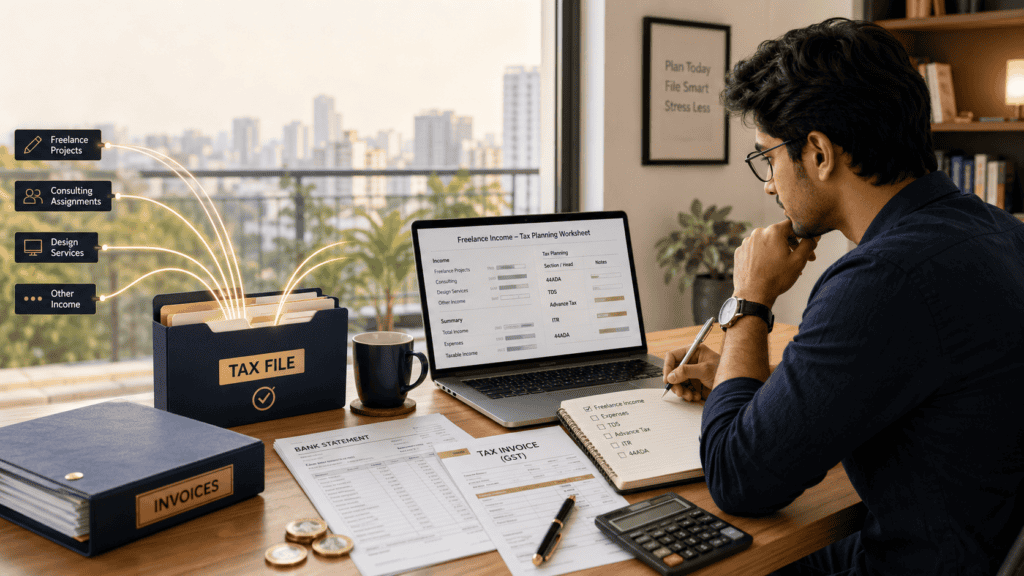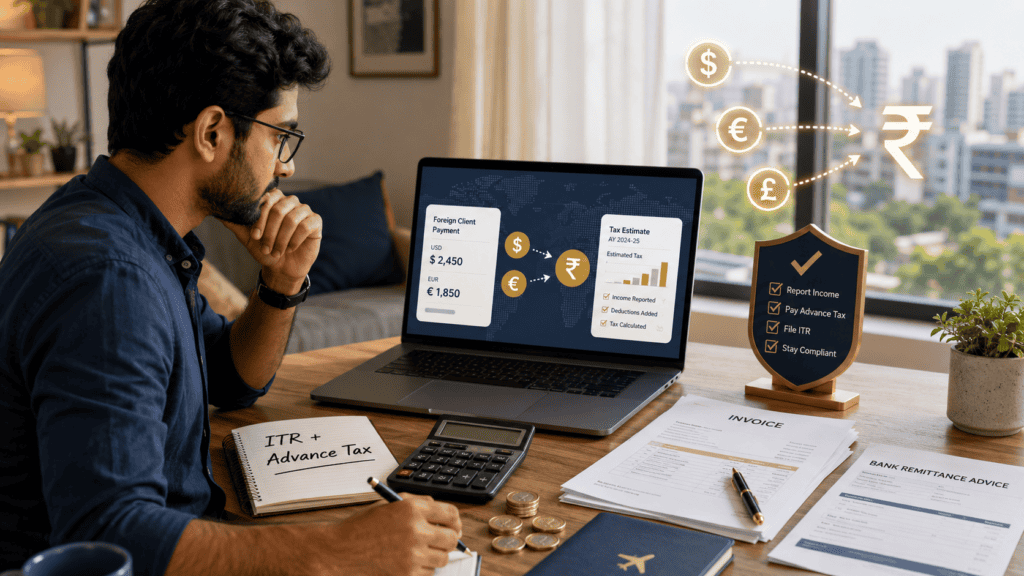
If you are a freelancer, consultant, or sole proprietor in India, your tax bill is not just a function of what you earn — it is also a function of what you are allowed to subtract before the taxman calculates what you owe. Business expense deductions for self-employed individuals exist precisely to ensure you are taxed on profit, not on gross receipts. Yet most self-employed Indians either claim too little (leaving real money on the table) or claim too loosely (risking rejection or scrutiny during assessment). The difference between those two situations usually comes down to three things: understanding which expenses qualify, keeping the right documentation, and knowing where the personal-versus-business line actually sits. This article walks through all three — clearly, with real numbers, and without the legal jargon.
Quick Answer: Business Expense Deductions for Self-Employed
Business expense deductions for self-employed Indians are costs claimed against business or professional income when they are genuine, documented, and used wholly or partly for work. Common examples include office rent, internet, phone, software, travel, professional fees, and laptop depreciation under Section 37 principles, but personal expenses are not allowed. Keep invoices, receipts, bank proof, and notes on business purpose for every claim. Always verify the applicable assessment year and current rules at incometax.gov.in before filing.

Key Takeaways
- An expense is deductible only if it is incurred wholly or partly for business or professional purposes — mixing personal use without reasonable allocation will get the claim disallowed.
- Capital items such as laptops and cameras cannot be fully expensed in one year; depreciation rules under the Income Tax Act determine how much you can deduct annually.
- Mixed-use expenses — home internet, mobile bills, home rent for a work-from-home setup — require a documented, reasonable split between business and personal use before claiming.
- If you use presumptive taxation under Section 44ADA (professionals) or Section 44AD (businesses), you cannot separately claim individual expenses; only the deemed-profit percentage applies.
- Every deduction claim needs supporting proof: a GST invoice or receipt, bank payment record, and a note on the business purpose — especially for travel, meals, and client-meeting costs.
- Readers with gross professional receipts above the applicable threshold, foreign clients, employees on payroll, or large asset purchases should consult a qualified Chartered Accountant before filing.
- Tax rules, ITR forms, audit thresholds, and presumptive taxation limits can change with each Budget — verify current figures at incometax.gov.in before the filing deadline.
Key Facts at a Glance
| Parameter | Rule / Detail | Notes |
|---|---|---|
| Who can claim | Freelancers, consultants, sole proprietors, and professionals with income under “Profits and Gains of Business or Profession” | Not available to salaried employees under “Salaries” head |
| Governing provision | Section 37(1), Income Tax Act — expenses incurred wholly and exclusively for business | Capital and personal expenses are excluded |
| Common deductible expenses | Office rent, coworking fees, internet, phone (business portion), software subscriptions, travel for work, professional fees, accounting charges | Proof required for all |
| Common non-deductible expenses | Personal groceries, home rent (unless work-from-home allocation is justified), personal travel, fines and penalties, income tax paid | Disallowed even if paid from a business account |
| Capital items (laptops, cameras) | Depreciation allowed annually under the Income Tax Act — not full cost in Year 1 | Rate varies by asset category |
| Presumptive taxation impact | Under 44ADA or 44AD, deemed profit replaces actual expense claims | Limits and rates — verify at incometax.gov.in before filing |
| ITR form | Generally ITR-3 (actual expenses) or ITR-4 (presumptive) | Confirm applicable form for current assessment year |
| Proof required | Invoice/receipt, bank payment record, business purpose note | Digital records are acceptable |
What Are Business Expense Deductions and Why Do They Matter?
Under the Income Tax Act, self-employed individuals — freelancers, independent consultants, designers, developers, doctors, architects, lawyers, and anyone else operating as a sole proprietor — are taxed on the profit from their business or profession, not on their gross receipts. That profit is calculated by subtracting allowable business expenses from total income. This happens under the income head called “Profits and Gains of Business or Profession” (PGBP).
The central rule is found in Section 37(1) of the Income Tax Act. It allows a deduction for any expenditure that is:
- Not capital in nature (i.e., not the purchase of a long-term asset)
- Not personal, private, or household expenditure
- Incurred wholly and exclusively for the purpose of the business or profession
- Not expressly disallowed by any other provision of the Act
According to the Income Tax Department, fines, penalties, and income tax payments are specifically excluded — you cannot deduct the tax you paid last year as a business expense this year.
For a comprehensive overview of how freelance income is taxed in India, see our guide on freelancer income tax, which covers the full picture before you focus on expense-level claims.
Revenue Expenses vs Capital Expenses
One of the most misunderstood distinctions in self-employed taxation is this: not every business cost can be deducted in full in the year it is paid. The key split is between revenue expenditure and capital expenditure.
Revenue expenditure is a recurring cost that does not create a long-term asset — monthly coworking rent, a SaaS subscription, an accountant’s fee. These are deductible in the year they arise, subject to documentation. Capital expenditure creates a long-term asset — a laptop, a camera, a desk, recording equipment. The cost of a capital asset is not immediately deductible. Instead, depreciation — a percentage of the asset’s value — is deductible each year under the Income Tax Act’s depreciation schedules.
Common Deductible Expense Categories
Office rent and coworking fees: If you rent a dedicated office space or pay for a coworking desk or meeting-room access wholly for work, the full amount is typically deductible. Keep the rental agreement, GST invoices, and bank payment records.
Internet and phone bills: Most self-employed professionals use the same broadband connection and mobile plan for both work and personal browsing. The full bill is not automatically deductible. A reasonable and documented business-use allocation — for example, 70% business use based on your actual usage pattern — is required. Claiming 100% on a shared household plan is a weak position and increases scrutiny risk.
Software and subscriptions: Design tools, project management platforms, accounting software, antivirus, cloud storage used for work — these are typically deductible as revenue expenses in the year of payment. Save the subscription invoice or payment confirmation for each tool.
Professional and accounting fees: Fees paid to a Chartered Accountant for bookkeeping, GST filing, or ITR preparation are deductible. Legal fees for business contracts are deductible. Personal legal expenses are not.
Travel for business: Travel directly connected to work — commuting to a client site, attending a professional conference, travelling for a project — is deductible. Personal holidays that include a work meeting are not fully deductible. Keep travel invoices, boarding passes, or cab receipts, and add a short note on the business purpose (client name, project, event name).
Home office (work-from-home): If you work from home, a proportionate share of home rent — based on the floor area used exclusively for work — may be deductible. This is a grey area that requires conservative estimation, clear documentation, and professional guidance if amounts are material. Claiming your entire home rent when you use a corner of the living room for work is not supportable.
Depreciation on business assets: A laptop purchased for ₹80,000 is a capital asset. You cannot deduct ₹80,000 in Year 1. Under the Income Tax Act’s depreciation rules, computers and software typically attract a depreciation rate — verify the current applicable rate at incometax.gov.in before filing, as rates are subject to change.
Real Example: Rohan’s Freelance Digital Marketing Business
Rohan is 31 years old, based in Bengaluru, and works as a self-employed digital marketer serving Indian and overseas clients. His gross professional receipts for the financial year are ₹12,00,000. He decides to file using the actual expense method rather than presumptive taxation, because his legitimate business costs are significant.
His documented annual expenses look like this:
- Coworking membership: ₹84,000 (monthly ₹7,000 — GST invoice saved every month)
- Internet (70% business allocation of ₹14,400 annual bill): ₹10,080
- Mobile phone (60% business allocation of ₹18,000 annual bill): ₹10,800
- Software subscriptions (design and analytics tools): ₹36,000
- Laptop depreciation (on ₹80,000 laptop purchased this year — at applicable rate): ₹variable — verify rate before filing
- Professional fees (CA for GST filing and ITR): ₹18,000
- Business travel (client visits, invoices and notes saved): ₹22,000
His total documented expenses, excluding depreciation (which requires rate verification), come to approximately ₹1,80,880. Once depreciation on the laptop is added at the applicable rate, his deductible expenses rise further. The key point: Rohan only claims expenses he can document and that he can explain as business-related. This example is illustrative — actual deductibility depends on facts, documentation, and current rules.
How to Calculate Business Profit After Expense Deductions
Business / Professional Profit = Gross Business Receipts − Allowable Business Expenses
Using Rohan’s figures as an illustration:
| Scenario | Key Figures | Result |
|---|---|---|
| No expense claims | Gross receipts ₹12,00,000 — no deductions | Taxable profit ₹12,00,000 |
| With documented expense claims | Gross receipts ₹12,00,000 − expenses ₹2,40,000 | Taxable profit ₹9,60,000 |
| Presumptive taxation (44ADA) | 50% of ₹12,00,000 deemed as profit (verify current rate) | Taxable profit ₹6,00,000 (no individual expense claims) |
Final tax on any of the above scenarios depends on the applicable income tax regime (old or new), other income sources, Chapter VI-A deductions, and current tax slabs — none of which are static. Use the freelance tax calculator on Ridhi to estimate the current-year impact once you have verified the latest slabs and rates.
Comparison: Actual Expense Method vs Presumptive Taxation vs Risky Claims
| Parameter | Actual Expense Method | Presumptive Taxation (44ADA / 44AD) |
|---|---|---|
| Who it suits | Professionals with genuine, large, well-documented expenses | Professionals or small businesses with low costs and simple records |
| Expense claims | Each expense claimed individually with proof | No individual expense claims — deemed profit percentage applies |
| Record keeping | Full books of accounts required; audit may apply above threshold | Simplified — no mandatory detailed books if within limits |
| CA support needed | Strongly advisable, especially above audit threshold | Less intensive, but still useful for first-time filers |
| Gross receipts limit | No upper limit, but audit triggered above threshold | Verify current eligibility limits and deemed-profit rates at incometax.gov.in |
| Best for Rohan? | Yes — if expenses exceed deemed profit | Only if expenses are low relative to receipts |
For a detailed comparison of when presumptive taxation saves more than actual expense tracking, see our article on the presumptive tax scheme.
How to Decide What’s Right for You
Your documented, genuine business expenses exceed the deemed profit under presumptive taxation — THEN the actual expense method may result in lower taxable income and may be worth considering with professional guidance.
Your business expenses are low, you have no large asset purchases, and your bookkeeping is minimal — THEN presumptive taxation under 44ADA or 44AD may be simpler and may reduce compliance burden.
You have overseas clients, GST registration, TDS deducted by clients, or employees on payroll — THEN your tax situation is more complex and a qualified CA is worth the fee before you decide on an approach.
You purchased significant capital assets this year — a laptop, camera, or equipment — THEN verify applicable depreciation rates at incometax.gov.in before treating these as simple expenses.
You work from home and want to claim a portion of home rent — THEN document the floor area used exclusively for work, keep your rent agreement and receipts, and take a conservative allocation; material claims should be reviewed by a CA.
You cannot produce invoices, bank records, or a coherent business-purpose explanation for an expense — THEN do not claim it. A weak claim creates more risk than the tax saving is worth.
Common Mistakes to Avoid
Claiming Personal Expenses as Business Costs
A grocery bill, personal streaming subscription, or family holiday does not become deductible because it was paid from a business account or because you opened your laptop on the last day of the trip.
If assessed, the Income Tax Officer will disallow expenses that cannot be connected to a genuine business purpose. This can result in additional tax demand, interest, and — in egregious cases — penalty proceedings.
Keep personal and business expenses strictly separated, and only claim what you can explain in plain language as a work cost.
Skipping Invoices and Bank-Payment Records
A mental note that you paid for coworking last month is not documentation. For any expense above a trivial amount, you need an invoice or receipt and a bank or digital payment record that matches it.
Cash payments for large expenses — rental deposits, equipment, professional fees — are particularly difficult to defend without a proper receipt and cash-flow trail.
See our article on freelance invoice basics for guidance on building clean invoice habits that make ITR documentation easier.
Claiming 100% of Phone and Internet Bills Without Allocation
Most freelancers use the same mobile plan and broadband connection at home for both personal and professional use. Claiming the full annual cost without a documented allocation is a weak position.
If your annual phone bill is ₹18,000 and you estimate 60% business use, claim ₹10,800 and keep a note of how you arrived at that percentage. A reasonable, consistent allocation is more defensible than a full claim.
Treating Capital Purchases as Simple Expenses
Buying a ₹90,000 laptop and deducting ₹90,000 as an expense in the year of purchase may be incorrect. Computers are capital assets and are typically subject to depreciation rules under the Income Tax Act rather than immediate full deduction.
Check the applicable depreciation rate for computers at incometax.gov.in before filing. Over multiple years, you may recover most of the cost — but the timing and rate matter for the current year’s return.
Ignoring Presumptive Taxation When It Would Actually Suit You
Some freelancers spend time tracking every small expense and filing ITR-3 when their actual expense claims are well below what presumptive taxation would have allowed as a deemed deduction.
If your net actual expenses are, say, ₹80,000 on gross receipts of ₹8,00,000 — but 44ADA would deem only 50% as profit — you may be paying more tax than necessary by going the detailed-expense route without checking both options first.
Missing the Audit Threshold Without CA Support
If your gross receipts exceed the audit threshold applicable for your category under the Income Tax Act, a tax audit becomes mandatory and must be completed before the filing deadline.
Filing without a required audit — or filing after the deadline because you did not know an audit applied — can result in penalties. Verify the current audit threshold at incometax.gov.in, especially if your income has grown significantly in the current year.
Not Noting Business Purpose for Travel, Meals, and Client Meetings
A ₹4,200 Bengaluru-to-Mumbai flight is deductible if it was for a client presentation. It is not deductible if it was a leisure trip. The invoice alone does not prove business purpose — you need a short note saved alongside it: “Client meeting — [client name] — [date] — [project].”
Meals with clients are particularly scrutinised. Claim only where the business purpose is clear and the amount is reasonable relative to your income level.
When This May Not Be the Right Choice
Tracking actual expenses and filing under the detailed method may not be the most practical choice for everyone. Consider whether this applies to you:
Very small side income with minimal costs: If your freelance income is a small supplement to a salary and your expenses are negligible, the effort of maintaining books, categorising expenses, and filing ITR-3 may exceed any tax benefit. Presumptive taxation, if eligible, is simpler.
Expenses that are mostly personal or undocumented: If you cannot produce invoices, bank records, or a business-purpose explanation for most of what you want to claim, the resulting deduction will be small and the risk of disallowance is real.
Complex income mix — foreign clients, employees, or business loans: Where your income involves multiple streams, TDS from foreign remittances, payroll for staff, or business loan interest, a CA should structure the full filing — not a self-managed expense list.
Already on presumptive taxation and not maintaining full books: If you opted for Section 44ADA or 44AD in a prior year, switching to the actual expense method requires maintaining full books of accounts from the start of that financial year — you cannot retrospectively reconstruct records at filing time.
If any of these apply to your situation, it may be worth exploring alternatives before committing.
Official Rules and Where to Verify
The rules governing business expense deductions for self-employed individuals in India are set out in the Income Tax Act and updated through Budgets, circulars, and notifications. The following are the authoritative sources to check before filing:
- Income Tax Department — incometax.gov.in: Applicable ITR form for the current assessment year, business/profession income provisions, depreciation rates, audit thresholds, presumptive taxation limits under 44ADA and 44AD, and filing deadlines.
- Income Tax Department — incometaxindia.gov.in: Supplementary guidance, FAQs, and circulars on PGBP income and deductions.
- GST Portal — gst.gov.in: GST registration obligations, invoice requirements, and input tax credit rules if you are a GST-registered freelancer.
- CBIC — cbic.gov.in: Clarifications on GST applicability for professional and digital services.
Rules, limits, and rates on this topic can change with each Budget or regulatory update. Always verify current figures directly from the official source before making any financial decision.
For a step-by-step walkthrough of the actual filing process, see our guide on freelancer ITR filing, which covers ITR form selection, schedule completion, and submission on the income tax portal. If your GST status is unclear, see our article on freelancer GST registration.
Expert Tips
- Open a separate bank account for your freelance business — even a basic savings account used only for client receipts and business payments. When every transaction in that account is work-related, reconciling expenses at filing time takes hours, not days.
- Create monthly expense folders (digital or physical) — one folder per month, sub-divided by category: rent, internet, software, travel, professional fees. Drop each invoice into its folder when you pay it, not at year-end when you are scrambling before the deadline.
- Write a one-line business-purpose note for every travel and meeting expense — client name, project, date, purpose. “Met [client] re: SEO audit — 14 March” on the back of a cab receipt is the difference between a defensible deduction and one you cannot explain six months later.
- Reconcile your AIS and Form 26AS before finalising expense claims — make sure every rupee of TDS deducted by clients appears correctly, because discrepancies can trigger notices that complicate an otherwise clean filing.
- Estimate your advance tax using your net profit after expenses — not your gross receipts. Freelancers who overpay advance tax based on gross receipts end up waiting for refunds; those who underpay face interest. See our guide on advance tax planning for the calculation method.
- Do not claim an expense for the first time during a scrutiny response — if an expense was real and deductible, it should be in your return, not introduced after the fact. Consistency across years strengthens your position.
- If your gross professional receipts have crossed or are approaching the audit threshold — engage a CA at the start of the financial year, not in July. An audit completed under time pressure increases the chance of errors that create further notices.
Frequently Asked Questions
Can a freelancer claim the full cost of a laptop as a business expense in one year?
Generally, no. A laptop is a capital asset, and the Income Tax Act requires that capital assets be depreciated over their useful life rather than expensed in full in the year of purchase. Computers typically attract a specific depreciation rate — verify the current applicable rate at incometax.gov.in, as rates can be revised. Only the depreciation amount for the year, calculated from the date of purchase, is deductible in that financial year.
Can internet and phone bills be claimed as business expense deductions?
Yes, to the extent they are used for business. If you use your home broadband and personal mobile plan for both work and personal purposes, only the business-use proportion is deductible. Estimate a reasonable percentage — for example, 60–70% — document your reasoning, and claim that portion. Claiming 100% on a household plan shared with family is unlikely to hold up if queried.
Can I claim home rent if I work from home?
A proportionate share of home rent — based on the area of the home used exclusively for work purposes — may be deductible as a business expense. This is a grey area that requires conservative estimation, clear documentation (rent agreement, receipts, floor-area calculation), and ideally professional review before the amount is material. Do not claim your entire home rent as a business expense.
What proof do I need for business expense deductions?
For each expense you claim, keep three things: (1) the invoice or receipt from the vendor — preferably a GST invoice where applicable, (2) a bank statement or digital payment record confirming the payment, and (3) a short note on the business purpose, especially for travel, meals, and client-related costs. Digital records — PDFs, screenshots, email confirmations — are acceptable.
What happens to my expense claims if I use presumptive taxation?
If you opt for presumptive taxation under Section 44ADA (for eligible professionals) or Section 44AD (for eligible businesses), you cannot separately claim individual business expenses. The scheme deems a fixed percentage of your gross receipts as profit — all expenses are considered to have been accounted for within that percentage. Verify current eligibility, gross receipt limits, and deemed-profit percentages at incometax.gov.in before choosing this route.
Can food, coffee, and client entertainment be claimed?
Client entertainment expenses — meals at a restaurant, coffee with a prospective client — may be deductible where the business purpose is genuine and documented, but this category attracts scrutiny. The amounts should be reasonable relative to your income and the business context must be clear. Personal meals and purely social outings are not deductible. There is no guaranteed allowance for entertainment expenses under Indian tax law; each claim stands on its documented facts.
Is software subscription cost deductible in the year of payment?
Yes, software subscriptions paid for tools used in your business or profession are generally treated as revenue expenditure and are deductible in the year of payment. This includes design software, project management tools, accounting platforms, and cloud storage used for work. Keep the subscription invoice or payment confirmation for each tool.
Can I claim professional fees paid to a CA as a business expense?
Yes. Fees paid to a Chartered Accountant for bookkeeping, GST filing, ITR preparation, or business advisory services related to your profession are deductible as business expenses. Keep the CA’s invoice (GST invoice where applicable) and the bank payment record. Personal tax planning that is not connected to your business income is less clearly deductible and should be reviewed.
Is GST I collected from clients a business expense?
No. GST collected from clients is a liability you hold on behalf of the government — it is not your income and it is not an expense. GST paid on your business purchases may be recoverable as input tax credit if you are registered under GST. For questions about GST obligations and input credit, refer to freelancer GST registration and verify your position at gst.gov.in.
Which ITR form do I use to claim business expenses?
Self-employed individuals claiming actual business expenses typically file ITR-3, which accommodates detailed business/profession income schedules. Those opting for presumptive taxation typically use ITR-4 (Sugam). The applicable form depends on your income sources, turnover, and whether you maintain regular books of accounts. Confirm the correct form for the current assessment year at incometax.gov.in before filing.
Final Verdict
Business expense deductions for self-employed Indians are a legitimate and useful tool — but only when the expenses are real, connected to work, and properly documented. The goal is not to claim everything that passes through your bank account; it is to claim what you can clearly support. Start with the obvious categories — coworking rent, software, professional fees, allocated internet and phone — and build your documentation habit from Day 1 of the financial year rather than from April. If your gross professional receipts are growing, your expenses are significant, or your client mix involves overseas income, TDS, or GST, a qualified CA’s input before filing is worth the cost. Always verify the applicable assessment year, ITR form, audit threshold, depreciation rates, and presumptive taxation limits at incometax.gov.in before you file. Always verify the latest rules from official sources or consult a qualified professional before making any financial decision.
This article is for educational purposes only and should not be treated as personalised financial, tax, investment, insurance, or legal advice. Tax rules, interest rates, regulatory limits, and product features can change with each Budget or policy update. Please verify current rules from official government sources or consult a qualified and registered professional before making any financial decision.

Amit Verma writes about money management for Indian freelancers, consultants, creators, professionals, and self-employed workers. His content focuses on income planning, tax basics, GST awareness, cash flow, invoicing, business expenses, and financial stability for people who do not receive a fixed monthly salary.
He covers topics such as Section 44ADA, presumptive taxation, professional income, advance tax, GST basics, TDS for freelancers, invoice planning, business expense tracking, ITR filing for self-employed professionals, emergency funds, health insurance, retirement planning, and irregular income management.
Amit’s writing is practical, relatable, and built around the realities of independent work. He understands that freelancers often deal with delayed payments, uneven income, unclear tax deductions, missing employer benefits, and uncertainty around compliance. His guides help readers organise their financial life better, but they are educational and not a substitute for professional advice. Since tax rules, GST limits, filing requirements, and deduction treatment can change, readers should verify current rules from official sources or consult a qualified professional.