
If you freelance in India — as a consultant, designer, developer, accountant, or doctor — you already know the tax anxiety that hits every March. Clients have deducted TDS. You have stacked invoices from five different projects. And somewhere in between, you are trying to figure out whether your laptop, internet, and home-office costs count as deductions. Presumptive taxation under Section 44ADA is designed to cut through that complexity for eligible professionals. But it is not a universal tax shortcut, and it does not apply to every self-employed person automatically. This guide on the presumptive taxation scheme 44ADA explains exactly who qualifies, how the income calculation works, which ITR form applies, and when you might actually be better off using actual expense accounting instead. For a broader overview, see our guide on freelancer income tax.
Quick Answer: Presumptive Taxation Scheme 44ADA
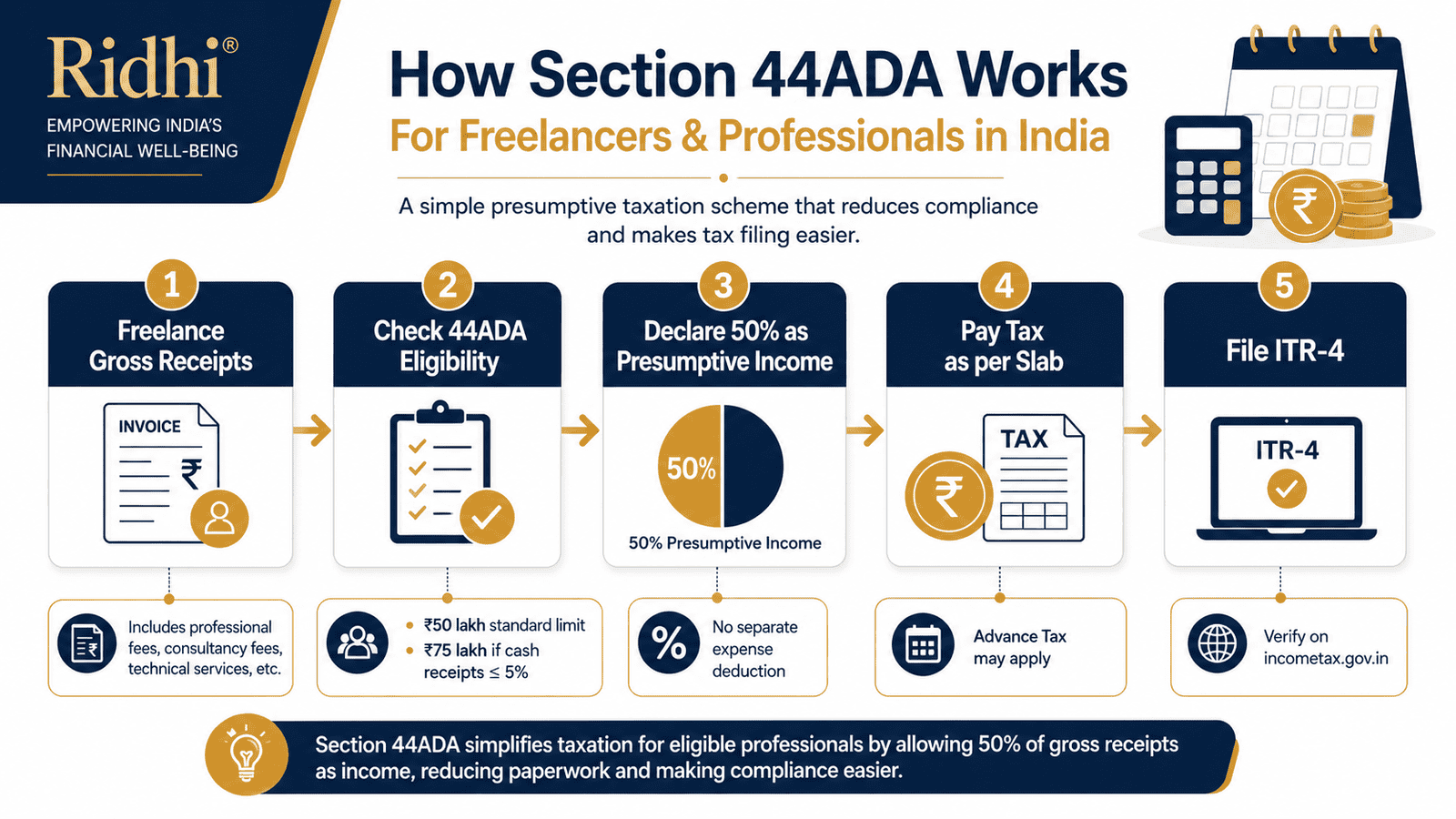
Presumptive taxation scheme 44ADA lets eligible resident professionals declare 50% of gross professional receipts as taxable income, instead of tracking every expense. It generally applies up to ₹50 lakh receipts, or ₹75 lakh if cash receipts stay within 5%, subject to Income Tax rules. Income is then taxed at normal slab rates under whichever tax regime applies.
Key Takeaways
- Section 44ADA applies only to eligible resident professionals — not every self-employed person who invoices clients can opt in automatically.
- Presumptive income is computed at 50% of gross professional receipts; you may declare a higher percentage, but not lower.
- The standard receipt limit is ₹50 lakh per financial year; an enhanced limit may apply up to ₹75 lakh if cash receipts do not exceed 5% of total receipts — verify current thresholds before filing.
- Once you use the presumptive method, you generally cannot claim separate deductions for actual business expenses in the same year for that income.
- Advance tax may still apply under presumptive taxation — it does not disappear simply because income is presumptively assessed.
- ITR-4 (Sugam) is typically the applicable return form for eligible presumptive-income filers, subject to other eligibility conditions for that form.
- 44ADA may reduce compliance burden and may reduce tax if actual expenses are low — it does not guarantee a lower tax outgo for every professional.
Key Facts at a Glance
| Parameter | Rule Under 44ADA | Notes |
|---|---|---|
| Applicable section | Section 44ADA, Income Tax Act 1961 | Verify current text at incometaxindia.gov.in |
| Eligible taxpayers | Resident individual or partnership firm (not LLP) carrying on specified profession | LLP eligibility — verify at official source |
| Presumptive income rate | 50% of gross professional receipts (or higher if voluntarily declared) | Verify current rate before filing |
| Receipt limit (standard) | ₹50 lakh per financial year | Verify current limit before filing |
| Receipt limit (enhanced) | ₹75 lakh if cash receipts ≤ 5% of total receipts | Verify cash receipt condition before filing |
| Applicable ITR form | ITR-4 (Sugam) where all other conditions for that form are also satisfied | Confirm eligibility for ITR-4 each Assessment Year |
| Bookkeeping under 44AA | Mandatory bookkeeping under Section 44AA may not be required if presumptive scheme is used | Keep invoices and bank records regardless |
| Tax audit under 44AB | May not be required if 44ADA is used and income is declared at 50% or above | Verify audit trigger thresholds before filing |
What Is the Presumptive Taxation Scheme 44ADA?
India’s income tax system normally requires professionals to maintain detailed books of account — recording every receipt, every expense, and every asset. For a freelancer juggling client projects, that is a significant administrative burden. Section 44ADA of the Income Tax Act 1961 offers a simplified alternative: instead of computing actual profit by deducting real expenses from real income, the law deems your professional income to be 50% of your gross receipts.
That 50% is a floor, not a cap. You can always declare a higher percentage if your actual profit is higher. But you cannot declare less than 50% while still claiming the presumptive scheme — that triggers a different set of obligations.
What Are Gross Professional Receipts?
Gross receipts means all amounts you actually receive or are credited for professional services during the financial year. This includes payments by bank transfer, cheques, UPI, and cash. It also includes TDS amounts deducted by clients — those are receipts for the year even if you never received the full cash. The total of all these amounts is your gross receipt figure for 44ADA purposes.
According to the Income Tax Department’s guidelines at incometaxindia.gov.in, the scheme specifically applies to “specified professionals” — a defined list under Section 44AA of the Income Tax Act. The list includes: legal, medical, engineering, architectural, accountancy, technical consultancy, interior decoration, and other notified professions. Software development and IT consultancy have generally been covered, but verify whether your specific profession is listed under the current notification before filing.
How the 50% Deemed Income Works
Once you establish that you are eligible and your receipts are within the applicable threshold, the calculation is simple. If your gross professional receipts for the year total ₹30 lakh, your presumptive income under 44ADA is ₹15 lakh. You then add any other income — interest, rental income, salary from another source — and compute tax on the combined total at applicable slab rates.
The 50% rate means that the law is effectively allowing a 50% deemed deduction for all expenses — office rent, equipment, internet, travel, professional subscriptions — without you having to prove a single rupee. If your actual expenses are lower than 50%, the presumptive method gives you a better result. If your expenses genuinely exceed 50% of receipts, you may be better off under actual accounting. That comparison matters and we cover it in the comparison section below.
Note that GST registration is an entirely separate question. Many freelancers cross the GST threshold before they cross the 44ADA receipts limit. Check our article on GST registration rules for freelancers — do not conflate GST turnover limits with income tax receipt thresholds, because they operate under different legislation and different limits.
Bookkeeping and Records Under 44ADA
One of the most practical benefits of opting for presumptive taxation is that mandatory bookkeeping requirements under Section 44AA may not apply for that professional income. However, this does not mean you should stop maintaining records entirely. Your bank statements, invoices, and client contracts remain essential for reconciling TDS credits in Form 26AS and the Annual Information Statement (AIS), defending your receipts figure if questioned, and computing advance tax accurately. The scheme simplifies income computation — it does not eliminate your responsibility as a taxpayer.
Real Example: Priya’s Freelance Consulting Income
Priya, 31, is a Bengaluru-based freelance UX consultant. During FY 2024–25, she invoiced five clients and received total gross professional receipts of ₹30 lakh. All payments came by bank transfer — no cash receipts.
Under Section 44ADA, Priya’s presumptive professional income is ₹15 lakh (50% of ₹30 lakh). She also earned ₹48,000 as savings account interest during the year. Her total gross income for the year is ₹15,48,000. She now applies her chosen tax regime, standard deduction if applicable, and any other deductions she is eligible for — arriving at taxable income and the final tax liability.
Her clients deducted TDS at 10% on payments made to her, totalling approximately ₹3 lakh over the year. Priya needs to match this amount in her AIS and Form 26AS against her own invoice records before filing. Any shortfall in TDS credit must be checked against client records. To understand exactly how to track freelance TDS and claim a refund, work through the reconciliation process before the filing deadline.
The key insight: Priya’s actual expenses — a home-office desk, software subscriptions, and some travel — came to roughly ₹4.5 lakh. Under actual accounting, her taxable income would have been ₹25.5 lakh. Under 44ADA, it is ₹15 lakh. The presumptive method delivers a meaningfully lower taxable income precisely because her actual expenses are well below 50%.
How to Calculate Presumptive Income Under 44ADA
Presumptive Professional Income = Gross Professional Receipts × 50%
(Or a higher percentage if voluntarily declared — verify current rate at incometaxindia.gov.in)
Here is the step-by-step process using Priya’s figures from the example above:
Step 1 — Total gross receipts: Add all professional receipts received or credited during the financial year, including amounts on which TDS was deducted. Priya: ₹30,00,000.
Step 2 — Check threshold eligibility: Confirm receipts are within the applicable 44ADA limit for the relevant Assessment Year. Priya’s ₹30 lakh is below the standard ₹50 lakh limit — verify current threshold before filing.
Step 3 — Compute presumptive income: ₹30,00,000 × 50% = ₹15,00,000. This is the presumptive professional income.
Step 4 — Add other income: Priya adds ₹48,000 interest income. Total gross income: ₹15,48,000. Apply any eligible deductions and tax regime logic.
Step 5 — Reconcile TDS and advance tax: Priya’s ₹3 lakh TDS credit offsets her tax liability. Any balance tax due may require advance tax payment in the correct installments.
| Scenario | Gross Receipts | Presumptive Income (50%) |
|---|---|---|
| Low-receipt year | ₹12,00,000 | ₹6,00,000 |
| Mid-range year (Priya) | ₹30,00,000 | ₹15,00,000 |
| Near-limit year | ₹48,00,000 | ₹24,00,000 |
Comparison: 44ADA Presumptive Method vs Actual Expense Accounting
| Parameter | 44ADA Presumptive Method | Actual Expense Accounting |
|---|---|---|
| Income computation | 50% of gross receipts deemed as income | Gross receipts minus actual documented expenses |
| Bookkeeping obligation | Mandatory bookkeeping under 44AA may not apply | Full books of account required under Section 44AA |
| Expense documentation | No need to prove individual expenses for the deemed deduction | Every expense must be documented, justified, and retained |
| Tax audit under 44AB | May not be required if income declared at 50% or above — verify threshold | Required if receipts exceed the audit threshold under 44AB |
| Best suited for | Professionals whose actual expenses are below 50% of receipts | Professionals whose actual expenses exceed 50% of receipts |
| Can claim laptop, travel, office rent separately? | No — deemed deduction covers all expenses | Yes — actual expenses are deducted from receipts |
| Compliance effort | Lower | Higher |
| More detail on deductible expenses | — | See guide on actual business expenses |
How to Decide What’s Right for You
You are a resident individual carrying on a specified profession under Section 44AA and your gross receipts are within the ₹50 lakh limit — THEN you are likely eligible to use Section 44ADA and should compare actual expenses with 50% before deciding.
Your gross receipts are between ₹50 lakh and ₹75 lakh and your cash receipts do not exceed 5% of total receipts — THEN you may qualify for the enhanced threshold; verify the current cash receipt condition at incometaxindia.gov.in before filing.
Your actual documented professional expenses — rent, equipment, software, travel, salary to staff — total less than 50% of your gross receipts — THEN the presumptive method is likely to result in lower taxable income than actual accounting.
You run a high-overhead consultancy — renting office space, employing assistants, or spending heavily on equipment — and your documented expenses comfortably exceed 50% of receipts — THEN actual expense accounting is likely to produce a lower taxable income.
You earn foreign professional income from overseas clients — THEN verify how those receipts are treated for 44ADA purposes before filing; foreign income and Double Tax Avoidance Agreement (DTAA) rules add complexity.
Your profession is not covered under the specified professional categories in Section 44AA, or you operate through an LLP — THEN Section 44ADA may not apply to you; consult a qualified CA before filing under this provision.
You have high receipts, multiple income sources, foreign income, or ongoing GST disputes — THEN do not file under 44ADA without professional guidance; the apparent simplicity can mask complex interactions with other tax provisions.
Common Mistakes to Avoid
Assuming Every Freelancer Qualifies for 44ADA
Section 44ADA is for specified professionals under Section 44AA — not every self-employed person who raises invoices.
A freelance photographer, event manager, or social media creator may not be covered under the specified professional categories. Filing under 44ADA without confirming eligibility can lead to a defective return notice or reassessment. The Income Tax Department can send scrutiny notices years after the filing date.
Check the current list of notified professions at incometaxindia.gov.in before opting in.
Claiming Separate Expenses After Using Presumptive Income
The 50% deemed deduction under 44ADA covers all professional expenses — there is no additional deduction for laptop costs, internet bills, or travel.
Some freelancers assume they can declare 50% of receipts as income and also separately deduct ₹1.2 lakh in equipment costs. That is not how the scheme works. Claiming double deductions is an error that can attract penalties.
If you want to claim actual expenses, move to actual accounting — you cannot mix the two methods for the same income stream.
Ignoring TDS in Form 26AS and AIS
Clients who paid you more than ₹30,000 per contract, or ₹1 lakh per year in aggregate, are generally required to deduct TDS at 10% on professional fees under Section 194J.
If you do not reconcile these TDS credits with your filed return, you either miss legitimate refunds or face mismatch notices. Cross-check every client payment with Form 26AS and the AIS on the income tax portal before filing.
Even under presumptive taxation, the income figure you report must be consistent with what clients have reported to the department.
Forgetting Advance Tax
Presumptive taxation does not eliminate your advance tax obligation. If your total tax liability for the year is expected to exceed ₹10,000 after TDS, you are required to pay advance tax.
Under Section 44AD and 44ADA provisions, advance tax for presumptive income may be paid in a single instalment by 15 March — verify the current rule at incometax.gov.in before the due date. Missing it attracts interest under Sections 234B and 234C.
Set aside a portion from each client payment to avoid a large lump-sum outgo in March.
Assuming the ₹75 Lakh Limit Applies Automatically
The enhanced ₹75 lakh threshold applies only if cash receipts during the year do not exceed 5% of total receipts.
If even one client paid you ₹2 lakh in cash and your total receipts are ₹74 lakh, you may be disqualified from the enhanced limit. The standard ₹50 lakh limit would then apply — and receipts above ₹50 lakh would require different treatment. Verify current thresholds and conditions before assuming which limit applies to you.
Not Reviewing the Method Every Year
Your expense ratio changes from year to year. A year you bought new equipment or moved to a paid office may push actual expenses above 50% — making actual accounting more beneficial.
Freelancers who set their tax strategy once and never revisit it often overpay. Review 44ADA vs actual expense accounting at the start of every financial year, not just once when you first file as a freelancer.
When This May Not Be the Right Choice
High-expense professionals: If you spend heavily on equipment, premises, or staff — and those costs genuinely exceed 50% of your gross receipts — actual expense accounting will produce a lower taxable income than the presumptive method. The 50% deemed rate works against you when your real cost ratio is higher.
Professionals in ineligible categories: Not every freelancer falls within the Section 44AA specified professions. If your work is not on the notified list, Section 44ADA simply does not apply — and filing under it would be incorrect regardless of your receipts.
Receipts above the applicable threshold: If your professional receipts exceed ₹50 lakh — or ₹75 lakh where the cash condition is satisfied — the presumptive scheme is unavailable for the excess. You will need to maintain proper books and may be subject to tax audit requirements under Section 44AB. Verify current thresholds before each filing.
Loss years or low-margin years: The presumptive scheme requires you to declare at least 50% of receipts as income. In a year where actual expenses are very high — for instance, you invested heavily in infrastructure — actual accounting would allow you to carry forward losses or declare a lower profit. 44ADA does not accommodate this.
If any of these apply to your situation, it may be worth exploring alternatives before committing.
Official Rules and Where to Verify
Rules, limits, and rates on this topic can change with each Budget or regulatory update. Always verify current figures directly from the official source before making any financial decision.
The authoritative sources for Section 44ADA are:
- Income Tax Department — incometaxindia.gov.in (full text of Section 44ADA, Section 44AA specified professions list, ITR-4 instructions for each Assessment Year)
- Income Tax e-Filing Portal — incometax.gov.in (ITR form downloads, AIS, Form 26AS, advance tax payment, and current Assessment Year notifications)
Before filing, confirm: the current receipt thresholds, the cash receipt condition percentage, the list of specified professions, ITR-4 eligibility criteria for your income type, and whether any Budget amendment has changed the presumptive rate or limit for the relevant Assessment Year.
Use the official portal rather than social media summaries, influencer videos, or last year’s blog posts — these frequently carry outdated figures. To walk through the full filing process, our step-by-step guide on how to file ITR correctly as a freelancer covers the end-to-end flow.
Expert Tips
- Issue proper invoices for every assignment. Even though 44ADA reduces the bookkeeping burden, every receipt must be traceable. Clients reporting TDS on payments not in your records creates a reconciliation nightmare at filing time.
- Reconcile bank credits with AIS every quarter. Log into the income tax portal, check your AIS, and match it against your invoices. Finding a mismatch in February when the return is due is far more stressful than catching it in October.
- Set aside 15–25% of every client payment for taxes. Under 44ADA, your taxable income is 50% of gross receipts. Depending on your slab, effective tax on gross receipts ranges roughly from 7.5% to 15% — set aside accordingly. Exact rates depend on your total income and applicable regime; verify current slabs.
- Pay advance tax on time if applicable. Under the presumptive scheme, advance tax for professionals may be payable in a single instalment by 15 March — verify current due dates at incometax.gov.in. Missing the deadline attracts interest under Sections 234B and 234C. Our guide on freelancer advance tax walks through the calculation and payment process.
- Do not assume the same method is optimal every year. Your gross receipts and expense ratio shift. Run a quick comparison — 50% of receipts vs actual documented expenses — before every return filing season. The method that saved you tax at ₹18 lakh in receipts may not be the best at ₹42 lakh.
- Keep contracts and purchase records even under presumptive taxation. If the Income Tax Department issues a scrutiny notice, they can ask for supporting evidence for any figure in your return — including your gross receipts total. Invoices, contracts, and bank statements are your defence.
- If you opted out of 44ADA in a prior year, check re-entry rules. Opting out of the presumptive scheme in a particular year carries conditions about when you can re-enter — verify current rules at incometaxindia.gov.in before switching methods again.
Frequently Asked Questions
Can freelancers use Section 44ADA?
Yes — but only freelancers who carry on a specified profession listed under Section 44AA of the Income Tax Act. This includes legal, medical, engineering, architectural, accountancy, technical consultancy, interior decoration, and other notified professions. Not every self-employed person qualifies automatically. Verify whether your profession is covered under the current notification at incometaxindia.gov.in.
Can software developers and IT consultants use 44ADA?
Software development and IT consultancy have generally been treated as technical consultancy — a specified profession under Section 44AA — by many tax practitioners. However, the precise classification depends on the nature of services and current official guidance. Verify your profession’s eligibility before filing, especially if your services include product development, SaaS, or non-consulting work.
Can I claim laptop, internet, and home-office expenses separately under 44ADA?
No. The 50% deemed deduction under Section 44ADA covers all professional expenses, including equipment, internet, travel, and office costs. You cannot claim additional deductions on top of the presumptive income figure. If you want to claim actual expenses, you must use normal expense accounting — not the presumptive scheme — for that year.
Is ITR-4 mandatory for filing under 44ADA?
ITR-4 (Sugam) is the appropriate form for individuals and HUFs with presumptive income under Sections 44AD, 44ADA, or 44AE, subject to other conditions for that form — such as income limits, nature of income, and directorship restrictions. Verify the current ITR-4 eligibility conditions in the official ITR instructions for the relevant Assessment Year at incometax.gov.in.
What happens if my receipts exceed ₹50 lakh?
If gross receipts cross ₹50 lakh, you generally cannot use the standard 44ADA threshold. An enhanced limit of ₹75 lakh may apply if cash receipts do not exceed 5% of total receipts — verify the current condition before assuming eligibility. Receipts above the applicable threshold require normal bookkeeping and may trigger tax audit requirements under Section 44AB.
Is advance tax required under 44ADA?
Yes. If your estimated tax liability exceeds ₹10,000 after accounting for TDS, advance tax is applicable. Under the presumptive taxation provision for professionals, advance tax may be payable in a single instalment by 15 March — verify current rules and due dates at incometax.gov.in before the advance tax deadline.
Can I switch between 44ADA and actual accounting every year?
There are conditions governing the opt-out and re-entry for presumptive schemes. If you opt out of 44ADA in a particular year, re-entry may not be permitted for a specified number of years under current rules. Verify the opt-out and re-entry conditions at incometaxindia.gov.in before changing your method for any Assessment Year.
What if I declare income below 50% of receipts?
If you declare professional income at less than 50% of gross receipts, you generally cannot use Section 44ADA for that year. You would need to maintain books of account under Section 44AA and may be subject to tax audit requirements under Section 44AB. The 50% rate is the minimum threshold for the presumptive scheme — not a suggested rate.
Does 44ADA apply to partnership firms?
The provision may apply to partnership firms (other than LLPs) carrying on a specified profession, subject to eligibility conditions. LLPs are generally not covered under the current provision. Verify whether your firm’s structure qualifies before filing under 44ADA — the official text at incometaxindia.gov.in is the definitive source.
Can I use 44ADA for foreign professional income?
Foreign receipts from professional services are part of gross receipts for a resident Indian taxpayer. However, foreign income also triggers considerations around DTAA, Form 67 (foreign tax credit), and the treatment of foreign bank account credits in AIS. These add complexity beyond the basic 44ADA computation. Consult a qualified CA if a significant portion of your income comes from overseas clients.
Final Verdict
The presumptive taxation scheme 44ADA is a genuinely useful provision for eligible resident professionals whose actual expenses are well below 50% of gross receipts. It simplifies income computation, may reduce the bookkeeping burden, and can result in lower taxable income compared to actual accounting when your cost structure supports it. But it is not automatically the best choice for every freelancer, and it is not available to every self-employed person regardless of what they earn.
Check your profession’s eligibility, confirm your receipts fall within the applicable threshold, verify the cash receipt condition if you are near the ₹75 lakh limit, and reconcile your TDS and advance tax position before filing. If your receipts are high, your income includes foreign earnings, or your expense ratio is genuinely above 50%, take professional advice before opting in. Always verify the latest rules from official sources or consult a qualified professional before making any financial decision.
This article is for educational purposes only and should not be treated as personalised financial, tax, investment, insurance, or legal advice. Tax rules, interest rates, regulatory limits, and product features can change with each Budget or policy update. Please verify current rules from official government sources or consult a qualified and registered professional before making any financial decision.

Amit Verma writes about money management for Indian freelancers, consultants, creators, professionals, and self-employed workers. His content focuses on income planning, tax basics, GST awareness, cash flow, invoicing, business expenses, and financial stability for people who do not receive a fixed monthly salary.
He covers topics such as Section 44ADA, presumptive taxation, professional income, advance tax, GST basics, TDS for freelancers, invoice planning, business expense tracking, ITR filing for self-employed professionals, emergency funds, health insurance, retirement planning, and irregular income management.
Amit’s writing is practical, relatable, and built around the realities of independent work. He understands that freelancers often deal with delayed payments, uneven income, unclear tax deductions, missing employer benefits, and uncertainty around compliance. His guides help readers organise their financial life better, but they are educational and not a substitute for professional advice. Since tax rules, GST limits, filing requirements, and deduction treatment can change, readers should verify current rules from official sources or consult a qualified professional.