
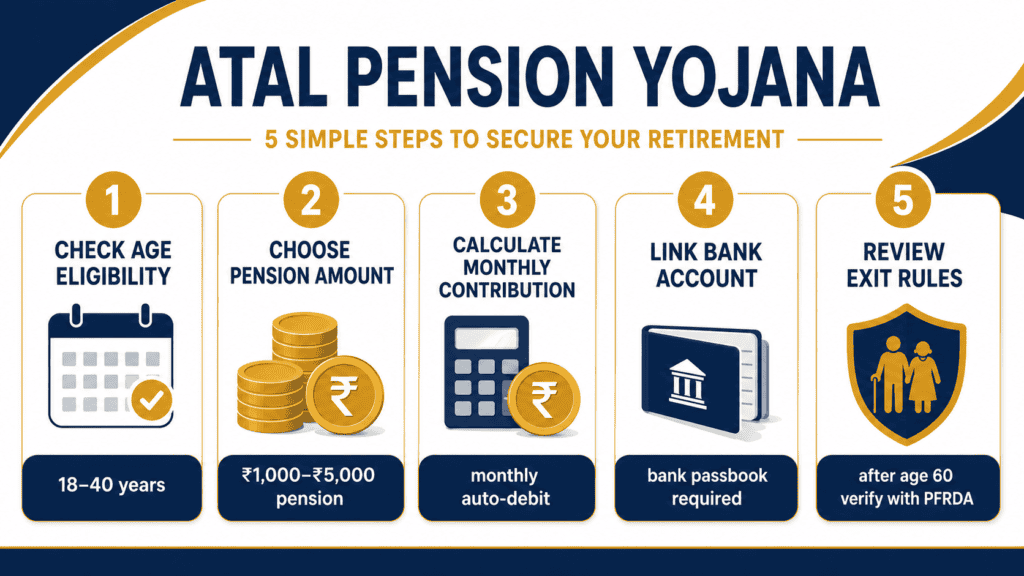
Millions of Indians work without any employer-backed pension — no EPF, no gratuity, no EPS. If you are self-employed, a daily-wage worker, a homemaker with a savings account, or running a small business, retirement can feel like a blank. That is exactly the gap Atal Pension Yojana was designed to address. The scheme lets eligible subscribers choose a fixed monthly pension of ₹1,000 to ₹5,000 after age 60, funded through regular contributions made during their working years. Before you or a family member consider joining, though, you need to understand who qualifies, how contribution amounts work, what the income-tax payer restriction means, and what happens at exit. This article covers all of it — plainly, with official source pointers and no jargon.
Quick Answer: Atal Pension Yojana
Atal Pension Yojana is a government-backed pension scheme for eligible Indian citizens who join between age 18 and 40. Subscribers contribute until age 60 and choose a monthly pension of ₹1,000 to ₹5,000, depending on age and contribution.
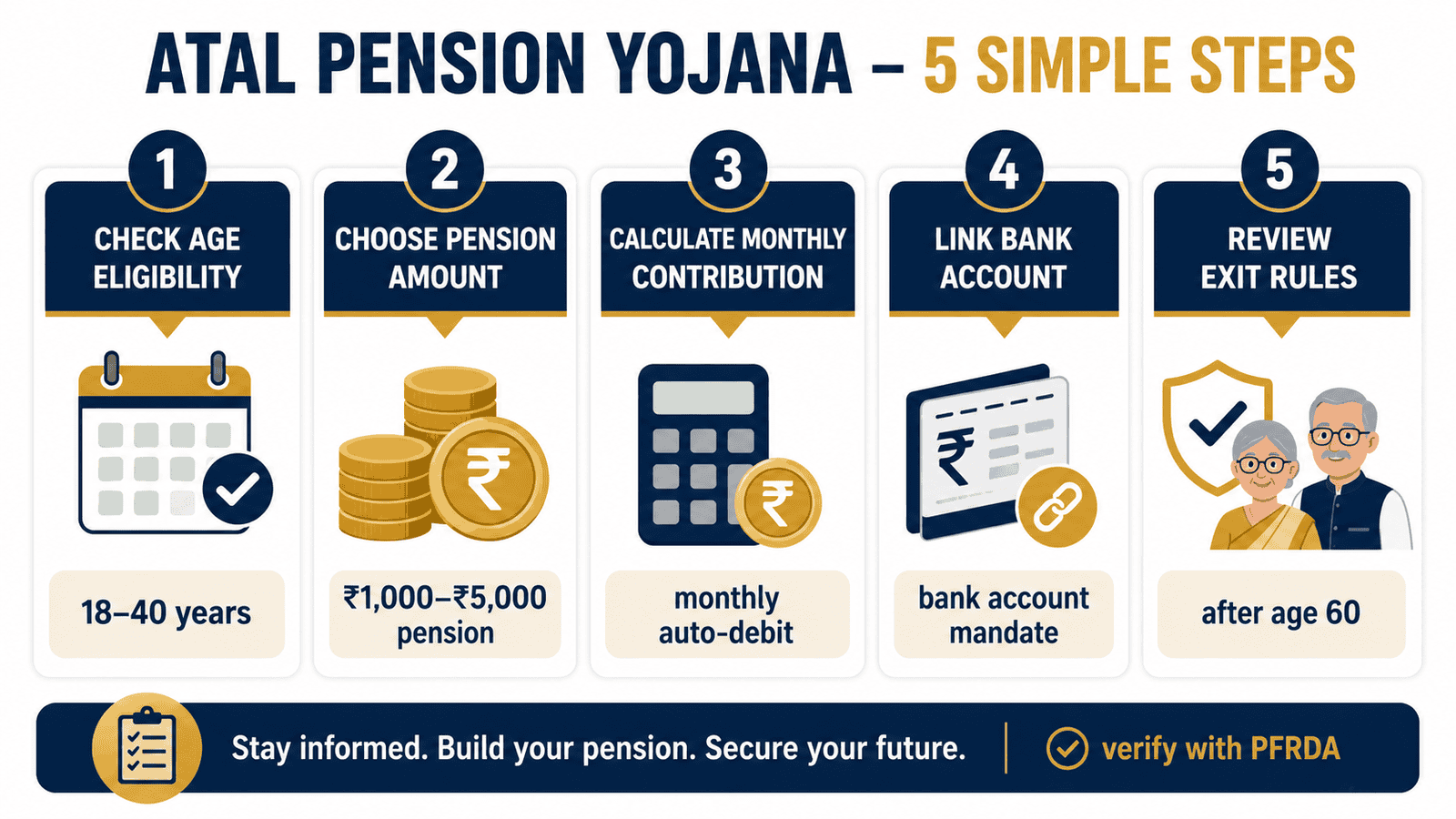
Key Takeaways
- APY is a defined-pension scheme — you choose a pension slab (₹1,000, ₹2,000, ₹3,000, ₹4,000, or ₹5,000 per month) and contribute accordingly until age 60.
- Entry age is between 18 and 40 years; the minimum contribution period is 20 years, which is why 40 is the upper entry limit.
- From 1 October 2022, individuals who are, or have been, income-tax payers are not eligible to join APY — verify the latest eligibility conditions at pfrda.org.in before applying.
- Monthly contribution depends on both entry age and chosen pension amount — a 25-year-old pays less for ₹5,000 pension than a 38-year-old choosing the same slab.
- On the subscriber’s death, the spouse is entitled to continue the pension or receive the corpus; the nominee receives the corpus if the spouse is also not alive — verify current rules with PFRDA/NPS Trust before relying on this.
- Premature exit before age 60 is allowed only in exceptional circumstances; ordinary voluntary exit is limited — check the latest exit rules at npstrust.org.in.
- APY contributions may be eligible for deduction under Section 80CCD of the Income Tax Act — verify current tax treatment at incometax.gov.in before filing.
Key Facts at a Glance
| Parameter | Detail | Verify At |
|---|---|---|
| Scheme Name | Atal Pension Yojana (APY) | pfrda.org.in |
| Regulatory Authority | PFRDA / NPS Trust | npstrust.org.in |
| Entry Age | 18–40 years | pfrda.org.in |
| Pension Starts | Age 60 | pfrda.org.in |
| Monthly Pension Slabs | ₹1,000 / ₹2,000 / ₹3,000 / ₹4,000 / ₹5,000 | pfrda.org.in |
| Minimum Contribution Period | 20 years | pfrda.org.in |
| Account Requirement | Savings bank account or post office savings account | Bank / Department of Posts |
| Income-Tax Payer Restriction | Applicable from 1 October 2022 | pfrda.org.in / incometax.gov.in |
| Contribution Mode | Monthly auto-debit from savings account | pfrda.org.in |
| Tax Deduction | Eligible under Section 80CCD — verify current treatment | incometax.gov.in |
Verify all figures above with your bank, post office, or directly at pfrda.org.in before applying.
What Is Atal Pension Yojana and How Does It Work
Atal Pension Yojana is not a savings deposit, a mutual fund, or an insurance policy. It is a defined-pension scheme — meaning you choose a fixed monthly pension amount you want to receive after age 60, and your monthly contribution is calculated based on that choice and your entry age. According to PFRDA guidelines, the scheme is designed primarily for workers in the unorganised sector and those without formal employer-backed retirement benefits.
Think of it this way: APY is like choosing a future pension target and paying monthly for it. The earlier you join, the lower your monthly payment for the same pension outcome. The later you join, the more you pay each month because you have fewer years to accumulate the required corpus.
APY is administered through the National Pension System infrastructure. However, it is a separate product from NPS explained simply — NPS is a market-linked retirement corpus product with variable returns, while APY offers a fixed guaranteed minimum pension slab with no market exposure from the subscriber’s side. Many beginners confuse the two because both are linked to PFRDA, but they serve different purposes and have different eligibility rules.
Who Can Join APY — The Eligibility Checklist
Eligibility for Atal Pension Yojana is not just about age. All four conditions below must be satisfied simultaneously:
- Citizenship: Must be an Indian citizen.
- Age: Must be between 18 and 40 years at the time of joining.
- Bank or post office account: Must hold an active savings bank account or a post office savings account linked to a mobile number.
- Income-tax payer restriction: From 1 October 2022, any person who is, or has been at any point, an income-tax payer is not eligible to enrol. Verify whether this condition applies to your situation at pfrda.org.in and incometax.gov.in before applying.
This fourth condition catches many readers by surprise. A salaried employee who has filed income-tax returns — even if they are no longer earning — may be ineligible under the current restriction. Similarly, a business owner who crossed the taxable income threshold in even one past year may be affected. Always confirm current eligibility rules before assuming you qualify.
How Contribution and Pension Amount Connect
APY contributions are not a flat amount. Your monthly contribution is determined by two inputs: your age at the time of joining and the monthly pension slab you select. According to the official APY contribution chart published by PFRDA and NPS Trust, younger subscribers pay significantly less per month for the same pension than subscribers who join later. This is because a subscriber joining at 18 has 42 years to contribute, while someone joining at 40 has only 20 years — the minimum allowed period.
The five pension slabs available are ₹1,000, ₹2,000, ₹3,000, ₹4,000, and ₹5,000 per month. These amounts represent the pension the subscriber will receive every month starting from age 60, as long as the subscriber is alive. The contribution is collected through automatic monthly debit from the subscriber’s savings bank account or post office account. Maintaining sufficient account balance for auto-debit on the due date is essential — defaults attract overdue charges under the current scheme rules.
Spouse and Nominee Benefit — The Broad Framework
After the subscriber starts receiving pension at age 60, on the subscriber’s death, the spouse is entitled to receive the same monthly pension for their lifetime. On the death of both subscriber and spouse, the nominee is entitled to receive the pension corpus accumulated. These are the broad outlines of the benefit flow as per APY scheme guidelines — the exact conditions, timelines, and documentation requirements should be confirmed directly with PFRDA or NPS Trust, as these may be updated over time.
Real Example: Ramesh, 34, Electrician, Pune
Ramesh is a 34-year-old self-employed electrician in Pune earning around ₹35,000 per month. He has no EPF, no EPS, and no employer pension. He has heard about APY from a friend and wants to understand whether ₹5,000 pension per month after age 60 is achievable and what it will cost him today.
According to the official APY contribution chart (verify current values at pfrda.org.in before applying), a subscriber joining at age 34 and choosing the ₹5,000 per month pension slab will need to make a monthly contribution that is higher than someone who joined at, say, age 25 for the same slab — because Ramesh has fewer contributing years remaining before age 60.
Ramesh also considers the ₹1,000 slab — a much lower monthly contribution — but realises that ₹1,000 per month in retirement will barely cover basic household expenses by the time he is 60. He decides to explore the ₹3,000 or ₹4,000 slab as a middle ground: meaningful pension support without overcommitting his current monthly cash flow to auto-debit.
The key insight for Ramesh — and most readers in a similar position — is this: APY is not meant to replace a complete retirement plan. It is a floor. A small, predictable, government-backed pension that supplements other savings, not a substitute for them.
How to Calculate Your APY Contribution
There is no single universal formula for APY contribution because the amounts are tabulated, not calculated freely. PFRDA and NPS Trust publish an official APY contribution chart that lists the required monthly contribution for every combination of entry age (18 to 40) and chosen pension slab (₹1,000 to ₹5,000). You must use this official chart, not a private-website estimate, before committing to a slab.
APY Contribution Logic = Entry Age + Chosen Pension Slab → Monthly Auto-Debit Amount (from official chart)
The underlying principle is straightforward:
- Younger entry age + any pension slab = lower monthly contribution (more years to accumulate).
- Older entry age + same pension slab = higher monthly contribution (fewer years remaining before age 60).
- Higher pension slab + same entry age = higher monthly contribution.
For example: A subscriber joining at age 18 choosing the ₹1,000 pension slab will pay a much smaller monthly amount than a subscriber joining at age 40 choosing the ₹5,000 slab — both in pension outcome and in monthly affordability, these are very different commitments. Verify exact contribution amounts from the current official APY chart at pfrda.org.in or npstrust.org.in before enrolling.
| Scenario | Entry Age + Pension Slab | What to Expect |
|---|---|---|
| Early joiner, small pension | 18 years + ₹1,000 slab | Lowest monthly contribution — most affordable, but smallest pension |
| Mid-age joiner, medium pension | 30 years + ₹3,000 slab | Moderate monthly contribution — balanced affordability and pension benefit |
| Late joiner, maximum pension | 40 years + ₹5,000 slab | Highest monthly contribution — maximum pension but requires strongest monthly cash flow commitment |
Use the retirement corpus estimate tool to compare what a fixed APY pension slab means against the kind of corpus-based retirement income a different instrument might provide over the same period.
Comparison: APY vs NPS vs PPF vs EPF/EPS
| Feature | APY | NPS / PPF / EPF-EPS |
|---|---|---|
| What you get at retirement | Fixed monthly pension (₹1,000–₹5,000) | NPS: market-linked corpus + annuity; PPF: lump-sum corpus; EPF: lump sum + EPS monthly pension |
| Who it suits | Unorganised/informal workers; self-employed without employer pension | NPS: salaried + self-employed; PPF: anyone with long investment horizon; EPF/EPS: salaried employees only |
| Contribution flexibility | Fixed slab — no top-up | NPS: flexible amounts; PPF: ₹500–₹1.5 lakh/year; EPF: fixed % of salary |
| Market/investment risk | No market risk for subscriber | NPS: market-linked; PPF: government-set interest rate; EPF: government-declared rate |
| Pension or corpus | Defined monthly pension | NPS: corpus + mandatory annuity; PPF: corpus only; EPS: monthly pension (salary-linked) |
| Eligibility restriction | Income-tax payer restriction applies from Oct 2022 | NPS/PPF: open to tax payers; EPF/EPS: salaried with employer enrolment only |
| Official source | pfrda.org.in / npstrust.org.in | pfrda.org.in; epfindia.gov.in; incometax.gov.in |
For a deeper look at PPF account basics as a long-term savings option, or a full comparison of NPS PPF EPF comparison across all three major retirement products, Ridhi has dedicated guides for each. If you are a salaried employee also covered by EPS, the EPF pension basics guide explains how that pension works differently from APY.
How to Decide What’s Right for You
You are an Indian citizen aged 18–40, hold a savings bank or post office account, have never been an income-tax payer, and want a small but predictable pension after age 60 — APY may be a suitable starting point for your retirement planning.
You are currently self-employed, in the informal sector, or a homemaker with an active bank account and meet all eligibility conditions — APY can provide a low-cost pension floor that requires no investment decision-making from your side.
You are choosing between the ₹1,000 and ₹5,000 pension slabs — choose based on what monthly auto-debit amount your account can reliably sustain, not the highest pension you want. Defaulting on contributions attracts penalties and can disrupt the plan.
You understand that even ₹5,000 per month from APY is unlikely to be sufficient for full retirement living expenses — then APY works best as one layer of a broader plan that includes PPF, NPS, emergency savings, or other instruments.
You are 35 or older and only now considering APY — your monthly contribution will be higher than a younger joiner for the same pension slab. Check the official contribution chart before committing so the auto-debit does not strain your cash flow.
You have been an income-tax payer at any point and the current restriction applies to you — APY may not be open to you. Explore NPS, PPF, or other pension products instead and verify your options at pfrda.org.in.
You expect APY’s fixed pension slab to independently cover your retirement expenses — recognise that ₹3,000–₹5,000 per month in 20–25 years may have reduced purchasing power due to inflation. Read the retirement planning guide to understand how much corpus you may actually need.
Common Mistakes to Avoid
Ignoring the Income-Tax Payer Restriction
From 1 October 2022, income-tax payers are not eligible to enrol in APY.
Many readers assume APY is open to everyone who meets the age requirement. If you have filed an income-tax return — even in a previous year when your income crossed the basic exemption limit — you may be ineligible under the current restriction. Enrolling without checking this could lead to your account being closed and contributions refunded without the pension benefit.
Verify current eligibility conditions at pfrda.org.in and incometax.gov.in before applying.
Choosing the Highest Pension Slab Without Checking Affordability
Many subscribers select the ₹5,000 slab thinking they are maximising benefit without checking the required monthly contribution at their current age.
If the auto-debit amount is too high for your regular income cycle, you risk defaults. Each month of default attracts an overdue charge — verify current penalty amounts at pfrda.org.in. Repeated defaults can eventually lead to account closure.
Choose a slab where the monthly contribution fits comfortably within your current income before committing.
Missing Auto-Debit Contributions
APY relies on an automatic monthly debit from your savings account on a fixed date.
If your account balance is insufficient on the due date, the contribution defaults. Even a single default attracts a penalty. Consistent defaults over months can freeze or close your APY account. Set a reminder or maintain a separate balance buffer specifically for your APY due date.
Assuming APY Is a Complete Retirement Plan
A ₹5,000 monthly pension is the maximum under APY.
In real terms, ₹5,000 per month will likely not be sufficient to meet living expenses for most households in India by the time subscribers reach age 60. APY is best treated as a pension floor — one component of a broader retirement plan that includes emergency savings, PPF, NPS, or other instruments — not the entire plan.
Not Updating Nominee and Spouse Details
Many APY subscribers enrol and then never update nominee or spouse details when their family situation changes.
If your nominee or spouse information is outdated or missing, the benefit flow after your death may be complicated or delayed. Update these details promptly at your bank or post office branch when there is any change in your family situation.
Confusing APY With NPS
Both APY and NPS are administered under PFRDA, but they are fundamentally different products.
NPS is a market-linked retirement corpus scheme where returns depend on investment performance. APY is a defined-pension scheme where the pension slab is fixed at enrolment and is not market-dependent from the subscriber’s perspective. Mixing up the two can lead to incorrect eligibility assumptions and wrong expectations about what the subscriber will receive at retirement.
Relying on Third-Party Contribution Figures Without Verifying
Contribution amounts for APY change only through official PFRDA updates, but many private finance websites display outdated tables.
Always check the current official APY contribution chart at pfrda.org.in or npstrust.org.in before deciding your slab and commitment. Using an outdated chart to plan your budget can cause a surprise when the actual auto-debit amount differs from what you expected.
When This May Not Be the Right Choice
APY may not suit your situation if you are, or have been, an income-tax payer — the current restriction introduced from 1 October 2022 disqualifies such individuals from enrolment. Verify the latest eligibility rule at pfrda.org.in before assuming you can join.
APY may also not be appropriate if you need flexible withdrawals before retirement, a higher potential corpus, or returns that outpace inflation over the long term. The fixed ₹1,000–₹5,000 pension slabs are designed for a minimum income floor — not wealth growth.
If you already have strong employer retirement benefits — such as EPF, EPS, and gratuity through formal employment — APY adds only a very small incremental pension benefit and may not be the most efficient use of your monthly savings commitment.
If you cannot reliably maintain sufficient bank balance for monthly auto-debit, the default penalties and risk of account closure make APY a poor fit until your cash flow is more stable.
If any of these apply to your situation, it may be worth exploring alternatives before committing.
Official Rules and Where to Verify
APY rules, contribution charts, pension slabs, eligibility conditions, and exit rules are governed by PFRDA and administered through NPS Trust. Always verify the current position directly from official sources — not from private finance websites or this article alone — before applying or making any decision.
Rules, limits, and rates on this topic can change with each Budget or regulatory update. Always verify current figures directly from the official source before making any financial decision.
- PFRDA — pfrda.org.in (APY eligibility, contribution chart, exit rules, scheme notifications)
- NPS Trust — npstrust.org.in (APY subscriber FAQ, contribution details, forms)
- Income Tax Department — incometax.gov.in (income-tax payer restriction context, Section 80CCD deduction rules)
- Your savings bank branch or Department of Posts branch — for enrolment, auto-debit setup, nominee update, and account-level queries
Expert Tips
- Before enrolling, download and read the current APY subscriber registration form from npstrust.org.in — it contains the contribution chart and eligibility declaration. Do not rely on a printed copy from a bank counter that may be outdated.
- If you are 30 or older and considering APY for the first time, compare the monthly contribution for your age at the ₹3,000 and ₹5,000 slabs side by side. The difference in monthly auto-debit is significant, and choosing the wrong slab can create cash-flow pressure you did not anticipate.
- Maintain a dedicated monthly buffer in your linked savings account — ideally set aside the APY contribution amount as a separate routine the day your salary or income arrives, before other expenses. A single default triggers a penalty; consistent defaults risk account closure.
- Note your APY PRAN (Permanent Retirement Account Number) and keep a copy of your enrolment acknowledgement. You will need this for any future modification, exit request, or nominee update at the branch.
- Review your APY enrolment annually alongside your EPF pension basics coverage if you move between informal and salaried employment — your eligibility status under APY may change based on your income-tax filing position.
- APY works best as one layer in a retirement plan. Pair it with a PPF account, emergency fund, and — where eligible — NPS contributions to build a more complete financial cushion for age 60 and beyond.
- If you are helping a family member join APY — a parent, sibling, or spouse — confirm their income-tax filing history before the application. An incorrect declaration at enrolment can result in account closure later.
Frequently Asked Questions
Who is eligible for Atal Pension Yojana?
An Indian citizen aged between 18 and 40 years who holds an active savings bank account or post office savings account is broadly eligible. From 1 October 2022, individuals who are or have been income-tax payers are not eligible to enrol. All eligibility conditions must be verified at pfrda.org.in before applying — eligibility rules may be updated by PFRDA from time to time.
What is the age limit for APY?
The entry age for APY is 18 to 40 years. The upper limit of 40 is set because APY requires a minimum contribution period of 20 years before the pension begins at age 60. If you are older than 40, you cannot join APY. Verify the current age limit at pfrda.org.in before applying, as scheme conditions may be revised.
What pension amount can I get under APY?
APY offers five fixed monthly pension slabs: ₹1,000, ₹2,000, ₹3,000, ₹4,000, and ₹5,000 per month, payable after the subscriber reaches age 60. You choose your slab at enrolment. The pension is a defined minimum amount — not market-linked from the subscriber’s perspective. Verify current slab details and associated contribution amounts at pfrda.org.in or npstrust.org.in.
Can income-tax payers join APY?
From 1 October 2022, individuals who are, or have been at any point, income-tax payers are not eligible to enrol in APY. This applies even if you currently have no taxable income but have filed income-tax returns in the past. If you enrol without meeting this condition, your APY account may be closed and contributions refunded without the pension benefit. Confirm the current restriction at pfrda.org.in and incometax.gov.in.
What happens after I turn 60 under APY?
Once you reach age 60 and have completed the minimum contribution period, you start receiving the fixed monthly pension you chose at enrolment. You must apply to exit and begin the pension through your bank or post office branch. On your death after 60, the same pension is payable to your spouse for their lifetime. On the death of both subscriber and spouse, the accumulated corpus is paid to the nominated beneficiary. Verify the exact current process and documentation at pfrda.org.in or npstrust.org.in.
Can APY be closed before age 60?
Voluntary exit from APY before age 60 is restricted under the current scheme rules. Premature exit is generally permitted only in exceptional circumstances — such as a terminal illness or death of the subscriber before age 60 — and not as a routine voluntary withdrawal. If the subscriber dies before age 60, the spouse may choose to continue APY contributions or receive the corpus. Verify the latest exit rules at pfrda.org.in before assuming premature exit is available.
Is APY better than NPS or PPF?
APY, NPS, and PPF serve different purposes and are not directly comparable on a single ranking. APY offers a small fixed pension and suits eligible informal workers who want a defined pension floor without market exposure. NPS offers a larger, flexible, market-linked retirement corpus and is open to a wider group including tax payers. PPF offers a long-term corpus with government-backed interest and is suitable for those wanting tax-efficient savings. Whether APY suits you depends on your eligibility, income level, and broader retirement planning needs — not a single best-or-worst comparison.
Is there a tax deduction for APY contributions?
APY contributions may be eligible for deduction under Section 80CCD of the Income Tax Act, subject to current rules and limits. However, income-tax payers are currently restricted from joining APY. If you are eligible and enrolled, verify the current deduction treatment and limits at incometax.gov.in before claiming any benefit in your return.
What is the minimum contribution period for APY?
The minimum contribution period for APY is 20 years, which is why the upper entry age is 40 — so that every subscriber contributes for at least 20 years before the pension starts at age 60. If you join at 25, you will contribute for 35 years. Verify the current scheme conditions at pfrda.org.in before applying.
Can I change my pension slab after joining APY?
APY subscribers may have an option to upgrade or downgrade their pension slab, subject to current PFRDA rules and applicable timelines. This is not unrestricted at all times — check whether a change is possible, how often it is permitted, and what the revised contribution amount would be, directly at your bank, post office branch, or at pfrda.org.in before attempting any modification.
Final Verdict
Atal Pension Yojana fills a real gap for eligible Indians who have no employer-backed pension — informal workers, self-employed individuals, homemakers, and daily-wage earners who want at least a small, predictable monthly income after age 60. If you meet the eligibility conditions, the scheme offers a straightforward, low-maintenance pension floor with no investment decision-making required from your side.
That said, even the maximum ₹5,000 monthly pension under APY is unlikely to cover full retirement living expenses on its own. Treat it as one layer — not the complete answer. Pair it with broader savings, and if you need to understand how much retirement corpus you actually need, the retirement planning guide is a useful next read.
Always verify the latest rules from official sources or consult a qualified professional before making any financial decision.
This article is for educational purposes only and should not be treated as personalised financial, tax, investment, insurance, or legal advice. Tax rules, interest rates, regulatory limits, and product features can change with each Budget or policy update. Please verify current rules from official government sources or consult a qualified and registered professional before making any financial decision.

Suresh Nair writes about Indian government savings schemes, post office schemes, and conservative long-term savings options. His content is especially useful for families, parents, senior citizens, and low-risk savers who want to understand scheme rules before depositing money.
He covers topics such as Public Provident Fund, Sukanya Samriddhi Yojana, Senior Citizens’ Savings Scheme, National Savings Certificate, Kisan Vikas Patra, Post Office Monthly Income Scheme, National Pension System, post office fixed deposits, post office recurring deposits, child savings schemes, senior citizen savings options, maturity rules, withdrawal rules, lock-in periods, and tax treatment.
Suresh’s writing is mature, rule-focused, and cautious. He explains eligibility, deposit limits, tenure, interest calculation, tax benefits, withdrawal conditions, and practical use cases in simple language. His articles are useful for readers who prefer safety and predictable rules over high-risk investments. Since government scheme interest rates, deposit limits, lock-in rules, and tax treatment may change through official notifications, readers should verify current details from India Post, PFRDA, Income Tax Department, or relevant government sources before investing.