
Your first real salary lands in your account and for a few seconds, it feels like the answer to everything. Then rent, groceries, a credit card swipe, some money home to the family, a weekend out with colleagues — and by the 20th of the month, you are already wondering where it went. At 25, the problem is rarely that you earn too little. The problem is that nobody ever told you what to do first. Most financial advice gives you a long list — budget, invest, get insurance, save tax, build a corpus — without telling you the order. That order is everything. This article is a practical financial planning checklist for 25 year old salaried earners in India: what to set up in the first three months, what to build across the first year, and what to review every year after that.
Quick Answer: Financial Planning Checklist for a 25-Year-Old
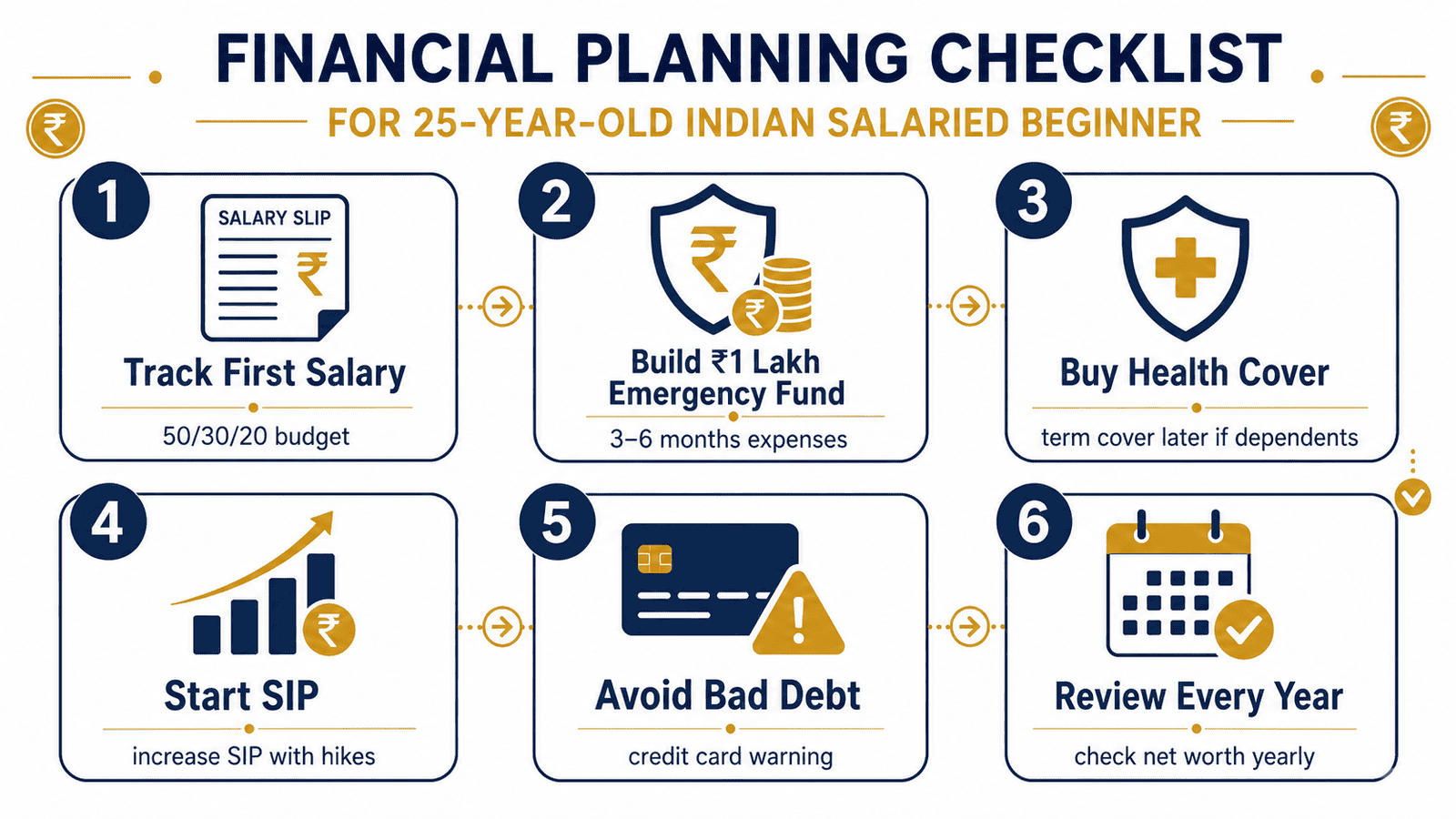
A financial planning checklist for 25 year old earners should start with budgeting, a ₹1 lakh emergency-fund target, basic health insurance, debt control, tax awareness, and small monthly SIPs. The goal is not perfection, but building repeatable money habits before lifestyle inflation and random spending take over.
Key Takeaways
- Build your budget from actual in-hand salary — not CTC. A ₹7 lakh CTC often translates to ₹48,000–₹55,000 in hand after EPF and tax deductions.
- Set a starter emergency fund target of ₹1 lakh before increasing your SIP. Once hit, grow it to 3–6 months of total monthly expenses.
- Health insurance from your employer is a start — not a complete safety net. Employer cover typically lapses if you leave the job or are hospitalised for a pre-existing condition in year one.
- A SIP of even ₹2,000 per month started at 25 builds a significantly larger corpus by 45 than ₹5,000 per month started at 35 — compounding rewards early starters.
- Paying only the minimum due on a credit card at 30–42% annualised interest can silently erase months of savings. Clear the full outstanding every month.
- Review your budget, net worth, insurance coverage, and financial goals at least once a year — especially after every salary hike.
- Tax rules, EPF rates, and insurance product features can change each Budget. Verify current figures from official sources before acting.
Key Facts at a Glance
| Checklist Item | Starter Target | Why It Matters |
|---|---|---|
| Monthly Budget | Track every rupee from day one | Shows where money leaks before habits form |
| Emergency Fund | ₹1 lakh first, then 3–6 months of expenses | Prevents debt during a job loss or medical shock |
| Health Insurance | ₹3–5 lakh cover at minimum | A single hospitalisation can wipe out months of savings |
| Term Insurance | If dependents exist — 10–15× annual income | Cheapest way to protect family income at 25 |
| SIP / Investing | Start with ₹1,000–₹2,000 per month; automate | Habit matters more than amount at this stage |
| Tax Awareness | Submit declarations, check Form 16, file ITR | Avoids excess TDS and missed deductions |
| EPF Contribution | Already active if employer is EPFO-registered | Forced long-term retirement saving with employer match |
| Credit Score | Check once a year; pay credit card in full | Determines loan eligibility and interest rate in future |
The Complete Financial Planning Checklist for a 25-Year-Old
Financial planning at 25 is not about having the perfect portfolio. It is about building five simple habits before salary hikes, EMIs, and peer pressure make them harder to start. Here is the order that actually works for most Indian salaried earners. To understand the broader framework this checklist fits into, read our money basics guide.
Step 1: Know Your Real Monthly Income
Start with your in-hand salary — the amount credited to your bank account — not your CTC. Your CTC includes your employer’s EPF contribution, gratuity provisions, and other benefits that never reach your account directly. A ₹7 lakh CTC can easily translate to ₹48,000–₹55,000 in hand after professional tax, employee EPF deduction at 12% of basic, and income tax TDS. If you plan a budget based on CTC, you will overspend every single month.
Also map your fixed monthly commitments: rent, electricity, mobile recharge, family support transfer, and any loan EMI. Subtract these from in-hand salary. What remains is your actual discretionary income — the money you truly control.
Step 2: Create a Budget That Reflects Real Life
A popular starting framework is to allocate roughly 50% of in-hand salary to needs, 30% to wants, and 20% to savings and investments. But in high-rent cities like Bengaluru, Pune, or Mumbai, rent alone can eat 35–40% of a ₹55,000 monthly salary. Do not treat any ratio as a law. The real goal is to ensure your savings allocation — emergency fund, insurance, SIP — is protected first, and lifestyle spending happens with what is left.
Track every spend for 30 days using any UPI-linked app or a basic spreadsheet. Most 25-year-olds who do this discover ₹4,000–₹8,000 in monthly spending they cannot explain. That gap is where wealth-building begins. For practical alternatives to the 50/30/20 rule tailored for Indian families, see our guide on the monthly budget method.
Step 3: Build an Emergency Fund Before Investing
An emergency fund is cash you can access in 48 hours — not a fixed deposit that locks your money for a year. Target ₹1 lakh first. Park it in a high-interest savings account or a liquid fund. At ₹5,000 per month, you hit ₹1 lakh in 20 months. At ₹8,000 per month, you hit it in 13 months. Once you reach ₹1 lakh, expand the target to 3–6 months of your total monthly expenses.
According to EPFO guidelines, your provident fund is a retirement instrument — not an emergency account. Withdrawing from PF early has tax consequences and disrupts long-term compounding. Keep your emergency fund separate.
Step 4: Cover Yourself With Insurance Basics
Most 25-year-olds either over-insure (buying ULIPs or endowment plans that mix insurance with investment at high charges) or under-insure (relying entirely on employer group health cover that lapses between jobs). According to IRDAI guidelines, insurance and investment are best kept separate. Here is what you actually need at 25:
Health Insurance: Buy an individual personal policy with ₹3–5 lakh sum insured, even if your employer provides group cover. Employer cover typically does not travel with you after you change jobs. Premiums are lowest when you buy at 25 with no pre-existing conditions.
Term Insurance: Only if you have financial dependents — parents, a spouse, or siblings who depend on your income. A ₹50 lakh pure term cover at 25 can cost as little as ₹6,000–₹9,000 per year. If no one depends on your income today, term insurance can wait until that changes.
Step 5: Start Investing Small and Automate It
The single most important investing action at 25 is automation. Set up a SIP — Systematic Investment Plan — in one or two SEBI-registered mutual funds, on the 2nd or 3rd of the month, the day after your salary typically credits. Start with ₹1,000 or ₹2,000. The amount is less important than the habit. As SEBI-registered investment products, mutual funds are regulated but do not offer guaranteed returns. Mutual fund investments are subject to market risk; read all scheme-related documents carefully before investing.
Your EPF contribution is also a form of forced long-term saving. If your employer is EPFO-registered, 12% of your basic salary is contributed by you and matched by your employer. This is a strong retirement foundation — do not withdraw it unless there is a genuine crisis.
Real Example: How Rohan Splits ₹55,000 Every Month
Rohan is 25, a software support analyst in Pune, earning ₹55,000 per month in hand after EPF and tax deductions. He pays ₹12,000 rent, sends ₹5,000 home every month, and has no loan EMI yet. Here is how a sensible first-year allocation looks for him, using our start SIP basics guide as a reference for his investment setup:
Rent: ₹12,000 | Food and groceries: ₹6,000 | Commute: ₹2,000 | Family support: ₹5,000 | Health insurance premium (monthly): ₹700 | Emergency fund SIP: ₹5,000 | Equity mutual fund SIP: ₹2,000 | Learning and upskilling: ₹1,000 | Personal spend (clothes, OTT, eating out, UPI): ₹14,300 | Buffer: ₹7,000
Rohan is not investing a large amount yet. But he is building the emergency fund first, covering his health insurance, and starting the SIP habit. When his salary becomes ₹65,000 next year, he plans to increase the SIP to ₹4,000 and the emergency fund contribution until the ₹1 lakh target is hit. The key insight: his current split is not optimal — it is sustainable. Mutual fund investments are subject to market risk; returns are not guaranteed.
How to Calculate a Starter Monthly Allocation
Savings Rate = (Emergency Fund + Insurance Premium + SIP) ÷ Monthly In-Hand Salary × 100
Using Rohan’s numbers: (₹5,000 + ₹700 + ₹2,000) ÷ ₹55,000 × 100 = 14% savings rate in month one. This is below the often-cited 20% target, but realistic given rent and family support obligations in a metro. The goal is to hit 20%+ savings rate by year two as fixed costs are controlled and salary grows.
For the emergency fund timeline: at ₹5,000 per month, Rohan reaches ₹1 lakh in 20 months. If he adds his annual bonus — even ₹20,000 — that drops to about 16 months. Use the monthly budget method to build your own version of this allocation based on your city, rent, and family obligations.
| Scenario | Monthly Saving Toward ₹1 Lakh | Months to Target |
|---|---|---|
| Conservative (high rent city) | ₹3,000 | 33–34 months |
| Moderate (Rohan’s plan) | ₹5,000 | 20 months |
| Accelerated (low rent / no family support) | ₹8,000 | 13 months |
These are examples only. Adjust the numbers based on your actual rent, city, debt, and family obligations. This is not financial advice.
Comparison: What to Do Now, Later, or Only When Relevant
| Action Item | When to Do It | When to Delay |
|---|---|---|
| Track spending and build a budget | Month 1 | Never delay — start immediately |
| Open savings account, set auto-transfer | Month 1 | No reason to delay |
| Individual health insurance policy | Month 1–3 | Only if employer cover is comprehensive and portable — rare |
| Start emergency fund savings | Month 1 | Do not delay even to start investing |
| Submit tax declarations to employer | April–June | Missing deadline increases TDS deduction |
| Start first SIP | Month 3–6 | Delay until at least ₹25,000–₹30,000 emergency fund is started |
| File income tax return (ITR) | July 31 every year | No delay — mandatory if income exceeds basic exemption |
| Term insurance | When dependents exist | No financial dependents = term insurance can wait |
| Annual net-worth review | Year 1, then every April | Do not skip after receiving a salary hike |
| NPS / retirement planning beyond EPF | Year 2 onwards | After emergency fund and insurance basics are in place |
How to Decide What’s Right for You
No two 25-year-olds have the same financial situation. The checklist above is a starting framework — here is how to adjust it based on your specific reality.
Your rent is above 35% of in-hand salary — THEN focus entirely on cash-flow control and the emergency fund before starting any SIP. High rent means one job loss equals a crisis within 30 days.
You carry high-interest debt — credit cards unpaid in full, or personal loan at 18%+ — THEN clear that debt before increasing lifestyle spending or SIP amounts. No investment reliably earns more than 18–30% per year after tax.
Parents or siblings depend on your income — THEN insurance planning (health and term) moves to the top of the list, not year two. Losing your income is a family crisis, not just a personal setback. Use our guide on emergency fund first to decide how much safety net to build before investing.
You have no debt, low rent (below 25% of salary), and family support from parents — THEN you can accelerate both the emergency fund and SIP together from month one. Your risk exposure is lower than average.
You are in a Tier-1 city with a roommate and shared expenses — THEN your effective fixed cost ratio is lower. Redirect the saving to the emergency fund first, then increase SIP after ₹50,000 is saved.
You are not yet tracking your spending consistently — do not increase your SIP amount yet. More investment into a leaking bucket does not fix the leak. Fix the budget first.
Common Mistakes to Avoid
Lifestyle Inflation After Every Salary Hike
Each salary hike feels like permission to upgrade — a better phone, a higher-rent flat, more frequent dining out.
If you increase spending by 90% of every hike and save only 10%, a ₹10,000 hike generates just ₹1,000 in new savings. Over five years, this pattern delays wealth-building by years, not months.
Instead, commit to saving at least 50% of each salary hike before touching it. Read our guide on how to avoid lifestyle inflation for a detailed strategy.
Starting SIPs Before Building Any Emergency Buffer
Investing ₹3,000 per month in mutual funds while keeping ₹0 in an emergency fund is structurally fragile.
A medical bill, a bike repair, or a sudden travel expense can force you to redeem your SIP at a loss — especially if markets are down the day you need the money.
Build at least ₹25,000–₹30,000 in liquid savings before your first SIP. Then grow both in parallel.
Paying Only the Minimum Due on Credit Cards
The minimum payment on a credit card keeps the account active — it does not reduce the principal meaningfully.
At annualised interest of 30–42%, a ₹20,000 unpaid credit card balance can grow to over ₹27,000 in one year if only minimum payments are made. According to RBI consumer finance guidelines, understanding the true cost of revolving credit is a basic financial literacy requirement.
Pay the full outstanding every month. If you cannot, stop using the card immediately and make debt repayment your top financial priority.
Buying Investment-Linked Insurance Products Without Understanding Charges
ULIPs and endowment plans sold as investments carry high premium allocation charges, policy administration charges, and fund management fees — especially in the first three to five years.
The returns after charges on many such products are lower than a combination of a pure term policy and a simple equity mutual fund SIP. According to IRDAI guidelines, always ask for the benefit illustration showing internal rate of return before signing any insurance-linked investment product.
Buy term insurance for protection. Buy mutual funds for wealth building. Keep the two separate.
Ignoring Tax Declarations and Form 16
Many first-job employees skip the annual investment declaration form submitted to HR between April and June.
If you do not declare your 80C investments, HRA, or other deductions, your employer will deduct higher TDS through the year. You get the refund only after filing your ITR — months later. According to the Income Tax Department, submitting accurate declarations at the start of the financial year reduces unnecessary TDS and simplifies year-end tax filing.
Submit declarations in April. Collect and preserve your Form 16 every June. File your ITR before July 31 each year.
Skipping Annual Financial Review
A financial plan built at 25 on a ₹55,000 salary becomes wrong by 28 if salary has grown, a loan has been taken, or family responsibilities have increased.
Not reviewing means you may still carry the same ₹5 lakh health cover at 28 while your income, liabilities, and dependents have all changed.
Block one evening every April to review your budget, insurance cover, SIP amount, emergency fund size, and net worth. It takes two hours and prevents years of misalignment.
When This May Not Be the Right Choice
This checklist is designed for a salaried 25-year-old with regular monthly income and manageable fixed costs. It may need significant modification in these situations:
Major family medical expenses underway: If a parent is undergoing treatment and you are the primary financial contributor, building your personal emergency fund takes second priority. Immediate medical cash-flow management comes first.
High-interest debt from college or personal loans: If you carry a personal loan at 18–24% interest, the correct financial sequence changes. Aggressive debt repayment before SIP increases is mathematically more beneficial in most cases.
Irregular or contract-based income: Freelancers and contractual employees need a larger emergency fund — 6–9 months of expenses — before beginning regular investing, because income gaps are more likely.
Near-term major financial events: If you are planning higher studies, a significant relocation, or a wedding within two years, goal-based short-term savings should be separated from long-term investing. SIPs in equity mutual funds carry short-term market risk.
If any of these apply to your situation, it may be worth exploring alternatives before committing.
Official Rules and Where to Verify
The rules, limits, and rates that affect financial planning — tax deductions, EPF contribution percentages, insurance regulations, mutual fund norms — can change with each Union Budget or regulatory circular. Always verify current figures directly from official sources before making any financial decision.
- Income tax filing, Form 16, AIS, deductions, and tax regime details: Income Tax Department — incometax.gov.in
- Bank account safety, credit card rules, and loan-related consumer information: Reserve Bank of India — rbi.org.in
- Mutual fund, SIP, and investment advisory regulation: Securities and Exchange Board of India — sebi.gov.in
- EPF, UAN, PF contribution, and withdrawal rules: Employees’ Provident Fund Organisation — epfindia.gov.in
- Health insurance and life insurance consumer information: Insurance Regulatory and Development Authority of India — irdai.gov.in
- NPS and retirement account information: Pension Fund Regulatory and Development Authority — pfrda.org.in
Rules, limits, and rates on this topic can change with each Budget or regulatory update. Always verify current figures directly from the official source before making any financial decision.
Expert Tips
- Automate savings on salary day. Set up an auto-transfer to your emergency fund account on the 1st or 2nd of the month — before any discretionary spending happens. What is not visible is not spent.
- Increase your SIP with every salary hike — before increasing lifestyle. If your salary goes from ₹55,000 to ₹65,000, increase your SIP by at least ₹1,500 before upgrading your flat or phone. Over 10 years, this habit creates a significantly larger corpus than any single product choice.
- Track net worth every six months, not just savings. Net worth = total assets minus total liabilities. A ₹2 lakh SIP portfolio alongside a ₹1.5 lakh unpaid personal loan is not the same as ₹50,000 in true wealth. Use our guide on how to track real wealth to set up a simple bi-annual tracker.
- Maintain a simple documents folder. Keep scanned copies of: salary slips from the last 3 months, Form 16, health insurance policy copy, term insurance policy copy, UAN/PF statement, and latest ITR acknowledgement. This folder saves hours in a loan application or insurance claim.
- Learn one financial concept per month. Compounding, credit score, inflation, asset allocation, tax-loss harvesting — one concept per month means 12 concepts per year. In three years, you will outperform 80% of casual retail investors purely through informed decisions, not luck.
- Check your credit score once a year for free. RBI guidelines require credit bureaus to provide one free credit report per year. A score above 750 gives you access to better loan interest rates and credit card offers. Errors on credit reports are more common than most people assume — checking annually catches them early.
- Do not skip EPF withdrawal rules before switching jobs. According to EPFO guidelines, EPF balance can be transferred online using your UAN when switching employers. Withdrawing EPF before 5 years of continuous service attracts tax. Transfer, do not withdraw, unless it is a genuine emergency.
Frequently Asked Questions
How much should a 25-year-old save every month?
A commonly used starting benchmark is 20% of in-hand salary. On ₹55,000 per month, that is ₹11,000 — split across emergency fund, insurance premium, and SIP. If high rent makes 20% impossible in month one, start with 10–12% and increase by 2–3% with each salary hike. Consistency matters more than the exact percentage.
Should I build an emergency fund or start a SIP first?
Emergency fund first — always. A SIP in equity mutual funds is a long-term instrument that should not be redeemed in a crisis. If you have no liquid savings and face a ₹40,000 medical bill, you will redeem your SIP, possibly at a loss. Build at least ₹25,000–₹30,000 in liquid savings before your first SIP. Then run both in parallel.
Do I need term insurance at 25?
Only if someone financially depends on your income — a parent, sibling, or spouse. If you have no dependents, term insurance is not urgent at 25. The advantage of buying early is that premiums are significantly lower. A ₹50 lakh term cover bought at 25 costs far less annually than the same cover bought at 32 with a medical history.
Is employer health insurance enough, or do I need a personal policy?
Employer group health cover is a starting point, not a complete solution. It typically lapses between jobs, may exclude some family members, and can have sub-limits on specific treatments. Buying an individual personal policy with ₹3–5 lakh cover while you are young and healthy locks in lower premiums and ensures continuous cover regardless of your employer. According to IRDAI, portability of health insurance policies between insurers is your right — keep your personal policy active.
How much SIP should I start with after my first job?
Start with an amount you will not miss — even ₹500 or ₹1,000. The habit of automating an investment on salary day is worth far more than the amount at this stage. Once the emergency fund is partially built and insurance is in place, increase the SIP amount gradually. Mutual fund investments are subject to market risk; returns are not guaranteed.
What money documents should I keep from my first job?
Preserve: salary slips for the last 3–6 months, Form 16 from each employer, UAN/PF passbook or annual PF statement, health and term insurance policy documents, ITR acknowledgement for the last two years, and your bank statements. These documents are required for home loan applications, visa applications, and insurance claims — often at short notice.
How often should I review my financial plan?
At minimum once a year — ideally every April at the start of the financial year, and again after a salary hike or major life change like a new loan, a dependent added, or a job switch. A review covers: budget accuracy, emergency fund size versus current expenses, insurance cover adequacy, SIP amount versus savings rate target, and net worth direction.
Can I use my EPF as an emergency fund?
EPF is not designed as an emergency fund. Partial withdrawals are allowed for specific purposes — medical emergencies, housing, education — under EPFO rules, but they reduce your retirement corpus and can attract tax if withdrawn before five years of continuous service. Keep a separate liquid emergency fund. Your EPF is for retirement.
What is the right tax regime for a 25-year-old with a first job?
The choice between the old tax regime (with deductions like 80C, HRA, NPS) and the new tax regime (lower slab rates, no deductions) depends on your specific salary structure and actual investments. The Income Tax Department’s official tax calculator at incometax.gov.in allows you to compare both regimes. Submit your regime preference to HR at the start of the financial year — you can switch once per year when filing your ITR.
Final Verdict
The best financial planning checklist for a 25 year old is not the most sophisticated one — it is the one you will actually follow every month. Start with a budget built from your real in-hand salary. Build a starter emergency fund of ₹1 lakh before taking large investment risk. Get a personal health insurance policy while premiums are low. Control credit card debt before it controls you. Start a small automated SIP and raise it with every salary hike. Review the whole system once a year.
You do not need to do everything perfectly in year one. You need to do the basics consistently. The gap between a 25-year-old who starts these habits and one who waits until 30 is not just five years of savings — it is five years of compounding. Always verify the latest rules from official sources or consult a qualified professional before making any financial decision.
This article is for educational purposes only and should not be treated as personalised financial, tax, investment, insurance, or legal advice. Tax rules, interest rates, regulatory limits, and product features can change with each Budget or policy update. Please verify current rules from official government sources or consult a qualified and registered professional before making any financial decision.

Sanya Malhotra writes about everyday personal finance for Indian individuals and families. Her content focuses on budgeting, saving, emergency funds, debt control, net worth tracking, family money decisions, and practical habits that help readers manage money with more confidence.
She covers topics such as monthly budgeting, expense planning, saving habits, emergency fund behaviour, debt repayment, household financial planning, family discussions about money, financial mistakes, net worth tracking, short-term vs long-term goals, and beginner personal finance concepts.
Sanya’s writing style is warm, simple, and realistic. She avoids making personal finance feel intimidating and instead explains money decisions through relatable Indian examples, ₹ budgets, checklists, and step-by-step frameworks. Her articles are useful for students, freshers, couples, parents, and families who want to improve daily money habits. Her content is educational and does not provide personalised financial advice. Readers should adapt examples to their own income, family responsibilities, city, debt level, risk comfort, and financial goals.