
You submit rent receipts to your employer every January — and then discover in March that your HRA exemption was rejected. Either the landlord’s PAN is missing, the receipts don’t match your bank transfer dates, or the amounts don’t add up across the year. The result: more TDS deducted, a smaller take-home, and a scramble to fix things at ITR filing time. If your salary slip includes an HRA component and you pay rent, understanding what makes a rent receipt valid — and what gets it rejected — is worth thirty minutes of your time before the proof deadline.
Quick Answer: Rent Receipt for HRA
A rent receipt for HRA is proof that a salaried employee paid house rent and wants to claim HRA exemption. It should include tenant name, landlord name, rented address, rent amount, period, payment mode, signature, and landlord PAN if annual rent exceeds ₹1 lakh.
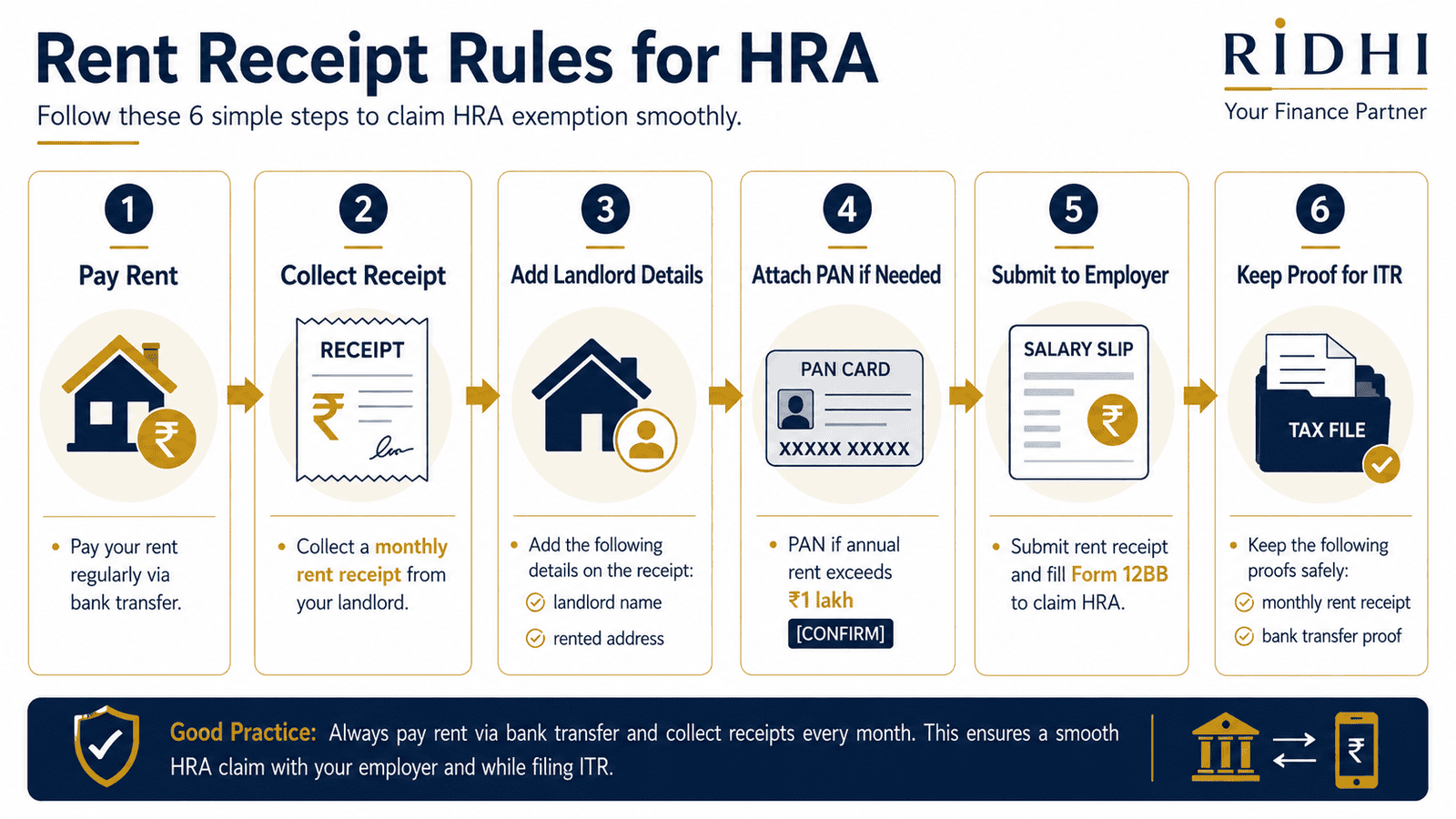
Key Takeaways
- A rent receipt must include six core elements — tenant name, landlord name, address, rent amount, period covered, and landlord signature — to be considered valid by most employers.
- Landlord PAN is mandatory when your total annual rent exceeds ₹1,00,000 (i.e., more than ₹8,333 per month on average).
- HRA exemption is available only under the old tax regime — if you have opted for the new tax regime, rent receipts have no impact on your tax liability.
- Form 12BB is the standard employer declaration form; HRA proof (receipts plus PAN) must be attached to it before your employer’s deadline.
- Cash payments carry scrutiny risk — bank transfer records or UPI screenshots significantly strengthen your documentation trail.
- If you pay rent to a parent, HRA exemption is permitted but the rent must be declared as income by your parent and supported by a rent agreement and receipts.
- Revenue stamps are no longer legally required on rent receipts under Indian Stamp Act amendments, but some employers still ask for them — check your HR policy.
Key Facts at a Glance
| Parameter | Rule / Limit | Where It Applies |
|---|---|---|
| Landlord PAN threshold | Annual rent > ₹1,00,000 | Employer proof submission |
| HRA exemption regime | Old tax regime only | Section 10(13A), Rule 2A |
| Form for employer declaration | Form 12BB | Payroll / TDS adjustment |
| Minimum receipt frequency | Monthly (one per calendar month) | Employer standard practice |
| Rent agreement required? | Not mandatory by law; required by many employers | Payroll / scrutiny |
| Revenue stamp required? | Not legally required; employer-dependent | HR proof policy |
What Is a Rent Receipt for HRA — and Why Does It Matter?
House Rent Allowance is a component of your salary that your employer pays to cover your housing costs. Under Section 10(13A) of the Income Tax Act, read with Rule 2A, a portion of your HRA can be exempted from tax — but only if you actually pay rent and can prove it. The rent receipt is that proof.
Without valid receipts, your employer’s payroll system has no basis to reduce TDS on your HRA. The result is straightforward: more tax deducted at source every month, and a potentially larger gap to reconcile when you file your ITR. Your Form 16 will reflect the exemption your employer accepted — so the quality of your receipts directly shapes that number.
What Must a Valid Rent Receipt Contain?
A rent receipt does not need to follow a government-prescribed format, but it must contain the following fields to be accepted by employers and withstand income tax scrutiny:
- Date of receipt — the specific date on which rent was received
- Tenant’s full name — must match your PAN/Aadhaar name exactly
- Landlord’s full name — must match their PAN if provided
- Full address of the rented property — house/flat number, street, city, PIN
- Rent amount in figures and words — e.g., ₹28,000 (Rupees Twenty-Eight Thousand Only)
- Period covered — e.g., “for the month of November 2024”
- Mode of payment — cash, bank transfer, UPI, cheque
- Landlord’s signature — handwritten, not typed
- Landlord’s PAN — mandatory when annual rent exceeds ₹1,00,000
Each receipt should cover exactly one calendar month. Do not club two or three months together on a single receipt — most payroll systems and scrutiny assessments look for month-on-month continuity.
Landlord PAN: The Most Common Rejection Trigger
If your annual rent exceeds ₹1,00,000 — that is, roughly ₹8,334 or more per month on average — you are required to furnish your landlord’s PAN to your employer. This is a Rule 26C requirement under the Income Tax Rules. If your landlord does not have a PAN, they must provide a declaration in writing confirming that they do not hold one. Your employer is expected to collect this before granting the exemption.
According to Income Tax Department guidelines, employers are required to obtain proof of rent payments including landlord PAN where applicable before adjusting TDS under Form 12BB. Missing this detail is the single most common reason payroll departments reject HRA claims before the February cutoff.
Does a Rent Agreement Replace a Rent Receipt?
No. A rent agreement establishes that a rental relationship exists — it confirms the monthly amount, tenure, and parties involved. But it does not prove that each month’s payment was actually made. Rent receipts are payment acknowledgements. Most employers require both: a rent agreement as background proof, and monthly receipts as payment proof. Neither document replaces the other.
Cash Rent and Why It Creates Risk
Paying rent in cash is not prohibited, but it creates a documentation gap. Unlike a bank transfer or UPI payment, there is no independent third-party record of a cash transaction — only the landlord’s signature on the receipt. During income tax scrutiny, assessments under Section 10(13A) have been challenged when the only evidence of rent payment is a paper receipt with no corroborating payment trail. If you pay cash, your receipt is your only evidence. If you pay by bank transfer or UPI, the receipt plus the transaction record creates a stronger, corroborated proof trail.
Form 12BB: Where the Receipt Gets Submitted
Form 12BB is the standard declaration form through which salaried employees inform their employer about tax-saving investments and exemptions — including HRA. Under the HRA section of Form 12BB, you declare: the name and address of your landlord, the total rent paid during the year, and your landlord’s PAN (if applicable). Your rent receipts are attached as supporting documents. This form is submitted to your employer — not to the Income Tax Department directly. Your employer uses it to adjust TDS. If you are reviewing your ITR filing checklist, note that Form 12BB is an employer-facing document; the receipts themselves may be needed again if your return is picked up for scrutiny.
Rent Paid to Parents — Is It Allowed?
Yes. You can pay rent to your parents and claim HRA exemption on it, subject to conditions. The rent payment must be genuine — it cannot be a nominal or token amount. Your parent must declare the rent received as income in their own ITR. You must have a written rent agreement with your parent, issue proper monthly receipts signed by them, and transfer the amount through a traceable mode (bank transfer is strongly recommended). Both sides of this transaction need to be consistent across both returns for it to hold up.
Real Example: Rohit’s HRA Proof Submission in Bengaluru
Rohit is 29, a software engineer in Bengaluru earning ₹12 lakh per year. His monthly rent is ₹28,000 — totalling ₹3,36,000 annually. His salary slip shows an HRA component of ₹24,000 per month.
Because his annual rent exceeds ₹1,00,000, Rohit must collect his landlord’s PAN. His landlord provides PAN ABCDE1234F along with a signed declaration. Rohit generates 12 monthly receipts — one for each month from April 2024 to March 2025 — each showing: his name, landlord name, property address in Koramangala, ₹28,000 for the specific month, payment mode (bank transfer), and landlord signature. He attaches all 12 receipts plus the landlord PAN declaration to his Form 12BB and submits to HR before the January 31 employer deadline.
Because his rent transfer records in his bank statement match the receipt dates and amounts, his employer accepts the proof without follow-up. His HRA exemption calculator shows an exempt amount of ₹1,44,000 for the year — reducing his taxable salary by that figure under the old regime. The key insight: the bank records and the receipts told the same story. That match is what makes proof defensible.
Comparison: Rent Receipt vs Other HRA Proof Documents
| Document | What It Proves | Required By Employer? |
|---|---|---|
| Rent receipt (monthly) | Each month’s payment was made | Always |
| Rent agreement | Rental relationship exists; agreed amount | Usually |
| Landlord PAN / declaration | Landlord identity; tax compliance | If rent > ₹1L/year |
| Bank transfer / UPI record | Independent payment trail | Recommended |
| Form 12BB (filled) | Employer declaration of HRA claim | Always |
| Revenue stamp on receipt | No legal requirement post-amendment | Employer-dependent |
How to Decide What’s Right for You
your annual rent exceeds ₹1,00,000 — THEN you must collect your landlord’s PAN before submitting proof; missing it will likely result in your employer rejecting the HRA claim entirely.
you are under the new tax regime — THEN rent receipts are irrelevant for your tax liability; HRA exemption under Section 10(13A) is not available in the new regime. Use our old vs new regime guide to check which regime suits your income. You can also use the income tax calculator to compare your actual tax outgo under both options before deciding.
you pay rent by cash — THEN ensure receipts are signed with date and amount clearly stated; the absence of a bank trail means receipts are your only evidence and must be complete and consistent.
you pay rent to a parent — THEN use bank transfers, get a written rent agreement, and confirm your parent is declaring the rental income in their ITR; an undeclared rental income on their side invalidates the entire claim.
your employer’s deadline has passed and you missed submission — THEN do not skip HRA at ITR filing; you can still claim the exemption directly while filing your return under Section 10(13A), even if your Form 16 does not reflect it.
your salary structure includes an HRA component — THEN rent receipts will not help you; salaried employees who do not receive HRA as part of their CTC cannot claim this exemption regardless of how much rent they pay.
Common Mistakes to Avoid
1. Submitting One Receipt for Multiple Months
Some employees generate a single receipt covering three or six months to save time.
Employers and tax assessors typically expect one receipt per calendar month. A clubbed receipt creates a mismatch with monthly payroll cycles and may be rejected outright during employer proof review or IT scrutiny. It also makes it harder to verify payment continuity.
Generate one receipt per month, with the specific period stated on each — “for the month of June 2024,” not “April–June 2024.”
2. Using an Online Generator Without Cross-Checking the Fields
Many free online rent receipt generators auto-fill a template but skip the landlord PAN field or leave the payment mode blank.
An incomplete receipt — even a well-formatted one — gives your employer grounds to reject it. If your annual rent is above ₹1 lakh, missing PAN alone can cost you the entire exemption, which at a ₹28,000 monthly rent and 30% tax bracket could mean ₹40,000+ in additional tax deducted.
Fill every field manually and verify it matches your bank transfer records before submitting.
3. Mismatched Amounts Between Receipt and Bank Transfer
If your bank shows a transfer of ₹27,500 but the receipt says ₹28,000, you have a discrepancy — even if the difference is a rounding or maintenance adjustment.
During scrutiny, this mismatch is exactly the kind of inconsistency assessors flag. It suggests either the receipt or the bank record is inaccurate, and raises questions about the payment’s genuineness.
Ensure the amount on every receipt matches the exact transfer amount from your bank or UPI record for that month.
4. Not Collecting Landlord PAN Until the Last Minute
Many tenants only ask for their landlord’s PAN in January when employer proof submission deadlines arrive.
Landlords sometimes refuse, delay, or are unreachable close to deadlines. Without PAN, you cannot claim HRA exemption if your rent exceeds ₹1 lakh per year — and there is no workaround available at the employer level after the cutoff.
Collect PAN at the start of the financial year — ideally when signing or renewing the rent agreement.
5. Assuming the Rent Agreement Replaces Receipts
Some employees submit only a rent agreement to HR, assuming it covers the entire year’s proof.
A rent agreement is a contract — it confirms the relationship and the agreed rent. It does not prove each month’s payment was made. Most employers require both documents. Submitting only the agreement typically results in rejection of the HRA claim.
Keep the agreement as background proof and issue fresh receipts every month.
6. Backdating Receipts at Year-End
Generating all twelve months’ receipts in January or March with different dates is a common shortcut.
Backdated receipts created in bulk have a tell: the paper, ink, or printer metadata may be inconsistent, and in digital form the file creation dates are visible. Under income tax scrutiny, backdated documents are treated as fabricated evidence, which can trigger penalty proceedings under Section 271(1)(c).
Issue receipts on or near the actual payment date each month. If you missed a few months, generate them promptly with accurate dates — do not backdate.
7. Paying Rent to a Spouse and Claiming HRA
Paying rent to a husband or wife and claiming HRA exemption on it is not permitted under Indian income tax rules.
Courts and tax assessors have consistently held that rent paid to a spouse does not qualify for Section 10(13A) exemption, as there is no genuine landlord-tenant relationship. If detected, the entire HRA claim is disallowed and interest under Section 234B may apply.
Rent to parents is permitted; rent to a spouse is not. This distinction is clear and non-negotiable.
8. Ignoring the Regime Before Submitting
Submitting HRA proof when you are under the new tax regime serves no tax purpose — your employer will not apply the exemption under the new regime regardless.
This wastes your employer’s processing time and creates confusion in Form 16 Part B. More importantly, employees sometimes assume their receipts were rejected when they simply were not applicable.
Confirm your active tax regime before submitting any HRA proof to HR.
When This May Not Be the Right Choice
You are under the new tax regime. HRA exemption under Section 10(13A) is not available if you have opted for the new tax regime. Submitting receipts to your employer has no tax benefit in this case.
Your salary does not include an HRA component. If your CTC is structured without HRA — common in some startups and contract roles — there is no exemption to claim. Salaried employees without HRA in their salary structure cannot access Section 10(13A) regardless of how much rent they pay.
Your rent is very low relative to your salary. If HRA received is small and your actual rent is low, the calculated exemption under Rule 2A may be negligible after factoring the 10% of basic salary deduction. Running the numbers through an HRA calculator before investing effort in documentation is worth doing first.
You own a property in the same city. If you own a home in the same city where you claim to be paying rent, income tax assessors may scrutinise the arrangement. Claiming HRA while owning a property in the same location requires a clear explanation and supporting evidence.
If any of these apply to your situation, it may be worth exploring alternatives before committing.
Official Rules and Where to Verify
HRA exemption rules are governed by the Income Tax Act and associated rules. Limits, thresholds, and documentation requirements can change with the Union Budget or administrative circulars. Always verify current figures before submitting proof or filing your return.
- Income Tax Department — incometax.gov.in — for Section 10(13A), Rule 2A, Form 12BB notifications, and current rent thresholds requiring PAN
Rules, limits, and rates on this topic can change with each Budget or regulatory update. Always verify current figures directly from the official source before making any financial decision.
When you are ready to file, keep your ITR filing checklist handy — it covers all documents a salaried employee should have before submitting their return, including HRA proof.
Expert Tips
- Set a calendar reminder on the 1st of each month to collect and save your rent receipt — this takes two minutes and eliminates the January scramble entirely.
- Always pay rent via bank transfer or UPI and use the same account every month. Your bank statement then becomes an automatic corroborating record that matches your receipts date-for-date and rupee-for-rupee.
- At the start of the financial year (April), collect your landlord’s PAN and get a signed declaration — before any deadlines approach. File it with your rent agreement immediately.
- If your rent increases mid-year — say from ₹25,000 to ₹28,000 in October — issue receipts clearly reflecting the new amount from the month of revision. Update your Form 12BB declaration accordingly. Inconsistent amounts across the year without explanation invite queries.
- If you missed submitting HRA proof to your employer before the payroll cutoff, do not assume the exemption is lost. You can claim it directly at ITR filing under Section 10(13A). The exemption is yours by law — your employer’s deadline is a payroll convenience, not a legal bar.
- If your landlord is reluctant to provide PAN, explain that Rule 26C requires you to collect it for rent above ₹1 lakh annually — it is a legal requirement on you as the tenant, not a personal request. Most landlords comply once they understand it is an Income Tax Rule obligation.
- Store soft copies of all 12 receipts, the rent agreement, landlord PAN copy, and bank transfer records in a single folder — organised by financial year. Income tax notices for scrutiny can arrive up to 3–6 years after the assessment year; having everything retrievable in minutes protects you completely.
Frequently Asked Questions
Is a rent receipt mandatory for claiming HRA exemption?
Yes, for most practical purposes. While the Income Tax Act does not specify a prescribed rent receipt format, your employer requires proof of rent payment to adjust TDS under Form 12BB. Without receipts, your employer has no basis to reduce TDS on your HRA component. You can still claim the exemption at ITR filing, but you will need documentation if the return is scrutinised.
What happens if my annual rent is exactly ₹1,00,000 — do I need landlord PAN?
The threshold is rent exceeding ₹1,00,000 per year. If your annual rent is exactly ₹1,00,000, you are at the boundary. Most employers and tax practitioners treat “exceeds” strictly — meaning ₹1,00,001 and above triggers the PAN requirement. However, collecting PAN regardless is always safer and avoids any dispute.
Can I claim HRA if I pay rent in cash?
Yes, cash rent is not prohibited. However, cash payments have no independent trail. If your return is scrutinised, the only evidence is the landlord’s signature on the receipt. To strengthen your position, ensure receipts are complete, consistent, and issued on the correct dates. Bank transfer is significantly safer from a documentation standpoint.
Is a revenue stamp required on rent receipts in India?
Revenue stamps are no longer legally required on rent receipts following amendments to the Indian Stamp Act. However, some employers’ HR policies still ask for them. Check your company’s HR guidelines — if they require it, affix a ₹1 revenue stamp; if they do not mention it, a stamp is not legally necessary.
Can I claim HRA if I live with my parents and pay them rent?
Yes, subject to conditions. You must have a written rent agreement with your parent, pay via bank transfer, issue monthly receipts, and — critically — your parent must declare the rent received as income in their own ITR. If your parent does not report it, the claim is at risk of disallowance. The arrangement must be genuine, not a paperwork exercise.
What if I change my rented accommodation mid-year?
You can claim HRA for both properties — for the respective periods during which you paid rent at each address. Issue separate receipts for each address and ensure the months do not overlap. Inform your employer of the change and update your Form 12BB declaration with both sets of details.
Is a rent agreement compulsory for HRA exemption?
Not compulsory under the law, but required by most employers as background proof. A rent agreement establishes that the rental relationship is genuine and pre-agreed. Without it, some employers will not process the HRA claim even if monthly receipts are provided. Practically speaking, a rent agreement plus monthly receipts plus bank transfers is the strongest combination.
What if my landlord refuses to give their PAN?
If your landlord does not hold a PAN, they must provide a written declaration stating this. If they hold a PAN but refuse to share it, you are in a difficult position — without PAN, your employer cannot grant the HRA exemption for rent above ₹1 lakh per year. You may need to either negotiate with your landlord (explaining the legal requirement) or accept that the employer-level exemption will not be granted. You can still attempt to claim it at ITR filing, but be prepared to explain the missing PAN if scrutinised.
Can I claim HRA exemption directly when filing ITR if I forgot to submit proof to my employer?
Yes. The HRA exemption under Section 10(13A) is a statutory right — your employer’s internal deadline is not a legal bar. If your Form 16 does not reflect the HRA exemption, you can claim it yourself at ITR filing. Keep all receipts, rent agreement, landlord PAN, and bank transfer records as supporting documentation in case of scrutiny.
Does HRA exemption apply under the new tax regime?
No. HRA exemption under Section 10(13A) is available only under the old tax regime. If you have opted for the new tax regime, you cannot claim this exemption — receipts, agreements, and PAN details are irrelevant for HRA purposes in your case. This is one of the key trade-offs to consider when choosing between regimes.
Final Verdict
A rent receipt for HRA is not a formality — it is a legally relevant document that determines whether your employer reduces TDS on your HRA component and whether your exemption holds up under income tax scrutiny. Salaried employees paying monthly rent above ₹8,334 should collect landlord PAN proactively, issue one receipt per month with full details, pay via bank transfer, and file everything under Form 12BB before the employer deadline. If you missed the employer cutoff, claim directly at ITR filing — but keep your documentation clean and consistent. The combination of receipts, bank records, and a rent agreement is your best defence. Always verify the latest rules from official sources or consult a qualified professional before making any financial decision.
This article is for educational purposes only and should not be treated as personalised financial, tax, investment, insurance, or legal advice. Tax rules, interest rates, regulatory limits, and product features can change with each Budget or policy update. Please verify current rules from official government sources or consult a qualified and registered professional before making any financial decision.

Kavita Mehra writes and edits Ridhi.com’s income tax content for Indian taxpayers, with a special focus on salaried employees and beginners who find tax rules confusing. Her work explains complex tax topics in simple language, helping readers understand how income, deductions, exemptions, rebates, TDS, Form 16, ITR filing, and refunds connect in real life.
She covers topics such as old vs new tax regime, income tax slabs, standard deduction, Section 87A rebate, HRA exemption, 80C, 80D, 80E, 80G, TDS on salary, taxable income, Form 16, AIS, Form 26AS, advance tax, and ITR filing checklists. Her content aims to help readers become more informed before filing returns or discussing tax matters with a professional.
Kavita’s approach is careful, compliance-focused, and official-source oriented. Because Indian tax rules can change after Budgets, circulars, and policy updates, her articles encourage readers to verify current figures, filing deadlines, and rules from the Income Tax Department or a qualified tax professional before acting.