
Most investors who look up dividend yield mutual funds are actually looking for the same thing: reliable equity exposure that also throws off some income — something that feels less volatile than a pure growth fund. The confusion starts when terms like IDCW, NAV adjustment, and dividend payout all get used interchangeably. They mean very different things, and understanding the difference could save you from a costly misreading of how these funds actually work.
This article walks you through exactly what dividend yield mutual funds are, how they differ from simply receiving “dividends,” what the tax rules mean for your returns, and whether this category genuinely belongs in your portfolio.
Quick Answer: Dividend Yield Mutual Funds
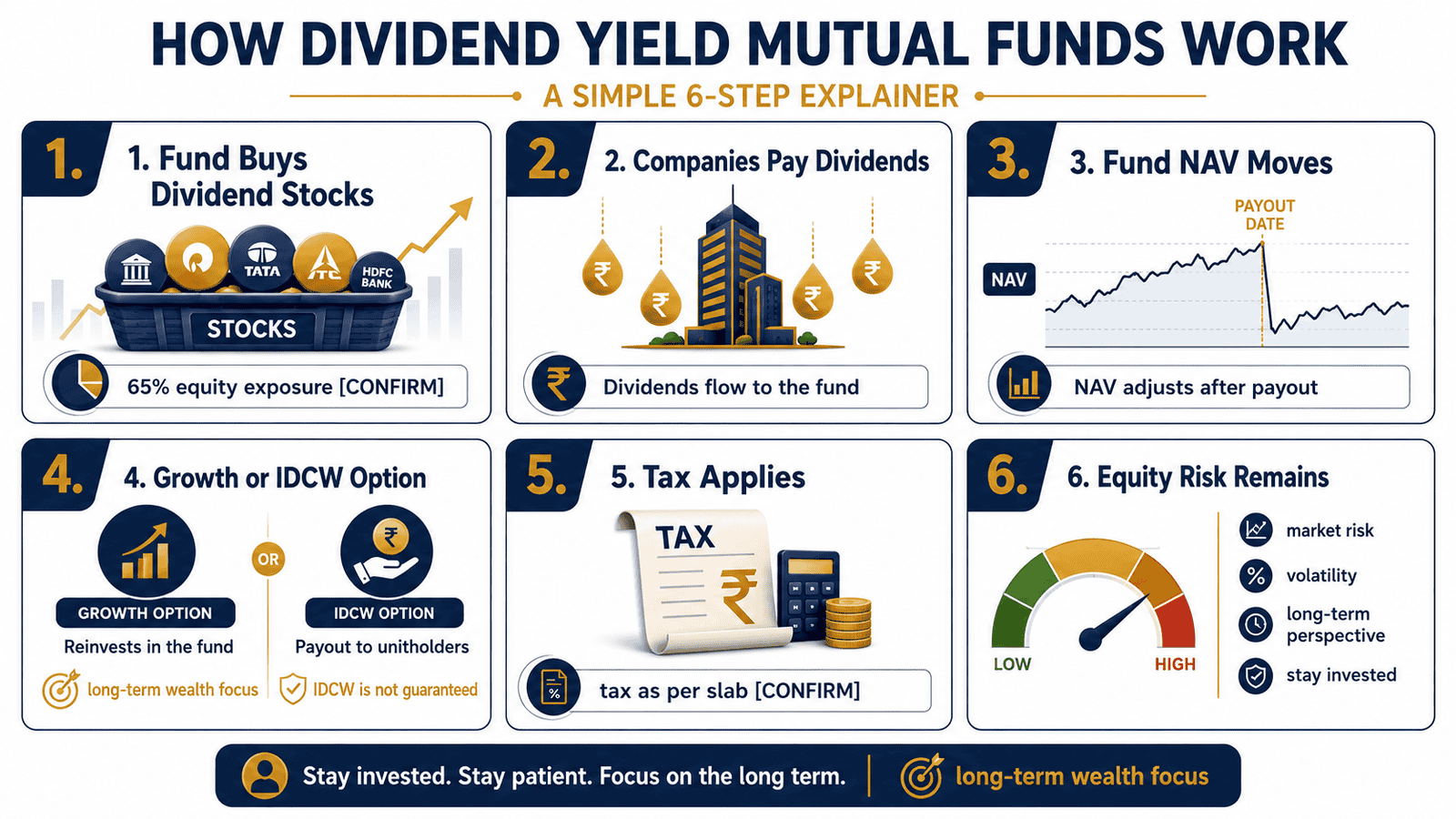
Dividend yield mutual funds are equity funds that mainly invest in dividend-paying stocks. Under SEBI category norms, they generally maintain at least 65% equity exposure. They may suit long-term investors seeking equity exposure with an income/value tilt, but returns and IDCW payouts are not guaranteed.
Key Takeaways
- Dividend yield mutual funds invest primarily in stocks with a high dividend yield ratio — companies that distribute a consistent portion of their profits as dividends.
- SEBI categorises these as equity mutual funds; they are subject to equity taxation — 15% short-term capital gains (STCG) if held under 12 months and 10% long-term capital gains (LTCG) on gains above ₹1 lakh if held over 12 months.
- Choosing the IDCW option does not mean regular guaranteed income — when a fund pays out IDCW, your NAV drops by an equivalent amount. You are not receiving extra money; you are receiving part of your own investment back.
- These funds carry sector concentration risk — dividend-paying stocks cluster in sectors like utilities, PSUs, and FMCG, which can underperform during high-growth market phases.
- Under the current tax rules, any IDCW you receive is added to your income and taxed at your applicable slab rate — making IDCW a tax-inefficient option for investors in the 20% or 30% bracket.
- The growth option of a dividend yield fund lets your returns compound, avoids IDCW taxation, and still gives you the underlying portfolio’s value-tilt without triggering tax events each time a company declares a dividend.
- Investors who genuinely want periodic income from equity may find the SWP (Systematic Withdrawal Plan) route in the growth option more tax-efficient than the IDCW option.
Key Facts at a Glance
| Parameter | Detail |
|---|---|
| SEBI Category | Equity — Dividend Yield Fund |
| Minimum Equity Exposure | At least 65% in dividend-yielding stocks (verify at sebi.gov.in) |
| Investment Style | Value / income tilt; focuses on dividend yield ratio |
| STCG Tax Rate | 15% — if held less than 12 months |
| LTCG Tax Rate | 10% on gains above ₹1 lakh — if held 12 months or more |
| IDCW Tax Treatment | Added to investor’s income; taxed at applicable slab rate |
| Dividend Distribution Tax (DDT) | Abolished — companies no longer deduct DDT before paying dividends |
| Payout Guarantee | None — IDCW declared at fund’s discretion |
| Suitable Horizon | 5 years or more |
| Risk Level | Moderate to high (equity risk applies) |
What Are Dividend Yield Mutual Funds and How Do They Work
A dividend yield mutual fund is an equity mutual fund that builds its portfolio primarily around stocks with a high dividend yield. The dividend yield of a stock is a straightforward ratio: the annual dividend paid by a company divided by its current market price. A stock trading at ₹200 that pays ₹10 per year as dividend has a dividend yield of 5%.
Fund managers in this category screen the market for companies that consistently pay dividends — PSUs, large FMCG companies, utilities, and certain financial sector firms tend to dominate. The underlying idea is a value-investing tilt: companies paying steady dividends tend to be established businesses with predictable cash flows, and they are often available at relatively modest valuations compared to high-growth technology or consumer companies.
Understanding the mutual fund basics is important here before going further — because a dividend yield fund is still a mutual fund that pools investor money, appoints a fund manager, and generates returns through NAV appreciation and any income the underlying stocks generate.
The SEBI Categorisation
SEBI’s mutual fund categorisation framework defines a Dividend Yield Fund as one that predominantly invests in dividend-yielding stocks. The minimum equity allocation under SEBI norms is at least 65% in such stocks. This categorisation keeps the fund honest — a fund cannot call itself a “dividend yield fund” if it is quietly holding a majority of high-growth non-dividend stocks. According to SEBI guidelines, verify the current category definition at sebi.gov.in before making investment decisions.
What Is IDCW — and Why It Is Not the Same as Income
SEBI renamed the Dividend Option in mutual funds to IDCW — Income Distribution cum Capital Withdrawal — precisely to correct a persistent investor misconception. Many investors believed that receiving a mutual fund “dividend” was equivalent to earning income on top of their investment, the way FD interest works.
It is not. When a fund declares an IDCW payout of ₹2 per unit and you hold 1,000 units, you receive ₹2,000. But the fund’s NAV drops by ₹2 per unit on the ex-dividend date. Your total holding value — units × NAV — remains the same before and after the payout. What changes is the tax event: that ₹2,000 IDCW is now added to your income and taxed at your applicable slab rate.
To understand why NAV movement matters so much to your actual returns, reading up on how fund NAV works will give you a much clearer picture of what you actually own at any point in time.
Growth Option vs IDCW Option
The same dividend yield fund typically offers both a growth option and an IDCW option. In the growth option, the dividends that underlying stocks pay into the fund are reinvested. No payout is made to you. Your NAV grows over time, and you pay capital gains tax only when you redeem.
In the IDCW option, the fund may periodically declare payouts. These payouts are funded from the scheme’s distributable surplus — which includes dividends received from portfolio companies and realised gains. The frequency and amount are entirely at the fund house’s discretion. There is no commitment to a fixed monthly or quarterly IDCW.
What Drives Returns
Returns from a dividend yield fund come from two sources: NAV appreciation (the fund’s portfolio growing in value as stock prices rise) and, if you are in the IDCW option, periodic payouts from distributable surplus. The portfolio’s dividend yield ratio gives the fund its character — but it does not translate directly into a guaranteed return percentage. Market risk, sector performance, and macro conditions all shape the outcome.
Real Example: Rohan’s Investment Decision
Rohan is 34 years old, lives in Bengaluru, and works as a senior software engineer earning ₹22 lakh per year. He has been investing in a large-cap fund via SIP for three years but recently heard that dividend yield funds offer more stability and some income. He wants to understand whether shifting part of his portfolio makes sense.
Rohan invests ₹5,000 per month via SIP into a dividend yield fund — growth option. Over 7 years, assuming an annualised return of 11%, his corpus grows to roughly ₹6.1 lakh. Had he chosen the IDCW option, he might have received periodic small payouts — but each payout would be taxed at his 30% income slab. On ₹50,000 of IDCW received over the holding period, that is ₹15,000 in additional tax compared to zero additional tax events in the growth option during accumulation.
Rohan also realises that his assumption — dividend yield fund = income every month — was incorrect. The fund declared IDCW only twice in three years, and the amounts varied each time. He decides to stay in the growth option and use a SIP calculator to estimate his wealth over a 10-year horizon instead of relying on sporadic payouts.
How to Calculate Your Real Return from a Dividend Yield Fund
The most common mistake investors make is treating IDCW payouts as returns without accounting for NAV reduction. Here is the correct way to think about it.
Total Return = (Final NAV − Purchase NAV + Total IDCW received) ÷ Purchase NAV × 100
Using Rohan’s simplified figures: Purchase NAV ₹20, Final NAV ₹26, Total IDCW received ₹3 per unit.
Total Return = (26 − 20 + 3) ÷ 20 × 100 = 45%
If he had chosen the growth option with no IDCW, and the NAV had instead grown to ₹29 (because the distributable surplus was reinvested): Total Return = (29 − 20) ÷ 20 × 100 = 45%
The total return is mathematically similar — but in the IDCW scenario, ₹3 per unit of that return was taxable at slab rate, while in the growth scenario the entire gain is taxed at 10% LTCG on the amount above ₹1 lakh. For a 30% bracket investor, the growth option is clearly more tax-efficient.
| Scenario | Key Details | Tax Impact (30% Bracket) |
|---|---|---|
| Growth Option — Held 5+ Years | NAV grows from ₹20 to ₹29; no interim payouts | 10% LTCG on gains above ₹1 lakh |
| IDCW Option — Periodic Payouts | NAV grows from ₹20 to ₹26; ₹3/unit paid as IDCW | IDCW taxed at 30% slab; capital gains on balance at 10% |
| IDCW Option — No Payouts Declared | NAV grows from ₹20 to ₹29; no IDCW declared that year | 10% LTCG on gains above ₹1 lakh — same as growth |
Comparison: Dividend Yield Fund vs Flexi Cap Fund
| Parameter | Dividend Yield Fund | Flexi Cap Fund |
|---|---|---|
| Investment Universe | Dividend-yielding stocks (value/income tilt) | Any listed equity across market caps |
| Min. Equity Allocation | 65% in dividend-yielding stocks | 65% in equity across market caps |
| Fund Manager Flexibility | Moderate — restricted to dividend-paying companies | High — can go anywhere across market cap |
| Sector Concentration Risk | Higher — utilities, PSUs, FMCG dominate | Moderate — diversified by design |
| Potential Upside in Bull Runs | Moderate — value stocks may lag growth stocks | Higher — can hold high-growth mid/small caps |
| Volatility Profile | Generally lower — mature dividend-paying companies | Varies — depends on market cap allocation |
| IDCW Option Available | Yes | Yes |
| Taxation (Equity Rules) | LTCG 10%; STCG 15% | LTCG 10%; STCG 15% |
For most long-term investors comfortable with equity risk, a flexi cap fund offers more flexibility. The dividend yield fund suits investors who specifically want a value-tilt and are comfortable with concentrated exposure to dividend-heavy sectors. If you want the broadest equity exposure with fewest constraints on the fund manager, explore the flexi cap fund category as a comparison.
How to Decide What’s Right for You
You want equity exposure with a value and income tilt and are comfortable holding for 7+ years — THEN a dividend yield fund in the growth option is worth considering as part of a diversified portfolio.
You are in the 30% tax bracket and expect periodic IDCW payouts to supplement income — THEN the IDCW option is likely tax-inefficient for you; consider the growth option with a planned SWP instead.
You are a conservative equity investor who wants relatively stable large-cap, dividend-paying companies and lower exposure to high-momentum growth stocks — THEN dividend yield funds may suit your temperament better than a mid/small-cap fund.
You are starting a long-term SIP and want to build wealth over 10–15 years — THEN pair your SIP investing basics with the SIP investing fundamentals to understand how compounding works before choosing between fund categories.
You want maximum growth potential and do not require a value tilt — THEN a flexi cap or diversified equity fund with no sector constraint will give the fund manager more room to generate returns across market conditions.
You do not understand how NAV drops when IDCW is declared, or you are expecting monthly fixed income similar to an FD — dividend yield funds are not the right starting point; build your understanding of how direct and regular plans differ and how equity funds work before investing.
Common Mistakes to Avoid
Treating IDCW as Regular Income
Many investors choose the IDCW option expecting monthly income like an FD.
IDCW is not guaranteed, not fixed, and not additional money — it is a partial withdrawal from your own investment, with your NAV adjusting downward by the same amount. An investor expecting ₹2,000 per month from a ₹3 lakh investment will frequently be disappointed when no IDCW is declared for quarters at a time.
If you need regular cash flow, use a Systematic Withdrawal Plan (SWP) from the growth option instead.
Ignoring the Tax Cost of IDCW
Investors in the 20% or 30% bracket often overlook that every IDCW payout is added to their taxable income.
If you receive ₹30,000 as IDCW in a year and fall in the 30% bracket, ₹9,000 of that goes to tax. In the growth option, the same ₹30,000 growth in NAV would attract 0% tax if total LTCG is under ₹1 lakh, or 10% if above — still far lower than slab rate taxation.
Always calculate post-tax return before choosing the IDCW option.
Assuming Dividend Yield Funds Are Low Risk
These are equity funds. They carry full equity market risk.
The underlying portfolio of dividend-paying stocks can and does fall sharply in bear markets. A fund heavily weighted in PSU banks or public sector utilities is not “safe” — it is simply less volatile than a small-cap fund, not risk-free. Mutual fund investments are subject to market risks, and past performance does not guarantee future returns.
Never substitute a dividend yield fund for a debt fund or FD in your emergency or short-term allocation.
Judging Performance by IDCW Payout Alone
Some investors compare funds only by how much IDCW was declared in the last year.
A fund that paid ₹5 per unit as IDCW and saw its NAV fall ₹6 has actually delivered a negative total return. The only correct way to evaluate performance is total return — NAV growth plus any payouts, measured over the full holding period. Use CAGR and XIRR to compare fund returns properly.
Look at 3-year and 5-year total return CAGR, not last year’s IDCW per unit.
Overlooking Sector Concentration
Dividend yield funds often have significant exposure to sectors like utilities, PSUs, energy, and FMCG — all traditionally high-dividend sectors.
During phases when technology, consumer discretionary, or financial growth stocks outperform, this sector mix can lag the broader market significantly. Between 2018 and 2022, several dividend yield funds underperformed large-cap diversified funds by 3–5 percentage points annually in certain periods simply because the growth sectors were not well represented.
Be aware of what sectors your specific fund is concentrated in before investing.
Investing in IDCW Option for Tax Planning
Some investors mistakenly believe that since companies pay dividends from their profits, there is some special tax efficiency in the IDCW route.
There is not — and it is the opposite. The old Dividend Distribution Tax (DDT) regime has been abolished. Under current rules, IDCW is fully taxable at slab rate in the investor’s hands. For most salaried investors in the 20–30% bracket, the IDCW option is the least tax-efficient route in an equity mutual fund.
Skipping the Scheme Information Document
Dividend yield funds differ significantly across fund houses — some hold a tighter definition of “high dividend yield,” others include growth stocks that have started paying small dividends.
The Scheme Information Document (SID) discloses the exact investment mandate, minimum dividend yield threshold, and sector constraints. Reading it takes 20 minutes and tells you whether the fund actually follows the investment philosophy it claims. Always download and read the SID from the AMC’s official website before investing.
When This May Not Be the Right Choice
If you have a short investment horizon of less than 3–5 years, dividend yield funds carry the same equity risk as any other equity fund — a market downturn in year 2 can leave your corpus lower than what you invested, and there is no IDCW payout that will compensate for that.
If you are primarily seeking capital growth and want the fund manager to have full freedom to buy high-growth companies without being constrained to dividend-paying stocks, the dividend yield mandate will feel restrictive. A significant portion of India’s best-performing companies in the last decade — many in technology and new-age sectors — pay little or no dividend.
If you are in a lower income bracket (nil or 5% slab) and were considering the IDCW option for income, be aware that dividend yield funds do not guarantee IDCW payouts — and there are simpler, more predictable debt instruments for genuine income needs.
If any of these apply to your situation, it may be worth exploring alternatives before committing.
Official Rules and Where to Verify
The rules governing dividend yield mutual funds, IDCW taxation, capital gains, and SEBI categorisation norms are set by official regulatory bodies. Rules, limits, and rates on this topic can change with each Budget or regulatory update. Always verify current figures directly from the official source before making any financial decision.
- SEBI (Securities and Exchange Board of India) — sebi.gov.in: For mutual fund categorisation norms, minimum equity allocation requirements, IDCW declaration rules, and scheme categorisation definitions.
- Income Tax Department — incometax.gov.in: For current LTCG and STCG tax rates on equity mutual funds, IDCW taxation rules, TDS thresholds on IDCW payouts, and applicable slab rates.
Expert Tips
- Always choose the growth option over IDCW if you are in the 20% or 30% tax slab and investing for wealth creation — the post-tax compounding advantage compounds significantly over a 10-year period compared to the IDCW route.
- Before investing in any dividend yield fund, download the Scheme Information Document and check the fund’s actual sector allocation. If utilities and PSUs together exceed 40% of the portfolio, you are taking concentrated sector bets — know this before you commit.
- Use direct plan over regular plan for dividend yield funds — expense ratios on regular plans eat into returns more noticeably in a value-style fund where the NAV appreciation is steadier and slower than a high-growth fund.
- If you are investing for 7+ years and want both equity growth and a value tilt, consider holding a dividend yield fund alongside a flexi cap or index fund — not as a replacement. A 70:30 split between a broad equity fund and a dividend yield fund gives you sector diversification without over-concentrating in dividend-heavy sectors.
- Do not evaluate a dividend yield fund’s performance based on its IDCW history. Always look at the total return NAV (growth option NAV or equivalent) over 3 and 5 years — that is the honest measure of what the fund has actually delivered to investors.
- If you need periodic cash flow from your mutual fund investments, a Systematic Withdrawal Plan (SWP) on a growth option is almost always more tax-efficient than the IDCW option — and you control the timing and amount of each withdrawal.
- For beginners evaluating whether a dividend yield fund suits their broader portfolio, run the numbers using a returns comparison tool — understanding CAGR vs XIRR for mutual fund returns will help you set realistic expectations on what this fund category typically delivers over a full market cycle.
Frequently Asked Questions
What is a dividend yield mutual fund?
A dividend yield mutual fund is an equity mutual fund that primarily invests in stocks with a high dividend yield ratio — companies that distribute a significant portion of profits as dividends. SEBI categorises these separately, with a minimum equity allocation requirement in dividend-yielding stocks. They are suitable for long-term equity investors who prefer a value and income-oriented investment style.
Is the IDCW payout in a dividend yield fund guaranteed?
No. IDCW payouts are entirely at the discretion of the fund house. They are declared from the scheme’s distributable surplus and can vary in amount or not be declared at all in a given period. There is no contractual obligation for the fund to pay a fixed IDCW — unlike an FD or bond where interest is predetermined.
How is dividend yield mutual fund income taxed in India?
Any IDCW you receive is added to your total income and taxed at your applicable income tax slab rate. There is no flat tax on IDCW. Capital gains on redemption are taxed at 15% (STCG) if held under 12 months, and 10% on gains above ₹1 lakh (LTCG) if held 12 months or more. Verify current rates at incometax.gov.in before making decisions.
What is the difference between IDCW and growth option in a dividend yield fund?
In the growth option, all income and gains within the fund are reinvested — your NAV grows over time and you pay tax only when you redeem. In the IDCW option, the fund periodically distributes a portion of its surplus to investors. When it does, your NAV falls by the amount paid out. You do not receive additional money — you receive part of your own investment back, and that amount is taxed at slab rate.
Can I invest in a dividend yield fund via SIP?
Yes, most dividend yield mutual funds accept SIP investments. The SIP mechanics work identically to any other equity fund — a fixed amount is invested at regular intervals, buying units at the prevailing NAV. For long-term investors, SIP in the growth option of a dividend yield fund is generally the most recommended approach.
What happens to the NAV when IDCW is declared?
On the ex-dividend date, the NAV of the fund falls by the amount of IDCW declared per unit. If the NAV was ₹50 and the fund declares ₹2 per unit as IDCW, the post-IDCW NAV will be ₹48. Your total portfolio value remains the same at that moment — you simply hold the same NAV-adjusted units plus the cash payout. The payout is then taxed at your income slab rate.
Is a dividend yield mutual fund safer than other equity funds?
Not inherently. Dividend yield funds are equity funds and carry full market risk. Their portfolio of dividend-paying stocks may be less volatile than small-cap funds, but they are not capital-protected instruments. In a broad market correction, dividend yield funds can and do fall in value. Mutual fund investments are subject to market risks, and past performance does not guarantee future returns.
What is the minimum investment amount for dividend yield funds?
Minimum lump sum investment is typically ₹100 to ₹5,000 depending on the fund house, and SIP minimums are often ₹100 to ₹500 per month. Check the specific fund’s Scheme Information Document for exact minimums, as these vary.
How is a dividend yield fund different from a flexi cap fund?
A dividend yield fund is constrained to investing primarily in dividend-paying stocks — which concentrates it in value-oriented sectors like utilities, PSUs, and FMCG. A flexi cap fund has no such constraint and can invest across market caps and sectors, giving the fund manager more flexibility to chase growth. Both are equity funds with the same tax treatment, but their risk-return profiles and sector exposures differ meaningfully.
What should I check before investing in a dividend yield mutual fund?
Check the Scheme Information Document for the fund’s minimum dividend yield threshold and sector allocation. Look at the 3-year and 5-year total return CAGR — not IDCW history. Confirm whether the expense ratio in the direct plan is significantly lower than the regular plan. Verify the fund manager’s track record across a full market cycle. And confirm the latest tax rules at incometax.gov.in before choosing the growth vs IDCW option.
Final Verdict
Dividend yield mutual funds are a legitimate equity category for investors who want a value and income tilt in their portfolio — but they are not an income-generating tool in the way many beginners expect. The IDCW option does not provide guaranteed regular income; it returns a portion of your own investment to you, with a tax bill attached. For most investors in the 20–30% bracket, the growth option is the more rational choice — your money compounds, and you pay capital gains tax at a lower rate when you eventually redeem.
These funds suit long-term investors with a 7+ year horizon who want exposure to dividend-paying, cash-generating businesses and are comfortable with sector concentration in utilities, PSUs, and FMCG. They are less suited to investors seeking maximum capital growth or flexibility.
Build a clear picture of what you own by understanding how fund NAV works before choosing your option. Always verify the latest rules from official sources or consult a qualified professional before making any financial decision.
This article is for educational purposes only and should not be treated as personalised financial, tax, investment, insurance, or legal advice. Tax rules, interest rates, regulatory limits, and product features can change with each Budget or policy update. Please verify current rules from official government sources or consult a qualified and registered professional before making any financial decision.

Arjun Kapoor writes about mutual funds, SIPs, ELSS, fund categories, investment returns, and beginner investing concepts for Indian readers. His focus is on education, not product promotion or fund recommendations. He helps readers understand how mutual funds work before they start investing or comparing schemes.
He covers topics such as mutual fund meaning, SIP meaning, SIP calculator, direct mutual funds vs regular plans, NAV, ELSS tax-saving funds, CAGR, absolute returns, XIRR, expense ratio, large cap vs mid cap vs small cap funds, flexi cap funds, index funds vs active funds, liquid funds, debt mutual funds, SIP pause vs SIP stop, lumpsum vs SIP, and how to start SIP in India.
Arjun’s writing is simple, risk-aware, and long-term oriented. He avoids guaranteed-return language and explains investment concepts using examples, timelines, and comparison tables. His articles remind readers that mutual fund investments are subject to market risks, and past performance does not guarantee future returns. Readers should verify scheme details from SEBI, AMFI, fund houses, and official scheme documents.