

You’ve probably heard someone say their portfolio “earns dividends” — and that sounds reassuring. Stable companies, steady payouts, less drama than a pure growth fund. Dividend yield mutual funds tap into exactly that appeal: they invest primarily in companies with relatively higher dividend yields, giving your portfolio a tilt toward cash-generating, mature businesses. But before you assume this means predictable income, there’s something important to clear up. Dividend yield mutual funds are still equity mutual funds. Their NAV moves with the market. Payouts are never guaranteed. And a ₹10 lakh investment can still fall to ₹8.5 lakh during a broad market correction — dividends or no dividends. This article explains how these funds actually work, what IDCW really means for your returns, how taxation applies, and whether this category fits your situation.
Quick Answer: What Are Dividend Yield Mutual Funds?
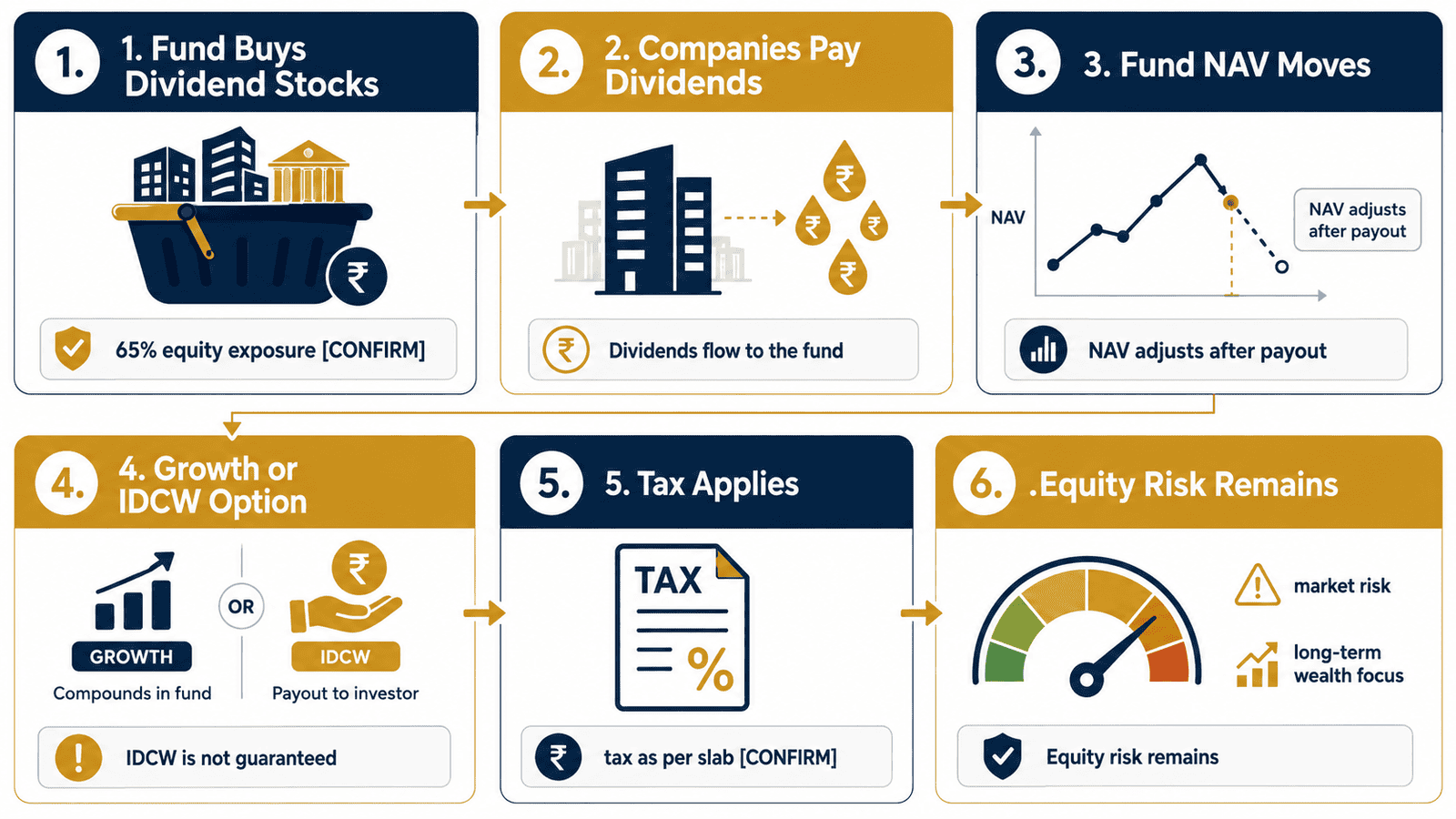
Dividend yield mutual funds are equity funds that invest mainly in companies with relatively high dividend yields. They may suit investors seeking exposure to mature, cash-generating companies, but dividend payouts, NAV movement, and returns are not guaranteed. A ₹10 lakh investment can still fall in value during market corrections, so risk matters.
Key Takeaways
- Dividend yield funds invest in stocks where annual dividends are relatively high compared to the stock’s market price — for example, a company paying ₹8 per share on a ₹100 stock has an 8% dividend yield.
- These are not guaranteed income products. There is no fixed monthly or quarterly payout — fund managers distribute income only when it is available and declared.
- Choosing the IDCW option does not mean free money: when a fund pays out ₹2 per unit as IDCW, the NAV drops by approximately ₹2 on the payout date.
- Taxation on IDCW payouts and capital gains follows current equity mutual fund rules — verify applicable STCG, LTCG, and TDS rates from the Income Tax Department before investing.
- Suitability depends on your investment horizon (typically 5+ years for equity), your existing equity allocation, and your ability to tolerate drawdowns of 20–35% in a poor market year.
- Total return — not just the dividend yield of the underlying stocks — is what actually matters for your wealth. A fund holding 5% yield stocks can still deliver negative returns if those stocks fall sharply in price.
Key Facts at a Glance
| Parameter | Detail | Note |
|---|---|---|
| Fund category | Equity-oriented mutual fund (SEBI categorisation) | Minimum 65% in equity and equity-related instruments |
| Investment strategy | Stocks with relatively high dividend yield | Fund manager picks based on yield, quality, and valuation |
| Available options | Growth and IDCW (Income Distribution cum Capital Withdrawal) | Growth defers payouts; IDCW distributes periodically |
| Risk level | Market-linked equity risk | NAV can fall 20–35%+ in a market downturn |
| Capital gains tax | Equity mutual fund STCG and LTCG rules apply | Verify current rates and exemption limits at incometax.gov.in |
| IDCW tax treatment | Added to investor’s income, taxed at slab rate; TDS applicable | Verify current TDS threshold and rate at incometax.gov.in |
| Typical investment horizon | 5 years or more | Shorter horizons expose investor to full equity downside |
How Dividend Yield Mutual Funds Work
To understand these funds, start one level below — at the company. Every listed company that earns a profit can choose to share some of it with shareholders as a dividend. The dividend yield is simply how much a company pays annually relative to its current share price. A company paying ₹10 per share when the stock trades at ₹200 has a 5% dividend yield. For more on how companies pay dividends and what they signal, read our guide on dividend stock basics.
A dividend yield mutual fund manager uses this metric as a screening filter. Instead of simply chasing growth companies, the fund looks for businesses that consistently return cash to shareholders — typically established, mature companies in sectors like energy, utilities, FMCG, and PSUs. The logic is that companies paying regular dividends tend to have stable cash flows and disciplined management. However, that is a tendency, not a guarantee. A company can cut or skip its dividend at any time.
Growth Option vs IDCW Option
When you invest in a dividend yield fund, you choose between two options. In the growth option, any dividends the fund receives from its portfolio companies are reinvested back into the fund. Your NAV grows over time as the portfolio appreciates. You receive no periodic payouts — all gains are realised only when you sell units. This is generally more tax-efficient if you are building long-term wealth, since capital gains tax applies only at redemption.
In the IDCW option (formerly called the dividend option), the fund periodically distributes money to investors. This sounds attractive, but here is the part most investors miss: the payout comes out of the fund’s NAV. If your NAV is ₹50 per unit and the fund pays ₹3 per unit as IDCW, your NAV falls to approximately ₹47 on the payout date. The ₹3 is not free money — it is your own capital being returned to you, often in a less tax-efficient form.
For a thorough explanation of how NAV moves and what drives changes, see our article on NAV movements explained. And if you are entirely new to how mutual funds are structured, start with our beginner’s guide to mutual fund basics first.
What Drives the Fund’s Total Return
According to SEBI’s mutual fund categorisation framework, dividend yield funds must maintain at least 65% of their portfolio in equity and equity-related instruments, qualifying them as equity-oriented funds. Their total return comes from two sources: price appreciation of the underlying stocks, and dividends received from those companies. Neither is guaranteed. In a year when dividend-paying companies cut payouts and their stock prices fall — as happened across sectors during the 2020 COVID shock — a dividend yield fund can deliver negative returns. Total return, not just the dividend yield number, is what matters for your wealth.
Real Example: Rohan’s SIP in a Dividend Yield Fund
Rohan is 34, a senior analyst in Bengaluru earning ₹18 lakh per year. He starts a SIP of ₹10,000 per month in a dividend yield fund and chooses the IDCW option, assuming it will give him regular cash flow — somewhat like an FD interest payout.
In year one, the fund performs well. Rohan sees a quarterly IDCW credit of ₹1,200. But he notices his NAV has fallen from ₹48 to ₹45 per unit. He checks and finds the IDCW payout coincided with an NAV drop — which is exactly how IDCW works. The ₹1,200 was not additional income; it was a portion of his existing investment value paid out to him.
In year two, markets correct sharply. Many portfolio companies reduce dividends, and the fund’s NAV drops 22% over six months. No IDCW is declared that year. Rohan’s cumulative investment of ₹2.4 lakh is now worth approximately ₹1.95 lakh on paper. His expectation of stable income has not been met — not because the fund manager failed, but because equity risk is real and dividend payouts are not contractual obligations.
The lesson is not that dividend yield funds are bad — it is that they need the same long-term horizon and risk tolerance as any equity fund. Rohan’s best approach would be to invest through SIP investing basics, maintain a 5–7 year horizon, and choose the growth option if his goal is wealth accumulation rather than periodic cash flow.
How to Calculate Dividend Yield — and Why It’s Only Part of the Story
Dividend Yield (%) = (Annual Dividend Per Share ÷ Current Market Price Per Share) × 100
Suppose a company pays ₹5 as an annual dividend and its share price is ₹100. The dividend yield is 5%. If the same company’s share price rises to ₹125 while the dividend stays at ₹5, the yield drops to 4%. If the price falls to ₹80, the yield rises to 6.25% — but that does not mean the investment is more attractive. A rising yield driven by a falling price often signals distress, not value.
Now apply this to a fund. Even if the fund holds stocks averaging 5% dividend yield, the investor’s actual return depends on:
- Price movement of all portfolio stocks
- Whether dividends were actually paid or cut
- Fund expenses (expense ratio)
- Tax on IDCW payouts and capital gains at redemption
| Scenario | Stock dividend yield | Investor return after price movement |
|---|---|---|
| Stable market, dividend paid | 5% | ~5–8% total (price flat + dividend) |
| Rising market, dividend paid | 4% (yield compresses) | 12–18% total (price up + dividend) |
| Falling market, dividend cut | Yield calculation unreliable | Negative return despite earlier yield |
These are illustrative scenarios, not projections. Actual returns depend on the specific portfolio, market conditions, and time period.
Comparison: Dividend Yield Funds vs Other Options
| Fund / Product | Return source | Income guarantee |
|---|---|---|
| Dividend yield mutual fund | Stock price appreciation + portfolio dividends | None |
| Diversified equity / flexi cap fund | Stock price appreciation across all growth styles | None |
| Value fund | Undervalued stock appreciation; partial overlap | None |
| Debt mutual fund | Interest income and bond price movement | None |
| Bank fixed deposit | Fixed interest at contracted rate | Contractual |
| Fund / Product | Risk level | Tax treatment (verify current rates) |
|---|---|---|
| Dividend yield mutual fund | Equity market risk (high) | Equity STCG / LTCG; IDCW taxed at slab rate |
| Diversified equity / flexi cap fund | Equity market risk (high) | Same equity capital gains rules |
| Value fund | Equity market risk; may concentrate in cyclicals | Same equity capital gains rules |
| Debt mutual fund | Interest rate and credit risk (moderate) | Debt fund tax rules (verify at incometax.gov.in) |
| Bank fixed deposit | Low (DICGC-insured up to ₹5 lakh) | Interest taxed at slab rate |
When comparing total returns — not just payouts — read our explainer on fund return metrics to understand why CAGR, absolute, and XIRR measures give very different pictures depending on how long you have been invested.
How to Decide What’s Right for You
you want equity exposure with a tilt toward mature, cash-generating companies and have a 5+ year horizon — dividend yield funds may be worth evaluating as part of your equity allocation.
you are building long-term wealth and want to defer tax — prefer the growth option over IDCW, subject to your tax situation and current applicable rules.
you already hold large-cap or value-style funds in your portfolio — check for overlap before adding a dividend yield fund, since the underlying stock universe may be similar.
you understand that IDCW payouts are not guaranteed income and are comfortable with NAV adjustments — the IDCW option may be considered, though growth is usually more tax-efficient.
your primary goal is comparing different equity fund categories before deciding — review diversified equity, flexi cap, value, and index funds alongside dividend yield funds before committing.
you need guaranteed regular income — dividend yield funds are not a substitute for FDs, annuities, or other contractual income products. Equity funds carry full market risk.
you have a short investment horizon of under 3 years — the equity drawdown risk significantly outweighs any benefit from dividend yield in a short timeframe.
Common Mistakes to Avoid
Treating IDCW as guaranteed monthly income
The most common mistake is expecting regular, fixed payouts similar to FD interest.
IDCW distributions are not contractual. The fund declares them only when distributable surplus exists. In a bad market year, no IDCW may be declared at all — and even when declared, the NAV drops by the payout amount.
If you need fixed income, use products designed for it. Mutual funds are not that product.
Choosing a fund purely based on past IDCW payout history
A fund that paid high IDCW in the last two years may have done so by depleting accumulated surplus, not because of sustainable portfolio income.
Past IDCW payout history is not a reliable indicator of future payouts. Review total return — growth option NAV appreciation over 5 and 10 years — rather than IDCW frequency.
Check rolling returns and downside periods instead of only recent performance.
Ignoring the expense ratio
A fund with a 1.8% expense ratio on a portfolio yielding 4% dividend income is giving back less than half its dividend income to costs before any market-related movement.
Expense ratios compound over time and significantly affect long-term wealth accumulation. Read our guide on expense ratio impact before comparing funds.
Direct plans have lower expense ratios than regular plans in the same fund — confirm both before investing.
Assuming dividend-paying stocks are low risk
Mature companies paying dividends can still fall sharply in value. PSU stocks, energy companies, and some FMCG businesses — common in these funds — can drop 30–40% during sector-specific downturns or market-wide corrections.
Dividend yield is a stock-selection filter, not a risk-reduction guarantee.
Check the fund’s riskometer in the Scheme Information Document before investing.
Investing short-term money in an equity fund
A dividend yield fund is an equity fund. If you invest ₹3 lakh needed in 18 months, a 25% market correction turns that into ₹2.25 lakh at exactly the wrong time.
Equity funds require a 5-year minimum horizon to meaningfully ride out market cycles.
Short-term goals belong in liquid funds, FDs, or short-duration debt funds — not equity.
Confusing dividend yield funds with value funds
These categories overlap significantly — both tend to avoid expensive growth stocks — but they are not the same. Value funds screen for price-to-book and price-to-earnings metrics; dividend yield funds screen for dividend yield. A company can be undervalued without paying dividends, and vice versa.
Understand which category you are buying before adding it to your portfolio.
When This May Not Be the Right Choice
If you need guaranteed income every month to cover living expenses, dividend yield mutual funds will disappoint you. Payouts are neither fixed nor contractual, and years can pass without meaningful IDCW declarations during market downturns.
If your investment horizon is under three years, the full equity drawdown risk applies — a 20–30% NAV fall can occur within months and may not recover within your required window.
If you already hold large-cap or value-style equity funds in significant proportions, adding a dividend yield fund may create substantial portfolio overlap without meaningful diversification benefit.
If you cannot tolerate seeing your NAV fall by 20–35% during a correction without redeeming in panic, equity funds in general — including this category — may not suit your temperament at this stage.
If any of these apply to your situation, it may be worth exploring alternatives before committing.
Official Rules and Where to Verify
Rules governing dividend yield mutual funds, IDCW treatment, and investor taxation can change with each Union Budget or SEBI regulatory update. Always verify current figures directly from the official source before making any financial decision.
- SEBI (Securities and Exchange Board of India) — sebi.gov.in: Mutual fund categorisation rules, scheme information documents, and investor education resources.
- Income Tax Department — incometax.gov.in: Current STCG and LTCG rates on equity mutual funds, IDCW taxation treatment, TDS thresholds, and exemption limits.
- Fund house Scheme Information Document (SID): The official document for any specific fund — covers investment objective, benchmark, riskometer, portfolio strategy, expense ratio, and exit load.
Rules, limits, and rates on this topic can change with each Budget or regulatory update. Always verify current figures directly from the official source before making any financial decision.
Expert Tips
- Look at the fund’s 5-year and 10-year rolling returns in the growth option — not IDCW payout frequency. A fund that has paid high IDCW but delivered weak NAV growth has simply been returning your own capital to you in a less tax-efficient form.
- Check the fund’s portfolio concentration: if the top 10 holdings account for 55–65% of the portfolio, a bad year for two or three sectors can disproportionately hurt returns. Concentration risk is real in dividend yield funds that cluster around PSUs and energy.
- Before adding a dividend yield fund, compare its 3-year rolling downside capture ratio with a diversified large-cap or flexi cap fund. If the downside capture is similar but the upside is lower, you may not be getting the defensive tilt you expected.
- Use SIP for this category only if your horizon is 5+ years and you can stay invested through a 20–25% drawdown without switching. According to SEBI guidelines, your scheme’s riskometer should be a starting reference point — check it before you invest.
- If your goal is wealth accumulation, the growth option is almost always more tax-efficient than IDCW — but verify current capital gains tax rates and IDCW tax treatment from incometax.gov.in before deciding, as these can change with each Budget.
- Read the Scheme Information Document for any fund before investing. It tells you the investment objective, benchmark index, minimum dividend yield threshold used for stock selection, and exit load — information no fund comparison website fully captures.
- Do not confuse a fund’s name with its strategy. Some funds with “dividend” in their name are IDCW plan variants of regular funds, not dividend yield strategy funds. Check whether “dividend yield” is actually the stated investment strategy in the SID.
Frequently Asked Questions
Are dividend yield mutual funds safe investments?
No — they are equity funds and carry full market risk. NAV can fall 20–35% or more during market downturns. The perception that dividend-paying companies are inherently safer is a tendency, not a rule. Companies can cut dividends, and stock prices can fall sharply regardless of dividend history. Mutual fund investments are subject to market risks; past performance does not guarantee future returns.
Do dividend yield mutual funds give monthly dividends?
No. There is no guaranteed monthly payout. If you choose the IDCW option, the fund declares distributions only when there is a distributable surplus — which depends on portfolio performance, market conditions, and the fund manager’s discretion. In a weak market year, no IDCW may be declared. The frequency and amount are not fixed.
What is the difference between the growth option and IDCW option?
In the growth option, profits stay within the fund and your NAV appreciates over time. You pay capital gains tax only when you sell units. In the IDCW option, the fund periodically pays out a portion of accumulated surplus — but this reduces the NAV by the payout amount. IDCW is not additional income; it is a return of a portion of your investment, often taxed at your income slab rate. For most long-term investors, the growth option tends to be more tax-efficient — but verify current rules at incometax.gov.in.
How are dividend yield mutual funds taxed in India?
As equity-oriented funds, capital gains on redemption follow current equity mutual fund tax rules — short-term capital gains (STCG) apply if units are held for less than 12 months, and long-term capital gains (LTCG) apply beyond 12 months. IDCW received is added to your taxable income and taxed at your applicable income slab rate, with TDS applicable above a threshold. These rates and thresholds can change with each Budget — always verify current figures at incometax.gov.in before investing.
Are dividend yield mutual funds better than fixed deposits?
They serve fundamentally different purposes. FDs offer contractual interest income and capital protection (up to ₹5 lakh per bank under DICGC). Dividend yield funds offer equity market exposure with no income guarantee and full NAV risk. If you need certainty of income, FDs are better suited. If you can accept equity risk over 5+ years and seek potentially higher long-term returns, equity funds — including dividend yield funds — may be worth evaluating alongside other equity categories.
Who should consider investing in dividend yield funds?
Investors with a 5-year or longer horizon who want equity exposure specifically tilted toward mature, cash-generating companies may consider evaluating this category. They should already understand that equity NAVs fluctuate, that IDCW is not guaranteed income, and that the growth option is typically more tax-efficient for wealth accumulation. This is not a suitable category for investors seeking regular income, capital protection, or short-term returns.
Are dividend yield funds better than value funds?
Both categories tilt toward quality and valuation discipline rather than pure growth momentum, and their portfolios often overlap significantly. Dividend yield funds screen explicitly for dividend yield as a criterion; value funds screen for price-to-earnings, price-to-book, and similar valuation ratios. Neither category is universally superior — performance depends on market cycles, sector rotation, and the specific fund manager’s execution. Before choosing either, compare both against broader diversified equity and index fund options for your portfolio.
Can I invest in a dividend yield fund through SIP?
Yes — systematic investment plans work with dividend yield funds like any other equity mutual fund. SIP helps average your purchase NAV over time and reduces the risk of investing a lump sum at a market peak. However, SIP does not eliminate equity risk. If your horizon is under 3–5 years or you cannot stay invested through drawdowns, no investment method changes the fundamental risk of equity exposure.
What happens to my dividend yield fund investment when markets crash?
Your fund’s NAV will fall in line with the decline in its portfolio stocks. Portfolio companies may reduce or skip dividends, which further reduces distributable surplus — meaning IDCW payouts may also be suspended. There is no floor on how far the NAV can fall. Recovery depends on market conditions and how long you stay invested. This is why a 5+ year horizon and the ability to stay invested through downturns are essential for equity funds.
Is IDCW the same as the old dividend option in mutual funds?
Yes. SEBI renamed the dividend option to IDCW (Income Distribution cum Capital Withdrawal) to more accurately reflect what actually happens: payouts come from the fund’s accumulated surplus, which includes both income and capital gains — not just dividend income from portfolio companies. The renaming was meant to prevent investors from treating IDCW as guaranteed dividend income similar to FD interest.
Final Verdict
Dividend yield mutual funds are a legitimate equity fund category — not a shortcut to regular income. They invest in companies with relatively high dividend yields and may appeal to investors who want equity market participation with a tilt toward mature, cash-generating businesses. But they carry full equity market risk, their payouts are not guaranteed, and their total returns depend far more on stock price movement than on the dividend income of their portfolio companies.
If you want wealth accumulation over 5+ years and are comfortable with equity volatility, this category is worth evaluating — alongside diversified equity, value, and index fund options — as part of a well-considered asset allocation. It is not a substitute for FDs, annuities, or any other guaranteed income product. Always verify the latest rules from official sources or consult a qualified professional before making any financial decision.
This article is for educational purposes only and should not be treated as personalised financial, tax, investment, insurance, or legal advice. Tax rules, interest rates, regulatory limits, and product features can change with each Budget or policy update. Please verify current rules from official government sources or consult a qualified and registered professional before making any financial decision.

Arjun Kapoor writes about mutual funds, SIPs, ELSS, fund categories, investment returns, and beginner investing concepts for Indian readers. His focus is on education, not product promotion or fund recommendations. He helps readers understand how mutual funds work before they start investing or comparing schemes.
He covers topics such as mutual fund meaning, SIP meaning, SIP calculator, direct mutual funds vs regular plans, NAV, ELSS tax-saving funds, CAGR, absolute returns, XIRR, expense ratio, large cap vs mid cap vs small cap funds, flexi cap funds, index funds vs active funds, liquid funds, debt mutual funds, SIP pause vs SIP stop, lumpsum vs SIP, and how to start SIP in India.
Arjun’s writing is simple, risk-aware, and long-term oriented. He avoids guaranteed-return language and explains investment concepts using examples, timelines, and comparison tables. His articles remind readers that mutual fund investments are subject to market risks, and past performance does not guarantee future returns. Readers should verify scheme details from SEBI, AMFI, fund houses, and official scheme documents.