
You get the email: “Spend ₹2 lakh in a year and earn a ₹3,000 voucher.” It sounds like easy money — until you work out what you actually have to do to get it. Milestone benefits on credit cards are one of the most misunderstood features in Indian personal finance. Some are genuinely valuable. Many are traps that push you to spend more than you would otherwise. This article gives you a clear framework to tell the difference — before you start chasing a target that costs you more than it pays.
Quick Answer: Milestone Benefits on Credit Cards
Milestone benefits on credit cards are worth it only when you can reach the annual spend target through normal expenses and the net value exceeds the annual fee. For example, a ₹3,000 voucher is not useful if you spend extra just to unlock it.
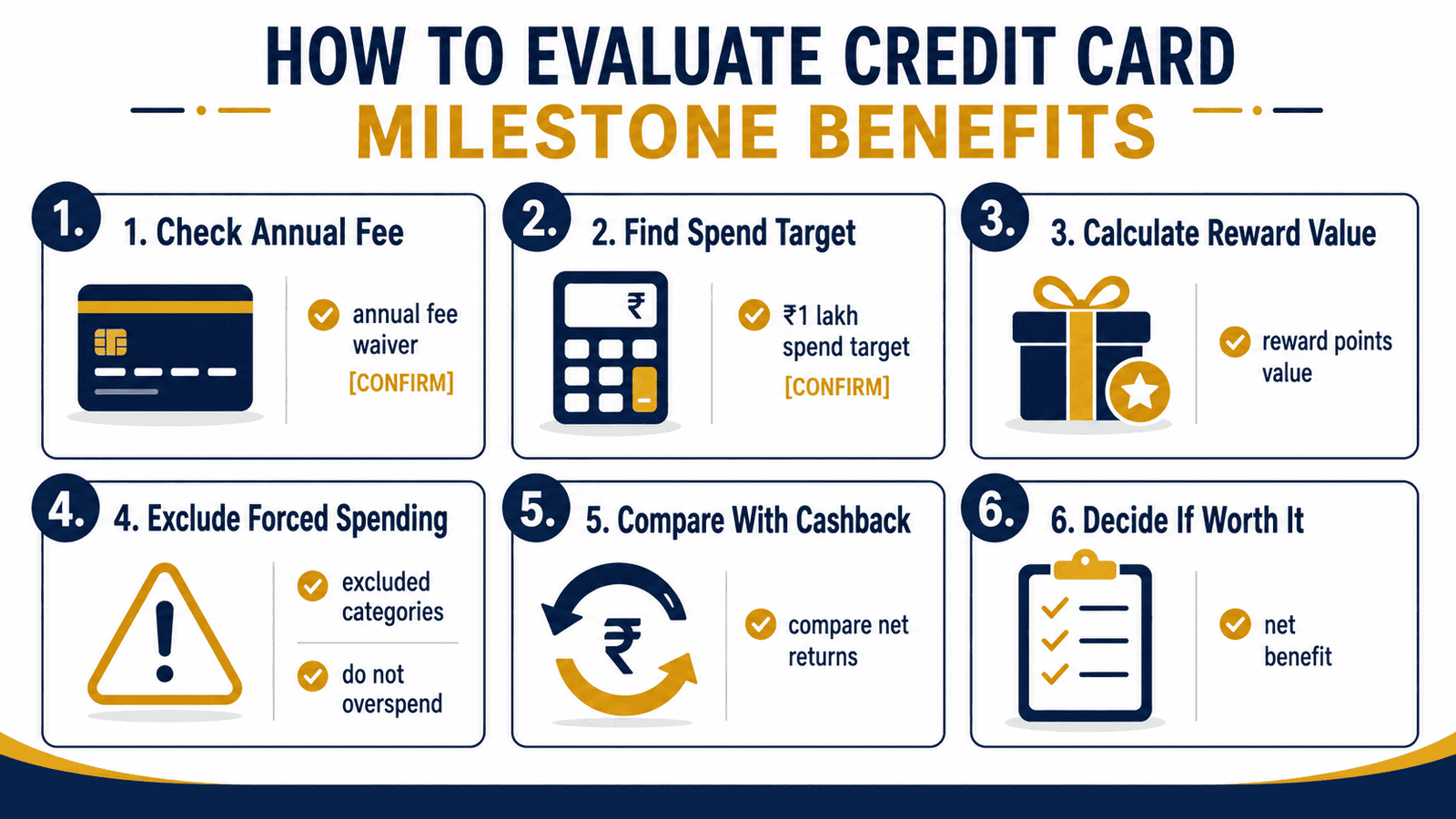
Key Takeaways
- A milestone benefit only has net value if the reward exceeds the annual fee and you would have spent the qualifying amount anyway.
- Excluded categories — fuel, utility bills, rent, EMI payments — often reduce your eligible spend significantly below your actual spend, making the target harder than it appears.
- A ₹2,000 voucher from a milestone benefit is not worth ₹2,000 if it can only be redeemed at a single partner brand you never use.
- Cards with a ₹5,000 annual fee and a ₹3,000 milestone voucher have a net cost of ₹2,000 even if you hit the target — before you account for what you overspent to get there.
- Spend-based annual fee waivers are a separate category of milestone benefit and are often the most straightforward to calculate.
- Reward point milestones expire. If you cannot redeem within the validity period, the reward is zero — and you already paid the annual fee.
- Cards with no annual fee (lifetime free) remove the fee-offset problem entirely — but still require you to evaluate whether any milestone target is realistic for your actual spend pattern.
Key Facts at a Glance
| Feature | What to Know | Why It Matters |
|---|---|---|
| Milestone spend threshold | Typically ₹1 lakh–₹5 lakh per year | Determines whether your organic spend can reach the target |
| Common milestone rewards | Vouchers, bonus reward points, lounge visits, fee waiver | Reward type affects actual usable value |
| Annual fee range (mid-tier cards) | ₹500–₹5,000 per year | Must be subtracted before calling any milestone “free” |
| Excluded spend categories | Fuel, rent, utilities, EMIs, insurance, wallet loads | Reduces eligible spend below total spend |
| Reward point value | ₹0.25–₹1 per point depending on card and redemption method | High point count does not equal high rupee value |
| Redemption fee | Some cards charge ₹99–₹199 per redemption request | Erodes small reward balances entirely |
| Stale data risk | High — thresholds, fees, and exclusions change by bank | Always verify from official card MITC before applying |
What Are Milestone Benefits on Credit Cards?
A milestone benefit is an additional reward that a credit card issuer gives you when your cumulative spend crosses a defined threshold — usually within a calendar year or card anniversary year. Unlike base reward points that accrue on every transaction, milestone benefits are unlocked in one go once you hit the target.
The most common forms of milestone benefits in India include:
- Vouchers: Brand-specific gift vouchers — typically for Amazon, Flipkart, MakeMyTrip, Taj Hotels, or similar partners
- Bonus reward points: A lump sum of reward points credited to your account on crossing the threshold
- Complimentary lounge access: Domestic or international airport lounge visits unlocked after a spend milestone
- Annual or renewal fee waiver: Your next year’s annual fee is waived if you spend above a specified amount in the current year
- Statement credit: A direct credit applied to your outstanding balance — arguably the most transparent form of milestone benefit
Each type has a very different real-world value, and treating them as equivalent is one of the most common mistakes cardholders make.
How Milestone Benefits Are Structured — and Where the Traps Are
Banks design milestone benefits to increase engagement and monthly spend. That is not a criticism — it is simply useful context. When you understand the design, you can use it to your advantage instead of being shaped by it.
Eligible Spend vs. Total Spend
The spend threshold on a milestone benefit almost never means every rupee you charge to the card. Most cards exclude some or all of the following from milestone calculation: fuel transactions, utility bill payments, government service payments, insurance premiums, rent payments via third-party apps, wallet loads, and EMI conversions of existing purchases. If you use your card heavily for these categories — which many salaried employees do — your eligible spend can be significantly lower than your total card spend. Before you decide whether a milestone target is reachable, check the card’s MITC (Most Important Terms and Conditions) for the exact exclusion list. If you’re new to evaluating cards this way, our guide on how to choose your first credit card in India explains what to read before applying.
Monthly Reward Caps
Some cards have a monthly cap on the reward points you can earn — separate from the milestone. This means even if you are on track for the annual milestone, your base reward points may stop accruing after a certain point each month. Check for a monthly cap in the rewards section of the MITC — not just in the milestone section.
Anniversary Year vs. Calendar Year
Milestone periods are usually either the card anniversary year (the 12 months from your card issue date) or the calendar year (January to December). This matters because if you apply for a card in August, a calendar-year milestone gives you only five months to hit the target in your first year. An anniversary-year milestone gives you a full 12 months. Understanding this is part of managing your billing cycle and due date effectively.
The Voucher Redemption Problem
A ₹2,000 voucher sounds straightforward, but its real value depends entirely on whether you would actually spend at that partner. A MakeMyTrip voucher is worth ₹2,000 if you book a flight anyway. It is worth zero if you never travel for leisure. Many milestone vouchers are also non-transferable and expire within 6–12 months of issue. Factor in whether you will genuinely use the reward before counting it as income.
Redemption Fees and Point Value
When milestone rewards come as bonus points rather than vouchers or statement credits, you need to calculate the actual rupee value. Most Indian card reward points are worth ₹0.25 to ₹1 per point depending on the redemption method — catalogue redemptions are usually at the lower end, while travel or statement credit redemptions may be at the higher end. Some cards also charge a redemption fee of ₹99–₹199 per request, which can erase the value of small milestones entirely.
Real Example: Priya in Bengaluru
Priya, 34, works as a senior analyst in Bengaluru and earns ₹14 lakh per year. She holds a mid-tier rewards card with an annual fee of ₹2,500 and a milestone benefit of a ₹3,000 brand voucher on spending ₹2 lakh in a year. Her total annual card spend is approximately ₹2.4 lakh — but ₹60,000 of that is utility bills and insurance premiums, which are excluded from milestone calculation. Her eligible spend is therefore ₹1.8 lakh — ₹20,000 short of the ₹2 lakh target.
To hit the milestone, Priya would need to shift ₹20,000 in purchases she currently makes by UPI or debit card onto the credit card. She checks whether those are eligible categories — they are. So she shifts her grocery and dining spend. She now hits ₹2 lakh eligible spend and receives a ₹3,000 voucher. Her net position: ₹3,000 voucher minus ₹2,500 annual fee = ₹500 net gain. But the voucher is for a hotel chain she rarely uses. The actual usable value to Priya is close to zero. The annual fee waiver option on her card requires ₹3 lakh — well beyond her reach — so she is paying the full fee every year.
Key insight: A ₹3,000 voucher that you cannot use is worth less than a ₹500 cashback you actually receive.
How to Calculate Whether a Milestone Benefit Is Worth It
Net Milestone Value = Milestone Reward Value − Annual Fee − Cost of Forced Spend
Use Priya’s numbers as a worked example:
- Milestone reward: ₹3,000 voucher (usable value: ₹0 for Priya, ₹3,000 if she travels)
- Annual fee: ₹2,500
- Forced spend (extra spend to hit target): ₹20,000 — but these were genuine purchases she made anyway, so forced spend cost = ₹0
- Net milestone value (if voucher is usable): ₹3,000 − ₹2,500 = ₹500
- Net milestone value (if voucher is not usable): ₹0 − ₹2,500 = −₹2,500
| Scenario | Key Inputs | Net Value |
|---|---|---|
| Voucher is usable, organic spend reaches target | ₹3,000 reward, ₹2,500 fee, ₹0 forced spend | +₹500 |
| Voucher not usable, organic spend reaches target | ₹0 effective reward, ₹2,500 fee | −₹2,500 |
| Organic spend short; forced ₹30,000 extra spend | ₹3,000 reward, ₹2,500 fee, ₹30,000 incremental spend | Reward does not justify discretionary overspend |
| Statement credit milestone, annual fee waived | ₹2,000 credit, ₹0 fee (waived), organic target met | +₹2,000 |
Comparison: Milestone Reward Types
| Reward Type | Ease of Valuation | Worth Chasing? |
|---|---|---|
| Statement credit | High — direct rupee value | Yes — if organic spend qualifies |
| Annual fee waiver | High — saves exact fee amount | Yes — clearest ROI calculation |
| Brand voucher (partner you use) | Medium — depends on usability | Maybe — verify redemption window |
| Bonus reward points | Medium — depends on point value | Maybe — calculate ₹ value first |
| Brand voucher (partner you don’t use) | Low — effective value is zero | No — do not chase this |
| Complimentary lounge access | Medium — value if you travel | Maybe — only if travel is regular |
For a deeper comparison between reward points and cashback as a base earn mechanism, see our guide on reward points vs cashback credit cards.
How to Decide What’s Right for You
Your organic card spend already exceeds the milestone threshold through normal monthly expenses — THEN the milestone benefit is very likely worth having, provided you can use the reward.
The milestone reward is a statement credit or an annual fee waiver — THEN the value is transparent and easy to verify. These are generally the best-value milestone benefits.
You need to shift spend from UPI or debit to credit card to reach the target, but those are eligible spend categories — THEN shifting them is sensible as long as you pay the full outstanding amount every month. Carrying a balance destroys reward value instantly.
Your milestone reward is a voucher for a brand you genuinely spend at — THEN verify the expiry date and redemption process first, then evaluate whether the net value after fee justifies the card.
You are within ₹5,000–₹10,000 of the fee-waiver spend threshold at year-end — THEN it may be worth making a purchase you were already planning, to avoid paying the annual fee. Do not make unnecessary purchases for this purpose.
If your natural spend is significantly below the milestone threshold and you would need to change your behaviour or make purchases you would not otherwise make — do not chase the milestone. The reward will not compensate for the incremental spend or the risk of carrying a balance.
If the milestone reward is a voucher for a brand you do not use and cannot transfer — skip the card entirely. An attractive-sounding reward with no practical redemption path is worth nothing.
Common Mistakes to Avoid
Counting Total Spend Instead of Eligible Spend
Many cardholders assume every transaction counts toward the milestone threshold.
Most cards exclude fuel, utility bills, rent, insurance, wallet loads, and EMI conversions. A person spending ₹2.5 lakh annually may find only ₹1.6 lakh qualifies — leaving them short of a ₹2 lakh milestone without realising it until the year ends.
Read the exclusion list in your card’s MITC before the year begins, not after you miss the target.
Treating a Voucher as Cash
A ₹5,000 voucher is not ₹5,000.
If the voucher is for a luxury hotel brand, an airline you never fly, or a retail partner where you would not ordinarily spend, its effective value is zero. Many milestone vouchers also expire within 6 months and cannot be used partially — you must use the full amount in a single transaction.
Always verify the partner, expiry date, and minimum transaction requirement before including the voucher in your reward calculation.
Ignoring the Annual Fee in the Calculation
The annual fee is a cost that must be subtracted from the milestone reward to get net value.
A card with a ₹3,000 annual fee that offers a ₹3,000 milestone voucher has a net value of ₹0 — before accounting for any spend you had to adjust to hit the target. Many comparison sites list milestone rewards without showing the fee impact clearly.
Always compute: Reward Value minus Annual Fee = Net Gain (or Loss).
Spending Extra to Hit the Threshold
Spending ₹20,000 more than you planned to unlock a ₹2,000 reward is a loss of ₹18,000 in discretionary cash, regardless of how the reward is presented.
A milestone benefit is only value-positive when your organic spend reaches the threshold. As soon as you change your behaviour to hit the number, the economics reverse.
Set a reminder at ₹80% of your milestone threshold — not to force spend, but to check whether normal expenses over the remaining months will get you there organically.
Not Checking Reward Points Expiry
Bonus reward points earned through a milestone often have the same expiry as your regular reward points — typically 2–3 years, but some cards set expiry at the card anniversary date.
If you accumulate bonus points but do not redeem them before expiry, you lose the entire reward. The annual fee you paid to earn them is not refunded.
Treat points as time-sensitive — set a calendar reminder six months before expected expiry.
Missing the Monthly Reward Cap
Some cards cap the reward points you earn per month even when a milestone is active.
This means that front-loading large purchases in one month may not generate the expected points. You need to read both the milestone terms and the base rewards terms together — they are often in separate sections of the MITC. Check your credit card statement regularly to confirm points are posting as expected. Our guide on how to read a credit card statement explains where to find reward postings.
Assuming Milestone Benefits Stay Constant
Banks can and do revise milestone thresholds, reward values, and partner vouchers — sometimes mid-year with 30-day notice.
If you signed up for a card based on a specific milestone benefit, verify at renewal time that the benefit is unchanged. A card that offered a ₹5,000 flight voucher milestone in Year 1 may offer a ₹2,500 shopping voucher in Year 2.
Subscribe to your bank’s card update emails and read them before dismissing as promotional material.
Carrying a Balance While Earning Rewards
This is the most expensive mistake of all. Indian credit cards charge interest rates of approximately 30–42% per year on revolving balances.
A ₹3,000 milestone reward is completely erased if you carry even ₹10,000 of balance for a single month at these rates. Understanding how credit card interest is calculated in India makes this clear — rewards and interest must never coexist. Pay your full outstanding balance every month without exception.
When This May Not Be the Right Choice
Milestone benefits on credit cards may not be right for you if your monthly expenses are already managed carefully on a zero-credit-use basis and introducing a spend target would change your financial behaviour in ways that increase risk.
If you carry a revolving balance — even occasionally — reward-chasing is the wrong priority. At 36–42% annual interest, no milestone benefit can offset even a modest unpaid balance.
If your natural card spend is well below the milestone threshold and the gap cannot be filled by shifting existing eligible purchases, the annual fee will simply become a cost with no offsetting benefit.
If you are early in your credit journey and focused on building a good credit score, tracking milestone spend targets introduces unnecessary complexity and potential for overspending that could affect your credit utilisation ratio and CIBIL score.
If any of these apply to your situation, it may be worth exploring alternatives before committing.
Official Rules and Where to Verify
Credit card milestone benefits, annual fees, reward point values, exclusions, and redemption terms are governed by the individual card issuer’s terms and conditions — not a single central regulation. The Reserve Bank of India sets broader credit card conduct rules, but specific benefit structures are set by banks and NBFCs.
Always verify milestone terms from these sources:
- RBI — rbi.org.in: Credit card conduct regulations, fair practice norms, and grievance redressal framework
- Your card issuer’s official website: Most Important Terms and Conditions (MITC) document — this is the binding document, not marketing collateral
- Your card’s official mobile app or net banking portal: Current reward point balance, expiry dates, milestone progress tracker (if available)
Rules, limits, and rates on this topic can change with each Budget or regulatory update. Always verify current figures directly from the official source before making any financial decision.
Expert Tips
- Map your actual spend before applying: Before you apply for any milestone card, list your last three months of expenses by category and identify what portion would be eligible spend. If eligible spend is consistently below the threshold, the card is already earning negative returns before you start.
- Prioritise fee-waiver milestones over voucher milestones: An annual fee waiver saves you the exact amount of the fee — no redemption friction, no brand dependency. If two cards have similar base rewards, prefer the one where the milestone benefit is a fee waiver rather than a partner voucher.
- Set a spend tracker alert at 80% of the milestone threshold: Many bank apps allow you to set spending alerts. Set one at ₹80% of the milestone amount — not to force spend, but to review whether organic spend will reach the target in the remaining time. Make no purchases purely to close the gap.
- Calculate reward point value before the card, not after: If the milestone gives bonus points, find the rupee value of those points for the specific redemption you plan to use — not the highest possible value. Check whether a redemption fee applies, and subtract it. A 5,000-point milestone worth ₹0.25/point with a ₹149 redemption fee is worth ₹1,101 — not ₹1,250.
- Check milestone benefit tier structure carefully: Some cards have tiered milestones — a smaller benefit at ₹1.5 lakh and a larger benefit at ₹3 lakh. If you are consistently hitting the lower tier but far from the upper tier, you may be better served by a different card that matches your actual spend pattern rather than aspirational targets.
- Review benefit terms at each anniversary renewal: Banks change milestone structures at card renewal. Read the updated MITC when you receive your renewal notice — not just the headline benefit on the mailer. If the milestone has been downgraded significantly, it may be worth requesting retention benefits or switching cards.
- Never combine reward-chasing with installment spend: Converting purchases to EMIs is smart for large purchases, but EMI transactions are frequently excluded from milestone calculations and can trigger interest charges that erase reward value. Confirm EMI treatment in MITC before using this feature.
Frequently Asked Questions
What exactly counts as eligible spend for a credit card milestone benefit?
Eligible spend means the transactions that count toward your milestone threshold. Most cards exclude fuel, utility bill payments, rent via third-party platforms, insurance premiums, wallet loads, and EMI conversions. The exact list is in the Most Important Terms and Conditions document on your bank’s website — the marketing page rarely lists exclusions clearly. Always check the MITC before assuming a spend category counts.
Is a ₹1,500 fee waiver milestone better than a ₹2,000 voucher milestone?
In most cases, yes — if both require the same spend threshold. A fee waiver saves you a fixed, guaranteed amount with no redemption friction. A voucher is only worth its face value if you use it fully, at a partner you already spend with, before it expires. The fee waiver is transparent; the voucher requires verification of usability before you can assign it a value.
Can milestone benefits be earned on add-on credit cards?
This depends on the card issuer. Some banks pool the eligible spend from the primary and add-on cardholder toward a single milestone threshold. Others count only primary cardholder spend. Check the specific terms in your card’s MITC or call your bank before assuming add-on spend contributes.
What happens if I miss the milestone threshold by a small amount at year-end?
If you miss the threshold, no milestone benefit is credited for that period — there is no proportional benefit for reaching 90% of the target. You either hit the number or you do not. Some banks offer a grace period of a few days into the next cycle, but this is not standard. You may be able to call the bank and request a retention benefit if you narrowly missed, but this is at the bank’s discretion.
Is it worth spending extra to hit a milestone threshold?
Only if the net benefit — milestone reward minus annual fee — exceeds the incremental spend you would be making unnecessarily. In almost all cases, the answer is no. The only exception is if you are within a small amount of the threshold (₹2,000–₹5,000) and have a purchase you were already planning to make — in that case, bringing the purchase forward is sensible. Never spend extra on items you do not need to unlock a reward.
Do reward points earned through a milestone bonus expire?
Yes, milestone bonus points typically follow the same expiry rules as your regular reward points — usually 2–3 years from the date of earning, but this varies by card. Some cards expire all points on the anniversary date regardless of when they were earned. Check the reward point validity terms in your MITC and redeem before expiry. Unclaimed expired points cannot be reinstated.
Can I get a milestone benefit on a lifetime free credit card?
Yes — some lifetime free cards do offer milestone benefits, typically as bonus points or vouchers rather than fee waivers. Since there is no annual fee, the net value calculation is simpler: the milestone reward is what you receive at no cost, provided your organic spend reaches the target. However, exclusions and voucher usability considerations still apply.
What is the difference between a milestone benefit and a welcome benefit on a credit card?
A welcome benefit is a one-time reward given when you first get the card — often tied to spending a minimum amount within the first 30–90 days. A milestone benefit is a recurring reward available each year when you cross a spend threshold. Both have eligibility conditions; welcome benefits are often easier to achieve because the threshold is lower and the timeline is compressed.
How do I check my progress toward a milestone target?
Log into your card’s net banking portal or mobile app — most banks now show milestone progress under your reward summary. Alternatively, your monthly credit card statement may show cumulative eligible spend. If neither is available, call your card’s customer care. Do not rely on total spend figures — always check eligible spend separately.
What should I do if a milestone benefit I was promised is not credited?
First, verify you met the threshold based on eligible spend — not total spend. If you are confident you qualified, raise a dispute through the bank’s official app or website. If unresolved within 30 days, escalate to the RBI Banking Ombudsman at rbi.org.in. Keep records of your statements showing the eligible spend amount.
Final Verdict
Milestone benefits on credit cards can deliver real value — but only under a specific set of conditions. If your organic eligible spend already reaches the threshold, the reward type is transparent (a statement credit or fee waiver), and the annual fee is manageable, milestone benefits are a legitimate return on your existing spend. For a salaried professional spending ₹15,000–₹25,000 per month on eligible categories, the right milestone card can return ₹1,000–₹3,000 in annual value above fees.
The trap is the threshold chase. The moment you start spending money you would not otherwise spend — or buying from brands you do not use — the reward turns negative. Evaluate every milestone card on three questions: Can I hit the eligible spend target through normal purchases? Is the reward type one I can actually use? Does the net value after annual fee justify keeping the card?
If you are not sure whether any card justifies its fee, our guide on lifetime free credit cards in India covers alternatives where the fee calculation is simpler. Always verify the latest rules from official sources or consult a qualified professional before making any financial decision.
This article is for educational purposes only and should not be treated as personalised financial, tax, investment, insurance, or legal advice. Tax rules, interest rates, regulatory limits, and product features can change with each Budget or policy update. Please verify current rules from official government sources or consult a qualified and registered professional before making any financial decision.

Nikhil Bansal writes about credit cards, billing cycles, card charges, rewards, cashback, credit utilisation, card EMI, BNPL, and responsible credit usage in India. His content is designed for readers who want to use credit cards wisely without falling into expensive repayment mistakes.
He covers topics such as how to choose a first credit card, credit card billing cycle, due date, grace period, minimum amount due, credit utilisation ratio, reward points vs cashback, lifetime free credit cards, annual fee waivers, credit card statement reading, add-on cards, cash advance charges, EMI on credit cards, credit card fraud reporting, BNPL vs credit card, and foreign transaction fees.
Nikhil’s writing is beginner-friendly, direct, and risk-aware. He explains how small mistakes such as paying only the minimum due, withdrawing cash from a credit card, missing due dates, or overusing credit limits can become costly. Since card fees, interest rates, reward rules, waiver conditions, and bank offers change often, readers should verify the latest Most Important Terms and Conditions from the card issuer.