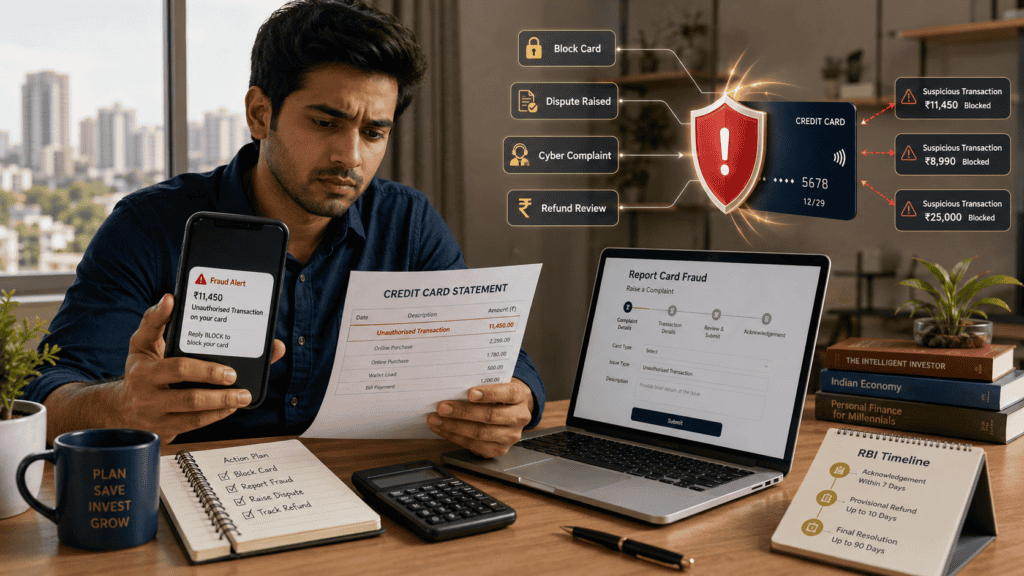

You open your credit card statement in March and see a line item that should not be there: Annual Membership Fee — ₹999 plus GST. You thought you had spent enough to avoid it. You did not check the MITC. The bank charged it anyway — and the dispute window is closing fast.
This is exactly what happens to thousands of salaried cardholders every year. A credit card annual fee waiver is not automatic on most cards. It depends on eligible spends, a specific renewal month, and terms buried in the Most Important Terms and Conditions that most people never read.
This guide explains how the waiver works, how to calculate whether you qualify, what counts as eligible spend, and what to do if the fee is charged despite meeting conditions — all without recommending any single card as the best option.
Quick Answer: Credit Card Annual Fee Waiver
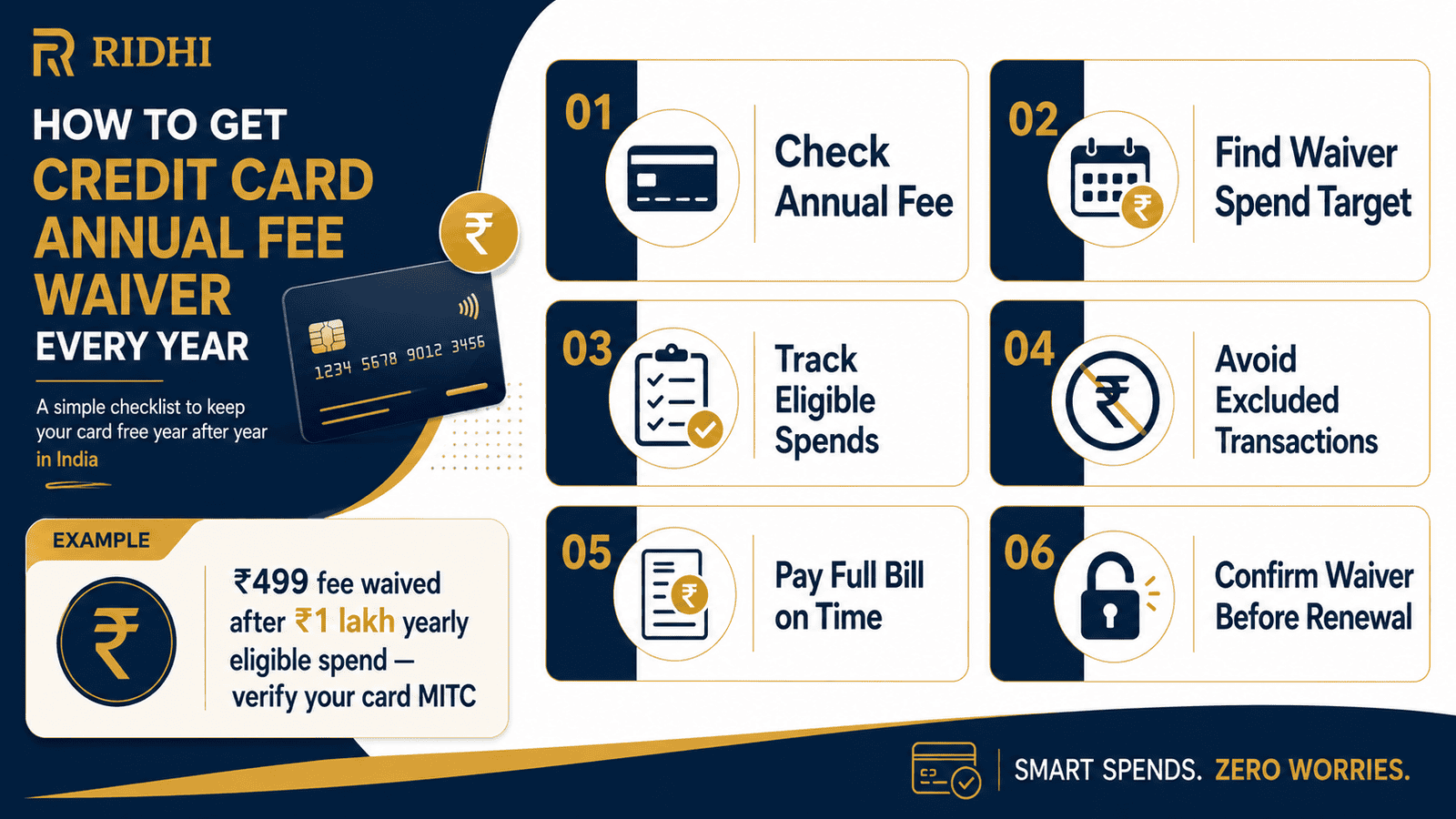
A credit card annual fee waiver lets you avoid the yearly renewal fee when you meet the card issuer’s conditions, usually a minimum annual eligible spend such as ₹1 lakh. Check the card MITC, excluded transactions, renewal month, and statement before assuming the waiver is automatic.
Key Takeaways
- Most paid credit cards waive the annual fee only if you cross a minimum eligible spend threshold — typically ₹1 lakh or more per year — not total spends.
- Excluded transactions such as rent payments, wallet loads, fuel above a limit, EMI conversions, and cash advances often do not count toward the waiver threshold.
- The annual fee can still appear on your statement even if you crossed the spend target — some issuers require a customer care request or system processing time to reverse it.
- GST at 18% is charged on the annual fee itself and is typically not waived even when the base fee is reversed — so a ₹999 fee costs you ₹1,178.82 if charged.
- Spending ₹15,000–₹20,000 extra purely to save a ₹500–₹999 fee is usually irrational — calculate net benefit before chasing the threshold.
- Lifetime-free cards remove fee anxiety entirely but may offer fewer rewards, lower credit limits, or reduced lounge access compared to paid variants.
- Always read your card’s MITC and schedule of charges — these are the only documents that legally bind the issuer’s fee waiver conditions, not the marketing brochure.
Key Facts at a Glance
| Term | What It Means | Where to Check |
|---|---|---|
| Annual / Renewal Fee | Yearly charge for keeping the card active, levied on the card anniversary or renewal month | Card MITC, Schedule of Charges |
| Joining Fee | One-time fee when the card is first issued — separate from the annual renewal fee | Card welcome letter, MITC |
| Spend-Based Waiver | Annual fee is waived or reversed when eligible spends in the card year cross a set threshold | Card MITC, bank rewards portal |
| Eligible Spends | Transaction types that count toward the waiver threshold — usually retail purchases | Card MITC, issuer website |
| Excluded Transactions | Spends that do not count — often rent, wallet loads, fuel above limit, EMI, cash advance | Card MITC, Schedule of Charges |
| MITC | Most Important Terms and Conditions — the legally binding document for all card rules | Card issuer website, card app |
| Dispute Window | Period after fee is charged within which you can raise a reversal request — typically 30–60 days | Card issuer customer care policy |
How Credit Card Annual Fee Waiver Works in India
A credit card annual fee waiver is the reversal or non-charging of the yearly membership fee when a cardholder meets the issuer’s qualifying conditions. It is not a discount or a promotional offer — it is a defined benefit written into the card’s terms.
Most paid cards in India use a spend-based waiver model. The issuer sets a minimum annual eligible spend — say ₹1 lakh — and if your card account crosses that figure within the card year, the renewal fee is either not charged at all or is automatically reversed within one or two billing cycles after renewal.
Joining Fee vs Annual Fee: Not the Same Thing
This confusion trips up many first-time cardholders. The joining fee is a one-time charge when the card is first issued. Some issuers waive it if you spend a minimum amount within the first 60 or 90 days of card issuance. The annual fee, also called the renewal fee or annual membership fee, is a recurring yearly charge. These are governed by different conditions and must be tracked separately.
If you are still figuring out which card suits your spending habits, reading the first credit card guide will help you factor fee waiver conditions into your card selection from the start.
Why the MITC Is the Only Document That Counts
Bank marketing pages, welcome emails, and app notifications can describe waiver benefits in general terms. The Most Important Terms and Conditions — the MITC — is the document that legally binds the issuer. It spells out the exact threshold, which transaction types are excluded, and how the reversal is processed. According to the RBI’s credit card regulatory framework, issuers are required to disclose key fees and charges clearly to cardholders. The MITC is typically available on the card issuer’s website or through the card app.
Automatic Waiver vs Request-Based Waiver
Some issuers process the waiver automatically — the fee is never charged, or a reversal credit appears in the next billing cycle without any action from you. Others require you to call customer care or raise a service request after you have crossed the threshold. A third category processes it only at the point of renewal and may still show the fee on an intermediate statement. Check your MITC to know which model your card follows — assuming it is automatic is one of the most expensive assumptions a cardholder can make.
Lifetime-Free Cards Are Different
A lifetime-free card has no annual fee from issuance, so there is no threshold to track and no renewal decision to make. However, lifetime-free cards in India often come with lower reward rates, reduced partner offers, and fewer premium benefits compared to paid cards at the same income tier. The right choice depends on your actual spend pattern — not the card’s marketing language.
Real Example: Rohit’s Annual Fee Waiver Calculation
Rohit, 29, is a software engineer in Pune earning ₹11 lakh per year. He uses a mid-tier paid credit card for online shopping, fuel, dining, and monthly utility bill payments. The card has an annual fee of ₹999 plus GST and a spend-based waiver condition of ₹1,00,000 in eligible spends per card year.
Rohit tracks his last 12 months of card spends and finds the following:
| Spend Category | Annual Amount | Counts as Eligible? |
|---|---|---|
| Online shopping, dining, bills | ₹65,000 | Yes |
| Fuel transactions | ₹12,000 | Partially — check MITC fuel cap |
| Rent via payment app | ₹18,000 | No — excluded in most cards |
| Wallet loads | ₹6,000 | No — excluded in most cards |
| Eligible total (approximate) | ₹77,000 | ₹23,000 short of waiver |
Rohit is ₹23,000 short of the waiver threshold through natural spending. Spending ₹23,000 extra on purchases he does not need costs far more than the ₹999 fee he is trying to save. His better options: pay the fee and evaluate whether the card’s rewards still justify it, or check whether his issuer offers a downgrade to a lifetime-free variant without closing the account. Understanding your billing cycle dates also matters here — Rohit must know exactly which statement period his renewal falls in to track spends correctly.
How to Calculate Whether You Will Qualify
Eligible Yearly Spends = Total Card Spends − Excluded Transactions
Gap to Waiver = Waiver Threshold − Eligible Yearly Spends
Net Benefit = (Rewards Earned + Fee Saved) − Cost of Any Extra Spend to Hit Threshold
Using Rohit’s numbers:
- Eligible spends: ₹77,000
- Waiver threshold: ₹1,00,000
- Gap: ₹23,000
- Annual fee: ₹999 plus GST of ₹179.82 = ₹1,178.82 total if charged
If Rohit spends ₹23,000 unnecessarily just to save ₹999, he has spent ₹23 to save ₹1. That is not a waiver — that is a loss disguised as a saving.
| Scenario | Eligible Spend | Outcome |
|---|---|---|
| Comfortable above threshold | ₹1,20,000+ | Waiver achieved through normal use — no action needed |
| Close to threshold (₹5,000–₹10,000 short) | ₹90,000–₹95,000 | Worth bridging with planned expenses such as a large grocery bill or utility payment |
| Far below threshold | Under ₹75,000 | Pay the fee or evaluate downgrade — do not manufacture spends |
Paid Waivable Card vs Lifetime-Free Card vs Premium Card
| Feature | Paid Card with Waiver | Lifetime-Free Card | Premium Card (High Fee) |
|---|---|---|---|
| Annual fee | ₹500–₹3,000 (waivable) | Nil | ₹5,000–₹10,000+ (rarely waivable) |
| Waiver condition | Spend threshold (₹1L–₹2L typical) | No threshold needed | Very high (₹5L–₹10L+) or no waiver |
| Reward rate | Moderate to good | Basic to moderate | High — lounge, travel, dining credits |
| Best-fit user | Salaried user with ₹8L–₹20L income and regular card spend | Low-spend user or beginner who wants zero fee risk | Frequent flier or high-spend user who uses premium benefits regularly |
| Main risk | Missing threshold, paying fee and losing rewards advantage | Lower rewards may not offset opportunity cost vs paid card | High fee if benefits go unused |
| MITC complexity | Moderate — check excluded spends carefully | Low — no waiver rules to track | High — complex benefit structure and spend exclusions |
How to Decide What’s Right for You
your natural eligible annual card spend comfortably crosses the waiver threshold without any extra effort — THEN keep the card and claim the waiver every year.
you are less than ₹10,000 short of the threshold and have planned expenses like an annual insurance premium, a large grocery run, or a utility bill due soon — THEN it may make sense to route those through the card to bridge the gap.
you are more than ₹20,000–₹25,000 short of the threshold with two months to go — THEN pay the fee and re-evaluate the card at next renewal rather than manufacturing spends.
the card’s actual benefits — reward points, lounge access, fuel surcharge waiver, cashback — are worth more than the annual fee — THEN paying the fee may still be worthwhile even without a waiver.
closing the card would eliminate your oldest credit account or significantly reduce your total available credit — THEN think carefully about the CIBIL impact before making that decision. Understanding your credit utilisation ratio will help you see why this matters for your CIBIL score.
the card issuer allows a downgrade to a lifetime-free variant — THEN that preserves your credit history without recurring fee risk.
you regularly pay your full statement balance every month — THEN a credit card annual fee waiver is not the biggest cost to worry about. Interest charges at 36–42% per year will far exceed any fee you save.
Common Mistakes to Avoid
Assuming All Spends Count
Many cardholders believe every rupee spent on the card counts toward the waiver threshold.
Rent payments via third-party apps, wallet loads, fuel transactions above a set limit, EMI conversions, and cash advances are excluded on most cards. A cardholder who routes ₹25,000 in rent through the card may assume they are ₹25,000 closer to the waiver — they are not.
Read the MITC section on eligible spends before assuming any category counts.
Ignoring GST on the Annual Fee
The annual fee of ₹999 does not cost ₹999. GST at 18% is added, bringing the actual charge to ₹1,178.82.
This matters when calculating net benefit — the fee saving is the gross fee, but the actual charge (if not waived) includes GST. Check whether the waiver covers both or only the base fee.
Verify this explicitly with customer care or in the MITC before assuming full reversal.
Not Knowing Your Renewal Month
The card year does not always match the calendar year. If your card was issued in July, your card year may run from July to June and the renewal fee is charged around the anniversary date.
Spend tracking must align with the card year, not January to December. Tracking the wrong period means you may think you have crossed the threshold when you have not.
Check your card welcome email or statement header for the card issuance date.
Missing the Fee Charge on the Statement
A ₹999 annual fee line item can appear buried below reward reversals, interest, and other adjustments on a busy statement.
Learning to read card statement carefully every month means you will catch the charge before the dispute window closes. Missing it for two billing cycles may mean the bank refuses the reversal.
Set a calendar reminder for the month your card renews.
Calling Customer Care After the Dispute Window Closes
Most issuers allow you to raise a fee reversal request within 30 to 60 days of the charge appearing.
Calling three months later gives the bank a legitimate reason to decline. Issuers are not required to reverse a fee outside their stated dispute window, regardless of your eligibility.
Act within the first billing cycle after the fee appears.
Spending Unnecessarily to Reach the Threshold
Buying goods you do not need or prepaying services just to cross ₹1 lakh defeats the purpose of the waiver.
If the gap is ₹20,000 and the fee is ₹999, you are effectively paying ₹20,000 to save ₹999. That is a net loss of ₹19,001 regardless of how it feels.
Only bridge the gap with spends you would have made anyway.
Confusing Joining Fee Waiver with Annual Fee Waiver
The welcome email may say “joining fee waived on first spend of ₹5,000.” This applies only to the one-time joining fee.
The annual renewal fee is governed by a completely different condition. Cardholders who assume the joining fee waiver repeats every year are caught off-guard at the first renewal.
Read both sections of the MITC separately.
When This May Not Be the Right Choice
Chasing a credit card annual fee waiver is not always the smartest move. There are specific situations where paying the fee — or switching cards — makes more sense.
If your natural eligible spends are consistently well below the threshold — say ₹50,000 when the waiver needs ₹1,50,000 — you will never qualify through normal use. The waiver is not a realistic benefit for your usage pattern.
If the card’s actual rewards earned in a year are worth less than the annual fee, then the waiver saves you from a fee you should not be paying in the first place — and that may signal the card is simply not right for your spending profile.
If most of your spending falls into excluded categories — rent, fuel above limits, wallet loads — your eligible spend will always fall short regardless of total card use.
If you carry an unpaid balance and pay interest every month, the annual fee is a minor cost compared to interest at 36–42% per year. Consider exploring lifetime free cards that reduce fee pressure while you build healthier card habits.
If any of these apply to your situation, it may be worth exploring alternatives before committing.
Official Rules and Where to Verify
Credit card fee waiver conditions are legally binding only as written in the card’s MITC and Schedule of Charges. Marketing material, bank websites, and third-party comparison portals may describe benefits in general terms that do not match the actual rules. Always verify from these sources before making any assumption:
- Card MITC: Available on the issuer’s official website and through the card app. Search for “credit card MITC [card name]” on the issuer’s domain.
- Schedule of Charges: A separate document from the MITC that lists all fees, GST applicability, and waiver thresholds. Usually linked from the card page.
- Monthly Credit Card Statement: The fee charge, waiver reversal, and any adjustments appear here. Review every statement in the renewal month.
- SMS or Email from the Issuer: Many banks send a fee waiver confirmation or a pre-renewal reminder. Save these communications.
- Customer Care Service Request Number: If you call to request a reversal, always record the service request number for follow-up.
- RBI Credit Card Guidelines: The Reserve Bank of India sets disclosure standards for credit card issuers. Refer to rbi.org.in for the regulatory framework on credit card charges and disclosures.
Rules, limits, and rates on this topic can change with each Budget or regulatory update. Always verify current figures directly from the official source before making any financial decision.
Expert Tips
- Track eligible spends — not total spends: Open your MITC, list the excluded categories, and subtract them from your card total every month. A ₹90,000 total spend with ₹20,000 in excluded categories means only ₹70,000 counts. Know your real eligible figure three months before renewal.
- Set a renewal month calendar reminder: Mark the month your card year ends. Check your statement for the fee charge within the first week of that billing cycle — not six weeks later when the dispute window may be closing.
- Screenshot your waiver terms when you read them: MITC documents can change. If your threshold was ₹1 lakh when you checked in January and the bank revises it to ₹1.5 lakh in September, you need evidence of the original terms to challenge a disputed charge.
- Ask for a retention waiver if you are a consistent user: If you have been a cardholder for more than two years and use the card regularly, customer care may offer a discretionary fee waiver or an upgrade deal even if you missed the spend threshold. It costs nothing to ask — and many retention teams have the authority to offer it.
- Consider a downgrade before closing: Most issuers allow you to downgrade a paid card to a free variant within the same card family. This preserves the account age, credit limit, and your CIBIL history without annual fee risk.
- Never revolve credit just to earn reward points for a waiver: Interest on a revolving balance runs at 36–42% per year on most cards. No reward rate beats that cost. Understand credit card interest before treating a fee waiver as a financial win while carrying a balance.
- Route genuinely eligible spends through the card: If you already pay for subscriptions, insurance premiums, school fees, or utility bills in cash or UPI, switching those to your credit card (and paying the full balance on time) can add ₹20,000–₹40,000 in eligible spends annually without any additional spending.
Frequently Asked Questions
Is the annual fee waiver automatic or do I need to call the bank?
It depends on your card issuer and card variant. Some issuers process the waiver automatically once you cross the eligible spend threshold — the fee is either not charged or a reversal credit appears in the next cycle. Others require you to raise a service request after crossing the threshold. Check your card’s MITC for the specific process — never assume it is automatic.
Does rent payment count toward the credit card fee waiver spend?
On most credit cards in India, rent payments made through third-party payment apps are classified as excluded transactions and do not count toward the annual fee waiver threshold. Some cards may count them partially or fully — verify your specific card’s MITC under the excluded transactions section before routing rent through your card.
Does wallet loading count toward the spend threshold?
Wallet loads — topping up Paytm, PhonePe wallet, or similar services using a credit card — are excluded on the majority of Indian credit cards. They also typically do not earn reward points. Check your card MITC before assuming wallet loads count toward any benefit threshold.
Is GST waived when the annual fee is reversed?
Not always. Many issuers reverse only the base annual fee, not the 18% GST charged on it. On a ₹999 card, you may still pay ₹179.82 in GST even after a successful fee waiver. Verify with customer care or check the MITC to understand whether the reversal is for the full charge or only the base fee.
Can customer care reverse the annual fee even if I missed the spend threshold?
Sometimes, yes — but it is discretionary, not a right. Customers with a long tenure, consistent payment history, and strong annual spend sometimes receive a goodwill reversal from the retention team. Ask politely and mention your history with the card. Do not count on this as a regular strategy — it may not work every year.
Is a lifetime-free card always better than a paid card?
Not necessarily. Lifetime-free cards often offer lower reward rates, fewer premium benefits, and smaller credit limits compared to paid cards at the same income tier. If you use a paid card’s rewards or lounge access regularly and meet the spend threshold naturally, the paid card may deliver better value. If you rarely use the card’s benefits or consistently miss the threshold, a lifetime-free card removes the fee risk entirely.
What is the difference between a joining fee and an annual fee?
The joining fee is charged once when the card is first issued and is sometimes waived if you spend a minimum amount within the first 60–90 days. The annual fee — also called the renewal fee or annual membership fee — is a recurring yearly charge. They are governed by different waiver conditions in the MITC. Qualifying for a joining fee waiver does not mean the annual fee is also waived in subsequent years.
Should I close my credit card if the annual fee is not waived?
Closing a credit card — especially your oldest one — can affect your CIBIL score by reducing your total available credit and credit history length. Before closing, consider whether a downgrade to a lifetime-free variant within the same card family is possible. This removes the fee without losing the account history. Only close the card if no downgrade option exists and the fee outweighs the card’s continued benefit.
What happens if the annual fee is charged but I was eligible for a waiver?
Raise a service request with customer care within the dispute window — typically 30 to 60 days of the charge appearing on your statement. Provide evidence of your eligible spend (your statements or the bank’s spend summary in the app) and quote the waiver condition from the MITC. Record the service request number. If the reversal is denied, escalate to the bank’s grievance redressal officer and, if needed, the RBI’s Integrated Ombudsman Scheme.
Can I get a fee waiver if I have partially used EMI on the card?
EMI conversions of existing purchases are excluded from eligible spend on most cards. The original retail purchase may count toward the threshold, but the EMI processing fee and interest are separate charges that usually do not count. Check your card MITC under the section on eligible spends and EMI treatment to confirm how your issuer handles this.
Final Verdict
A credit card annual fee waiver is a genuine benefit — but only when you earn it through spends you would have made anyway. The mechanics are not complicated: know your eligible spend threshold, subtract excluded transactions, track the real gap three months before renewal, and act fast if the fee appears on your statement despite meeting conditions.
Paid cards can absolutely be worth their fee — either through the waiver or because the rewards genuinely exceed the cost. Lifetime-free cards are the simpler choice if you are not a consistent card spender or want to avoid tracking waiver conditions altogether. Neither is universally better; your natural eligible spend and actual benefit usage decide it.
Do not manufacture spends. Do not revolve balances. Do not assume the waiver is automatic. Read your MITC once — it takes ten minutes and can save you ₹1,178 every year.
Always verify the latest rules from official sources or consult a qualified professional before making any financial decision.
This article is for educational purposes only and should not be treated as personalised financial, tax, investment, insurance, or legal advice. Tax rules, interest rates, regulatory limits, and product features can change with each Budget or policy update. Please verify current rules from official government sources or consult a qualified and registered professional before making any financial decision.

Nikhil Bansal writes about credit cards, billing cycles, card charges, rewards, cashback, credit utilisation, card EMI, BNPL, and responsible credit usage in India. His content is designed for readers who want to use credit cards wisely without falling into expensive repayment mistakes.
He covers topics such as how to choose a first credit card, credit card billing cycle, due date, grace period, minimum amount due, credit utilisation ratio, reward points vs cashback, lifetime free credit cards, annual fee waivers, credit card statement reading, add-on cards, cash advance charges, EMI on credit cards, credit card fraud reporting, BNPL vs credit card, and foreign transaction fees.
Nikhil’s writing is beginner-friendly, direct, and risk-aware. He explains how small mistakes such as paying only the minimum due, withdrawing cash from a credit card, missing due dates, or overusing credit limits can become costly. Since card fees, interest rates, reward rules, waiver conditions, and bank offers change often, readers should verify the latest Most Important Terms and Conditions from the card issuer.