

If you are comparing NPS Tier 1 vs Tier 2 before opening an account or deciding how to split contributions, the confusion is understandable — both accounts sit inside the National Pension System, both use the same pension fund infrastructure regulated by PFRDA, and both show up on the same PRAN dashboard. But they serve completely different purposes, and conflating them leads to two expensive mistakes: locking money you will need before retirement, or missing tax deductions you were counting on.
Tier 1 is the mandatory retirement account — disciplined, tax-linked under the old regime, and restricted on withdrawal by design. Tier 2 is an optional add-on with flexible access but, for most private sector salaried employees, no broad income tax deduction. This article explains exactly what separates them, maps the tax rules to your regime, covers all withdrawal and exit conditions, and tells you when each account actually makes sense.
Quick Answer: NPS Tier 1 vs Tier 2
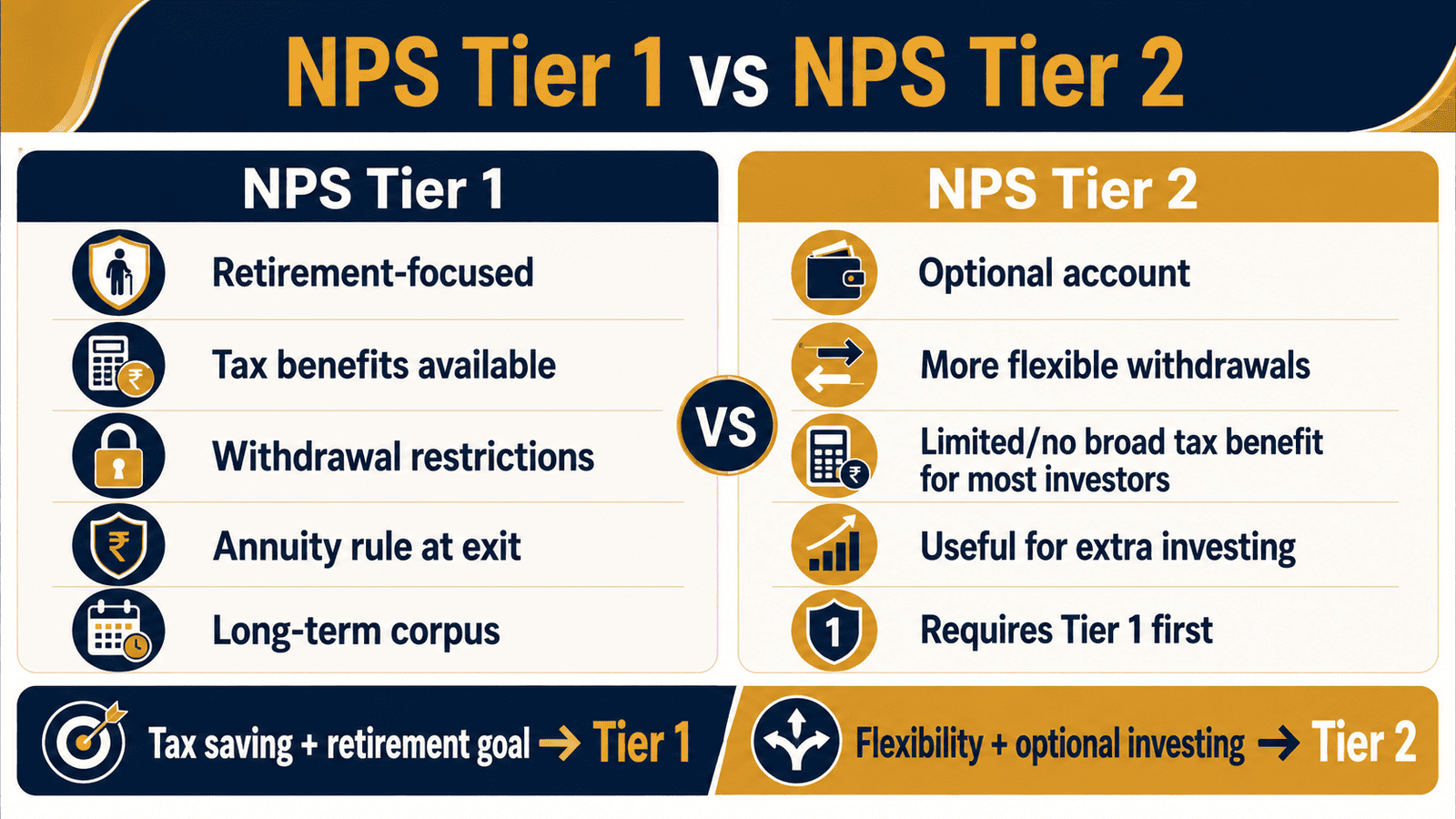
NPS Tier 1 vs Tier 2 mainly differs in purpose, tax benefit and withdrawal flexibility. Tier 1 is the main retirement account with tax benefits such as ₹50,000 under Section 80CCD(1B), while Tier 2 is optional, more liquid, and generally offers no broad tax deduction for most investors.
Key Takeaways
- NPS Tier 1 is the mandatory retirement account; Tier 2 is optional and can only be opened after an active Tier 1 account exists.
- Under the old tax regime, your own Tier 1 contribution qualifies for deduction under Section 80CCD(1) within the ₹1.5 lakh 80CCE ceiling, plus an additional ₹50,000 under Section 80CCD(1B) — a total possible deduction of up to ₹2 lakh from NPS Tier 1 alone.
- NPS Tier 2 contributions carry no income tax deduction for most private sector salaried employees; it is not a tax-saving account for the majority of NPS users.
- Tier 1 withdrawal is significantly restricted before age 60 — partial withdrawals are allowed only after three years, for specific approved purposes, and limited to 25% of your own contributions.
- Tier 2 allows withdrawal of any amount at any time with no restrictions, making it function more like an investment account than a retirement vehicle.
- Under the new tax regime, own NPS contributions under 80CCD(1) and 80CCD(1B) are not deductible; only the employer’s NPS contribution under Section 80CCD(2) remains deductible in both regimes.
- NPS rules, tax deduction limits, and withdrawal conditions are regulated by PFRDA and the Income Tax Act — verify all figures at pfrda.org.in and incometax.gov.in before acting.
Comparison: NPS Tier 1 vs NPS Tier 2
| Parameter | NPS Tier 1 | NPS Tier 2 |
|---|---|---|
| Purpose | Mandatory retirement savings account | Optional investment account |
| Who can open it | Indian citizen aged 18–70 years | Only if NPS Tier 1 is active |
| Tax benefit — own contribution | Available under old regime (80CCD(1) + 80CCD(1B)) | Not available for most private sector investors |
| Tax benefit — employer contribution | Available in both regimes under 80CCD(2) | Not applicable |
| Withdrawal flexibility | Restricted — partial only after 3 years; full exit at 60 | Flexible — withdraw anytime, any amount |
| Minimum contribution | ₹500 per contribution; ₹1,000 per financial year | ₹250 per contribution; no annual minimum |
| Lock-in period | Until age 60 (subject to limited partial withdrawal rules) | No lock-in period |
| Best for | Long-term retirement and tax planning (old regime) | Optional medium-term flexibility after Tier 1 is active |
Key Facts at a Glance
| Feature | NPS Tier 1 | NPS Tier 2 |
|---|---|---|
| Account type | Mandatory retirement account | Optional investment account |
| Eligibility | Indian citizen, 18–70 years | Active Tier 1 required first |
| Own contribution tax deduction | Yes — 80CCD(1) + 80CCD(1B), old regime only | Generally no deduction (most investors) |
| Partial withdrawal rule | After 3 years; up to 25% of own contributions; specific purposes only | Anytime; any amount; no conditions |
| Normal exit at age 60 | 60% lump sum; 40% mandatory annuity purchase | Withdraw full balance; no annuity rule |
| Regulator | PFRDA — pfrda.org.in |
Verify all current rules, limits, and contribution requirements from PFRDA and NPS Trust before acting on any figure in this table.
What Is the NPS Tier 1 Account?
NPS Tier 1 is the primary account under the National Pension System — and it is not optional. Every NPS subscriber opens a Tier 1 account first. According to NPS Trust guidelines, this account is specifically designed as a long-term retirement savings vehicle, which is why PFRDA places strict conditions on when and how you can access the money.
Your contributions earn market-linked returns based on the pension fund manager and asset class you choose. Three broad options are available: equity (E), corporate bonds (C), and government securities (G). A fourth asset class for alternatives (A) exists for eligible subscribers. The account is portable — your Permanent Retirement Account Number (PRAN) stays with you regardless of employer changes or city changes.
The tax benefit under the old tax regime is the primary reason most salaried employees open Tier 1. Your own contribution is eligible for deduction under Section 80CCD(1) — up to 10% of basic salary plus dearness allowance — and this falls within the ₹1.5 lakh 80CCE ceiling shared with Section 80C and 80CCC investments. Beyond that, Section 80CCD(1B) allows an additional ₹50,000 exclusively for NPS Tier 1 contributions, over and above the ₹1.5 lakh ceiling. For most salaried employees whose EPF and home loan principal have already used up the 80C basket, this ₹50,000 under 80CCD(1B) is the single most accessible incremental tax deduction available.
If your employer also contributes to NPS, that contribution is separately deductible under Section 80CCD(2) — and unlike 80CCD(1) and 80CCD(1B), this deduction is available under both the old and new tax regime. For a detailed breakdown of how employer NPS contributions affect your CTC and in-hand salary, see employer NPS contribution, tax benefit and withdrawal rules.
The exit structure at normal retirement age (60) is different from EPF or PPF. At least 40% of the accumulated Tier 1 corpus must be used to purchase an annuity from an IRDAI-registered insurer. The remaining 60% can be withdrawn as a tax-free lump sum. This annuity requirement surprises many investors at exit — it is not optional, and it fundamentally changes how you should think about your total retirement income from NPS.
What Is the NPS Tier 2 Account?
NPS Tier 2 is a voluntary add-on available only if you already have an active Tier 1 account. You cannot open Tier 2 without Tier 1 — there is no standalone version. Unlike Tier 1, Tier 2 imposes no lock-in, no annuity obligation, and no withdrawal restrictions. You can move money in and out freely, at any time, in any amount.
That flexibility is its defining feature — and its main limitation as a retirement tool. For most private sector salaried employees, NPS Tier 2 contributions do not qualify for any income tax deduction under Section 80CCD. Putting ₹1 lakh into Tier 2 gives you zero tax relief, while the same amount in Tier 1 under Section 80CCD(1B) saves approximately ₹15,600 in tax at the 30% bracket under the old regime.
There is a limited exception: central government employees can claim a deduction on Tier 2 contributions under Section 80C, subject to a three-year lock-in condition. If you are a private sector employee, this provision does not apply to you. Verify the current status of this provision at incometax.gov.in before assuming it is available in your case.
How the New Tax Regime Changes the NPS Calculation
Since FY 2023-24, the new tax regime has become the default for salaried employees under the Income Tax Act. This single change significantly alters the logic for NPS Tier 1 as a tax-saving tool. Under the new regime, deductions under Section 80CCD(1) and 80CCD(1B) — covering your own NPS contributions — are not available. If you file under the new regime, contributing to Tier 1 for the purpose of claiming these deductions provides no benefit.
The employer’s contribution under Section 80CCD(2) remains deductible in both regimes, making employer-contributed NPS the more powerful NPS tax lever for new-regime taxpayers. For own contributions, NPS Tier 1 still builds a retirement corpus, but without the immediate tax deduction that makes it compelling under the old regime.
Before opening NPS for tax saving, check which regime you are actually filing under. To understand the full NPS structure before comparing account types, read NPS meaning and how it works explained simply.
Real Example: Rahul in Bengaluru
Rahul, 34, is a product manager in Bengaluru earning ₹22 lakh per year. His basic salary is approximately ₹8.8 lakh annually. He already has EPF through his employer and is exploring NPS specifically for additional tax saving and retirement planning.
Under the old tax regime, Rahul’s own Tier 1 contribution qualifies for deduction under Section 80CCD(1) up to ₹88,000 — which is 10% of his ₹8.8 lakh basic. This amount falls within his ₹1.5 lakh 80CCE ceiling, shared with EPF and any other 80C investments. Separately, he can contribute ₹50,000 to Tier 1 under Section 80CCD(1B) and claim that as an additional deduction. At the 30% tax bracket, that ₹50,000 saves him approximately ₹15,600 in tax, including cess.
Now Rahul asks: should he also open Tier 2? His answer rests on a single question — does he need money before retirement that he cannot reach from Tier 1? If not, there is no strong tax reason to activate Tier 2. If he wants a parallel flexible investment account, Tier 2 is one option, but a mutual fund or liquid fund may serve the same purpose with more fund choice and transparency. His employer’s NPS contribution, if any, adds a further dimension — see employer NPS contribution and tax benefit for how that affects his total NPS picture.
How to Calculate NPS Tier 1 Tax Benefit
Total NPS Tier 1 deduction (old regime) = 80CCD(1) contribution [within ₹1.5L 80CCE ceiling] + 80CCD(1B) contribution [up to ₹50,000 additional]
Using Rahul’s figures as an illustration:
| Deduction Section | Applicable Amount (Rahul) | Tax Saved — 30% Bracket + Cess |
|---|---|---|
| Section 80CCD(1) — own NPS Tier 1 contribution | Up to ₹88,000 (within ₹1.5L 80CCE, shared with EPF etc.) | Shared with other 80C investments |
| Section 80CCD(1B) — additional NPS Tier 1 contribution | ₹50,000 (fully over and above ₹1.5L ceiling) | Approximately ₹15,600 |
| Section 80CCD(2) — employer’s NPS contribution | Up to 10% of basic salary (no monetary ceiling) | Available in both old and new regime |
The ₹50,000 under Section 80CCD(1B) is typically the most actionable NPS deduction for salaried employees — because it sits outside the congested ₹1.5 lakh 80C basket that EPF and home loan principal have usually already filled. These figures are illustrative only; actual tax savings depend on your total income, other deductions, and the regime you file under. Use the NPS calculator to estimate how your Tier 1 contributions could grow into a retirement corpus over time — keeping in mind that NPS returns are market-linked and not guaranteed.
How to Decide What’s Right for You
You are filing under the old tax regime and your ₹1.5 lakh 80C bucket is already used by EPF and home loan — contribute ₹50,000 to NPS Tier 1 under Section 80CCD(1B) for the additional deduction. It is the cleanest incremental tax saving available.
Your employer contributes to NPS — Tier 1 benefits you regardless of whether you are in the old or new regime, because the employer’s Section 80CCD(2) deduction applies to both. This makes employer-contributed NPS more universally valuable than own-contributed NPS.
You are in the new tax regime and your employer does not contribute to NPS — Tier 1 still builds a retirement corpus, but you will not receive any immediate income tax deduction on your own contributions. Evaluate it as a retirement investment, not a tax tool.
You already have an active Tier 1, want a flexible parallel investment account, and clearly understand that your own Tier 2 contributions carry no tax deduction — Tier 2 is a reasonable option for medium-term money that you may need before retirement.
You need the money within the next three to five years — do not put it in NPS Tier 1. The withdrawal restrictions will trap it. Keep this money in an instrument you can actually access.
You do not have a clear reason to lock money until retirement — do not open NPS Tier 1 expecting it to double as a short-term savings tool. Before committing, compare it against PPF and EPF for long-term corpus building. See NPS vs PPF vs EPF: which builds the best retirement corpus for a structured side-by-side.
Common Mistakes to Avoid
Assuming Tier 2 gives the same tax benefit as Tier 1
Many first-time NPS subscribers open Tier 2 expecting the 80CCD deductions they associate with NPS in general.
For most private sector employees, Tier 2 contributions offer zero income tax deduction. A ₹50,000 contribution to Tier 2 saves nothing on tax; the same ₹50,000 in Tier 1 under Section 80CCD(1B) saves approximately ₹15,600 at the 30% bracket under the old regime. That is a ₹15,600 difference on a single decision.
Understand which deductions apply before splitting contributions between tiers.
Putting money in Tier 1 without understanding withdrawal restrictions
NPS Tier 1 is not a flexible savings account. Before the age of 60, your contributions are restricted — partial withdrawals require a minimum three-year holding period, must be for specific approved purposes, and are capped at 25% of your own total contributions.
If you contribute ₹3 lakh to Tier 1 expecting to draw on it in 18 months for a house renovation, you will find it entirely inaccessible. That mistake cannot be reversed once the contribution is made.
Map your liquidity needs across a two-to-five-year horizon before deciding how much to lock in Tier 1.
Ignoring the new tax regime impact on NPS deductions
Under the new tax regime, your own NPS contributions under 80CCD(1) and 80CCD(1B) provide no deduction. Salaried employees who switch to the new regime mid-year — or who file under it without checking — sometimes contribute to Tier 1 expecting a tax benefit that simply does not apply. Use the income tax calculator for FY 2025-26 to check whether the old regime with NPS deductions actually results in lower tax than the new regime before committing contributions.
Confusing lump sum withdrawal with full exit at age 60
At normal exit, NPS Tier 1 does not allow full lump sum withdrawal. At least 40% of the accumulated corpus must be used to purchase an annuity from an IRDAI-registered insurer. Only the remaining 60% comes to you as a lump sum. Many investors assume NPS works like PPF — full withdrawal at maturity — and are unprepared for the annuity requirement.
Build this into your retirement income planning; the annuity provides monthly income but reduces the upfront lump sum you receive.
Treating the tax deduction as a return on investment
The ₹50,000 Section 80CCD(1B) deduction reduces your taxable income. It does not guarantee any return on your NPS investment. Your actual corpus at retirement depends on contribution duration, fund performance, and asset allocation — none of which are fixed or predictable.
Keep the tax benefit and investment return as two separate questions in your planning.
Not saving contribution records before filing returns
If you plan to claim NPS deductions, you need the annual contribution statement from your CRA (Central Recordkeeping Agency) as documentary support. Many salaried employees assume this is automatically filed by their employer. It is not always the case. Log into your CRA account and download your statement before the return filing deadline each year.
When This May Not Be the Right Choice
NPS Tier 1 may not suit you if you have not yet built a basic emergency fund covering at least six months of expenses. Contributing to a locked retirement account while carrying that gap creates a liquidity risk — any unexpected expense will have nowhere to go. Similarly, if you are carrying high-interest debt such as a personal loan or credit card balance, the net wealth impact of locking money in NPS while paying 18–24% interest elsewhere is negative regardless of the tax benefit.
NPS Tier 2 adds little specific value if your primary goal is tax saving — it simply does not deliver the deduction most investors expect. And if you need full control over withdrawal timing, asset choice, and short-term access, NPS in either tier is not designed for that purpose. Mutual funds, liquid funds, or PPF may serve the goal better depending on your time horizon.
If any of these apply to your situation, it may be worth exploring alternatives before committing.
Official Rules and Where to Verify
NPS Tier 1 and Tier 2 are regulated by PFRDA, and tax treatment is governed by the Income Tax Act as amended through each Union Budget. Blog articles — including this one — may become outdated after Budget announcements or PFRDA circular updates. The following official sources should always be your first stop before contributing, withdrawing, or claiming deductions:
- PFRDA — pfrda.org.in (exit rules, withdrawal rules, partial withdrawal conditions, annuity requirements)
- NPS Trust — npstrust.org.in (account features, contribution limits, fund options, CRA services)
- Income Tax Department — incometax.gov.in (Section 80CCD(1), 80CCD(1B), 80CCD(2) deduction eligibility, tax regime rules)
Rules, limits, and rates on this topic can change with each Budget or regulatory update. Always verify current figures directly from the official source before making any financial decision.
Expert Tips
- Understand Tier 1 fully before activating Tier 2. Most salaried employees do not need Tier 2 at all — opening it without a clear purpose adds account complexity without adding any tax benefit for private sector investors.
- If you are in the old tax regime and your ₹1.5 lakh 80C limit is fully used by EPF and home loan principal, the ₹50,000 Section 80CCD(1B) deduction is the most direct additional tax saving available under NPS — no competing investment needed, no shared ceiling to navigate.
- Check your tax regime before treating NPS as a tax-saving instrument. Under the new tax regime, only your employer’s NPS contribution under Section 80CCD(2) produces a deduction. Your own contributions provide no deduction and reduce your liquidity without the compensating tax relief.
- Keep emergency money out of NPS Tier 1. Once contributed, accessing that amount before retirement is subject to significant restrictions. This is not a liquid account, and treating it as one will cost you access to money you may genuinely need.
- Review your pension fund manager and asset allocation at least once a year. The default auto choice may not match your risk profile as you move through different career stages. Equity-heavy allocation may be appropriate at 30; it may need rebalancing at 55.
- Save your annual NPS contribution statement from your CRA login before the return filing deadline each year. Do not assume your employer’s Form 16 captures all NPS contribution detail automatically.
Frequently Asked Questions
Is NPS Tier 2 mandatory?
No. NPS Tier 2 is entirely optional. You can use NPS throughout your working career without ever opening a Tier 2 account. The only requirement to open Tier 2 is that your NPS Tier 1 account must already be active.
Can I open NPS Tier 2 without Tier 1?
No. PFRDA rules require an active Tier 1 account as a prerequisite for opening Tier 2. There is no standalone Tier 2 account. If your Tier 1 account becomes dormant, verify with your CRA whether Tier 2 operations are affected.
Does NPS Tier 2 give any tax benefit?
For most private sector salaried employees, NPS Tier 2 contributions do not qualify for any income tax deduction under current rules. Central government employees have a separate provision under Section 80C with a three-year lock-in condition on Tier 2 contributions, subject to current rules. If you are a private sector employee, do not assume any Tier 2 tax deduction applies — verify at incometax.gov.in before contributing.
Can I withdraw from NPS Tier 1 anytime?
No. NPS Tier 1 withdrawals before age 60 are restricted. Partial withdrawals are permitted only after three years of account opening, for specific approved purposes such as children’s higher education or marriage, purchase of a primary home, or treatment of specified critical illnesses — and only up to 25% of your own contributions. At normal exit (age 60), 60% can be withdrawn as a lump sum and 40% must be used to purchase an annuity. Verify the current approved purposes and withdrawal limits at pfrda.org.in before initiating any withdrawal.
Which is better for tax saving: NPS Tier 1 or Tier 2?
NPS Tier 1 is clearly better for tax saving under the old tax regime — it qualifies for deductions under both Section 80CCD(1) and 80CCD(1B). NPS Tier 2 offers no comparable deduction for most investors. Under the new tax regime, own contributions to neither tier provide a deduction; only the employer’s Tier 1 contribution under Section 80CCD(2) remains deductible.
Is NPS Tier 2 better than mutual funds?
NPS Tier 2 invests in the same fund options as Tier 1 and may carry slightly lower expense ratios than some mutual funds, but it offers fewer fund choices and less flexibility compared to a full mutual fund platform. Whether Tier 2 suits you better than mutual funds depends on cost sensitivity, fund choice needs, and whether you already have Tier 1 active. For most investors who want flexible medium-term investing, a mutual fund platform offers more options and comparable or better transparency.
What happens if I stop contributing to NPS Tier 1?
If your Tier 1 account falls below the minimum annual contribution of ₹1,000 in a financial year, the account becomes dormant. Your existing balance stays invested — the account is not closed and you do not lose the corpus. You can reactivate the account by paying the shortfall amount plus applicable penalties as specified by PFRDA. Verify the current reactivation process and penalty structure at npstrust.org.in.
Can I transfer money from NPS Tier 2 to Tier 1?
Yes. PFRDA rules permit one-way transfer from Tier 2 to Tier 1. You cannot transfer from Tier 1 to Tier 2 — the restriction reinforces Tier 1’s retirement-first purpose and prevents circumventing the lock-in by cycling money to Tier 2. Verify the current transfer process through your CRA login or at npstrust.org.in.
Is the NPS Tier 1 lump sum withdrawal at 60 tax-free?
The 60% lump sum withdrawal from NPS Tier 1 at normal exit (age 60) is currently exempt from income tax under the rules applicable as of the knowledge date of this article. The annuity income you receive subsequently is taxable in the year of receipt. Tax treatment of NPS withdrawals is subject to current rules — verify at incometax.gov.in before exit planning.
Final Verdict
NPS Tier 1 is the right starting point for any NPS subscriber. It is the mandatory retirement account, and under the old tax regime, the ₹50,000 Section 80CCD(1B) deduction makes it one of the most accessible incremental tax benefits once the ₹1.5 lakh 80C bucket is full. If you are in the new tax regime and your employer contributes to NPS, the Section 80CCD(2) deduction still works in your favour regardless of regime choice.
NPS Tier 2 is optional and mainly useful if you want a flexible investment account within the NPS ecosystem after Tier 1 is active — not as a tax-saving instrument for most private sector employees. Do not build a retirement plan around tax saving alone; the annuity exit rule, corpus projections, and long-term corpus adequacy matter far more. See retirement planning India: how much corpus do you really need for a structured approach to working out your actual retirement number. Always verify the latest rules from official sources or consult a qualified professional before making any financial decision.
This article is for educational purposes only and should not be treated as personalised financial, tax, investment, insurance, or legal advice. Tax rules, interest rates, regulatory limits, and product features can change with each Budget or policy update. Please verify current rules from official government sources or consult a qualified and registered professional before making any financial decision.

Suresh Nair writes about Indian government savings schemes, post office schemes, and conservative long-term savings options. His content is especially useful for families, parents, senior citizens, and low-risk savers who want to understand scheme rules before depositing money.
He covers topics such as Public Provident Fund, Sukanya Samriddhi Yojana, Senior Citizens’ Savings Scheme, National Savings Certificate, Kisan Vikas Patra, Post Office Monthly Income Scheme, National Pension System, post office fixed deposits, post office recurring deposits, child savings schemes, senior citizen savings options, maturity rules, withdrawal rules, lock-in periods, and tax treatment.
Suresh’s writing is mature, rule-focused, and cautious. He explains eligibility, deposit limits, tenure, interest calculation, tax benefits, withdrawal conditions, and practical use cases in simple language. His articles are useful for readers who prefer safety and predictable rules over high-risk investments. Since government scheme interest rates, deposit limits, lock-in rules, and tax treatment may change through official notifications, readers should verify current details from India Post, PFRDA, Income Tax Department, or relevant government sources before investing.