

Every April, millions of salaried employees in India open an appraisal letter, feel briefly richer, and then discover three months later that nothing has materially changed. The hike arrived. The wealth did not. A salary increase strategy is what separates employees who build on every raise from those who absorb it into lifestyle and start over.
This guide walks through the full cycle in plain terms: how to negotiate your hike before the budget is finalised, how to calculate what the increase actually adds to your bank account every month, and how to allocate that extra cash before it is quietly claimed by rising expenses.
The difference between a CTC headline and real in-hand impact is often wider than employees expect. Understanding that gap — and acting on it before your spending habits adjust — is where a salary increase strategy actually begins.
Quick Answer: Salary Increase Strategy
A salary increase strategy is a plan to negotiate your hike, calculate the real monthly in-hand increase, and allocate it before lifestyle inflation absorbs it. For example, if your in-hand salary rises by ₹12,000 per month, you may split it between emergency savings, SIP step-up, debt repayment, and planned spending.
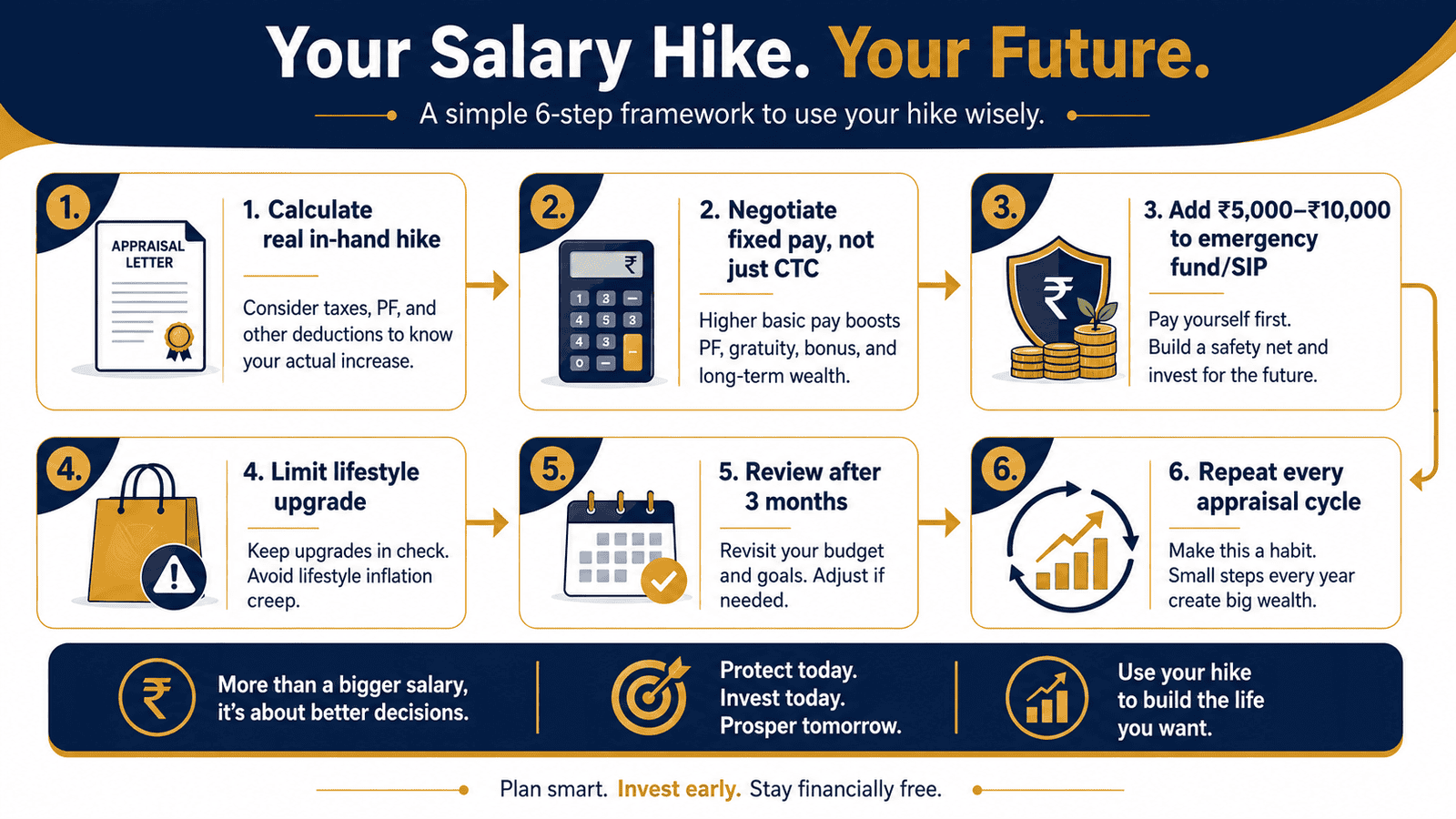
Key Takeaways
- Negotiate on fixed pay and role value — a ₹2 lakh hike locked into fixed pay adds more predictable monthly cash than the same amount shifted into variable pay or annual bonus.
- A 15% CTC hike at ₹14 lakh adds roughly ₹10,000–₹14,000 per month in-hand, not the full proportional increase you might expect from the headline percentage alone.
- Allocate the extra cash in writing before your first revised salary credit arrives — lifestyle habits expand the moment income does, and reversing them is far harder than preventing them.
- Direct at least 50% of the monthly hike toward financial priorities — emergency fund, SIP step-up, or debt repayment — before adding any lifestyle expenses.
- Step up your SIP by even ₹1,000–₹2,000 per month after each hike; small annual increases started in your late twenties and sustained over 15 years can build a meaningfully larger corpus over time.
- Review your hike allocation after three salary cycles — your income, expenses, and goals will shift, and your plan should too.
Key Facts at a Glance
| Factor | What It Means | Why It Matters |
|---|---|---|
| CTC hike vs in-hand hike | CTC includes employer PF contribution, gratuity, and benefits; in-hand is what reaches your bank account | A 15% CTC raise may add only 8–11% to monthly take-home, depending on your salary structure |
| Fixed pay vs variable pay | Fixed pay is guaranteed every month; variable pay depends on individual or company performance targets | Never base SIP step-ups or new EMI commitments on variable pay alone |
| Immediate use of hike | Emergency fund top-up, high-interest debt repayment | Removing financial risk before building wealth is the more stable sequence |
| Long-term use of hike | SIP step-up, goal-based saving, insurance gap cover | Compounding works best when contributions increase consistently over time |
| Mistake to avoid | New loan or EMI commitment immediately after appraisal | Locks future flexibility before you confirm actual revised monthly cash flow |
Before planning your allocation, it helps to understand how your salary is actually structured. Our CTC and in-hand pay guide explains why a higher package does not always fully reflect in your monthly bank credit.
Your Salary Increase Strategy: A Step-by-Step Framework
A salary increase strategy has three distinct phases: what you do before the appraisal, what you negotiate during the discussion, and how you act in the first 30 days after the hike is confirmed. Most employees skip the first and rush the third. All three matter.
Phase 1 — Build Your Case Before the Appraisal Cycle Closes
Appraisal budgets are typically decided at a company level before individual discussions happen. By the time your manager sits across from you, the range has often already been set. Your job is to ensure you are positioned for the higher end of that range — and to make a case for exceeding it if your contributions justify it.
Start four to six weeks before your expected review date. Document your achievements in specific, outcome-oriented language. Not “managed the project” but “delivered the product module two weeks ahead of schedule, contributing to a client renewal worth ₹38 lakh.” Numbers make value concrete. Descriptions keep it vague.
Research salary benchmarks for your role, experience level, and city. Look at industry surveys, recruiter conversations, and peer data where available. If the market rate for your profile in Bengaluru has moved to ₹17–₹19 lakh, that benchmark belongs in your preparation — stated as a reference, not as an ultimatum.
Review your current CTC structure before the conversation: basic salary, HRA, special allowances, variable pay, PF contributions. If your basic is a small fraction of your total CTC, a percentage hike on the same structure may give you less in-hand than it appears. Knowing this lets you ask the right questions during negotiation.
Phase 2 — What to Ask During Salary Negotiation
Most employees anchor salary discussions on a percentage number. That is often the least useful thing to focus on. Before accepting any figure, ask these questions:
- Is this hike applied to basic salary, gross salary, or total CTC?
- What portion is fixed monthly pay and what portion is variable or performance-linked?
- Does this revision include a change in job level or designation, or is it a salary increment only?
- When is the next formal review cycle?
A ₹15,000 per month increase in fixed pay is more useful for planning than a ₹20,000 increase in variable pay that depends on quarterly performance. If your variable component is large, ask whether any portion can be shifted into fixed pay during the revision. Some employers will accommodate this request when it is raised specifically.
Salary negotiation works best when it is specific and evidence-based. “Based on my contributions this year and the market benchmarks I have researched, I was hoping to discuss a revised fixed pay of ₹X” is more effective than a general request for a better percentage. The ask should be confident, not aggressive — rooted in what you have delivered, not what you feel entitled to.
Also clarify: bonus structure, review frequency, and any planned promotions. A 10% hike in a year where a promotion was due is different from a 10% hike in a stable year. Understanding the full picture helps you evaluate what was actually offered.
Phase 3 — Calculate the Real Monthly In-Hand Increase
Once the hike is confirmed, your first task is to find out what it means in rupees per month — not on the CTC letter, but on your salary slip.
Request your revised salary slip as soon as it is available, or ask HR for a revised salary break-up. The slip shows you revised basic salary, revised HRA, any changes in allowances, revised employee PF deduction, and the resulting net take-home. All of these change when CTC changes.
Use a take-home salary estimate tool to model the revised in-hand in advance, if the actual slip is not yet available. Subtract your old monthly in-hand from the new figure. That result — not the CTC percentage — is your actual monthly hike. It is the number you plan with.
This matters because your revised basic determines your revised PF deduction, your revised gross determines TDS recalculation, and any structural changes in your salary package can shift the final number further. The CTC headline is for comparison. The in-hand number is for decisions.
Phase 4 — Allocate the Hike Before Lifestyle Adjusts
The highest-risk window is the first four to six weeks after your revised salary arrives. Expenses tend to expand to fill available income without any single large decision — slightly better restaurants, a new subscription, an EMI for something you were already considering, a rental upgrade at the next renewal. Each feels justified. Together, they absorb the hike.
The fix is to write down your allocation plan before the first revised salary credit. Decide how much goes to emergency fund, how much to SIP increase, how much to debt, and how much to intentional lifestyle spending. Then automate the savings and investment portions on or before the day the revised salary arrives. What is automated does not get spent. What is left after automating is available for life — consciously, not passively.
Salary Structures Vary — Plan for Your Specific Situation
Salary structures differ significantly by employer, industry, city, and role level. The framework described here is a general guide for salaried employees in India. Your actual in-hand calculation will depend on your specific CTC break-up, employer PF policies, tax-saving investments already declared, and city-based HRA rules. Always use your own salary slip as the primary input for planning, not a general percentage estimate.
Real Example: Aarav’s Appraisal in Bengaluru
Aarav, 29, is a software engineer in Bengaluru earning ₹14 lakh CTC. After a strong performance year, he receives a 15% CTC hike — taking his revised CTC to ₹16.1 lakh. His old monthly in-hand was ₹88,000. His revised in-hand, after accounting for higher PF deductions on the increased basic and a slightly revised TDS, comes to approximately ₹1,00,500 per month.
Real monthly hike: ₹12,500.
Before the revised salary arrives, Aarav reviews his position. His emergency fund stands at ₹1.8 lakh — enough for about two months of expenses. His six-month target is ₹5.4 lakh. He has a car loan EMI of ₹3,200 remaining for 14 months at a low interest rate — no urgency to prepay. No credit card debt.
Aarav’s allocation of ₹12,500 per month:
- Emergency fund top-up: ₹4,000 (to reach ₹5.4 lakh target in approximately nine months)
- SIP step-up: ₹5,000 (added to his existing ₹8,000 per month SIP, with mutual fund market risk acknowledged)
- Annual holiday goal saving: ₹1,500
- Intentional lifestyle upgrade: ₹2,000
Aarav sets up the ₹5,000 SIP step-up and the ₹4,000 recurring transfer on the same day his revised salary arrives. The remaining ₹3,500 is available for daily life — deliberately, not by default. The key insight: the hike never felt like a windfall because it was never freely available to drift into unplanned expenses.
How to Calculate Your Real Monthly Hike
Real Monthly Hike = New Monthly In-Hand Salary − Old Monthly In-Hand Salary
This is a behavioural planning calculation, not a tax calculation. It uses the net amount that actually reaches your bank account — not CTC, not gross salary, not cost to company including employer benefits.
Step 1: Note your old monthly in-hand salary from the last salary slip before the hike took effect.
Step 2: Confirm or estimate your new monthly in-hand using a revised salary slip or a salary increment impact calculator.
Step 3: Subtract to find the real extra monthly cash available for allocation.
Step 4: Divide the result across saving, investing, debt repayment, and intentional spending — in that priority order based on your current situation.
Step 5: Review after three salary cycles to check whether the allocation is holding and adjust if your situation has changed.
| Scenario | Key Inputs | Suggested Monthly Use of Hike |
|---|---|---|
| Emergency fund incomplete | Buffer covers under 3 months of expenses | 60–70% toward cash buffer until target is reached |
| High-interest debt active | Credit card or personal loan at 15%+ interest | 50–60% toward accelerated repayment before investing |
| Buffer full, no high-cost debt | Stable income, basic life and health insurance in place | 60–70% toward SIP step-up or goal-based savings |
| Balanced starting position | 3–4 months buffer, low-cost debt only | 40% invest, 30% save, 30% intentional lifestyle |
Comparison: Four Ways Employees Use Salary Hikes
| Approach | May Work When | Key Risk |
|---|---|---|
| Spend-first | Emergency fund is full, all goals are on track, no outstanding debt | High Lifestyle lock-in; spending habits are very difficult to reverse once established |
| Save-first (cash buffer) | Emergency fund is weak or missing; income or job recently changed | Medium Opportunity cost if buffer is already at six or more months of expenses |
| Invest-first (SIP step-up) | Buffer is full, income is stable, investment goals have a long horizon | Medium Market risk applies; mutual fund returns are not guaranteed |
| Balanced allocation | Buffer at 3+ months, some financial goals defined, low or no high-cost debt | Lower Requires consistent discipline but spreads risk across multiple priorities |
How to Decide What’s Right for You
The right allocation depends on where you currently stand financially — not on what sounds responsible in general. Use these if/then statements as a starting framework, not as prescriptive rules.
Your emergency fund covers fewer than three months of monthly expenses — THEN direct 60–70% of your monthly hike toward building the buffer before anything else. A missing emergency fund is what forces people to break long-term investments at the wrong time.
You have active credit card debt or a personal loan at 15% or higher interest — THEN accelerate repayment with 50–60% of the hike before stepping up any new investments.
Your buffer is in place and you have no high-cost debt — THEN this is the right moment to increase your SIP or start a goal-based savings plan with the monthly hike amount.
A major planned expense — wedding, home down payment, family medical cost — is likely within the next 12–18 months — THEN direct the hike toward that specific goal rather than locking it into a long-horizon SIP.
You want to upgrade your lifestyle after a hike — THEN cap that upgrade intentionally at 20–30% of the monthly hike, and let the rest go toward financial priorities. A deliberate lifestyle upgrade is fine. Passive lifestyle drift is not.
You do not yet have basic term life or health insurance in place — stepping up SIP investments while carrying an insurance gap means your wealth-building plan has no floor if something goes wrong.
For a practical framework on dividing your total monthly income — not just the hike — read our guide on the monthly budget framework that Indian salaried families can follow in practice.
Common Mistakes to Avoid
Treating the CTC Hike as Your In-Hand Hike
The most common mistake is planning around the percentage increase on CTC rather than the actual in-hand difference.
A 15% hike on a ₹14 lakh CTC is ₹2.1 lakh annually on paper. After revised PF deductions on the higher basic salary and TDS adjustments, the real monthly in-hand increase may be ₹10,000–₹14,000 — meaningfully less than a naive percentage calculation suggests.
Always work from your revised salary slip numbers before committing to any allocation plan. The slip is the truth; the CTC letter is the headline.
Upgrading Lifestyle Before Calculating the Real Hike
Many employees mentally earmark lifestyle upgrades before the first revised salary arrives — a better flat, an upgraded vehicle, improved dining habits.
If the assumed hike was ₹18,000 per month but the real in-hand increase turns out to be ₹11,500, the lifestyle decisions made in that gap create a permanent cost increase that is very difficult to reverse.
Calculate the real in-hand number first. Decide lifestyle changes after. Not simultaneously, and not on assumption.
Taking a New EMI Immediately After the Appraisal Letter
Appraisal letters trigger a well-known behavioural pattern: it feels like exactly the right moment to buy the car, upgrade the phone plan, or take the appliance on easy EMI.
A new EMI locks future monthly cash flow based on an expected income before you have confirmed that income on your slip. If variable pay does not arrive as expected or a medical expense appears, that EMI cannot be paused.
Wait at least two revised salary cycles before committing to any new fixed monthly liability after a hike.
Ignoring Variable Pay Uncertainty
If a significant portion of your revised CTC is in variable pay, treat it as uncertain income. Variable components depend on individual performance ratings, team outcomes, and company financials — all of which can shift.
Plan your monthly hike allocation only on the fixed pay increase. Treat variable pay as a bonus when it actually arrives — not as a guaranteed monthly income stream that supports recurring commitments.
Not Increasing Savings or Investments at All
Some employees allocate the entire hike to lifestyle without a single rupee going toward savings or investments. Three years later, their income is noticeably higher but their financial position is largely unchanged.
Even a ₹2,000 per month SIP step-up is a meaningful first move. The habit of investing from every hike matters as much as the initial amount — perhaps more so in the early years.
Falling into Lifestyle Inflation Gradually
Lifestyle inflation does not usually happen through one big decision. It happens through slightly better restaurants, one new subscription, a more expensive flat at the next renewal, and a few purchases brought forward because income feels comfortable.
Each individual choice is defensible. Together, they can absorb every hike across an entire career. To understand and break this pattern specifically in the Indian context, read our guide on controlling lifestyle inflation.
When This May Not Be the Right Choice
Directing every rupee of a salary hike toward investments is often recommended — but it is not always the right first move.
If your emergency fund does not cover at least three months of essential monthly expenses, building that buffer takes priority over any new investment. A missing emergency fund is what forces people to liquidate long-term investments at the wrong time when unexpected costs arise.
If your job stability is uncertain — a company restructuring, a project ending, or a contract role without guaranteed renewal — this is not the moment to commit to new SIP mandates based on current income levels.
If you carry active high-interest debt at 15% or above, the return from accelerating repayment is both certain and immediate — which is rarely the case with new investments in the short term.
If a known major expense is approaching within the next 12 months — a medical procedure, a family event, a home renovation — earmark the hike for that purpose rather than locking it into an illiquid or long-horizon investment.
If any of these apply to your situation, it may be worth exploring alternatives before committing.
Official Rules and Where to Verify
Rules around income tax, PF contributions, salary structures, and financial products change regularly with each Union Budget and regulatory update. The sources below are the primary reference points for verifying current figures before making any decisions:
- Income Tax Department — incometax.gov.in: Current tax slabs, deduction limits under Sections 80C and 80D, TDS rules, and income tax filing information.
- EPFO — epfindia.gov.in: Employee and employer PF contribution rules, withdrawal eligibility, UAN-related processes, and EPF interest rate updates.
- SEBI — sebi.gov.in: Investor education resources, mutual fund regulations, and verification of registered investment advisers and intermediaries.
- RBI — rbi.org.in: Banking regulations, benchmark lending rate guidelines, and information on financial products offered by regulated lenders.
Rules, limits, and rates on this topic can change with each Budget or regulatory update. Always verify current figures directly from the official source before making any financial decision.
Expert Tips
- Negotiate before the appraisal decision is communicated — once a number has been offered and verbally accepted, reopening it is significantly harder. The effective window is during the review cycle, not after the letter arrives.
- If your variable pay component is 20% or more of your CTC, specifically ask during the revision whether any of it can be converted into fixed pay. Fixed pay gives you a reliable planning base; variable pay is bonus-class income and should be treated accordingly.
- Automate your SIP step-up and savings transfer before the first revised salary arrives. Set it up on the day the deposit hits your account — what is automated before spending habits adjust does not get absorbed.
- After each salary hike, consider increasing your SIP contribution by a set percentage of the monthly hike rather than a flat amount. This keeps your investment rate growing in proportion with your income. For a detailed look at how this works over time, read our guide on increasing SIP yearly.
- Treat a one-time annual bonus entirely differently from a monthly hike. Monthly hikes change your income baseline permanently; bonuses are one-time events. Use them for specific defined goals — emergency fund completion, partial loan prepayment, or a clearly named financial milestone.
- Review your term life and health insurance coverage every time your CTC increases significantly. Under-insurance is a financial risk that rising investments cannot fully offset. SEBI’s investor education resources at sebi.gov.in include guidance on finding registered financial advisers who can help match coverage to your current income.
- Salary benchmarking is not only for negotiation — it also tells you whether your career trajectory and compensation are aligned with the market. If your CTC is consistently below market for your experience, a job change may deliver a more meaningful increment than any internal appraisal cycle.
Frequently Asked Questions
How much of my salary hike should I save?
There is no universal percentage, but a common starting framework is to direct at least 50% of the monthly hike toward savings, investments, or debt repayment before allocating anything to lifestyle expenses. If your emergency fund is incomplete, that share should be higher — 60–70% — until your buffer target is met. Once priorities are covered, the remaining portion is yours to spend intentionally.
Should I invest my entire salary increase?
Not necessarily. If your emergency fund is incomplete, high-interest debt is active, or a known major expense is approaching, investing every rupee of the hike is not the optimal first move. Investing works best when your financial foundation — emergency buffer, basic insurance, no high-cost debt — is reasonably in place. Build the base before optimising for growth.
Should I negotiate CTC or in-hand salary?
Both matter, but in-hand is what you actually live on and plan with. Negotiate total CTC while specifically asking about the fixed monthly take-home component. If your CTC has a high variable proportion, ask whether any of it can be shifted to fixed pay — this directly improves your monthly cash position and gives you a more reliable number for financial planning.
Is it okay to spend part of my hike on lifestyle upgrades?
Yes — intentionally. The problem is not lifestyle spending; it is passive, unplanned lifestyle spending that absorbs the entire hike without a deliberate choice being made. Capping your lifestyle upgrade at 20–30% of the monthly hike and planning the rest allows you to enjoy your progress without eroding the financial benefit. Deliberate spending within a defined limit is healthier than either full restriction or untracked drift.
Should I repay debt or start a SIP after a hike?
It depends on the interest rate on your debt. High-interest debt — credit cards, personal loans at 15% or above — should typically be addressed before new SIP investments are started, because the interest cost likely exceeds expected investment returns in the short term. Low-interest debt — home loan, car loan at lower rates — can coexist with SIP contributions depending on your tax situation and investment horizon. When in doubt, a fee-based financial adviser can help map this for your specific numbers.
How do I avoid lifestyle inflation after a salary increase?
Automate savings and investments before lifestyle spending adjusts. Once the recurring transfers are set up, the balance available in your account naturally shapes your spending habits — rather than your gross salary credit. For a more detailed framework on identifying and breaking the pattern, read our guide on controlling lifestyle inflation in India.
What if my hike is mostly in variable pay?
Treat the variable component as uncertain income and plan your allocation only on the fixed pay increase. If the variable pay arrives, use it for one-time, clearly defined goals — completing your emergency fund, partial loan prepayment, or a specific financial milestone. Never plan recurring SIPs or new EMIs on variable income that is not guaranteed every month.
When is the best time to negotiate a salary hike?
The most effective window is before the appraisal decision is communicated — typically four to six weeks before your formal review date. Once a number has been offered, the negotiation window narrows significantly. Preparing your case early, initiating the conversation with your manager before budgets are finalised, and making a specific evidence-based ask gives you the best realistic chance of a meaningful outcome.
Final Verdict
A salary increase strategy is not about being aggressive in negotiations or obsessive about every rupee. It is about applying the same deliberateness to every hike that you applied to the work that earned it.
Negotiate based on your contributions and market benchmarks — not on a gut-feel percentage. Calculate the real monthly in-hand impact from your salary slip, not the CTC letter. Allocate the extra cash to financial priorities before lifestyle habits expand. Step up your investments with each hike, consistently, over time.
The employees who build wealth on a salaried income are not necessarily the highest earners. They are the ones who treat every appraisal cycle as both an income event and a planning event — and who act before the first revised salary credit quietly disappears into daily life.
Always verify the latest rules from official sources or consult a qualified professional before making any financial decision.
This article is for educational purposes only and should not be treated as personalised financial, tax, investment, insurance, or legal advice. Tax rules, interest rates, regulatory limits, and product features can change with each Budget or policy update. Please verify current rules from official government sources or consult a qualified and registered professional before making any financial decision.

Ishita Sharma writes about goal-based financial planning for Indian families and individuals. Her content connects saving, budgeting, investing, insurance, and debt decisions to real-life goals such as child education, marriage, retirement, home buying, emergency funds, family protection, and long-term wealth building.
She covers topics such as child education planning, marriage goal planning, retirement planning, home-buying goals, inflation-based goal estimation, monthly investment planning, savings timelines, emergency buffers, asset allocation basics, family financial milestones, and goal calculators.
Ishita’s writing is structured, thoughtful, and decision-oriented. She helps readers move from vague goals like “save more” to clearer questions such as how much may be needed, by when, what assumptions matter, and what trade-offs exist. Her articles use Indian examples, timelines, ₹ amounts, and simple planning frameworks. Her content is educational and should not be treated as personalised investment, tax, loan, or insurance advice. Since future costs, inflation, returns, product rules, and tax treatment can change, readers should verify current information before acting.