

Most people planning an MBA in India start researching colleges and entrance exams long before they look at the money. By the time admission offers arrive, the cost shock is real — and borrowing decisions get made in a hurry. If you have 5 years, you can avoid that entirely. MBA in India cost is not just the fee shown on a brochure. It includes hostel charges, food, travel, laptop, exam registration, coaching, relocation — and the EMI you will carry for years after you graduate. This article breaks down every cost bucket, shows you how to estimate your personal target, and gives you a clear planning framework for savings, loans, or a combination of both.
Quick Answer: How Much Does an MBA in India Cost?
MBA in India cost can range from under ₹2 lakh at some government/state colleges to ₹25–35 lakh at top private or premium institutes. If you have 5 years, plan for tuition, hostel, exam fees, living costs, laptop, and loan EMI before choosing a college.
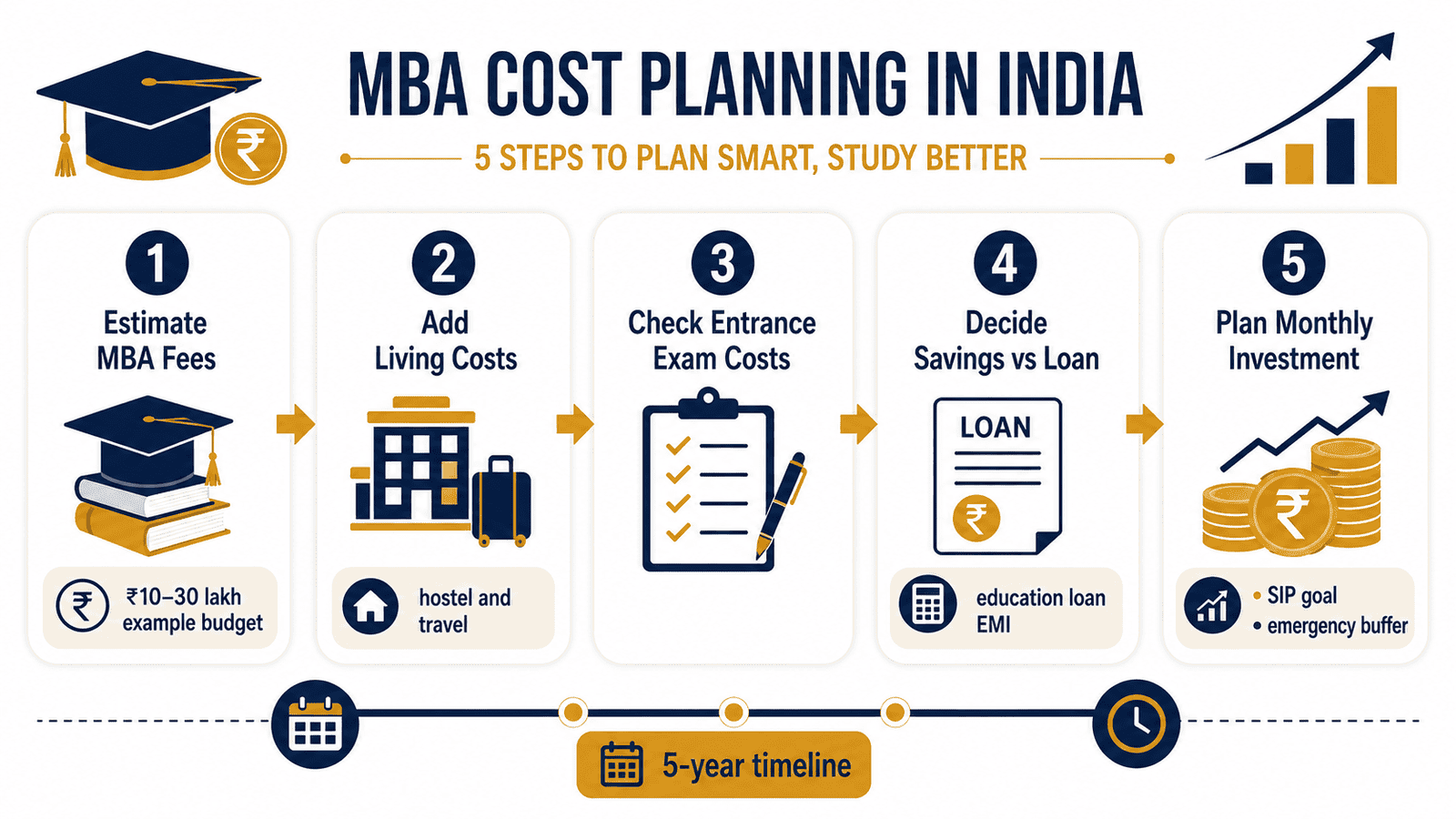
Key Takeaways
- The total MBA cost is often 40–60% higher than the tuition fee alone once you add hostel, food, travel, books, laptop, and entrance exam preparation.
- A 5-year savings plan using SIPs can build a meaningful corpus that reduces how much education loan you need — potentially saving lakhs in interest.
- Education loan interest under Section 80E is tax-deductible for up to 8 years from the start of repayment — but the principal is not deductible.
- A savings-only plan for ₹20 lakh over 5 years requires roughly ₹28,000–₹30,000 per month in a conservative instrument, or less if you use SIPs with step-up contributions.
- MBA ROI in India depends heavily on college, industry, and your role before the MBA — a ₹30 lakh programme at a low-placement college may not pay off within 5 years.
- Never use your emergency fund for MBA fees. Keep 3–6 months of expenses separate and untouched throughout the planning period.
- A hybrid plan — partial savings plus a manageable loan — works for most salaried readers who cannot save the full amount in 5 years.
Key Facts at a Glance
| Cost Bucket | Typical Range (Illustrative) | Notes |
|---|---|---|
| Tuition — Government/State | ₹1–5 lakh total | Verify on official college site before applying |
| Tuition — Private Institutes | ₹8–20 lakh total | Range is wide; check each college brochure |
| Tuition — Premium/IIM-Tier | ₹20–35 lakh total | Living and travel add more on top |
| Hostel / Accommodation | ₹80,000–₹2.5 lakh per year | Varies sharply by city and campus type |
| Food and Daily Living | ₹40,000–₹1 lakh per year | Higher in metro cities |
| Laptop, Books, Stationery | ₹50,000–₹1 lakh one-time | Laptop may be mandatory at some institutes |
| Entrance Exam + Coaching | ₹15,000–₹1.5 lakh total | Depends on number of attempts and coaching mode |
| Travel and Relocation | ₹20,000–₹80,000 | Varies by distance and programme city |
| Buffer / Contingency | 10–15% of total budget | Medical, repairs, re-attempts, fee hikes |
All figures above are illustrative and based on broadly available public information. Verify actual costs from official college fee pages, bank loan documents, and exam official websites before planning.
What “MBA in India Cost” Really Means
The fee mentioned in a college brochure is the starting point — not the full picture. Understanding each component separately is what separates a well-funded MBA plan from an underfunded one.
Tuition Is One Line Item, Not the Full Budget
Tuition fees are the largest single component, but they typically represent 55–70% of your actual total spend over the programme. The rest — hostel, food, travel, books, study materials, and miscellaneous expenses — adds up faster than most people expect. A programme with ₹18 lakh tuition may realistically cost ₹24–26 lakh all-in once you account for two years of living costs in a metro city.
Full-Time vs Executive MBA vs Online Programmes
Full-time MBA programmes require you to leave your job. That means not just paying fees — it also means two years without your current salary. For a salaried reader earning ₹85,000 per month, that is ₹20.4 lakh in foregone income over 24 months, separate from fees. This opportunity cost is real money even if it does not appear on any invoice.
Executive MBA programmes are designed for working professionals and usually allow you to continue earning while studying. They tend to cost more per year but spread costs differently. Online or blended MBAs from recognised institutions can cost significantly less, though placement outcomes vary by programme.
Why City and Campus Type Change the Numbers
Hostel accommodation on campus in a Tier 2 city may cost ₹80,000 per year all-in. A private flat near a premium Mumbai campus could cost ₹1.5–2 lakh per year just in rent and utilities. Living costs in Bengaluru, Delhi, or Mumbai run materially higher than in Indore, Jaipur, or Ahmedabad. When shortlisting colleges, always check whether on-campus accommodation is available and affordable.
Entrance Exam Costs Add Up Across Attempts
CAT, XAT, SNAP, NMAT, GMAT — most serious applicants attempt 2–4 exams across one or two application cycles. Registration fees for each exam range from ₹2,000–₹5,000 per attempt. Coaching classes, if used, can cost ₹30,000–₹1.2 lakh depending on whether you choose online self-paced, live online, or classroom formats. Factor in mock test series, books, and group discussion preparation when building your entrance exam budget.
If you are at the start of your career, the early career checklist can help you think about how an MBA goal fits into your broader money plan before you allocate savings toward any single goal.
Lost Salary: The Cost Nobody Calculates
For working professionals doing a full-time MBA, lost salary is often the largest invisible cost. Combine two years of no income with two years of fees and living costs, and the real investment becomes far larger than the brochure suggests. An executive MBA that costs more in fees but lets you keep earning can sometimes have a more favourable total cost structure, depending on your current salary level and career goals.
Real Example: Rohan’s 5-Year MBA Budget
Rohan, 27, is a software analyst in Pune earning ₹85,000 per month. He wants to do an MBA from a reputed private business school in 5 years and estimates a total target of ₹20 lakh for tuition and living costs combined. Here is how he breaks it down:
Tuition fees: ₹14 lakh (illustrative, for a mid-tier private programme). Hostel and living expenses over 2 years: ₹4 lakh. Entrance exam registration and coaching: ₹60,000. Laptop and books: ₹60,000. Buffer for fee hikes, extra exam attempts, and medical: ₹1.8 lakh. Total estimate: ₹21 lakh.
Rohan immediately realises his mental estimate of ₹15 lakh was 28% short of the realistic all-in number. He also recognises he has not yet factored in 2 years of lost salary — which at his current level would be ₹20.4 lakh more. That changes the decision calculus for a full-time vs executive MBA entirely.
These numbers are illustrative only. Replace them with figures from the official fee pages of colleges on your shortlist.
How to Calculate Your Monthly Savings Target
Monthly Savings Required = (Target Amount − Current Savings Already Earmarked) ÷ Number of Months Remaining
Using Rohan’s example with a ₹20 lakh target and 5 years (60 months) to go, and assuming he has ₹2 lakh already set aside:
Amount still to accumulate: ₹20 lakh − ₹2 lakh = ₹18 lakh. Savings-only route (no returns assumed): ₹18,00,000 ÷ 60 = ₹30,000 per month. SIP route at a conservative 8% assumed annual return: approximately ₹23,000–₹24,000 per month. Step-up SIP route (increasing by 10% annually) at 8% return: starting SIP of approximately ₹18,000–₹19,000 per month.
Mutual fund returns are market-linked and not guaranteed. The 8% figure is illustrative only. Actual returns may be higher or lower. Do not use high-risk equity funds for a goal that is 3–5 years away without understanding the risk of short-term market falls near the goal date.
Understanding how SIPs work is essential before you start: the starting SIP basics guide covers how monthly SIP investing works, and the step-up SIP plan explains how to increase your contribution every year after an annual hike — which can make a meaningful difference to your corpus over 5 years without straining your budget today.
| Scenario | Key Inputs | Monthly Saving Required |
|---|---|---|
| Savings only (no return) | ₹18 lakh target, 60 months | ₹30,000/month |
| SIP at 8% p.a. return | ₹18 lakh target, 60 months | ~₹23,500/month |
| Step-up SIP, 10% annual increase | ₹18 lakh target, 60 months, starting low | ~₹18,500/month to start |
All figures are illustrative. Use a goal-based SIP planner to calculate your own number based on actual target, timeline, and return assumptions.
Comparison: Savings-Only vs Loan-Only vs Hybrid Funding
| Funding Route | Best Suited For | Key Risk / Trade-Off |
|---|---|---|
| Savings-only | Readers with 4–6 years runway and consistent monthly surplus | Requires high monthly discipline; full amount may not be built if goal is underestimated |
| Loan-only | Readers with strong post-MBA placement confidence and low current savings | Post-MBA EMI can be significant; moratorium ends; total interest cost adds 20–40% to borrowing |
| Hybrid (savings + loan) | Most salaried readers with moderate savings capacity | Requires discipline on both fronts; reduces total loan and interest cost meaningfully |
| Family support / scholarship | Those with confirmed family contribution or merit-based aid | Uncertain; should not be the primary plan; scholarships are competitive and not guaranteed |
The step-up SIP approach using annual salary hikes is particularly useful in a hybrid plan — you lock in a base SIP today and route a portion of each future hike toward your MBA corpus, reducing how much loan you eventually need.
you have a 5-year timeline and can save ₹20,000–₹25,000 per month — THEN a hybrid approach (partial SIP savings + smaller loan at admission) is likely more manageable than full borrowing.
your post-MBA target college has consistently strong placement records and average salary data — THEN the loan EMI may be serviceable within 2–3 years of graduation; verify placement reports on the college’s official website.
your current monthly surplus after rent, EMIs, insurance premiums, and family expenses is under ₹15,000 — THEN a savings-only route for a ₹20+ lakh goal in 5 years is not realistic; plan for a combination of savings and borrowing.
you are unsure about your career direction and are considering MBA as a fallback — THEN calculate the total cost including lost salary before committing; a lower-cost certification or strategic job switch may achieve the same outcome at far less cost.
your target college charges ₹15+ lakh and you have no savings set aside today — THEN start with a monthly budget system to find your monthly surplus before estimating how much SIP to run.
you are confident about post-MBA placement and salary uplift, and your current EMI-to-income ratio is already above 40% — taking a large education loan may not be advisable without a clear repayment plan.
Common Mistakes to Avoid
Planning Only for Tuition Fees
The most common mistake is treating the tuition fee as the total MBA cost.
Living expenses, hostel, travel, books, laptop, and exam preparation can add ₹4–8 lakh to the bill depending on the city and programme. Underestimating means arriving at admission with a ₹5–6 lakh shortfall at the worst possible time.
Build your budget with all cost buckets — not just the fee brochure number.
Ignoring the Opportunity Cost of Lost Salary
Leaving a job for a full-time MBA means foregoing 24 months of salary.
For a reader earning ₹85,000 per month, that is ₹20.4 lakh in income not earned. Combined with fees and living costs, the real total commitment can exceed ₹40–45 lakh for a premium programme. Many readers do not factor this in when assessing MBA ROI.
Compare the total investment — including lost salary — against realistic post-MBA salary uplift before deciding.
Using the Emergency Fund for MBA Fees
Some readers plan to “dip into” their emergency savings if the corpus falls short at admission time.
This leaves you without a financial buffer during two years of no salary — exactly when you are most vulnerable. A medical emergency, a family need, or a fee hike during the programme can push you into expensive personal borrowing.
Keep your emergency fund target separate and untouched throughout the MBA planning and study period.
Borrowing Without Checking Post-MBA EMI Affordability
Taking a ₹15 lakh education loan without checking what the monthly EMI looks like after graduation is a common planning gap.
At a 10–12% interest rate over 7–8 years, the monthly EMI on ₹15 lakh borrowing can be ₹25,000–₹28,000. If your post-MBA starting salary is ₹80,000–₹1,00,000 per month, that EMI can consume 25–35% of take-home pay — leaving very little room for rent, insurance, and basic savings.
Calculate EMI before taking the loan, not after. Verify current education loan rates directly on the lender’s official website.
Assuming MBA Automatically Means a High Salary
MBA ROI in India varies enormously by college, industry, function, and the candidate’s pre-MBA experience.
A premium programme from a top-10 college may produce strong placement outcomes. A ₹20 lakh programme from a lesser-known college with weak placement data is a different risk profile entirely. Do not base your borrowing decision on the college’s average salary claim — read the full placement report including median salary, not just the peak figure.
Verify placement data from the official college placement report before finalising your funding plan.
Not Accounting for Entrance Exam Re-Attempts
Many candidates need 2–3 CAT attempts before cracking a target college. Each cycle adds exam fees, coaching renewal costs, and crucially — another year of planning horizon.
Budget for at least two exam cycles in your 5-year plan and adjust your target admission year accordingly. A one-year delay compresses your savings window significantly if not planned in advance.
When This May Not Be the Right Choice
A full-time MBA may not be the right financial decision in every situation. If you already carry high EMIs — home loan, car loan, or personal loan — adding an education loan on top may push your total debt service ratio to an unsustainable level. If your income is irregular or your job security is uncertain, committing to 5 years of structured savings and then 7–8 years of loan repayment adds significant financial risk.
If the colleges on your realistic shortlist have weak or unverified placement outcomes relative to their fees, the programme’s ROI may not justify the total investment. If you are broadly unhappy in your current career and see MBA as a general reset, a targeted skill certification or a strategic role change may solve the same problem at a fraction of the cost.
If funding an MBA requires liquidating long-term investments like equity mutual funds or PPF before their natural horizon, the cost of disrupting compounding may outweigh the benefit.
If any of these apply to your situation, it may be worth exploring alternatives before committing.
Official Rules and Where to Verify
MBA cost planning involves several areas where rules, rates, and charges change regularly. Always verify the following from official sources before making any financial decision:
- Education loan interest rates and terms — check directly on the official website of your chosen bank or NBFC. The Reserve Bank of India (rbi.org.in) publishes guidelines on education loan borrower protections and moratorium rules.
- Section 80E income tax deduction on education loan interest — verify the current eligibility conditions, applicable years, and any restrictions on the Income Tax Department’s official portal (incometax.gov.in). The education loan tax guide on Ridhi covers this deduction in detail, but always confirm the current rules from the official source.
- College tuition fees and hostel charges — verify exclusively from the official fee page of each college and the admission brochure for the year you are applying.
- Entrance exam registration fees — check the official websites of CAT (iimcat.ac.in), XAT, GMAT, SNAP, and NMAT for current cycle fees before registration.
- Mutual fund investment regulations and risk disclosures — SEBI (sebi.gov.in) is the authoritative regulator for mutual fund investments in India.
Rules, limits, and rates on this topic can change with each Budget or regulatory update. Always verify current figures directly from the official source before making any financial decision.
Expert Tips
- Build three cost scenarios before you start saving. Create a budget, realistic, and stretch estimate by picking one college from each tier on your shortlist. This tells you whether your 5-year plan needs ₹15 lakh, ₹22 lakh, or ₹30 lakh — and your monthly SIP target changes sharply between those numbers.
- Route annual bonuses directly to your MBA corpus. If you receive a year-end or performance bonus, move it to a dedicated liquid fund or short-duration debt fund earmarked for MBA fees. Bonuses not assigned a purpose tend to get absorbed into lifestyle spending within a month.
- Open a separate savings or investment account for the MBA goal. Mixing MBA savings with your regular account makes it easy to unconsciously spend them. A dedicated account with auto-debit SIP removes friction and keeps the corpus visible.
- As your goal gets closer to 3 years away, shift to lower-risk instruments. SEBI guidelines consistently remind investors that equity mutual funds are long-term instruments. For a goal that is 3 years or less away, moving a portion to short-duration debt funds or recurring deposits reduces the risk of a market correction wiping out part of your corpus near admission time.
- Recheck your target cost every year. Fees at most private business schools increase 5–10% annually. What costs ₹18 lakh today may cost ₹23–25 lakh in 5 years. Build an annual review into your plan to adjust your SIP or savings rate.
- Do not count scholarships or family contributions as confirmed until they are confirmed. Plan your corpus assuming you will fund it yourself. Any scholarship or family help that arrives is a bonus — not a planning assumption.
Frequently Asked Questions
How much does an MBA cost in India overall?
MBA in India cost varies widely. Government and state universities can charge under ₹5 lakh for the full programme. Mid-tier private institutes typically range from ₹8–18 lakh. Premium institutions, including top IIMs and elite private schools, can charge ₹20–35 lakh in tuition alone. Add hostel, food, books, and travel and the total all-in cost rises further. Always verify the current fee from the official college website for the admission year you are targeting.
Is an education loan better than saving for an MBA?
Neither is universally better — it depends on your timeline, current savings rate, income stability, and target college’s placement outcomes. Saving reduces total borrowing and interest cost. A loan preserves liquidity but creates post-MBA EMI pressure. A hybrid approach — saving a meaningful portion now and borrowing the balance — works for most salaried readers. Assess your EMI affordability before deciding how much to borrow.
How much should I save every month for MBA in 5 years?
If your total target is ₹20 lakh and you already have ₹2 lakh set aside, you need to accumulate ₹18 lakh in 60 months. A savings-only route requires approximately ₹30,000 per month. A conservative SIP at 8% per year requires approximately ₹23,500 per month. A step-up SIP starting at ₹18,500 per month and increasing 10% each year can reach the same target. Use a goal-based SIP planner to calculate your exact number. Market-linked returns are not guaranteed.
What costs do people usually miss when planning MBA fees?
The most commonly missed costs are: hostel or rent for 2 years, daily food and utilities, entrance exam registration and coaching fees across multiple attempts, laptop and academic software, relocation expenses, and a contingency buffer for fee hikes or delayed admission. Together these can add ₹4–8 lakh to what the brochure fee shows.
Can I claim a tax benefit on MBA education loan interest?
Yes — under Section 80E of the Income Tax Act, interest paid on an education loan taken for higher studies is deductible from taxable income. There is no upper cap on the deduction amount, and it is available for up to 8 consecutive assessment years starting from the year repayment begins. The deduction applies to interest only — not principal repayment. Verify current eligibility conditions from the Income Tax Department’s official website (incometax.gov.in) before filing.
Is MBA ROI worth it in India?
MBA ROI in India is highly programme-specific. A top-tier programme with strong placements in a high-paying sector — consulting, investment banking, FMCG — can generate returns that justify a ₹25–30 lakh investment within 4–6 years. A mid-tier programme in the same cost range with weaker placement outcomes may take far longer to pay off, if at all. Assess ROI using median salary from official placement reports, total all-in cost including living and lost salary, and your specific career goal — not peak salary figures from marketing materials.
What is the moratorium period in an education loan and how does it work?
The moratorium period in education loans is a repayment holiday — typically the duration of the course plus 6–12 months after completion — during which you are not required to make EMI payments. Interest continues to accrue during this period, however, and is added to the outstanding principal. By the time you start repaying, the total loan amount is higher than what you originally borrowed. Factor this into your total cost estimate when planning how much to borrow. Verify current moratorium terms with your specific lender.
What happens if I need more than one attempt to clear entrance exams?
Multiple exam attempts are common — plan for at least two CAT cycles in your 5-year roadmap. Each additional cycle adds exam fees, coaching renewal, and one year to your planning horizon. If you push admission back by a year, your savings window compresses or your monthly savings target increases. Budget ₹50,000–₹1.5 lakh for two rounds of exam preparation including coaching, mock tests, and registration across multiple exams.
Should I invest aggressively in equity for a 5-year MBA goal?
A 5-year horizon is on the shorter end for equity investing. Equity mutual funds can deliver good long-term returns but can also fall 20–30% in a bad year. If your MBA goal is 5 years away and fixed, a sudden market fall in year 4 could materially reduce your corpus right before you need it. A balanced approach — equity funds for the first 2–3 years, gradually shifting to hybrid or short-duration debt funds as the goal approaches — is more prudent. SEBI recommends understanding your risk profile before investing in market-linked products.
Can I use my PPF or EPF savings for MBA fees?
PPF allows partial withdrawal from the 7th financial year onward under specific conditions; premature closure has restrictions. EPF withdrawals for education are allowed under specific circumstances after 7 years of service, subject to EPFO rules. Using these accounts for MBA fees disrupts long-term compounding and retirement savings. It is generally advisable to build a separate dedicated corpus rather than raiding retirement savings — unless the programme cost and expected return clearly justify the trade-off. Verify current withdrawal rules from the official EPFO website and PPF scheme guidelines.
Final Verdict
MBA in India cost is a multi-layered number — not the single fee printed in a brochure. The total investment, including tuition, living, entrance preparation, and lost salary for a full-time programme, can easily be 1.5 to 2 times what most readers initially estimate. The good news is that a 5-year planning window gives you meaningful choices: a savings-only route, a hybrid funding plan, or a structured combination of SIP investing and manageable borrowing. Any of these is more financially sound than arriving at admission without a plan and borrowing everything under pressure. Start by building a realistic total cost estimate using the actual fee page of colleges on your shortlist — then run your numbers. Always verify the latest rules from official sources or consult a qualified professional before making any financial decision.
This article is for educational purposes only and should not be treated as personalised financial, tax, investment, insurance, or legal advice. Tax rules, interest rates, regulatory limits, and product features can change with each Budget or policy update. Please verify current rules from official government sources or consult a qualified and registered professional before making any financial decision.

Ishita Sharma writes about goal-based financial planning for Indian families and individuals. Her content connects saving, budgeting, investing, insurance, and debt decisions to real-life goals such as child education, marriage, retirement, home buying, emergency funds, family protection, and long-term wealth building.
She covers topics such as child education planning, marriage goal planning, retirement planning, home-buying goals, inflation-based goal estimation, monthly investment planning, savings timelines, emergency buffers, asset allocation basics, family financial milestones, and goal calculators.
Ishita’s writing is structured, thoughtful, and decision-oriented. She helps readers move from vague goals like “save more” to clearer questions such as how much may be needed, by when, what assumptions matter, and what trade-offs exist. Her articles use Indian examples, timelines, ₹ amounts, and simple planning frameworks. Her content is educational and should not be treated as personalised investment, tax, loan, or insurance advice. Since future costs, inflation, returns, product rules, and tax treatment can change, readers should verify current information before acting.