

Moving out from your parents’ home is not just a change of address. The day you sign a rent agreement, pay a deposit, and start budgeting for your own groceries, you step into a different relationship with money — one where every rupee has a job and no one is quietly covering the shortfall. Most young salaried professionals underestimate what this shift actually costs. They plan for rent. They forget the deposit, the electricity bill, the insurance gap, and the uncomfortable question of how much to send home every month. Financial separation from parents is not about cutting family ties — it is about building a structure that lets you support yourself and your family without chaos.
This article gives you a practical, sequenced Indian checklist: from your first-month cash needs to how to set a fair family support amount without draining your savings.
Quick Answer: Financial Separation from Parents
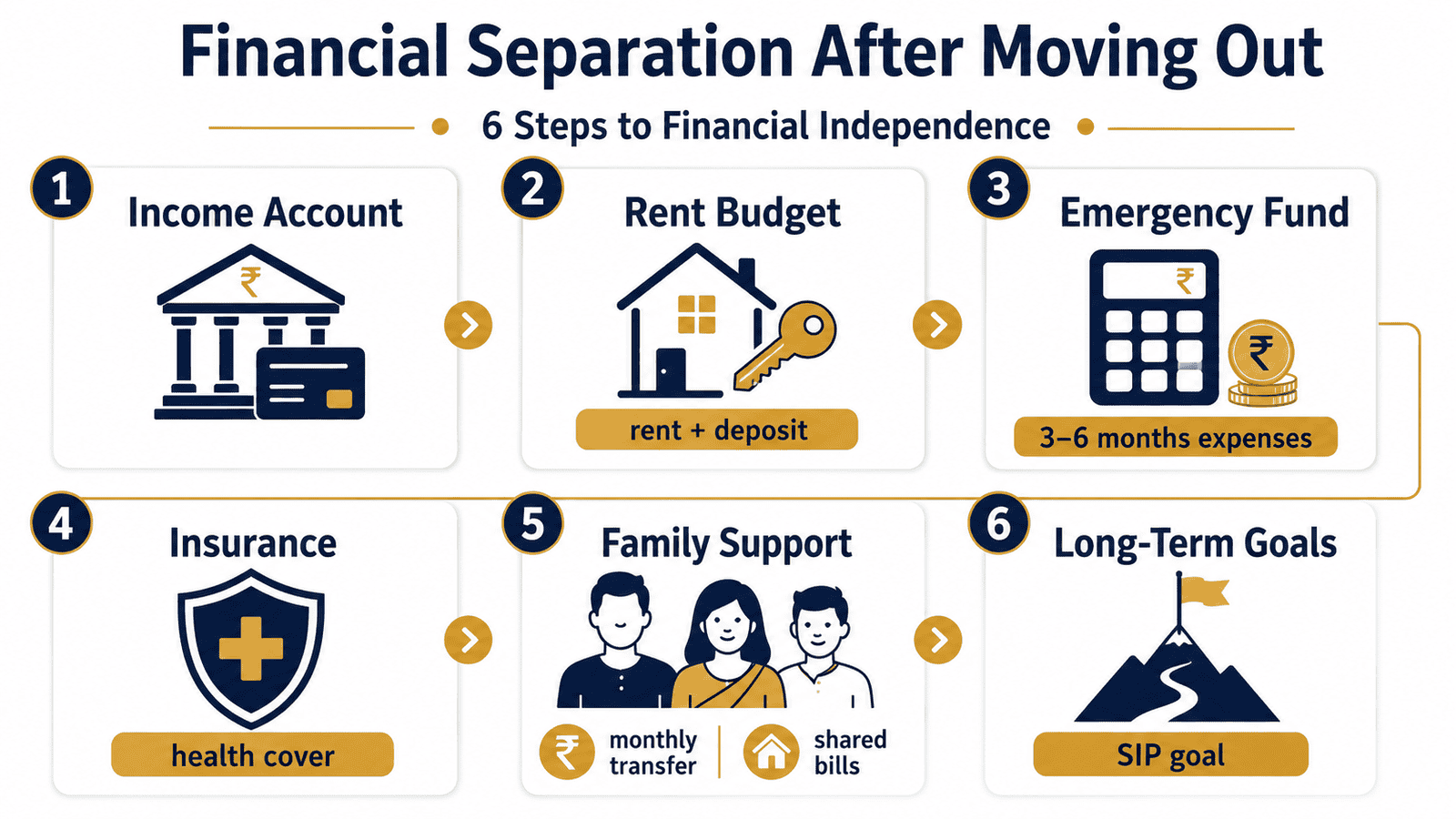
Financial separation from parents means taking responsibility for your own rent, bills, savings, insurance and long-term goals while still handling family support thoughtfully. After moving out, start with a basic budget, keep at least 3–6 months of essential expenses as an emergency fund, separate bank accounts, review health insurance and automate savings.
Key Takeaways
- Moving out creates both a one-time cash demand (deposit, setup) and a permanent increase in monthly fixed expenses — budget for both before you shift.
- Your emergency fund should reach 3–6 months of essential expenses before you start investing aggressively; on a ₹72,000 in-hand salary with ₹45,000 monthly costs, that means ₹1.35–2.70 lakh set aside first.
- Health insurance must be reviewed the month you move out — employer group cover often has limits on pre-existing conditions, and parent floater policies may not extend to you after a certain age.
- Family support should be a fixed monthly amount you decide in advance, not an open-ended transfer that changes every time there is a family need.
- Lifestyle inflation — eating out more, spending on convenience, upgrading devices — is the biggest silent risk in the first 12 months after moving out.
- Nominee details on your bank accounts, PF, and any insurance policies should be updated immediately after you set up independent accounts.
- Financial separation is a process of 6–12 months, not a single dramatic event — your first three months will likely have higher costs and lower savings than the steady state.
Key Facts at a Glance
| Money Area | What Changes After Moving Out | Action Step |
|---|---|---|
| Rent and deposit | Deposit is typically 2–3 months’ rent; monthly rent becomes your largest fixed cost | Budget deposit separately from monthly expenses before moving |
| Food, utilities, commute | All costs now fall on you; no shared household subsidy | Track actual spend for 30 days and set a realistic cap |
| Emergency fund | You no longer have a parental safety net; 3–6 months of expenses is the minimum | Build emergency fund before increasing investment amount |
| Health insurance | Parent floater may no longer cover you; employer cover may have gaps | Review policy, check age limit, and buy individual cover if needed |
| Family support | You choose what you send home; no default arrangement | Set a fixed monthly transfer amount that your budget can sustain |
| Savings and investing | No one else is saving for your goals; automation prevents neglect | Set up auto-debit for SIP or RD within the first month |
What Financial Separation from Parents Actually Means
In most Indian families, money does not come with clear boundaries. Parents pay for groceries. You contribute when you feel like it. A health emergency dips into whoever’s account has money. This is not dysfunction — it is how most households manage. But when you move out, that informal arrangement stops working. Every cost lands in your account. Every gap is your problem to solve.
Financial separation from parents does not mean cutting them off financially. It means separating your personal cash flow from the family cash flow — so you can plan accurately, avoid debt, and still support family when you genuinely can.
Start With Your In-Hand Salary, Not Your CTC
Many young professionals make the mistake of budgeting from their CTC. Your cost-to-company figure includes PF contributions, gratuity provisions, and sometimes insurance — none of which hits your bank account each month. Build every plan from your in-hand salary: the amount actually credited after all deductions. If your CTC is ₹10 lakh per year but your monthly in-hand is ₹72,000, your budget ceiling is ₹72,000 — not ₹83,333.
Once you know your in-hand number, divide it into four honest buckets:
- Fixed costs — rent, EMI if any, insurance premium, subscriptions you will never cancel
- Variable costs — food, groceries, commute, medical, clothes, entertainment
- Savings and investments — emergency fund top-up, SIP, RD, PF top-up
- Family support — a fixed monthly transfer to parents or siblings
The discipline is in keeping these buckets separate in your head — and ideally in your accounts. When your fixed costs bucket is full, you know what is left. There is no ambiguity. Follow a step-by-step monthly budget guide for salaried Indians to set this up before you move out, not after.
Why Written Clarity Prevents Family Tension
One of the most underrated steps after moving out is having a direct conversation about money with your parents — and writing down your own plan. Not a formal contract. Just a note to yourself that says: “I will send ₹8,000 home every month by the 5th. That is the number I can sustain without using a credit card.” When the amount is fixed, it removes emotional unpredictability from both sides. Your parents know what to expect. You know what you have left.
Dignity works both ways. You do not owe your parents silence about your financial limits. And they do not owe you a perfect reaction. But clarity prevents the slow resentment that builds when either side is guessing.
Real Example: Aarav in Pune
Aarav, 26, is a software analyst in Pune earning ₹72,000 per month after tax. He recently moved into a shared flat with one flatmate. Here is how his first-month budget looked, with numbers that are illustrative and city-dependent:
One-time setup costs (Month 1 only): Rent deposit ₹30,000 (2 months’ rent at ₹15,000), basic household items ₹8,000, gas connection ₹2,000. Total one-time cost: approximately ₹40,000.
Monthly recurring costs: Rent ₹15,000 (shared), electricity and water ₹1,500, groceries and cooking ₹5,000, eating out and food delivery ₹4,000, commute ₹3,000, mobile and internet ₹800, subscriptions ₹500, personal care and miscellaneous ₹2,000. Total fixed and variable costs: ₹31,800.
Family support: ₹8,000 per month, transferred on the 5th.
Savings allocation: Emergency fund top-up ₹10,000, SIP ₹10,000. Total savings: ₹20,000.
Total: ₹31,800 + ₹8,000 + ₹20,000 = ₹59,800 — leaving ₹12,200 as a buffer in Month 1 to recover the ₹40,000 setup cost over 3–4 months. Aarav deliberately kept his SIP lower for the first 3 months while he built the emergency fund. After Month 4, he planned to increase his monthly SIP by ₹5,000. If you are managing money after your first job in India, the same principle applies: stabilise before you optimise.
These numbers are illustrative. Rent in Mumbai or Bengaluru can be significantly higher; smaller cities may cost less. Adjust the model to your actual in-hand salary and city.
How to Calculate Moving-Out Readiness
Monthly Essential Expenses = Rent + Utilities + Food + Commute + Insurance Premium + Family Support
3-Month Emergency Fund = Monthly Essential Expenses × 3
6-Month Emergency Fund = Monthly Essential Expenses × 6
First-Month Cash Requirement = Rent Deposit + One-Time Setup Costs + Month 1 Expenses
Using Aarav’s numbers: monthly essential expenses of ₹45,000 (₹31,800 costs + ₹8,000 family support + ₹5,200 in insurance and miscellaneous). His 3-month emergency fund target: ₹1,35,000. His 6-month target: ₹2,70,000. His first-month cash requirement before moving: ₹40,000 deposit + setup + ₹31,800 = roughly ₹72,000 available in liquid form before signing the lease.
If you do not have this first-month amount without using a personal loan or credit card, it is worth delaying the move by one or two pay cycles. Starting independent life with fresh debt is one of the hardest holes to climb out of. Use the emergency fund calculator to find your specific target based on your monthly costs.
| Scenario | Monthly Essential Expenses | 3-Month Emergency Fund Target |
|---|---|---|
| Tier-2 city, shared flat | ₹30,000 | ₹90,000 |
| Tier-1 city, shared flat | ₹50,000 | ₹1,50,000 |
| Tier-1 city, solo flat | ₹70,000 | ₹2,10,000 |
Comparison: Living With Parents vs Moving Out
| Financial Parameter | Living With Parents | Moving Out |
|---|---|---|
| Rent and utilities | Nil or minimal | ₹10,000–₹30,000+ per month |
| Food costs | Shared or absorbed | Full personal responsibility |
| Health insurance | May be on parent floater | Needs individual review |
| Emergency safety net | Parental backup available | Self-funded; 3–6 months needed |
| Family contribution pressure | Informal and variable | Can be fixed and planned |
| Lifestyle spending control | Natural checks from family | Full personal discipline required |
| Savings potential | Higher due to lower costs | Lower initially; improves with planning |
How to Decide What’s Right for You
You have 3 months of essential expenses saved in liquid form and your monthly salary comfortably covers rent, bills, family support, and at least ₹5,000 in savings — you are financially ready to move out.
You are on probation or in the first 6 months of a new job with variable pay — wait until your income is stable before committing to a rent agreement and deposit.
You have existing EMIs or personal loan repayments that consume more than 30% of your in-hand salary — moving out now will likely push you into credit card dependency within 2–3 months.
Your employer health insurance covers you adequately and you are below 25 — verify whether your parents’ floater policy still includes you; if not, budget ₹6,000–₹15,000 per year for an individual policy before moving.
Your family has a medical or caregiving situation that requires regular financial support — plan the support amount in advance; do not move out assuming the amount will stay small.
You have already built a 3-month emergency fund and have stable income — work towards building a 6-month emergency fund before cutting back savings to fund lifestyle upgrades after moving out.
You are not moving out for financial reasons but purely for lifestyle reasons, and your savings are under ₹50,000 — this is not a financially sound moment to move. Delay by 3–6 months, accumulate the deposit and setup amount, and revisit.
Common Mistakes to Avoid
Budgeting Only for Rent and Forgetting Utilities
Rent is the obvious cost. Electricity, water, gas, WiFi, and maintenance charges are not.
A ₹15,000-per-month flat can easily cost ₹18,000–₹20,000 per month once utilities are added. First-month electricity bills in summer can shock a new tenant. Budget ₹1,500–₹2,500 per month for utilities in shared accommodation and ₹2,500–₹4,000 solo — then adjust after your first bill cycle.
Check your rental agreement for maintenance charges before signing. Some societies charge ₹2,000–₹5,000 per month separately.
Funding Setup Costs With a Credit Card or Personal Loan
A deposit of ₹30,000, furniture of ₹15,000, and a gas connection of ₹2,000 add up to ₹47,000 before your first month starts.
Funding this with a personal loan at 14–18% interest or revolving credit card debt means you are paying a premium on your independence before you have even started building savings. Setup costs should be funded from savings — not from borrowing.
If you do not have this amount saved, delay the move by one or two salary cycles.
Sending Variable Family Support Without Checking Your Own Cash Flow
An unplanned ₹5,000 extra sent home in a tight month can mean skipping your SIP or going into overdraft.
Emotional requests for money are hard to refuse — and most families do not intend to create financial stress. But an informal arrangement means you never know what next month looks like. Fix the monthly transfer amount. Communicate it clearly. Any additional support beyond that is an active decision, not a default.
Ignoring Health Insurance After Moving Out
Many young adults assume employer group health cover is sufficient. It often is not — coverage limits may be low, pre-existing conditions may have waiting periods, and the policy ends the day you resign.
According to IRDAI guidelines, health insurance policies vary significantly in their scope, sub-limits, and exclusions. Review your employer policy carefully. If the sum insured is below ₹5 lakh or your city’s hospitalisation costs are high, consider a top-up or individual plan. Understand what health insurance covers and what it excludes before deciding whether your current cover is enough.
Investing Before Building an Emergency Fund
Starting a ₹10,000 SIP sounds responsible. But if a medical bill or job gap hits and your emergency fund is zero, you will either break the SIP or borrow — both of which cost you more than the SIP earned.
Build at least ₹1 lakh in a liquid savings account or liquid mutual fund before starting an aggressive SIP. Then invest. The sequence matters more than the amount.
Lifestyle Inflation in the First 12 Months
Freedom feels like Swiggy every night, a gym membership, and a new phone on EMI.
Each upgrade is individually affordable. Collectively, they can consume ₹8,000–₹15,000 per month in expenses that were not in your original budget. Track variable spending for the first 3 months with a simple note or app. You will likely find 2–3 items that cost more than expected and can be trimmed without reducing quality of life.
Not Updating Nominees After Opening Independent Accounts
Your salary account, PF account, and any insurance policy should have a nominee. Most people leave this blank or list a parent without reviewing it after moving out.
If your financial situation changes — you are engaged, married, or supporting a sibling — your nominee details should reflect your actual wishes. This takes 10 minutes online for most banks and the EPFO portal.
When This May Not Be the Right Choice
Moving out is not the right financial decision for everyone at every point in their career. Consider waiting if:
You are on probation or in a new job with variable pay. Signing a 12-month rent agreement before your income is stable adds significant financial pressure. Most landlords require 2–3 months’ deposit upfront.
You carry existing debt. If your EMI or personal loan repayments already consume 30–40% of your in-hand salary, adding rent will leave almost nothing for savings or emergency reserves.
Your family has a medical or caregiving dependency on you. Full financial separation becomes very difficult if you are the primary support for a parent’s treatment or a sibling’s education. A joint account arrangement for family expenses may be more practical than a clean separation in these situations.
Your savings are under one month of projected expenses. Moving out with less than ₹30,000–₹50,000 in liquid savings for most Indian cities means the first crisis — a medical bill, a delayed salary, a repair — will require borrowing.
If any of these apply to your situation, it may be worth exploring alternatives before committing.
Official Rules and Where to Verify
Several money decisions after moving out connect to official regulations. Verify current rules directly from these sources before acting:
- RBI (rbi.org.in) — for banking customer rights, account rules, and any guidance on bank transfers and nominee-related matters.
- IRDAI (irdai.gov.in) — for health and life insurance policy terms, portability rights, and consumer protection guidelines. Insurance premiums, coverage limits, and exclusions vary by insurer and policy.
- EPFO (epfindia.gov.in) — for PF account management, UAN, and nomination updates. Your PF account follows you between jobs; keep your UAN details updated.
- Income Tax Department (incometax.gov.in) — for tax treatment of income, deductions, and any rules around family transfers or gifts that may apply to your situation.
- SEBI (sebi.gov.in) — for rules around mutual fund investments, SEBI-registered advisors, and investor protection norms if you begin investing after settling into independent living.
Rules, limits, and rates on this topic can change with each Budget or regulatory update. Always verify current figures directly from the official source before making any financial decision.
Expert Tips
- Run a 30-day trial budget before you move. For one full month while still at home, track every rupee as if you were already paying rent, utilities, groceries, and family support. You will discover gaps you never expected — and you can fix them before they become a cash crisis.
- Automate your three most important transfers within Week 1 after salary credit. Set up auto-debit for rent or rent contribution, your savings SIP or RD, and the family support transfer. What leaves your account automatically does not get spent on impulse.
- Fix your family support amount before you move, not after. The conversation is easier when you are not yet under financial pressure. Tell your parents: “I will transfer ₹X on the 5th of every month. I will let you know if anything changes.” It removes ambiguity for both sides.
- Keep a moving-out folder — digital or physical. Rent agreement, deposit receipt, electricity account number, gas connection proof, insurance policy documents, PAN, Aadhaar, and employer offer letter. You will need at least one of these within the first 90 days of moving out. Finding them under pressure wastes time and money.
- Review your budget at 90 days, not after Month 1. Your first month will have setup costs, adjustment spending, and over-caution. Your second month will be more realistic. Your third month shows you the actual pattern. Make budget revisions based on Month 3 data, not Month 1 stress.
- Do not count your PF as savings you can touch. Your PF balance is growing each month — but it is locked for retirement or qualifying events. Your actual liquid savings are what is in your bank account and liquid funds. Build those separately.
- If you are supporting parents financially, check whether it qualifies for any tax benefit. Certain medical expenses for dependent parents may qualify for deductions under the Income Tax Act. Verify current rules at incometax.gov.in and consult a registered tax professional if your amounts are significant.
Frequently Asked Questions
How much salary is enough to move out in India?
There is no fixed threshold, but a rough rule: your rent should not exceed 30–35% of your in-hand monthly salary, and you should have at least 2–3 months of total projected expenses saved before signing a lease. On a ₹50,000 in-hand salary in a Tier-1 city with shared accommodation, this is tight but possible. On ₹30,000, it is very difficult unless you have a very low-cost living arrangement.
Should I send money to parents every month after moving out?
This is a personal and family decision — not a financial formula. If your parents are financially dependent or have limited income, a fixed monthly transfer makes sense. If they are financially comfortable, you may choose a smaller amount or support specific needs. What matters financially is that the amount is fixed, affordable, and does not prevent you from building an emergency fund or paying for your own insurance. An open-ended arrangement where the amount varies with emotional pressure is unsustainable.
Should I invest before building an emergency fund?
No. Build your emergency fund first. If a job loss, health issue, or urgent expense hits before your emergency fund is in place, you will either break your investments at a loss or go into debt. Both outcomes are worse than delaying your SIP by 4–6 months. Once your emergency fund reaches 3 months of essential expenses, begin investing and grow both in parallel.
Do I need separate health insurance if my employer covers me?
Employer group health insurance is a good starting point, but it has three key risks: the policy ends if you resign or are laid off; coverage limits may be too low for your city’s hospitalisation costs; and some plans have sub-limits on room rent or procedures. If your employer covers less than ₹5 lakh or has significant exclusions, buying an individual policy or top-up plan is worth considering. Verify your current employer policy terms before deciding.
Should I keep a joint account with parents after moving out?
A joint account is useful if you are managing shared family expenses — for example, parents’ medical bills or a sibling’s fees. It is not necessary if your finances are fully independent. A joint account means both account holders can operate it, which can complicate your own cash-flow planning. If you use one for family transfers, keep it separate from your primary salary account.
What is the first thing I should do financially after moving out?
Write down your monthly in-hand salary and then list every recurring cost you now own: rent, utilities, food, commute, insurance premium, family support. Check if the total leaves enough for at least ₹5,000–₹10,000 in savings. If it does not, something in the cost list needs to be smaller before you sign the lease. This exercise — which takes 20 minutes — prevents most of the financial stress that hits new renters in Month 2 and 3.
Can my parents claim me as a dependent for tax purposes once I move out?
Tax rules on family dependencies are specific and require verification. If your parents are paying for significant costs on your behalf, or if you are claiming deductions related to family medical expenses, consult the Income Tax Department website at incometax.gov.in or a registered tax professional to understand the current rules applicable to your situation.
Is it fine to use a credit card for the initial deposit and setup costs?
It is strongly not advisable. Deposit and setup costs are large one-time amounts — typically ₹40,000–₹80,000. Carrying this on a credit card at 36–42% annualised interest while also paying rent and building savings is a very difficult financial hole to exit. If you cannot fund the deposit from savings, delay the move. Use a credit card only for everyday expenses you can clear in full by the due date each month.
What if I cannot afford family support and my own expenses at the same time?
Be honest about it — with yourself first, and then with your family if possible. Sending money you cannot afford while going into debt or skipping your own insurance is not sustainable support; it is a delayed crisis. If your income genuinely cannot cover both, a smaller fixed amount that you can actually sustain is better than a larger amount you will miss in 3 months. Your financial stability also protects your family in the long run.
How do I handle the rent deposit if my savings are not enough?
Delay the move by one or two salary cycles and save the deposit amount specifically. Alternatively, some landlords accept the deposit in two parts — discuss this before signing. Borrowing from a trusted family member with a clear repayment plan is less damaging than a personal loan at high interest. What you should avoid is entering into a rental commitment and funding the deposit through a loan or credit card.
Final Verdict
Financial separation from parents is one of the most significant money transitions a young salaried person goes through — and it is a process, not a single event. The core sequence is not complicated: know your in-hand salary, build a budget that honestly accounts for all your costs including family support, build a 3-month emergency fund before investing aggressively, review your health insurance immediately, and automate your savings transfers early. Moving out on borrowed money or with no savings buffer creates the kind of stress that undoes both your finances and your family relationships. Do it when your numbers support it — not just when the apartment looks good. Always verify the latest rules from official sources or consult a qualified professional before making any financial decision.
This article is for educational purposes only and should not be treated as personalised financial, tax, investment, insurance, or legal advice. Tax rules, interest rates, regulatory limits, and product features can change with each Budget or policy update. Please verify current rules from official government sources or consult a qualified and registered professional before making any financial decision.

Ishita Sharma writes about goal-based financial planning for Indian families and individuals. Her content connects saving, budgeting, investing, insurance, and debt decisions to real-life goals such as child education, marriage, retirement, home buying, emergency funds, family protection, and long-term wealth building.
She covers topics such as child education planning, marriage goal planning, retirement planning, home-buying goals, inflation-based goal estimation, monthly investment planning, savings timelines, emergency buffers, asset allocation basics, family financial milestones, and goal calculators.
Ishita’s writing is structured, thoughtful, and decision-oriented. She helps readers move from vague goals like “save more” to clearer questions such as how much may be needed, by when, what assumptions matter, and what trade-offs exist. Her articles use Indian examples, timelines, ₹ amounts, and simple planning frameworks. Her content is educational and should not be treated as personalised investment, tax, loan, or insurance advice. Since future costs, inflation, returns, product rules, and tax treatment can change, readers should verify current information before acting.