
Your first salary credit is one of the best feelings you will ever have. Then, three weeks later, you check your bank balance — and wonder where it all went.
This is not a willpower problem. It is a systems problem. Most first-job earners in India receive no one to tell them: what to do with their salary, in what order, and how much to set aside for what. Rent, food, family support, commute, subscriptions, social spending, and sudden expenses all compete for the same limited pot of money.
The good news: you do not need a large salary to build a strong financial foundation. You need a practical sequence — and you need to start it early, even imperfectly. This article gives you exactly that: how to plan finances after your first job in India, step by step, without jargon or product pushing.
Quick Answer: How to Plan Finances After First Job in India
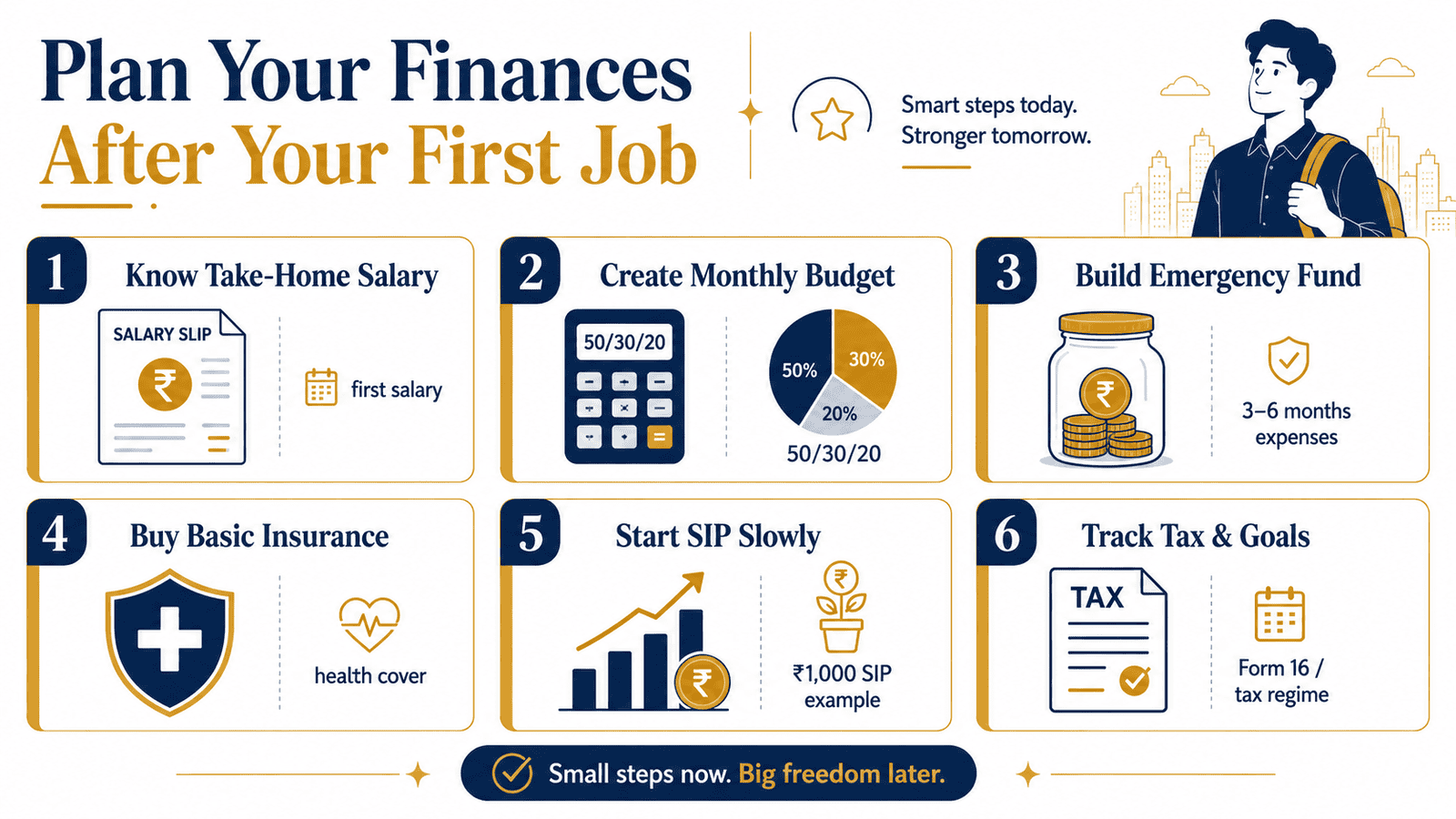
How to plan finances after first job in India starts with knowing your real take-home salary, setting a simple monthly budget, building a 3–6 month emergency fund, buying basic health and term insurance if needed, and starting small goal-based investments like SIPs only after essential protection is in place.
Key Takeaways
- Always plan from your actual monthly bank credit — not your CTC or gross salary. Your take-home after EPF, tax, and deductions can be ₹8,000–₹15,000 less than you expected.
- Build at least 3 months of essential expenses as an emergency fund before starting aggressive investing — this prevents broken SIPs and credit-card debt when surprises hit.
- Health insurance should not be delayed just because your employer provides cover — employer policies end when you leave the job, and individual cover is cheaper to buy young.
- Term insurance is protection for dependents, not a wealth-creation tool — if no one depends on your income yet, it may not be your first priority.
- A ₹500 or ₹1,000 SIP started consistently beats a ₹5,000 SIP started two years later — the habit matters more than the amount in your first year.
- Lifestyle inflation — upgrading your phone, rent, and subscriptions within the first three months — is the single fastest way to erase your savings potential at this stage.
- Your first salary is also your first tax event: choose old or new tax regime carefully, because getting it wrong costs you money for an entire financial year.
Key Facts at a Glance
| Planning Area | What to Do | Why It Matters |
|---|---|---|
| Salary Understanding | Read salary slip; note net pay, EPF, and tax deducted | Your real budget starts from bank credit, not CTC |
| Monthly Budget | Split into needs, wants, family support, and savings | Without a split, spending fills every rupee available |
| Emergency Fund | Build 3–6 months of essential expenses in a liquid account | Prevents loans and broken investments during setbacks |
| Health Insurance | Check employer cover; consider personal policy if needed | Employer cover ends when the job ends |
| Term Insurance | Consider only if you have dependents relying on your income | Protects family income, not investment returns |
| SIP / Investing | Start small after emergency fund is partially built | Consistency over amount in the early years |
| Tax Awareness | Choose tax regime at job start; review Form 16 annually | Wrong regime can cost ₹5,000–₹30,000+ in a year |
| Review Cycle | Track expenses monthly; review goals and tax annually | Small corrections early prevent large gaps later |
Your Complete First-Job Finance Plan: Step by Step
Step 1: Understand What You Actually Earn
The number in your offer letter is your CTC — Cost to Company. This is not what you will receive in your bank account. Before you plan anything, you need to know your net take-home salary: what actually gets credited after all deductions.
Deductions typically include your EPF contribution (usually 12% of basic salary, as governed by EPFO guidelines at epfindia.gov.in), income tax (TDS deducted based on your projected annual income and tax regime), professional tax (varies by state, usually ₹150–₹200 per month), and any deductions for employer insurance premiums or canteen charges.
For example, a CTC of ₹6 lakh per annum can translate to a monthly take-home of ₹42,000–₹44,000 depending on your salary structure, city, and employer. Some CTC packages include variable pay, which you may not receive every month. Read your first salary breakup carefully before deciding anything.
Step 2: Build a Monthly Budget Before Spending
The most expensive mistake new earners make is spending first and saving whatever is left. That remainder is usually zero. Flip the sequence: decide your budget on paper before your salary hits your account.
Divide your take-home into four buckets:
- Fixed needs: Rent, EMIs if any, commute, groceries, utility bills
- Flexible spending: Eating out, entertainment, clothing, social expenses
- Family support: Monthly transfer home, if applicable — treat this as a fixed need, not optional
- Savings and goals: Emergency fund contribution, insurance premiums, SIPs
A useful starting framework for Indian first-job earners is to keep fixed needs under 50% of take-home, flexible spending under 30%, and savings and goals at a minimum of 20%. This is a starting point, not a rigid rule — your city, family obligations, and rent load will affect these proportions. Use this monthly budget setup guide to build yours.
Step 3: Build Your Emergency Fund First
Before you put a single rupee into a SIP or investment, you need a financial buffer. An emergency fund is 3–6 months of your essential monthly expenses — rent, groceries, transport, EMIs — kept in a liquid, accessible account such as a savings account or liquid mutual fund.
Why does this come before investing? Because without it, a medical bill, job loss, or unexpected family expense forces you to break your SIP, take a personal loan at 14–18% interest, or max out a credit card. All of these set your finances back by months or years.
You do not need to build the entire fund in month one. Start with a ₹5,000–₹10,000 contribution from your first salary and add consistently until you reach your target. Keep this money separate from your spending account so it is not accidentally used.
Step 4: Review Your Insurance Coverage
Your employer may provide group health insurance. This is useful — but it covers only as long as you are employed by that company. If you resign, are laid off, or change jobs, the cover ends. Personal health insurance, bought young, is significantly cheaper in premium than the same cover bought at 35 or 40 with health conditions.
Term insurance — a pure life cover with no investment component — is worth considering if someone depends on your income: parents with no pension, a sibling you support, or a spouse. If no one financially depends on you today, term insurance is less urgent at this stage. IRDAI at irdai.gov.in oversees all insurance products in India and maintains a list of registered insurers where you can verify policy terms and insurer credentials.
Step 5: Start Goal-Based Investing After Your Foundation Is Stable
Once your emergency fund is at least partially built and your insurance gaps are covered, you can start goal-based saving and investing. The key word here is goal-based: invest with a specific purpose — a down payment in three years, a travel fund in 12 months, retirement in 30 years — rather than investing aimlessly because social media tells you to.
SIPs (Systematic Investment Plans) in mutual funds are one disciplined route for goal-based investing. According to SEBI at sebi.gov.in, mutual fund investments are subject to market risk — past returns do not guarantee future performance. Start with an amount you are comfortable losing in value temporarily, because equity markets fluctuate. A ₹1,000 monthly SIP is a perfectly valid start.
Real Example: Rohan’s First Salary Plan
Rohan, 23, is a software support associate in Pune earning ₹42,000 per month in hand. His rent for a shared PG is ₹9,000. He sends ₹5,000 home to his parents monthly. Here is how he divided his first salary:
- Rent and utilities: ₹9,500
- Food and groceries: ₹5,000
- Commute: ₹2,000
- Family support: ₹5,000
- Flexible spending (going out, subscriptions, clothing): ₹6,000
- Emergency fund contribution (Month 1): ₹8,000
- SIP (starting Month 4, after 3 months of emergency saving): ₹2,000
- Health insurance premium (monthly estimate): ₹500
- Remaining buffer: ₹4,000
In months 1–3, Rohan skips the SIP and puts that ₹2,000 toward the emergency fund instead, building it faster. By month 4, he has ₹30,000 in emergency savings — about two months of his essential expenses. He then starts a ₹2,000 SIP for a goal five years away. This is not the perfect plan — it is a workable plan. For a step-by-step breakdown of how to structure your own monthly allocations, read the monthly budget setup guide.
How to Calculate Your First-Salary Allocation
Monthly Savings Available = Take-Home Salary − Fixed Needs − Family Support − Flexible Spending
Here is how to apply it step by step, using a ₹42,000 take-home as the base:
| Step | Amount (₹) | Running Balance (₹) |
|---|---|---|
| Start: Take-home salary | 42,000 | 42,000 |
| Subtract fixed needs (rent, food, commute) | −16,500 | 25,500 |
| Subtract family support | −5,000 | 20,500 |
| Subtract flexible spending (capped, not unlimited) | −6,000 | 14,500 |
| Emergency fund contribution (priority) | −8,000 | 6,500 |
| Insurance premium (health) | −500 | 6,000 |
| SIP (start only after 3 months of emergency saving) | −2,000 | 4,000 |
| Buffer / irregular expenses | 4,000 | 0 |
The key lesson here: you do not calculate your SIP amount first. You calculate what is left after needs, support, and emergency fund — and invest only from that. Use the emergency fund target calculator to estimate your specific goal before deciding how much to allocate each month.
Never copy a friend’s SIP amount without knowing their rent load, family obligations, and income level. A ₹10,000 SIP that forces you to borrow ₹8,000 the following month defeats its own purpose entirely.
Comparison: Wrong Way vs Right Way to Manage Money After First Job
| Approach | Wrong Way | Right Way |
|---|---|---|
| Salary reference point | Plan from CTC or offer letter figure | Plan from actual monthly bank credit only |
| Spending vs saving order | Spend freely, save whatever is left | Decide savings first, spend what remains after |
| Emergency fund vs investing | Start ₹5,000 SIP before any emergency buffer | Build 3 months emergency fund before committing to SIP |
| Insurance approach | Buy a ULIP or endowment “for insurance and returns” | Buy pure term + health insurance; invest separately |
| Lifestyle spending | Upgrade phone, bike, and rent in the first three months | Delay non-essential upgrades until savings goal is partially met |
| Tax decisions | Stay in default regime without comparing options | Review old vs new regime based on actual deductions and salary |
How to Decide What’s Right for You
You are living with parents and have no rent obligation — THEN your savings rate can be 30–40% from month one; prioritise emergency fund completion and then SIP for medium-term goals.
You are paying rent in a metro city — THEN emergency fund is especially urgent; job loss without savings in a high-cost city creates debt within weeks.
You are the primary earner supporting parents or a sibling — THEN consider term insurance sooner, even in your mid-20s; consult an IRDAI-registered advisor to understand options and exclusions.
Your expenses are stable and emergency fund is 3+ months built — THEN start a small start your first SIP for a specific goal; remember that mutual fund investments carry market risk and returns are not guaranteed, as regulated by SEBI.
Your employer provides health insurance with adequate sum insured for your needs — THEN a personal health policy can wait until your emergency fund is complete; but review the employer policy terms carefully.
You have taken an education loan or credit card debt at high interest — THEN consider clearing high-interest debt before committing to long-term SIPs; the math rarely favours paying 14% interest while earning market returns.
No one financially depends on you and you have no existing debt — THEN term insurance is not your most urgent priority right now; focus on health cover and emergency fund first.
Common Mistakes to Avoid
Upgrading Everything in the First Three Months
New phone, new bike EMI, shifting to a better flat — all within 90 days of the first salary.
Each upgrade permanently raises your fixed cost baseline. A ₹8,000 bike EMI that feels small in month one becomes a rigid monthly drain that competes with your emergency fund and SIP for years. Lifestyle inflation is much easier to prevent than reverse.
Delay discretionary upgrades until you have completed at least two months of emergency fund savings and established a working budget.
Starting a Large SIP Before Any Emergency Buffer
Social media makes a ₹5,000 SIP sound like the first thing you should do.
If an emergency hits before your buffer is built, you will either break the SIP — resetting any lock-in — or take a personal loan at 14–18% to cover the gap. Both outcomes hurt more than not starting the SIP in the first place.
Start with a smaller SIP only after you have built at least one month of essential expenses as a liquid buffer.
Assuming Employer Health Cover Is Enough
Employer group health insurance is valuable but not permanent.
It ends when you leave the company. Buying individual health insurance in your 20s is substantially cheaper than buying the same cover at 35 when pre-existing conditions may apply. IRDAI at irdai.gov.in maintains a list of registered insurers where you can compare and verify policy terms before buying.
Review your employer cover carefully. If the sum insured is low or the exclusions are broad, consider a basic personal health plan alongside it.
Paying Only the Minimum Due on a Credit Card
A credit card minimum payment clears only 5% of the outstanding — the rest rolls over at annualised interest rates often between 36–44%.
If you carry a ₹20,000 balance for six months paying only minimums, you may effectively pay ₹5,000–₹7,000 in interest charges on top of your original spending. Credit cards are a useful tool when the full balance is cleared monthly — dangerous when used as a loan.
Set a standing instruction to auto-pay the full outstanding each month, or at a minimum track the balance weekly.
Buying Investment Insurance Instead of Separating the Two
ULIPs and endowment plans bundle life cover with investment. On paper, this sounds efficient.
In practice, you often get lower insurance cover than a term plan and lower investment returns than a mutual fund — while paying higher charges. Term insurance for basic term cover is significantly cheaper per lakh of cover. If you need insurance, compare pure term options through IRDAI-registered advisors before committing.
Keep insurance and investment separate in your budget and your products.
Ignoring the Salary Slip and Form 16
Many first-job earners never read their salary slip beyond the net pay figure.
Your salary slip shows EPF deductions, TDS, HRA components, and allowances — all of which affect your tax planning. Form 16, issued by your employer annually, is your tax summary and essential for filing returns. Not understanding it means you may miss deductions or file incorrectly.
Set a calendar reminder to review your salary slip on payday and your Form 16 after the financial year ends.
Choosing a Tax Regime Without Comparing Both Options
The new tax regime has lower slab rates but fewer deductions. The old regime allows deductions under Sections 80C, 80D, HRA, and others but has higher base rates.
Getting this wrong is not a small error — depending on your salary and investments, the difference can be ₹10,000–₹30,000 per year. Your HR typically asks for a declaration at the start of the financial year, and changing mid-year has limitations.
Use a comparison tool and decide before your employer asks, not after.
When This May Not Be the Right Choice
The standard first-job financial planning sequence — budget, emergency fund, insurance, then SIP — works well for most new earners. But your situation may require a different priority order:
If you are on probation or in an unstable contract: A standard 3-month emergency fund target may be insufficient. Consider building 4–6 months before starting any long-term investment commitments, since income continuity is not yet certain.
If your family has existing high-interest debt: Household debt at 14%+ may call for accelerating repayments before building a long-term investment position. The math of servicing high-cost debt usually outweighs starting a new SIP during the same period.
If you have a near-term mandatory expense: Higher education, a wedding contribution, or a planned relocation in 12–18 months means long-term equity SIPs may not be the right vehicle; short-term savings instruments may be more appropriate depending on your timeline and risk appetite.
If dependents are fully reliant on your income now: Standard sequencing may place insurance lower than your situation warrants. If parents or family depend entirely on your salary, discussing term and health cover with an IRDAI-registered advisor early — even before the emergency fund is complete — may be worth considering.
According to RBI at rbi.org.in, financial planning decisions involving debt repayment, credit, and borrowing can carry significant consequences. If any of these apply to your situation, it may be worth exploring alternatives before committing.
Official Rules and Where to Verify
Rules, limits, and rates on this topic can change with each Budget or regulatory update. Always verify current figures directly from the official source before making any financial decision.
- Income Tax Department — incometax.gov.in: tax slabs, deductions, Form 16, filing deadlines, and tax regime comparison. Use the official compare tax regimes tool to estimate your own tax under both options.
- EPFO — epfindia.gov.in: EPF contribution rates, UAN activation, passbook access, and withdrawal rules
- SEBI — sebi.gov.in: registered mutual fund houses, investor education resources, and intermediary verification
- IRDAI — irdai.gov.in: registered insurance companies, grievance redressal, and policy comparison frameworks
- RBI — rbi.org.in: banking regulations, interest rate guidelines, and information on credit and lending products
Expert Tips
- Automate your savings on salary day: Set up a standing instruction or auto-debit for your emergency fund contribution within 24 hours of salary credit. Money you do not see in your spending account does not get spent.
- Use a separate savings account for your emergency fund: Keep it in a different bank or sub-account from your day-to-day spending. Name it “Emergency Only” in your banking app — the label alone reduces accidental withdrawals.
- Increase your SIP by ₹500–₹1,000 with each salary hike: A 10% annual increment is a strong opportunity to raise your SIP before lifestyle inflation consumes the extra income. This one habit can meaningfully accelerate your goal timeline over five years.
- Audit your subscriptions every month for the first year: Most first-job earners accumulate 6–8 active subscriptions within 90 days. A ₹1,500 monthly subscription audit can free ₹3,000–₹5,000 annually — money better directed toward your emergency fund or goals.
- Do not mix short-term and long-term investment buckets: If you are saving for a two-year travel goal, keep that money in a recurring deposit or liquid fund — not in an equity SIP that may be down 20% when you need the money. Match instrument to timeline.
- Declare your tax regime decision to HR before the deadline: Typically at the start of the financial year, your employer asks for your tax regime preference to compute TDS correctly. Missing or defaulting without comparing can mean either overpaying tax or underpaying and facing a demand at filing time.
- Read your salary slip for three consecutive months before locking in your budget: Month one may include joining bonuses or LTA adjustments that inflate your apparent take-home. Your true monthly baseline typically stabilises by month three.
Frequently Asked Questions
How much should I save from my first salary?
There is no universal answer — it depends on your city, rent, family obligations, and take-home salary. A common starting framework is to save and invest a minimum of 20% of take-home pay. If you are living with parents and have no rent, you may be able to save 30–40%. If you are paying rent in a metro and supporting family, even 10–15% saved consistently is a strong start. The key is building the habit, not hitting a specific percentage immediately.
Should I start a SIP right after my first job?
You can — but a small one, and only after at least one month of emergency savings has been set aside. Starting a ₹5,000 SIP with zero liquid buffer means any unexpected expense forces you to break the SIP or take a loan. Start with ₹500–₹1,000 and build it up once your emergency fund reaches 2–3 months of expenses. Mutual fund investments carry market risk and returns are not guaranteed.
Do I need to buy insurance in my first job?
Health insurance — yes, even if your employer provides it. Personal health insurance is cheaper to buy young and continues when you change jobs. Term insurance depends on your situation: if no one financially depends on your income, it is not urgent. If parents or family rely on your salary, discuss pure term cover with an IRDAI-registered advisor. Avoid products that combine insurance and investment unless you have fully compared them to separate options.
Is EPF enough for retirement planning?
EPF is a useful foundation — it is a mandated, low-risk, tax-efficient savings vehicle. But it alone is unlikely to fund a full retirement for most salaried employees, especially in an era of longer life expectancy and rising costs. EPF should be one part of a broader retirement plan that may include NPS, mutual funds, or other instruments as your income grows. Verify your EPF balance and contribution details at epfindia.gov.in.
Should I choose the old or new tax regime?
It depends on your salary structure, how much you can claim under deductions like 80C, 80D, and HRA, and whether those deductions exceed the standard deduction advantage in the new regime. There is no single correct answer — the right regime varies by individual. Use an official comparison or consult a registered tax professional. Verify current slab rates and deduction limits at incometax.gov.in before deciding.
What should I do in the first 90 days after joining?
In your first 90 days: activate your UAN and check EPF contributions at epfindia.gov.in; read your salary slip and understand each deduction; open a separate savings account for your emergency fund; choose your tax regime before HR’s deadline; avoid large EMI commitments; and begin tracking your monthly spending to understand your real baseline before committing to any investment amount.
Can I start investing if my salary is very low — say, ₹20,000 per month?
Yes, though the priority order becomes even more important. At ₹20,000 take-home, your first focus is covering essential expenses without debt and building a modest ₹10,000–₹15,000 liquid buffer. Even a ₹500 monthly SIP is a valid start once your basics are stable. A small amount invested consistently outperforms waiting until you earn more — but never invest money you may need in the next 30 days.
What is lifestyle inflation and why does it matter?
Lifestyle inflation means raising your spending level every time your income rises — a better phone after your first raise, a bigger flat after your second. Each upgrade raises your permanent cost base and reduces the gap available for savings and investment. In the first three years of your career, keeping lifestyle costs relatively flat while income grows is the simplest way to build wealth without needing a large salary.
Is it okay to give money to family from my first salary?
Yes, and it is a common reality for many Indian earners. Treat family support as a fixed expense in your budget rather than an afterthought — plan for it upfront and allocate it before flexible spending. The key is that it should be a decided, budgeted amount rather than an unlimited drain. This protects both your relationship with family and your own financial foundation.
Final Verdict
Learning how to plan finances after your first job in India is less about getting every number perfect and more about building the right sequence. Start by understanding your real take-home salary — not the CTC. Build a monthly budget that accounts for needs, family support, and savings before flexible spending. Grow your emergency fund before committing to long-term investments. Add health insurance protection early, when premiums are low. Then — and only then — start small, consistent goal-based investing through SIPs or other instruments matched to your actual goals and timeline.
You do not need a large salary to begin. You need a working system, started now, adjusted as your income grows. Steady progress beats delayed perfection at every stage of a career. Always verify the latest rules from official sources or consult a qualified professional before making any financial decision.
This article is for educational purposes only and should not be treated as personalised financial, tax, investment, insurance, or legal advice. Tax rules, interest rates, regulatory limits, and product features can change with each Budget or policy update. Please verify current rules from official government sources or consult a qualified and registered professional before making any financial decision.

Ishita Sharma writes about goal-based financial planning for Indian families and individuals. Her content connects saving, budgeting, investing, insurance, and debt decisions to real-life goals such as child education, marriage, retirement, home buying, emergency funds, family protection, and long-term wealth building.
She covers topics such as child education planning, marriage goal planning, retirement planning, home-buying goals, inflation-based goal estimation, monthly investment planning, savings timelines, emergency buffers, asset allocation basics, family financial milestones, and goal calculators.
Ishita’s writing is structured, thoughtful, and decision-oriented. She helps readers move from vague goals like “save more” to clearer questions such as how much may be needed, by when, what assumptions matter, and what trade-offs exist. Her articles use Indian examples, timelines, ₹ amounts, and simple planning frameworks. Her content is educational and should not be treated as personalised investment, tax, loan, or insurance advice. Since future costs, inflation, returns, product rules, and tax treatment can change, readers should verify current information before acting.