

You have ₹5,000 sitting in your salary account every month and you want to put it to work in a mutual fund SIP. You open an app, search “best fund for 5000 SIP,” and get a list of top performers from the last one or three years. You pick one. That is exactly where most beginners go wrong — not because the fund is necessarily bad, but because nobody told you whether it suits your goal, your timeline, or your ability to stay invested when markets fall 20%.
A ₹5,000 monthly SIP is a genuinely strong starting amount. Over 10 to 15 years, it builds real wealth — but only if the fund category, cost structure, and risk level are matched to what you actually need. The best fund for your ₹5,000 SIP is not the one that topped last year’s return chart. It is the one that fits your goal duration, your risk tolerance, and your understanding of what you are investing in.
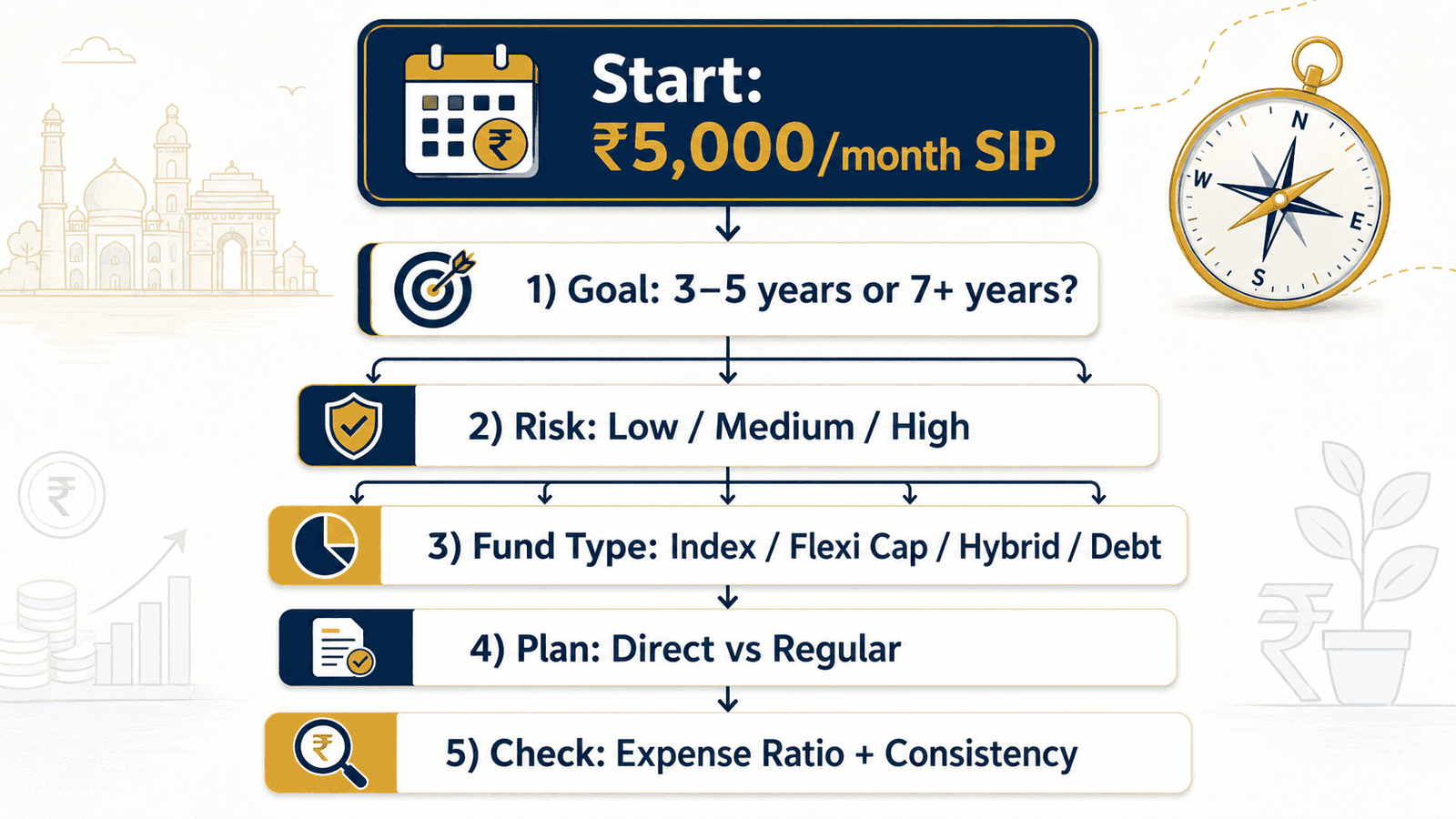
This article does not name one universal best fund. Instead, it gives you a practical framework to choose a fund category, understand direct vs regular plans, avoid beginner mistakes, and start a ₹5,000 SIP that you will not abandon the first time the market dips.
Quick Answer: Best Fund for ₹5,000 SIP
The best fund for 5000 SIP depends on your goal, risk level and investment time horizon. For a beginner with a 7+ year goal, a low-cost index fund or diversified flexi cap fund may be easier to understand than chasing last year’s top performer. Decide your goal duration first — then choose a fund category. Mutual fund investments are subject to market risks. Past performance does not guarantee future returns.
Key Takeaways
- ₹5,000/month is enough to start building long-term wealth, but too small to justify splitting across more than two funds — spreading thin adds complexity without meaningful diversification benefit.
- Choose your fund category before choosing a scheme name — an index fund, flexi cap fund, hybrid fund, and debt fund serve very different goals and carry very different risks.
- For a goal 7+ years away, a low-cost equity index fund or diversified flexi cap fund can be considered; for a 1–3 year goal, equity funds carry significant drawdown risk that beginners often underestimate.
- Direct plans of mutual funds have no distributor commission — they carry a lower expense ratio than regular plans of the same scheme, which compounds meaningfully over 10–15 years.
- Judging a fund only by its 1-year return is one of the most common beginner mistakes — short-term performance can reflect market timing, not fund quality or consistency.
- No emergency fund or high-interest personal loan? Sort those first. A SIP in an equity fund does not protect you from needing to redeem at a market low when an emergency hits.
- According to SEBI guidelines, every mutual fund scheme must publish a Scheme Information Document (SID) and a Key Information Memorandum (KIM) — read both before investing.
Key Facts at a Glance
| Parameter | Detail | Why It Matters |
|---|---|---|
| SIP amount | ₹5,000/month | Builds discipline; small enough to start, meaningful enough to compound |
| Minimum time horizon for equity SIP | 5–7 years (ideally 10+) | Equity funds can fall 30–40% in a downturn; time allows recovery |
| Fund categories to consider | Index, Flexi Cap, Hybrid, Debt/Liquid | Category determines risk level and expected volatility |
| Plan type | Direct vs Regular | Direct has lower expense ratio; difference compounds over long periods |
| Key document to read | Scheme Information Document (SID) | Contains fund objective, risk, benchmark, and cost — official source |
| Review frequency | Once a year or after a major life change | Avoid reacting to short-term market movements |
| Regulator | SEBI — sebi.gov.in | All mutual funds in India are regulated by SEBI |
How SIP, Mutual Funds and Fund Categories Actually Work
Before you can choose the best fund for your ₹5,000 SIP, you need to be clear on what a SIP actually is — and what it is not. A Systematic Investment Plan is a method of investing, not a fund category. You choose a mutual fund scheme first; the SIP is just the instruction to your bank or app to invest ₹5,000 on a fixed date every month. Learn how SIP mechanics work, including rupee cost averaging and return calculation, at SIP basics first before choosing a fund.
A mutual fund pools money from thousands of investors and deploys it according to the scheme’s stated investment objective — which could be tracking the Nifty 50 index, investing across large, mid and small-cap companies, or lending to short-duration bonds. Every day, the fund calculates its Net Asset Value (NAV): the per-unit value of all the fund’s holdings. When your ₹5,000 SIP instalment is processed, it buys units at that day’s NAV. When the NAV is lower, your ₹5,000 buys more units. When it is higher, it buys fewer. This is rupee cost averaging — it smooths out your average purchase cost over time, but it does not eliminate market risk.
Why Fund Category Matters More Than App Rankings
App rankings show you which funds returned the most over 1 year, 3 years, or 5 years. That is useful data — but it is not a suitability filter. A mid-cap fund that returned 45% last year may have done so because mid-cap stocks rallied sharply. In a correction, the same fund can fall 35–40%. If your goal is 3 years away, that fall can wipe out your gains and damage your corpus precisely when you need to redeem.
According to SEBI’s mutual fund categorisation framework, each scheme must clearly state its investment universe and benchmark. Understanding the category tells you what asset class and market segment the fund invests in, how volatile it is likely to be, and whether it suits a 3-year goal or a 15-year one. This is why you should choose the fund category before you choose the scheme name.
The Four Categories Most Relevant for a ₹5,000 Beginner SIP
Index fund: Passively tracks a market index such as Nifty 50 or Nifty 100. No active fund manager decisions — the portfolio mirrors the index. Generally carries a lower expense ratio than active funds. Suitable for long-term (7+ year) equity exposure with minimal decision complexity.
Flexi cap fund: An actively managed equity fund that can invest across large, mid and small-cap companies in any proportion. The fund manager adjusts allocation based on market conditions. Higher potential returns, but also higher dependence on manager skill and more volatility than a pure large-cap index fund.
Hybrid fund: Invests in both equity and debt in varying proportions depending on the sub-category (aggressive hybrid, balanced advantage, conservative hybrid). Can suit moderate-risk investors who want some equity growth with a buffer from debt.
Debt and liquid funds: Invest in fixed-income instruments like government bonds, corporate paper, and money market instruments. Lower volatility than equity funds, but not risk-free. More appropriate for goals that are 1–3 years away, or for parking your emergency fund.
Real Example: Three Investors, Same ₹5,000 SIP, Different Funds
Rohan, 29, is a software tester in Bengaluru earning ₹75,000/month. His goal is long-term wealth — he wants to build a corpus over the next 12–15 years for financial independence. He has an emergency fund in place and no high-interest debt. For Rohan, an equity-oriented fund — either a Nifty 50 index fund or a diversified flexi cap fund — could be worth considering, given his long horizon and ability to stay invested through market cycles. His biggest risk is panic-selling during a 25% market fall in year 3.
Neha, 35, is a schoolteacher in Pune earning ₹48,000/month. She wants to save for a house down payment in 3 years. Her ₹5,000 SIP feels like a good idea, but an equity fund for a 3-year goal could leave her with less than she invested if the market falls in year 2 or 3. A debt fund or hybrid conservative fund may be more aligned with her goal timeline — even if the expected return is lower.
Amit, 42, is a sales executive in Hyderabad earning ₹90,000/month. He has never invested in mutual funds before and finds the terminology confusing. For Amit, a simple diversified fund with low complexity — like a Nifty 50 index fund — is easier to monitor and understand than a sector fund or thematic fund he saw trending on social media. Simplicity beats novelty for a first-time investor.
The insight: the same ₹5,000/month produces very different outcomes depending on which fund is chosen — and why that choice was made.
How to Calculate Your ₹5,000 SIP Estimate
You cannot know what a ₹5,000 SIP will actually return because mutual fund returns are market-linked and not guaranteed. What you can do is model different scenarios using assumed return rates to understand the range of outcomes.
Estimated Corpus = SIP Amount × [((1 + r)^n – 1) / r] × (1 + r)
Where r = assumed monthly return rate (annual assumed rate ÷ 12), n = total number of instalments
Rather than hardcoding return assumptions here — which can become misleading if markets behave differently — use the Ridhi SIP calculator to enter your own assumptions and see estimated corpus values across different time horizons. The table below shows only the invested amount (principal) at different durations — not projected returns, which depend entirely on assumed rates.
| Duration | Total Invested (₹5,000/month) | Estimated Corpus Range* |
|---|---|---|
| 5 years | ₹3,00,000 | Varies by fund category and market conditions |
| 10 years | ₹6,00,000 | Varies by fund category and market conditions |
| 15 years | ₹9,00,000 | Varies by fund category and market conditions |
*Corpus estimates depend on assumed return rates, which are not guaranteed. Use the Ridhi SIP calculator to model scenarios. Mutual fund investments are subject to market risks. Past performance does not guarantee future returns.
Comparison: Fund Categories for a ₹5,000 Monthly SIP
For a deeper explanation of how large-cap, mid-cap, and small-cap categories differ in risk and behaviour, read the guide on comparing fund categories. The table below focuses on the four broad categories most relevant to a beginner deciding where to start.
| Fund Category | Suitable For | Key Risk / Watch Out |
|---|---|---|
| Index Fund (e.g. Nifty 50) | Long-term (7+ years), beginners who want simplicity, lower expense ratio | Returns mirror the index — no outperformance, but also no underperformance by manager decisions |
| Flexi Cap Fund | Long-term (7+ years), investors comfortable with active management and higher volatility | Depends heavily on fund manager allocation decisions; can underperform index in some periods |
| Hybrid Fund (Aggressive / Balanced) | Medium to long-term (5+ years), moderate-risk investors wanting equity + debt mix | Equity portion can still fall significantly in a downturn; not a substitute for a debt-only instrument |
| Debt / Liquid Fund | Short-term goals (1–3 years), emergency corpus parking, capital preservation priority | Not risk-free — credit risk, interest rate risk, and liquidity risk still exist in debt funds |
| Sector / Thematic Fund | Experienced investors with a specific sector view; not recommended as a first SIP | Concentrated risk — entire portfolio tied to one sector; high volatility and high sequence risk |
How to Decide What’s Right for You
Your goal is 10+ years away and you want low decision complexity — THEN a Nifty 50 or broad-market index fund is worth shortlisting; track its tracking error and expense ratio in the SID.
Your goal is 7–10 years and you are comfortable with an active fund manager’s allocation decisions — THEN a SEBI-categorised flexi cap fund can be considered; compare 3–5 year rolling returns rather than just point-to-point 1-year return.
Your goal is 5–7 years and you want some cushion against equity volatility — THEN an aggressive hybrid fund (equity 65–80% + debt) may reduce drawdown compared to a pure equity fund.
Your goal is under 3 years — THEN equity funds carry meaningful drawdown risk for your timeline; a debt or hybrid conservative fund may be more aligned, though returns will be lower.
You are unsure whether to choose direct or regular plan — THEN read the comparison of direct plan vs regular plan; direct plans have a lower expense ratio because there is no distributor commission, which matters significantly over 10+ years.
You are a first-time equity investor and you found a trending sector or thematic fund on an app — THEN consider starting with a broader diversified fund first; sector funds can fall far more sharply and recover far more slowly than a diversified equity fund.
You do not have a 3–6 month emergency fund, or you are carrying high-interest personal loan or credit card debt — do not prioritise a ₹5,000 equity SIP yet. Clearing 15–24% interest debt before starting a SIP that may return 10–12% (not guaranteed) is straightforward arithmetic.
Common Mistakes to Avoid
Choosing a Fund Based Only on 1-Year Returns
A fund that returned 50% last year may have done so because its sector or market cap segment had a sharp rally — not because of superior stock selection.
Short-term return rankings change dramatically year to year. A fund ranked #1 this year can rank in the bottom quartile next year. Judging a ₹5,000 SIP fund on 12 months of data is like buying a car based on how fast it went in one race. Learn to read fund returns correctly — CAGR, absolute, and XIRR explained before comparing schemes.
Instead, look at rolling returns over 3–5 year periods and consistency across different market cycles.
Splitting ₹5,000 Across Too Many Funds
A ₹5,000 monthly amount spread across 4 or 5 funds means ₹1,000 per fund — this adds tracking complexity without meaningful diversification, because most equity funds already hold 40–80 stocks.
Owning three large-cap funds does not reduce your large-cap equity risk; it just multiplies the number of statements you receive. A beginner is better served by 1–2 well-understood funds than 5 half-understood ones.
Start with one fund, understand it, then add a second only when your SIP amount grows or a genuinely distinct goal requires it.
Picking a Sector or Thematic Fund as Your First SIP
Sector funds — technology, pharma, infrastructure, defence — are concentrated bets on one industry cycle.
When that sector is in favour, returns look spectacular on app charts. When it falls out of favour, the fund can lose 40–60% and stay depressed for years. A ₹5,000 monthly SIP in a sector fund can underperform a simple index fund over 10 years if the sector timing is wrong.
Save sector funds for when you have a diversified base already in place and you understand what drives that sector.
Ignoring Expense Ratio and Plan Type
The expense ratio is charged every year as a percentage of your invested corpus — it silently reduces your returns whether the fund goes up or down.
The difference between a direct plan (e.g. 0.15% expense ratio) and a regular plan (e.g. 1.10% expense ratio) for the same scheme is nearly 1% per year. On a ₹5,000/month SIP over 15 years, that compounding gap can mean a lakhs-level difference in final corpus.
Always check whether you are buying a direct or regular plan before confirming your SIP.
Stopping SIP at Every Market Correction
Market corrections are exactly when rupee cost averaging does its best work — your ₹5,000 buys more units at lower NAVs.
Stopping a SIP when the market falls 15% and restarting when it recovers means you bought fewer units at the low and missed the recovery. Behavioural discipline matters more than fund selection for most retail investors.
Review the fund’s suitability once a year — do not react to monthly market swings.
Not Reading the Scheme Information Document
Most first-time SIP investors start a fund from an app without reading a single line of the scheme document.
The SID tells you what the fund is allowed to invest in, what the benchmark is, what the riskometer says, and what the exit load and expense ratio are. A 10-minute read before starting your SIP can prevent choosing a fund that is fundamentally misaligned with your goal.
When This May Not Be the Right Choice
No emergency fund in place: If you have less than 3–6 months of expenses saved in a liquid instrument, starting an equity SIP first is risky. A job loss or medical emergency may force you to redeem at a market low — undoing months of investment returns.
You are carrying high-interest debt: Personal loans at 18–24% interest and credit card debt at 36–42% annual interest will cost more than most equity SIPs can earn in the same period — not guaranteed, but mathematically likely. Clear high-interest debt before or alongside starting a SIP.
Your goal is less than 2–3 years away: Equity mutual funds can lose 30–40% in a bear market. If you need the money in 2 years — for a wedding, down payment, or higher education fee — an equity SIP carries sequence-of-returns risk that can materially damage your corpus at redemption time.
You cannot tolerate watching your portfolio fall: If a 20% temporary fall in NAV will cause you to panic-sell or lose sleep, an equity fund SIP is not yet the right product — regardless of what apps recommend. Understand what you are signing up for before investing.
If any of these apply to your situation, it may be worth exploring alternatives before committing.
Official Rules and Where to Verify
All mutual funds in India are regulated by the Securities and Exchange Board of India (SEBI). SEBI sets the rules for fund categorisation, disclosure, expense ratio limits, and investor protection. The official website is sebi.gov.in.
Before investing in any mutual fund scheme, read the scheme-level documents that every fund house is required to publish:
- Scheme Information Document (SID): Full details of the fund’s investment objective, strategy, benchmark, risk factors, exit load, and expense ratio.
- Key Information Memorandum (KIM): A shorter, standardised summary of the SID for quick reference.
- Factsheet: Monthly document published by the fund house showing current portfolio, NAV, AUM, and performance data.
- Riskometer: SEBI-mandated risk label on every scheme — ranges from Low to Very High.
Rules, limits, and rates on this topic can change with each Budget or regulatory update. Always verify current figures directly from the official source before making any financial decision.
Expert Tips
- Start with one fund and understand it fully before adding a second. Most long-term wealth goals do not require more than 2–3 mutual fund schemes. Complexity does not equal diversification — read the step-by-step guide to starting a SIP correctly before placing your first order.
- Choose direct plan over regular plan if you are investing independently. The lower expense ratio in direct plans compounds meaningfully over 10–15 years. If you are using a distributor or adviser for guidance, the cost may be justified — but know which plan you are buying before you confirm.
- Do not increase fund count when you want to increase SIP amount. If your income rises and you want to add ₹2,000 more per month, consider stepping up the existing SIP in the same fund rather than starting a new one — unless a genuinely separate goal justifies it.
- Keep goal-specific funds separate. If you have a 3-year goal and a 12-year goal, do not mix them in one SIP. Different goals need different fund categories, redemption timelines, and risk profiles.
- Review your SIP once a year — not every month. Check whether the fund’s investment objective still matches your goal, whether the expense ratio is in line with peers, and whether your risk tolerance has changed. Reacting to monthly NAV movements is a reliable way to destroy long-term returns.
- Maintain a simple record of why you chose this fund. Write down: goal, time horizon, fund category, plan type, and date of first SIP. This makes the annual review structured and prevents you from switching based on noise rather than fundamentals.
- If you want to increase your SIP amount annually, a step-up SIP instruction can automate this. A ₹5,000 SIP stepped up by 10% per year grows your contribution meaningfully over a decade without requiring a separate decision each time.
Frequently Asked Questions
Which fund is best for a ₹5,000 SIP?
There is no single best fund for everyone. The right fund depends on your goal, investment time horizon, and ability to tolerate market volatility. For a long-term (7+ year) goal, a low-cost index fund or diversified flexi cap fund is commonly considered by beginners — but suitability depends on your specific situation. Read the Scheme Information Document before investing.
Is ₹5,000/month enough to build meaningful wealth through a SIP?
Yes — ₹5,000/month invested consistently over 10–15 years can build a significant corpus, depending on fund performance and market conditions. The key factors are consistency (not stopping during market dips), time horizon, and choosing a fund category that matches your goal. Exact corpus cannot be guaranteed as returns are market-linked.
Should I split ₹5,000 across multiple funds?
Generally not advisable for a beginner. ₹5,000 split across 3–5 funds means ₹1,000–₹1,667 per fund — this adds tracking complexity without adding meaningful diversification, since most equity funds already hold 40–80 stocks. Start with one fund. Add a second only when your monthly SIP amount is higher or a distinct goal requires a different fund category.
Is an index fund SIP better than an active fund SIP for a beginner?
An index fund is simpler — it tracks a benchmark like the Nifty 50, has a lower expense ratio, and requires no assessment of fund manager decisions. An active fund (like a flexi cap) can potentially outperform the index, but also carries the risk of underperforming it. Neither is universally better; the choice depends on your preference for simplicity vs active management, your time horizon, and the specific scheme’s consistency. Mutual fund investments are subject to market risks.
Should beginners choose a direct plan or regular plan for SIP?
Direct plans have a lower expense ratio because there is no distributor commission. For an investor who is researching and investing independently, a direct plan is worth considering. If you are receiving ongoing advice and service from a registered distributor or adviser, the cost difference may be offset by the guidance. Understand which type you are buying before confirming — check the scheme name; it will say “Direct” or “Regular.”
Can I stop or change my SIP later?
Yes. Most mutual fund platforms allow you to pause, stop, or modify your SIP with reasonable notice. Stopping a SIP does not automatically redeem your units — your existing investment remains in the fund. However, frequently stopping and restarting SIPs during market volatility can reduce the benefit of rupee cost averaging over time.
What happens if the fund underperforms for 2–3 years?
Short-term underperformance relative to a benchmark is common for actively managed funds. Before switching, check whether the underperformance is consistent (across different market cycles) or temporary (a specific period where the fund’s style was out of favour). Switching funds frequently based on short-term performance is one of the most common ways retail investors damage long-term SIP outcomes. Review annually, not quarterly.
Is it safe to invest ₹5,000/month in a mutual fund SIP?
Mutual fund investments are subject to market risks — equity funds can fall significantly in the short term. “Safe” depends on your time horizon and fund category. An index fund SIP for a 12-year goal carries very different risk than a sector fund SIP for a 2-year goal. According to SEBI guidelines, every scheme must display a riskometer. Read it before investing.
Can I invest ₹5,000/month in ELSS for tax saving?
ELSS (Equity Linked Savings Scheme) is a mutual fund category eligible for deduction under Section 80C of the Income Tax Act, with a 3-year lock-in per instalment. If you are in the old tax regime and have Section 80C space remaining, ELSS may be worth considering. If you are in the new tax regime, Section 80C deductions are not available. Verify your regime and Section 80C utilisation before treating an ELSS SIP as a tax-saving instrument.
Final Verdict
The best fund for a ₹5,000 SIP does not exist in a universal list — it exists in the intersection of your goal duration, risk tolerance, understanding of fund categories, and commitment to staying invested through market cycles. For a beginner with a long-term horizon, simplicity and suitability matter far more than chasing the top-returning scheme from last year’s app chart.
Start by defining your goal and timeline. Then choose a broad fund category — index or flexi cap for long-term equity goals, hybrid or debt for shorter timelines. Decide between direct and regular plan. Read the Scheme Information Document. And then invest — consistently, without reacting to every market movement.
There is no shortcut past this framework. Any article, app, or adviser that tells you there is one universal best fund for every ₹5,000 SIP is selling simplicity that does not exist in equity markets.
Always verify the latest rules from official sources or consult a qualified professional before making any financial decision.
This article is for educational purposes only and should not be treated as personalised financial, tax, investment, insurance, or legal advice. Tax rules, interest rates, regulatory limits, and product features can change with each Budget or policy update. Please verify current rules from official government sources or consult a qualified and registered professional before making any financial decision.

Arjun Kapoor writes about mutual funds, SIPs, ELSS, fund categories, investment returns, and beginner investing concepts for Indian readers. His focus is on education, not product promotion or fund recommendations. He helps readers understand how mutual funds work before they start investing or comparing schemes.
He covers topics such as mutual fund meaning, SIP meaning, SIP calculator, direct mutual funds vs regular plans, NAV, ELSS tax-saving funds, CAGR, absolute returns, XIRR, expense ratio, large cap vs mid cap vs small cap funds, flexi cap funds, index funds vs active funds, liquid funds, debt mutual funds, SIP pause vs SIP stop, lumpsum vs SIP, and how to start SIP in India.
Arjun’s writing is simple, risk-aware, and long-term oriented. He avoids guaranteed-return language and explains investment concepts using examples, timelines, and comparison tables. His articles remind readers that mutual fund investments are subject to market risks, and past performance does not guarantee future returns. Readers should verify scheme details from SEBI, AMFI, fund houses, and official scheme documents.