

If you have spent any time researching mutual funds in India, you have almost certainly hit this wall: should I put my SIP money into a large cap fund, a mid cap fund, or a small cap fund? The three categories all sit under the equity mutual fund umbrella, but they behave very differently — especially when markets fall. Choosing based on recent returns alone, or picking the category a friend mentioned, is one of the most common and costly mistakes new investors make. This article explains exactly what separates these three categories, what risk actually looks like in practice, and how to think about which one may fit your goals — without telling you which fund to buy. Mutual fund investments are subject to market risks. Past performance does not guarantee future returns.
Quick Answer: Large Cap vs Mid Cap vs Small Cap Funds
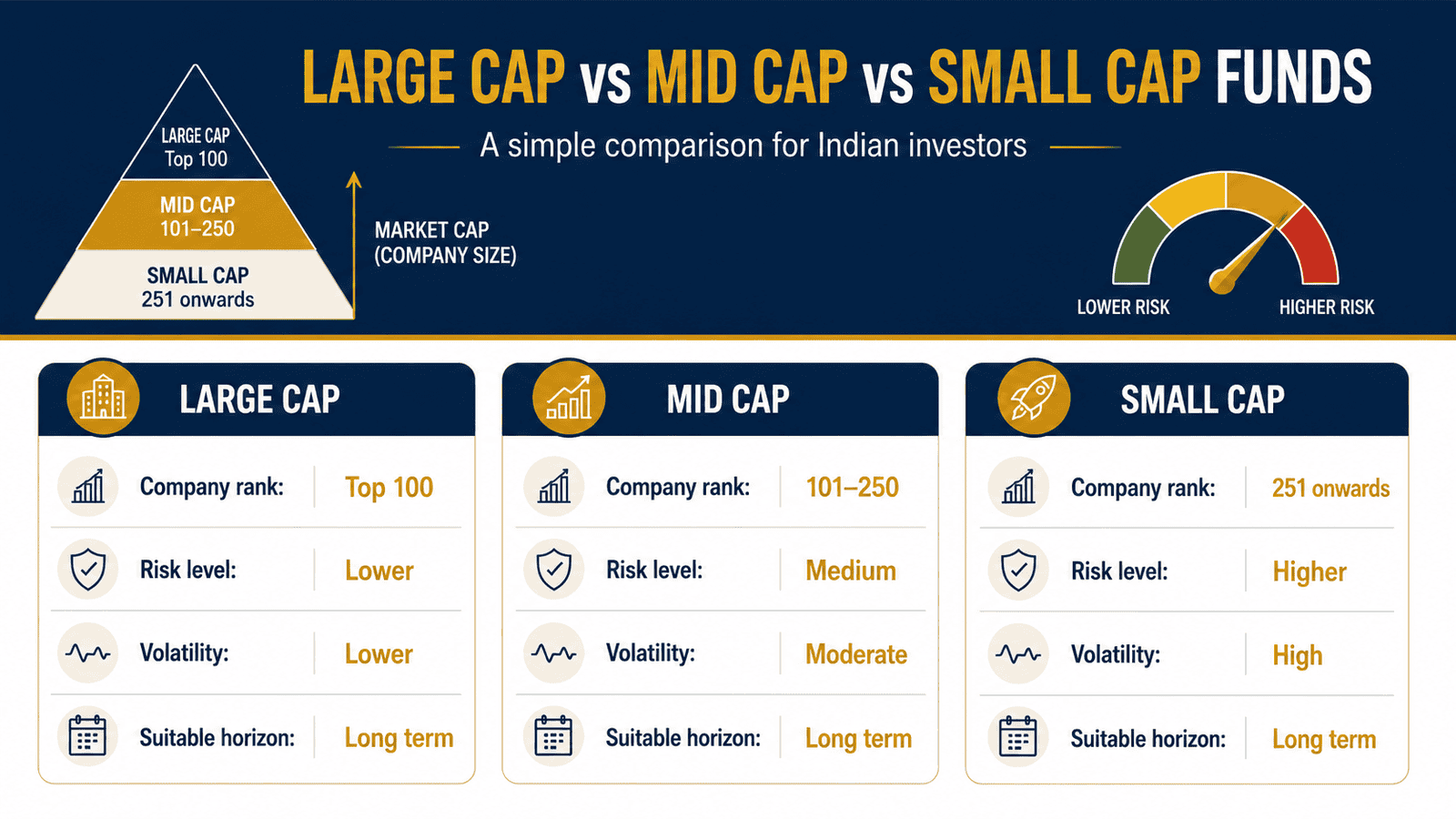
Large cap vs mid cap vs small cap funds compares equity funds by company size and risk. Large cap funds invest mainly in the top 100 companies, mid cap funds in companies ranked 101–250, and small cap funds beyond 250. Risk usually rises from large to small cap. Large cap funds tend to be more stable within equity, mid cap funds are balanced-growth oriented, and small cap funds carry the highest volatility of the three. Do not choose a category based only on what performed well last year — that is a short-term lens applied to a long-term decision.
Key Takeaways
- SEBI classifies large cap funds as those investing at least 80% in top 100 listed companies by market capitalisation; mid cap funds must invest at least 65% in companies ranked 101–250; small cap funds must invest at least 65% in companies ranked 251 and beyond.
- Large cap funds generally carry relatively lower volatility within the equity category — they can still fall sharply in a market crash, but tend to recover faster than mid or small cap funds.
- Mid cap funds have historically offered higher growth potential than large cap funds over long periods, but with meaningfully higher drawdowns during corrections — expect 30–40% temporary falls in a bad market cycle.
- Small cap funds can see temporary portfolio declines of 50% or more during a sharp market fall — if seeing ₹1 lakh drop to ₹50,000 on paper would cause you to exit, small cap funds are likely not suited to you.
- Beginners who cannot yet monitor their portfolio calmly during a bear market may find large cap or diversified categories easier to hold through volatility than mid or small cap funds.
- Past performance should never drive category selection — a category that outperformed in the last 3 years often underperforms in the next 3.
- Your investment horizon matters as much as your risk appetite: for goals under 5 years, pure equity exposure across any of these categories carries meaningful risk.
| Parameter | Large Cap Funds | Mid Cap Funds | Small Cap Funds |
|---|---|---|---|
| Company size (SEBI ranking) | Top 100 by market cap | Ranked 101–250 | Ranked 251 and beyond |
| Minimum equity allocation (SEBI) | 80% in large cap stocks | 65% in mid cap stocks | 65% in small cap stocks |
| Typical risk level within equity | Lower | Moderate–High | High |
| Typical volatility | Lower relative to peers | Higher than large cap | Highest of the three |
| Return potential (long-term horizon) | Moderate within equity | Higher than large cap | Highest potential, highest variance |
| Liquidity of underlying stocks | High — large companies trade heavily | Moderate | Lower — exits can be harder in a downturn |
| Suggested investment horizon | 5+ years | 7+ years | 10+ years |
| What can go wrong | Still falls in broad market crashes; returns can lag if economy slows | Steeper drops in corrections; recovery takes longer | Can fall 50%+ in a severe bear market; illiquidity risk |
| Beginner suitability | More suitable | Moderate — needs patience | Caution for beginners |
| Parameter | Detail | Source |
|---|---|---|
| Classification basis | SEBI market-cap ranking published by AMFI every six months | SEBI / AMFI |
| Large cap definition | Top 100 companies by full market capitalisation | SEBI |
| Mid cap definition | Companies ranked 101–250 by full market capitalisation | SEBI |
| Small cap definition | Companies ranked 251 and beyond | SEBI |
| Risk level (broad) | Low → Moderate → High (large to small cap) | General industry consensus |
| Suitable for investors who | Understand equity volatility and can stay invested through market cycles | — |
What Are Large Cap, Mid Cap, and Small Cap Mutual Funds?
Before comparing these categories, it helps to understand what market capitalisation actually means — and why SEBI decided to use it as the classification basis. If you are new to mutual funds entirely, the article on mutual fund basics will give you useful grounding before continuing here.
Market Capitalisation: The Number Behind the Category
Market capitalisation — or market cap — is simply the total value of a listed company’s shares at current market prices. Multiply the share price by the number of shares outstanding and you have the market cap. A company with a share price of ₹500 and 100 crore shares outstanding has a market cap of ₹50,000 crore. The larger this number, the larger the company in stock-market terms. For a deeper explanation of how market cap ranking works across all listed Indian companies, the article on market cap basics covers the full picture.
How SEBI Defines the Three Categories
According to SEBI’s mutual fund categorisation circular, AMFI publishes a list of listed companies ranked by full market capitalisation every six months. This ranking is the official basis for classification — not the brand, not the sector, not whether a company is “famous.” The top 100 companies on this list are classified as large cap companies. Companies ranked 101 to 250 are classified as mid cap. Companies ranked 251 and beyond are classified as small cap.
Mutual fund schemes are then required by SEBI to invest a minimum percentage of their corpus in the relevant category. Large cap funds must invest at least 80% of their total assets in large cap stocks. Mid cap funds must invest at least 65% in mid cap stocks. Small cap funds must invest at least 65% in small cap stocks. This mandatory minimum ensures that a fund labelled “large cap” actually invests in large companies — not a loose mix.
Large Cap Funds: Stability Within Equity
Large cap funds invest primarily in well-established, financially strong, widely tracked Indian companies. These companies have existed through multiple market cycles, have analyst coverage, publish audited financials regularly, and tend to have more predictable business models. That does not make them risk-free — all equity funds carry market risk. But large cap funds generally recover from market corrections more quickly than mid or small cap funds, and their daily price swings tend to be narrower.
The trade-off is that large cap funds are unlikely to deliver extraordinary returns in a short time. Their underlying companies are already large — so the growth runway is narrower than for a smaller, younger company with room to multiply.
Mid Cap Funds: Growth Potential With Higher Risk
Mid cap funds invest in companies ranked between 101 and 250 by market cap — the middle tier of Indian listed companies. These companies are often in a phase of active expansion: entering new markets, scaling revenues, building brand recognition. When business growth accelerates, their stock prices can rise faster than large cap stocks. That is why mid cap funds have historically offered higher long-term return potential than large cap funds in many market cycles.
But the same growth phase that creates upside also creates downside. Mid cap companies are more sensitive to interest rate changes, economic slowdowns, and sector-specific stress. In a market correction, mid cap funds can fall significantly steeper than large cap funds — and can take longer to recover. Investors in mid cap funds need both a longer investment horizon and the emotional resilience to stay put through drawdowns.
Small Cap Funds: Highest Potential, Highest Risk
Small cap funds invest in companies ranked 251 and beyond — businesses that may be early in their journey, operating in niche markets, or growing rapidly but with limited market coverage or analyst tracking. The upside potential here can be substantial over a decade-long horizon if the underlying companies grow significantly. Some of today’s mid cap leaders were once small cap companies.
However, the risks are proportionally higher. Small cap stocks are less liquid — meaning it can be harder to buy or sell them in large quantities without affecting the price. In a severe bear market, small cap funds can experience drawdowns of 50% or more. They also take longer to recover. According to SEBI guidelines, small cap fund investors should be prepared for significant volatility and should not invest money they may need in the near term.
Real Example: Rohan’s ₹10,000 Monthly SIP Decision
Rohan is 29, lives in Bengaluru, and works as a software engineer earning ₹1.2 lakh per month. He wants to start a ₹10,000 monthly SIP but is confused about which category suits him. He has read about small cap funds delivering strong returns in the last three years and is tempted — but he is also saving towards a flat purchase in 7 years and has ₹0 in existing equity investments.
Here is how Rohan’s thinking should shift based on his goal timeline. If he needs the money in 3 years: pure equity exposure across any category carries meaningful risk at that horizon — a large market correction in year 2 could leave his portfolio well below what he put in when he needs to withdraw. If his horizon is 7 years: large cap or a diversified category is a reasonable starting point; mid cap could be considered for a portion, but not 100% allocation. If his horizon is 15 years: mid cap and small cap become more meaningful options — but only after he understands what a 40–50% portfolio fall looks like emotionally and can stay invested through it.
Rohan’s mistake would be selecting small cap funds purely because their recent 3-year returns look impressive. That is a rear-view-mirror decision. Before starting his SIP, reading about starting SIP journey will help him understand how SIP discipline works — and what it cannot protect against.
How to Calculate Illustrative Risk in ₹ Terms
Return projections for mutual funds are not reliable inputs for planning — markets do not deliver uniform annual returns. But understanding portfolio drawdown in rupee terms can make the risk difference between categories very concrete.
Illustrative Portfolio Fall = Invested Value × Drawdown Percentage
Say Rohan has invested ₹1,20,000 over 12 months (₹10,000 × 12) and the market enters a correction. Here is what a temporary fall could look like across categories — these are illustrative scenarios only, not return forecasts or expected outcomes.
| Scenario | Illustrative Drawdown | Approximate Portfolio Value on ₹1,20,000 Invested |
|---|---|---|
| Large cap fund — moderate market fall | ~10% | ~₹1,08,000 |
| Mid cap fund — sharp market correction | ~25–30% | ~₹84,000–₹90,000 |
| Small cap fund — severe bear market | ~40–50% | ~₹60,000–₹72,000 |
These figures are illustrative and do not represent guaranteed losses or actual fund behaviour. Market conditions vary significantly. The key insight: if seeing your ₹1,20,000 drop to ₹60,000 on a screen would cause you to panic-sell, small cap funds are likely not suitable for you yet — regardless of what past returns show. Use the SIP calculator to model growth assumptions, but always treat projections as scenarios, not promises.
Your investment horizon is 7 years or more and you can stay invested through a 15–20% temporary fall without exiting — THEN large cap funds may be a suitable starting point within equity.
You have a 10-year horizon, stable income, and can emotionally handle a 30–35% portfolio fall — THEN mid cap funds may suit a portion of your portfolio.
You have a 10–15 year horizon, existing large/mid cap exposure, and high risk tolerance — THEN a small allocation to small cap funds may make sense as part of a broader portfolio.
You are investing for a goal under 5 years — THEN equity mutual funds across all three categories may be too volatile for that specific goal, regardless of which category you pick.
You already hold broad index funds or flexi cap funds — THEN adding a separate large cap fund may create significant overlap without meaningfully improving diversification.
You cannot tolerate seeing your portfolio value drop by 40–50% temporarily — then small cap funds are likely not the right category for you at this stage, irrespective of their return history.
Common Mistakes to Avoid
Chasing Last Year’s Best-Performing Category
Small cap funds that delivered strong returns in a bull run attract fresh investors right before a correction. The investor who entered at peak valuations then experiences the full force of the drawdown.
Equity mutual fund categories rotate in performance. A category that ranked first over 3 years often underperforms over the next 3. Selecting a category based on recent returns is one of the most expensive beginner mistakes in mutual fund investing.
Instead, assess whether the category suits your risk tolerance and investment horizon — not whether it topped the return charts last year.
Assuming Large Cap Funds Are Risk-Free
Large cap funds carry lower volatility relative to mid and small cap funds — but they are not capital-protected. In a broad equity market crash, large cap funds can also fall 20–30% temporarily.
Treating large cap funds as fixed deposits or guaranteed-return instruments is a misunderstanding of how equity markets work. All equity mutual funds carry market risk.
Understand that “lower risk within equity” is a relative statement — not an absolute safety guarantee.
Confusing Fund Category With Fund Plan Type
Many beginners conflate the fund category (large cap, mid cap, small cap) with the plan type (direct vs regular). These are completely separate choices. The article on direct vs regular plans explains this distinction clearly.
You can invest in a large cap fund through either a direct plan or a regular plan. Getting the category right and the plan wrong still costs you money in excess expense ratio.
Decide category first, then plan type — they are independent decisions.
Investing Short-Term Goal Money Into Small or Mid Cap Funds
If you need ₹5 lakh in 2 years for a car purchase or home down payment, putting it in a small cap SIP is a mismatch between goal timeline and fund volatility.
A 40% drawdown in year 1 means your ₹5 lakh goal becomes ₹3 lakh on paper at exactly the moment you need the money. Equity mutual funds — especially mid and small cap — need a long runway to recover from sharp falls.
Match your fund category choice to your goal’s time horizon, not just your return aspiration.
Holding Too Many Funds Across Overlapping Categories
Owning three large cap funds, two mid cap funds, and two small cap funds does not equal seven sources of diversification — it often means significant stock-level overlap across funds, higher mental overhead, and no real reduction in risk.
Over-diversification within equity categories can create a complicated portfolio that is hard to track and rebalance without a clear benefit over a simpler allocation.
Start with fewer funds with clear mandates. Add complexity only when you understand what each fund adds to your portfolio.
Ignoring Liquidity Risk in Small Cap Funds
Small cap stocks trade in lower volumes. During a sharp market downturn, fund managers may find it difficult to sell small cap holdings quickly without affecting the price — this can amplify losses.
SEBI has put in place liquidity risk management frameworks for mutual funds, but small cap funds inherently carry higher liquidity risk than large or mid cap funds. This risk is often invisible during bull markets and only becomes apparent during corrections.
Factor liquidity risk into your assessment of small cap funds, especially for amounts that may need to be redeemed at short notice.
When This May Not Be the Right Choice
If your financial goal has a timeline under 3 years — a wedding, a home down payment, a car purchase — pure equity funds across all three categories are likely too volatile for that goal. Even large cap funds can fall significantly in a bear market within a 3-year window.
If you find yourself anxiously checking your portfolio value every week and would likely exit during a market fall, aggressive mid cap or small cap exposure is probably unsuitable for you right now — not because these funds are bad, but because the emotional response to volatility often leads to selling at exactly the wrong time.
If you already hold a broad market index fund or a well-diversified flexi cap fund, adding a separate large cap fund may simply duplicate holdings without providing meaningful additional diversification. Your portfolio complexity increases without a proportionate benefit.
If your goal is capital protection — preserving the amount you invest — equity mutual funds in any category do not provide that. Equity carries the real possibility of loss, especially over short time horizons.
If any of these apply to your situation, it may be worth exploring alternatives before committing.
Official Rules and Where to Verify
Mutual fund categorisation rules in India are set and enforced by SEBI — the Securities and Exchange Board of India (sebi.gov.in). The market-cap ranking list used to classify companies into large, mid, and small cap is published by AMFI — the Association of Mutual Funds in India (amfiindia.com) — every six months.
Before investing in any mutual fund, read the Scheme Information Document (SID) and Key Information Memorandum (KIM) for that specific fund. These documents confirm the fund’s investment mandate, benchmark, risk factors, and expense structure.
- SEBI — sebi.gov.in (mutual fund regulations, categorisation circulars)
- AMFI — amfiindia.com (market-cap classification list, NAV data, fund disclosures)
- Individual AMC websites (scheme documents, portfolio disclosures)
Rules, limits, and rates on this topic can change with each Budget or regulatory update. Always verify current figures directly from the official source before making any financial decision.
Expert Tips
- Do not chase last year’s best-performing category. Fund performance rotates across market cycles — a category that led over 3 years frequently lags over the next 3. Chasing recent returns is one of the most reliable ways to underperform a basic index fund.
- Before comparing return percentages across categories, understand how returns are measured. Reading the article on understanding fund returns will help you compare CAGR, absolute return, and XIRR correctly — three numbers that can look very different for the same investment.
- If you are evaluating a mid or small cap fund, look at its drawdown behaviour — not just peak returns. A fund that fell 55% in the 2020 correction but recovered by 2022 behaved very differently from one that fell 30% and recovered in 6 months. Both may show the same 5-year CAGR on a screen today.
- SIP discipline reduces the risk of poor entry timing, but it does not eliminate market risk. A small cap SIP started at a market peak still carries full category-level volatility — SIP only lowers your average entry cost gradually over time, it does not remove the possibility of loss.
- Review your category exposure once or twice a year — not after every market move. Excessive monitoring leads to reactive decisions. Set your allocation based on your goal and risk tolerance, then let it run unless your life circumstances change significantly.
- If you are a first-time equity investor, starting with a large cap fund or a broad index fund gives you real exposure to how equity markets behave — including falls — without the steeper volatility of mid or small cap funds. Once you have experienced a market correction and stayed invested, you are better equipped to decide whether higher-risk categories suit you.
- Beware of recency bias in conversations with friends or online communities. If everyone around you is talking about how much their small cap SIP made last year, that is often a signal that valuations have already run up — not that it is a good time to enter at full allocation.
Frequently Asked Questions
Which is better: large cap, mid cap, or small cap fund?
There is no single answer. “Better” depends entirely on your investment horizon, risk tolerance, and financial goal. Large cap funds are generally more stable within equity. Mid cap funds offer higher growth potential with higher risk. Small cap funds carry the most volatility but also the highest long-term return potential. The right choice is the one that matches your personal situation — not the one that performed best recently. Mutual fund investments are subject to market risks. Past performance does not guarantee future returns.
Are small cap funds good for beginners?
Generally, small cap funds require caution for first-time investors. The volatility is high — portfolio values can fall 40–50% temporarily in a market downturn. Beginners who are still learning how equity markets behave may find this level of drawdown difficult to sit through without exiting, which can lock in losses. A beginner who genuinely has a 10+ year horizon and stable income can consider a small allocation to small cap, but it should not be the starting point for most new investors.
Are large cap funds safe?
Large cap funds are relatively lower risk within the equity mutual fund universe — but they are not safe in the way a bank deposit or government bond is safe. All equity funds carry market risk, including large cap funds. In a severe market crash, large cap funds can and do fall. The distinction is that they typically fall less steeply and recover faster than mid or small cap funds. “Lower risk” within equity is a relative comparison, not an absolute safety guarantee.
Can I invest in all three categories simultaneously?
Yes, many investors build multi-category equity portfolios. However, having separate large cap, mid cap, and small cap funds is not automatically better than a single diversified or flexi cap fund — the latter can allocate across all three segments under a single mandate. Before adding multiple funds, check whether they are creating meaningful diversification or simply increasing complexity with overlapping holdings.
What is the SEBI classification for large, mid, and small cap companies?
According to SEBI’s categorisation circular, large cap companies are defined as the top 100 listed companies by full market capitalisation. Mid cap companies are ranked 101 to 250. Small cap companies are ranked 251 and beyond. AMFI publishes this ranking list every six months. Mutual funds labelled as large cap, mid cap, or small cap are required to maintain minimum allocations to their respective categories as per SEBI rules.
Is SIP safer in small cap funds because you invest monthly?
SIP reduces timing risk by spreading your entry across market levels — this is called rupee cost averaging. But SIP does not reduce category-level risk. A small cap SIP is still invested in small cap stocks, which carry high volatility. You buy more units when prices fall and fewer when they rise, which can improve your average cost over time. But if you need the money at a point when small cap stocks are in a downturn, SIP does not protect your exit value. SIP helps with entry discipline, not with exit timing or volatility.
What happens if a mid cap company grows into the top 100 companies?
If a company’s market cap grows enough to enter the top 100 list, AMFI’s periodic reclassification will move it to the large cap category. A mid cap fund holding that stock may be required to reduce its exposure to stay within its SEBI-mandated allocation. Fund managers handle these transitions as part of regular portfolio rebalancing — it is a normal part of how equity mutual funds operate.
Can I switch from one category to another if my risk appetite changes?
Yes, mutual fund units can be redeemed and reinvested into a different category. However, switches may attract exit loads if done within the exit load period, and redemption gains are subject to capital gains tax. Before switching, check the exit load schedule of your current fund and the tax implications of the redemption. A switch is a taxable event in India — it is not a free transfer.
What is the difference between a large & mid cap fund and a pure large cap fund?
SEBI has a separate category called “large & mid cap fund” which must invest at least 35% each in large cap and mid cap stocks. This creates a blended risk profile — higher than a pure large cap fund but generally lower than a pure mid cap fund. A pure large cap fund must maintain at least 80% in top 100 companies. The two serve different risk-return objectives and should not be treated as interchangeable.
Is it better to start with a large cap fund and add mid/small cap later?
Starting with a large cap or index fund is a reasonable approach for many first-time investors — it gives you real equity exposure and teaches you how your portfolio behaves during market cycles. Once you have experienced a correction and stayed invested, you will be in a better position to assess whether mid cap or small cap allocations suit your temperament. This is not a rule, but a common pattern among investors who build equity portfolios gradually and sensibly.
Final Verdict
Large cap vs mid cap vs small cap funds is not a question with a universally correct answer — it is a question about fit. Large cap funds generally offer relatively lower volatility within equity and are a reasonable starting point for beginners with a 5–7 year horizon. Mid cap funds may suit investors who can accept higher drawdowns in exchange for higher long-term growth potential and have a 7–10 year horizon to let that play out. Small cap funds require the highest risk tolerance, the longest time horizon, and the emotional discipline to stay invested through severe market corrections — they are rarely the right first choice for a new investor. The most important thing to avoid across all three categories is selecting based on recent return rankings. If you are just starting your equity journey, understanding how different categories behave — and finding the one that suits your risk appetite and goals — matters far more than finding the one with the best last-3-year return. Always verify the latest rules from official sources or consult a qualified professional before making any financial decision.
This article is for educational purposes only and should not be treated as personalised financial, tax, investment, insurance, or legal advice. Tax rules, interest rates, regulatory limits, and product features can change with each Budget or policy update. Please verify current rules from official government sources or consult a qualified and registered professional before making any financial decision.

Arjun Kapoor writes about mutual funds, SIPs, ELSS, fund categories, investment returns, and beginner investing concepts for Indian readers. His focus is on education, not product promotion or fund recommendations. He helps readers understand how mutual funds work before they start investing or comparing schemes.
He covers topics such as mutual fund meaning, SIP meaning, SIP calculator, direct mutual funds vs regular plans, NAV, ELSS tax-saving funds, CAGR, absolute returns, XIRR, expense ratio, large cap vs mid cap vs small cap funds, flexi cap funds, index funds vs active funds, liquid funds, debt mutual funds, SIP pause vs SIP stop, lumpsum vs SIP, and how to start SIP in India.
Arjun’s writing is simple, risk-aware, and long-term oriented. He avoids guaranteed-return language and explains investment concepts using examples, timelines, and comparison tables. His articles remind readers that mutual fund investments are subject to market risks, and past performance does not guarantee future returns. Readers should verify scheme details from SEBI, AMFI, fund houses, and official scheme documents.