

Every year, millions of Indian taxpayers earn interest on their savings accounts and fixed deposits — and most of them have no idea whether to report it, ignore it, or claim a deduction on it. If you have ever left the “income from other sources” section blank in your ITR because you were unsure what to do with your ₹8,000 or ₹42,000 bank interest, you are not alone.
Sections 80TTA and 80TTB of the Income Tax Act both deal with bank interest deductions — but they apply to different taxpayers and cover different types of interest. Using the wrong section, or skipping both, is one of the most common filing errors for salaried employees and retirees alike.
This article explains which section applies to you, what qualifies as eligible interest, how to report it correctly, and what to verify before filing. Rules under both sections are subject to change through Budget updates — always confirm current limits at incometax.gov.in before filing your return.
Quick Answer: 80TTA vs 80TTB
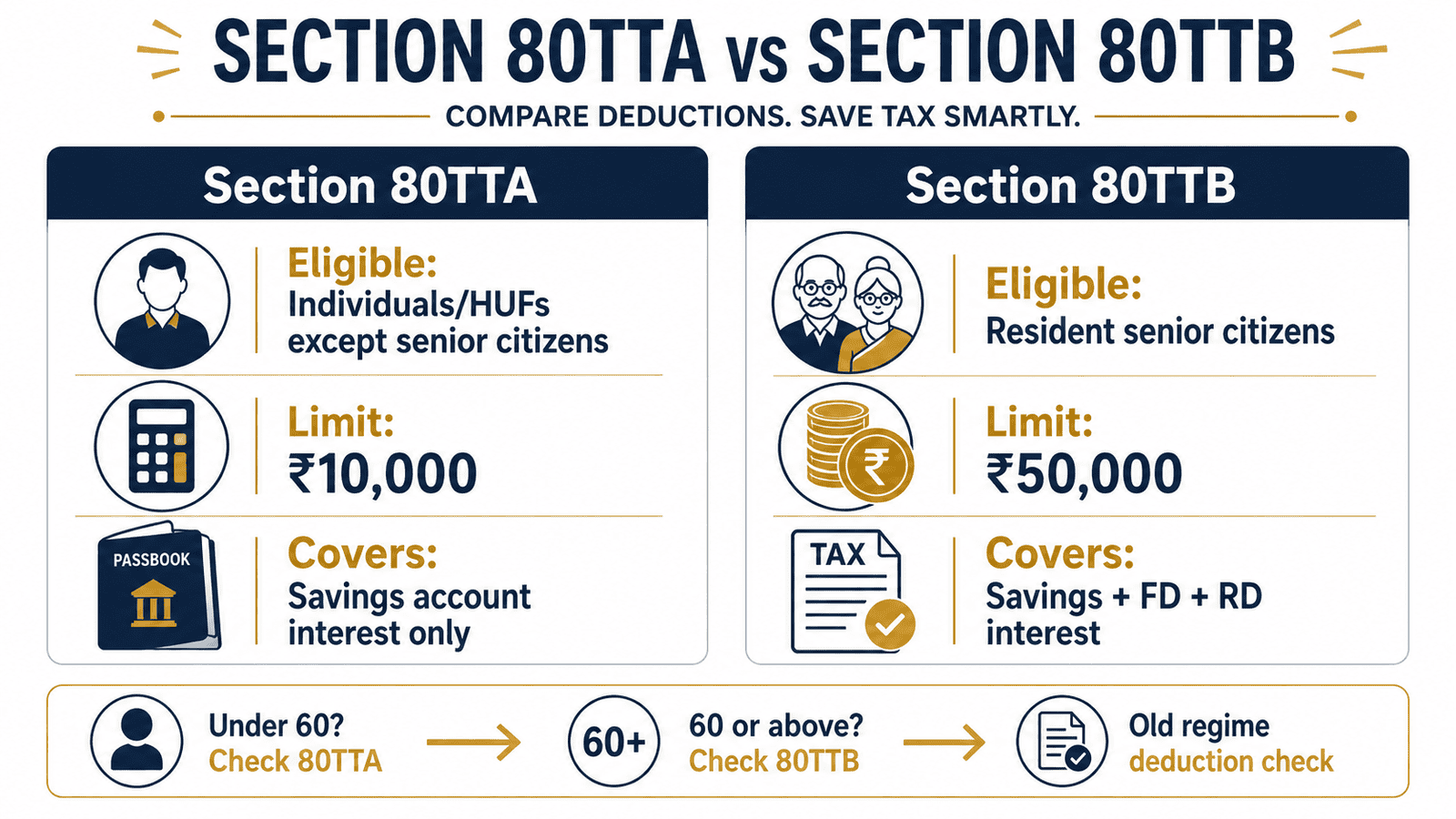
80TTA vs 80TTB decides which bank interest deduction applies. Most non-senior individuals and HUFs use 80TTA for savings account interest up to ₹10,000, while resident senior citizens use 80TTB for eligible savings and deposit interest up to ₹50,000.
Key Takeaways
- 80TTA and 80TTB are separate deductions — an individual taxpayer can only claim one, not both.
- Under 80TTA, eligible individuals and HUFs may deduct savings account interest up to ₹10,000 from income; the balance above that limit remains taxable.
- Resident senior citizens aged 60 or above can claim a deduction of up to ₹50,000 on eligible interest income under 80TTB — covering savings accounts as well as time deposits such as FDs and RDs.
- FD interest does not qualify under 80TTA for non-senior taxpayers; it must be reported in full as income from other sources.
- Interest income must always be reported first — the deduction reduces your taxable income, it does not make interest income invisible to the tax department.
- Both deductions are available only under the old tax regime; if you have opted for the new tax regime, these deductions are generally not available — check your regime before assuming any benefit. You can compare regimes using the tax regime comparison guide.
- A senior citizen who is a non-resident Indian may not be eligible for 80TTB — residency status must be confirmed before filing.
Comparison: Section 80TTA vs Section 80TTB
| Parameter | Section 80TTA | Section 80TTB |
|---|---|---|
| Who can claim | Individuals and HUFs (not covered by 80TTB) | Resident senior citizens (aged 60 or above) |
| Maximum deduction | Up to ₹10,000 per year | Up to ₹50,000 per year |
| Savings account interest | Eligible | Eligible |
| Fixed deposit (FD) interest | Not eligible | Eligible |
| Recurring deposit (RD) interest | Not eligible | Eligible |
| Post office savings interest | Eligible | Eligible |
| Cooperative bank savings interest | Eligible | Eligible |
| Tax regime availability | Old tax regime only | Old tax regime only |
| Senior citizen FD context | Not applicable | See senior citizen FD rules |
Key Facts at a Glance
| Detail | Section 80TTA | Section 80TTB |
|---|---|---|
| Applicable taxpayer | Individual / HUF (non-senior) | Resident senior citizen (60+) |
| Eligible interest type | Savings account only | Savings + time deposits (FD, RD) |
| Maximum deduction | ₹10,000 | ₹50,000 |
| FD/RD included | No | Yes |
| Where to report interest | Income from Other Sources in ITR | Income from Other Sources in ITR |
| Deduction available in new tax regime | Generally not available | Generally not available |
Understanding Section 80TTA and Section 80TTB
What Section 80TTA Covers
Section 80TTA of the Income Tax Act allows eligible individuals and Hindu Undivided Families to claim a deduction on interest earned from savings accounts held with a bank, a cooperative bank carrying on banking business, or a post office. The deduction is capped at the actual interest earned or ₹10,000, whichever is lower. If your savings account earned ₹7,500 in interest in a financial year, your deduction is ₹7,500. If it earned ₹15,000, your deduction is ₹10,000 — and the remaining ₹5,000 stays taxable.
Importantly, Section 80TTA does not cover interest from fixed deposits, recurring deposits, or any other time deposits. This is a common source of confusion for salaried employees who see a combined interest credit on their bank statement and assume the entire amount qualifies.
Section 80TTA also explicitly excludes assessees who are covered under Section 80TTB — meaning if you are a resident senior citizen, you cannot use 80TTA. You use 80TTB instead.
For a complete picture of which deductions are available under the old regime alongside 80TTA, the old regime deductions guide covers all Chapter VIA deductions in one place.
What Section 80TTB Covers
Section 80TTB was introduced specifically to provide a larger interest deduction to resident senior citizens — those who are 60 years of age or above at any point during the relevant financial year. The deduction limit under 80TTB is up to ₹50,000 and covers a broader category of interest income: savings account interest, fixed deposit interest, and recurring deposit interest — all from banks, cooperative banks, and post offices.
This is a meaningful difference. A retired individual earning ₹45,000 annually from FDs and ₹6,000 from a savings account can potentially claim a deduction on the combined ₹51,000 — up to the ₹50,000 limit — rather than only on the ₹6,000 savings component.
What “Time Deposits” Means
The term “time deposits” in Section 80TTB refers to deposits that are made for a fixed period — FDs and RDs are the most common examples. These are the deposits that earn guaranteed interest at agreed rates, unlike savings accounts where the rate floats. Non-senior taxpayers earn interest on FDs too, but that interest goes directly into taxable income with no deduction available under 80TTA.
Income from Other Sources — Report First, Deduct Second
This is where many beginners go wrong. Interest income — whether savings, FD, or RD — must be reported as “Income from Other Sources” in your ITR before any deduction is applied. The deduction under 80TTA or 80TTB then reduces your gross total income. You cannot simply skip reporting interest because you plan to claim a deduction — the income entry and the deduction entry are separate line items in your ITR form.
Understanding savings account interest calculations helps you verify the amount your bank credits before you report it.
Old Tax Regime Relevance
Both Section 80TTA and Section 80TTB deductions are generally applicable only under the old tax regime. If you have opted for the new tax regime for a financial year, you typically cannot claim these deductions. This makes your choice of tax regime especially relevant if you or a family member earns significant bank interest income. Verify your regime selection carefully — and use an income tax calculator to compare the impact in your specific situation.
Real Example: Two Taxpayers, Two Different Rules
Arjun, 35, Bengaluru — Software Engineer, ₹18 lakh annual salary
Arjun has a savings account that earned ₹14,000 in interest during FY 2024-25. He also has an FD that earned ₹22,000. Under Section 80TTA, only his savings account interest qualifies — and only up to ₹10,000. So he reports ₹36,000 (₹14,000 + ₹22,000) as income from other sources, claims a ₹10,000 deduction under 80TTA, and pays tax on the remaining ₹26,000. His FD interest of ₹22,000 receives no deduction benefit at all.
Meena, 67, Pune — Retired, pension + FD income
Meena’s bank accounts earned ₹8,000 in savings interest and her FDs earned ₹48,000 during the same year. As a resident senior citizen, she uses Section 80TTB. She reports ₹56,000 as income from other sources, then claims a deduction of up to ₹50,000 under 80TTB. Only ₹6,000 remains taxable as interest income. The key insight: Meena’s FD interest qualifies under 80TTB in a way it never would for Arjun under 80TTA.
How to Calculate Your Eligible Deduction
Deduction = Lower of (Total Eligible Interest Earned) or (Applicable Limit: ₹10,000 for 80TTA / ₹50,000 for 80TTB)
Step 1 — Identify all eligible interest income
For 80TTA: savings account interest only (from banks, cooperative banks, post office).
For 80TTB: savings + FD + RD interest (from banks, cooperative banks, post office).
Step 2 — Add up the eligible interest
Use your annual interest certificate from the bank, or cross-check with your AIS/Form 26AS on the income tax portal.
Step 3 — Apply the cap
If eligible interest is ₹7,000 → deduction is ₹7,000.
If eligible interest is ₹18,000 and your limit is ₹10,000 → deduction is ₹10,000; ₹8,000 remains taxable.
Step 4 — Report income, then deduct
Enter total interest income under “Income from Other Sources” in your ITR. Then claim 80TTA or 80TTB deduction in the deductions schedule. Never reverse this order.
| Scenario | Key Inputs | Taxable Interest After Deduction |
|---|---|---|
| Non-senior, ₹7,000 savings interest | 80TTA, ₹7,000 eligible | ₹0 (full deduction) |
| Non-senior, ₹14,000 savings + ₹22,000 FD | 80TTA, only ₹14,000 eligible; cap ₹10,000 | ₹26,000 (₹4,000 savings + ₹22,000 FD) |
| Senior citizen, ₹8,000 savings + ₹48,000 FD | 80TTB, ₹56,000 eligible; cap ₹50,000 | ₹6,000 |
How to Decide What’s Right for You
You are under 60, an individual taxpayer or HUF, and earn savings account interest — check whether Section 80TTA applies to you under the old tax regime.
You are a resident Indian aged 60 or above — check Section 80TTB, which covers both savings and time deposit interest up to ₹50,000 and is more beneficial than 80TTA.
You earn FD or RD interest and are not a senior citizen — that interest does not qualify under 80TTA. Report it fully as income from other sources.
You have opted for the new tax regime — check whether you can claim 80TTA or 80TTB at all; these deductions are generally not available under the new regime.
Your savings interest exceeds ₹10,000 and you are a non-senior — only ₹10,000 is deductible; the balance remains taxable and must be reported.
You want to verify what interest income has been reported against your PAN — check your AIS and Form 26AS on incometax.gov.in before filing. Cross-check with your savings account interest records.
You are a resident senior citizen — Section 80TTA is not the right section for you. Do not claim 80TTA when 80TTB is the applicable deduction for your age category.
Common Mistakes to Avoid
Not Reporting Savings Interest at All
Many salaried taxpayers skip reporting small savings account interest, assuming it is automatically exempt below ₹10,000.
Savings interest is taxable income — the deduction reduces your gross total income, it does not make the interest invisible. If you earn ₹9,500 in savings interest and do not report it, your ITR is technically incorrect even if the tax liability would have been zero after deduction.
Always report interest first under “Income from Other Sources,” then claim the deduction.
Claiming 80TTA on FD Interest
Section 80TTA covers only savings account interest. FD and RD interest is explicitly excluded for non-senior taxpayers.
A salaried employee claiming 80TTA on ₹30,000 of FD interest is claiming a deduction they are not entitled to. This can attract a notice from the income tax department if the FD interest appears in Form 26AS and the ITR shows a deduction without eligible savings interest to match.
Separate your savings interest and FD interest before filing — use your bank’s annual interest certificate.
Senior Citizens Attempting to Claim Both 80TTA and 80TTB
Section 80TTB explicitly covers individuals who qualify as senior citizens. Section 80TTA excludes assessees who are covered under 80TTB. Claiming both in the same ITR is not permitted.
A senior citizen earning ₹55,000 in combined savings and FD interest should claim up to ₹50,000 under 80TTB — not ₹10,000 under 80TTA alongside it.
Use only 80TTB if you are a resident senior citizen aged 60 or above.
Assuming Deduction Equals Tax-Free Income
A deduction reduces gross total income. It does not exempt you from TDS that the bank has already deducted, nor does it cancel your obligation to report the income.
If your bank deducted TDS on FD interest and you are a non-senior taxpayer with no 80TTA benefit on FDs, you may still need to report the income and claim TDS credit — not ignore it.
Report income fully; claim deduction separately; and reconcile TDS with your tax liability.
Forgetting Post Office or Cooperative Bank Interest
Both 80TTA and 80TTB cover savings accounts held with post offices and cooperative banks, not just scheduled commercial banks.
If you have a post office savings account earning ₹3,500 in interest, that amount counts towards the 80TTA limit. Many taxpayers miss this because they focus only on their primary bank savings account.
Collect interest certificates from every institution before filing.
Claiming 80TTA or 80TTB Under the New Tax Regime
These deductions are generally not available if you have opted for the new tax regime. Claiming them in your ITR under the new regime can result in a defective return notice.
Confirm your tax regime selection in your ITR carefully before entering any Chapter VIA deductions.
When This May Not Be the Right Choice
If you have opted for the new tax regime for the relevant assessment year, Section 80TTA and Section 80TTB deductions are generally not available to you. Switching regimes purely to claim a ₹10,000 deduction may not result in a net tax benefit — use a tax calculator to compare both options before deciding.
If the interest income belongs to a firm, AOP (Association of Persons), or BOI (Body of Individuals), Section 80TTA and 80TTB are not applicable. These sections apply to individuals and HUFs only.
If you are a senior citizen but hold NRI status during the relevant financial year, Section 80TTB may not be available to you — residency status determines eligibility. This needs careful verification on incometax.gov.in or with a qualified tax professional.
If your bank interest income significantly exceeds the deduction limit — for example, ₹2 lakh in FD interest for a non-senior — the deduction provides limited relief; the majority of the interest income remains fully taxable at your applicable slab rate.
If any of these apply to your situation, it may be worth exploring alternatives before committing.
Official Rules and Where to Verify
The rules governing Section 80TTA and Section 80TTB are contained in the Income Tax Act, 1961. Deduction limits, eligible taxpayer categories, and account types are all subject to amendment through the Union Budget or subsequent notifications. Always confirm current figures from official sources before filing.
- Income Tax Department — incometax.gov.in (ITR filing, AIS, Form 26AS, official section text)
- Reserve Bank of India — rbi.org.in (banking and cooperative bank regulations where relevant)
- Your bank or post office — annual interest certificates for savings and deposit accounts
Rules, limits, and rates on this topic can change with each Budget or regulatory update. Always verify current figures directly from the official source before making any financial decision.
Before filing, use the ITR filing checklist to make sure you have all interest certificates and income documents in order.
Expert Tips
- Download your annual interest certificate from every bank in March or April — most banks allow this through net banking or the bank branch. This gives you the exact savings and FD interest split you need for correct ITR reporting.
- Cross-check your interest income against your AIS on incometax.gov.in — the Annual Information Statement shows what banks have reported against your PAN. If the AIS shows a higher interest figure than your certificate, investigate the discrepancy before filing.
- Do not ignore interest below ₹500 — even small savings interest from a dormant account or post office account needs to be reported if it is taxable income. The deduction limit is not a filing exemption; it is a deduction from income.
- Keep senior citizen and non-senior family interest separate — if you manage finances for both a parent aged 65 and yourself, their ITRs need separate income and deduction entries. Your 80TTA and their 80TTB cannot be combined or confused across returns.
- Verify your tax regime before assuming deduction benefit — if you are unsure whether you are in the old or new regime for the current year, check your last employer TDS calculation or your previous ITR acknowledgment. Both 80TTA and 80TTB require the old regime to apply.
- If your savings interest is just above ₹10,000 — say ₹11,200 — the deduction brings only ₹10,000 off your taxable income. The remaining ₹1,200 is taxable at your slab rate. Do not assume the full amount is covered.
- Senior citizens with multiple FDs across banks — add all FD and savings interest across institutions before applying the ₹50,000 limit under 80TTB. The limit applies to the total, not per bank.
Frequently Asked Questions
Can senior citizens claim Section 80TTA?
No. Section 80TTA explicitly excludes assessees who are covered under Section 80TTB. Resident senior citizens aged 60 or above should use Section 80TTB, which provides a higher deduction of up to ₹50,000 covering both savings and time deposit interest.
Is FD interest covered under Section 80TTA?
No. Section 80TTA covers only savings account interest from banks, cooperative banks, and post offices. Fixed deposit and recurring deposit interest are time deposits and are not eligible under 80TTA. FD interest for non-senior taxpayers is fully taxable as income from other sources.
Is FD interest covered under Section 80TTB?
Yes, for resident senior citizens. Section 80TTB covers interest on both savings accounts and time deposits — including FDs and RDs — from banks, cooperative banks, and post offices. The combined eligible interest is deductible up to ₹50,000.
Is savings account interest fully tax-free if it is under ₹10,000?
Not exactly. Savings account interest under ₹10,000 may result in zero net tax liability after claiming the 80TTA deduction, but the interest is still taxable income that must be reported. You report it as income from other sources and then claim the deduction — if eligible interest is ₹8,000 and your limit is ₹10,000, the deduction offsets the full ₹8,000 and no tax is owed on it (assuming old regime).
Do I need to report interest before claiming a deduction?
Yes, always. Interest income must appear under “Income from Other Sources” in your ITR. The 80TTA or 80TTB deduction is then claimed separately in the deductions schedule. Reporting the income and claiming the deduction are two distinct steps — you cannot skip reporting simply because you intend to deduct it.
Can an HUF claim Section 80TTB?
No. Section 80TTB applies to individual resident senior citizens only. An HUF cannot claim 80TTB. HUFs may be eligible for 80TTA on savings account interest, subject to applicable conditions and the old tax regime requirement.
Does Section 80TTA apply to post office savings interest?
Yes. Interest earned on savings accounts held with a post office is eligible under Section 80TTA for non-senior individuals and HUFs. This is in addition to savings interest from scheduled commercial banks and cooperative banks. Note that post office time deposit interest does not qualify under 80TTA — only savings account interest does.
Can I claim both 80TTA and 80C together?
Yes, if you are a non-senior individual or HUF filing under the old tax regime, you can claim both 80TTA and 80C deductions in the same ITR — they are separate Chapter VIA deductions. However, 80TTA covers bank interest only, while 80C covers investments such as EPF, PPF, ELSS, and life insurance premiums.
What happens if my savings interest is higher than ₹10,000?
Under 80TTA, the deduction is capped at the lower of actual eligible savings interest or ₹10,000. If your savings account earned ₹13,500, you claim ₹10,000 as deduction and the remaining ₹3,500 is taxable as income from other sources at your applicable slab rate.
Final Verdict
Section 80TTA and Section 80TTB are not interchangeable — they serve different taxpayer categories and cover different types of interest income. If you are under 60, you use 80TTA and your deduction is limited to savings account interest up to ₹10,000. If you are a resident senior citizen aged 60 or above, you use 80TTB, which extends to FD and RD interest with a limit of up to ₹50,000 — a significantly broader and more valuable deduction.
The single most important thing to remember with 80TTA vs 80TTB is that reporting your interest income and claiming the deduction are two separate steps in your ITR. Skipping the income entry is not the same as a deduction. Both sections are also generally available only under the old tax regime, so your regime choice directly affects whether these deductions are accessible at all.
Verify current deduction limits at incometax.gov.in before filing — limits can be revised through the Union Budget. Always verify the latest rules from official sources or consult a qualified professional before making any financial decision.
This article is for educational purposes only and should not be treated as personalised financial, tax, investment, insurance, or legal advice. Tax rules, interest rates, regulatory limits, and product features can change with each Budget or policy update. Please verify current rules from official government sources or consult a qualified and registered professional before making any financial decision.

Kavita Mehra writes and edits Ridhi.com’s income tax content for Indian taxpayers, with a special focus on salaried employees and beginners who find tax rules confusing. Her work explains complex tax topics in simple language, helping readers understand how income, deductions, exemptions, rebates, TDS, Form 16, ITR filing, and refunds connect in real life.
She covers topics such as old vs new tax regime, income tax slabs, standard deduction, Section 87A rebate, HRA exemption, 80C, 80D, 80E, 80G, TDS on salary, taxable income, Form 16, AIS, Form 26AS, advance tax, and ITR filing checklists. Her content aims to help readers become more informed before filing returns or discussing tax matters with a professional.
Kavita’s approach is careful, compliance-focused, and official-source oriented. Because Indian tax rules can change after Budgets, circulars, and policy updates, her articles encourage readers to verify current figures, filing deadlines, and rules from the Income Tax Department or a qualified tax professional before acting.