You swipe your Indian credit card at a Singapore restaurant, the bill shows SGD 85, and you think nothing of it. A week later, your card statement shows an INR amount that is noticeably higher than what the exchange rate alone would explain. That gap — the difference between the foreign price and your final INR bill — is credit card foreign transaction charges at work. These extra costs can quietly add 3–5% or more to every overseas spend, whether you are travelling, booking a foreign hotel online, or paying for an international subscription from your sofa in Bengaluru. This article explains every charge layer, shows you the maths, and tells you exactly how to reduce the extra cost. Rates and features can change without notice; always verify current terms before you travel.
Quick Answer: Credit Card Foreign Transaction Charges
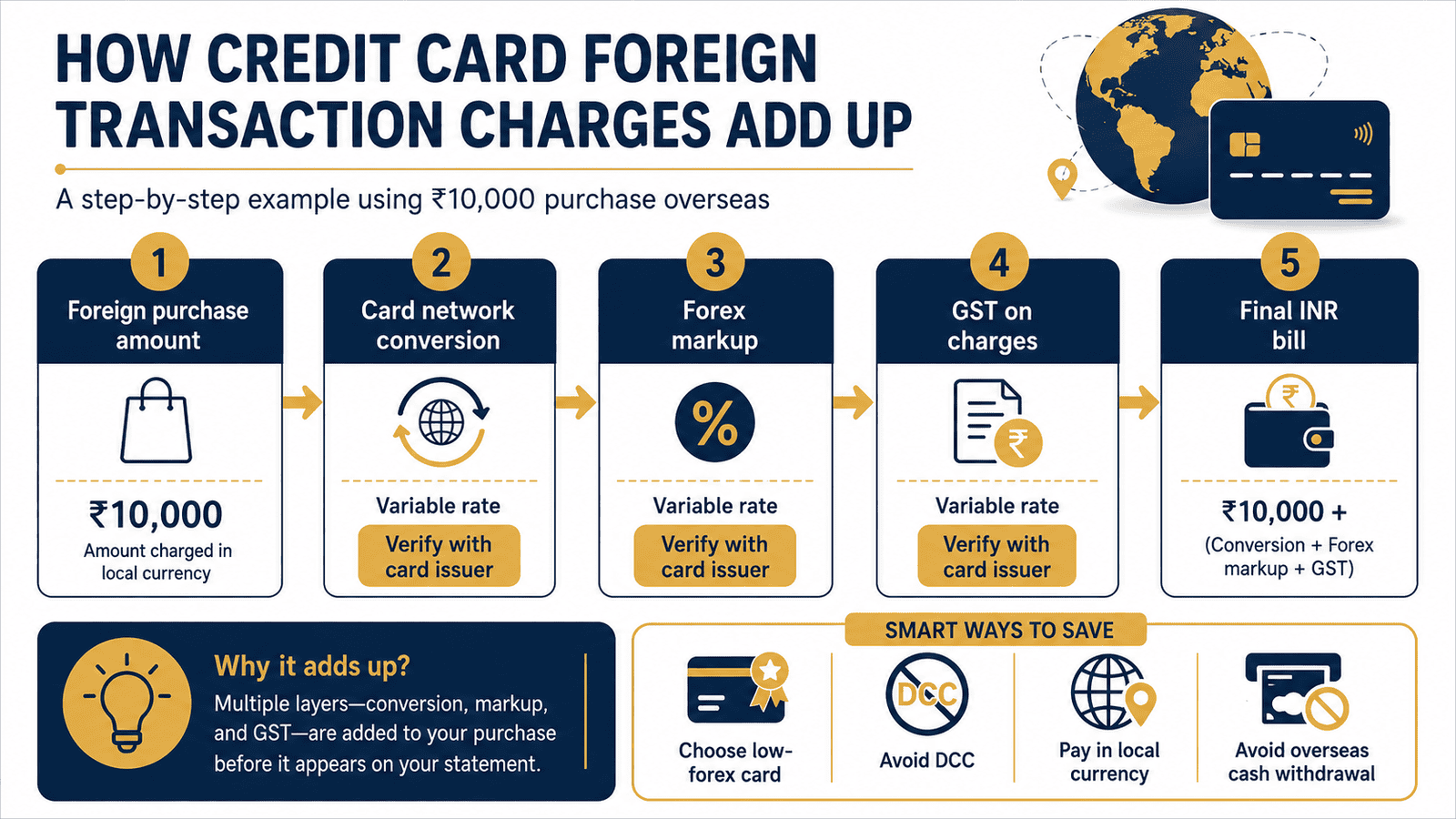
Credit card foreign transaction charges are extra costs added when you use an Indian credit card for overseas spends, usually including forex markup, network conversion, GST on fees, and possible DCC markup. For a ₹10,000 foreign purchase, compare card terms, pay in local currency, avoid ATM cash withdrawals, and choose lower-forex cards to reduce extra cost.
Key Takeaways
- Your final INR bill on a foreign purchase typically includes the card network’s conversion rate, the issuer’s forex markup, and GST on applicable charges — not just the raw exchange rate.
- Paying in INR at a foreign merchant terminal (Dynamic Currency Conversion) is not automatically cheaper — the DCC rate can add a further markup on top of normal issuer fees.
- Using your credit card at an ATM abroad can attract both a cash advance fee and a separate ATM usage fee, making it one of the costliest ways to access money overseas.
- A zero-forex-markup card reduces one layer of cost, but you still pay the card network’s conversion rate plus GST on other applicable charges — verify the full fee schedule in the MITC before applying.
- Reward points and cashback may partially offset forex costs, but only if the reward value per rupee spent exceeds the forex markup percentage — run the numbers for your card specifically.
- International online spends — subscriptions, e-commerce, foreign hotel bookings — attract the same foreign transaction charges as in-person overseas swipes; the card does not distinguish between the two.
- Always read your card’s Most Important Terms and Conditions (MITC) and fee schedule before international travel, as issuer charges vary widely across cards and can change without notice.
Key Facts at a Glance
| Charge Type | What It Is | Where to Verify |
|---|---|---|
| Card Network Conversion | Base INR equivalent set by Visa, Mastercard, or RuPay at the time of settlement | Visa / Mastercard exchange rate pages; card statement |
| Issuer Forex Markup | Percentage added by your bank or NBFC on top of the network rate; varies by issuer and product | Card MITC and fee schedule at issuer’s official site |
| GST on Charges | Goods and Services Tax applied on the issuer’s forex markup and other applicable card fees | GST rate: cbic.gov.in; applicable fees: card MITC |
| Dynamic Currency Conversion (DCC) | When a foreign merchant bills you in INR instead of local currency — often at a less favourable rate | Merchant terminal screen; compare with network rate before accepting |
| Overseas Cash Advance Fee | Fee for credit card ATM withdrawals abroad; often higher than domestic cash advance fee | Card MITC; charges vary by issuer |
| ATM Operator Fee | Fee charged by the foreign ATM operator directly; separate from issuer fees | Displayed at foreign ATM terminal before transaction |
How Credit Card Foreign Transaction Charges Work
When you swipe an Indian credit card at a foreign merchant — or pay an international website — the transaction travels through several layers before reaching your statement. Each layer can add cost. Understanding these layers is the first step to reducing them.
Layer 1: Card Network Currency Conversion
The transaction starts in foreign currency — say, USD or SGD. Your card network (Visa, Mastercard, RuPay, or Amex) converts this to INR using its own wholesale exchange rate on the settlement date. This rate is typically close to the interbank rate but is not the same as what you see on Google. The settlement date may differ from the transaction date by one to three business days, which means the INR amount can shift slightly between the time you swipe and the time the charge posts to your account.
Layer 2: Issuer Forex Markup
Once your bank or NBFC receives the INR-equivalent amount from the network, it adds its own forex markup — a percentage fee for processing the foreign currency transaction. This is issuer-specific. Some cards carry a markup in the range of 1.5% to 3.5% as of recent data, but rates vary widely and can change without notice. A zero-forex-markup card waives this layer, but the network conversion rate still applies. Always check the forex markup percentage in your card’s MITC rather than assuming it matches any figure you read online.
To see exactly where these charges appear in your monthly bill, read your credit card statement line by line — forex charges and GST are usually listed separately from the transaction amount.
Layer 3: GST on Applicable Charges
Goods and Services Tax is levied on the issuer’s forex markup and on other applicable card service fees. The applicable GST rate should be verified at cbic.gov.in and through your card MITC, as tax treatment of financial services can change. This means even a seemingly small markup percentage carries an additional tax cost on top of it.
Layer 4: Dynamic Currency Conversion (DCC)
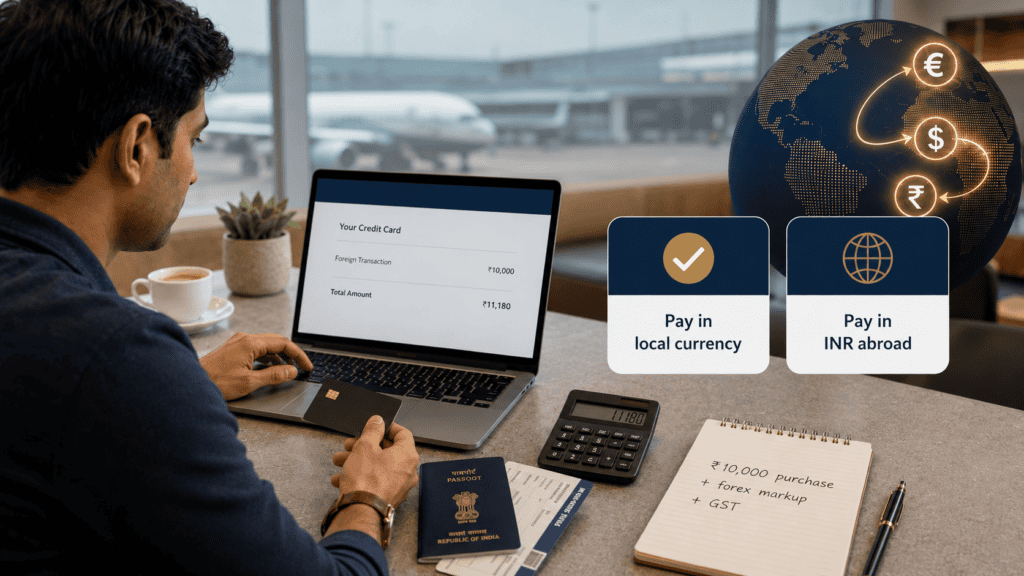
At many foreign hotels, restaurants, and shops — and sometimes on foreign e-commerce checkout pages — you may be offered the option to pay in INR rather than the local currency. This is Dynamic Currency Conversion. The merchant or acquiring bank sets the INR rate, which is often less favourable than the rate your card network would use. Accepting DCC does not save you from issuer markup or GST — it simply replaces the network rate with a potentially worse merchant rate, while the rest of the charges remain. According to RBI guidelines at rbi.org.in, cardholders have the right to choose their billing currency; you are never obligated to accept INR conversion at a foreign terminal.
Layer 5: Overseas Cash Advance and ATM Fees
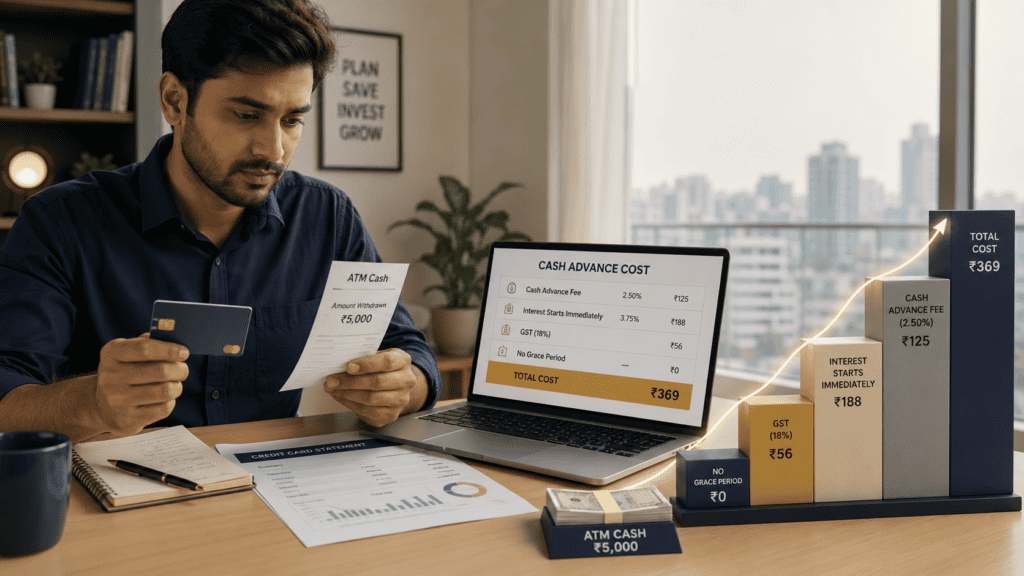
Withdrawing cash from a foreign ATM using your credit card is one of the most expensive ways to access money abroad. The transaction attracts the standard cash advance fee (a percentage of the amount withdrawn, subject to a minimum), plus the issuer’s overseas ATM usage fee if applicable, plus the foreign ATM operator’s own fee, plus interest from the date of withdrawal since cash advances typically have no interest-free period. The combined cost of these fees can make a cash withdrawal abroad significantly more expensive than a regular purchase transaction.
International Online Transactions
Foreign e-commerce, streaming subscriptions, software platforms, and hotel bookings made from India also attract foreign transaction charges if the merchant’s billing currency is not INR. The physical location of the cardholder is irrelevant — what matters is the currency of the transaction and the merchant’s country of registration. This surprises many readers who assume the charges only apply when travelling in person.
Real Example: Ananya’s Singapore Trip
Ananya, 31, is a product manager in Bengaluru earning ₹22 lakh per year. She uses her Indian credit card to pay a restaurant bill in Singapore equivalent to approximately ₹10,000 in INR terms at the day’s mid-market rate.
Here is how her final INR bill is built — using illustrative figures only, since actual rates must be verified from the issuer’s MITC and the card network’s published rate:
Step 1 — Network conversion: The card network converts SGD to INR at its settlement rate. Ananya gets a slightly different rate from the mid-market rate she checked on her phone — this is normal and issuer-independent.
Step 2 — Issuer forex markup: Ananya’s card carries a forex markup as per its MITC. On a ₹10,000 equivalent transaction, even a 2% markup adds ₹200 to her bill before taxes.
Step 3 — GST on the markup: GST at the applicable rate is added on the markup amount. If the markup is ₹200 and GST applies at 18% (verify at cbic.gov.in), that is an additional ₹36.
Scenario A — Paying in SGD (local currency): Ananya declines DCC at the terminal, pays in SGD, and her final INR bill is approximately ₹10,236 on a ₹10,000-equivalent purchase — the markup and GST account for the gap.
Scenario B — Accepting INR through DCC: The merchant terminal offers INR conversion at a rate that values the same meal at ₹10,500 before issuer markup. Ananya’s final bill could be higher than Scenario A, not lower. The key insight: paying in local currency and letting your card network convert is almost always preferable to accepting the merchant’s DCC rate.
How to Calculate Your Final Foreign Transaction Cost
Final INR Bill = (Foreign Amount × Network Exchange Rate) + Issuer Forex Markup % + GST on Applicable Charges + Any DCC Markup + Cash Advance / ATM Fee (if applicable)
Use these steps with your own card’s MITC figures before your next international trip:
Step 1: Take the foreign currency amount and multiply by the card network’s settlement rate on the transaction date. The network publishes daily rates on its official website.
Step 2: Add the issuer’s forex markup percentage. For a ₹10,000 equivalent transaction, a markup of 2% adds ₹200; a markup of 3.5% adds ₹350. Verify the exact percentage in your card MITC.
Step 3: Add GST on the forex markup and any other applicable service charges. Verify the current GST rate at cbic.gov.in.
Step 4: If you accepted DCC, your base INR amount in Step 1 is already the merchant’s conversion — which may be higher than the network rate. The issuer markup and GST still apply on top of this inflated base.
| Scenario | Key Variable | Likely Outcome on ₹10,000 Equivalent |
|---|---|---|
| Regular card, pay in local currency | Network rate + issuer markup + GST | ₹10,200–₹10,400 (illustrative; verify MITC) |
| Regular card, accept DCC in INR | Merchant DCC rate + issuer markup + GST | Potentially higher than above; DCC rate varies |
| Zero-forex-markup card, pay in local currency | Network rate + GST on applicable charges only | Closer to ₹10,000; verify full MITC for other fees |
| Credit card ATM cash withdrawal abroad | Network rate + markup + cash advance fee + ATM fee + interest | Materially higher than purchase transaction |
Comparison: Payment Options for Overseas Spending
| Payment Option | Cost Visibility | Key Trade-off |
|---|---|---|
| Regular credit card abroad | Medium — charges appear in statement after travel | Wide acceptance, rewards possible; forex markup and GST add cost |
| Low / zero forex markup credit card | Higher — markup layer removed or reduced | Annual fee may apply; network rate and GST still apply; verify full MITC |
| Debit card abroad | Medium — similar forex and network charges as credit card | No credit risk; exposes savings account; check issuer fee schedule |
| Prepaid forex card | High — rate locked at load time | Rate predictability; reload fees; limited acceptance at some merchants |
| Credit card ATM cash withdrawal | Low — multiple fee layers, interest from Day 1 | High Cost Avoid unless emergency; use prepaid card or debit card for cash instead |
How to Decide What’s Right for You
You travel internationally once a year or less — THEN check your existing card’s MITC for the forex markup percentage before applying for a new card. The annual fee on a dedicated travel card may exceed your total forex savings for occasional travel.
You travel internationally three or more times a year — THEN comparing low-forex or zero-forex-markup cards on annual fee, lounge access, reward rate on overseas spends, and customer support quality may make financial sense. Use “as of recent data” and verify current offers before applying.
You regularly pay for international online subscriptions or foreign e-commerce — THEN your card’s forex markup applies to every billing cycle, making a low-forex card worth investigating even without any travel.
Your card offers high reward points on overseas spends — THEN calculate whether the reward value per rupee exceeds your card’s forex markup percentage before concluding the card is cost-effective for international use. Compare rewards and cashback card value to run this calculation for your card type.
You are travelling with family and need a backup payment option — THEN carry at least two cards on different networks (e.g., Visa and Mastercard) and a small amount of local currency or a forex prepaid card for merchants that do not accept credit cards.
You have not read your card’s MITC before international travel — do not assume your forex charges will match any generic figure you read online. Issuer rates vary significantly and can change without notice. If you are choosing a first card for travel, compare card features and overseas fee schedules before applying.
Common Mistakes to Avoid
Accepting INR Conversion (DCC) Without Comparing Rates
Foreign merchants often present the INR amount on the terminal as a convenience, and many cardholders tap “confirm” without checking the exchange rate used.
The DCC rate set by the merchant or acquiring bank is typically less favourable than the rate your card network would apply. Accepting DCC does not remove issuer markup or GST — you simply pay a worse base rate before those charges are added.
Always choose local currency at the terminal unless you have confirmed that the DCC rate is genuinely better — which is rare.
Using a Credit Card for ATM Cash Withdrawal Abroad
A credit card ATM withdrawal abroad triggers the cash advance fee, the overseas ATM usage fee, the foreign ATM operator’s charge, and interest from the day of withdrawal — not from the due date.
On a ₹10,000-equivalent withdrawal, the combined fees and interest can add several hundred rupees before you even spend the cash. Avoid overseas cash withdrawal on a credit card whenever a debit card, prepaid forex card, or local currency alternative is available.
If you need emergency cash abroad, use a debit card linked to your savings account or a loaded forex prepaid card — both are cheaper options than a credit card ATM withdrawal.
Assuming Reward Points Always Offset Forex Charges
A card that earns accelerated reward points on overseas spends can appear to cancel out the forex markup. But reward value per point varies by redemption method, and expiry rules or capping may reduce the effective return.
If your card earns 5 reward points per ₹100 and each point is worth ₹0.25, your effective reward rate is 1.25% — which may not fully offset a forex markup of 2% or more plus GST.
Run the arithmetic for your specific card and redemption category before concluding the rewards make international spending free.
Ignoring the GST Line on Your Statement
Many cardholders notice the forex markup but miss the GST charged on it. On a ₹10,000 international transaction, a 2% markup is ₹200, and GST at the applicable rate adds further cost on top of that amount.
Check your statement carefully for lines labelled as “GST,” “tax on forex,” or similar descriptions — these are legitimate charges that add up across multiple transactions.
Verify the current GST rate applicable to credit card forex charges at cbic.gov.in before assuming any number you read is current.
Not Enabling or Disabling International Usage Correctly
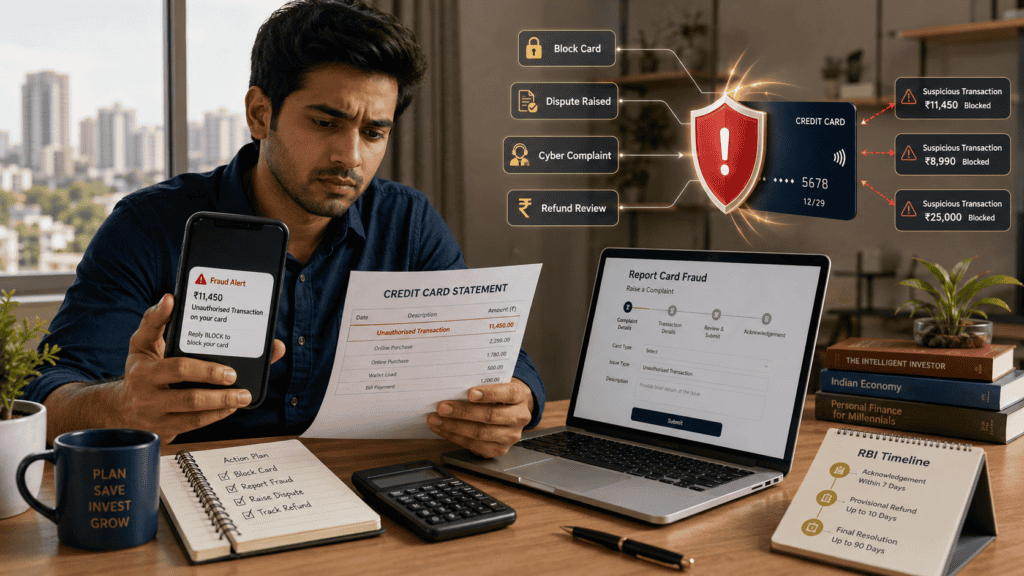
RBI guidelines require card issuers to provide cardholders with controls to enable or disable international usage. Leaving international use permanently enabled increases fraud exposure when you are not travelling.
Conversely, forgetting to enable international use before departure can result in declined transactions at foreign merchants or online platforms.
Enable international transactions a day before travel and consider disabling them after returning. Check your card issuer’s app or website for the exact control method.
Not Checking Whether an Online Purchase Is a Foreign Transaction
Booking a hotel through a foreign-registered platform, subscribing to a US-based streaming service, or paying for cloud software billed in USD all attract the same foreign transaction charges as an in-person overseas swipe.
Many readers are surprised to see forex charges on a transaction they made from home in India. The billing currency and the merchant’s registration country determine whether the charge is foreign — not your physical location.
Check whether the payment page shows a foreign currency amount before confirming, and factor in the forex markup for recurring subscriptions.
When This May Not Be the Right Choice
Using a standard Indian credit card for all overseas spending may not be the most cost-effective choice in every situation. Consider alternatives if any of the following apply to you:
Your card carries a high forex markup and low rewards. If the forex markup is above 2.5–3% and the card offers minimal reward on international spends, the extra cost on each transaction compounds quickly across a two-week trip or recurring subscriptions. A prepaid forex card loaded at a competitive rate may be cheaper for large, predictable spends.
The merchant consistently pushes DCC. Some hotel chains and tourist-area merchants default to INR billing. If you are at a destination where DCC is aggressively presented and you cannot decline it clearly, total costs rise further. In these cases, having a low-forex card or prepaid card as backup reduces exposure.
You will need frequent cash withdrawals. If the destination is largely cash-based and ATM access is the primary source of local currency, using a credit card for those withdrawals is one of the most expensive choices available. A debit card or prepaid forex card is better suited for this need.
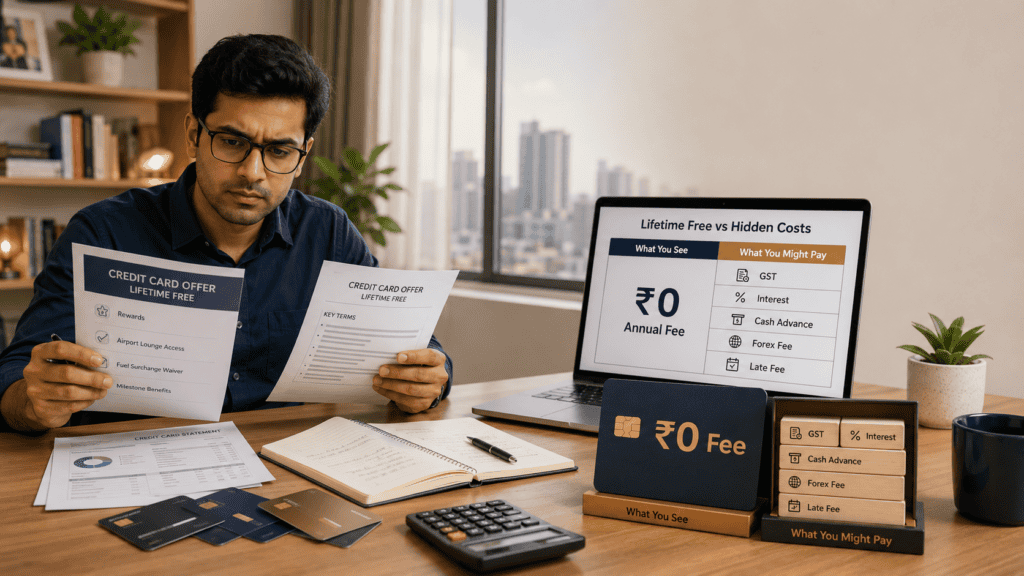
The annual fee on a dedicated travel card exceeds your expected forex savings. A card that saves 2% on forex but costs ₹5,000 per year in annual fee requires at least ₹2.5 lakh in annual international spending to break even on the fee alone — before accounting for reward redemption. Check hidden card costs before committing to a paid travel card.
If any of these apply to your situation, it may be worth exploring alternatives before committing.
Official Rules and Where to Verify
Foreign transaction charges on Indian credit cards are governed by card issuer policies within the framework of RBI guidelines. Because rates and terms can change at any time, always verify directly from the authoritative sources below before your next international spend:
- RBI (Reserve Bank of India) — rbi.org.in: For broad credit card regulatory guidelines, cardholder rights, and the Master Direction on Credit Cards and Debit Cards.
- Your card issuer’s official website: For the Most Important Terms and Conditions (MITC), the schedule of charges, and the current forex markup percentage specific to your card product.
- Visa, Mastercard, or RuPay exchange rate pages: For the network’s daily settlement rates used to convert foreign currency to INR.
- CBIC — cbic.gov.in: For the current GST rate applicable to credit card service charges and forex fees.
- NPCI — npci.org.in: For RuPay card-specific guidelines on international acceptance and fees.
- Your card statement and SMS/app alerts: For the actual INR amount billed on each foreign transaction, including all charges separately itemised.
Rules, limits, and rates on this topic can change with each Budget or regulatory update. Always verify current figures directly from the official source before making any financial decision.
Expert Tips
- Always pay in local currency at foreign terminals. When a merchant terminal or online checkout offers to bill you in INR, decline and choose the local currency. The DCC rate almost always works against you. Your card network’s conversion rate, while not perfect, is typically more transparent and competitive.
- Enable international usage the day before departure — not weeks before. Most card issuer apps now let you toggle international transactions on and off in under a minute. Keeping the limit enabled for extended periods when you are not travelling increases fraud risk without any benefit.
- Check your statement within a week of returning from any international trip. Foreign transaction charges and potential DCC discrepancies are easier to dispute when raised promptly. Most issuers have a dispute window; don’t let unfamiliar charges sit unreviewed. Report suspicious card use through your issuer’s official channels immediately.
- Carry one card on a different network as a backup. If your primary card is Visa, carry a Mastercard as backup. Acceptance varies by country and merchant type. Having both networks available prevents a declined transaction from becoming a crisis in an unfamiliar city.
- For frequent international online subscriptions, calculate the annual forex cost. If you pay ₹2,000 per month across foreign-billed services and your card carries a 2% markup plus GST, you are paying an extra ₹480–₹550 per year in forex charges alone on subscriptions — enough to justify checking whether a lower-forex card makes sense.
- Read the full MITC for any new card before applying. Card marketing may highlight “low forex fee” or “travel benefits” without spelling out the annual fee, reward cap, or minimum spend for waiver. The MITC is the legally binding document — it is available on every issuer’s official website and is typically downloadable as a PDF.
- Keep a small amount of local currency or a loaded prepaid forex card for cash-dependent situations. This avoids the temptation of a credit card ATM withdrawal when a taxi driver or market stall does not accept cards — the most predictable expense trigger for expensive overseas cash advances.
Frequently Asked Questions
What are credit card foreign transaction charges?
Credit card foreign transaction charges are fees added to a transaction when you use an Indian credit card to make a payment in a foreign currency or to a foreign merchant. They typically include the card network’s currency conversion, the issuer’s forex markup, and GST on applicable charges. Some transactions may also include a DCC markup if you accepted INR billing at a foreign terminal.
Is forex markup the same as the exchange rate?
No. The exchange rate converts foreign currency to INR — this is determined by the card network (Visa, Mastercard, RuPay) on the settlement date. The forex markup is a separate percentage fee charged by your bank or NBFC on top of that converted INR amount. Both apply to most foreign transactions, but they are distinct charges appearing on different lines of your statement.
Should I pay in INR or local currency when abroad?
Almost always choose local currency. When you accept INR billing through Dynamic Currency Conversion at a foreign terminal, the exchange rate used is set by the merchant or acquiring bank — typically less favourable than your card network’s rate. You do not avoid issuer markup or GST by accepting DCC; you simply add a potentially worse base rate on top of those charges. According to RBI guidelines, you have the right to choose your billing currency; always exercise it.
Do international online subscriptions attract foreign transaction charges?
Yes. If a subscription service is registered in a foreign country and bills in a foreign currency — whether it is a US-based streaming service, a cloud software tool, or a foreign e-commerce platform — your Indian credit card will treat the payment as a foreign transaction. The issuer’s forex markup, network conversion rate, and GST on applicable charges all apply, regardless of whether you are physically in India when the payment is processed.
Are zero forex markup cards really free for international use?
Not entirely. A zero-forex-markup card removes the issuer’s markup layer, but the card network’s currency conversion rate still applies, and GST may apply on other fees. Some zero-forex cards carry annual fees, require minimum spends for fee waiver, or apply reward earning restrictions on overseas transactions. Verify the full fee schedule in the card’s MITC — “zero forex markup” describes one specific charge, not total freedom from all international transaction costs.
Is using a credit card for cash withdrawal abroad safe?
It is technically possible but financially costly. A credit card ATM withdrawal abroad attracts a cash advance fee (a percentage of the amount, often with a minimum floor), an overseas ATM usage fee from the issuer, the foreign ATM operator’s charge, and interest from the withdrawal date — not from the statement due date. The combination makes it one of the most expensive ways to access money overseas. Use a debit card or a prepaid forex card for overseas cash needs wherever possible.
Can rewards offset foreign transaction fees?
Sometimes, but not always. To calculate whether rewards offset costs, divide the reward value per rupee spent by the forex markup percentage. If your card earns reward points worth 1% back on overseas spends and your forex markup is 2%, you are still paying 1% net on each transaction before GST. Compare rewards and cashback card value against the forex cost for your specific card and redemption method before concluding that rewards make international spending cost-neutral.
Where can I check my card’s current foreign transaction fee?
The most reliable source is your card’s Most Important Terms and Conditions (MITC), available on the issuer’s official website — usually downloadable as a PDF from the card product page or the “schedule of charges” section. You can also call the issuer’s customer care or log in to your card account to view the current fee schedule. Rates shown on comparison sites or third-party articles may be outdated; the MITC is the legally binding document.
What is Dynamic Currency Conversion and how does it affect my bill?
Dynamic Currency Conversion (DCC) is when a foreign merchant or ATM offers to convert your transaction to INR at the point of sale, rather than letting your card network handle the conversion. The DCC rate is set by the merchant’s acquirer and typically includes a margin that works against the cardholder. If you accept DCC, the INR amount is already fixed before your issuer adds its markup and GST — meaning you could pay more on both conversion and fees. Decline DCC and pay in local currency to avoid this additional markup.
Can I dispute a DCC charge on my credit card statement?
If you believe you did not explicitly consent to DCC, or if the rate was not disclosed clearly before you confirmed the transaction, you can raise a dispute with your card issuer. Keep your transaction receipts showing the currency and amount. Contact the issuer’s dispute resolution channel promptly — most issuers have a defined window for raising transaction disputes, and delays can reduce your chances of resolution. Per RBI guidelines at rbi.org.in, issuers are required to have a complaint redressal mechanism for cardholders.
Final Verdict
Credit card foreign transaction charges are not a single fee — they are a stack of costs that includes network conversion, issuer forex markup, GST on applicable charges, and potentially a DCC markup if you accepted INR billing at a foreign terminal. For most Indian travellers, the biggest avoidable cost is accepting DCC without comparing the rate, and the most expensive error is using a credit card for ATM cash withdrawals abroad. Understanding how your specific card builds these charges is more valuable than any general benchmark figure, because rates and terms vary significantly across issuers and change without notice. A low-forex card can reduce extra cost for frequent international spenders, but only after you verify the annual fee, reward structure, and full MITC — not just the headline markup percentage. Always verify the latest rules from official sources or consult a qualified professional before making any financial decision.
This article is for educational purposes only and should not be treated as personalised financial, tax, investment, insurance, or legal advice. Tax rules, interest rates, regulatory limits, and product features can change with each Budget or policy update. Please verify current rules from official government sources or consult a qualified and registered professional before making any financial decision.

Nikhil Bansal writes about credit cards, billing cycles, card charges, rewards, cashback, credit utilisation, card EMI, BNPL, and responsible credit usage in India. His content is designed for readers who want to use credit cards wisely without falling into expensive repayment mistakes.
He covers topics such as how to choose a first credit card, credit card billing cycle, due date, grace period, minimum amount due, credit utilisation ratio, reward points vs cashback, lifetime free credit cards, annual fee waivers, credit card statement reading, add-on cards, cash advance charges, EMI on credit cards, credit card fraud reporting, BNPL vs credit card, and foreign transaction fees.
Nikhil’s writing is beginner-friendly, direct, and risk-aware. He explains how small mistakes such as paying only the minimum due, withdrawing cash from a credit card, missing due dates, or overusing credit limits can become costly. Since card fees, interest rates, reward rules, waiver conditions, and bank offers change often, readers should verify the latest Most Important Terms and Conditions from the card issuer.