

Most Indian families insure their cars without a second thought. Many now buy health insurance. Yet the ₹80 lakh flat they spent years saving for — with all its furniture, electronics, and personal belongings — often sits completely uninsured. Home insurance in India remains one of the most under-purchased financial products, even as floods, earthquakes, and urban fires make headlines every monsoon season.
There is also a lot of confusion here. Is the property insurance your bank bundled into your home loan actually useful? Does it cover a flood, or just the loan outstanding? Who needs structure cover, who needs contents cover, and who genuinely does not need either right now?
This guide cuts through the noise. It explains what home insurance in India covers, what it excludes, how premiums are calculated, and — most importantly — whether you actually need it and which type fits your situation.
Quick Answer: Home Insurance in India
Home insurance in India protects your house structure, and sometimes contents, against risks such as fire, natural calamities, burglary, and accidental damage, depending on the policy. It is most useful for homeowners, flat owners, landlords, and home-loan borrowers with property worth ₹50 lakh or more.
Key Takeaways
- Home insurance and home loan insurance are two different products — one protects the physical property, the other repays your outstanding loan balance if you die.
- Structure cover protects the building; contents cover protects furniture, electronics, and valuables inside — you can buy either separately or together.
- If you are a tenant, you do not own the structure, so structure insurance is your landlord’s concern — but contents cover for your own belongings may still make sense.
- A low premium means nothing if you have not read the exclusions — damage from poor maintenance, gradual wear, or pre-existing cracks is routinely excluded.
- Bharat Griha Raksha is a standardised home insurance product and an important benchmark to understand before comparing other policies.
- Claim documents — bills, photos, policy schedule — must be kept ready in advance; assembling them after a loss is harder and increases the risk of a dispute.
- According to IRDAI (irdai.gov.in), home insurance is not mandatory in India unless linked to a specific lender requirement.
Key Facts at a Glance
| Parameter | Detail |
|---|---|
| What it can cover | Structure, contents, or both — depending on policy chosen |
| Who can buy it | Homeowners, flat owners, landlords, tenants (contents only), home-loan borrowers |
| Covered perils (typical) | Fire, lightning, flood, earthquake, cyclone, burglary, accidental damage |
| Common exclusions | Wear and tear, maintenance damage, war, nuclear hazard, pre-existing damage |
| Is it mandatory? | No — not mandated by law; some lenders may require property insurance for a loan |
| Claim documents (typical) | Policy schedule, FIR (for theft), photos of damage, bills/invoices for contents |
| Regulatory body | Insurance Regulatory and Development Authority of India (IRDAI) — irdai.gov.in |
| Standardised product | Bharat Griha Raksha — available from multiple insurers |
How Home Insurance Works in India
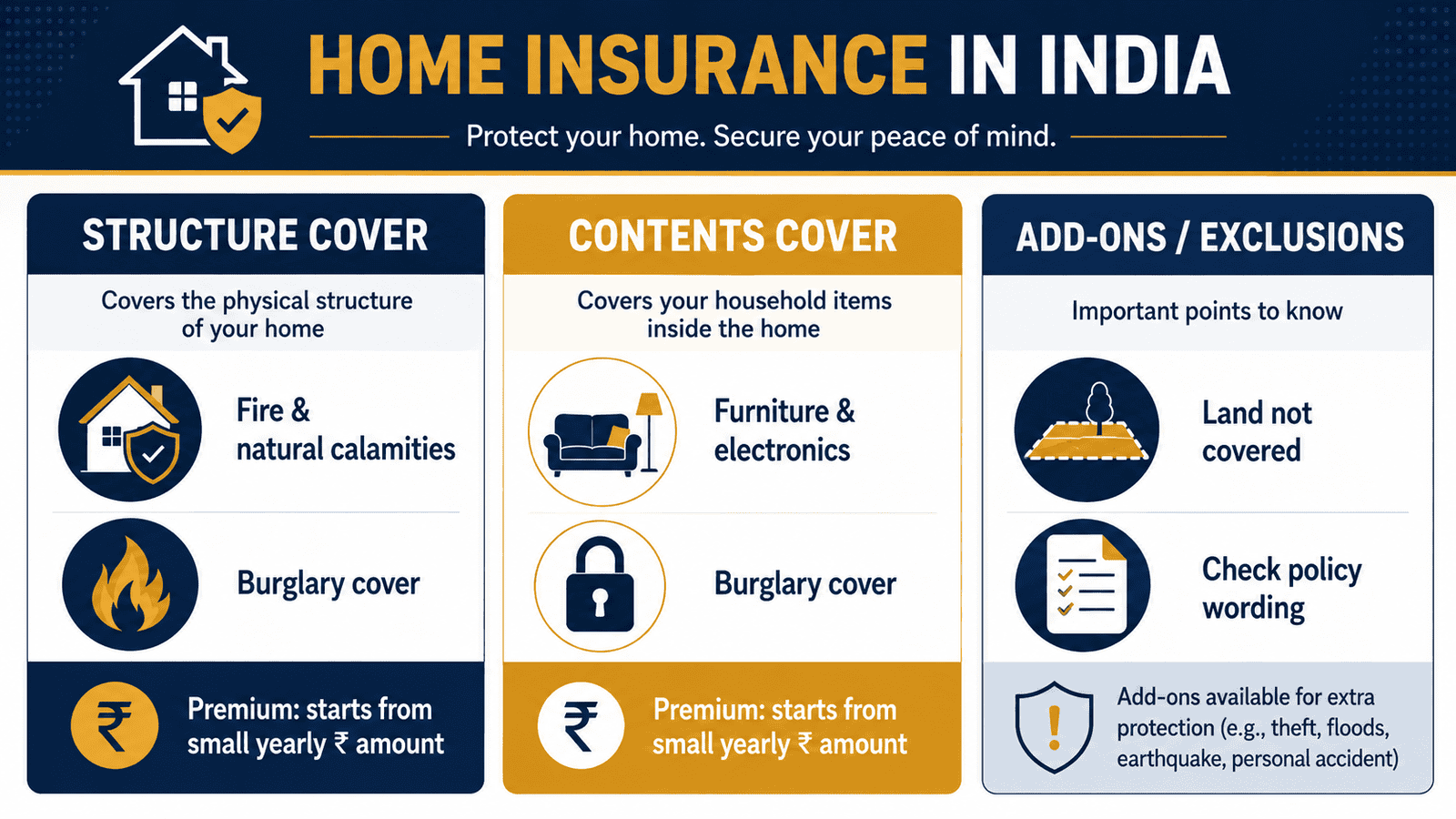
Home insurance in India is broadly split into two categories: structure cover and contents cover. You can buy either individually or as a combined package. Understanding this split is the first step — because most confusion about home insurance starts here.
Structure Cover (Building Insurance)
Structure cover insures the physical building — the walls, roof, floors, doors, windows, fitted fixtures, and permanent fittings like plumbing and electrical wiring. If a fire damages your kitchen walls or a cyclone rips off the roof, structure cover is what pays for reconstruction.
The sum insured under structure cover is typically based on reconstruction cost — not market value and not land value. This is an important distinction. If you own a flat worth ₹90 lakh in Bengaluru, the land underneath is not insurable under a home policy. What matters is the cost to rebuild the built-up area. Reconstruction cost is generally lower than market value, which means you do not need to insure your property for its full purchase price.
Contents Cover
Contents cover protects moveable items inside the home — furniture, televisions, laptops, refrigerators, washing machines, jewellery (subject to limits), and other household belongings. This is particularly relevant for tenants who do not own the structure but own everything inside it, and for homeowners with expensive interiors.
Some policies cover contents automatically up to a limit. Others require you to declare specific items. High-value items such as jewellery or art may need separate scheduling. Always check whether your contents are included automatically or need a separate declaration — this is a common point of confusion at claim time.
Fire and Allied Perils, Natural Calamities, Burglary
Most home insurance policies in India group covered risks into standard categories. Fire and allied perils typically include fire, lightning, explosion, aircraft damage, and riot or strike damage. Natural calamity cover usually includes earthquake, flood, cyclone, storm, and landslide. Burglary and theft cover applies to break-in and forced entry. Accidental damage to the structure may be covered under some policies but not others — read the policy wording carefully, as IRDAI-registered policies differ in scope across insurers.
Bharat Griha Raksha — The Standardised Policy
IRDAI introduced Bharat Griha Raksha as a standardised home insurance product available across registered general insurers in India. It offers a common set of covered perils — making it easier to compare across insurers — and covers the building structure along with basic home contents. Because the product definition is standardised, comparing Bharat Griha Raksha quotes across two or three insurers is a cleaner exercise than comparing different proprietary products where the fine print varies significantly.
Home Insurance vs Term Insurance vs Loan Protection
These three products solve entirely different problems. Family protection planning through term insurance replaces your income for dependents if you die — it does not protect the physical property. Home loan insurance or mortgage protection repays the outstanding loan balance if the borrower dies — again, it does not cover physical damage to the structure. Home insurance covers the actual building and contents against damage, loss, and natural calamity. Do not assume that buying home loan insurance means your flat is covered if a flood damages it. These are separate risks requiring separate cover, depending on your situation.
Real Examples: Who Needs What
Coverage needs look very different depending on whether you own, rent, or let out your property. Here are four realistic scenarios.
Scenario 1 — Flat owner with home loan, Pune: Rahul, 38, works in IT in Pune and recently bought a ₹95 lakh apartment on a home loan. His lender suggested property insurance during home loan process documentation. Rahul’s primary concern should be structure cover for the reconstruction value of the flat — not the full purchase price. If the building suffers fire or flood damage, a structure policy covers repairs. His loan protection insurance (if any) covers his outstanding loan balance in case of death — an entirely separate risk.
Scenario 2 — Tenant with electronics, Bengaluru: Priya, 31, rents a flat and owns a ₹1.5 lakh laptop, a ₹60,000 TV, and assorted appliances worth another ₹80,000. The structure is the landlord’s concern — Priya needs contents cover only. A standalone contents policy may protect her belongings against theft, fire, and accidental damage.
Scenario 3 — Landlord renting out a flat, Chennai: Suresh, 55, has a flat that he rents out. His tenant’s belongings are not his responsibility, but the structure is. A basic structure-only home insurance policy protects his investment against physical damage.
Scenario 4 — Homeowner in flood-prone zone, Mumbai or Hyderabad: Meena, 45, owns her flat in a low-lying area with a history of flooding. Natural calamity cover — including flood and inundation — is relevant here. She should confirm with the insurer that flood damage to the structure and contents is explicitly covered, not excluded.
How to Think About Premium vs Potential Loss
Home insurance premium in India depends on multiple factors: the sum insured for the structure (based on reconstruction cost, not market value), the sum insured for contents, the property’s location, the building’s construction type (RCC, load-bearing, or mixed), add-ons chosen, and the insurer’s own pricing. Premium also varies depending on the policy period — some policies allow a one-time long-term premium for multi-year cover.
Annual Premium (indicative) = Base Rate × Sum Insured ÷ 1,000 + Add-on loadings
To illustrate the logic without using live rates: suppose Vikram owns a flat with a reconstruction value of ₹75 lakh. His contents — furniture, appliances, and electronics — are worth approximately ₹8 lakh. An indicative combined policy might apply a base rate to each sum insured separately. The annual premium for such a policy is typically a small fraction of the total sum insured. The right question is not “is the premium cheap?” but “how does this premium compare to the cost of repairing or replacing what I would lose in a fire, flood, or burglary?” For a ₹75 lakh reconstruction value, even a 20% partial loss is ₹15 lakh — making a multi-year policy worth evaluating seriously.
Note: Reconstruction cost is not the same as land value. Land is excluded from the insurable value. Request a reconstruction cost estimate from the insurer or a licensed valuer — do not self-estimate. Actual premium rates vary by insurer and must be confirmed directly from insurer websites or their registered agents.
Structure vs Contents vs Combined: Which Fits Your Situation?
| Cover Type | What Is Protected | Best Suited For |
|---|---|---|
| Structure Only | Building, walls, roof, fixtures, fittings | Homeowners, flat owners, landlords with no/minimal contents risk |
| Contents Only | Furniture, appliances, electronics, valuables | Tenants; homeowners who already have structure cover elsewhere |
| Structure + Contents (Combined) | Both building and belongings | Owner-occupied homes with significant interior investment |
| Key Limitation | Exclusions apply to all three; check policy wording | Wear and tear, maintenance damage, and pre-existing damage not covered |
How to Decide What’s Right for You
You own your home outright and it is worth ₹50 lakh or more in reconstruction value — THEN structure cover is likely worth evaluating, especially if you live in a region prone to floods, cyclones, or earthquakes.
You have a home loan — THEN check whether your lender’s bundled property insurance is standalone structure cover or a loan protection plan; they are different, and you may need both separately depending on your exposure.
You are a tenant with electronics, appliances, or valuables worth ₹3 lakh or more — THEN a contents-only policy may be worth considering, since your belongings are not covered by the landlord’s policy.
You are a landlord renting out a furnished flat — THEN check whether your standard structure policy covers contents left in the flat; many do not include tenant-occupied furnished contents automatically.
You live in a flood-prone, cyclone-prone, or seismically active area — THEN confirm explicitly with the insurer whether natural calamity perils including flood and earthquake are covered or excluded. Check insurer claim reliability before purchasing, not after a claim.
You have recently renovated your home or purchased expensive appliances — THEN your existing cover may be underinsured. Updating the sum insured after a major purchase is the policyholder’s responsibility, not the insurer’s.
You are a tenant with minimal belongings and no significant electronics or furniture investment — you may not need home insurance at all right now. Address term insurance and health insurance first as higher-priority protection.
Common Mistakes to Avoid
Buying only because the bank bundled it
Many home-loan borrowers purchase property insurance because the lender presented it alongside the loan documents.
The bundled policy may be a loan protection plan — not structure or contents cover. If your flat is damaged by fire, a loan protection policy does not pay for repairs; it only covers your outstanding loan balance in the event of your death. Treating these as interchangeable is a costly misunderstanding. Just as employer cover limits can leave significant health gaps, a lender-bundled plan may leave your physical property entirely unprotected.
Ask your lender explicitly: does this policy cover physical damage to the structure? If not, evaluate a separate structure policy.
Assuming contents are covered when only structure is insured
A structure-only policy does not cover furniture, electronics, or valuables.
A family with ₹6 lakh in appliances and electronics might recover ₹0 for stolen or fire-damaged contents if they bought only a building policy. The policy schedule clearly states what is and is not included — reading it is not optional.
If contents are important, either choose a combined policy or add a contents endorsement.
Ignoring exclusions and deductibles
Most home insurance policies exclude gradual deterioration, wear and tear, seepage, and maintenance-related damage.
If water seeps through a poorly maintained roof over time and damages the interior, this is typically maintenance damage — not a covered peril. Policyholders who discover this during a claim are understandably frustrated. Reading the exclusions section before buying — not after a loss — prevents this.
Check the deductible or excess too: you bear the first portion of any claim, which affects how small claims are handled.
Underinsuring expensive interiors
Renovations — premium flooring, modular kitchens, custom wardrobes — can add ₹10 lakh or more to a flat’s interior value but may not be reflected in the original sum insured.
In the event of a fire, the insurer pays based on the declared sum insured, not the actual replacement cost. If your declared contents value is ₹4 lakh but the actual replacement cost is ₹9 lakh, you absorb the difference.
Review your sum insured annually or after any significant purchase or renovation.
Not keeping documentary evidence for claims
Insurers typically require supporting documents to assess and settle a claim. For contents, this means purchase invoices, warranty cards, or photographs. For structure damage, this means photos taken immediately after the incident.
Many policyholders do not maintain records of household items until a loss occurs — by which point some documentation is unrecoverable. A phone photo album and a shared folder with scanned invoices takes one afternoon to set up and can materially reduce claim disputes.
Store documents in cloud storage, not only on a device that could itself be lost in the same event.
Not verifying the claim intimation window
Most home insurance policies require the policyholder to intimate a claim within a defined period after the incident. Missing this window can result in a reduced settlement or rejection.
This window varies by insurer and policy — check the claims section of your policy document specifically, rather than assuming a standard number of days.
When This May Not Be the Right Choice
If you are a tenant with minimal furnishings — a cot, a basic TV, a few appliances totalling under ₹1.5 lakh — a standalone contents policy may add more process than protection. Your emergency fund and health insurance are higher priority uses of the same budget.
If your primary concern is title risk, builder default, or a legal property dispute, home insurance does not address any of those. Insurance covers physical damage, not ownership disputes or construction delays. For those risks, RERA rights, legal title verification, and a rent or buy decision based on thorough due diligence are more relevant protections.
If you have not yet purchased term insurance or built a basic emergency fund, those provide broader financial resilience and may deserve priority over home insurance for most Indian families at the beginning of their protection journey.
If any of these apply to your situation, it may be worth exploring alternatives before committing.
Official Rules and Where to Verify
Home insurance in India is regulated by the Insurance Regulatory and Development Authority of India (IRDAI). All general insurers offering home insurance products are registered with and governed by IRDAI. For regulatory context, product category definitions, and consumer rights related to insurance, refer to irdai.gov.in.
For specific policy coverage, exclusions, premium rates, and claim procedures, always refer to:
- The official website of your chosen insurer — registered on irdai.gov.in
- Your policy schedule and policy wording document issued at the time of purchase
- Your lender’s official loan documentation if property insurance was linked to a home loan
- The proposal form, claim intimation form, and any add-on endorsement documents
Rules, limits, and rates on this topic can change with each Budget or regulatory update. Always verify current figures directly from the official source before making any financial decision.
Expert Tips
- Compare coverage scope first — not premium. Two policies at similar premiums can differ sharply on whether flood or earthquake is covered, whether contents are included, and what the deductible is. The cheaper policy is not better if it excludes your highest-risk peril.
- Before buying, ask the insurer one direct question: “If my flat is flooded and the interiors are damaged, what exactly will the claim cover and what will be excluded?” The answer will tell you more than the brochure.
- Use Bharat Griha Raksha as a baseline comparison. Because its covered perils are standardised, comparing its premium and terms across two or three IRDAI-registered insurers is more apples-to-apples than comparing proprietary products with varying fine print.
- Photograph your major household items — room by room — and save the images to cloud storage along with purchase invoices. This takes under an hour and can prevent significant disputes during a theft or fire claim.
- Update your sum insured after any renovation or significant purchase. The insurer does not automatically adjust your cover if you add a modular kitchen worth ₹4 lakh after the policy was issued.
- Check the claim intimation timeline in your policy document — not the marketing brochure. Some policies require intimation within 24 to 48 hours for theft claims. Missing this window, even unintentionally, can complicate your settlement.
- If you are buying home insurance alongside a home loan, ask the lender in writing whether the bundled insurance covers physical structural damage or only the outstanding loan balance in case of death. These are different products. Both may be relevant — but they are not substitutes for each other.
Frequently Asked Questions
Is home insurance mandatory in India?
No. Home insurance is not legally mandatory in India. Some lenders may require borrowers to have property insurance as a condition of the home loan, but this is a lender requirement, not a law. IRDAI does not mandate it. Verify with your lender whether any such condition applies to your specific loan agreement.
Does home insurance cover earthquakes and floods in India?
It depends on the policy. Many standard home insurance policies in India include earthquake and flood under natural calamity cover, but this is not universal. Some policies treat these as add-ons. Read the perils section of the policy document carefully and ask the insurer explicitly before purchasing — especially if you live in a seismically active zone or a flood-prone area.
Can a tenant buy home insurance in India?
Yes. A tenant cannot buy structure insurance — because they do not own the building — but they can buy a contents-only home insurance policy to protect their furniture, electronics, and valuables. The landlord is responsible for insuring the structure, not the tenant’s belongings.
Is home insurance required for a home loan?
Not mandated by law, but some lenders include property insurance as part of the loan terms. What lenders often bundle is a home loan protection plan — which covers the outstanding loan balance if the borrower dies — not damage to the physical structure. These are different. If your lender’s bundled product does not cover physical structural damage, a separate home insurance policy may fill that gap. Consult your lender’s official loan documents for the exact requirement. For a full picture of the loan process, see the home loan process guide.
What is not covered in a typical home insurance policy?
Common exclusions include: gradual wear and tear, maintenance-related deterioration, pre-existing damage at policy inception, damage caused by poor upkeep, war and nuclear perils, wilful damage, and loss of cash or documents unless specifically covered. Exclusions vary by policy — always read the exclusions section of your policy document, not just the coverage highlights. Understanding exclusions is as important as understanding coverage, just as it is with health cover basics.
How is the claim amount calculated for home insurance?
It depends on whether the policy is on a reinstatement value basis (paying the cost to repair or rebuild) or a market value or indemnity basis (paying current value after depreciation). Reinstatement value policies are generally more favourable for the policyholder, particularly for older properties. Check which basis your policy uses — it materially affects the payout. The deductible you bear is also subtracted from any claim settlement.
What is Bharat Griha Raksha?
Bharat Griha Raksha is a standardised home insurance product mandated by IRDAI and available from registered general insurers in India. Because the covered perils and product structure are defined by the regulator, it is easier to compare quotes across insurers than with proprietary products. It typically covers the building structure and basic home contents against standard perils. Check with individual insurers for current pricing and specific terms, as premium and add-on availability may vary.
What happens if I am underinsured at the time of a claim?
If your sum insured is lower than the actual reconstruction or replacement cost, insurers may apply an “average” or pro-rata clause. This means the insurer pays only a proportionate share of the claim, not the full loss. For example, if your flat’s reconstruction cost is ₹80 lakh but you insured it for ₹40 lakh, the insurer may settle only 50% of a valid claim. This is a significant risk of underinsurance — one of the strongest reasons to periodically review your sum insured.
Can I claim home insurance if the damage was caused by a neighbour’s actions?
It depends on the cause and the policy wording. If your flat is damaged by a fire that started in a neighbouring unit, your home insurance policy may cover your damage under fire and allied perils — subject to the policy terms. Third-party liability claims and recovery from the negligent party are separate matters. Some policies include third-party liability cover; check your policy schedule to confirm.
Final Verdict
Home insurance in India is a genuinely useful product for homeowners, flat owners, landlords, and home-loan borrowers — particularly those with property worth ₹50 lakh or more, those living in flood-prone or seismically active areas, and those with significant interior investment. It is not a luxury. For a property that represents years of savings, the annual premium is a small cost relative to the reconstruction or replacement exposure.
That said, it is not a substitute for term insurance, health insurance, or a basic emergency fund — those remain higher-priority for most Indian families starting their financial protection journey. And buying a policy without reading the exclusions is worse than not buying at all, because it creates false confidence. Coverage scope, claim settlement behaviour, and exclusion clarity matter far more than the cheapest premium. Use the guidance here, compare at least two IRDAI-registered insurers, and read the policy document before paying. Always verify the latest rules from official sources or consult a qualified professional before making any financial decision.
This article is for educational purposes only and should not be treated as personalised financial, tax, investment, insurance, or legal advice. Tax rules, interest rates, regulatory limits, and product features can change with each Budget or policy update. Please verify current rules from official government sources or consult a qualified and registered professional before making any financial decision. Insurance is a subject matter of solicitation. Please read the policy document carefully before purchasing.

Priya Nambiar writes about insurance concepts for Indian families, salaried employees, self-employed professionals, and first-time policy buyers. Her content focuses on helping readers understand coverage, exclusions, claim conditions, premiums, riders, and policy documents before buying or renewing insurance.
She covers topics such as term insurance, health insurance, family floater plans, riders, critical illness cover, employer insurance vs personal insurance, waiting periods, exclusions, deductibles, co-payment, no-claim bonus, claim settlement, premium comparison, renewal rules, and tax benefits linked to insurance.
Priya’s writing is careful, consumer-focused, and policy-document oriented. She explains why insurance should be understood as financial protection, not just a tax-saving tool or investment substitute. Her articles encourage readers to compare coverage, understand limitations, and ask better questions before buying a policy. Premiums, exclusions, claim rules, and benefits vary by insurer, age, health, sum insured, and product type. Insurance is a subject matter of solicitation, and readers should read the official policy document carefully before purchasing.