

Your bank relationship manager, insurance agent, or a colleague at the office has probably pitched this at some point: “Sir, one plan — insurance plus investment. Cover for your family, returns for your future.” It sounds efficient. But when you sit down to compare actual numbers, the picture gets complicated fast.
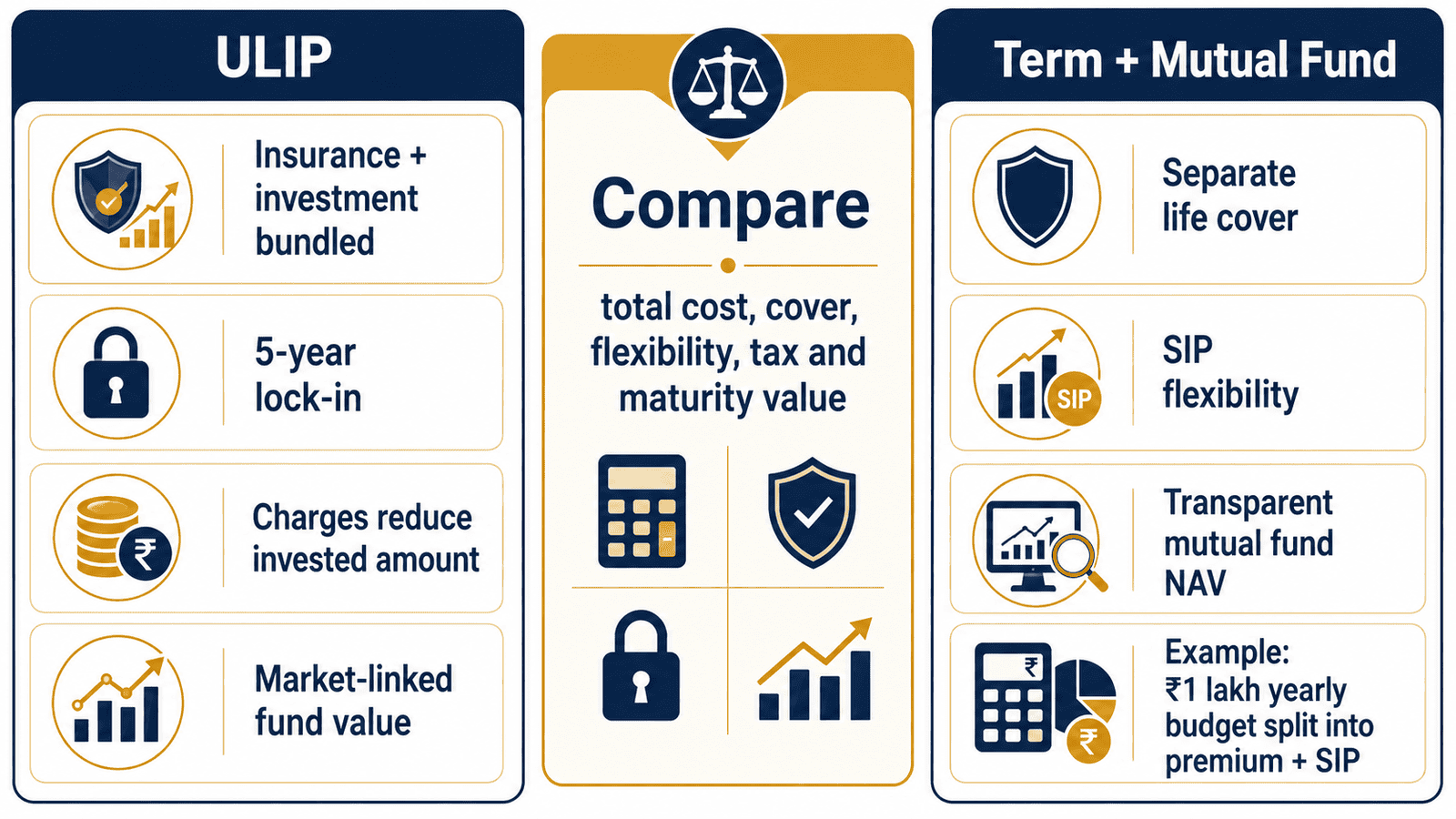
ULIPs — Unit Linked Insurance Plans — bundle life cover with market-linked investing. Term insurance plus a mutual fund SIP keeps those two jobs separate. For a salaried family in India with a fixed budget, the choice between these two routes affects life cover adequacy, long-term wealth, charges, and tax treatment. This article breaks down both options using the same annual budget, the same tenure, and real ₹ figures — so you can compare outcomes, not just features.
Quick Answer: ULIP vs Term Insurance and Mutual Fund
ULIP vs term insurance and mutual fund is a comparison between buying one bundled insurance-investment product and separating protection from investing. For example, a ₹1 lakh yearly budget may buy lower bundled cover in a ULIP, while term insurance plus SIP can separate family protection from market-linked wealth creation. Actual outcomes depend on age, health, insurer, charges, fund performance, and tenure.
Key Takeaways
- A ULIP combines life cover and market-linked investment in one premium — but only a portion of your premium actually goes into the fund after charges.
- Term insurance plus mutual fund SIP separates protection and wealth creation, making costs and returns visible for each component independently.
- ULIPs typically carry a 5-year lock-in period; surrendering early triggers surrender charges and can result in significant loss of invested capital.
- ULIP charges — including premium allocation, mortality, fund management, and policy administration — can cumulatively reduce fund value, especially in the first few years.
- Term insurance premiums can be as low as ₹8,000–₹15,000 per year for a ₹1 crore cover for a 30–35-year-old non-smoker, freeing up the remaining budget for SIP investment.
- Tax treatment under Section 80C and Section 10(10D) for ULIPs and Section 80C for ELSS SIPs can change — verify current rules at incometax.gov.in before deciding.
- The right choice depends on your life cover requirement first — never compromise on family protection to chase investment packaging.
ULIP vs Term Insurance and Mutual Fund: Side-by-Side Comparison
| Parameter | ULIP | Term Insurance + Mutual Fund SIP |
|---|---|---|
| Product structure | Bundled insurance + investment in one premium | Separate pure-risk cover + standalone SIP |
| Life cover | Sum assured included; may be lower relative to premium | Term plan offers high cover at low cost (e.g. ₹1 crore for ₹8,000–₹15,000/year) |
| Investment control | Limited to ULIP-linked funds; switching allowed within policy | Full flexibility — any fund house, any category, any time |
| Key charges | Premium allocation, mortality, fund management, policy administration, surrender charges | Term premium + mutual fund expense ratio (typically 0.5%–1.5% for direct funds) |
| Lock-in period | 5 years (verify current rule at irdai.gov.in) | No lock-in for most mutual funds; ELSS has 3-year lock-in |
| Liquidity | Low in first 5 years; surrender charges apply | High — mutual fund units can be redeemed any time (subject to exit load period) |
| Tax treatment | 80C for premium; 10(10D) for maturity — verify current limits and conditions | 80C for ELSS SIP; LTCG/STCG for equity fund gains — verify current rules |
| Ideal use case | Disciplined long-term investor who understands charges and wants a bundled structure | Families wanting maximum cover + transparent, flexible investing |
| Verify before buying | Policy document, benefit illustration, charge table — from insurer directly | Scheme information document, expense ratio, riskometer — from AMC / SEBI |
Key Facts at a Glance
| Term / Concept | What It Means | Where to Verify |
|---|---|---|
| ULIP (Unit Linked Insurance Plan) | Life insurance policy where part of premium buys insurance cover and part is invested in market-linked funds (equity, debt, or balanced) | irdai.gov.in |
| Term Insurance | Pure life cover with no maturity value in standard policies; pays sum assured only on death during policy term | irdai.gov.in |
| Mutual Fund SIP | Systematic Investment Plan — fixed periodic investment into a market-linked mutual fund scheme | sebi.gov.in |
| Sum Assured | The guaranteed life cover amount payable to the nominee on death of the insured | Policy document |
| NAV (Net Asset Value) | Per-unit price of a ULIP fund or mutual fund, calculated daily based on market value of holdings | AMC / insurer website |
| Surrender Value | Amount payable if a ULIP is exited before maturity; may be nil if surrendered within lock-in period | Policy document |
| Section 80C / 10(10D) | Tax deduction on premium paid / possible tax treatment on maturity proceeds — rules apply with conditions; verify current limits | incometax.gov.in |
| Expense Ratio | Annual fee charged by a mutual fund as a percentage of assets under management | sebi.gov.in, AMC SID |
How a ULIP Works — And Why the Premium Split Matters
When you pay a ULIP premium, it does not go entirely into investment. According to IRDAI guidelines, ULIPs are required to disclose all charges, but the allocation structure means several deductions happen before your money reaches the fund.
The premium allocation charge is deducted first — this is a percentage of the premium that covers distribution, underwriting, and administrative costs. In some products, this can be as high as 5%–35% in the first year, reducing sharply in later years. Whatever remains after this deduction buys fund units.
From those fund units, the insurer then deducts a mortality charge every month — the cost of the actual life cover you hold. This charge increases with age, meaning the older you are, the more expensive your insurance protection becomes within the ULIP structure.
A fund management charge (FMC) is applied on the fund value daily. IRDAI has capped the FMC for ULIPs; verify the current cap at irdai.gov.in. Additionally, a policy administration charge may be deducted monthly from fund units throughout the policy tenure.
Put together, these charges can meaningfully reduce the compounding of your invested money — particularly in the first 5–7 years. This is why ULIP benefit illustrations must be read carefully, and why comparing ULIP fund value with a direct mutual fund SIP without accounting for charges leads to misleading conclusions. You can explore life cover basics to understand why pure protection is the foundation before comparing investment options.
How Term Insurance Plus Mutual Fund SIP Works
The alternative approach separates the two jobs entirely. Term insurance buys the maximum possible life cover for the lowest possible premium — leaving more of the annual budget free for investing. A healthy 30–35-year-old non-smoker can typically get ₹1 crore of pure life cover for ₹8,000–₹15,000 per year, though actual premiums vary by age, health, sum assured, riders, policy term, and the insurer you choose.
The remaining budget goes into a mutual fund SIP — directly into the market through a fund house of your choice, in any category that matches your risk profile and time horizon. The expense ratio on a direct mutual fund plan (bought directly from the AMC or through SEBI-registered platforms) is typically 0.5%–1.5% per year for equity funds, compared to the layer of charges in a ULIP. Understanding mutual fund basics can help first-time investors evaluate the investment side of this route.
The advantage of this separation is cost visibility — you know exactly what you are paying for insurance and exactly what you are investing. The discipline requirement is real: unlike a ULIP that forces continued payment due to lock-in, a term plus SIP structure only works if the investor actually keeps investing the difference consistently over the long term.
According to SEBI’s framework for mutual funds, all mutual fund schemes must disclose their expense ratio, riskometer, and investment objective in the Scheme Information Document (SID). This transparency is a meaningful advantage when comparing with ULIP fund charges.
Real Example: Rohit’s ₹1 Lakh Annual Budget, Pune
Rohit is 34, works as an IT manager in Pune, earns ₹18 lakh per year, and has a spouse and one child. He has a ₹1 lakh annual budget for insurance and long-term investment. A financial advisor has pitched him a ULIP; he is comparing it with term insurance plus SIP over a 20-year horizon.
Route A — ULIP: Rohit puts the full ₹1 lakh into a ULIP. After premium allocation charges (assumed at 5% in Year 1, declining thereafter), mortality charges, fund management charges, and policy administration charges, the effective amount invested in the fund is meaningfully lower than ₹1 lakh in early years. The sum assured in a standard ULIP is often 10 times the annual premium, meaning Rohit may receive ₹10 lakh life cover — far below what a family with his income actually needs.
Route B — Term + SIP: Rohit pays approximately ₹12,000 for a ₹1 crore term insurance cover (indicative — actual premium depends on age, health, insurer, and riders). The remaining ₹88,000 per year goes into a direct equity mutual fund SIP. Over 20 years, ₹88,000 per year at an assumed 10% CAGR (not guaranteed; illustrative only) grows to approximately ₹56 lakh. At 12% CAGR it grows to approximately ₹71 lakh. At 8% CAGR it grows to approximately ₹44 lakh. Simultaneously, his family has ₹1 crore in life cover from day one.
The key insight: Route B gives Rohit’s family 10x more life cover for the same budget while keeping investment costs transparent and flexible. The actual comparison will differ based on the specific ULIP product, fund selection, charges, and market performance — but the structural difference in cover adequacy is significant.
How to Calculate and Compare Both Routes
SIP Future Value (approximate) = P × [((1 + r)^n − 1) / r] × (1 + r)
Where P = monthly SIP amount, r = assumed monthly return rate, n = number of months
Step 1 — Fix the same annual budget for both routes. Use ₹1,00,000 in this example.
Step 2 — Deduct the term premium. Term premium for ₹1 crore cover: approximately ₹12,000 per year (indicative for a 34-year-old non-smoker; actual premium varies). Remaining for SIP: ₹88,000 per year = ₹7,333 per month.
Step 3 — Estimate SIP value under assumed return scenarios. These are not guaranteed; market returns fluctuate.
| Scenario | Assumed CAGR (Illustrative) | Approx SIP Value After 20 Years |
|---|---|---|
| Conservative | 8% per annum | ~₹44 lakh |
| Moderate | 10% per annum | ~₹56 lakh |
| Optimistic | 12% per annum | ~₹71 lakh |
Step 4 — Estimate ULIP value after charges. ULIP fund value depends on premium allocation charges, mortality charges, FMC, policy administration charges, and the specific fund’s NAV performance. Always request the benefit illustration from the insurer that shows projected values at 4% and 8% assumed returns as mandated by IRDAI. Do not compare only the “high return” projection.
Step 5 — Compare life cover separately. A standard ULIP with ₹1 lakh annual premium typically provides ₹10 lakh in sum assured. Route B provides ₹1 crore. For a family with a ₹18 lakh annual income, ₹10 lakh cover is severely inadequate. You can use the SIP growth estimator to test the investment side with your own budget and assumptions.
How to Decide What’s Right for You
Your family depends on your income and you need ₹50 lakh–₹2 crore in life cover — THEN start with a term insurance plan to secure that cover first, before allocating to any investment product.
You are considering a ULIP — THEN request the benefit illustration showing all charges year by year and compare the net fund value against a simple SIP projection at the same assumed return rate.
You have the discipline to invest the premium difference every month without skipping — THEN term plus SIP gives you higher transparency, more flexibility, and typically more life cover per rupee.
You know from experience that you will spend the investment difference instead of investing it — THEN a ULIP’s forced premium structure may keep you more disciplined, provided you understand and accept the lock-in and charges.
You are a high-income earner and the tax treatment of a ULIP is a key consideration — THEN verify the current conditions under Section 10(10D) and applicable premium limits at incometax.gov.in before deciding, as rules have changed in recent Budgets.
You do not need life cover at all (for example, you have no financial dependents and significant existing assets) — THEN neither a ULIP nor a term plan may be necessary; evaluate direct mutual fund investing on its own merits instead. Use the right cover amount calculator to check your actual need.
Common Mistakes to Avoid
Comparing ULIP Fund Value with Mutual Fund Value Without Comparing Life Cover
Many comparisons show only the projected maturity value of a ULIP alongside a mutual fund SIP — without mentioning that the ULIP’s sum assured may be ₹10 lakh while the term plan in the alternative route offers ₹1 crore.
This makes the ULIP appear more attractive on investment grounds while hiding a severe gap in family protection. Always compare the complete package: life cover amount, projected fund value after charges, and premium paid.
Instead: run the comparison using the same annual budget, list both the life cover and the investment value separately for each route.
Ignoring the Full Charge Stack in a ULIP
Buyers often notice only the fund management charge when reviewing a ULIP. But the premium allocation charge, mortality charge, and policy administration charge collectively reduce the investable amount — especially in early years.
A ULIP that deducts even 10% of the first-year premium in allocation charges means ₹10,000 out of every ₹1 lakh never reaches the fund. Over 5–10 years, this compounds into a meaningful difference in wealth creation.
Instead: ask for the complete charge table from the insurer and model the impact over your intended policy term. Check how the fund cost impact of mutual fund expense ratios compares with ULIP charges over time.
Buying a ULIP Primarily for Tax Saving
ULIP premiums can qualify under Section 80C (subject to conditions and limits) and maturity proceeds may receive tax treatment under Section 10(10D) — but tax rules have changed across Budgets and conditions apply.
Buying a 20-year policy only to save tax in March, without reading the charges and lock-in, is a costly mistake. Surrendering early to exit a poorly chosen ULIP can result in surrender charges and taxable gains depending on the year of exit.
Instead: verify current tax rules at incometax.gov.in and consider whether the investment quality and charges justify the purchase, independent of tax benefit.
Assuming ULIP Illustrated Returns Are Guaranteed
IRDAI mandates that product illustrations show projections at standard assumed return rates — they are not guaranteed. Many buyers conflate the illustration with a promise.
If market-linked fund performance is lower than the illustration rate, your actual maturity value will be lower — and charges still apply regardless of performance.
Instead: always model the conservative scenario from the benefit illustration and compare it with a similarly conservative SIP scenario.
Choosing an Insurer Only by Premium or Agent Promise
For term insurance, the cheapest premium or the most persuasive salesperson is not sufficient basis for selection. The insurer’s claim settlement history matters — particularly for a 20–40-year policy where the claim may be filed decades later.
Check the insurer claim record using IRDAI’s annual report data before committing to any long-term insurance product.
Surrendering a ULIP Early Without Modelling the Cost
Surrendering a ULIP within the lock-in period means the surrender value is paid only after the lock-in ends — not immediately. In some cases, the amount returned may be significantly lower than premiums paid due to accumulated charges.
Instead: if you are reconsidering an existing ULIP, review the surrender value statement from the insurer and consult a qualified financial advisor before exiting.
When This May Not Be the Right Choice
ULIP may not be right for you if you need liquidity within the first 5 years — surrender within the lock-in period means your money is locked and any surrender will attract charges. It may also be unsuitable if the sum assured is inadequate for your family’s income replacement need, which is a common outcome when the premium is split between insurance and investment.
Term plus SIP may not be right for you if your investment behaviour shows that you consistently spend the “savings” rather than investing them. The separation only works if the SIP actually runs. If you have no knowledge of or interest in mutual funds and will not monitor the SIP periodically, you may not get the expected benefit.
Mutual fund SIPs in equity funds are subject to market volatility and are generally unsuitable for goals with a horizon under 5 years. Do not replace emergency funds or short-term goals with equity SIPs. Review the fund cost impact to understand how expense ratios affect long-term returns.
If any of these apply to your situation, it may be worth exploring alternatives before committing.
Official Rules and Where to Verify
Rules, limits, and rates on this topic can change with each Budget or regulatory update. Always verify current figures directly from the official source before making any financial decision.
- IRDAI (Insurance Regulatory and Development Authority of India) — irdai.gov.in: for ULIP charge caps, lock-in rules, sum assured requirements, benefit illustration format, and insurer claim settlement data.
- SEBI (Securities and Exchange Board of India) — sebi.gov.in: for mutual fund regulations, expense ratio limits, and scheme classification guidelines.
- Income Tax Department — incometax.gov.in: for current rules on Section 80C deductions, Section 10(10D) exemption conditions for ULIP maturity proceeds, and LTCG/STCG tax treatment for equity mutual fund gains.
- Insurer’s Policy Document and Benefit Illustration: for ULIP-specific charges year by year, surrender value table, and projected maturity values at standard assumed return rates.
- Mutual Fund Scheme Information Document (SID): for expense ratio, riskometer, investment objective, and exit load details for any specific SIP you are considering.
Expert Tips
- Always ask the agent or insurer for the IRDAI-mandated benefit illustration before signing a ULIP — it must show projected values at standard assumed return rates. If you are not shown this document, ask for it in writing before proceeding.
- When reviewing a ULIP benefit illustration, focus on the column showing lower assumed returns (typically 4%) — not just the higher projected scenario. This conservative figure is closer to a stress-test outcome and sets realistic expectations.
- Separate the cover question from the investment question entirely. First decide: how much life cover does my family need? Then evaluate which product provides that cover at the lowest cost. Only then consider investment options.
- Check the ULIP charge table year by year — most products show dramatically improving net invested amounts after Year 5. If your budget and goals can’t sustain a 15–20 year commitment, this product may not suit you.
- For the mutual fund side, use direct plans (bought directly through the AMC or SEBI-registered online platforms) rather than regular plans — the expense ratio difference of 0.5%–1% per year compounding over 20 years can amount to a significant portion of your final corpus.
- Do not use tax benefit as the primary reason to buy either a ULIP or an ELSS SIP. Tax rules can change; the underlying financial merit of the product must justify the investment on its own.
- If you already hold a ULIP and are unsatisfied with charges or cover, do not surrender impulsively. Request the current surrender value statement from the insurer, compare it with your remaining premium obligation, and consult a SEBI-registered investment advisor before making an exit decision.
Frequently Asked Questions
Is ULIP better than term insurance and mutual fund?
There is no universal answer. A ULIP provides bundled insurance and investment with a forced savings structure, which can suit disciplined long-term investors who understand the charges. Term insurance plus mutual fund SIP provides more life cover for the same budget and higher investment transparency. The better choice depends on your cover requirement, investment discipline, time horizon, and understanding of ULIP charges.
Is ULIP tax-free in India?
ULIP premiums paid can qualify for deduction under Section 80C subject to limits, and maturity proceeds may be eligible for tax treatment under Section 10(10D) subject to conditions including premium-to-sum-assured ratio. However, tax rules for ULIPs have been amended in recent Budgets and conditions apply. Verify current rules at incometax.gov.in before making a purchase or filing decision.
What is the lock-in period of a ULIP?
The current ULIP lock-in period is 5 years as per IRDAI regulations. During this period, you cannot surrender and receive the surrender value — though partial withdrawals may be permitted after the lock-in in some products. Verify the current rule and your specific product’s terms at irdai.gov.in and in your policy document.
Can a ULIP give guaranteed returns?
No. Standard ULIPs are market-linked products — the fund value depends on the performance of the underlying market-linked funds (equity, debt, or balanced) chosen by the policyholder. Returns are not guaranteed. The benefit illustration shows projections at assumed rates, not promises. The mortality charge, FMC, and other charges are deducted regardless of fund performance.
Is term insurance plus SIP better for salaried people?
For most salaried families in India who need adequate life cover and want transparent, flexible investing, term insurance plus SIP often provides more value per rupee — more life cover, lower charges, and full investment flexibility. However, this route requires the discipline to consistently invest the premium difference. If you are unlikely to invest the remaining amount, the forced structure of a ULIP may offer a behavioural advantage.
What is “buy term, invest the rest”?
“Buy term, invest the rest” is a widely discussed personal finance principle suggesting that buyers should purchase the cheapest pure-risk life cover (term insurance) and invest the premium difference independently in market-linked products like mutual fund SIPs. The logic is that separating protection from investing reduces overall charges and maximises both cover and investment efficiency. The approach requires consistent investment discipline to deliver its potential benefit.
Should I surrender my existing ULIP?
Surrendering an existing ULIP is a product-specific and situation-specific decision. Consider: the surrender value you will receive versus premiums paid to date, the remaining charges if you continue, the adequacy of the life cover, and your overall financial plan. Surrendering within the lock-in period may result in receiving nothing immediately. Consult a SEBI-registered investment advisor or IRDAI-licensed financial advisor before exiting a long-term policy.
Can I switch funds within a ULIP?
Yes. Most ULIPs allow a limited number of free fund switches per year — typically 4–12 — between the equity, debt, and balanced fund options available within the policy. Additional switches may carry a fee. This is different from mutual funds, where you can switch between any scheme across thousands of funds available in the market, with no contractual limit.
What happens if I stop paying ULIP premiums?
If you stop paying ULIP premiums within the lock-in period, the policy may lapse or move to a reduced paid-up status depending on the product’s terms. The surrender value may be paid only after the lock-in ends. After the lock-in, some policies convert to paid-up status where the insurance cover reduces proportionately. Review your policy document and contact your insurer for the specific treatment applicable to your plan.
Is the expense ratio of a mutual fund the same as the ULIP fund management charge?
They serve a similar function — both are annual fees on the fund value — but they are not identical. The mutual fund expense ratio covers fund management and distribution (in regular plans), while the ULIP FMC covers only fund management within the ULIP structure. ULIP policyholders also pay separate mortality charges, premium allocation charges, and policy administration charges on top of the FMC. The total charge load in a ULIP is typically higher than the expense ratio of a comparable direct mutual fund plan.
Final Verdict
The ULIP vs term insurance and mutual fund comparison ultimately comes down to what you value more — bundled convenience or transparent separation. A ULIP may work for someone who understands all the charges, can commit to a 15–20 year horizon without needing liquidity, and wants a forced savings structure. Term insurance plus mutual fund SIP is worth serious consideration for families who need maximum life cover for their budget and want full visibility and flexibility on the investment side.
What should never be sacrificed is adequate life cover. A ₹10 lakh sum assured is not meaningful protection for a family dependent on a ₹15–18 lakh annual income. Evaluate cover adequacy first, charges second, and investment potential third — in that order. Always verify the latest rules from official sources or consult a qualified professional before making any financial decision.
This article is for educational purposes only and should not be treated as personalised financial, tax, investment, insurance, or legal advice. Tax rules, interest rates, regulatory limits, and product features can change with each Budget or policy update. Please verify current rules from official government sources or consult a qualified and registered professional before making any financial decision. Insurance is a subject matter of solicitation. Please read the policy document carefully before purchasing. Mutual fund investments are subject to market risks. Past performance does not guarantee future returns.

Priya Nambiar writes about insurance concepts for Indian families, salaried employees, self-employed professionals, and first-time policy buyers. Her content focuses on helping readers understand coverage, exclusions, claim conditions, premiums, riders, and policy documents before buying or renewing insurance.
She covers topics such as term insurance, health insurance, family floater plans, riders, critical illness cover, employer insurance vs personal insurance, waiting periods, exclusions, deductibles, co-payment, no-claim bonus, claim settlement, premium comparison, renewal rules, and tax benefits linked to insurance.
Priya’s writing is careful, consumer-focused, and policy-document oriented. She explains why insurance should be understood as financial protection, not just a tax-saving tool or investment substitute. Her articles encourage readers to compare coverage, understand limitations, and ask better questions before buying a policy. Premiums, exclusions, claim rules, and benefits vary by insurer, age, health, sum insured, and product type. Insurance is a subject matter of solicitation, and readers should read the official policy document carefully before purchasing.