

Your child is three years old today. College feels far away. But ₹50 lakh — what a single year of engineering or an overseas degree can cost a decade from now — does not build itself. Indian education costs have been rising at 8–10% a year for years, and every month you wait, your required monthly investment goes up. Child education planning is not about predicting the future perfectly. It is about starting with a reasonable number, putting a plan in motion, and reviewing it every year. If you are a new parent figuring out where education fits in your financial priorities, the new parent money steps guide is a useful starting point. This article focuses on the numbers: what it takes to reach ₹50 lakh by age 18, using a fixed SIP, a step-up SIP, or a mix.
Quick Answer: Child Education Planning
Child education planning means estimating your child’s future college cost, years left until age 18, inflation, current savings and required monthly investment. To build a ₹50 lakh corpus, parents can use a goal-based SIP or step-up SIP, but the exact amount depends on return assumptions, timeline and risk comfort.
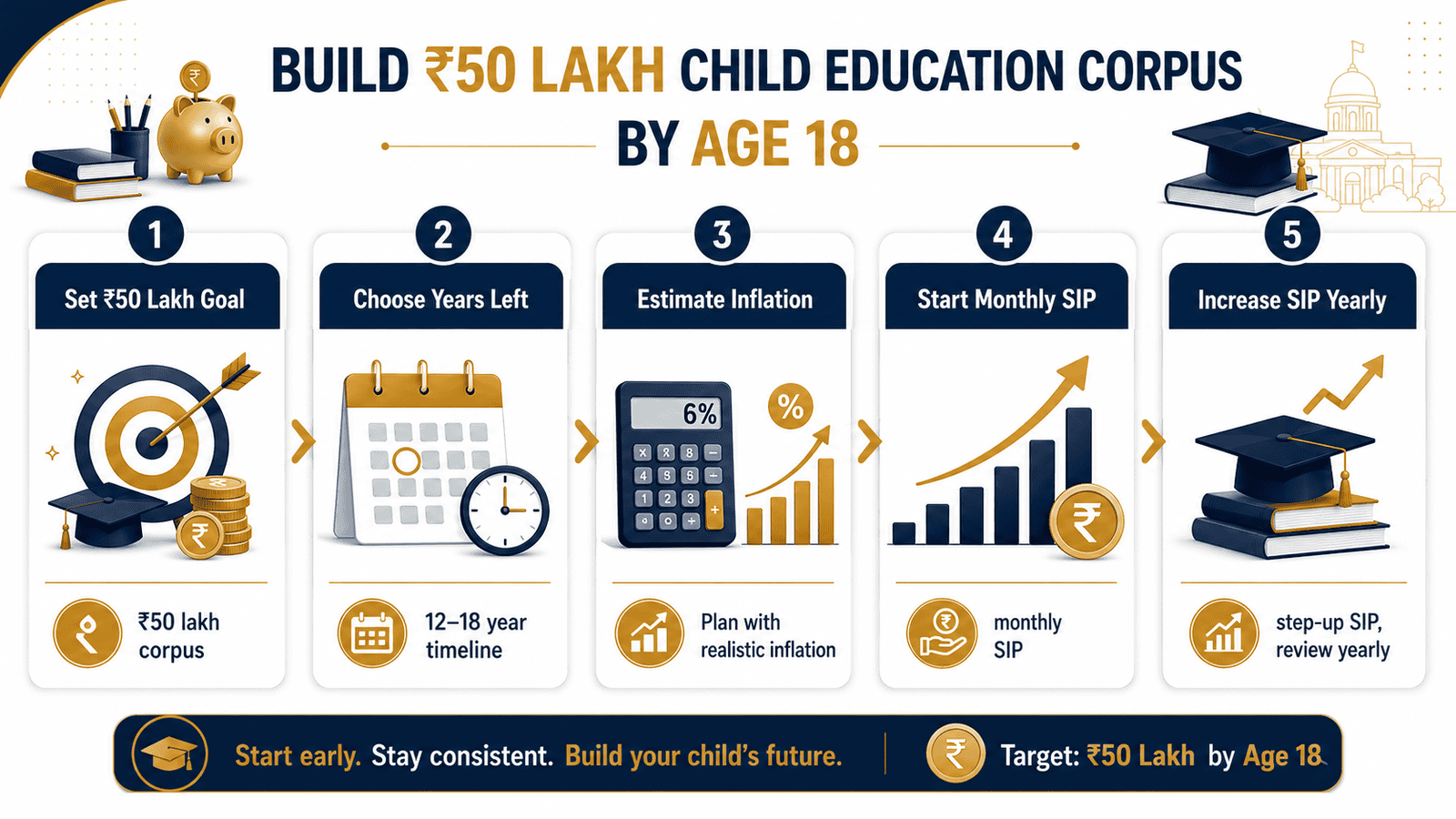
How to Calculate Your Monthly SIP for a ₹50 Lakh Education Corpus
The core formula is straightforward: you need to know your goal amount, your investment horizon, and a realistic expected annual return. From those three inputs, a SIP formula gives you the required monthly contribution.
Monthly SIP = Goal Amount ÷ [((1 + r)^n − 1) ÷ r × (1 + r)]
Where r = monthly return (annual return ÷ 12) and n = total months
At an illustrative 12% annual return (not guaranteed — actual mutual fund returns can be higher or lower), here is what a ₹50 lakh target requires at different starting points. These are estimates only. Use the estimate SIP amount calculator to run your own numbers.
| Child’s Current Age | Years to 18 | Est. Monthly SIP (12% p.a.) |
|---|---|---|
| 1 year | 17 years | ≈ ₹6,100 |
| 3 years | 15 years | ≈ ₹7,500 |
| 5 years | 13 years | ≈ ₹10,000 |
| 8 years | 10 years | ≈ ₹14,400 |
| 10 years | 8 years | ≈ ₹19,900 |
Mutual fund investments are subject to market risks. Past performance does not guarantee future returns. The figures above use an illustrative 12% annual return — actual outcomes will differ based on the fund chosen, market conditions, and timing.
Step-Up SIP: A More Realistic Approach for Salaried Parents
A step-up SIP lets you start lower and increase your contribution by a fixed percentage each year — typically 10% — as your salary grows. For a 15-year horizon at an illustrative 12% return with a 10% annual step-up, you could start at roughly ₹4,900 per month instead of ₹7,500. The total contribution is similar over 15 years, but the starting burden is meaningfully lower. Learn how annual increases work in the increase SIP yearly guide.
How Existing Savings Reduce Your SIP Requirement
If you already have ₹2 lakh invested and growing at 12% p.a., it will compound to approximately ₹13.7 lakh over 15 years. That reduces your required SIP corpus from ₹50 lakh to roughly ₹36.3 lakh — cutting the required monthly SIP from ₹7,500 to around ₹5,400. Any existing investment directed toward this goal should be counted before deciding your SIP amount. According to SEBI’s investor education resources, aligning investment horizon with asset allocation is a key principle of goal-based investing.
Key Takeaways
- A 3-year-old’s parent needs approximately ₹7,500/month (illustrative 12% return) to reach ₹50 lakh by age 18 — waiting until the child is 8 raises that to ₹14,400/month.
- A step-up SIP of ₹4,900/month with a 10% annual increase can match the same ₹50 lakh target over 15 years, reducing starting pressure on a salaried household.
- Every ₹1 lakh already saved and invested at 12% p.a. reduces your required SIP corpus by roughly ₹6.8 lakh over 15 years — starting early multiplies existing savings too.
- Education inflation in India has historically run at 8–10% a year; if your target college actually costs ₹80 lakh by 2040, a ₹50 lakh corpus only covers part of it — review assumptions yearly.
- Shift equity-heavy allocation to lower-risk instruments 3–5 years before the child turns 18 — market timing risk near the goal can wipe out years of disciplined investing.
Key Facts at a Glance
| Parameter | Value / Assumption | Notes |
|---|---|---|
| Planning goal | ₹50 lakh by age 18 | Illustrative target; actual cost depends on course and city |
| Return assumption used | 12% p.a. (equity SIP) | Illustrative only — not guaranteed |
| Education inflation | 8–10% p.a. (historical) | Review target amount every 1–2 years |
| Recommended review frequency | Once a year | Compare actual corpus vs required corpus |
| Derisking window | 3–5 years before goal | Move to debt/hybrid as deadline approaches |
| Step-up SIP increase | 10% per year (typical) | Align with salary hike cycle |
How Child Education Planning Works
The mechanics are simple. The challenge is staying consistent across 15–18 years.
Start With a Target Corpus
₹50 lakh is a planning anchor, not a guaranteed number. A four-year private engineering degree currently costs ₹8–20 lakh depending on the college and city. An IIM MBA or a UK master’s degree can run ₹30–80 lakh. Using ₹50 lakh as your baseline is reasonable for domestic higher education in 2040 — but you should revisit it every year as your child’s direction becomes clearer.
Adjust for Education Inflation
Tuition, hostel, and coaching costs in India have risen faster than general CPI inflation. Understanding why costs may rise over time — and why a fixed ₹50 lakh target may need upward revision — is explained well in the understand education inflation guide. If education inflation runs at 9% a year and current college costs ₹25 lakh today, that same degree could cost ₹59 lakh in 10 years. Your plan should ideally target the future cost, not today’s cost.
Choose Your Investment Mix Based on Timeline
Asset allocation should shift as the deadline approaches. With 15+ years left, equity-heavy exposure makes sense — equity mutual funds have historically delivered higher long-term returns than fixed deposits or debt funds, though with higher short-term volatility. With 3–5 years left, gradually move to hybrid or short-term debt funds. According to SEBI’s published guidance for mutual fund investors, aligning investment horizon with fund category is a foundational principle — investors with long-term goals can typically tolerate more equity exposure than those with short horizons.
Account for Gaps Between Contributions and Goal
Missed SIP instalments, market downturns in the final two years, or an upward revision of your target can all create a shortfall. Build a 15–20% buffer into your target — if you think you need ₹50 lakh, plan for ₹57–60 lakh. This is not pessimism; it is prudent goal-based investing.
Real Example: Rohit and His 3-Year-Old Daughter in Pune
Rohit is 34, a senior software engineer in Pune earning ₹1.8 lakh per month. His daughter Aanya is 3 years old. He has no existing education corpus. His goal: ₹50 lakh by the time Aanya turns 18 — a 15-year horizon.
At an illustrative 12% annual return, Rohit needs a fixed SIP of approximately ₹7,500 per month. That is 4.2% of his take-home income — manageable, but he needs to start now and not dip into this corpus for other goals.
Alternatively, Rohit starts a step-up SIP at ₹4,900/month with a 10% annual increase. By year 5, he is investing ₹7,900/month. By year 10, ₹12,700/month. The total investment over 15 years is comparable to the fixed SIP, but the early years are lighter — useful when Rohit’s EMIs are still running.
If Rohit waits until Aanya is 8 to start, his required fixed SIP at 12% jumps to ₹14,400/month — nearly double. Five years of delay nearly doubles the monthly burden. Starting at 3 versus starting at 8 saves Rohit approximately ₹4.1 lakh in total contributions for the same ₹50 lakh outcome, because of the additional compounding years. The key insight: the corpus does not care when you planned it. It only rewards when you started.
Comparison: Ways to Build a ₹50 Lakh Child Education Corpus
| Approach | Best Suited For | Key Trade-off |
|---|---|---|
| Fixed SIP (equity mutual funds) | 15+ year horizon, consistent income | Good compounding — market risk, discipline needed |
| Step-up SIP (equity mutual funds) | Salaried parents expecting salary growth | Lower start amount — requires commitment to annual increase |
| Lumpsum + SIP combo | Parents with existing savings or bonus income | Reduces monthly SIP — lumpsum timing risk |
| FD / RD only | Very short horizons (under 3 years) or very low risk tolerance | Lower returns — may not beat education inflation over 15 years |
| Equity-heavy early, derisked near goal | Parents starting 12–15 years before the goal | Balances growth and safety — needs active rebalancing |
According to RBI guidance, bank fixed deposits offer guaranteed returns but at rates typically lower than long-term equity returns. For a 15-year goal, relying entirely on FDs at 6–7% p.a. would require a monthly RD of approximately ₹18,500 to reach ₹50 lakh — more than double the SIP equivalent at 12%. For information on step-up SIP implementation, the increase SIP yearly guide covers the mechanics in detail.
How to Decide What’s Right for You
Your child is under 5 and you have 13+ years — a fixed equity SIP of ₹7,000–10,000/month at an illustrative 12% return gives you a realistic shot at ₹50 lakh without extreme pressure.
Your salary grows steadily each year — a step-up SIP starting at ₹4,500–5,500/month with a 10% annual increase is a better fit than a flat SIP, and reduces early-year financial strain.
You already have ₹3–5 lakh in investments — redirect that as the starting corpus, recalculate the gap, and reduce your SIP requirement before committing to an unnecessarily high amount.
You are aiming for overseas education — a ₹50 lakh target may be insufficient; revise upward to ₹80–100 lakh and recalculate accordingly, ideally starting before the child is 5.
You do not yet have a family emergency fund of 4–6 months’ expenses — before you start an aggressive education SIP, covering that base is a higher priority. See the emergency fund first guide for the right sequencing.
Your income is irregular or you carry high-interest debt (personal loan, credit card) — do not lock ₹7,000–15,000/month into a long-horizon equity plan before clearing that debt; the interest drag will outpace investment gains.
Common Mistakes to Avoid
Starting Too Late
Many parents plan to “start next year” once the EMI reduces or the bonus arrives.
Waiting from when your child is 3 to when they are 8 nearly doubles your required monthly SIP from ₹7,500 to ₹14,400 for the same ₹50 lakh goal. That is ₹6,900 extra every month — ₹82,800 a year — for a decision that cost nothing but time.
Start at any amount — even ₹2,000/month — and increase it when income allows.
Ignoring Education Inflation
Planning for ₹50 lakh in today’s money without adjusting for 8–10% annual education inflation means your corpus may fall short when it actually matters.
A private medical degree that costs ₹30 lakh today could cost ₹65–70 lakh in 15 years. Review your target corpus every two years and adjust upward if costs are rising faster than expected.
Use the target amount at the time of the goal, not today’s fee structure.
Assuming Equity Returns Are Guaranteed
Many parents hear “12% returns from mutual funds” and treat it as certain. It is not.
Equity mutual funds have delivered 10–14% CAGR over 15-year periods historically, but individual fund performance and market timing can produce outcomes well outside that range. A market downturn in the final two years before admission can reduce a ₹50 lakh corpus to ₹36–40 lakh.
Use 10–11% as your planning assumption to build in a safety margin, and start derisking 3–5 years before the goal.
Keeping All Money in Risky Assets Near Admission Year
Staying 100% in equity mutual funds at age 15–17 is a common and costly mistake.
A 30–40% market correction in that window — not uncommon historically — could wipe out several years of progress just before you need the money. This is non-recoverable because your timeline ends.
Shift gradually to hybrid or short-duration debt funds starting 4–5 years before the goal.
Mixing Education Corpus With General Savings
Many families keep education money in the same bank account or mutual fund folio as household savings.
When a wedding expense or home down payment arises, education money gets borrowed from “temporarily” — and rarely fully restored. Keep a dedicated folio, account, or label for education funds so the purpose is clear and the temptation to borrow from it is lower.
Even a mental separation is better than none.
Not Reviewing the Plan Annually
A plan set up when the child is 2 may be wildly off-track by age 8.
Income changes, market returns, and revised education targets can all shift the required corpus significantly. An annual review — check actual corpus against required corpus, adjust SIP if needed — takes under 30 minutes and prevents large surprises near the goal.
Set a fixed annual reminder: every April, after the financial year closes.
When This May Not Be the Right Choice
Aggressive child education corpus planning may need to be deprioritised or scaled back in specific situations.
If you carry high-interest debt — personal loans above 14%, credit card outstanding — the interest cost alone exceeds most realistic SIP returns. Clearing that debt first is almost always the better financial sequence.
If your family has no emergency fund, investing ₹10,000–15,000/month in an education SIP while sitting on zero liquidity exposes you to a crisis where you redeem equity funds at the worst time — a market low — just to cover an unexpected hospital bill.
If your income is irregular or contract-based, a fixed monthly SIP commitment can create stress during low-income months. A flexible SIP or lumpsum strategy — investing when income arrives — may be more sustainable.
If your child is already 14–15 and you are starting from zero, a 3–4 year equity SIP may not accumulate meaningfully and exposes you to exit-point risk. A shorter-term debt or recurring deposit approach, combined with an education loan plan, may be more practical. According to RBI guidelines, education loans are a regulated product with structured repayment terms that can supplement a partial corpus.
If any of these apply to your situation, it may be worth exploring alternatives before committing.
Official Rules and Where to Verify
Child education planning involves mutual fund investments, savings products, and tax treatment of gains — all of which are governed by regulations that can change with each Budget or policy update.
- SEBI (sebi.gov.in) — Regulates mutual funds, SIP products, and investor protection norms. SEBI’s investor education portal is the authoritative source for how mutual funds work, risk classification, and SIP mechanics.
- Income Tax Department (incometax.gov.in) — Tax treatment of equity and debt mutual fund gains, indexation benefits, and any child-specific tax provisions. LTCG on equity funds above ₹1 lakh is currently taxed; verify current rates and thresholds before investing.
- RBI (rbi.org.in) — Governs bank deposits, recurring deposits, and education loan terms from scheduled banks.
- Fund house scheme documents — Each mutual fund scheme’s Scheme Information Document (SID) contains the actual terms, risks, charges, and investment mandate. Always read the SID before investing.
Rules, limits, and rates on this topic can change with each Budget or regulatory update. Always verify current figures directly from the official source before making any financial decision.
Expert Tips
- Start with a realistic ₹50 lakh target and revisit it every April. If your child’s school fees have jumped 12% this year, your college cost estimate likely needs to move up too — do not let the plan go stale.
- Time your step-up SIP increase with your annual appraisal cycle. If your salary typically rises in April or July, schedule the SIP step-up for the same month — you will not feel the increase because it comes from new income. The power of compounding guide shows why even small yearly increases compound dramatically over 15 years.
- Open a separate mutual fund folio exclusively for the education goal — label it “Aanya’s College” or similar. This single act prevents the money from quietly getting used for a car down payment or vacation.
- Once you are within 5 years of the goal, begin a systematic transfer plan (STP) moving equity units to short-term debt funds monthly. Do not wait for a market high to do this — systematic reduction removes timing anxiety.
- Track the corpus-to-target ratio once a year: required corpus at current child’s age versus actual corpus. If actual is below 80% of required, increase SIP immediately — do not wait for the “right time.”
- If you receive a performance bonus, earmark 20–30% of it to the education corpus as a lumpsum top-up. This accelerates compounding without increasing your monthly fixed commitment.
Frequently Asked Questions
How much SIP is needed for a ₹50 lakh child education corpus?
It depends on how many years you have. At an illustrative 12% annual return, a 15-year SIP requires approximately ₹7,500/month. A 10-year SIP requires approximately ₹14,400/month. A 8-year SIP needs approximately ₹19,900/month. Starting earlier significantly reduces the monthly burden. These are estimates — actual mutual fund returns can vary.
Is SIP in mutual funds safe for child education planning?
Equity mutual funds carry market risk — returns are not guaranteed and the corpus can fall in value during market downturns. For timelines of 12–15 years, equity has historically provided better long-term returns than fixed deposits, but short-term volatility is real. Derisking 3–5 years before the goal is strongly recommended. Mutual fund investments are subject to market risks. Past performance does not guarantee future returns.
Should I use mutual funds, FD, PPF, or Sukanya Samriddhi Yojana (SSY)?
Each has a different return profile and lock-in. PPF offers guaranteed returns with a 15-year lock-in and tax-free maturity — suitable as part of a conservative allocation. SSY (for girl children) offers a higher guaranteed rate with tax benefits under Section 80C — verify the current rate at the India Post or your bank. FDs offer certainty but at rates that historically trail education inflation. Equity mutual funds offer growth potential with volatility. A blend of equity SIP for growth and PPF or SSY for guaranteed allocation is a common approach. Verify current rates and tax treatment before choosing.
What if my child is already 10 years old?
With 8 years left, you need approximately ₹19,900/month at an illustrative 12% return. That is a high bar. Consider: how much you already have saved, whether a partial equity and partial debt approach makes sense, and whether an education loan plan can supplement a smaller corpus. Starting immediately is still far better than waiting another year.
Should I increase my SIP every year?
Yes — a 10% annual step-up can significantly reduce your starting SIP amount and aligns with typical salary growth for salaried professionals. It also helps account for rising target amounts due to education inflation. Even a 5% annual step-up meaningfully improves outcomes over a 15-year horizon.
Can I use this ₹50 lakh plan for overseas education?
₹50 lakh is likely insufficient for most overseas undergraduate degrees in the UK, USA, Canada, or Australia, which can cost ₹70–150 lakh in today’s values and will be higher by 2040 accounting for education inflation and currency movement. If overseas education is a possibility, consider revising your target to ₹80–100 lakh and recalculating accordingly. Education loans with structured repayment plans are also commonly used to bridge the gap.
Can I withdraw from the education corpus for emergencies?
Technically yes — open-ended mutual funds allow redemption at any time. But withdrawing from an education corpus reduces compounding and may force you to invest a higher amount later to recover. A separate emergency fund — covering 4–6 months of household expenses — is the right way to avoid touching the education corpus. Treat the two as completely separate pots.
What is the tax treatment on mutual fund gains for child education corpus?
Long-term capital gains (LTCG) on equity mutual funds held for more than 12 months are currently taxed above a ₹1 lakh annual threshold. Debt mutual fund gains have a different tax treatment. Tax rules can change with each Union Budget — verify current rates at incometax.gov.in before making investment decisions or at withdrawal time.
Final Verdict
Child education planning is one of the most deadline-driven financial goals a family faces. ₹50 lakh by age 18 is achievable — but only if you start early, stay consistent, and review assumptions every year. A fixed SIP of ₹7,500/month over 15 years gets you there at illustrative 12% returns. A step-up SIP starting at ₹4,900/month can do the same with a lighter early burden. Waiting even five years nearly doubles the monthly requirement. The plan is never perfect on day one — what matters is starting with a reasonable number and adjusting as education costs, income, and the market evolve. No corpus plan guarantees your exact target, but a plan you stick to for 15 years will almost always outperform one you kept delaying. Always verify the latest rules from official sources or consult a qualified professional before making any financial decision.
This article is for educational purposes only and should not be treated as personalised financial, tax, investment, insurance, or legal advice. Tax rules, interest rates, regulatory limits, and product features can change with each Budget or policy update. Please verify current rules from official government sources or consult a qualified and registered professional before making any financial decision.

Ishita Sharma writes about goal-based financial planning for Indian families and individuals. Her content connects saving, budgeting, investing, insurance, and debt decisions to real-life goals such as child education, marriage, retirement, home buying, emergency funds, family protection, and long-term wealth building.
She covers topics such as child education planning, marriage goal planning, retirement planning, home-buying goals, inflation-based goal estimation, monthly investment planning, savings timelines, emergency buffers, asset allocation basics, family financial milestones, and goal calculators.
Ishita’s writing is structured, thoughtful, and decision-oriented. She helps readers move from vague goals like “save more” to clearer questions such as how much may be needed, by when, what assumptions matter, and what trade-offs exist. Her articles use Indian examples, timelines, ₹ amounts, and simple planning frameworks. Her content is educational and should not be treated as personalised investment, tax, loan, or insurance advice. Since future costs, inflation, returns, product rules, and tax treatment can change, readers should verify current information before acting.