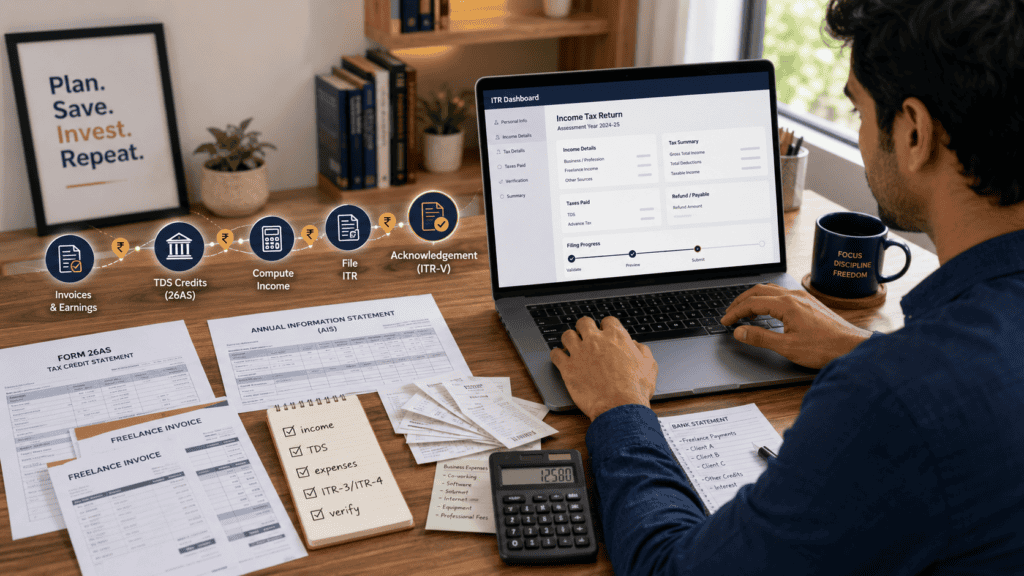
If you file your own taxes as a salaried employee, ITR-1 works fine. But the moment you start freelancing — whether it’s UI design, copywriting, software consulting, tutoring, or content creation — you’ve moved into a completely different corner of India’s tax system. Your income is now classified as business or professional income, and that changes everything: the form you file, how you handle TDS, whether you maintain books of accounts, and whether you qualify for a simpler presumptive taxation route. Millions of Indian freelancers file the wrong ITR form every year, miss TDS credits, or leave refunds unclaimed simply because nobody explained the workflow clearly. This guide walks you through exactly how to file ITR as a freelancer in India — from collecting the right documents to clicking e-verify.
Quick Answer: How to File ITR as Freelancer in India
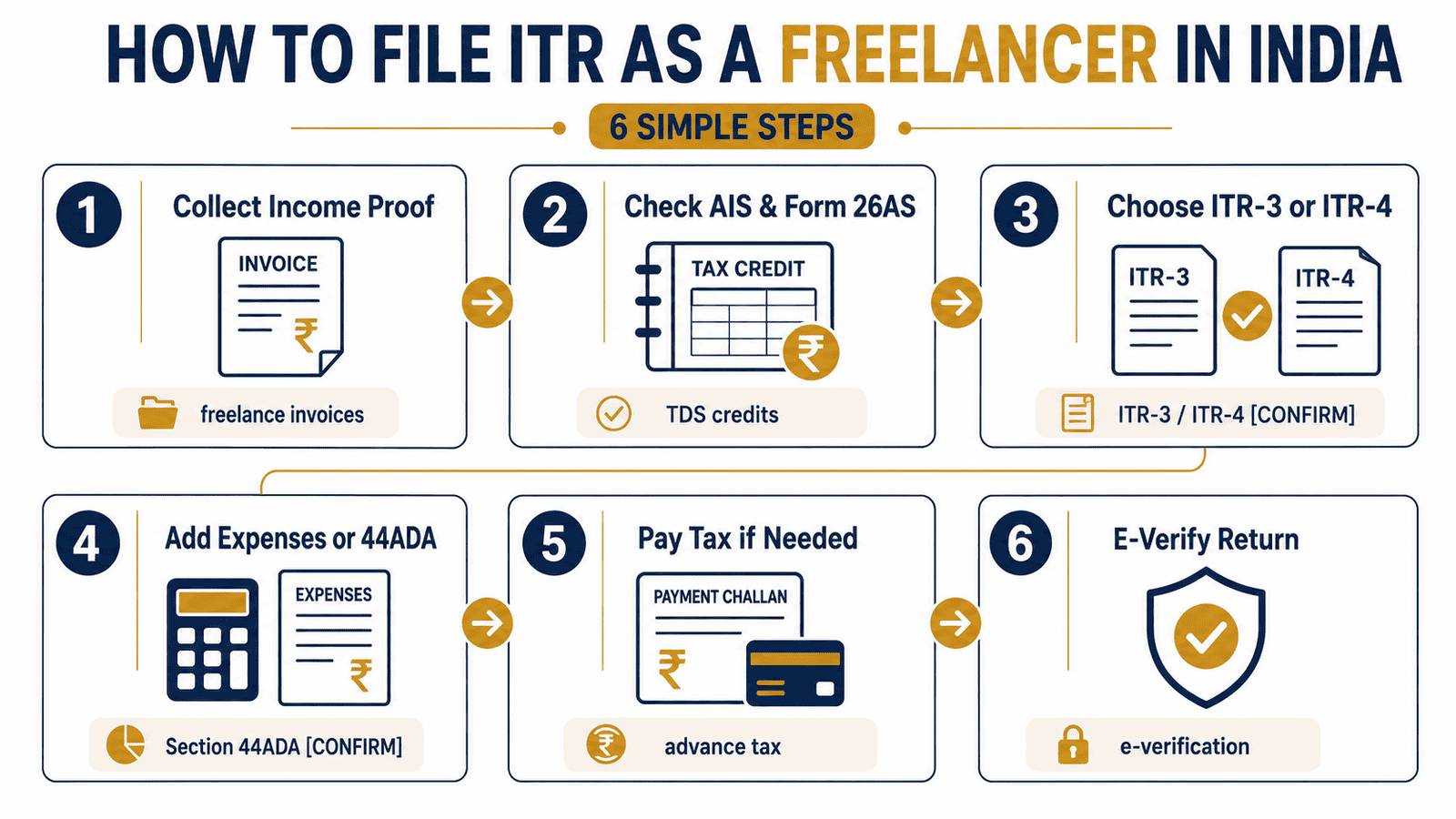
How to file ITR as freelancer in India starts with collecting invoices, bank statements, AIS, Form 26AS and expense records. Then choose ITR-3 or ITR-4 [CONFIRM — verify current form applicability for the relevant assessment year before publishing], report freelance income, claim eligible TDS, pay any balance tax, submit the return on incometax.gov.in and e-verify it.
Key Takeaways
- Freelancers must not file ITR-1 — freelance income is classified as income from business or profession, which ITR-1 does not cover.
- ITR-3 and ITR-4 are the two relevant forms; which one applies depends on your income type, turnover, and whether you opt for presumptive taxation — verify eligibility for the current assessment year on incometax.gov.in.
- AIS (Annual Information Statement) and Form 26AS must both be downloaded and matched against your own invoices and bank credits before you fill the ITR utility — mismatches invite scrutiny.
- TDS deducted by your Indian clients appears as a credit in Form 26AS; it is not your final tax liability — it only reduces the tax you owe after your actual income and deductions are calculated.
- If your total tax liability for a financial year exceeds ₹10,000, advance tax instalments are generally required — missing them can attract interest charges under Sections 234B and 234C.
- E-verification is mandatory after submitting the return — an unverified ITR is treated as if it was never filed.
- Section 44ADA offers a presumptive taxation option for eligible professionals, but income limits and eligible professions must be verified from incometax.gov.in for the current assessment year before opting in.
Key Facts at a Glance
| Parameter | Detail |
|---|---|
| Who this guide is for | Freelancers, independent consultants, professionals, creators, platform workers, side-income earners |
| Income head | Income from Business or Profession (not salary) |
| Relevant ITR forms | ITR-3 or ITR-4 — verify applicable form for your assessment year at incometax.gov.in |
| Key documents needed | Invoices, bank statements, AIS, Form 26AS, TDS certificates (Form 16A), expense proof |
| Presumptive taxation option | Section 44ADA — for eligible professionals; income and turnover limits apply — verify before use |
| Filing portal | incometax.gov.in |
| E-verification | Mandatory within 30 days of submission — verify current deadline at incometax.gov.in |
| Advance tax | Required if total tax liability exceeds ₹10,000 in a financial year — verify thresholds and due dates |
What Freelancer ITR Filing Actually Means in India
Most Indian tax guides explain freelancer taxation through the lens of deductions and savings. Very few explain the structural difference that makes freelancer filing different from salaried filing. That difference starts with the income head.
When you receive a salary, your employer deducts TDS under Section 192 and issues Form 16. Your income is classified as “Income from Salaries.” ITR-1 handles this. But when you raise an invoice as a freelancer — whether you’re a designer, developer, writer, tutor, architect, or doctor seeing private patients — your income is classified as Income from Business or Profession. That classification takes ITR-1 off the table entirely. For a solid grounding in how this classification works and what it means for your overall tax position, freelancer tax basics is a good starting point before you open the ITR utility.
Why Form Selection Matters
Filing the wrong ITR form can result in a defective return notice from the Income Tax Department. A defective return is not automatically rejected — you’re given a window to respond and file the correct form. But it creates unnecessary delays, and it flags your return for closer review. Getting the form right from the start avoids all of that.
ITR-3 vs ITR-4: The Core Choice
The two forms relevant to most Indian freelancers are ITR-3 and ITR-4 Sugam. ITR-3 is the more comprehensive form — it covers business or professional income where you are maintaining books of accounts and reporting actual income minus actual expenses. ITR-4 is available to taxpayers who opt for the presumptive taxation scheme under Sections 44AD, 44ADA, or 44AE, and is generally simpler to fill.
Not every freelancer qualifies for ITR-4. Section 44ADA — the presumptive scheme most relevant to professionals like designers, writers, engineers, consultants, and IT professionals — comes with eligibility conditions including profession type and gross receipt limits. These limits and eligible profession categories must be confirmed on incometax.gov.in before you assume you qualify for the current assessment year.
GST Filing Is Separate from Income Tax Filing
A question many freelancers ask is whether GST registration means they’ve already “filed taxes.” It does not. GST compliance and income tax filing are entirely separate obligations under different laws. Your GST returns report transaction-level revenue and tax collected. Your ITR reports net income, deductions, and final tax liability. You must do both independently if both obligations apply to you. According to Income Tax Department guidelines, all eligible individuals must file their ITR regardless of GST registration status.
Normal Business Income vs Presumptive Income
Under the normal method, you report your total freelance receipts, subtract actual and documented business expenses, and arrive at taxable professional income. This requires maintaining proper records: invoices raised, expenses incurred, and ideally a cash book or digital equivalent. Under the presumptive method (Section 44ADA), you declare a fixed percentage of your gross professional receipts as your income — you do not need to separately document and prove individual expenses. The trade-off is that you must declare at least the prescribed percentage and you give up the ability to claim individual deductions against your professional income.
For a detailed breakdown of how this calculation works and whether it saves you money, the article on presumptive tax option covers the mechanics in full.
Real Example: Riya’s ITR Filing Journey
Riya, 29, is a freelance UI designer based in Bengaluru. In FY 2024-25, she raised invoices totalling ₹12,00,000 to seven Indian clients — a mix of startups, agencies, and a mid-sized product company. Several of her clients deducted TDS at 10% before releasing payment, so ₹85,000 in TDS appears across multiple entries in her Form 26AS.
Before opening the ITR utility, Riya downloads her AIS from incometax.gov.in. She finds that the AIS shows ₹11,75,000 in professional receipts — ₹25,000 lower than her invoice total. She traces the gap to a payment from one client that was made in April of the next financial year. That payment belongs to the following year’s ITR. She reconciles this before proceeding.
Riya spent ₹1,40,000 during the year on a new laptop, design software subscriptions, internet, and a co-working space membership — all documented with receipts. She decides to check whether claiming actual expenses under ITR-3 or opting for presumptive income under ITR-4 works better for her situation — but she verifies Section 44ADA eligibility for her profession and the current gross receipt limit on incometax.gov.in before making the call. She tracks and claims her TDS using the guidance at freelance TDS tracking to ensure every ₹1 of TDS credit is correctly applied against her final tax liability.
Key insight: Reconciling AIS and Form 26AS before filing — not after — is what separates a clean return from a follow-up notice.
How to Calculate Your Taxable Freelance Income
Before you open the ITR portal, estimate your taxable income using this five-step approach. This is a pre-filing exercise — the actual tax must be calculated using the current ITR utility and applicable slabs on incometax.gov.in.
Taxable Professional Income (Actual Method) = Total Freelance Receipts − Eligible Business Expenses
Step 1 — Total receipts: Add all invoices for the financial year. Cross-check against bank credits and AIS. Use bank credits as the reconciliation anchor, not just invoice totals.
Step 2 — Subtract business expenses (actual method): Deduct only expenses that are wholly and exclusively for your freelance work — software, equipment, internet, coworking space, professional subscriptions, travel for client work. Personal expenses mixed in with business expenses are not deductible. For a complete list of what qualifies, the guide on business expense claims details what the Income Tax Act permits.
Step 3 — Alternatively, use the presumptive route (if eligible): Under Section 44ADA, a prescribed percentage of your gross professional receipts is treated as your income. No individual expense deduction is needed. Verify the current percentage and your profession’s eligibility before using this method.
Step 4 — Adjust for TDS and advance tax already paid: Your net tax payable = total tax on taxable income − TDS already deducted − advance tax already paid. If TDS and advance tax together exceed your liability, you’ll be entitled to a refund.
Step 5 — Pay self-assessment tax if needed: If there’s a balance after TDS and advance tax, pay self-assessment tax via Challan 280 on incometax.gov.in before submitting the return.
| Scenario | Gross Receipts / Method | Indicative Taxable Income |
|---|---|---|
| Actual expense method | ₹12,00,000 receipts − ₹1,40,000 expenses | ₹10,60,000 (before standard deductions) |
| Presumptive (44ADA) — verify % | ₹12,00,000 × prescribed % (verify at incometax.gov.in) | Depends on current prescribed rate |
| TDS already deducted | ₹85,000 in Form 26AS | Reduces final tax payable by ₹85,000 |
Comparison: ITR-3 vs ITR-4 for Freelancers
| Parameter | ITR-3 | ITR-4 Sugam |
|---|---|---|
| Who can use it | Individuals/HUFs with business or professional income not covered by presumptive schemes | Individuals/HUFs/Firms opting for presumptive taxation under 44AD, 44ADA, or 44AE — verify eligibility |
| Income reporting method | Actual receipts minus actual documented expenses | Prescribed percentage of gross receipts declared as income |
| Books of accounts | May be required depending on income/turnover | Not required under presumptive scheme |
| Expense documentation | Required — receipts, invoices, proof | Not required individually |
| Form complexity | Higher — more schedules | Lower — simpler form |
| Can claim capital gains, foreign income | Yes | No — not suitable if other complex income exists |
| Risk if form is wrong | Defective return notice — must be corrected within prescribed window |
For a thorough explanation of how Section 44ADA works and when it’s actually worth choosing, see the dedicated guide on the presumptive tax option.
How to Decide What’s Right for You
Your only income is from freelance professional work, your gross receipts are within the Section 44ADA limit (verify current limit at incometax.gov.in), and you do not want to document individual expenses — THEN ITR-4 with presumptive taxation may be worth exploring.
Your actual documented business expenses are substantial and exceed what presumptive income would allow you to deduct — THEN ITR-3 with the actual expense method is likely more tax-efficient; verify with a tax professional.
You have both freelance income and capital gains, foreign income, ESOPs, or salary from a part-time employer — THEN ITR-3 is the likely correct form, but confirm with a chartered accountant given the complexity.
Your total TDS deducted (visible in Form 26AS) is more than your estimated tax liability — THEN you are likely entitled to a refund; file the return to claim it and ensure AIS figures match your reported income.
Your gross professional receipts exceed the prescribed Section 44ADA threshold for the assessment year (verify current limit) — THEN presumptive taxation is not available and you must maintain books of accounts.
You are not sure whether your profession is listed under the eligible categories for Section 44ADA — do not assume eligibility. Verify the profession list on incometax.gov.in before filing ITR-4 under presumptive taxation.
Common Mistakes to Avoid
Filing ITR-1 With Freelance Income
ITR-1 is meant for salaried individuals with income from salary, one house property, and limited other sources. It does not cover business or professional income.
Filing ITR-1 when you have freelance income results in a defective return notice. The Income Tax Department will ask you to re-file in the correct form, and if the deadline has passed, late filing fees and interest can apply.
Always check your income classification first. If you raise invoices, you almost certainly need ITR-3 or ITR-4.
Not Downloading AIS Before Filing
Many freelancers rely solely on Form 26AS to check TDS. But the AIS (Annual Information Statement) contains a broader picture — including platform payments, bank interest, mutual fund transactions, and other financial activity reported by third parties.
If the income figure you report differs significantly from what AIS shows, it can trigger a notice or scrutiny. A ₹50,000 mismatch between AIS and your ITR is enough to generate an automated query.
Download AIS from incometax.gov.in, reconcile it with your bank credits and invoices, and only then open the ITR utility.
Treating TDS as the Final Tax
TDS deducted by clients is a credit — not the end of your tax calculation. Your actual liability depends on your total taxable income, applicable slab, and deductions claimed.
If your income pushes you into a higher bracket after adding all sources, TDS may not cover your full liability. The shortfall attracts interest under Section 234B if not paid by the assessment year’s due date.
Always calculate net tax payable before submitting the return, not after.
Claiming Personal Expenses as Business Expenses
A laptop you also use for streaming, a phone bill that includes personal calls, or a home internet connection used for both work and leisure — these are mixed-use assets. Only the proportionate business-use component is deductible.
Claiming 100% of a mixed-use expense as a business deduction inflates your expense claim and, if scrutinised, can result in disallowance plus interest.
Document the business-use basis clearly before claiming. The guide on business expense claims explains how to approach this correctly.
Missing Advance Tax Instalments
If your estimated tax liability for the financial year exceeds ₹10,000, advance tax is generally required to be paid in instalments across the year — not as a lump sum at filing time.
Missing advance tax instalments leads to interest charges under Sections 234B and 234C. For a freelancer earning ₹12 lakh annually, this interest can easily run into several thousand rupees — money paid for a procedural miss, not a deliberate default.
Set advance tax reminders and pay via Challan 280 on incometax.gov.in. The full schedule and calculation method is covered at advance tax payments.
Forgetting to E-Verify After Submission
Many first-time filers treat the submission confirmation as the finish line. It is not. An ITR that is submitted but not e-verified within the prescribed window is treated by the Income Tax Department as if it was never filed.
E-verification can be done via Aadhaar OTP, net banking, or by sending a signed physical ITR-V to CPC Bengaluru. The Aadhaar OTP method is the fastest. Verify the current e-verification deadline on incometax.gov.in at the time of filing.
Ignoring Form 26AS Mismatches
If a client deducted TDS but filed their TDS return late or with an error, the credit may not appear in your Form 26AS at the time you file. Claiming TDS that does not appear in Form 26AS will cause a mismatch during ITR processing and can result in a demand notice.
Follow up with the relevant client to correct TDS filing errors before you file — or file without claiming the disputed credit, and revise the return once the credit appears in Form 26AS.
When This May Not Be the Right Choice
Foreign income and overseas clients: If you earn from international clients, the taxation of that income depends on your residential status, applicable Double Taxation Avoidance Agreements (DTAA), and whether foreign tax credits apply. Self-filing without professional guidance in these cases carries meaningful risk.
Capital gains, ESOPs, or crypto transactions: If you hold or have sold mutual funds, stocks, ESOPs, or crypto assets during the year, those transactions introduce additional schedules and tax heads that complicate the return significantly. A simple freelancer workflow is not sufficient.
Tax audit applicability: If your turnover or gross receipts exceed prescribed thresholds (verify current limits at incometax.gov.in), a tax audit under Section 44AB may be mandatory. Filing without completing the audit is a compliance breach.
Prior notices, defective returns, or unresolved AIS mismatches: If you have received a notice from the Income Tax Department in a prior year, have a defective return pending, or have a large unexplained gap in your AIS, a DIY approach is risky without professional guidance.
If any of these apply to your situation, it may be worth exploring alternatives before committing.
Official Rules and Where to Verify
ITR filing rules, forms, due dates, tax slabs, presumptive taxation limits, and audit thresholds can change with every Budget and CBDT notification. Always verify current figures directly from the official source before making any financial decision.
- Income Tax Department — incometax.gov.in: ITR filing portal, ITR utilities, AIS download, Form 26AS access, e-verification, tax payment (Challan 280), and ITR form instructions for the current assessment year. This is the primary source for every rule referenced in this guide.
- CBIC — cbic.gov.in: GST registration, GST return filing, and export of services rules where applicable to your freelance work.
Rules, limits, and rates on this topic can change with each Budget or regulatory update. Always verify current figures directly from the official source before making any financial decision.
For a side-by-side explanation of what AIS and Form 26AS each contain and why both matter before filing, see the dedicated guide on AIS and Form 26AS.
Expert Tips
- Build four digital folders before filing season: one for invoices raised, one for bank credit confirmations, one for TDS certificates (Form 16A) received from clients, and one for expense receipts. Reconciling these four folders takes an hour if they’re organised — and a week if they’re not.
- Reconcile invoice totals with AIS line by line, not just in aggregate: A ₹10,000 discrepancy in one month that averages out against another month’s overage will still show as a mismatch in AIS — the Income Tax Department’s system does not net off discrepancies across entries.
- Chase TDS certificates before March 31, not after: Clients are required to issue Form 16A after each TDS return is filed. If you notice a client who deducted TDS hasn’t updated your Form 26AS by the time you file, follow up before the filing deadline — not after receiving a demand notice.
- Download your ITR acknowledgement (ITR-V) immediately after e-verification and store it in a dedicated folder. The Income Tax Department can send notices for returns up to several years old — having the acknowledgement ready saves significant back-and-forth.
- Review your tax position before February 28, not on July 30: If your advance tax instalments are already paid and you realise in February that your income has changed, you can still adjust your final instalment. Waiting until filing season means you’re paying interest that was entirely avoidable.
- If your income is near the Section 44ADA threshold: Do not assume eligibility rolls over from the prior year. Verify current gross receipt limits, prescribed percentage, and eligible profession list for the relevant assessment year at incometax.gov.in before choosing the presumptive route.
- Keep expense documentation for at least six years: The Income Tax Department can reopen assessments for prior years in specific cases. Receipts you toss in April may be exactly what you need if a notice arrives in August two years later.
Frequently Asked Questions
Which ITR form should a freelancer file in India?
Most freelancers should file ITR-3 or ITR-4 depending on whether they opt for presumptive taxation. ITR-1 is not applicable when income is from business or profession. Verify which form applies for the current assessment year at incometax.gov.in, as form applicability rules can change.
Can freelancers file ITR-4?
ITR-4 is available to freelancers who opt for the presumptive taxation scheme under Section 44ADA, provided their gross professional receipts are within the prescribed limit and their profession is listed as eligible under the scheme. Eligibility conditions must be verified from incometax.gov.in before filing ITR-4.
Is Section 44ADA available to all types of freelancers?
No. Section 44ADA applies to specific notified professions — which generally include engineering, architecture, medicine, legal, accountancy, interior decoration, technical consulting, film artistry, and certain others. A social media manager or general e-commerce consultant, for example, may not qualify. Always verify your profession’s eligibility and the current prescribed income limit before opting for this scheme.
What if TDS has been deducted but my income is below the taxable limit?
If TDS has been deducted by your clients but your total income after all deductions falls below the taxable threshold, you are entitled to a refund of the excess TDS. You must file an ITR to claim this refund — it is not automatic. The refund will be processed by the Income Tax Department after return verification.
Can freelancers claim laptop, internet, phone, and home-office expenses?
Yes — but only the proportionate business-use component. A laptop used entirely for client work can be claimed in full (subject to depreciation rules). A phone used for personal calls as well as client calls can only have the business-use portion claimed. Mixed-use expenses require a documented, reasonable basis for the split. The actual expense method under ITR-3 is where these deductions apply.
Is GST registration required before filing an ITR?
No. GST registration and ITR filing are separate obligations. Your ITR is filed under the Income Tax Act regardless of whether you are registered under GST. That said, if you are required to register under GST (typically when turnover exceeds prescribed limits, or for export of services regardless of turnover), that obligation exists independently of your ITR filing. Verify GST registration thresholds at cbic.gov.in.
What happens if I forget to e-verify my ITR after submitting?
An ITR that is submitted but not e-verified within the prescribed window is treated as invalid — as if the return was never filed. If the e-verification window lapses, you may need to file a condonation request with the Income Tax Department. E-verify immediately after submitting, using Aadhaar OTP, net banking, or any other available method on incometax.gov.in.
What is the difference between AIS and Form 26AS — and which one should I use?
Form 26AS is primarily a tax credit statement — it shows TDS deducted, advance tax paid, and self-assessment tax paid. AIS is broader — it includes income reported by multiple third parties (clients, banks, mutual funds, property registrars, and others). Both should be downloaded and reconciled against your records before filing. Where they conflict, investigate the source of the discrepancy — do not ignore it.
Can I revise my ITR after filing if I made an error?
Yes. A revised return can be filed within the prescribed revision window for the relevant assessment year. Common reasons to revise include discovering a TDS credit that appeared in Form 26AS after your original filing, or correcting an income figure. Verify the revision deadline applicable to your assessment year at incometax.gov.in.
What if a client deducted TDS but it doesn’t appear in my Form 26AS?
This usually means the client has not yet filed their quarterly TDS return, or filed it with an error in your PAN. Do not claim TDS that is not reflected in your Form 26AS — it will create a mismatch. Follow up with the client to correct their TDS filing, wait for Form 26AS to update, and file or revise your return after the credit appears. The detailed process is covered at freelance TDS tracking.
Final Verdict
Learning how to file ITR as a freelancer in India is not complicated — but it does require more preparation than a salaried return. The filing workflow has six non-negotiable steps: collect and reconcile documents, choose the correct ITR form, report income accurately, match TDS credits, pay any balance tax, and e-verify after submission. Miss any one of these and the return is either wrong, incomplete, or invalid. Freelancers with straightforward professional income, clean bank records, and documented expenses — or those eligible for Section 44ADA — can manage this confidently with the right preparation. If your situation involves foreign clients, capital gains, an AIS mismatch you can’t explain, or receipts above the audit threshold, bring in a qualified chartered accountant. Always verify the latest rules from official sources or consult a qualified professional before making any financial decision.
This article is for educational purposes only and should not be treated as personalised financial, tax, investment, insurance, or legal advice. Tax rules, interest rates, regulatory limits, and product features can change with each Budget or policy update. Please verify current rules from official government sources or consult a qualified and registered professional before making any financial decision.

Amit Verma writes about money management for Indian freelancers, consultants, creators, professionals, and self-employed workers. His content focuses on income planning, tax basics, GST awareness, cash flow, invoicing, business expenses, and financial stability for people who do not receive a fixed monthly salary.
He covers topics such as Section 44ADA, presumptive taxation, professional income, advance tax, GST basics, TDS for freelancers, invoice planning, business expense tracking, ITR filing for self-employed professionals, emergency funds, health insurance, retirement planning, and irregular income management.
Amit’s writing is practical, relatable, and built around the realities of independent work. He understands that freelancers often deal with delayed payments, uneven income, unclear tax deductions, missing employer benefits, and uncertainty around compliance. His guides help readers organise their financial life better, but they are educational and not a substitute for professional advice. Since tax rules, GST limits, filing requirements, and deduction treatment can change, readers should verify current rules from official sources or consult a qualified professional.