

You have been freelancing for a while. The money is coming in. A client asks for a “company invoice.” A friend says you should register an LLP. Someone else says Pvt Ltd is the only way enterprise clients will take you seriously. And somewhere in the middle, you are not sure whether you are even doing anything “illegal” by just working as yourself.
This confusion is common among Indian freelancers, consultants, developers, designers, and solo service providers — and most of it comes from mixing up three separate decisions: what legal structure to use, whether to register for GST, and how to file income tax. This article separates those three questions clearly, then helps you decide which structure — sole proprietorship, LLP, or private limited company — actually fits your situation right now.
Quick Answer: Sole Proprietorship vs LLP vs Pvt Ltd for Freelancers
sole proprietorship vs LLP vs Pvt Ltd for freelancers depends on risk, clients, partners, and scale. A solo low-risk freelancer can often start as a sole proprietor with 1 owner [CONFIRM — verify current rule before publishing], while LLP suits partner-led service firms and Pvt Ltd suits freelancers building teams, products, funding plans, or enterprise credibility. Most solo freelancers should start simple unless liability, partners, or client requirements justify formal structure. Tax and GST rules must be verified from official sources before acting — rules change with each Budget and regulatory update.
Key Takeaways
- Sole proprietorship means you and your business are the same legal person — there is no separate legal entity, which keeps compliance minimal but exposes personal assets to business risk.
- LLP creates a separate legal entity, protects partners from each other’s liabilities, and suits two or more consultants building a service firm together.
- Pvt Ltd has the strongest credibility for enterprise clients, ESOPs, equity, and fundraising — but it also has the highest annual compliance burden, including mandatory audits beyond a certain turnover.
- GST registration is a separate decision from entity registration — you may need GST as a sole proprietor just as much as a company, depending on your turnover and service type.
- Income tax for freelancers is filed as professional income under ITR-3 or ITR-4; eligibility for the presumptive scheme under Section 44ADA depends on profession type and gross receipts — verify current thresholds at incometax.gov.in before filing.
- Do not register a Pvt Ltd just because a client asks for an invoice — a sole proprietor with a GST number can issue a valid tax invoice to any Indian or foreign client.
- Compliance cost, not registration cost, is what distinguishes the three structures over time — a Pvt Ltd can cost ₹25,000–₹60,000 or more annually in CA and filing fees even with minimal activity.
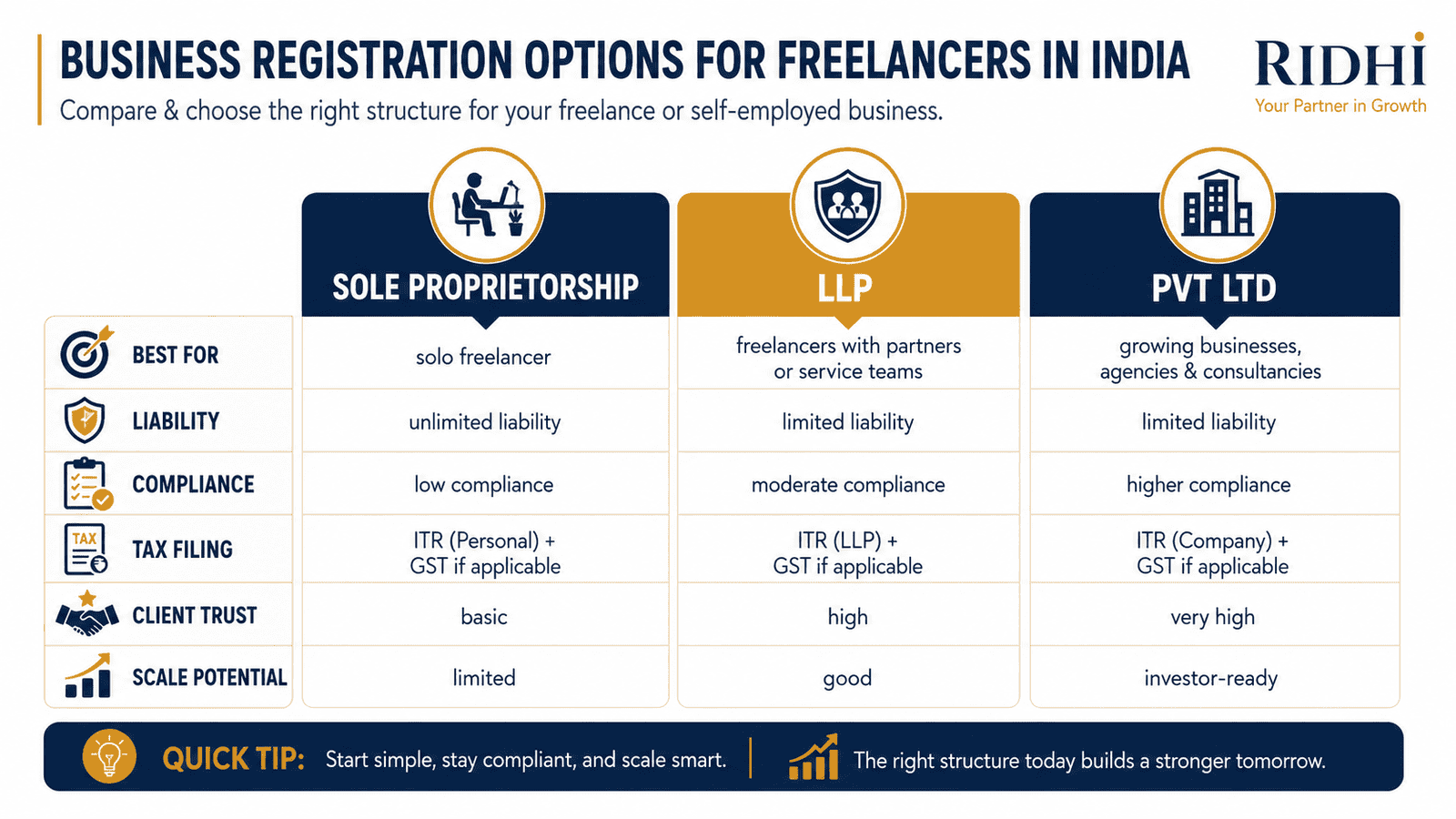
Sole Proprietorship vs LLP vs Pvt Ltd: Comparison at a Glance
| Parameter | Sole Proprietorship | LLP | Pvt Ltd |
|---|---|---|---|
| Legal identity | No separate entity — owner = business | Separate legal entity | Separate legal entity |
| Minimum owners | 1 | 2 designated partners | 2 directors, 2 shareholders |
| Liability | Unlimited — personal assets at risk | Limited to capital contribution | Limited to share capital |
| Registration body | No central registration — GSTIN/MSME/PAN suffice | MCA — mca.gov.in | MCA — mca.gov.in |
| Tax filing | ITR-3 or ITR-4 (individual) | ITR-5 (partnership return) | ITR-6 (company return) |
| GST applicability | Same threshold rules as any entity | Same threshold rules as any entity | Same threshold rules as any entity |
| Audit requirement | Tax audit if turnover exceeds threshold — verify at incometax.gov.in | Mandatory audit if turnover exceeds LLP Act threshold — verify at mca.gov.in | Mandatory statutory audit every year regardless of turnover |
| Annual MCA filings | None | Annual return + statement of accounts | Multiple ROC filings, board resolutions, director KYC |
| Funding / equity | Not possible — no shares | Limited — investor preference low | Full equity, ESOPs, VC funding |
| Client credibility | Moderate — acceptable for most SME clients | Good — recognised entity | Highest — preferred by enterprise |
| Setup cost (approx.) | Near zero — only GSTIN/MSME if needed | ₹5,000–₹15,000 professional fees | ₹10,000–₹25,000 professional fees |
| Annual compliance cost (approx.) | Low — ITR + GST returns if applicable | Moderate — LLP return, audit if triggered | High — mandatory audit, multiple ROC filings |
| Best for | Solo freelancers with low risk and simple clients | 2+ partners building a service agency | Freelancers building a scalable product or team |
| Avoid if | You have partners, high liability risk, or enterprise contracts requiring vendor onboarding | You are solo, purely transactional, or unable to manage annual filings | You are solo, stable-income, and not planning scale, funding, or equity |
All figures above are illustrative. Verify current rules at mca.gov.in, incometax.gov.in, and gst.gov.in before registering or filing. For GST-specific decisions, read our guide on GST for freelancers — GST registration is a completely separate decision from choosing a legal entity.
Key Facts at a Glance
| Fact | Detail | Verify At |
|---|---|---|
| Sole proprietorship registration | No mandatory central registration; GSTIN, MSME Udyam, or shop act registration common | gst.gov.in; udyamregistration.gov.in |
| LLP incorporation | Registered under LLP Act, 2008 via MCA portal; requires LLP agreement and DPIN for partners | mca.gov.in |
| Pvt Ltd incorporation | Registered under Companies Act, 2013 via MCA portal; requires DSC, DIN, MOA/AOA | mca.gov.in |
| Section 44ADA eligibility | Professionals in notified categories; gross receipts limit applies — verify current limit | incometax.gov.in |
| GST threshold for services | Registration required above a turnover threshold — currently different for normal and special category states; verify before assuming exempt | gst.gov.in; cbic.gov.in |
| LLP annual filing due dates | Form 8 (statement of accounts) and Form 11 (annual return) — verify current due dates | mca.gov.in |
| Pvt Ltd mandatory audit | Statutory audit required every financial year regardless of turnover or activity | mca.gov.in; icai.org |
Understanding Each Structure as a Freelancer in India
Sole Proprietorship: The Default Starting Point
When you work as a freelancer without registering any company, you are already operating as a sole proprietor. There is no separate legal entity. You, the individual, and your business are one and the same in the eyes of the law. Your PAN is your business’s tax identity. Your personal bank account — or a current account in your name — is your business account.
This is not illegal. In fact, most Indian freelancers, tutors, designers, writers, and consultants operate this way for years. A sole proprietor can get a GSTIN, open a current account, issue professional invoices, and deduct business expenses — all without forming a company. What you cannot do is create a liability firewall between your business debt and your personal savings. If a client sues you for a failed project, your personal assets are technically reachable.
According to the Income Tax Department, professional income earned by an individual is taxed under “Profits and Gains of Business or Profession” — the entity label does not change this classification for a sole proprietor.
For a deeper look at how your professional income is assessed and which deductions apply, see our full guide on freelancer income tax.
LLP: A Structured Middle Path
A Limited Liability Partnership is a separate legal entity registered under the LLP Act, 2008 with the Ministry of Corporate Affairs. It can own property, enter contracts, and sue or be sued in its own name. Partners are protected from each other’s individual liabilities — though they must still fulfil their capital contributions.
For freelancers, LLP makes the most sense when two or more people are working together as a service firm — for example, two UX designers running a consulting studio, or a developer and a project manager building an agency. It is also a reasonable choice for professionals in fields like chartered accountancy, architecture, or law where partnerships are a common and understood operating model.
The compliance burden is moderate: annual returns (Form 11 and Form 8) must be filed with MCA, a designated partner must maintain a DPIN, and an LLP agreement must be in place. If turnover exceeds a threshold defined under the LLP Act, a mandatory audit applies — verify current thresholds at mca.gov.in before assuming you are exempt.
Private Limited Company: Built for Scale, Not for Solo Work
A Pvt Ltd company registered under the Companies Act, 2013 is the most structurally complex option — and the most powerful if you are genuinely building a company. It offers the clearest separation between personal and business liability, the ability to issue equity shares and ESOPs, access to institutional investment, and the highest credibility with large enterprise procurement teams.
But it is also the most expensive to maintain. A statutory audit is mandatory every financial year regardless of turnover. ROC filings, director KYC, board meeting minutes, and annual returns are all compliance obligations that cannot be skipped. A chartered accountant or company secretary is not optional — they are effectively a recurring cost.
If you are a solo freelancer billing ₹15–20 lakh a year with no hiring plans and no funding goals, a Pvt Ltd is almost certainly over-engineered for your current stage. The compliance cost can easily run ₹40,000–₹60,000 annually, which eats into income that a sole proprietor could keep or reinvest.
The Three Decisions That Actually Matter
“Freelancer” is a work model, not a legal entity. When people say “I am a freelancer,” they are describing how they work — project-to-project, for multiple clients, independently. That work model can sit inside any of the three legal structures. The legal structure affects:
- Liability: Can a client claim your personal assets if something goes wrong?
- Tax filing: Which ITR form do you file and under which head?
- Compliance: How many annual filings, audits, and registrations do you need to maintain?
GST registration is a fourth, separate consideration — it depends on your turnover and service type, not on which legal entity you choose. A sole proprietor above the GST threshold must register for GST just as a Pvt Ltd must.
Real Example: Four Freelancers, Four Answers
Priya, 27, Pune — Content writer, ₹6 lakh/year, Indian clients only. Priya writes for startup blogs and digital agencies. All her clients pay via NEFT with TDS deducted. Her risk exposure is low — no physical product, no IP-heavy deliverables, no overseas work. Sole proprietorship works perfectly here. She files ITR-4 using the presumptive scheme under Section 44ADA (if her profession qualifies — verify current eligibility at incometax.gov.in), maintains a separate bank account, and issues invoices with her PAN. Zero MCA involvement needed.
See how the presumptive tax scheme can simplify filing in our presumptive tax option guide.
Rohan, 31, Bengaluru — Software consultant, ₹18 lakh/year, Indian and overseas clients. This is the target reader. Rohan has one enterprise client in Germany and two Indian SaaS startups. He is solo — no co-founders. His overseas client sends USD via wire transfer, which Rohan receives in his savings account as a foreign inward remittance. For now, sole proprietorship is still manageable. If the German client’s vendor onboarding form asks for a “company registration number,” Rohan can explain he is a registered professional under GST — many overseas clients accept this. If enterprise client onboarding becomes a recurring problem, an LLP or Pvt Ltd makes sense to revisit.
Karan and Sneha, 29 and 32, Hyderabad — Design and strategy consultants, ₹30 lakh combined, building an agency. Two people, shared work, shared risk. Sole proprietorship does not work cleanly here — whose PAN governs the business? An LLP is the right call. It gives them a named entity, a shared bank account under the LLP’s name, limited liability from each other’s actions, and a professional structure for client contracts. Annual compliance is manageable at this scale and a CA can handle it for approximately ₹15,000–₹25,000 per year.
Arjun, 34, Mumbai — Developer building a SaaS product, planning to raise funding. Arjun is not really a freelancer anymore. He is a founder. Pvt Ltd is the right structure — investors require it, ESOP pools need it, and his enterprise pilot clients are asking for a company registration. The compliance cost is real but justified by the business model.
How to Decide What’s Right for You
You are solo, have no partners, and your clients are Indian SMEs or startups — THEN sole proprietorship with a GSTIN (if applicable) is the simplest, lowest-cost starting point. Most compliance risk at this stage is income tax and GST, not corporate law.
You have two or more people working together as a shared business — THEN LLP is the cleanest structure. It creates a named entity, separates liability, and is formally recognised by clients and banks.
You plan to hire employees, raise institutional funding, issue equity or ESOPs, or land large enterprise contracts that specifically require a company registration — THEN Pvt Ltd is the right choice. Plan for ₹40,000–₹60,000+ in annual compliance costs from day one.
A foreign client asks for an invoice and you are a sole proprietor — THEN check their specific vendor onboarding requirements first. Many overseas clients accept a GSTIN-registered sole proprietor. Do not rush to incorporate a company just for one invoice.
Your freelance income is above ₹10 lakh/year and growing, and you are in a field with liability risk (legal, medical, cybersecurity, financial consulting) — THEN discuss LLP or Pvt Ltd with a CA or company secretary before your next contract renewal.
You are not ready to maintain annual MCA filings, pay for a mandatory audit, and manage ROC compliance year after year — THEN do not register a Pvt Ltd. A dormant or non-compliant company creates legal and financial problems that are more expensive to fix than the credibility benefit was worth.
Common Mistakes to Avoid
Registering a Pvt Ltd Before You Actually Need One
Many freelancers incorporate a Pvt Ltd because it “sounds professional,” then discover that mandatory annual audits, ROC filings, and director KYC updates cost ₹40,000–₹60,000+ per year even when the company has minimal activity.
A dormant Pvt Ltd that misses its annual filings accrues penalties and requires a formal strike-off process. Start with the simplest structure and upgrade when a specific business need — funding, equity, or genuine enterprise onboarding — justifies the cost.
Confusing GST Registration with Company Registration
Getting a GSTIN does not mean you have incorporated a company. And incorporating a company does not automatically make you GST-registered. These are two completely separate registrations with different thresholds, rules, and portals.
A sole proprietor above the GST turnover threshold must register for GST just as a Pvt Ltd must. Verify current thresholds at gst.gov.in before assuming you are exempt.
Mixing Personal and Business Finances
Running business income through a personal savings account without records is one of the most common reasons freelancers face scrutiny during income tax scrutiny assessments. Even as a sole proprietor, maintaining a separate current account and clean invoicing records strengthens your position.
Clients who deduct TDS will issue a Form 16A in your name — keeping a separate account makes reconciliation and ITR filing significantly easier.
Tracking TDS deducted by Indian clients is explained in our guide on freelance TDS tracking.
Ignoring Advance Tax Obligations
Freelancers with tax liability above a threshold are required to pay advance tax in instalments during the financial year. Missing advance tax deadlines attracts interest under Sections 234B and 234C of the Income Tax Act — verify current interest rates and thresholds at incometax.gov.in. This obligation applies to sole proprietors, LLP partners, and Pvt Ltd directors alike.
Choosing a Structure Without a CA or CS Consultation
Business registration has legal and tax consequences that vary by profession, state, client type, and income level. Choosing between LLP and Pvt Ltd without speaking to a chartered accountant or company secretary — even for a one-hour paid consultation — is a common and avoidable mistake. The consultation cost is typically ₹2,000–₹5,000 and the potential saving is substantially more.
Assuming Your Profession Qualifies for 44ADA Without Checking
Section 44ADA’s presumptive taxation scheme is available only to specified professionals, and the gross receipts limit and eligible profession list can be updated. Freelancers who assume they qualify and file accordingly — without verifying the current criteria at incometax.gov.in — risk filing a defective or incorrect return.
When This May Not Be the Right Choice
The guidance in this article is designed for individual freelancers, consultants, and small service teams. It may not apply if any of the following describe your situation:
Regulated professions: Architects, lawyers, doctors, chartered accountants, and company secretaries may be bound by professional body rules that restrict or define the business structures they may operate through. Check with your professional regulator before choosing an entity type.
High-liability service categories: If you work in cybersecurity, financial advisory, clinical research, legal consulting, or similar high-risk professional services, the liability implications of working as a sole proprietor may be significant. Unlimited personal liability in a contract dispute can have serious financial consequences.
Complex ownership structures: If you have co-founders with different equity expectations, overseas investors, or a holding company in another jurisdiction, the standard LLP or Pvt Ltd comparison above does not fully cover your scenario. You need specialised legal and tax structuring advice.
Rapidly growing teams: Once you have employees, contractors, and a payroll function, the compliance requirements and employment law implications go well beyond entity selection. A CA and HR compliance consultant should be involved from that point.
If any of these apply to your situation, it may be worth exploring alternatives before committing.
Official Rules and Where to Verify
Rules, limits, and rates on this topic can change with each Budget or regulatory update. Always verify current figures directly from the official source before making any financial decision.
- Income Tax Department — incometax.gov.in: ITR form selection, professional income classification, Section 44ADA eligibility, TDS rules, advance tax deadlines, and tax audit thresholds.
- GST Portal — gst.gov.in and CBIC — cbic.gov.in: GST registration thresholds, return filing requirements, export of services rules, Letter of Undertaking (LUT) for zero-rated exports, and invoice format requirements.
- MCA — mca.gov.in: LLP incorporation under LLP Act 2008, company incorporation under Companies Act 2013, annual return forms, name approval, director identification, and annual filing due dates.
- RBI — rbi.org.in: Foreign inward remittance guidelines, FEMA compliance for freelancers receiving overseas payments, and e-FIRA (electronic Foreign Inward Remittance Advice) documentation requirements.
For invoice formatting after you have chosen your entity and GST status, see our guide on how to create a GST invoice as a freelancer.
Expert Tips
- Start simple and upgrade with intent. Register the simplest compliant structure for your current stage. Moving from sole proprietorship to LLP or Pvt Ltd is straightforward when the business need is clear. The reverse — winding down a company you no longer need — is far more complicated and expensive.
- Open a separate current account immediately. Even as a sole proprietor, a current account in your business name (or your individual name for professional purposes) makes GST filing, TDS reconciliation, advance tax calculation, and ITR preparation significantly cleaner. Banks like HDFC, ICICI, and Kotak offer zero-balance current accounts for professionals — verify current eligibility criteria directly with the bank.
- Maintain contracts and engagement letters for every client. Your entity type determines your legal exposure; your contract determines whether you can actually enforce payment, limit liability, and define scope. A sole proprietor with a well-drafted contract is better protected than a Pvt Ltd director with no written agreement.
- Revisit your structure annually. Your entity choice should be reviewed every year or when a significant change occurs — a new co-founder, a large enterprise client, an overseas expansion, or a major revenue jump. What was right at ₹8 lakh/year may not be right at ₹40 lakh/year.
- Do not use Pvt Ltd to obscure income. Some freelancers believe a Pvt Ltd company creates a tax shield by retaining income inside the company. Unexplained retained earnings, director salary suppression, and non-arm’s-length transactions attract scrutiny under the Income Tax Act. Compliance quality matters more than entity label.
- Verify 44ADA eligibility before each filing. If you use the presumptive tax scheme under Section 44ADA, confirm your profession is on the eligible list and that your gross receipts are within the current threshold at incometax.gov.in before filing — do not assume last year’s position still applies.
Frequently Asked Questions
Can I work as a freelancer without registering any company?
Yes. Most Indian freelancers work as sole proprietors without any formal company registration. You are operating under your own name and PAN. The obligations that do apply — GST registration if turnover exceeds the threshold, income tax filing, and TDS compliance — are separate from company registration and apply regardless of entity type.
Is GST mandatory for freelancers?
GST registration depends on your aggregate turnover and whether you provide services across state lines or to overseas clients. The turnover threshold varies between normal and special category states — verify the current applicable limit at gst.gov.in. Freelancers providing export of services typically need to register and file a Letter of Undertaking (LUT) to zero-rate their invoices. This is a GST question, not an entity registration question.
Is LLP better than sole proprietorship for freelancers?
Not automatically. LLP is better when you have partners, want liability separation, or need a named entity for client contracts. For a solo freelancer, the additional compliance burden of LLP — annual returns, LLP agreement, designated partner requirements — often outweighs the benefit. Start with sole proprietorship and evaluate LLP when a partner or a specific liability concern arises.
Is a private limited company worth it for a solo freelancer?
Rarely, at an early stage. A Pvt Ltd requires a mandatory annual statutory audit, multiple ROC filings, and ongoing director compliance even if the company has minimal business. For most solo freelancers billing under ₹50 lakh/year without fundraising or equity goals, the compliance cost is disproportionate to the benefit. Revisit when you genuinely need it — funding, team, or specific enterprise onboarding requirements.
Can a sole proprietor use a business name?
Yes. A sole proprietor can operate under a trade name — for example, “Rohan Sharma doing business as Cloudcraft Solutions.” The business name is not separately registered unless you trademark it. Clients and banks will recognise this format. A separate current account can often be opened under the trade name with appropriate documentation.
Which ITR form should freelancers use?
Freelancers with professional income generally file ITR-3 (business and profession income with or without capital gains) or ITR-4 (if eligible for the presumptive scheme under Section 44ADA). The correct form depends on your income sources, gross receipts, and whether you opt for presumptive taxation. Verify current ITR form applicability at incometax.gov.in before filing. For a step-by-step walkthrough of the filing process, see our guide on freelancer ITR filing.
Can I convert from sole proprietorship to LLP or Pvt Ltd later?
You cannot technically “convert” a sole proprietorship — it is not a registered entity. What you do instead is incorporate a new LLP or Pvt Ltd and transfer your business operations, contracts, and bank accounts to the new entity. Existing contracts, GST registrations, and bank accounts tied to your individual PAN will need to be updated. This transition is manageable with CA/CS support and is best planned in a non-peak business period.
Do foreign clients require a Pvt Ltd registration?
Not necessarily. Many overseas clients — particularly startups, agencies, and individual businesses — are comfortable contracting with a GSTIN-registered Indian sole proprietor or LLP. Larger enterprise procurement teams at multinationals may have vendor onboarding requirements that prefer a company registration, but this varies by client and country. Always check the specific client’s onboarding requirements rather than assuming incorporation is mandatory.
What happens to my GST registration if I change entity type?
GST registration is PAN-linked. If you move from a sole proprietorship (your individual PAN) to an LLP or Pvt Ltd (its own PAN), you will need to apply for a new GST registration for the new entity and cancel the earlier one. Pending input tax credit and open return periods must be addressed before cancellation. Verify the current transfer and amendment rules at gst.gov.in or with a GST practitioner.
Can I claim business expenses as a sole proprietor?
Yes. Sole proprietors can deduct legitimate business expenses — software subscriptions, internet, equipment, co-working space, professional development, and more — against professional income under the Income Tax Act. Under Section 44ADA, if you opt for presumptive taxation, expenses are deemed at a fixed percentage and you cannot claim additional deductions separately — verify current rules at incometax.gov.in.
Final Verdict
For most solo freelancers in India, sole proprietorship is the practical and legitimate starting point — not a shortcut, but the correct structure for the scale, risk, and compliance capacity of an individual service provider. It is not inferior. It is appropriate.
LLP is the right upgrade when a business partner enters the picture or when liability separation becomes a genuine concern — not just a nice-to-have. And Pvt Ltd makes sense when you are honestly building a company: hiring people, raising capital, issuing equity, or winning enterprise contracts that specifically require a registered company.
The mistake most freelancers make is not choosing the wrong structure — it is choosing a structure based on image rather than actual business need. The sole proprietorship vs LLP vs Pvt Ltd for freelancers decision should be driven by partners, liability, clients, and scale — not by what sounds most impressive. If you are unsure whether your current structure still fits your growing income and client mix, our guide on freelancer income tax is a good next step.
Always verify the latest rules from official sources or consult a qualified professional before making any financial decision.
This article is for educational purposes only and should not be treated as personalised financial, tax, investment, insurance, or legal advice. Tax rules, interest rates, regulatory limits, and product features can change with each Budget or policy update. Please verify current rules from official government sources or consult a qualified and registered professional before making any financial decision.

Amit Verma writes about money management for Indian freelancers, consultants, creators, professionals, and self-employed workers. His content focuses on income planning, tax basics, GST awareness, cash flow, invoicing, business expenses, and financial stability for people who do not receive a fixed monthly salary.
He covers topics such as Section 44ADA, presumptive taxation, professional income, advance tax, GST basics, TDS for freelancers, invoice planning, business expense tracking, ITR filing for self-employed professionals, emergency funds, health insurance, retirement planning, and irregular income management.
Amit’s writing is practical, relatable, and built around the realities of independent work. He understands that freelancers often deal with delayed payments, uneven income, unclear tax deductions, missing employer benefits, and uncertainty around compliance. His guides help readers organise their financial life better, but they are educational and not a substitute for professional advice. Since tax rules, GST limits, filing requirements, and deduction treatment can change, readers should verify current rules from official sources or consult a qualified professional.