You want more spending room on your credit card — but the thought of digging up salary slips, Form 16, or last year’s ITR feels like too much effort. Or maybe you are between jobs, freelancing, or simply unsure what documents your bank will even ask for. The core question is straightforward: can a credit card limit be increased without submitting any income proof?
The answer is not a simple yes or no. It depends on whether your card issuer is offering the increase to you — or whether you are the one walking up and asking for it. These two situations work very differently, and every issuer has its own internal policy. No bank is required to increase your limit, and no formula guarantees approval. What this article does is separate the two routes clearly, explain what actually drives these decisions, and help you figure out which path makes sense for you right now.
Quick Answer: Credit Limit Increase Without Income Proof
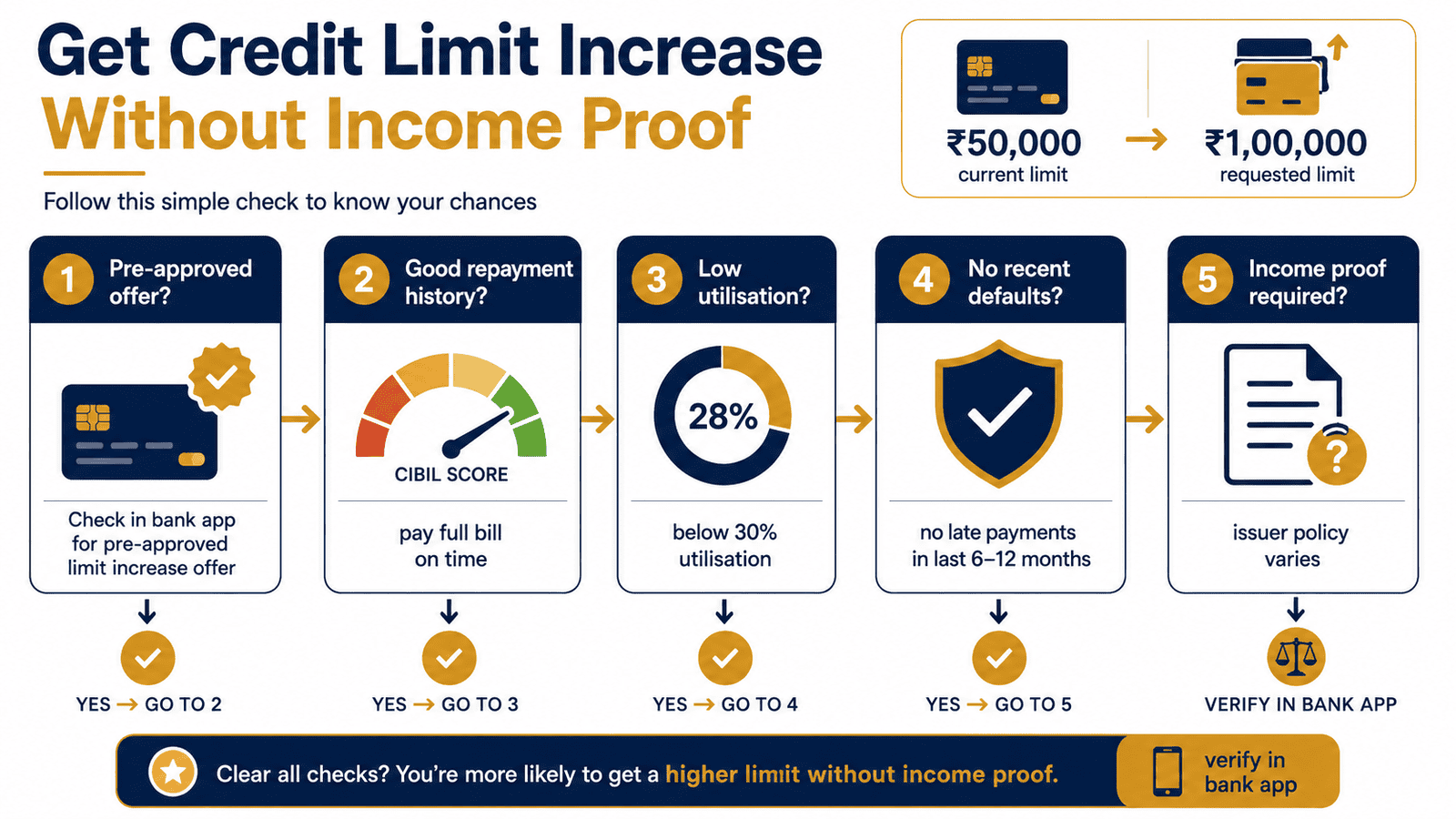
Credit limit increase without income proof is possible mainly when your card issuer gives a pre-approved limit enhancement based on repayment history, credit score, usage pattern, and internal risk checks. If you manually request a higher limit, banks may ask for salary slips, Form 16, ITR, or bank statements. Issuer policy varies — verify current requirements directly with your bank before applying.
Key Takeaways
- A credit limit increase without income proof is possible — but mainly when your issuer triggers a pre-approved offer, not when you manually request one.
- Manual limit enhancement requests typically require updated income documents such as a salary slip, Form 16, or ITR, though this varies by issuer and card type.
- A higher credit limit lowers your credit utilisation ratio only if your spending does not rise with it — keeping ₹20,000 outstanding on a ₹1,00,000 limit gives 20% utilisation versus 40% on a ₹50,000 limit.
- Good repayment history — paying the full billed amount before the due date every month — is one of the strongest signals that can trigger a pre-approved offer.
- A higher limit is not automatically beneficial: it can increase overspending risk and, in some cases, may affect a pending loan application.
- Never share your OTP, CVV, full card number, or net banking password with anyone calling to “process” a limit increase — this is a common fraud pattern flagged by RBI.
Key Facts at a Glance
| Factor | Pre-Approved Increase | Manual Request |
|---|---|---|
| Who initiates | Card issuer | Cardholder |
| Income proof typically needed | Usually not required | May be required |
| Primary driver | Repayment history, usage, internal score | Income, credit score, existing liabilities |
| Where to check / apply | Official app or net banking | Official app, net banking, or branch |
| Approval guaranteed? | No — issuer can withdraw offer | No — depends on issuer assessment |
| Impact on credit utilisation | Can improve if spending stays flat | Can improve if spending stays flat |
How Card Issuers Actually Decide on Credit Limits
Before you can understand the income-proof question, you need to understand three numbers that every credit card carries: the total credit limit, the available credit limit, and the cash limit.
Your total credit limit is the maximum the issuer will let you charge in a billing cycle before blocking transactions. Your available credit limit is what remains after your current outstanding amount is deducted — so if your total limit is ₹60,000 and you have already spent ₹18,000 this cycle, your available limit is ₹42,000. The cash limit is a sub-limit within your total limit that governs how much you can withdraw as a cash advance — typically a fraction of the total, and a channel you should mostly avoid given the high fees involved.
When you first receive a credit card, your limit is usually conservative. Issuers are extending credit to someone whose repayment behaviour they have not yet observed. As your relationship with the card grows — and as you pay bills in full and on time — the issuer builds confidence. That is when pre-approved offers tend to appear. If you are new to credit cards and wondering why your starting limit feels low, it helps to understand how issuers approach first card selection and the criteria involved in early credit decisions.
What Issuers Look at When Reviewing Your Limit
No bank publicly publishes the exact formula for a limit increase. But the factors that consistently appear across issuer documentation, MITC disclosures, and RBI’s credit card master directions include:
- Repayment history: Whether you pay the full billed amount, the minimum amount due, or something in between — and whether you ever miss or delay a payment.
- Credit utilisation: How much of your current limit you regularly use. Consistently high utilisation may signal financial stress; very low utilisation may suggest the limit is already more than enough.
- Income and income growth: For manual requests, issuers often want to confirm that your income supports a higher limit. This is where income proof enters the picture.
- Existing liabilities: EMIs, other credit cards, personal loans, and home loans all appear in your credit bureau report and affect how much additional credit an issuer is willing to extend.
- CIBIL score and bureau report: A credit bureau report from CIBIL, Experian, CRIF, or Equifax gives the issuer a snapshot of your overall credit discipline — not just your behaviour on their card.
- Internal scoring and product policy: Each issuer runs its own risk models. Two customers with identical CIBIL scores and incomes may receive different outcomes from the same bank because of internal policy differences.
Pre-Approved vs Manual: The Core Difference
A pre-approved limit enhancement means the issuer has already reviewed your profile and decided to offer a higher limit. You typically see it inside the official mobile app, net banking portal, or receive an SMS or email from the bank. Because the issuer has done its own assessment, it usually does not ask you to submit fresh documents — you simply accept or decline.
A manual limit-increase request is the reverse: you approach the bank and ask for a higher limit. Here, the issuer treats it like a fresh credit evaluation. You may be asked to submit a recent salary slip, the last two or three months of bank statements, Form 16, or your latest ITR — depending on the bank, your card type, and your current profile. Not every manual request results in documentation being required, but the probability is meaningfully higher than for a pre-approved offer.
Issuer policies on this vary and can change without notice. Always check the current requirements directly through your bank’s official app, net banking, or customer care before initiating a request.
Real Example: Rahul’s Pre-Approved Offer vs His Manual Request
Rahul, 29, works as a software developer in Pune and earns ₹75,000 per month. He has held his credit card for two years with a total limit of ₹60,000. His average monthly spend on the card is ₹18,000 — about 30% of his limit — and he has paid the full billed amount before the due date every single month. Understanding the billing cycle basics helped him develop this habit early.
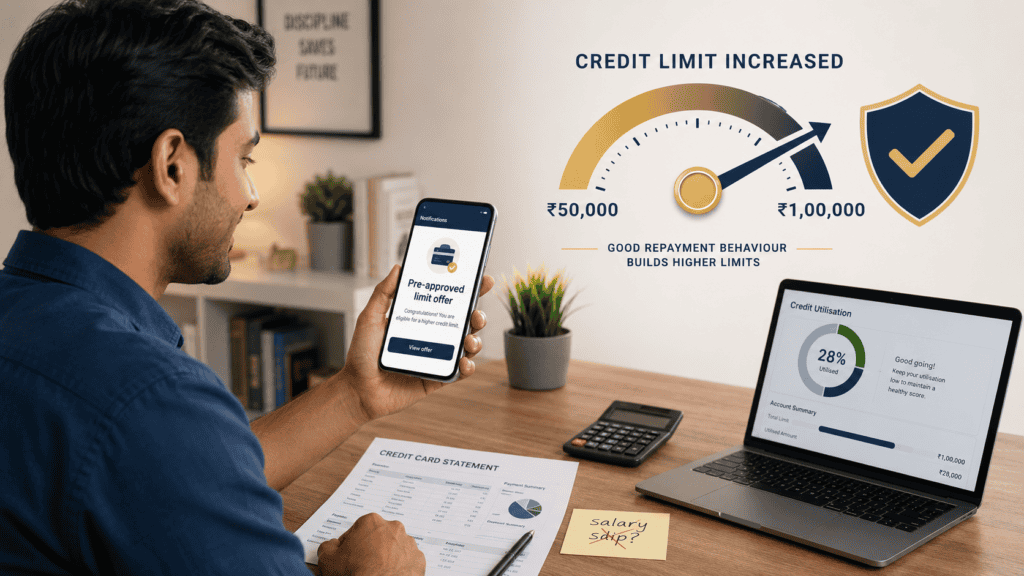
One morning, Rahul opens his bank’s mobile app and sees a banner: pre-approved limit increase to ₹1,20,000. No salary slip is requested — the bank has already reviewed his two years of on-time full payments and assessed the offer internally. Rahul accepts in two taps.
A few months later, Rahul wants to push his limit further to ₹2,50,000 for an international trip. He initiates a manual request through net banking. This time, the bank’s online form asks for his last three months’ salary slips and the latest three months’ bank statements. Because Rahul has the documents ready, the process is smooth — but the point is clear: the same bank, same customer, very different documentation experience depending on who initiated the request.
This is an illustrative example only. Actual issuer behaviour, documentation requirements, and approval outcomes will vary.
How to Calculate the Effect on Credit Utilisation
One of the most cited reasons for seeking a higher credit limit is the effect on your credit utilisation ratio — the share of your total available credit that you are currently using. Bureau models generally view lower utilisation more favourably, though specific thresholds are guidance rather than a hard legal rule.
Credit Utilisation Ratio = (Outstanding Balance ÷ Total Credit Limit) × 100
Example 1 — Before limit increase:
Outstanding balance: ₹20,000
Total credit limit: ₹50,000
Utilisation: (20,000 ÷ 50,000) × 100 = 40%
Example 2 — After limit increase (spending unchanged):
Outstanding balance: ₹20,000
Total credit limit: ₹1,00,000
Utilisation: (20,000 ÷ 1,00,000) × 100 = 20%
| Scenario | Outstanding / Limit | Utilisation |
|---|---|---|
| Before increase | ₹20,000 / ₹50,000 | 40% |
| After increase — spending flat | ₹20,000 / ₹1,00,000 | 20% |
| After increase — spending rises | ₹40,000 / ₹1,00,000 | 40% |
The utilisation benefit disappears entirely the moment you increase your spending to match the new limit. A higher limit alone does not improve your credit profile — disciplined spending does. For a deeper understanding of how this ratio affects your CIBIL score, the utilisation ratio guide explains the mechanics in detail.
Comparison: Pre-Approved Limit Increase vs Manual Limit Request
| Parameter | Pre-Approved Offer | Manual Request |
|---|---|---|
| Who initiates | Card issuer | Cardholder |
| Income proof required | Usually No | May Be Required |
| Basis of assessment | Issuer’s internal review of your history | Fresh credit evaluation by issuer |
| Speed of processing | Often instant on acceptance | Varies — hours to days |
| Risk of rejection | Lower | Higher if unsupported |
| Bureau enquiry impact | May or may not trigger a hard enquiry | Likely triggers a hard enquiry |
| Best suited for | Disciplined users with consistent repayment | Users with genuine income increase and documents |
Always verify whether accepting either type of offer creates a hard enquiry on your bureau report — this detail varies by issuer and can affect your score temporarily. Check with your bank’s official customer care or MITC before accepting.
How to Decide What’s Right for You
you can see a pre-approved limit increase in your bank’s official app or net banking, and you consistently pay your full billed amount before the due date — THEN accepting the offer is generally the lower-risk path and typically requires no income documents.
your income has genuinely grown since you got the card and you have recent salary slips, Form 16, or ITR to support a higher limit — THEN a manual request is a reasonable next step, provided your repayment record is clean.
you missed one or more payments in the past three to six months or your credit utilisation is consistently above 50% — THEN delay any limit increase request until you have rebuilt a cleaner repayment record.
you want the higher limit primarily to give yourself more spending room rather than for a specific need — THEN pause and assess whether a higher limit will genuinely help or simply increase the risk of carrying an unpaid balance.
you are planning to apply for a home loan or car loan within the next six to twelve months — THEN avoid triggering new hard enquiries from a manual limit request, as this can affect how lenders assess your credit profile.
you do not yet pay the full billed amount each month, or you regularly carry a revolving balance — THEN a higher credit limit is not the solution. A higher limit on a revolving balance means more interest charged at the card rate, which is typically very high. Understand your current statement first by reviewing how to read a credit card statement before making any decision.
Common Mistakes to Avoid
Applying Multiple Times After a Rejection
When a manual limit-increase request is rejected, some cardholders reapply immediately hoping for a different result.
Each manual request can trigger a hard enquiry on your bureau report. Multiple hard enquiries in a short window signal credit-hungry behaviour to issuers and bureaus, potentially lowering your score further and reducing your chances of approval.
Wait at least three to six months, address the underlying reason for rejection — typically utilisation, missed payments, or income mismatch — and then re-evaluate.
Increasing Spending After Getting a Higher Limit
The credit utilisation benefit of a higher limit exists only as long as your outstanding balance stays roughly flat.
If your limit moves from ₹60,000 to ₹1,20,000 and your monthly spend also doubles, your utilisation ratio stays the same — and you are now carrying a larger outstanding amount at the same interest risk.
Treat the new limit as a safety buffer, not as an invitation to spend more.
Paying Only the Minimum Amount Due
The minimum amount due is the smallest payment that prevents a late-payment mark on your record — it is not a good repayment strategy.
If you pay only the minimum on a ₹50,000 outstanding balance at a 3.5% monthly rate, the interest cost compounds quickly. More importantly, issuers observe minimum-only payment behaviour and may not extend a limit increase even if you have never technically missed a payment.
Pay the full billed amount before the due date wherever possible.
Sharing Card Details With Callers Offering a Limit Increase
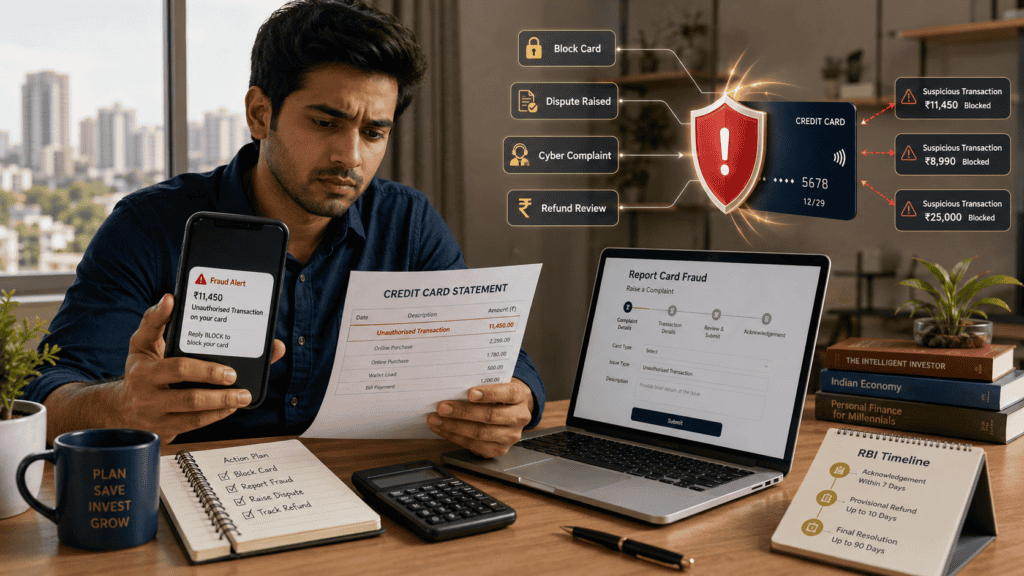
This is one of the most common credit card fraud patterns in India. A caller claims to be from your bank and offers to process a limit increase — but asks for your OTP, CVV, full card number, or net banking password to “verify” your identity.
Your bank will never ask for these details over a phone call. According to RBI guidelines on digital payment safety at rbi.org.in, you should never share OTP, CVV, or passwords with anyone. If you receive such a call, disconnect and report it to your bank immediately.
Use only the bank’s official app or net banking portal to accept or request any limit change.
Ignoring Annual Fee or Spend Conditions on an Upgraded Card
Some issuers use a limit increase to upgrade you to a higher-tier card that carries an annual fee or minimum spend condition for the fee waiver.
Read the offer terms carefully before accepting. A higher limit that comes with a ₹2,000–₹5,000 annual fee you were not expecting is a net cost if you do not use the card enough to justify it.
Check current fee and waiver conditions in the offer communication or your card MITC.
Not Checking Whether the Offer Creates a Hard Enquiry
Many cardholders assume that accepting a pre-approved limit increase is entirely passive with no credit impact. In practice, some issuers do run a hard bureau enquiry even for pre-approved offers — though others do not.
A hard enquiry causes a temporary, typically minor dip in your credit score. If you are close to applying for a major loan, this timing matters.
Ask your bank’s customer care or check the offer terms to confirm whether a hard enquiry will be triggered before you accept.
Treating Income Proof Submission as Mandatory for All Limit Requests
Some cardholders avoid requesting a limit increase entirely because they assume income proof is always required. This is not always the case — particularly for pre-approved offers or for issuers that already have recent income data on file.
Check the specific requirement for your card and issuer through official channels before assuming you need documents.
When This May Not Be the Right Choice
A higher credit card limit is not always a good idea. Consider delaying or skipping the request if any of these apply to you:
You already carry an unpaid revolving balance. A higher limit on an outstanding balance means more room to borrow at credit card interest rates — typically among the highest consumer lending rates available. Paying down the existing balance should come before requesting more credit.
You use your credit card for cash advances or emergency borrowing. Cash advances attract high fees and immediate interest — the credit limit that supports them is not the same as the spending limit you benefit from in normal use. A higher limit does not solve the underlying cash crunch.
The higher limit comes with a card upgrade and an annual fee. Before accepting, check whether the new card charges a fee and whether a waiver is achievable at your typical spend level. The annual fee waiver guide explains how to assess and negotiate these conditions.
You are actively trying to control your spending. A higher limit is a psychological nudge to spend more. If you have been working to reduce discretionary expenses, a higher limit can undermine that effort.
If any of these apply to your situation, it may be worth exploring alternatives before committing.
Official Rules and Where to Verify
Credit card limit policies, documentation requirements, and eligibility criteria are set by each issuer and reviewed periodically. There is no single universal rule that governs how all banks handle limit increase requests in India. Here is where to verify:
- Your card issuer’s official mobile app and net banking: The most reliable place to check whether a pre-approved offer is available for your account and what documentation, if any, is needed.
- Your card MITC (Most Important Terms and Conditions): The document issued with your card contains the issuer’s current policies on limits, fees, and documentation. Check the latest version on your bank’s official website.
- Your bank’s official customer care number or branch: For specific queries about manual limit requests, call only the number printed on the back of your card or listed on the official bank website.
- RBI (Reserve Bank of India) — rbi.org.in: RBI’s master directions on credit cards and digital payment safety guidelines are the regulatory backbone for all Indian card issuers. For a broader understanding of how creditworthiness is assessed, the good CIBIL score guide covers what factors matter and how the scoring system works.
Rules, limits, and rates on this topic can change with each Budget or regulatory update. Always verify current figures directly from the official source before making any financial decision.
Expert Tips
- Pay the full billed amount — not just the minimum — every single month. This single habit does more to trigger pre-approved offers than almost anything else. Issuers track full-payment behaviour closely as a creditworthiness signal.
- Keep your utilisation below 30% of your total limit on a regular basis. If you consistently spend close to your limit every month, the issuer may see the card as maxed out rather than actively used — these are different signals. A ₹60,000 limit works better when your typical outstanding is ₹12,000–₹18,000, not ₹55,000.
- Use the card for regular, varied purchases rather than a single large transaction per cycle. Active, spread-out usage across categories — fuel, groceries, bills, subscriptions — demonstrates organic card usage, which is a healthier signal than one large purchase and silence for the rest of the month.
- Update your income details through the official issuer channel only — never through a third-party link or a phone call. Many banks allow you to update income information within the app or by visiting a branch, which puts current income data on file and can support a future manual request without requiring you to reapply from scratch.
- Avoid applying for multiple new credit products within a six-month window. Each application typically creates a hard enquiry. If you recently took a personal loan, applied for a new card, or are considering a home loan, space out your credit applications to avoid appearing credit-hungry.
- Check your credit report once a year for free through CIBIL’s official portal or any licensed bureau. Errors on your report — wrong outstanding amounts, closed accounts still showing as open, or someone else’s enquiry linked to your profile — can suppress your score and reduce your chance of a limit increase without any fault on your part. Dispute errors promptly.
Frequently Asked Questions
Can I increase my credit card limit without a salary slip?
Yes — if your card issuer has already generated a pre-approved limit enhancement for your account, it is typically available to accept directly through the official app or net banking without submitting any income documents. If you are making a manual request and the bank asks for income proof, a salary slip, Form 16, bank statements, or ITR may be required. Requirements vary by issuer and card type.
Can my CIBIL score alone get my credit card limit increased?
A good CIBIL score is an important factor, but it is not sufficient on its own. Issuers also look at repayment history specifically on your card, current utilisation, total existing liabilities, and their own internal risk models. A high CIBIL score improves your eligibility but does not guarantee a limit increase.
Does accepting a pre-approved limit increase affect my CIBIL score?
It depends on the issuer. Some banks run a hard enquiry even for pre-approved offers; others do not. A hard enquiry causes a small, temporary dip in your score. Confirm with your bank whether accepting a specific offer triggers a hard enquiry before you proceed.
Why was my credit card limit increase request rejected?
Common reasons include: one or more missed or delayed payments in recent months, high credit utilisation on existing cards, a low or recently declined CIBIL score, high outstanding EMI obligations relative to income, or the income proof submitted not meeting the issuer’s minimum threshold for the limit requested. The bank is not required to disclose the specific reason for rejection in most cases.
Is a higher credit limit safe?
A higher limit is safe if you have the discipline to maintain your spending and repayment habits. It is not safe if it leads to carrying a higher outstanding balance, revolving debt, or using the card for cash advances. The limit itself is neutral — the risk depends on how you use it.
Should I request a limit increase or apply for a new card?
A limit increase on an existing card is generally preferable if you are happy with the card’s features and rewards. It avoids the hard enquiry that comes with a new card application and does not add a new credit line. Apply for a new card only if you genuinely need a different product — for example, better travel benefits or a higher reward rate — rather than simply more spending room.
What happens if I accept a limit increase and then do not use the extra limit?
Nothing negative happens. Unused available credit does not cost you anything and may help keep your utilisation ratio lower if your outstanding balance stays flat. There is no fee for having a higher limit unless your card has a limit-linked annual fee — check your MITC for that detail.
Can I request a credit limit decrease instead of an increase?
Yes. Most issuers allow you to request a lower limit through customer care or the official app if you find the current limit too high for your spending discipline or if you want to reduce the risk of unauthorised high-value transactions. This is a reasonable step and does not carry the same documentation burden as a limit increase.
Final Verdict
A credit limit increase without income proof is genuinely possible in India — but it works reliably only when your card issuer initiates the offer through a pre-approved enhancement visible in your official app or net banking. If you are approaching the bank with a manual request, be prepared for the possibility that income documentation will be required. The cleaner your repayment history, the more favourable your starting position for either route.
A higher limit is a useful financial tool only when paired with disciplined spending and full monthly repayment. If your outstanding balance grows along with your limit, the utilisation benefit disappears and your interest cost can increase significantly. The safest and most reliable first step is to log into your bank’s official app, check whether a pre-approved offer is already waiting for you, and read the terms carefully before accepting.
Always verify the latest rules from official sources or consult a qualified professional before making any financial decision.
This article is for educational purposes only and should not be treated as personalised financial, tax, investment, insurance, or legal advice. Tax rules, interest rates, regulatory limits, and product features can change with each Budget or policy update. Please verify current rules from official government sources or consult a qualified and registered professional before making any financial decision.

Nikhil Bansal writes about credit cards, billing cycles, card charges, rewards, cashback, credit utilisation, card EMI, BNPL, and responsible credit usage in India. His content is designed for readers who want to use credit cards wisely without falling into expensive repayment mistakes.
He covers topics such as how to choose a first credit card, credit card billing cycle, due date, grace period, minimum amount due, credit utilisation ratio, reward points vs cashback, lifetime free credit cards, annual fee waivers, credit card statement reading, add-on cards, cash advance charges, EMI on credit cards, credit card fraud reporting, BNPL vs credit card, and foreign transaction fees.
Nikhil’s writing is beginner-friendly, direct, and risk-aware. He explains how small mistakes such as paying only the minimum due, withdrawing cash from a credit card, missing due dates, or overusing credit limits can become costly. Since card fees, interest rates, reward rules, waiver conditions, and bank offers change often, readers should verify the latest Most Important Terms and Conditions from the card issuer.