

You have picked a mutual fund. You’ve chosen the scheme. Now the fund house asks: Growth option or IDCW Reinvestment? Most first-time investors either pick randomly or copy a friend. Both options invest in the same portfolio — but over 10 years, that one choice quietly changes your tax bill, your corpus size, and your paperwork load. This article breaks down exactly how dividend reinvestment vs growth option works, with a ₹10,000 monthly SIP held over a decade, a plain-English tax comparison, and a clear decision framework that tells you which option fits your situation.
Quick Answer: Dividend Reinvestment vs Growth Option
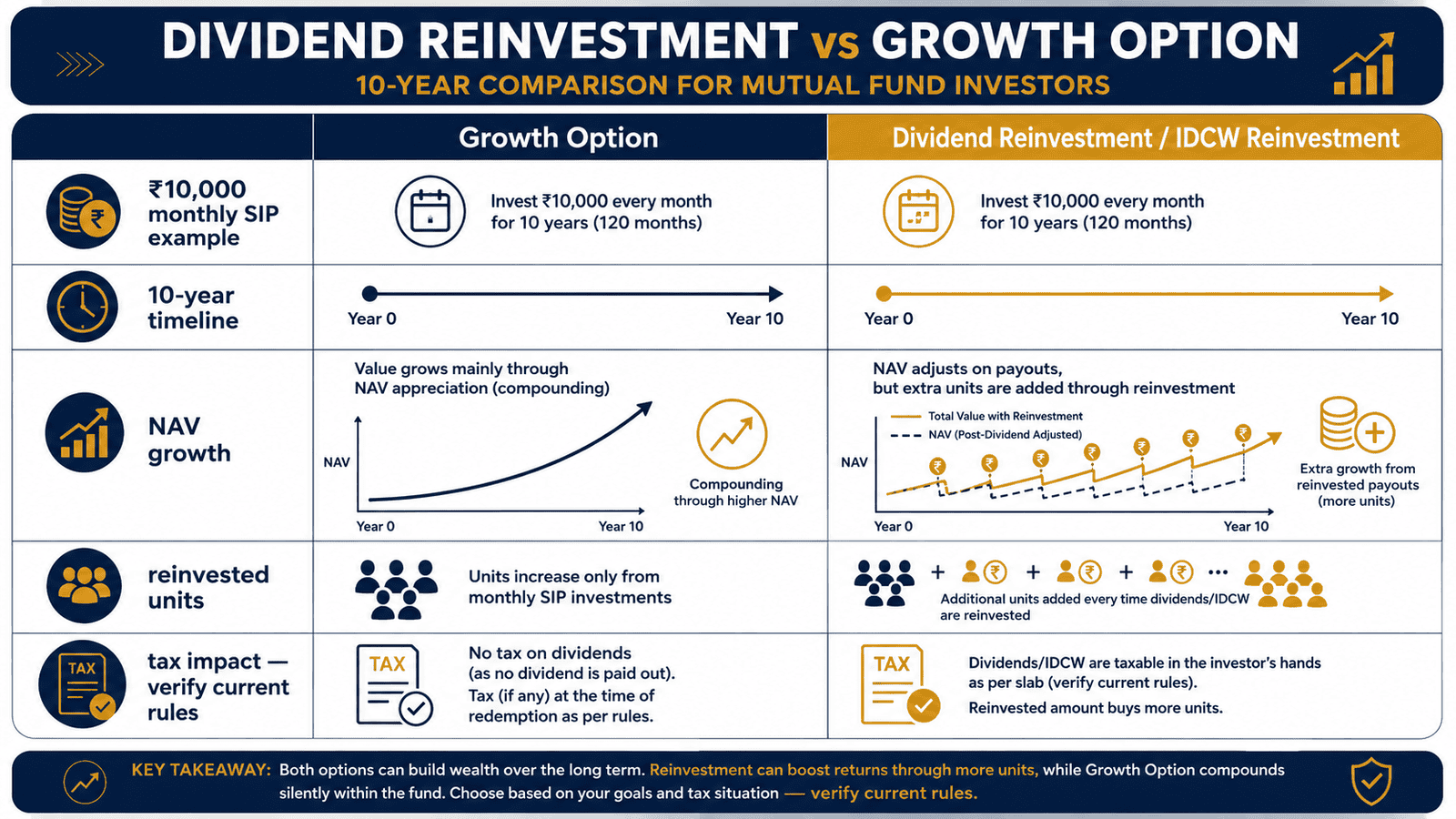
Dividend reinvestment vs growth option compares whether mutual fund payouts are reinvested as units or kept inside NAV growth. For a ₹10,000 monthly SIP over 10 years, the growth option usually makes compounding easier to track, while IDCW reinvestment can create tax and cash-flow complexity.
Key Takeaways
- In the Growth option, your money compounds inside the NAV — no payout, no extra tax event until you redeem.
- IDCW Reinvestment distributes income first, then buys back units at the post-payout NAV — each payout is taxable in your hands in the year it is received.
- SEBI renamed “Dividend” to “Income Distribution cum Capital Withdrawal” (IDCW) in 2021 to prevent the misconception that dividends are “extra” returns.
- For a 30% tax bracket investor, IDCW tax drag can reduce a 10-year corpus meaningfully compared to Growth — the exact gap depends on current rates, which should be verified at incometax.gov.in before deciding.
- Growth option simplifies ITR filing — only one capital gains event on redemption, not one per quarterly payout.
- IDCW Reinvestment is not “extra money” — the fund’s NAV drops by the payout amount on the ex-dividend date, leaving total value unchanged at the moment of distribution.
- For SIP-based long-term wealth creation (5 years or more), the Growth option is generally more tax-efficient for investors in the 20% or 30% slab.
Comparison: Growth Option vs IDCW Reinvestment
| Parameter | Growth Option | IDCW Reinvestment |
|---|---|---|
| How returns accumulate | NAV rises continuously — all gains stay inside the fund | Fund distributes payouts periodically; payout is used to buy new units at lower post-payout NAV |
| Tax event during holding | None — no tax until redemption | Yes — each distribution is taxable as per your income slab in that FY |
| Tax on distribution | N/A | Added to your income; taxed at your applicable slab rate |
| Tax on redemption | STCG or LTCG depending on holding period | STCG or LTCG on capital gains portion; distribution already taxed separately |
| NAV behaviour | Grows uninterrupted | Drops on ex-dividend date by payout amount; new units added |
| Compounding clarity | Simple — one NAV to track | Complex — multiple unit lots at different NAVs |
| ITR filing complexity | Low — one capital gains schedule on redemption | High — every distribution must be reported; multiple cost-of-acquisition lots |
| Best suited for | Long-term wealth creators in 20–30% slab | Retirees or those needing periodic income at lower tax slabs |
Key Facts at a Glance
| Fact | Detail |
|---|---|
| SEBI nomenclature change | “Dividend” renamed to “IDCW” — effective April 2021 |
| IDCW tax treatment | Taxed as income in the investor’s hands at applicable slab rate |
| Equity LTCG tax rate | Verify current rate at incometax.gov.in before investing |
| Equity STCG tax rate | Verify current rate at incometax.gov.in before investing |
| NAV on ex-dividend date | Drops by the exact distribution amount per unit |
| New units allotted (IDCW) | At post-payout (lower) NAV — same total value as Growth at that moment |
| Growth NAV | Reflects total return including all dividends not paid out |
| SIP calculator link | Use the Ridhi SIP Calculator to project 10-year corpus under both options |
What Is the Growth Option in a Mutual Fund?
When you choose the Growth option, the fund does not pay you anything during the holding period. Every rupee of profit — dividends from underlying stocks, bond interest, capital appreciation — stays inside the fund and gets reflected in a rising NAV.
Think of it like a snowball rolling downhill. As the NAV grows, future returns are calculated on a larger base. This is the textbook definition of compounding. Because no money leaves the fund, there is no tax event until you decide to redeem your units.
For a deeper understanding of how mutual funds work before comparing options, see our guide on mutual fund basics.
Your NAV in the Growth option includes everything. A ₹100 NAV fund that grows to ₹180 over five years reflects 80% total return — all kept inside, all compounding. You track one number. You report one event when you sell.
What Is the IDCW Reinvestment Option?
IDCW stands for Income Distribution cum Capital Withdrawal. Until April 2021, this was simply called the “Dividend” option. SEBI changed the name because many investors mistakenly believed dividends were “extra” earnings on top of their investment. They are not.
Here is what actually happens: The fund periodically declares a distribution — say ₹2 per unit. On the ex-dividend date, the NAV drops by exactly ₹2. If your NAV was ₹50, it becomes ₹48 on that day. The fund uses that ₹2 to buy you new units at ₹48. Your total portfolio value at that moment is identical whether you were in Growth or IDCW — the difference kicks in only when taxes enter the picture.
To understand how NAV adjustments work in detail, read our explainer on understanding fund NAV.
In the Reinvestment sub-option, you do not receive cash. But the distribution is still a taxable event. The fund house reports the payout to the tax department, and you must include it in your income for that financial year. This creates a tax drag that compounds in the wrong direction over time.
Why the NAV Gap Between Growth and IDCW Keeps Widening
This is the single most misunderstood part of the debate. Investors sometimes look at the Growth NAV (₹180) and the IDCW NAV (₹95) of the same scheme and think the Growth option has performed better. Not necessarily — the IDCW NAV is lower because distributions have been paid out repeatedly, reducing the base.
The correct comparison is total wealth: (IDCW NAV × units held) vs (Growth NAV × units held). On a pre-tax basis, the numbers should be nearly identical at any point in time. Post-tax is where Growth consistently pulls ahead for higher-slab investors.
According to SEBI’s mutual fund disclosure norms, fund houses must display both Growth and IDCW NAVs separately on their websites and factsheets. This helps investors track the correct NAV for their option.
Tax Is Where Growth Wins Over a Decade
Every IDCW payout — even if you never see the cash because it is reinvested — is taxable as income in the year of distribution. If you are in the 30% bracket, that payout shrinks by 30% plus applicable surcharge and cess before the reinvestment happens. That shrunken amount buys fewer units at the post-payout NAV.
In the Growth option, that same amount stays fully invested inside the NAV. It compounds without friction. After 10 years, that difference in starting base — year after year — adds up significantly. To understand how to measure the returns on either option correctly, see our guide on measuring fund returns.
For equity funds, LTCG on redemption has a threshold below which gains are exempt in a financial year — verify the current limit at incometax.gov.in, as this figure can change in a Budget. Even after LTCG, the Growth option investor typically retains more corpus than a comparable IDCW Reinvestment investor in higher tax brackets.
For debt funds, the tax treatment differs further — gains are taxed as per your slab regardless of holding period following changes in Finance Act 2023. This makes the Growth vs IDCW decision in debt funds almost entirely about simplicity rather than a tax arbitrage. Verify current debt fund taxation at incometax.gov.in before deciding.
Real Example: Rohan’s 10-Year SIP Comparison
Rohan, 31, works as a software engineer in Bengaluru earning ₹1.2 lakh per month. He invests ₹10,000 per month via SIP in an equity mutual fund. He is in the 30% income tax bracket. He wants to understand which option — Growth or IDCW Reinvestment — builds more corpus over 10 years.
For context on how SIPs compound over time, see our guide on how SIP works.
Growth option: ₹10,000/month SIP at an illustrative 12% CAGR (not guaranteed) over 10 years. No mid-period tax event. On redemption, LTCG applies on gains above the exempt threshold — verify current rate at incometax.gov.in. Approximate pre-tax corpus at 10 years: around ₹23.2 lakh on a total investment of ₹12 lakh (illustrative, based on 12% CAGR; actual returns will vary).
IDCW Reinvestment option: The same fund, same 12% CAGR assumption. Suppose the fund declares ₹1.50 per unit twice a year. Each distribution is taxable at 30% slab for Rohan. That 30% tax drag on each payout, applied twice annually for 10 years, reduces the effective reinvestment amount year after year. The corpus grows on a smaller base each time a payout is processed. By year 10, Rohan’s post-tax corpus in IDCW Reinvestment is meaningfully lower — the difference could run into several lakh rupees depending on payout frequency and fund NAV.
Key insight: The Growth option does not give Rohan “extra” returns — it simply defers the tax, keeps more money compounding, and reduces paperwork. For a 30% bracket investor like Rohan, that deferral over a decade is worth pursuing.
How to Calculate the Tax Drag in IDCW Reinvestment
Effective Reinvestment Amount = Payout per Unit × Units Held × (1 − Tax Rate)
Step 1: Determine the payout per unit (from the fund’s distribution notice).
Step 2: Multiply by your units held at that date.
Step 3: Apply your marginal tax rate to find how much is lost to tax.
Step 4: The remainder buys new units at the post-payout NAV.
Step 5: In Growth, 100% of that same amount stays inside the NAV compounding untouched.
| Scenario | Tax Slab | 10-Year Impact |
|---|---|---|
| Growth option, equity fund | 30% | Tax deferred to redemption; LTCG applies above exempt threshold — verify rate |
| IDCW Reinvestment, 30% slab | 30% | Each payout taxed at 30%; reinvestment base shrinks every distribution cycle |
| IDCW Reinvestment, 0% slab | 0% | No tax drag on distributions; corpus near-identical to Growth on pre-tax basis |
Use the SIP wealth estimate calculator to model your own corpus projection and then apply this tax-drag logic manually for your bracket.
How to Decide What’s Right for You
You are in the 20% or 30% income tax slab and investing for 5 or more years — THEN choose the Growth option; the tax deferral and compounding advantage almost always outweigh any perceived benefit of IDCW.
You are retired or in the 0–5% tax bracket and need the feeling of periodic “income” from your mutual fund — THEN IDCW Payout (not Reinvestment) may suit you better, or consider power of compounding in Growth and use Systematic Withdrawal Plan instead.
You find ITR filing complex and want to minimise capital gains reporting — THEN Growth wins: one event on redemption vs multiple IDCW entries per year.
You are investing in a debt mutual fund primarily for capital preservation — THEN verify whether current debt fund tax rules make either option meaningfully different; as of Finance Act 2023, the advantage narrowed significantly.
You want to switch from IDCW Reinvestment to Growth in an existing holding — THEN treat this as a redemption-and-reinvestment; capital gains tax may apply on the switch amount.
You are a first-time investor under 35 with a 10-year horizon — THEN the Growth option is almost always the simpler, more efficient, and lower-maintenance choice.
You are not in the higher tax slabs and you specifically want periodic reinvestment milestones to track progress psychologically — THEN IDCW Reinvestment is not wrong, but understand you are paying a tax premium for that psychological benefit.
Common Mistakes to Avoid
Treating IDCW as “Extra” Income
Many investors believe dividends are a bonus on top of their investment.
SEBI renamed the option to IDCW specifically to address this misconception. The NAV drops by exactly the payout amount on the ex-dividend date — you are receiving a portion of your own money back. Believing it is extra return leads to overestimating actual fund performance.
Always check total return (Growth NAV appreciation), not dividend history, to judge a fund’s performance.
Ignoring the Annual Tax Event
IDCW Reinvestment investors often forget that each distribution is taxable in the year of receipt, even though they never see the cash.
For a 30% slab investor receiving ₹10,000 in IDCW across the year, ₹3,000 is effectively lost to tax — and that ₹3,000 never enters the reinvestment cycle. Over a decade with semi-annual payouts, this drag compounds significantly.
Track every IDCW payout in your Form 26AS and Annual Information Statement (AIS) — the fund house reports it automatically to the tax department.
Comparing Growth NAV and IDCW NAV Directly
Looking at Growth NAV (₹180) vs IDCW NAV (₹85) and concluding Growth “outperformed” is incorrect.
The lower IDCW NAV simply reflects repeated distribution. The correct comparison is (NAV × units) for each option at the same date. Pre-tax, they should be nearly equal — the gap only emerges post-tax, through compounding over years.
Use a fund performance calculator that accounts for unit count and distribution history, not raw NAV.
Switching Options Without Understanding Tax Consequences
Switching from IDCW Reinvestment to Growth within the same scheme is treated as a redemption of IDCW units and a fresh purchase of Growth units by the Income Tax Department.
This means capital gains tax applies on the switch amount, even if you never touched the money. A switch after 3 years in equity may attract LTCG above the exempt threshold. Check current rules at incometax.gov.in before switching.
Consult a qualified tax professional before switching large accumulated holdings between options.
Assuming IDCW Reinvestment Is More Disciplined Than SIP
Some investors choose IDCW Reinvestment because they feel it “forces” reinvestment like a SIP.
It does not — it simply reinvests a portion of your own corpus at a higher tax cost. A regular SIP in the Growth option achieves disciplined reinvestment without any distribution tax event. The compounding logic of a SIP in Growth option is cleaner and more efficient for most salaried investors.
Use a SIP in the Growth option rather than IDCW Reinvestment for disciplined, tax-efficient accumulation.
Not Reviewing IDCW Frequency Before Choosing
Not all IDCW schemes pay out at the same frequency — some are monthly, some quarterly, some annual, and some are “growth-triggered” where the fund decides when to declare based on scheme NAV crossing a threshold.
Higher frequency payouts mean more frequent tax events in the same financial year. A fund declaring IDCW every month creates 12 taxable entries per year in your ITR — significantly increasing filing complexity.
Check the scheme information document (SID) for payout frequency before choosing IDCW Reinvestment.
Overlooking Cost of Acquisition for Multiple IDCW Lots
Every IDCW Reinvestment creates a new unit lot with its own purchase NAV and purchase date. After 10 years of semi-annual payouts, you may have 20+ unit lots across different SIP dates and IDCW reinvestment dates.
When you redeem, each lot carries a different holding period — some may qualify for LTCG, others for STCG, depending on the redemption date. Tracking this manually is error-prone.
Ensure your platform (broker, AMC) provides a clear FIFO-based capital gains statement before filing.
When This May Not Be the Right Choice
If you are in a zero or low tax bracket — for retirees or individuals with no other taxable income, the IDCW tax drag is minimal or absent. The Growth option’s tax deferral advantage shrinks considerably, and periodic distributions from IDCW Payout may actually serve a cash-flow need without meaningful cost.
If your investment horizon is under 3 years — for short-term parking in liquid or ultra-short-term debt funds, the Growth vs IDCW difference matters less than liquidity and safety. The compounding edge of Growth is largely irrelevant over short periods.
If you need a psychological spending anchor — some investors spend less of their corpus when the “income” appears as a separate payout rather than as a growing NAV number. For these individuals, IDCW Payout (not Reinvestment) combined with a strict budget may work better behaviourally, even if less tax-efficient.
If your fund is a hybrid or arbitrage fund with specific IDCW advantages — certain fund categories carry nuanced taxation at the scheme level. Verify with a qualified advisor whether IDCW treatment differs for your specific scheme type before concluding that Growth is universally better.
If any of these apply to your situation, it may be worth exploring alternatives before committing.
Official Rules and Where to Verify
Tax treatment for IDCW (formerly dividend) income, capital gains on equity and debt mutual funds, LTCG exemption thresholds, STCG rates, surcharge, and cess are all subject to change through the annual Union Budget or standalone regulatory amendments.
Rules, limits, and rates on this topic can change with each Budget or regulatory update. Always verify current figures directly from the official source before making any financial decision.
- SEBI (Securities and Exchange Board of India) — sebi.gov.in — for mutual fund scheme regulations, IDCW nomenclature rules, and disclosure norms.
- Income Tax Department — incometax.gov.in — for current LTCG and STCG rates, IDCW taxation as income, and capital gains exemption thresholds for equity and debt funds.
Expert Tips
- Use Growth by default in equity SIPs. Unless you have a specific cash-flow need or are in a zero-tax situation, Growth is the default choice for any equity mutual fund SIP with a 5-year-plus horizon. There is no credible scenario where IDCW Reinvestment beats Growth for a 30% slab long-term investor.
- Check your AIS before filing ITR. If you hold any IDCW Reinvestment units, the Annual Information Statement (available on the Income Tax portal) will show all distributions reported by the fund house. Cross-check this against your own records to avoid mismatches that trigger notices.
- Do not switch options impulsively. Switching from IDCW to Growth is a taxable event. If you have held for over a year in equity, calculate whether LTCG on the switch amount is worth the long-term efficiency gain. For small amounts (under ₹1–2 lakh market value), the tax may be negligible; for larger folios, do the math first.
- If you want regular income, use SWP — not IDCW. A Systematic Withdrawal Plan (SWP) from a Growth option fund gives you periodic cash inflow with better tax treatment (only the gains portion of each withdrawal is taxed, not the full amount). IDCW taxes the full distribution. For retirees, SWP from Growth is almost always more efficient.
- Track unit lots when holding IDCW Reinvestment. Each payout creates a new lot. When you redeem after 5–10 years, each lot carries a different purchase date and NAV. FIFO (First In, First Out) applies — request a consolidated capital gains statement from your AMC or broker that breaks this down before you file.
- Read the SID before investing. The Scheme Information Document tells you whether the fund pays IDCW monthly, quarterly, annually, or at the fund manager’s discretion. A fund that declares IDCW monthly generates 12 taxable events per year — factor this in before choosing.
- Run the numbers on the Ridhi SIP Calculator. The 12% CAGR assumption used in examples is illustrative only. Plug in your own investment amount, expected CAGR, and holding period. Then apply the tax drag from your slab to the IDCW payout scenario to see the real post-tax corpus difference for your numbers.
Frequently Asked Questions
Is dividend reinvestment the same as the Growth option?
No. In IDCW Reinvestment, the fund pays out a distribution, then uses that amount to buy new units at the post-payout NAV. In the Growth option, no payout happens — all returns stay inside the NAV. Both end up reinvesting, but via different mechanisms, and only IDCW Reinvestment creates a taxable event at the time of distribution.
What does IDCW stand for and why did SEBI rename “dividend”?
IDCW stands for Income Distribution cum Capital Withdrawal. SEBI changed the name in 2021 because many retail investors believed mutual fund “dividends” were income earned on top of their investment — similar to fixed deposit interest. In reality, the payout comes partly from capital, and the NAV drops by the payout amount on the ex-date. The new name is more accurate about what is actually happening.
Is IDCW reinvestment tax-free?
No. Even though you never receive the cash in a reinvestment sub-option, every IDCW distribution is taxable as income in the year of receipt, at your applicable slab rate. The fund house deducts TDS at the applicable rate before reinvesting the balance. Verify current TDS and taxation rules at incometax.gov.in.
Can I switch from IDCW Reinvestment to Growth without paying tax?
No. Switching between options within the same scheme (IDCW to Growth or vice versa) is treated as a redemption and fresh purchase by the income tax rules. Capital gains tax applies at the time of switch based on the holding period and fund category. Plan the switch carefully, especially if your holding has a large unrealised gain.
What happens to the NAV when IDCW is declared?
On the ex-dividend date, the NAV drops by exactly the distribution amount per unit. If the NAV was ₹50 and the fund declares ₹2 per unit, the ex-date NAV becomes ₹48. In the Reinvestment option, that ₹2 (minus taxes) buys new units at ₹48. In the Growth option, no NAV drop occurs — the fund does not declare a distribution at all.
Is the Growth option always better than IDCW reinvestment for long-term investors?
For most salaried investors in the 20% or 30% tax bracket investing for 5 or more years in equity funds, yes — the Growth option is typically more tax-efficient. However, for investors with no taxable income or those in the 5% bracket, the IDCW tax drag is minimal, and the choice becomes more about simplicity and cash-flow preference. Mutual fund investments are subject to market risks. Past performance does not guarantee future returns.
What is the tax on IDCW from equity mutual funds?
IDCW received from equity mutual funds is added to your total income and taxed at your applicable income tax slab rate. TDS may be deducted by the fund house before crediting or reinvesting the amount. The exact TDS rate and applicability should be verified at incometax.gov.in, as rates can change with Budget amendments.
Does the Growth option have TDS?
For resident Indian investors, there is generally no TDS on capital gains from Growth option redemptions — you self-report and pay advance tax or file ITR as applicable. For NRI investors, TDS rules differ. Verify current TDS provisions for your residential status at incometax.gov.in before investing.
What is the difference between IDCW Payout and IDCW Reinvestment?
Both are sub-options under the IDCW option. In IDCW Payout, the distribution is credited to your bank account in cash. In IDCW Reinvestment, the same distribution (after applicable tax deduction) is used to buy additional units in the same scheme at the post-payout NAV. In both cases, the distribution is taxable income in the year of receipt — the only difference is whether the net amount reaches your bank or buys units.
How do I calculate LTCG when I have IDCW Reinvestment units?
Each IDCW Reinvestment creates a new unit lot with its own purchase date and purchase NAV (post-payout NAV on the reinvestment date). When you redeem, gains are computed lot-by-lot using FIFO. Units held for more than 12 months qualify for LTCG treatment in equity funds; under 12 months attract STCG. Request a FIFO-based capital gains statement from your AMC or broker to simplify this calculation.
Final Verdict
For most salaried investors — particularly those in the 20% or 30% income tax bracket running SIPs for 5 to 10 years — the dividend reinvestment vs growth option debate has a clear practical answer: choose Growth. No mid-period tax drag, no fragmented unit lots, no quarterly ITR entries, and the full compounding engine running without friction. The IDCW Reinvestment option is not “wrong” — it is simply misunderstood. It makes sense for specific situations: zero-tax investors, retirees with a cash-flow need, or investors who understand and accept the tax cost for behavioural reasons.
If you want to see your 10-year corpus numbers before deciding, run the SIP wealth estimate calculator and factor in the tax drag from your bracket. Always verify the latest rules from official sources or consult a qualified professional before making any financial decision.
This article is for educational purposes only and should not be treated as personalised financial, tax, investment, insurance, or legal advice. Tax rules, interest rates, regulatory limits, and product features can change with each Budget or policy update. Please verify current rules from official government sources or consult a qualified and registered professional before making any financial decision.

Arjun Kapoor writes about mutual funds, SIPs, ELSS, fund categories, investment returns, and beginner investing concepts for Indian readers. His focus is on education, not product promotion or fund recommendations. He helps readers understand how mutual funds work before they start investing or comparing schemes.
He covers topics such as mutual fund meaning, SIP meaning, SIP calculator, direct mutual funds vs regular plans, NAV, ELSS tax-saving funds, CAGR, absolute returns, XIRR, expense ratio, large cap vs mid cap vs small cap funds, flexi cap funds, index funds vs active funds, liquid funds, debt mutual funds, SIP pause vs SIP stop, lumpsum vs SIP, and how to start SIP in India.
Arjun’s writing is simple, risk-aware, and long-term oriented. He avoids guaranteed-return language and explains investment concepts using examples, timelines, and comparison tables. His articles remind readers that mutual fund investments are subject to market risks, and past performance does not guarantee future returns. Readers should verify scheme details from SEBI, AMFI, fund houses, and official scheme documents.