
You’ve seen the ads — a co-branded card promising 10x points on flights or 5% cashback at one supermarket chain. Sounds better than the 1–2% general cashback card sitting in your wallet. But when the month-end statement arrives, the rewards don’t feel quite so impressive. Annual fees, exclusions, capped cashback, reward points that expire before you redeem them — this is where the gap between advertised value and real value opens up.
Most salaried Indians spending ₹20,000–₹30,000 a month on cards face exactly this dilemma: does a co-branded card with a flashy partner reward rate actually outperform a simple general card? The answer depends entirely on your spending pattern — not on which card has the higher headline rate. This article will not name any card as the best. Instead, it will give you a reusable decision framework so you can calculate real value for yourself, before you apply.
Quick Answer: Co-Branded vs General Credit Cards
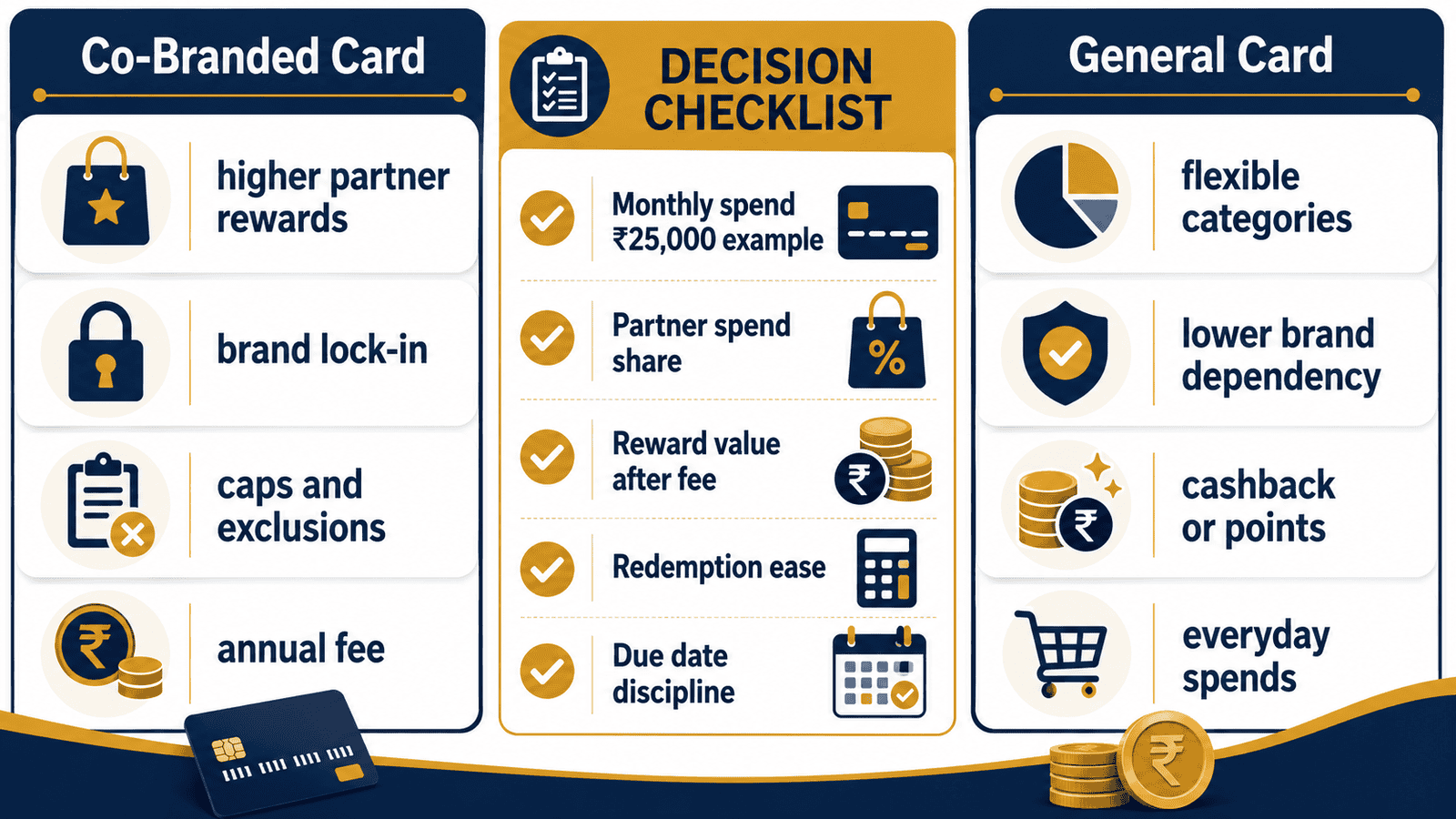
Co-branded vs general credit cards depends on where you spend. A co-branded card can give better value if a large share of your monthly spending goes to one partner brand. A general card is usually better when your ₹25,000 monthly card spend is spread across groceries, bills, fuel, travel and shopping. Note: card benefits, reward rates, annual fees and partner terms can change without notice — always verify current terms directly with the card issuer before applying.
Key Takeaways
- Co-branded cards earn outsized rewards only on the partner brand — if that brand represents less than 40–50% of your monthly card spending, a general card will likely give you more usable value across the remaining spend.
- Annual fee, reward caps, reward expiry and excluded categories (often rent, wallet loads, fuel, EMIs) can reduce the effective reward rate on any card to well below the advertised figure.
- Missing your due date once can cost you ₹500–₹1,500 in interest and late charges on a ₹25,000 outstanding balance — wiping out two to three months of rewards in a single billing cycle.
- Joining vouchers and lounge access are one-time or limited benefits — do not choose a card primarily because of its welcome offer.
- Beginners with no strong loyalty to one brand should start with a reliable general card; a co-branded card makes sense only when partner spending is already a predictable, recurring part of your lifestyle.
- Real card value = usable rewards + usable benefits − annual fee − avoidable charges. Anything that cannot be redeemed conveniently is not real value.
- All reward rates, annual fees, milestone thresholds and partner benefits listed by issuers require direct verification — these terms change without public announcement.
| Parameter | Co-Branded Card | General Credit Card |
|---|---|---|
| Reward structure | High rate on partner brand; low or standard rate elsewhere | Flat or tiered rate across most categories |
| Best for | Concentrated spending with one airline, retailer or fuel brand | Distributed spending across groceries, bills, fuel, dining |
| Reward type | Partner currency (air miles, brand points, store credits) | Cashback, bank points, or statement credit |
| Redemption flexibility | Limited — partner platform or catalogue only | Higher — bank portal, statement credit, or transfers |
| Annual fee recovery | Requires consistent partner spending to justify fee | Easier with distributed everyday spending |
| Exclusions risk | Non-partner spends earn little; exclusions on partner spend also common | Exclusions exist but spread across more categories |
| Partner dependency | High — value falls if partner relationship or terms change | None — not linked to any single merchant |
| Beginner suitability | Conditional | Better starting point |
| Fact | Co-Branded Card | General Card |
|---|---|---|
| Definition | Issued jointly by a bank and a merchant/brand partner | Issued by a bank with no single merchant partnership |
| Reward currency | Partner miles, store credits, or brand vouchers | Bank reward points, cashback, or statement credit |
| Headline reward rate | Often higher — on partner spends only | Usually lower but applied broadly |
| Primary risk | Brand lock-in; rewards stranded if partner changes terms | Lower headline rate on any single category |
| Key verification points | Partner exclusions, reward cap, redemption minimum, expiry | Excluded categories, annual fee waiver threshold, cap per cycle |
How Co-Branded and General Credit Cards Actually Work
A co-branded credit card is issued by a bank in partnership with a specific brand — an airline, a hotel chain, a fuel company, a supermarket, or an e-commerce platform. The bank handles the credit, the partner provides the reward currency. You earn the standard bank rate on most spends, but a boosted rate when you spend with the partner. That boosted rate is the headline figure you see in advertisements.
A general credit card has no single merchant partner. It earns rewards — cashback, bank points, or statement credit — across a broad set of categories at a flat or tiered rate. The advertised rate is lower, but it applies to more of what you actually spend on.
Why Partner Rewards Are Not Always What They Seem
A co-branded card advertising 10x points on a particular airline sounds impressive. But if the point redemption ratio is 1 point = ₹0.25 in flight value, 10x points on a ₹5,000 ticket gives you ₹12.50 in reward value — not ₹50. The effective cash value of partner rewards depends entirely on the redemption ratio, minimum redemption threshold, and whether the reward currency can be used for something you actually need.
Before you decide which card type suits you, it helps to understand the difference between reward types. Reward points vs cashback credit cards are fundamentally different in flexibility: cashback or statement credit lands directly on your bill with no conversion friction, while partner points or miles require you to redeem through a specific channel, often with expiry dates and minimum accumulation requirements.
Exclusions, Caps and Redemption Conditions
Most cards — co-branded and general alike — exclude certain transaction types from earning rewards. Common exclusions include rent payments via aggregators, wallet top-ups, fuel at some stations, EMI conversions, cash advances, and government transactions. On a co-branded card, the exclusions can also apply on the partner platform itself for certain payment modes or transaction types.
Cashback caps mean that even a 5% cashback card may cap your monthly benefit at ₹300–₹500. If your spending in that category is ₹15,000 per month, your effective rate on amounts above the cap is zero. General cards with a flat 1.5% uncapped rate may deliver more actual cashback over the same period.
If you are choosing your first card and are not yet sure which category dominates your spending, first card choice guidance can help you build the right starting framework before you compare specialised products.
Real Example: Rohan’s Card Decision in Bengaluru
Rohan, 31, is a product manager in Bengaluru earning ₹1.3 lakh per month. He spends roughly ₹25,000 per month on his credit card: ₹6,000 on groceries, ₹5,000 on dining and food delivery, ₹4,000 on fuel, ₹3,500 on utility bills, ₹4,000 on online shopping, and ₹2,500 on weekend travel bookings. His biggest fixed spend with any single brand is ₹4,000–₹5,000 per month with one travel booking platform.
Scenario A — Co-branded travel card: A co-branded card with the travel platform offers 8x points on bookings (assume ₹0.25 per point redemption value) and 1x elsewhere. His ₹4,500 monthly partner spend earns 36,000 points = ₹9,000 in annual partner value. On the remaining ₹20,500 per month, he earns 1x points = roughly ₹615 per month usable value. Total annual reward estimate: approximately ₹16,380 — before deducting the annual fee, any exclusions on fuel or wallets, and any reward expiry.
Scenario B — General cashback card: A general card with 1.5% flat cashback (no caps, broad acceptance) on the same ₹25,000 monthly spend earns ₹375 per month = ₹4,500 per year. If the general card has a lower annual fee or a fee waiver at ₹1.5–₹2 lakh annual spend, it may net ₹3,500–₹4,000 after fees.
In Scenario A, the co-branded card appears to win significantly — but only if Rohan continues to spend ₹4,500+ with that platform every month, the partner does not devalue points, he remembers to redeem before expiry, and the annual fee is recovered. The moment the travel platform changes its reward structure (which happens frequently, as of recent data from various issuers), the advantage narrows or disappears. These figures are illustrative only — actual card rates, caps and fees require direct verification with the issuer.
How to Calculate Real Card Value Before You Apply
Real Card Value = (Monthly Partner Spend × Partner Reward Rate × Redemption Ratio × 12) + (Monthly Other Spend × General Reward Rate × 12) + Annual Milestone Benefits − Annual Fee − Estimated Excluded-Spend Reward Loss
Let’s apply this to Rohan’s co-branded card example with illustrative figures (verify actual rates with issuer):
| Component | Co-Branded Card (Illustrative) | General Card (Illustrative) |
|---|---|---|
| Annual partner spend reward | ₹9,000 (8x points × ₹0.25) | ₹810 (1.5% on same ₹4,500/month) |
| Annual other-spend reward | ₹7,380 (1x points on ₹20,500/month) | ₹3,690 (1.5% on ₹20,500/month) |
| Estimated annual fee | −₹2,000 (verify with issuer) | −₹500 (or zero if waiver met) |
| Excluded-spend loss | −₹600 (fuel, wallet — estimated) | −₹200 (estimated) |
| Net annual value | ≈ ₹13,780 | ≈ ₹3,800 |
The gap looks large — but notice that the co-branded figure depends on point valuations staying constant and full redemption happening before expiry. A 30% devaluation in partner points or one missed redemption cycle can cut the co-branded advantage by ₹2,000–₹4,000 annually.
Annual fee recovery is a critical step in this calculation. Many cards offer a spend-based annual fee waiver — for instance, fee reversed if you spend ₹1.5 lakh or ₹2 lakh in the card year. Check whether your spending pattern realistically meets that threshold before treating the annual fee as zero in your calculations.
How to Decide What’s Right for You
One brand accounts for 40% or more of your monthly card spending — AND the reward rate and redemption ratio on that brand makes the annual fee recoverable — THEN a co-branded card for that partner may give better real value.
Your ₹20,000–₹30,000 monthly card spend is split across groceries, fuel, dining, bills and online shopping with no dominant brand — THEN a general card with flat cashback or broad reward points will deliver more consistent usable value.
You are applying for your first credit card and have not yet established a clear spending pattern — THEN start with a general card; add a co-branded card once you can identify a predictable, recurring partner spend of ₹5,000+ per month.
You calculated real value and the co-branded card recovers its annual fee only if you spend with the partner every single month without fail — THEN consider whether your lifestyle is genuinely that consistent, or whether a change in travel plans or shopping habits will leave you paying an annual fee for no return.
A card has an attractive welcome voucher or lounge access offer — THEN factor in only the benefits you will actually use, not the total stated value of the welcome kit.
You cannot commit to paying the full outstanding balance every billing cycle — do not choose any card based on rewards. Interest charges at 2–4% per month will eliminate any reward benefit within the first missed payment. Review your billing cycle basics before using any credit card for rewards optimisation.
Common Mistakes to Avoid
Counting vouchers you may never use as full reward value
A co-branded card may offer a ₹2,000 joining voucher for a specific brand. If you do not shop at that brand regularly, the voucher expires unused.
This inflates the apparent value of the card at sign-up and disappears without delivering any real benefit. Many cardholders never redeem joining vouchers before the validity period ends.
Count only cash, statement credit, or rewards you have a clear plan to redeem within 60–90 days.
Ignoring excluded transaction categories
Most credit cards do not earn rewards on certain transaction types. Common exclusions include rent paid via aggregator apps, mobile wallet top-ups, fuel surcharge waivers may apply but points may still be excluded, EMI conversions, cash advances and some government payments.
If ₹5,000–₹8,000 of your monthly card spend falls into excluded categories, your effective earning base is materially lower than the stated rate implies. Exclusion lists vary by issuer and card — verify the MITC (Most Important Terms and Conditions) document before applying.
Ask the issuer for the full exclusion list, not just the headline summary.
Missing reward expiry dates
Partner miles, brand points, and co-branded reward currencies often have validity periods of 12–24 months. Accumulated points that expire deliver zero value regardless of how many you earn.
Set a quarterly calendar reminder to check your reward balance and redemption status. Points approaching expiry should be redeemed for the best available option, even if it is not your first preference.
Paying annual fee without meeting spend-waiver conditions
Many cards reverse the annual fee if you spend a threshold amount — often ₹1–₹2 lakh in the card year. If you miss this threshold by ₹10,000, you pay the full fee despite being close.
This is particularly costly on premium co-branded cards where annual fees range from ₹1,500 to ₹5,000 or more. Track your card-year spending, not just the calendar year.
Set a milestone alert 60 days before the card anniversary if your issuer does not send one.
Not checking your statement for reward credits and reversals
Reward points and cashback can sometimes be incorrectly credited — or reversed without clear communication. A transaction in an excluded category may appear to earn rewards on the app but be reversed in the next cycle.
Review your credit card statement every month, not just the minimum amount due. Verify that rewards earned match your expectations given the categories you spent in.
Choosing a second card to match a sign-up bonus instead of a spending pattern
A ₹3,000 sign-up bonus sounds compelling — but if the card earns poorly on your actual spending pattern, you will pay the annual fee in year two for very little return.
Evaluate every card on its ongoing value, not its launch or joining offer. The joining bonus typically lasts 30–90 days; the annual fee recurs every year.
Letting reward-chasing increase your total monthly spending
Spending ₹5,000 more per month to hit a milestone benefit that delivers ₹1,500 in value means you spent ₹60,000 extra per year for ₹1,500 in reward — a deeply negative return.
Rewards must be earned on spending you would have made anyway. Never increase card spend to chase a reward threshold.
When This May Not Be the Right Choice
You carry an unpaid balance month to month. Credit card interest rates in India typically range from 24% to 48% per annum, as of recent data. Any rewards earned are wiped out many times over by interest charges the moment you do not pay in full. Reward optimisation only makes sense if you have zero revolving balance.
You are spending more specifically to earn rewards. If your monthly card spend has increased since you started tracking reward milestones, your behaviour has changed — and not in your favour financially. Rewards are designed to be earned on existing spend, not to justify new spend.
Your credit utilisation is already above 30%. Carrying high balances on any card to maximise rewards will harm your CIBIL score. The cost of a lower credit score — higher loan interest rates, lower approved limits — far outweighs the value of any credit card reward programme. Understand how utilisation ratio impact works before adding another card to your wallet.
You cannot reliably track multiple due dates. A missed payment on one card while managing two or three cards for reward optimisation carries a late payment fee, interest, and a negative entry on your credit report. Simplicity has financial value.
If any of these apply to your situation, it may be worth exploring alternatives before committing.
Official Rules and Where to Verify
Credit card terms in India are governed by RBI master directions and individual issuer agreements. Card features, reward rates, annual fees, exclusions, and partner terms are set by the issuer and the partner brand — they can change without public notice.
- RBI (Reserve Bank of India) — rbi.org.in — for credit card directions, customer protection guidelines, and grievance redress frameworks
- Your card issuer’s official website — for current reward programme terms, exclusion lists, fee schedules, and MITC documents
- Partner brand’s official website or app — for redemption terms, point validity, conversion rates and any changes to the co-branded programme
Rules, limits, and rates on this topic can change with each Budget or regulatory update. Always verify current figures directly from the official source before making any financial decision.
Expert Tips
- Before applying for any card, download its MITC (Most Important Terms and Conditions) document from the issuer’s website and search for the word “exclusion” — the full list is usually buried in the fine print, not the product page.
- Run the real value formula on at least two cards before applying: calculate usable rewards on your actual last three months of spending, subtract the annual fee, and compare — not the headline rate, the net figure.
- Set a card anniversary reminder 60 days before the renewal date. Check whether your spend in the card year meets the fee waiver threshold — if not, either accelerate regular spending in those 60 days or call the issuer to negotiate a fee waiver before it posts.
- Review your co-branded card’s partner terms every six months. Airline and retail partnerships change point valuations, introduce new exclusions, or modify redemption catalogues — what was worth ₹0.50 per point last year may be worth ₹0.25 today.
- If you hold both a co-branded and a general card, assign specific categories to each at the start of each year based on where each card currently earns best — and review annually as terms change.
- Never redeem reward points for merchandise at low redemption ratios (often ₹0.10–₹0.15 per point) when the same points could be used for statement credit or flight redemptions at ₹0.25–₹0.50 per point. The redemption ratio choice is where most cardholders lose value silently.
- If you are a beginner with no strong brand loyalty, a lifetime-free general card with flat cashback eliminates annual fee risk entirely and gives you time to understand your spending pattern before committing to a co-branded product.
Frequently Asked Questions
Are co-branded credit cards worth it?
They can be worth it if a significant share of your monthly spending goes to the partner brand, the reward rate on that brand delivers usable value after the redemption ratio is applied, and the annual fee is recoverable. If your spending with the partner is occasional or unpredictable, a general card is usually more practical. Verify current reward rates and terms with the issuer before applying.
Are general credit cards better for beginners?
Generally, yes. A general card with flat cashback or broad reward points is easier to manage, does not require brand loyalty to earn well, and is less likely to leave rewards stranded in a partner currency you cannot use. Beginners benefit from simplicity while establishing credit history and payment discipline.
Is cashback better than reward points?
Cashback or statement credit tends to be more transparent and easier to use — it reduces your outstanding balance with no redemption steps. Reward points can offer higher value if the redemption ratio is favourable, but they come with expiry dates, minimum thresholds, and category restrictions. For most everyday users, cashback is more reliably valuable. Detailed comparison in our reward type comparison guide.
Should I pay an annual fee for a credit card?
Only if your usable rewards and benefits exceed the annual fee. Calculate net value: annual rewards earned on your actual spending, plus any benefits you actually use, minus the annual fee. If the number is positive and the margin is comfortable, the fee is justified. If it depends on hitting a spend milestone you may miss, the risk is yours. Many issuers offer fee waivers based on annual spend — check the threshold before paying.
Can credit card rewards meaningfully improve my finances?
Modestly — and only if you pay in full every cycle. A consistent 1.5% cashback on ₹25,000 monthly spending yields ₹4,500 per year. That is useful but not life-changing. Rewards are a marginal benefit on responsible spending, not a financial strategy. Credit card interest charges at 2–4% per month will erase that benefit and more the moment a balance is carried.
What should I check before applying for any credit card?
Check: annual fee and waiver condition, reward rate on your actual spending categories, exclusion list, reward expiry period, redemption minimum threshold, redemption ratio for the currency type, and the full MITC document. Also check whether your credit score meets eligibility requirements and whether a similar card is available with a lower fee or better terms from another issuer.
Can a co-branded card hurt my credit score?
The card itself does not hurt your score — but behaviour can. Applying for multiple cards in a short period generates hard enquiries. Carrying a high balance to earn milestone rewards raises your credit utilisation ratio. Missing a due date creates a negative payment history entry. The card type is less relevant than how you manage it.
What happens if the co-branded partner changes reward terms?
You will typically receive a notice from the issuer — but the change can take effect relatively quickly. Your accumulated points under the old structure may be grandfathered or may be subject to new redemption terms from the effective date. Read all issuer communications carefully and redeem near-expiry points promptly when a programme change is announced.
Is it worth having both a co-branded and a general credit card?
It can be, if you can reliably manage both due dates and pay both balances in full each month. Assign the co-branded card to the partner category where it earns best, and the general card to all other spending. The risk is missing a payment on one card while managing two — which negates the reward benefit entirely. Keep the number of active cards limited to what you can track without friction.
What is a merchant category code (MCC) and why does it matter?
A merchant category code is a four-digit code assigned to every merchant by the card network. Your bank uses the MCC to determine the reward rate — or whether a transaction is excluded entirely. A transaction at a supermarket inside a fuel station may be coded as a fuel transaction and earn differently than a standalone grocery store. If a transaction earns unexpected low rewards, the MCC applied to that merchant is often the reason. You can request the MCC classification from your issuer if a reward credit seems incorrect.
Final Verdict
Co-branded cards can win decisively for users whose spending is genuinely concentrated with one partner brand — the boosted reward rate on partner spends can outperform a general card by a wide margin, provided annual fee, point devaluation and expiry risk are managed. General cards can win for users with distributed everyday spending across groceries, bills, fuel and dining — the lower headline rate applies to more of what they actually spend, and the redemption is simpler with fewer conditions.
For beginners, the practical advice is clear: start with a general card, pay in full every cycle, understand your actual spending pattern over six to twelve months, and only then evaluate whether a co-branded card would add genuine value on top. Chasing the highest reward rate on a card that does not suit your lifestyle is the single most common way Indian cardholders end up paying fees for benefits they never use.
Real value — not advertised value — is the only number that matters. Calculate it before you apply. Always verify the latest rules from official sources or consult a qualified professional before making any financial decision.
This article is for educational purposes only and should not be treated as personalised financial, tax, investment, insurance, or legal advice. Tax rules, interest rates, regulatory limits, and product features can change with each Budget or policy update. Please verify current rules from official government sources or consult a qualified and registered professional before making any financial decision.

Nikhil Bansal writes about credit cards, billing cycles, card charges, rewards, cashback, credit utilisation, card EMI, BNPL, and responsible credit usage in India. His content is designed for readers who want to use credit cards wisely without falling into expensive repayment mistakes.
He covers topics such as how to choose a first credit card, credit card billing cycle, due date, grace period, minimum amount due, credit utilisation ratio, reward points vs cashback, lifetime free credit cards, annual fee waivers, credit card statement reading, add-on cards, cash advance charges, EMI on credit cards, credit card fraud reporting, BNPL vs credit card, and foreign transaction fees.
Nikhil’s writing is beginner-friendly, direct, and risk-aware. He explains how small mistakes such as paying only the minimum due, withdrawing cash from a credit card, missing due dates, or overusing credit limits can become costly. Since card fees, interest rates, reward rules, waiver conditions, and bank offers change often, readers should verify the latest Most Important Terms and Conditions from the card issuer.