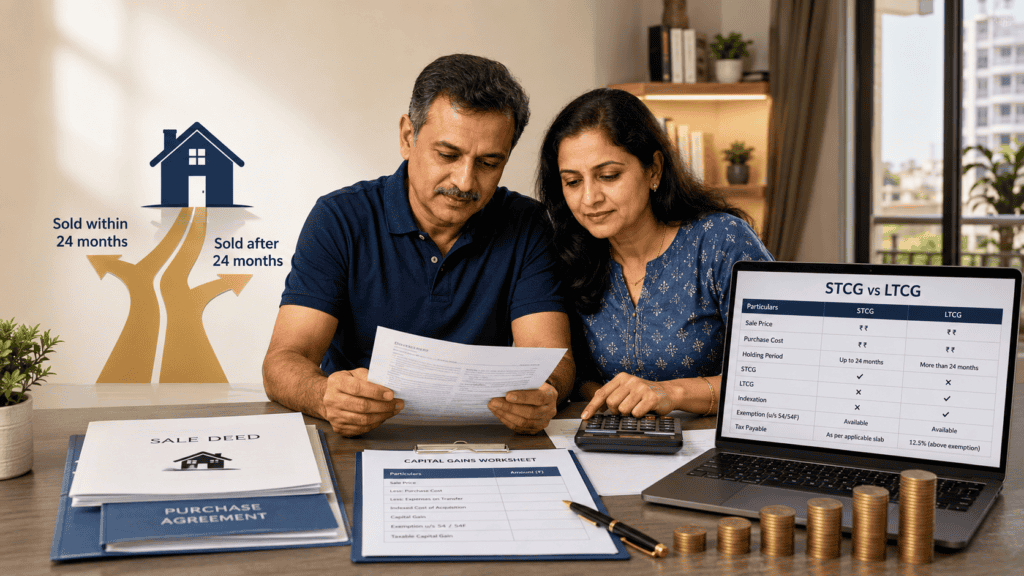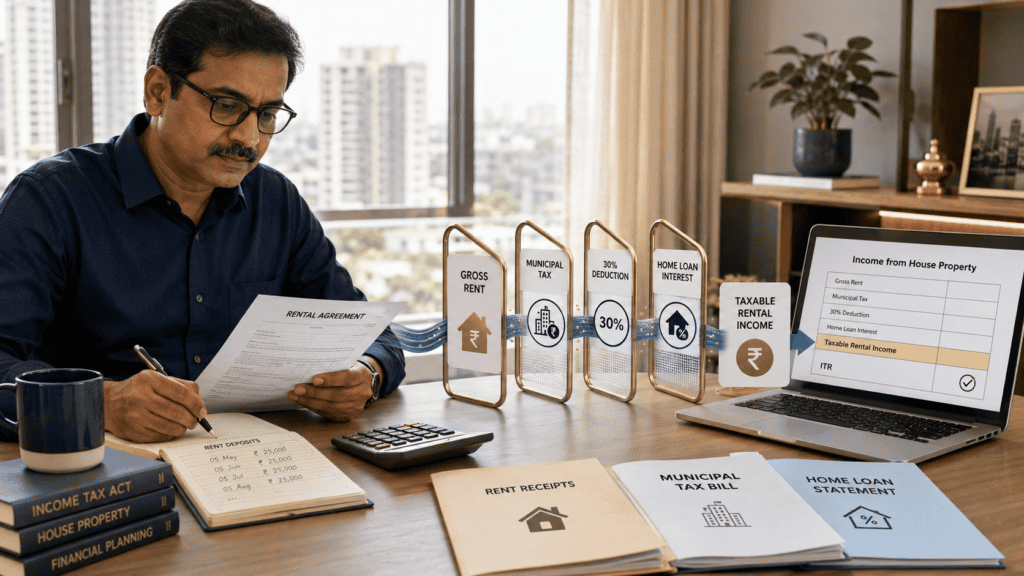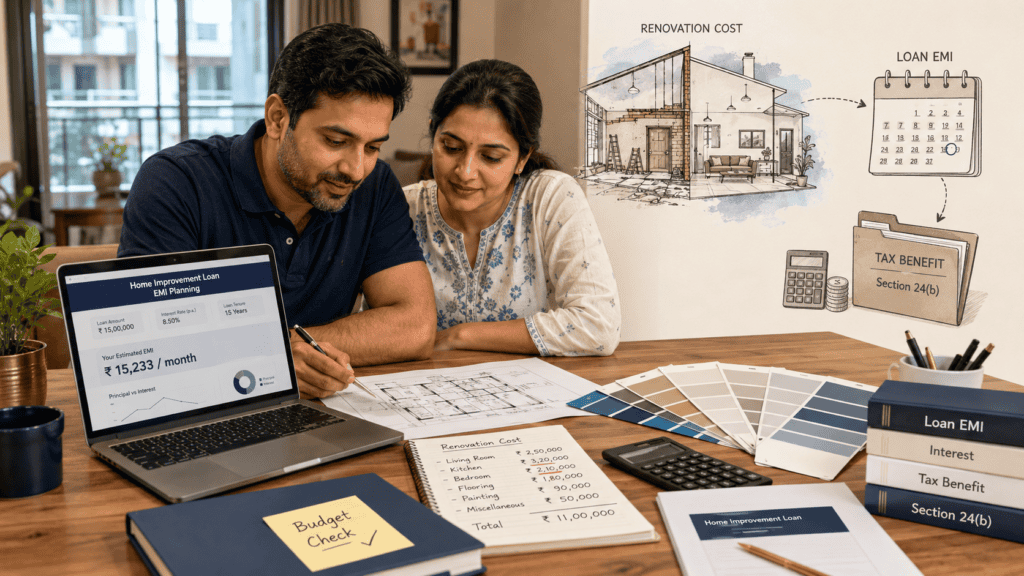

You have finalised the property, negotiated the price, and sorted the home loan — but there is one more compliance step that many first-time buyers in India completely miss before they transfer the payment to the seller. When you buy immovable property worth ₹50 lakh or more from a resident Indian, the law places a specific tax-deduction responsibility on you, the buyer. This is TDS on property purchase under Section 194IA of the Income Tax Act, and it is separate from stamp duty, registration charges, or any capital gains calculation. Getting it wrong — or simply forgetting it — can attract interest, penalties, and compliance headaches at precisely the moment you are trying to celebrate a major life milestone. This article walks you through what the rule requires, how the payment flow works, and the exact forms you need to handle. For context on the full purchase journey, see our guide on the home buying process.
Quick Answer: TDS on Property Purchase
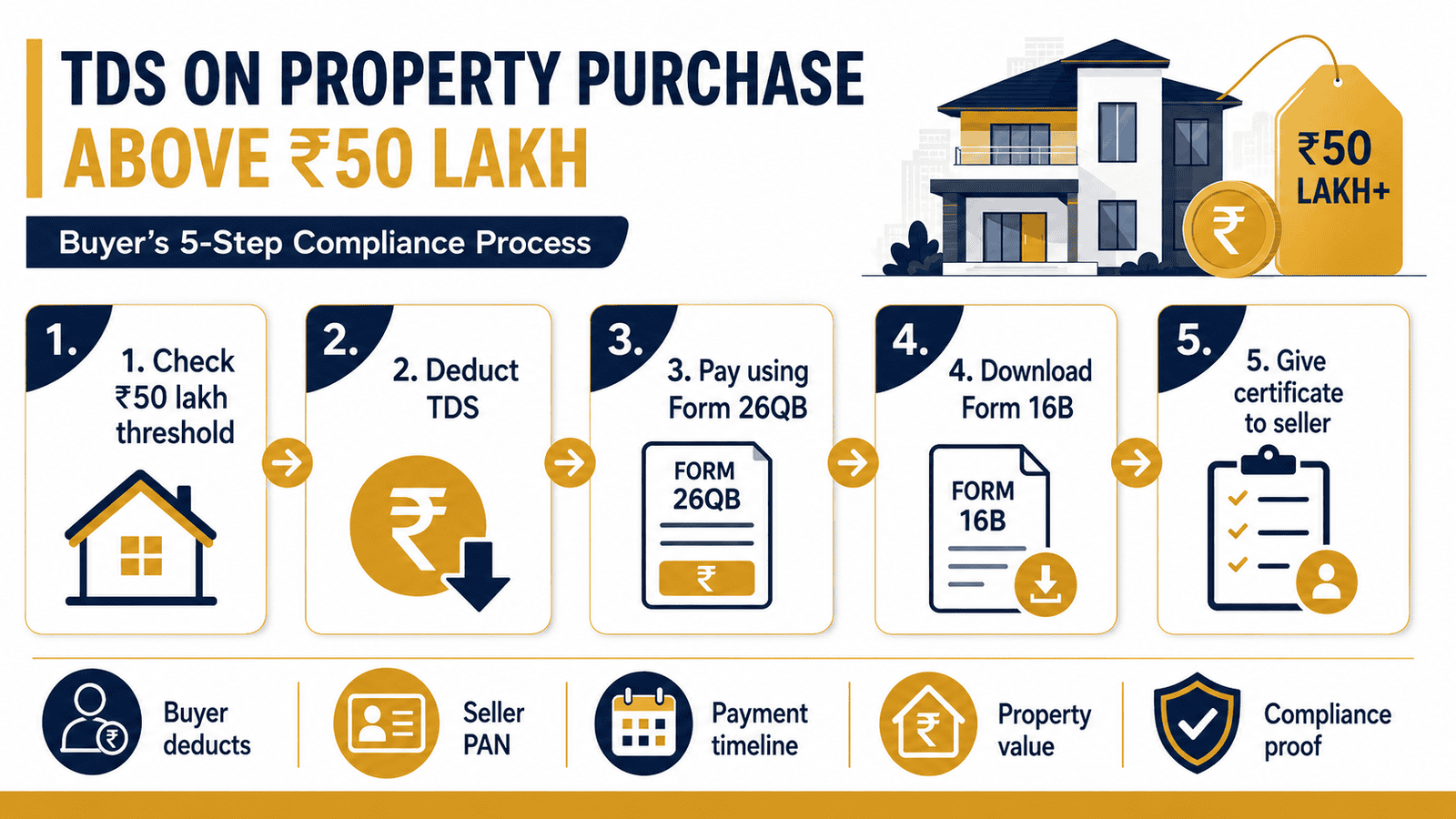
TDS on property purchase applies when a buyer purchases immovable property worth ₹50 lakh or more from a resident seller. The buyer generally deducts 1% TDS, pays it through Form 26QB within the prescribed timeline, and gives Form 16B to the seller. Verify the current rate, threshold, and payment deadline directly on incometax.gov.in before making any payment, as these figures are subject to change.
Key Takeaways
- TDS on property purchase is generally the buyer’s responsibility — not the seller’s and not the bank’s — when the purchase price is ₹50 lakh or more.
- The generally applicable TDS rate is 1% of the sale consideration — meaning on a ₹92 lakh flat, the TDS amount is approximately ₹92,000. Verify the current rate before payment.
- TDS is not the same as stamp duty or registration charges — it is a separate payment deposited to the government on behalf of the seller.
- The buyer must file Form 26QB and then download and hand over Form 16B to the seller — two distinct steps, both mandatory.
- In joint purchase or joint seller situations, each buyer-seller pair may need a separate Form 26QB — verify the current requirement on the TRACES portal.
- If the seller’s PAN is missing or incorrect, the consequences for the buyer can be significantly more severe — always verify PAN before finalising any payment.
- For under-construction property, TDS may be required at each instalment payment, not just at registration — confirm the current rule before your first disbursement.
Key Facts at a Glance
| Parameter | Rule / Detail | Where to Verify |
|---|---|---|
| Applicable section | Section 194IA, Income Tax Act | incometax.gov.in |
| Property threshold | ₹50 lakh or more (sale consideration) | incometax.gov.in |
| TDS rate (resident seller) | Generally 1% of sale consideration | incometax.gov.in |
| Who deducts TDS | The buyer (transferee) | incometax.gov.in |
| Form for payment | Form 26QB (challan-cum-statement) | incometax.gov.in |
| Certificate to seller | Form 16B (TDS certificate) | TRACES portal |
| Agricultural land | Generally excluded — verify current rule | incometax.gov.in |
| Stamp duty / registration | Separate payment — NOT replaced by TDS | State sub-registrar office |
See our registration charges guide for the stamp duty and registration costs you will also need to budget for alongside TDS.
What Is TDS on Property Purchase Under Section 194IA?
Section 194IA of the Income Tax Act requires that when a buyer purchases immovable property — broadly, a flat, house, plot, or commercial space — from a resident Indian seller, and the sale consideration is ₹50 lakh or more, the buyer must deduct tax at source at the applicable rate before releasing the full payment to the seller.
The logic behind this rule is straightforward. The seller will eventually have a capital gains tax liability on the property sale. Rather than wait for the seller to file their ITR and potentially miss or under-report the income, the government requires the buyer to deduct tax upfront at the point of payment. The buyer becomes, in effect, a deductor — much like an employer deducting TDS from an employee’s salary.
What Counts as Immovable Property Here?
For the purposes of Section 194IA, immovable property broadly includes residential flats, independent houses, plots of land (urban and non-agricultural), and commercial properties. Agricultural land — as defined under the Income Tax Act — is generally excluded from this provision. However, the definition of agricultural land in the IT Act has specific conditions tied to population and distance from municipality limits. Do not assume a piece of land is agricultural without verifying the current definition from incometax.gov.in.
Sale Consideration vs. Stamp Duty Value
One important point that catches buyers off guard: TDS is calculated on the sale consideration — the amount actually agreed upon in the sale deed. If the stamp duty value (circle rate value) of the property is higher than the agreement value, there are separate income tax provisions that may apply to both buyer and seller. The TDS calculation under Section 194IA, however, is generally on the consideration paid — verify the current basis on incometax.gov.in before your transaction.
When Exactly Must TDS Be Deducted?
The deduction must happen at the time of credit of the sum to the seller’s account or at the time of payment, whichever is earlier. In practice, this means you cannot pay the full amount first and then “sort out the TDS later.” If you pay ₹92 lakh to the seller without deducting TDS, you have already violated the provision — and the correction process is time-consuming.
Is TDS Applicable on the Entire Value or Only the Excess Above ₹50 Lakh?
TDS under Section 194IA is generally on the entire sale consideration, not just the amount above ₹50 lakh. So if you buy a property for ₹55 lakh, TDS is calculated on ₹55 lakh — not on ₹5 lakh. This is a common misconception. Verify the current treatment on incometax.gov.in.
What About Home Loan Disbursements?
If you are buying with a home loan, the bank will disburse funds directly to the seller (or builder, in case of under-construction property). Many buyers assume the bank will automatically deduct and deposit TDS. The bank does not do this. TDS remains the buyer’s personal compliance responsibility. You must coordinate with your lender to ensure you deduct TDS before or at the time of each disbursement — and deposit it through Form 26QB separately.
How to Pay TDS: The Form 26QB Process
Form 26QB is described by the Income Tax Department as a “challan-cum-statement” — meaning it serves both as the tax payment record and the declaration of the transaction. You do not need a TAN (Tax Deduction and Collection Account Number) to file it; individual buyers can file using their PAN.
The broad process is: log in to the Income Tax e-filing portal at incometax.gov.in, navigate to the Form 26QB section, enter property details (buyer PAN, seller PAN, property address, sale consideration, payment amount, assessment year), pay the TDS online, and save the acknowledgement. After the payment is processed and reflects in the system — which typically takes a few days — you can download Form 16B from the TRACES portal and hand it to the seller.
Verify the exact timeline for Form 26QB payment after each instalment or full payment on incometax.gov.in, as the prescribed due date has specific rules.
Real Example: Rohit’s ₹92 Lakh Resale Flat in Bengaluru
Rohit Sharma, 36, is a senior software engineer in Bengaluru earning ₹32 lakh a year. He is buying a resale apartment for ₹92 lakh — ₹35 lakh as his own contribution and ₹57 lakh as a home loan. Since the sale consideration crosses ₹50 lakh, Section 194IA applies.
At the time of paying the seller, Rohit deducts TDS at the applicable rate (generally 1%, i.e., ₹92,000 on ₹92 lakh — verify current rate before payment). He pays the seller ₹91,08,000 and deposits ₹92,000 to the government through Form 26QB. He then downloads Form 16B from the TRACES portal and hands it to the seller, who will use it to claim TDS credit when filing their own income tax return.
For the home-loan portion, Rohit explicitly tells his bank that he will handle TDS before each disbursement. The bank releases ₹57 lakh, but Rohit has already ensured the net payment to the seller is after TDS deduction — he coordinates payment dates carefully.
Now consider a different scenario: Rohit is buying an under-construction flat instead. The builder raises three payment demands — ₹30 lakh, ₹35 lakh, and ₹27 lakh at different construction stages. TDS may need to be deducted at each payment, not just the final one. Read our detailed comparison of ready or under-construction property to understand how timing differences affect tax planning.
How to Calculate TDS on Property Purchase
TDS Amount = Sale Consideration × Applicable TDS Rate
Using Rohit’s example with a generally applicable rate of 1% (verify current rate before payment):
Sale consideration: ₹92,00,000
TDS rate: 1%
TDS amount: ₹92,000
Amount paid to seller: ₹91,08,000
Amount deposited to government via Form 26QB: ₹92,000
| Scenario | Sale Consideration | TDS at 1% (Illustrative) |
|---|---|---|
| Just above threshold | ₹55,00,000 | ₹55,000 |
| Mid-range resale flat | ₹92,00,000 | ₹92,000 |
| Premium property | ₹1,50,00,000 | ₹1,50,000 |
All figures above are illustrative using a 1% rate. Verify the current applicable rate from incometax.gov.in before making any payment. If the seller’s PAN is not available or is incorrect, the applicable TDS rate can be significantly higher under Section 206AA — this is one of the most expensive mistakes a buyer can make.
Comparison: Property TDS in Different Buyer Situations
| Situation | TDS Requirement | Key Watch-Out |
|---|---|---|
| Resale flat, single buyer, single seller | Applicable — 1% generally | Straightforward; verify rate before payment |
| Under-construction flat, instalment payments | Applicable — each instalment | Do not wait until possession to deduct TDS |
| Property below ₹50 lakh | Not applicable — below threshold | Verify current threshold before assuming exemption |
| Joint buyers (2 buyers, 1 seller) | Each buyer’s share | Separate Form 26QB may be needed per buyer — verify |
| Joint sellers (1 buyer, 2 sellers) | Per seller’s share | Separate Form 26QB per seller; collect both PANs |
| Seller is NRI / non-resident | Different rules apply | Section 195 / FEMA may apply; consult a CA |
| Home-loan funded purchase | Applicable — buyer’s duty | Bank does NOT deduct TDS; coordinate with lender |
| Seller PAN missing or mismatched | Higher rate may apply | Verify seller PAN on PAN verification portal first |
For details on joint buying structures and how shared ownership affects tax treatment, see our guide on joint loan rules.
How to Decide What’s Right for You
Your property purchase price is ₹50 lakh or above and the seller is a resident Indian — THEN Section 194IA applies and you must deduct TDS before or at the time of each payment.
You are taking a home loan and the bank disburses directly to the seller — THEN do not assume the bank handles TDS; coordinate with your lender to ensure you deduct TDS before or at disbursement.
You are buying an under-construction property with stage-based payments — THEN check whether TDS applies on each instalment and do not wait until final possession to comply.
There are two or more sellers — THEN collect the PAN of each seller, confirm their individual shares, and verify whether a separate Form 26QB is needed for each seller-buyer combination.
You are unsure whether the seller is a resident Indian or an NRI — THEN do not proceed with Section 194IA alone; get written confirmation of residency status and consult a CA before making any payment.
The property is below ₹50 lakh — THEN Section 194IA may not apply, but verify the current threshold on incometax.gov.in before assuming you are exempt.
If you are not buying directly from a resident individual seller — for example, through an auction, court order, gift, or inheritance — do not apply the standard Section 194IA logic without professional guidance, as the TDS rules for these transactions may be different.
Common Mistakes to Avoid
Assuming the Bank Deducts TDS Automatically
This is the single most common and costly misconception. When your home loan is disbursed directly to the seller or builder, the bank transfers the sanctioned amount in full. TDS is not the bank’s responsibility.
If you pay the full ₹92 lakh without deducting TDS, you are in default as a deductor — attracting interest on the TDS amount plus potential penalties.
Before each disbursement, confirm with your lender exactly how much is being paid to the seller, deduct TDS from that amount, and deposit it via Form 26QB yourself.
Paying the Full Amount First, Then Trying to Recover TDS from the Seller
TDS must be deducted at the time of payment or credit — not after. Paying the full consideration and then asking the seller to return the TDS amount is not compliant and often leads to disputes.
Always structure the payment so that the seller receives the net amount and you deposit TDS separately. Make this explicit in the sale agreement.
Entering Wrong PAN, Wrong Assessment Year, or Wrong Property Details in Form 26QB
An error in the seller’s PAN, the assessment year, the property address, or the consideration amount in Form 26QB is extremely difficult and time-consuming to correct. The correction process on TRACES involves multiple steps and can delay property registration.
Double-check every field against the sale deed and seller’s PAN card before submitting Form 26QB. Verify the seller’s PAN independently using the PAN verification facility on incometax.gov.in.
Not Downloading and Handing Over Form 16B to the Seller
Deducting and depositing TDS is only step one. The seller needs Form 16B — the TDS certificate — to claim credit for the deducted amount in their own ITR and capital gains calculation.
Failing to give the seller Form 16B can delay their tax filing, create disputes during property registration, and expose you to complaints. Download it from the TRACES portal after the payment is processed and hand it over promptly.
Ignoring TDS in Instalment-Based Under-Construction Payments
Many buyers assume TDS is a one-time step at registration. For under-construction properties with multiple payment instalments, TDS may need to be deducted on each payment — not just the final one.
By the time buyers realise this at possession, several instalments have already gone to the builder without TDS deduction, creating a significant compliance backlog.
Mishandling Joint Seller Situations
When two people jointly own a property, the sale consideration needs to be split by ownership share, and a separate Form 26QB may need to be filed for each seller. Combining both sellers into one Form 26QB or using only one seller’s PAN is incorrect.
Verify the current requirement for joint sellers on incometax.gov.in before filing, and collect valid PAN for each co-seller. See our guide on property registration documents to ensure your compliance paperwork is complete.
Not Keeping TDS Records with Registration Papers
The Form 26QB acknowledgement, the TDS challan, and Form 16B are important documents that link your property purchase to the tax compliance record. Some sub-registrars ask to see proof of TDS deduction before completing registration.
Keep a printed and digital copy of all three documents with your sale deed and registration papers — not just in your email inbox.
When This May Not Be the Right Choice
Seller is a non-resident Indian (NRI) or non-resident: Section 194IA applies specifically to purchases from resident sellers. If the seller is an NRI, a different set of TDS rules may apply, potentially at a significantly higher rate under a different section of the Income Tax Act. Do not apply the standard 1% Section 194IA logic without verifying the seller’s residential status and consulting a qualified CA.
Property is agricultural land: Agricultural land as defined under the Income Tax Act is generally excluded from the Section 194IA requirement. However, the definition has specific legal conditions — do not assume land is agricultural without verifying the current exclusion criteria on incometax.gov.in.
Transaction involves inheritance, gift, or court order: Transfers through gift deeds, inheritance, family settlement, or court orders are not straightforward property “purchases” and may not fall under Section 194IA at all. These situations need professional legal and tax review before you decide how to handle TDS.
Complex joint ownership or developer payment structures: If your transaction involves multiple buyers, multiple sellers, a co-operative housing society, or a developer with a complex payment schedule, the application of Section 194IA across each payment can be complicated. A CA familiar with property transactions is worth the fee here.
If any of these apply to your situation, it may be worth exploring alternatives before committing.
Official Rules and Where to Verify
Rules, limits, and rates on this topic can change with each Budget or regulatory update. Always verify current figures directly from the official source before making any financial decision.
- Income Tax Department e-filing portal — incometax.gov.in: File Form 26QB, verify Section 194IA rules, check current threshold and TDS rate, and access PAN verification.
- TRACES portal (TDS Reconciliation Analysis and Correction Enabling System) — tdscpc.gov.in: Download Form 16B after TDS is deposited and processed. The seller uses TRACES/Form 26AS/AIS to verify that TDS credit has been received.
- Income Tax Department — incometaxindia.gov.in: Reference for Section 194IA text, related circulars, and FAQs issued by the department.
For the seller’s perspective — how TDS credit reduces capital gains tax liability at the time of filing — see our article on tax on property sale.
Expert Tips
- Build TDS into the payment schedule before signing the agreement. Mention in the sale agreement that the buyer will deduct TDS as required under Section 194IA. This avoids disputes with the seller later — especially if the seller is unfamiliar with the rule and expects the full consideration.
- Collect and verify the seller’s PAN before the agreement stage — not at the last minute before payment. Cross-check the name and PAN number using the PAN verification facility on incometax.gov.in. A PAN mismatch at the Form 26QB stage can force you into a higher deduction rate under Section 206AA.
- Ask your bank in writing how they will handle TDS in their disbursement. Get confirmation that the bank will disburse the amount net of TDS to the seller (or that you will transfer TDS separately). This protects you if there is a miscommunication later.
- File Form 26QB promptly after each payment — do not batch multiple payments into one late filing. Each deduction event may have its own deadline. Late filing attracts interest charges that compound over time and are avoidable with simple calendar reminders.
- Download Form 16B within a reasonable time after the payment reflects on TRACES and hand it to the seller before or at registration. Some sub-registrars now flag transactions where Form 16B is not produced alongside the sale deed.
- Keep a dedicated folder (digital and physical) for TDS compliance documents — Form 26QB acknowledgement, challan receipt, Form 16B — alongside the sale agreement and possession letter. You will need these if you sell the property later and want to demonstrate clean compliance history.
- If your property transaction is complex — joint buyers, joint sellers, under-construction with developer advances, or any NRI involvement — spend ₹3,000–₹7,000 engaging a CA for TDS compliance alone. The cost of a single Form 26QB correction or late-filing notice is far higher.
Frequently Asked Questions
Who pays TDS on property purchase — the buyer or the seller?
The buyer deducts TDS from the payment made to the seller and deposits it with the government. The TDS amount comes out of the sale consideration — the seller effectively receives the net amount. The seller then claims the deducted TDS as a credit when filing their own income tax return.
Is TDS applicable only on the amount above ₹50 lakh, or on the entire sale price?
TDS under Section 194IA is generally applicable on the entire sale consideration — not just the portion above ₹50 lakh. So if you buy a property for ₹65 lakh, TDS is calculated on ₹65 lakh. Verify the current treatment on incometax.gov.in before payment.
What is Form 26QB?
Form 26QB is a challan-cum-statement used by the buyer to pay TDS on property purchase to the government. It captures details of both the buyer and the seller — including PANs, property address, sale consideration, and the TDS amount paid. It is filed on the Income Tax Department’s e-filing portal at incometax.gov.in. The buyer does not need a TAN to file it.
What is Form 16B?
Form 16B is the TDS certificate that the buyer issues to the seller after depositing TDS through Form 26QB. The seller uses Form 16B to claim credit for the TDS deducted when computing their capital gains and filing their ITR. Form 16B is downloaded by the buyer from the TRACES portal — it is not issued automatically.
Is TDS needed for under-construction property instalments?
Yes, TDS on under-construction property payments is generally applicable at each instalment if the total consideration crosses the threshold. The deduction is triggered at the time of each payment or credit to the seller/builder. Do not wait until possession or final payment to deduct TDS. Verify the current requirement on incometax.gov.in.
What if there are two buyers or two sellers in the transaction?
In joint buyer or joint seller situations, a separate Form 26QB may be required for each buyer-seller combination. For example, if two buyers are purchasing from one seller, each buyer may need to file a Form 26QB for their share. Collect valid PAN for each co-buyer and co-seller. Verify the current procedure on incometax.gov.in or TRACES before filing.
What if the seller’s PAN is not available or is incorrect?
If the seller does not provide a valid PAN, Section 206AA of the Income Tax Act may require the buyer to deduct TDS at a significantly higher rate. This is an avoidable complication — always verify the seller’s PAN using the official PAN verification facility before making any payment or filing Form 26QB.
Does the bank deduct TDS automatically when disbursing a home loan to the seller?
No. The bank disburses the loan amount to the seller as instructed — it does not deduct or deposit TDS on your behalf. TDS on property purchase is entirely the buyer’s responsibility. If the bank disburses ₹57 lakh to the seller and you have not deducted TDS, you are in default even though the payment was made by the bank. Coordinate with your lender before each disbursement.
Can I claim a deduction for TDS paid on property purchase?
TDS paid under Section 194IA is not a deduction in your own income tax return — it is tax deducted on the seller’s income. The seller claims the credit; you do not get a personal tax benefit for it. Your responsibility is compliance — deducting correctly, depositing on time, and issuing Form 16B to the seller.
What happens if I miss the Form 26QB filing deadline?
Late filing of Form 26QB can attract interest on the TDS amount from the date of deduction to the date of payment, along with potential late filing fees. The longer you delay, the larger the interest amount. Filing on time is significantly easier than dealing with demand notices and correction procedures later — verify the current penalty and interest rules on incometax.gov.in.
Final Verdict
TDS on property purchase is one of the most overlooked compliance steps in India’s home-buying process — and one of the most expensive to get wrong. If your property purchase crosses the ₹50 lakh threshold and the seller is a resident Indian, the responsibility to deduct TDS, file Form 26QB, and issue Form 16B sits squarely with you, the buyer. Your home loan bank will not do it for you. Your broker will not remind you. The sub-registrar may not catch the gap until it is too late to correct easily.
Verify the current rate, threshold, and payment timeline on incometax.gov.in before your first payment. For complex transactions — joint buyers, joint sellers, under-construction property, or NRI sellers — the fee for a CA who specialises in property transactions is well worth it. Always verify the latest rules from official sources or consult a qualified professional before making any financial decision.
This article is for educational purposes only and should not be treated as personalised financial, tax, investment, insurance, or legal advice. Tax rules, interest rates, regulatory limits, and product features can change with each Budget or policy update. Please verify current rules from official government sources or consult a qualified and registered professional before making any financial decision.

Neha Kulkarni writes about the financial side of home buying, renting, property decisions, and real estate costs in India. Her content helps readers think beyond the EMI and understand the total cost of owning or buying a home.
She covers topics such as rent vs buy, home loan planning, down payment, stamp duty, registration charges, brokerage, maintenance cost, property tax, furnishing cost, home insurance, builder payment plans, resale property checks, home loan affordability, total cost of ownership, and hidden costs in property decisions.
Neha’s writing is practical, family-focused, and cost-conscious. She uses Indian city examples, ₹ calculations, and decision checklists to help readers evaluate whether a property decision fits their income, savings, loan eligibility, and long-term plans. Her articles are useful for first-time home buyers, salaried couples, families, and people comparing rent with home ownership. Since property rules, stamp duty, registration charges, local taxes, home loan rates, and legal requirements vary by state and city, readers should verify current details from official state, lender, and legal sources.