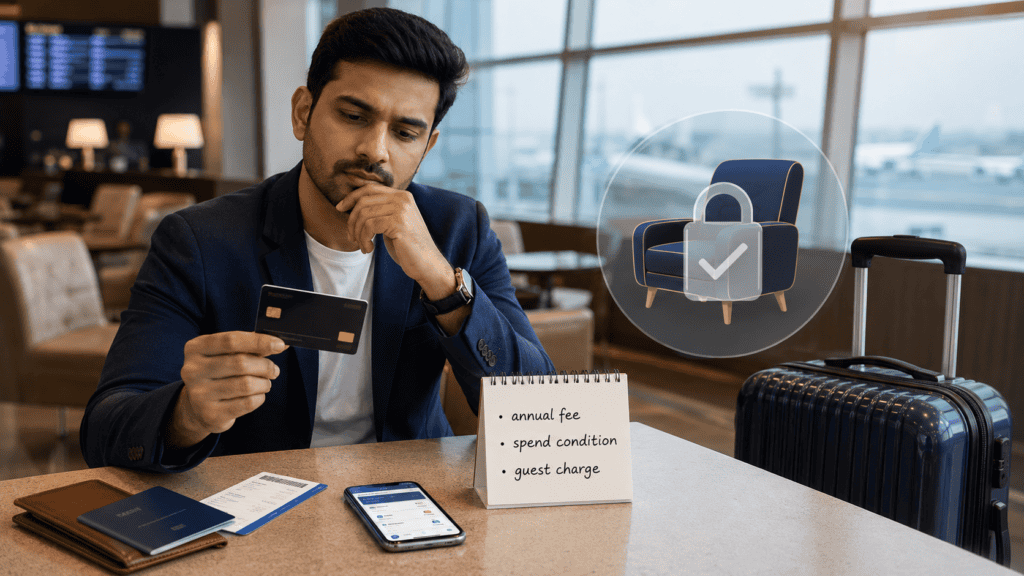
You are checking in at Bengaluru airport — it is 6 AM, your flight is delayed by 45 minutes, and the terminal is loud. Then you remember: your credit card might give you lounge access. You walk to the lounge entrance, tap your card, and get turned away because you haven’t met the quarterly spend target.
This happens more often than most cardholders realise. Airport lounge access credit cards are one of the most advertised premium benefits in India’s credit card market — and also one of the most misunderstood. The words “complimentary lounge access” in a card brochure can mean anything from unlimited free visits to two discounted visits per quarter, subject to conditions that change with every card variant, network, and issuer.
This guide explains how lounge access credit cards actually work in India — eligibility rules, annual fees, spend thresholds, domestic versus international access, guest charges, and every hidden condition worth checking before you apply.
Quick Answer: Airport Lounge Access Credit Cards
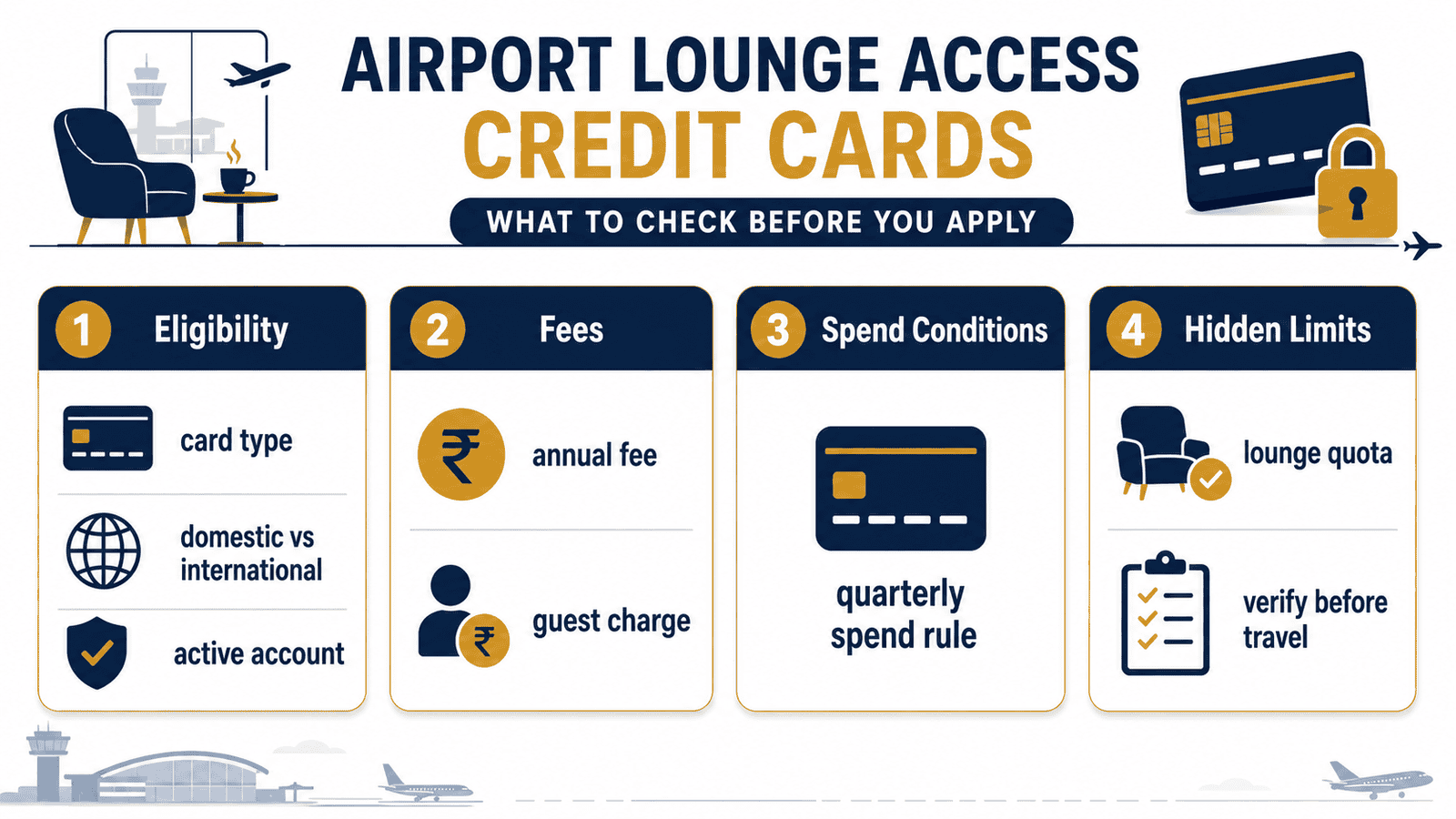
Airport lounge access credit cards offer complimentary lounge visits, but eligibility may depend on card type, quarterly spends, network rules and annual fees. A card with a ₹3,000 annual fee is useful only if you can actually use enough lounge visits to justify the cost. “Free” access is rarely unlimited — most cards cap visits per quarter or per year, apply spend conditions, and charge separately for guests. Always read the MITC and your bank’s current card benefits page before applying or travelling.
Key Takeaways
- Lounge access may be complimentary, spend-based, or quota-limited — a card that says “free lounge access” rarely means unlimited, unconditional visits.
- Domestic and international lounge access are separate benefits on most cards; a card offering domestic access at Indian airports may give you nothing at international terminals.
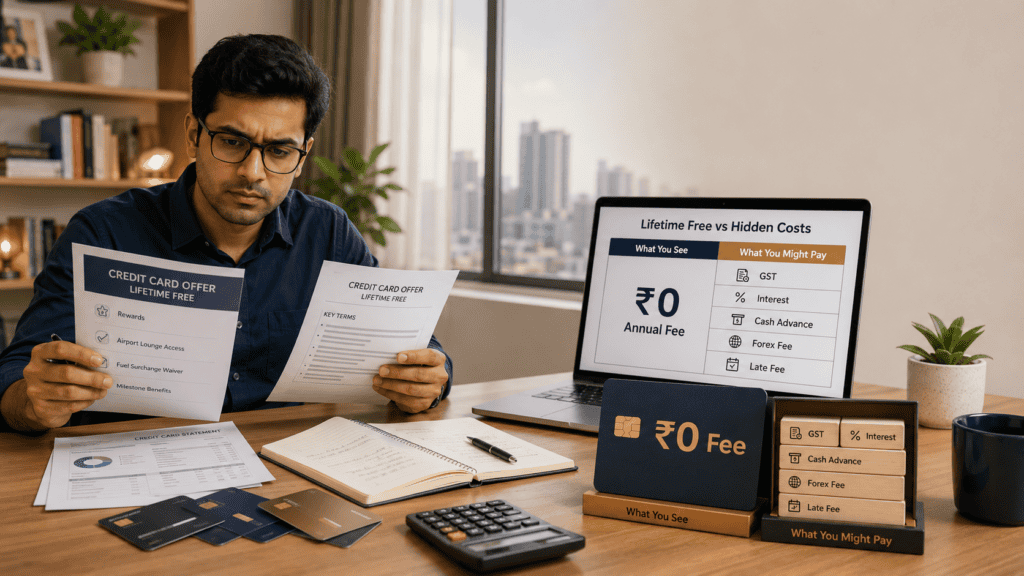
- Annual fees and renewal fees reduce real value — a ₹3,000 annual fee divided by 4 usable visits equals ₹750 per visit, which may be higher than a paid entry.
- Guest access is almost never free; most cards charge ₹500–₹900 per guest visit, and children above a certain age may be counted as guests too.
- Quarterly spend thresholds are the most common denial trigger — if your eligible spends in a quarter fall short, your lounge access for that quarter may be blocked.
- Add-on cardholders and debit cardholders on the same account may have different access rules than the primary cardholder.
- Card network matters — RuPay, Visa, and Mastercard run separate lounge programs with different participating lounges; the same card on a different network may give different access.
Comparison: Lounge Access Card Types at a Glance
| Card Type | Fee / Spend Condition | Domestic Access | International Access | Hidden Condition to Watch | Best Suited For |
|---|---|---|---|---|---|
| Lifetime-free card with limited lounge access | ₹0 annual fee; may require min quarterly spend | Limited — 1–2 visits/quarter | Not included | Spend condition; specific terminals only | Occasional domestic traveller; low card spend |
| Paid card with domestic lounge access | ₹500–₹3,000 annual fee; spend-linked quarterly quota | Yes — 2–4 visits/quarter | Not included | Quota resets quarterly; guest charges apply | Salaried employee travelling 4–8 times/year domestically |
| Premium card with domestic and international access | ₹3,000–₹10,000 annual fee; may require milestone spend | Yes — higher quota | Limited — Priority Pass or network program | International visits may be capped separately; forex charges apply at international lounges | Frequent traveller with both domestic and international flights |
| Travel-focused card with high annual fee | ₹5,000–₹15,000 annual fee; may waive on high annual spend | Yes — generous quota | Yes — Priority Pass included | Annual fee waiver threshold may be difficult to meet; reward points devalued if travel is low | High-spend traveller who flies internationally multiple times a year |
| Debit card with lounge access | Savings account relationship; may need min balance | Limited — fewer lounges | Rarely included | Lounge list is shorter; access may need pre-registration or app activation | Someone without a credit card; limited travel frequency |
All fees and access limits above are illustrative. Verify current terms from your bank’s official product page and MITC before applying.
For a broader look at how reward structures compare across card types, see our guide on reward points or cashback — it can help you evaluate whether lounge access is actually the best benefit to prioritise.
Key Facts at a Glance
| Factor | What to Know | Where to Verify |
|---|---|---|
| Eligibility | Card variant, network (RuPay/Visa/Mastercard), account status, quarterly spend met | Bank app, MITC, official card page |
| Annual / joining fee | ₹0 (lifetime-free) to ₹15,000+ (super-premium); waiver usually requires annual spend milestone | Bank’s official card product page |
| Guest visit charge | Typically ₹500–₹900 per guest visit; children above 2–3 years may be charged | MITC or lounge access terms document |
| Usage cap | Often 2–4 domestic visits per quarter; international capped separately or via Priority Pass | Bank app benefits tab |
| Common denial reasons | Wrong terminal, quarterly quota exhausted, spend threshold not met, unpaid dues, card inactive | Bank customer care or app |
| Paid visit rate | If quota is exhausted, most cards charge ₹200–₹500 per additional visit | MITC or lounge desk |
How Airport Lounge Access Credit Cards Actually Work in India
An airport lounge access credit card is a credit card that includes lounge visit privileges as a cardholder benefit. In practice, this benefit works through three different delivery mechanisms — card network programs, bank-negotiated lounge tie-ups, or international programs like Priority Pass — and understanding which mechanism your card uses changes everything about what you can actually access.
Domestic Lounge Access: How It Works
In India, domestic airport lounge access on most cards is delivered through card network programs. RuPay cards connect to the NPCI lounge access program, which currently covers a reasonable number of domestic airports. Visa and Mastercard run their own programs — Visa’s LoungeKey, for instance — and the participating lounges are different from the RuPay list.
This means two things. First, a lounge that accepts RuPay may not accept Visa, even if both cards carry a “complimentary lounge access” benefit. Second, the same credit card issued on different networks will give different lounge access. Always check the specific lounge list for your exact card variant and network on the bank’s website before you travel.
Beyond network, banks often layer spend conditions on top of network access. Your card might be eligible for lounge access through the network, but the bank may restrict it further — for example, requiring ₹10,000 or more in eligible purchases in the previous quarter before the lounge benefit activates for the current quarter. If you didn’t meet that threshold, your card will be declined at the lounge, even if the network technically supports it.
International Lounge Access: What Premium Cards Offer
International lounge access is a separate and generally more expensive benefit. Most mid-tier cards do not include it. For premium travel cards that do offer international access, the mechanism is usually Priority Pass — a global lounge membership program covering over 1,300 lounges worldwide. Priority Pass membership may be included with the card, but there is almost always a cap on how many complimentary visits are included per year before a per-visit charge kicks in.
A common structure on Indian premium cards: 6–8 complimentary Priority Pass visits per calendar year, after which each visit is charged at USD 27–35. If you are a heavy international traveller, exhausting this cap in a few months and paying USD 32 per additional visit can quickly erase the lounge benefit’s value.
If you are new to selecting a travel card and want to understand how to evaluate credit card benefits from the ground up, our first credit card guide walks you through the key decision factors before you commit to a premium card.
Complimentary vs Paid vs Discounted Lounge Access
Not all lounge access cards give you the same type of entry. Here is how the categories differ:
- Complimentary access: Entry is fully covered by the card benefit — no payment at the lounge desk, subject to quota and conditions being met.
- Discounted access: You pay a reduced entry fee at the lounge — for example, ₹200 instead of the full ₹700 walk-in rate. Some lifetime-free cards work this way rather than giving full complimentary access.
- Paid access on overflow: Once your quarterly or annual quota is used up, additional visits are charged to your card at a per-visit rate. You may not be explicitly told the quota is exhausted until after you have entered.
Always check which type of access applies to your specific card before assuming “lounge access” means free.
Real Example: Rohan’s Lounge Access Calculation
Rohan, 32, is a product manager in Bengaluru earning ₹18 lakh per year. He travels domestically about 6 times a year for work — roughly one trip every two months. He is considering a credit card with a ₹3,000 annual fee that advertises complimentary domestic lounge access.
The card offers 4 complimentary domestic lounge visits per year. Rohan’s 6 annual trips would generate 6 lounge opportunities, but he only gets 4 free visits. For the remaining 2 trips, he would either pay the walk-in rate or skip the lounge.
Here is where it gets sharper. Rohan checks the spend condition: he needs ₹10,000 in eligible spends in the previous quarter to unlock lounge access for the current quarter. Two of his 6 trips fall in a quarter where his card spend was lighter — say, ₹7,000. For those 2 trips, his lounge access is blocked entirely, leaving him with only 2 or 3 usable complimentary visits in practice.
This makes the effective cost not ₹3,000 ÷ 4, but ₹3,000 ÷ 3 — roughly ₹1,000 per visit. For comparison, a direct walk-in at many Indian domestic lounges costs ₹500–₹800. Whether Rohan’s card is good value depends heavily on whether the annual fee can be waived through a spend milestone — which would make the lounge access genuinely free.
For Rohan’s card specifically, understanding card fee waiver rules is as important as understanding the lounge benefit itself. A ₹3,000 fee waived at ₹1.5 lakh annual spend changes the entire calculation.
How to Calculate Your Effective Lounge Access Cost
Effective cost per visit = Annual card fee ÷ Realistic usable visits per year
Use this formula to cut through the marketing language. Here is a step-by-step working using Rohan’s numbers:
- Annual fee: ₹3,000
- Stated lounge visits per year: 4
- Realistic usable visits after spend conditions: 3 (one quarter’s access may be blocked)
- Effective cost per visit: ₹3,000 ÷ 3 = ₹1,000 per visit
- If annual fee is waived: ₹0 ÷ 3 = ₹0 per visit
| Scenario | Key Inputs | Effective Cost per Visit |
|---|---|---|
| Annual fee paid, 4 visits used | ₹3,000 fee ÷ 4 visits | ₹750 per visit |
| Annual fee paid, only 2 visits used (spend condition not met in 2 quarters) | ₹3,000 fee ÷ 2 visits | ₹1,500 per visit |
| Annual fee waived, 4 visits used | ₹0 fee ÷ 4 visits | ₹0 per visit |
| Guest taken along on 2 visits (₹700/guest) | ₹3,000 fee + ₹1,400 guest charges ÷ 4 visits | ₹1,100 per visit (combined) |
The calculation above uses illustrative figures. Unused lounge visits have zero practical value — they cannot be carried forward, and they do not reduce the annual fee. Guest charges are additional and should be factored into any value assessment separately.
How to Decide What’s Right for You
You take 6 or more domestic flights a year and your card spend naturally crosses the quarterly threshold — lounge access credit cards are likely to deliver real value.
You can get the annual fee waived through a spend milestone you would comfortably reach anyway — the lounge visits effectively become free, making the card strongly worth considering.
You travel mostly internationally and your destination airports have Priority Pass lounges — look for a premium card that explicitly includes Priority Pass membership, not just domestic lounge access.
You travel with family and plan to bring a guest to lounges regularly — factor in ₹500–₹900 per guest visit; the combined cost per trip may exceed the value of the benefit.
You are comparing a card primarily for its lounge benefit — check whether the card’s other features (reward rate, cashback, insurance cover) also meet your needs; lounge access alone rarely justifies a high annual fee.
You fly fewer than 3–4 times a year — a lounge access credit card is unlikely to justify its annual fee on travel benefits alone. A strong rewards or cashback card will almost certainly deliver better daily value.
You are likely to increase your card spending just to meet the quarterly threshold — do not overspend to unlock lounge access; the extra spend cost will exceed the benefit value.
Common Mistakes to Avoid
Assuming all airport lounges are covered
Many cardholders arrive at a lounge and find their card is not accepted there.
Lounge access is tied to specific programs — a RuPay card’s lounge list is different from a Visa card’s list, and not every terminal at every airport has a participating lounge. Checking the lounge list on your bank’s app before you travel, not at the lounge desk, saves you from an awkward and expensive surprise.
Search for your specific card variant in your bank’s app under “lounge access” or “travel benefits” to see the current list.
Ignoring the quarterly spend condition
The spend threshold is the most common reason for lounge access denial, yet most cardholders discover it only after being turned away.
If your card requires ₹10,000 in eligible spends in the previous quarter to activate lounge access for the current quarter, a light-spending quarter will lock you out — even if your card is valid and your quota is unused. Some cards also exclude certain transaction categories (fuel, government payments, wallet loads) from eligible spends.
Review your last quarter’s eligible spend in the bank app a few days before any trip where you plan to use the lounge.
Forgetting that guest access is charged separately
Most lounge access cards give complimentary entry only to the primary cardholder.
Guest entry is charged at ₹500–₹900 per visit on most cards. If you travel with your spouse or children regularly, factoring these charges into your cost calculation is essential. Two guest visits per quarter at ₹700 each add ₹5,600 to your annual lounge cost — potentially more than the card’s annual fee.
Check the MITC to confirm the current guest charge rate before your first family trip.
Treating domestic access as international access
A card offering “airport lounge access” in its marketing usually means domestic Indian airports only.
International lounge access typically requires a separate program (Priority Pass) or a higher-tier card. Assuming your domestic lounge card covers international airports can leave you paying full walk-in rates at overseas terminals — which are considerably higher than Indian domestic rates.
Check explicitly whether your card includes international access and through which program before any overseas trip.
Not reviewing the credit card statement after lounge visits
Lounge entry charges, guest fees, and even erroneous paid visit charges sometimes appear on statements incorrectly.
A paid visit charge may appear when your quota was not actually exhausted, or a guest fee may be double-charged. Reviewing your statement after each lounge visit, not just monthly, helps you catch and dispute errors quickly. Our guide on how to read your card statement walks through every line you should review after card activity.
Raise a dispute with your bank within the cycle’s due date for faster resolution.
Picking a lounge card without checking overall card value
A card with excellent lounge access but a poor rewards rate or high foreign transaction fee may cost more than it saves over a year.
Lounge access is one component of a card’s value proposition. A card that charges 3.5% on foreign transactions but gives you 4 lounge visits may actually cost you more than a card with no lounge access but zero forex fees — if you travel internationally even twice a year. Evaluate total card value, not a single benefit.
Build a quick cost-benefit list for any card you are seriously considering, covering fee, lounge, rewards, forex charge, and any other benefits you will realistically use.
Applying for a card only for lounge access, then not meeting spend conditions
Some cardholders apply for a premium card specifically for lounge access and then find they cannot naturally meet the spend threshold.
If the card requires ₹1,50,000 in annual spends for fee waiver and ₹10,000 per quarter for lounge activation, but your natural card spending is ₹6,000–₹7,000 per quarter, you will pay the annual fee and often lose the lounge benefit too. Never apply for a card with conditions you cannot meet through ordinary spending.
When This May Not Be the Right Choice
A lounge access credit card may not be suitable if you fly fewer than 3–4 times a year. At that frequency, the cost per usable lounge visit — even at a ₹1,500 annual fee — can exceed the walk-in rate at most Indian domestic lounges, making the benefit economically meaningless.
If your card spending varies significantly across quarters and you are unlikely to meet spend thresholds consistently, your lounge access will be blocked during the quarters that matter most — often peak travel months when you changed spending patterns for other reasons.
A lounge access card is also a poor choice if you travel primarily internationally but the card only covers domestic lounges. Paying a ₹5,000 annual fee for domestic lounge access when all your flights are international provides almost no travel benefit. International lounge access cards typically carry higher fees and foreign transaction charges — which can offset the travel benefit entirely. Our guide on foreign transaction charges explains the full cost to check before applying for an international travel card.
If any of these apply to your situation, it may be worth exploring alternatives before committing.
Official Rules and Where to Verify
Lounge access benefits, annual fees, spend conditions, and participating lounges can all change without prior notice. Before applying for a lounge access credit card — or before any trip where you plan to use the lounge — verify the following directly from official sources:
- Your bank’s official credit card product page: Lists current annual fee, joining fee, and stated lounge benefits for your exact card variant.
- MITC (Most Important Terms and Conditions): The full conditions document for your card — available on the bank’s website or by request. This contains the exact quarterly spend threshold, guest charge rate, eligible transaction categories, and exclusions.
- Card network lounge access list: Check your network’s current India lounge list (available on the network’s official site) to confirm which terminals at which airports are currently enrolled.
- Bank mobile app — benefits or lounge access section: The most current view of your specific card’s active lounge quota and eligibility status for the current quarter.
- RBI credit card directions: For your rights as a cardholder — including dispute resolution and fee disclosure requirements — refer to the Reserve Bank of India at rbi.org.in.
Rules, limits, and rates on this topic can change with each Budget or regulatory update. Always verify current figures directly from the official source before making any financial decision.
Expert Tips
- Check your lounge access status before every trip, not just before applying: Banks update lounge lists and access rules periodically. Log into your bank app before each trip to confirm the lounge at your departure airport is still covered under your card’s current benefits — terminal changes at Indian airports have removed lounges from coverage before.
- Track your quarterly spend windows using your billing cycle: Quarterly spend thresholds may reset on calendar quarters (January–March, etc.) or on rolling quarters from your card anniversary date — the two are different. Understanding your credit card billing cycle helps you plan which spends count toward which quarter’s access threshold.
- Keep a backup payment option at every airport: If your lounge access is denied — due to exhausted quota, a failed spend check, or a terminal not on the network list — having a debit card or cash for the walk-in fee saves you from being stranded outside. Most domestic lounges charge ₹500–₹800 for walk-in guests.
- Do not let lounge access justify a card with poor overall value: If a card’s reward rate is low, its forex charge is high, and its annual fee is not waivable, the lounge benefit is unlikely to offset those costs for most salaried users. Evaluate the card’s full value, not one feature.
- Confirm add-on cardholder access separately: If you hold an add-on card for your spouse or parent, their lounge access may work differently — shared quota from the primary card, a separate (often smaller) quota, or no access at all depending on the card variant. Check the MITC specifically for add-on access before assuming they can use the lounge independently.
- Ask the lounge desk about complimentary versus chargeable status before entering: Before swiping at the lounge entrance, ask the staff whether the visit will be complimentary or charged. If your quota is exhausted, they can tell you the current walk-in rate so you can decide before the charge hits your card.
Frequently Asked Questions
Are airport lounge access credit cards really free?
Not unconditionally. Most lounge access credit cards require you to either pay an annual fee, meet a quarterly spend threshold, or both. The lounge visits themselves may be complimentary once you meet those conditions, but the conditions are real costs. A card with a ₹3,000 annual fee that is not waived effectively makes each lounge visit cost ₹750 or more depending on how many visits you actually use.
Why was my lounge access denied even though my card has this benefit?
The most common reasons are: quarterly spend threshold not met in the previous quarter, quarterly quota already exhausted, the specific lounge at your terminal is not on your card’s network list, your card has unpaid dues or is blocked, or the lounge program has changed since you last checked. Log into your bank app to check your current eligibility status before travelling.
Does lounge access work for add-on cardholders?
It depends entirely on the card variant and the bank’s policy for add-on cards. Some cards give add-on cardholders their own separate lounge quota. Others share the primary cardholder’s quota. And some cards explicitly exclude add-on cardholders from lounge access entirely. Check the MITC for the add-on card section specifically.
Is international lounge access included in all airport lounge access credit cards?
No. International lounge access is a separate benefit and is typically available only on premium or travel-focused credit cards, usually through Priority Pass membership. Most mid-tier and entry-level cards that advertise lounge access cover domestic Indian airports only. Confirm explicitly whether your card includes international access before any overseas trip.
Are guest visits free on airport lounge access credit cards?
Rarely. Most credit cards charge a guest visit fee of ₹500–₹900 per person per visit. Some premium cards may include a limited number of complimentary guest visits, but conditions apply. Children above the age of 2–3 years are typically counted as guests and charged accordingly. Verify the current guest charge in your card’s MITC before bringing anyone along.
Is debit card lounge access better than credit card lounge access?
Debit card lounge access typically covers fewer lounges than credit card access and may require minimum account balance maintenance or pre-registration. Credit card lounge access programs tend to have wider domestic lounge coverage and, for premium cards, international access through Priority Pass. However, debit card access can be useful for those who do not hold a credit card or prefer not to.
Does using airport lounge access affect my credit score?
No. Using a benefit included in your credit card — including lounge access — does not affect your credit score. If a guest charge or paid visit is posted to your card, it becomes part of your outstanding balance. As long as you pay your bill on time and keep your credit utilisation reasonable, lounge usage has no negative impact on your CIBIL score.
Can I use lounge access if I have an outstanding balance on my card?
This depends on the bank. Some banks restrict or suspend lounge access if your card has unpaid overdue dues or has exceeded its credit limit. Even if the lounge entry itself is complimentary, the bank may block access as part of a delinquency action. Keep your card in good standing before any trip where you plan to use the lounge benefit.
What is a spend-based lounge access condition and how do I track it?
A spend-based condition means your lounge access for a given quarter is activated only if your eligible card spends in the previous quarter crossed a minimum threshold — for example, ₹10,000. Eligible spends usually exclude fuel, government payments, EMI conversions, and wallet loads. Track this in your bank app under transactions or in your monthly card statement. Our guide on how to read your card statement can help you identify which transactions counted.
What happens if I use more lounge visits than my quota allows?
Once your complimentary quota is exhausted for the quarter or year, additional lounge visits are typically charged to your card at a per-visit rate — commonly ₹200–₹500 for domestic and higher for international through Priority Pass. The charge is posted to your card statement. You may not always be warned in advance that your quota is exhausted, so tracking visits in the bank app and asking the lounge desk before entering is advisable.
Final Verdict
Airport lounge access credit cards offer a genuine and useful benefit — but only for cardholders who travel frequently enough, meet spend conditions naturally, and choose a card whose overall value justifies the annual fee. If you fly domestically 5 or more times a year, regularly cross the quarterly spend threshold through normal purchases, and can get the annual fee waived, these cards can deliver meaningful comfort at zero effective cost.
Occasional travellers — those flying 2–3 times a year — will almost always find the effective cost per visit exceeds the walk-in rate, especially once guest charges are factored in. For this group, a strong cashback or rewards card with no annual fee is likely to deliver better value across the full year of spending.
The key question is not “does this card have lounge access?” — most mid-tier cards do. The question is: given your actual travel frequency, your spend pattern, and the card’s fee structure, how many lounge visits will you realistically use at what effective cost? Run the calculation before you apply. Always verify the latest rules from official sources or consult a qualified professional before making any financial decision.
This article is for educational purposes only and should not be treated as personalised financial, tax, investment, insurance, or legal advice. Tax rules, interest rates, regulatory limits, and product features can change with each Budget or policy update. Please verify current rules from official government sources or consult a qualified and registered professional before making any financial decision.

Nikhil Bansal writes about credit cards, billing cycles, card charges, rewards, cashback, credit utilisation, card EMI, BNPL, and responsible credit usage in India. His content is designed for readers who want to use credit cards wisely without falling into expensive repayment mistakes.
He covers topics such as how to choose a first credit card, credit card billing cycle, due date, grace period, minimum amount due, credit utilisation ratio, reward points vs cashback, lifetime free credit cards, annual fee waivers, credit card statement reading, add-on cards, cash advance charges, EMI on credit cards, credit card fraud reporting, BNPL vs credit card, and foreign transaction fees.
Nikhil’s writing is beginner-friendly, direct, and risk-aware. He explains how small mistakes such as paying only the minimum due, withdrawing cash from a credit card, missing due dates, or overusing credit limits can become costly. Since card fees, interest rates, reward rules, waiver conditions, and bank offers change often, readers should verify the latest Most Important Terms and Conditions from the card issuer.