
Online shopping is easy. Picking a cashback credit card should be — but it usually isn’t. Every card promises 5% back, unlimited rewards, or exclusive online savings, and the fine print quietly mentions a ₹500 monthly cap, a long list of excluded merchants, and an annual fee that quietly eats your earnings. If you have ever seen “5% cashback” in an ad and then received far less in your statement, you already know the problem. This article is not a ranking of the best cashback credit cards in India. It is a comparison framework — a repeatable way to calculate real value from any cashback card based on your actual online spend, the card’s true cost, and which categories actually qualify. Card terms and cashback rates change without notice, so the method matters more than any specific card recommendation.
Quick Answer: Cashback Credit Cards for Online Shopping
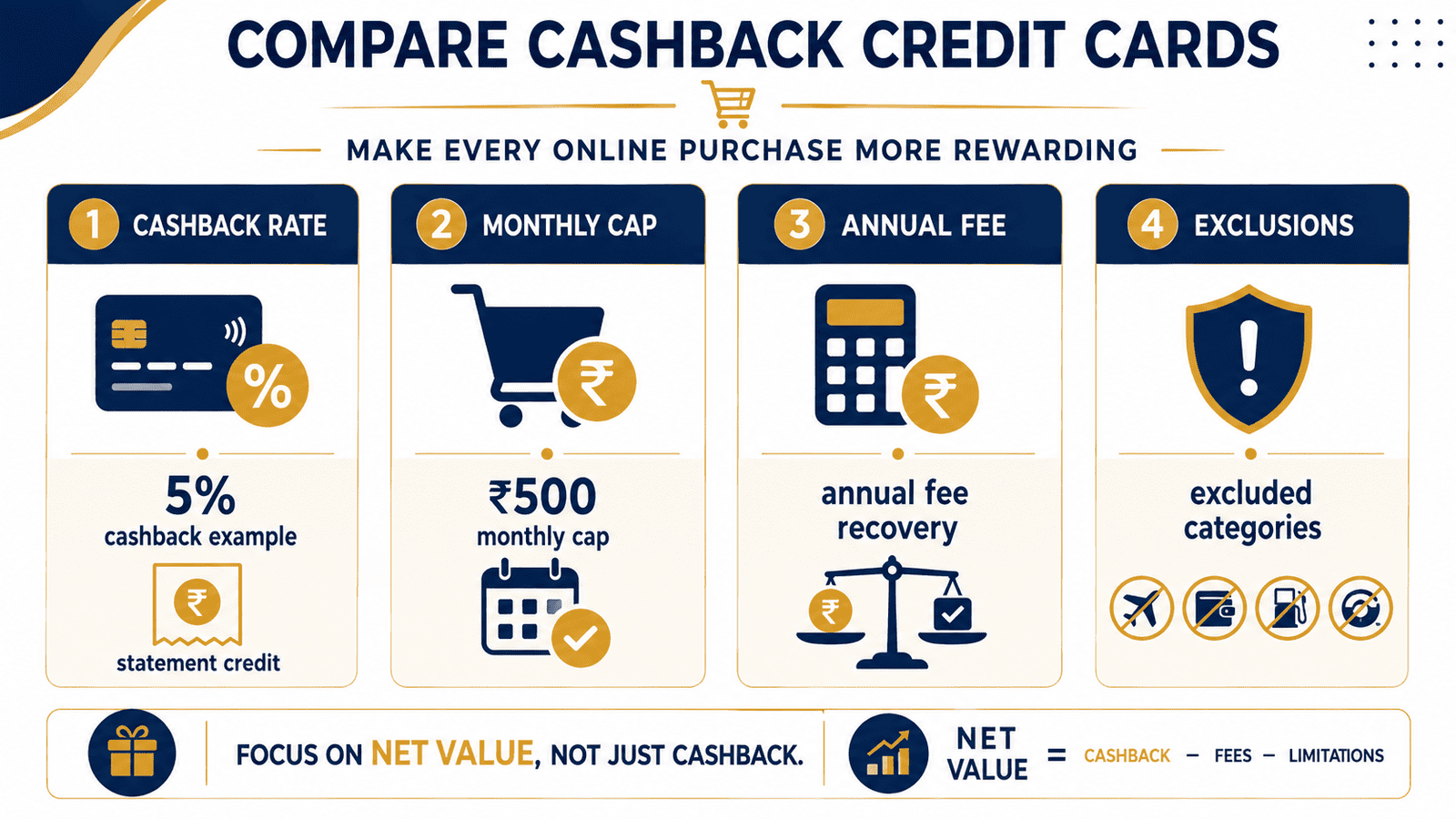
Cashback credit cards can be useful for disciplined online shoppers, but net value matters more than advertised cashback rate. A card offering 5% cashback with a ₹500 monthly cap gives a maximum of ₹6,000 per year before fees — not 5% of your total annual spend. Annual fee, renewal fee, and excluded categories reduce real value further. If you carry unpaid dues even once, the revolving interest at 36–42% per annum can wipe out months of cashback in a single billing cycle. Always verify current card terms, caps, and exclusions directly from the issuer before applying.
Key Takeaways
- A ₹500 monthly cashback cap means your maximum real saving is ₹6,000 per year — even if the headline rate is 5% and you spend ₹20,000+ online every month.
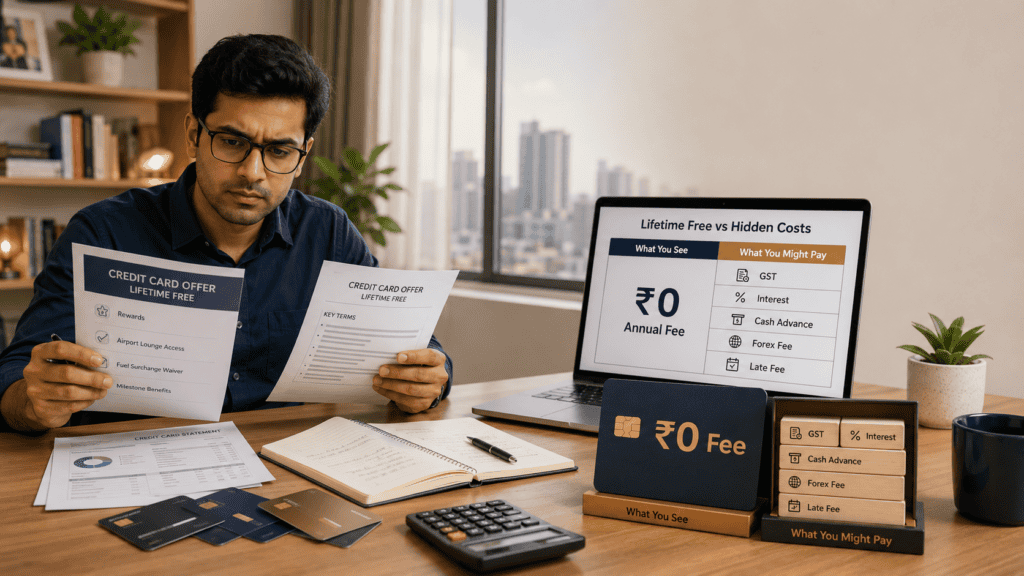
- Annual fee plus 18% GST on that fee reduces your net cashback value; a ₹1,000 annual fee costs you ₹1,180 effectively, and you must earn more than that just to break even.
- Not all online transactions qualify — merchants classified under excluded categories (insurance, fuel, utility prepaid wallets, and EMI conversions) often do not earn cashback.
- Lifetime-free cards may offer lower cashback rates but zero annual cost, making them better for low or irregular online spenders.
- Cashback does not reduce interest charges — if you pay only the minimum amount due, revolving credit interest runs at roughly 36–42% per annum and cancels any cashback benefit entirely.
- Verify the cashback rate, monthly or annual cap, eligible categories, and redemption method from the issuer’s Most Important Terms and Conditions (MITC) document before applying — not from comparison aggregator pages.
- According to RBI credit card guidelines at rbi.org.in, card issuers must disclose all charges and key terms upfront; use that right to read the full schedule of charges before applying.
Comparison: What to Look at When Comparing Cashback Credit Cards
The table below shows the parameters you should compare across any two or three cashback cards you are evaluating. Sample figures are illustrative only — actual rates, fees, and caps must be verified from the issuer’s current MITC document before applying. For a detailed look at whether reward points cards might suit you better, see our guide on reward points vs cashback credit cards.
| Parameter | What it means for you | What to check |
|---|---|---|
| Headline cashback rate | The advertised percentage — often 5% for select categories | Ask: is this capped? Is it on all online spends or specific merchants only? |
| Eligible online categories | Determines which merchants actually earn cashback | Check whether groceries, food delivery, electronics, and bill payments are included |
| Monthly cashback cap | The maximum cashback credited in one billing cycle | A ₹500 cap means you earn no extra cashback above ₹10,000 spend at 5% |
| Annual fee + renewal fee | Direct cost that reduces yearly net value | Confirm whether 18% GST applies on the fee; total cost is fee × 1.18 |
| Fee waiver threshold | Spend target above which the renewal fee is reversed | Check if online-only spend counts or if total card spend is required |
| Redemption method | How cashback is paid — statement credit, reward points, or wallet | Statement credit is simplest; reward points need conversion and may lapse |
| Excluded categories | Transactions that earn zero cashback despite being online | Common exclusions: fuel, insurance premiums, EMI conversions, wallet loads, rent payments |
| Joining fee | One-time charge at card issuance | Some issuers waive it on first-year spend; check the exact condition |
Key Facts at a Glance
| Term | Definition | Why it matters |
|---|---|---|
| Cashback rate | Percentage of eligible spend returned as cashback | Higher is better only when the cap and eligible categories also work for your spend pattern |
| Statement credit | Cashback applied directly to reduce your outstanding card balance | Most transparent form — no conversion, no expiry, no redemption step needed |
| Annual fee | Yearly charge for holding the card, plus 18% GST | Must be subtracted from total cashback earned to calculate real net value |
| Cashback cap | Maximum cashback credited per month or per year | Limits real earnings even if your spend is much higher than the cap threshold |
| Excluded categories | Merchant types where cashback is not earned despite the transaction being online | Misunderstanding exclusions is the most common reason cashback falls short of expectations |
| Billing cycle | The monthly statement period — typically 28–31 days | Cashback credited in one cycle may appear as statement credit only in the next cycle |
To understand how your billing cycle and due date affect cashback timing and payments, read our explainer on credit card billing cycle and due date.
How Cashback Credit Cards Work for Online Shopping in India
Cashback credit cards earn you a percentage of eligible spend back — usually as a statement credit, reward points, or a wallet balance, depending on the issuer. The mechanism sounds simple, but four layers of rules sit between the advertised rate and what you actually receive.
Eligible transactions and merchant category codes
Every credit card transaction is assigned a Merchant Category Code (MCC) by the card network — Visa, Mastercard, or RuPay. Cashback is earned only when the MCC falls within the issuer’s approved categories for that card. An online order from a large e-commerce platform may earn 5% cashback. A purchase from a small D2C website with an MCC classified as “miscellaneous retail” may earn a lower flat rate or zero cashback. This is why two online transactions on the same card can earn different cashback rates, even though both are digital purchases.
Direct cashback vs reward points vs wallet credit
Not all cards credit cashback the same way. Some cards offer direct statement credit — the cashback amount reduces your outstanding balance directly, with no action needed from you. Others convert cashback to reward points, which you must redeem separately and which may carry an expiry date or a redemption fee. A third model credits cashback to a third-party wallet or co-branded partner account. Statement credit is the most transparent and beginner-friendly option because it has no redemption step and no expiry risk.
Why online categories may be restricted
Issuers restrict certain online categories because they carry higher interchange costs or fraud risk. Common exclusions across many cashback cards include: insurance premium payments, government services, fuel purchased via apps, EMI conversions of existing transactions, wallet top-ups, and rent payments routed through payment apps. These categories are online transactions, but they often earn zero cashback or a much lower flat rate. The exclusion list is in the MITC document — which you should read before applying, not after.
Terms can change after issuance
Card issuers in India have the right to revise cashback rates, monthly caps, eligible categories, and redemption rules — typically with 30 days’ advance notice to cardholders. A card that offered 5% unlimited cashback when you applied may now have a ₹500 monthly cap. This is why comparison tables on aggregator sites can become outdated quickly. The issuer’s own product page and MITC document are the only reliable sources. If you are choosing your first credit card and wondering whether a cashback card is the right starting point, our guide on how to choose your first credit card in India walks through the full decision.
Real Example: Rohan’s Online Shopping Calculation
Rohan, 29, is a product analyst in Bengaluru earning ₹95,000 per month. He spends ₹20,000 every month online — across an e-commerce platform, a food delivery app, a grocery delivery service, and monthly streaming subscriptions. He is evaluating a cashback card with an advertised 5% cashback rate on online spends, a ₹500 monthly cap, and a ₹999 annual fee (plus 18% GST).
At 5% on ₹20,000, Rohan would theoretically earn ₹1,000 cashback per month. But the card’s monthly cap is ₹500. So his actual cashback credited per month is ₹500 — not ₹1,000. Over 12 months, that is ₹6,000 cashback before deducting the card’s annual cost. His annual fee is ₹999 plus ₹179.82 GST, totalling ₹1,178.82. His real net yearly value is ₹6,000 minus ₹1,178.82 — that is approximately ₹4,821. Now Rohan checks whether the card offers a fee waiver at ₹1,50,000 annual spend. His total annual card spend is well above that. If the waiver applies, his net value rises back to ₹6,000. The key insight: the monthly cap, not the cashback rate, determines his ceiling. He also checks that his food delivery and grocery spend qualifies — and finds that one grocery app is excluded. That reduces his eligible monthly spend to roughly ₹15,000, capping actual cashback at ₹500 anyway. The cap was the binding constraint all along. Read our guide on credit card annual fee waiver to understand how to track and claim fee reversals every year.
How to Calculate Real Value from Any Cashback Credit Card
Use this five-step formula to evaluate any cashback card before applying.
Real yearly value = (Monthly eligible cashback credited × 12) − Annual card cost
Step 1 — Eligible monthly spend: From your last three months of bank or UPI statements, separate online spend by category: e-commerce, food delivery, groceries, streaming, utility bills, and other. Remove any categories that fall under the card’s exclusion list.
Step 2 — Apply the cashback rate: Multiply eligible spend by the cashback rate. Example: ₹15,000 eligible spend × 5% = ₹750 gross cashback.
Step 3 — Apply the monthly cap: If the cap is ₹500, your credited cashback for the month is ₹500 — not ₹750. The cap is the actual ceiling, not the rate.
Step 4 — Subtract annual card cost: Annual fee + 18% GST on fee. If the annual fee is ₹999, your total card cost is ₹1,178.82. Divide by 12 to see the monthly cost: ₹98.24. Your net monthly value is ₹500 minus ₹98.24 = ₹401.76.
Step 5 — Compare with a lifetime-free card: A lifetime-free card with 1% flat cashback on the same ₹15,000 eligible spend gives ₹150 per month — but zero annual cost. Over a year, that is ₹1,800 vs ₹4,821 net from the paid card (after fee waiver). The paid card wins here — but only because Rohan’s spend is high enough to hit the cap every month. A lower spender may find the lifetime-free card better.
| Scenario | Key inputs | Real yearly value |
|---|---|---|
| High spender, cap hit every month, fee waived | ₹500 cap × 12, ₹0 annual cost | ₹6,000 |
| High spender, cap hit every month, fee not waived | ₹500 cap × 12, ₹1,179 annual cost | ₹4,821 |
| Low spender, cap not hit, fee not waived | ₹5,000 eligible × 5% = ₹250/month × 12, minus ₹1,179 | ₹1,821 |
All figures above are illustrative only and based on example card terms. Verify current rates, caps, and fees directly from your chosen card’s MITC document before applying.
How to Decide What’s Right for You
your monthly online spend consistently exceeds ₹10,000 on eligible categories — THEN a paid cashback card with a high monthly cap is likely to deliver better net value than a lifetime-free alternative, provided the annual fee is either low or reversible via a spend waiver.
your online spend varies heavily month to month and rarely exceeds ₹5,000 on eligible categories — THEN a lifetime-free flat-rate cashback card avoids annual fee risk and still earns you something on every eligible transaction.
most of your online spending is concentrated on one platform — such as a single e-commerce app or a grocery delivery service — THEN check whether a co-branded card for that platform offers a higher rate on exactly that merchant, rather than a general cashback card.
your spend is spread across e-commerce, food delivery, streaming, and bill payments — THEN compare which card covers the widest range of those MCC categories at a useful cashback rate, rather than optimising for a single platform.
you have existing reward points cards that already earn well on your spend — THEN run the five-step calculation above for both cards before switching; the reward-points value may already exceed the cashback card’s net yield.
you are able to pay your full card outstanding every month — do NOT use a cashback card to optimise savings. Revolving interest at 36–42% per annum will cost far more than any cashback earned, making the exercise counterproductive.
most of your online spend falls in excluded categories such as insurance premiums, wallet top-ups, or government payments — do NOT expect headline cashback rates to apply. Check the exclusion list first.
Common Mistakes to Avoid
Choosing the highest advertised cashback rate without checking the monthly cap
A 5% cashback headline sounds superior to 2% flat cashback. But if the 5% card has a ₹300 monthly cap and the 2% card has no cap, a ₹20,000 monthly spender earns ₹300 from the first card and ₹400 from the second. The rate is irrelevant once the cap is hit. Always calculate what the cap means at your actual spend level before comparing rates.
Ignoring the annual fee and its GST component
A ₹500 annual fee becomes ₹590 after 18% GST. A ₹1,500 annual fee costs ₹1,770 effectively. Many beginners compare cards only on cashback rate and miss this cost entirely. If your annual cashback earned is less than the total card cost, you are paying to shop — not saving.
Assuming every online transaction earns cashback
Transactions classified under excluded MCCs — insurance, fuel apps, government portals, wallet loads, and EMI conversions — typically earn zero cashback on most cashback cards, even though they are digital purchases. A reader who pays a ₹15,000 insurance premium expecting 5% cashback and receives nothing will be rightly frustrated. Read the exclusion list in the MITC before applying.
Missing the payment due date and paying revolving interest
Cashback of ₹500 per month adds up to ₹6,000 per year. Carrying an unpaid balance of ₹20,000 for one month at 3.5% monthly interest costs approximately ₹700. One missed payment wipes out more than a full month of cashback — and the interest compounds daily. According to RBI guidelines at rbi.org.in, cardholders should understand their total outstanding, not just the minimum amount due.
Spending more to chase cashback or hit fee waiver thresholds
Increasing discretionary spend to hit a ₹1,50,000 annual waiver threshold makes financial sense only if the incremental spend is on things you actually need. Spending an extra ₹10,000 to save ₹1,179 in annual fees is a poor trade. Track your natural spend first, then evaluate whether it already meets the waiver threshold.
Overlooking cashback expiry and redemption steps for reward-point-based cards
Some cards credit cashback as reward points rather than direct statement credit. Those points may expire if not redeemed within 1–2 years, and redemption may require a minimum point threshold or carry a processing fee. Before applying, confirm whether cashback is auto-credited or requires manual redemption — and whether it expires.
Relying on aggregator comparison tables for current card terms
Cashback rates, caps, eligible categories, and annual fees on third-party comparison sites may not reflect the issuer’s latest MITC. Issuers can and do revise terms. The only authoritative source is the issuer’s official product page and current MITC document. Treat comparison tables as a starting shortlist, not a final reference.
When This May Not Be the Right Choice
A cashback credit card for online shopping may not be the right product for you if you frequently pay only the minimum amount due rather than the full outstanding — revolving credit interest at 36–42% per annum makes any cashback benefit negligible, and the net result is a growing debt rather than savings. Read our explainer on how credit card interest is calculated in India before applying for any card you may not pay in full each month.
It may also be unsuitable if your monthly online spend is low or highly irregular — below ₹5,000 on eligible categories — where a lifetime-free card with flat cashback may deliver a similar or better result at zero annual cost. Similarly, if the bulk of your digital spending falls under excluded categories such as insurance, utility wallets, or government portals, the headline cashback rate will almost never apply to your real transactions.
Finally, if you are actively trying to reduce discretionary spending, holding a cashback card can subtly encourage higher spending to maximise rewards — which defeats the underlying financial goal.
If any of these apply to your situation, it may be worth exploring alternatives before committing.
Official Rules and Where to Verify
Cashback rates, monthly caps, eligible categories, annual fees, and redemption rules are set by individual card issuers — not by a central regulator. They can change with issuer policy updates, typically with 30 days’ advance notice to existing cardholders. Before applying or renewing a cashback credit card, verify the following from the issuer’s official sources:
- The card’s product page on the bank or NBFC’s official website
- The Most Important Terms and Conditions (MITC) document — downloadable from the issuer’s site
- The schedule of charges (covers annual fee, joining fee, GST, and late payment charges)
- The cashback terms section, which lists eligible categories, excluded MCCs, monthly or annual caps, and redemption method
- RBI’s credit card and debit card guidelines and master directions at rbi.org.in — these govern consumer rights, billing practices, and dispute resolution
To verify what each line item on your statement actually means — including credited cashback and fees — see our guide on how to read a credit card statement.
Rules, limits, and rates on this topic can change with each Budget or regulatory update. Always verify current figures directly from the official source before making any financial decision.
Expert Tips
- Pull your last three months of UPI and bank statements and categorise every online spend before choosing a card — this tells you your real eligible spend, not your assumed spend, and prevents picking a card optimised for a category you rarely use.
- If the card credits cashback as reward points rather than statement credit, calculate the actual rupee value of those points at today’s redemption rate and check whether points expire — a point worth ₹0.25 on an airline redemption is very different from ₹0.10 on a merchandise catalogue.
- Set a calendar reminder two months before your card renewal date to check whether you have hit the annual fee waiver threshold — if you are close, routing one or two planned purchases through the card can save ₹500–₹1,500 in fees without changing your spending behaviour.
- Check the cashback exclusion list every six months — issuers can add new excluded categories or MCCs mid-year, and a merchant that earned 5% cashback in January may earn zero from July onwards without a direct notification reaching you.
- Keep your credit utilisation ratio below 30% even when a high cashback card tempts you to spend more — a high utilisation ratio damages your CIBIL score, which can affect loan eligibility and interest rates far more than any cashback saving.
- If you are comparing a paid cashback card to a lifetime-free card, apply the five-step calculation from Section 8 above to your own numbers before deciding — the math takes under five minutes and is far more reliable than any aggregator’s “recommended card” badge.
- Avoid holding more than two or three credit cards simultaneously if you are a beginner — managing multiple billing cycles, due dates, and reward structures increases the risk of missed payments, which costs far more than any cashback benefit.
Frequently Asked Questions
Are cashback credit cards better than reward points cards for online shopping?
It depends on your redemption behaviour. Cashback — especially as direct statement credit — is simpler, more transparent, and guaranteed at a fixed rupee value. Reward points can offer higher value per rupee if redeemed for air miles or premium hotel stays, but require active management and carry expiry risk. If you prefer simplicity and want savings to apply automatically to your bill, cashback cards are easier to use correctly. For a detailed comparison, see our article on reward points vs cashback credit cards.
Is a lifetime-free cashback card better than a paid cashback card?
For low or irregular online spenders, yes — a lifetime-free card with 1% flat cashback delivers real value at zero cost. For high spenders who hit the monthly cashback cap every month, a paid card with a higher rate often wins after the fee is subtracted. Run the five-step calculation in Section 8 for your actual numbers. Some paid cards also offer fee waivers above a spend threshold, which effectively makes them free for high spenders.
Does cashback reduce my credit card bill directly?
Only if it is credited as statement credit. In that case, it reduces your outstanding balance automatically in the next billing cycle. If the card credits cashback as reward points or wallet balance, you must redeem it separately — and it does not automatically reduce your bill. Check the redemption method in the MITC before applying.
Do all online purchases earn cashback?
No. Only transactions at merchants whose Merchant Category Code falls within the card’s eligible categories earn the advertised cashback rate. Common online exclusions include insurance premium payments, fuel via apps, government portal payments, wallet top-ups, and EMI conversions. Even two purchases on the same e-commerce platform can earn different rates if one is a third-party seller with a different MCC.
Can I lose cashback if I do not pay my card bill on time?
Cashback already credited to your statement is not reversed for non-payment, but the interest and late payment charges you incur will far exceed the cashback earned. Some issuers may also suspend cashback accrual on accounts with overdue outstanding. The real risk is paying 3–3.5% monthly interest on unpaid balances — that is ₹300–₹350 in interest per month on a ₹10,000 unpaid balance, which exceeds a ₹200–₹250 monthly cashback earning in the same period.
Does using a cashback card affect my CIBIL score?
Yes, indirectly. Timely full payment improves your credit history and CIBIL score. Missing payments or paying only the minimum amount due can lower your score. High credit utilisation — using a large portion of your card limit to maximise cashback — can also lower your score. Keep utilisation below 30% of your total credit limit across all cards.
What is a monthly cashback cap and why does it matter?
A monthly cashback cap is the maximum cashback an issuer will credit in a single billing cycle, regardless of how much you spend. If the cap is ₹500 and you spend ₹50,000 online in a month at 5%, you still receive only ₹500. The cap makes the headline rate meaningless above a certain spend level. Always calculate the spend at which the cap is hit — ₹500 cap ÷ 5% = ₹10,000 eligible spend — and check whether your monthly spend typically exceeds that threshold.
How do I know if a cashback card’s annual fee will be waived?
The fee waiver condition is stated in the MITC. Most waivers require a minimum annual spend — for example, ₹1,50,000 in a card year. Check whether online-only spend counts or whether all card spends are included, whether the waiver applies automatically or requires a request, and what the deadline is. See our article on credit card annual fee waiver for a step-by-step guide.
Can I use a cashback card for large one-time purchases to earn more?
Only if the purchase falls within eligible categories and does not exceed the monthly cap. A ₹30,000 electronics purchase at 5% would earn ₹1,500 gross cashback — but if the monthly cap is ₹500, only ₹500 is credited. Large purchases may also push your credit utilisation ratio up significantly for that month, which can affect your CIBIL score. Pay the full amount before the due date to avoid interest erasing the cashback benefit.
What happens if a merchant’s MCC changes and my transaction stops earning cashback?
Issuers tie cashback eligibility to the MCC assigned to the merchant by the card network — not to the merchant’s name or category as you see it. If a merchant’s MCC changes (for example, if a grocery app reclassifies some transactions), your cashback rate on that merchant can change without notice. This is another reason to review your cashback credits on your statement monthly rather than assuming eligibility based on the original card offer.
Final Verdict
Cashback credit cards are genuinely useful for disciplined online shoppers who pay their full outstanding every month, whose spend falls consistently within eligible categories, and whose annual cashback earned exceeds the total card cost including fees and GST. For this group, a well-chosen cashback card can return ₹4,000–₹6,000 in real yearly value on ₹15,000–₹20,000 monthly online spend — without any change in spending behaviour. The key metric is not the headline cashback rate. It is the net yearly value after caps, exclusions, and annual fee — calculated using your own spending data, not a comparison site’s example. If you are just starting out and have not yet chosen your first card, our guide on how to choose your first credit card in India covers the full decision from the beginning. Card terms, cashback rates, and fee structures change without notice. Always verify the latest rules from official sources or consult a qualified professional before making any financial decision.
This article is for educational purposes only and should not be treated as personalised financial, tax, investment, insurance, or legal advice. Tax rules, interest rates, regulatory limits, and product features can change with each Budget or policy update. Please verify current rules from official government sources or consult a qualified and registered professional before making any financial decision.

Nikhil Bansal writes about credit cards, billing cycles, card charges, rewards, cashback, credit utilisation, card EMI, BNPL, and responsible credit usage in India. His content is designed for readers who want to use credit cards wisely without falling into expensive repayment mistakes.
He covers topics such as how to choose a first credit card, credit card billing cycle, due date, grace period, minimum amount due, credit utilisation ratio, reward points vs cashback, lifetime free credit cards, annual fee waivers, credit card statement reading, add-on cards, cash advance charges, EMI on credit cards, credit card fraud reporting, BNPL vs credit card, and foreign transaction fees.
Nikhil’s writing is beginner-friendly, direct, and risk-aware. He explains how small mistakes such as paying only the minimum due, withdrawing cash from a credit card, missing due dates, or overusing credit limits can become costly. Since card fees, interest rates, reward rules, waiver conditions, and bank offers change often, readers should verify the latest Most Important Terms and Conditions from the card issuer.