

You received a maturity payout from a life insurance policy — ₹10 lakh, maybe more — and now you are not sure whether it is tax-free, partly taxable, or already settled because TDS was deducted. This confusion is common among salaried people in India, and it costs money when handled incorrectly at ITR time.
Life insurance maturity proceeds — from LIC endowment plans, money-back policies, ULIPs, and traditional savings insurance — are not automatically tax-free. The tax treatment depends on Section 10(10D) of the Income-tax Act, 1961, the date your policy was issued, the annual premium you paid, and whether your policy qualifies as a ULIP or high-premium policy. Section 194DA governs TDS, and what appears in your AIS or Form 26AS must be reported correctly in your ITR.
This article explains how the tax rules apply to maturity proceeds — not to buying a new policy. By the end, you will know exactly which checks to run before filing your ITR.
Quick Answer: Life Insurance Maturity Proceeds Tax
Life insurance maturity proceeds tax depends on Section 10(10D), policy issue date, premium paid, sum assured and policy type. A ₹10 lakh maturity amount may be tax-free if conditions are met, but taxable policies may face TDS under Section 194DA and must be reported correctly in ITR.
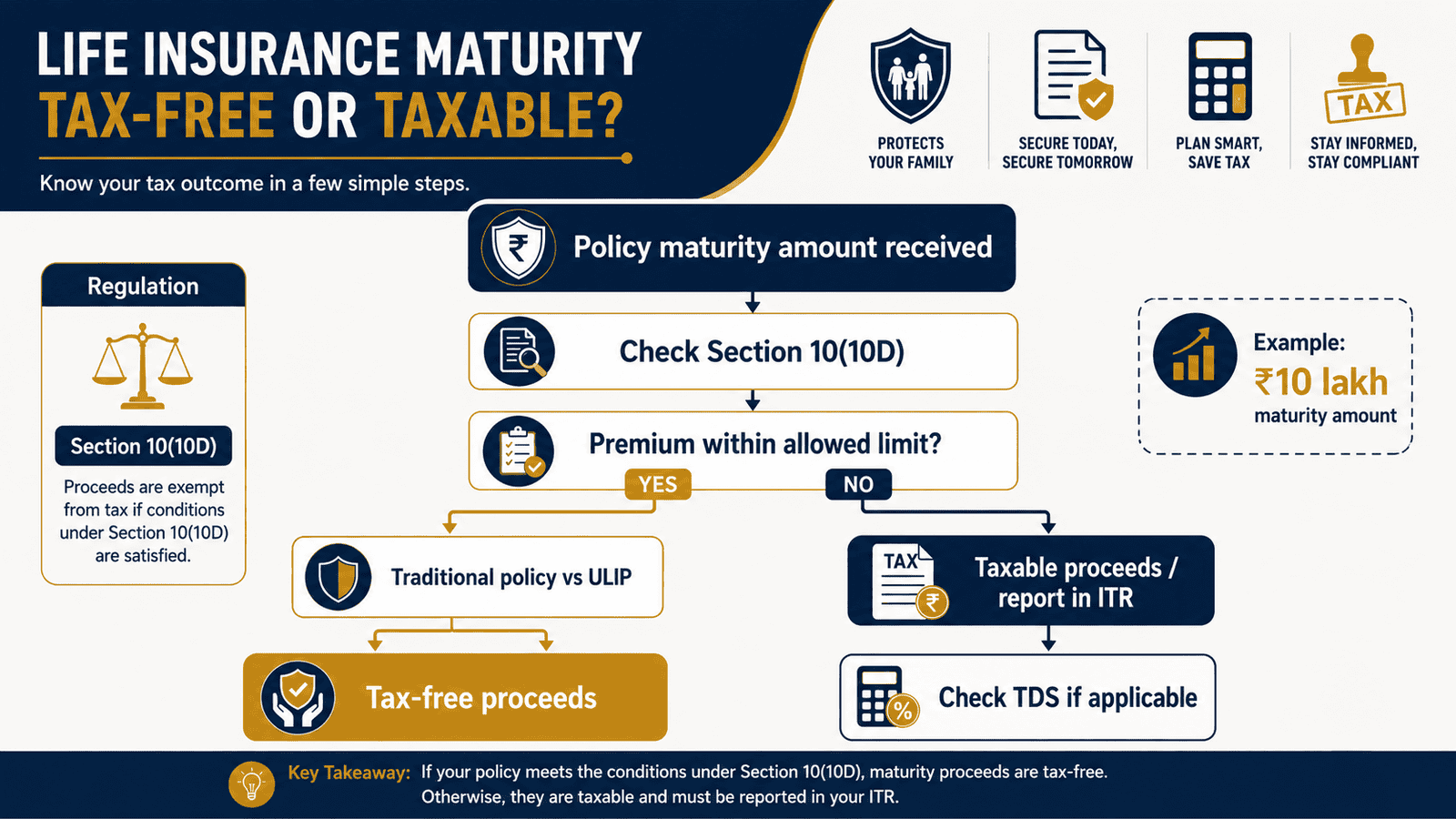
Key Takeaways
- Maturity proceeds are tax-free only if Section 10(10D) conditions are satisfied — the policy name or the insurer’s brand does not decide this automatically.
- If your annual premium exceeded 10% of the sum assured (for policies issued on or after 1 April 2012), the maturity amount is taxable — even if the policy is from LIC.
- Death benefit paid to the nominee is generally tax-free under Section 10(10D) regardless of premium-to-sum-assured ratio — this is a separate rule from maturity taxation.
- TDS under Section 194DA does not mean your tax is fully settled — if the maturity amount is taxable, the balance tax must be paid at your applicable income tax slab rate.
- Every maturity payout shows up in your AIS and Form 26AS — ignoring it in ITR can trigger a notice from the Income Tax Department.
- ULIP maturity proceeds issued on or after 1 February 2021 have a separate premium threshold rule that must be checked independently from traditional policy rules.
- Keep your policy bond, premium receipts, insurer maturity statement, and TDS certificate together before you open your ITR form — you will need all four.
Key Facts at a Glance
| Rule / Check | What It Means for Salaried People | Verify Before Filing |
|---|---|---|
| Section 10(10D) | Main exemption provision for life insurance maturity proceeds under the Income-tax Act, 1961 | incometax.gov.in |
| Policy issue date | Policies issued before 1 April 2003, between 1 April 2003–31 March 2012, and after 1 April 2012 each have different premium-to-sum-assured thresholds | Your policy bond |
| Annual premium ÷ sum assured ratio | If premium exceeds the allowed percentage of sum assured, Section 10(10D) exemption is lost for policies in that band — verify applicable threshold for your policy date | incometax.gov.in |
| Section 194DA (TDS) | TDS is deducted by the insurer on taxable maturity proceeds above a threshold — TDS rate and threshold must be verified before filing | incometax.gov.in |
| ULIP premium limit | ULIPs issued on or after 1 February 2021 with annual premium above a specified threshold lose Section 10(10D) exemption — verify current limit | incometax.gov.in |
| Non-ULIP high-premium threshold | Traditional policies issued on or after 1 April 2023 with annual premium above a specified threshold are taxable — verify current limit | incometax.gov.in |
| AIS and Form 26AS | Insurer reports maturity proceeds to the Income Tax Department — it will appear in your Annual Information Statement and must be reconciled before ITR filing | incometax.gov.in portal |
| ITR reporting | Exempt proceeds go in the exempt income schedule; taxable proceeds are added to income and taxed at your slab rate | ITR utility instructions |
How Life Insurance Maturity Proceeds Are Taxed in India
What counts as maturity proceeds?
Maturity proceeds are the lump sum or periodic payments an insurer pays you at the end of the policy term — provided you survive to that date. This includes the sum assured, any guaranteed additions, and accumulated bonuses. Survival benefits from money-back policies — the partial payouts you receive during the policy term — are treated in the same way as maturity proceeds for tax purposes. These are different from the death benefit, which is paid to your nominee if you die during the policy term.
Section 10(10D): the main exemption
Section 10(10D) of the Income-tax Act, 1961 says that any sum received under a life insurance policy, including bonus, is exempt from income tax — subject to conditions. The conditions are based on the policy’s issue date and the ratio of annual premium to sum assured. According to the Income Tax Department, the three broad bands are:
- Policies issued before 1 April 2003: No premium-to-sum-assured condition under Section 10(10D). Maturity proceeds are generally exempt.
- Policies issued between 1 April 2003 and 31 March 2012: Annual premium must not have exceeded 20% of the actual capital sum assured in any year during the policy term. If it did, the exemption is lost.
- Policies issued on or after 1 April 2012: Annual premium must not have exceeded 10% of the actual capital sum assured in any year. For policies covering persons with disability or specified illness, a 15% threshold applies — verify current conditions at incometax.gov.in.
If the premium-to-sum-assured condition is breached in even one policy year, the entire maturity proceeds lose Section 10(10D) exemption and become taxable in the year of receipt. This is the single most common reason salaried people receive a taxable maturity payout without realising it in advance.
For a clear overview of term insurance — which typically has no maturity proceeds and therefore no maturity tax question — see term insurance meaning and why every earning person needs it.
ULIP maturity taxation: a separate track
Unit-Linked Insurance Plans (ULIPs) follow a different rule for policies issued on or after 1 February 2021. If the aggregate annual premium across all ULIPs held by the same person exceeds a specified threshold, the maturity proceeds from those policies become taxable — the excess is treated similarly to equity fund gains. For ULIPs issued before 1 February 2021, the original Section 10(10D) conditions apply. The applicable ULIP premium threshold must be verified at incometax.gov.in before filing. For a detailed comparison of ULIP returns against a combination of term and mutual funds, see ULIP vs term plus mutual fund — a real comparison with numbers.
High-premium non-ULIP policies
Budget 2023 introduced an additional rule for traditional (non-ULIP) life insurance policies issued on or after 1 April 2023. If aggregate annual premiums across such policies exceed a specified threshold, the maturity proceeds are taxable as income from other sources in the year of receipt. This rule was introduced specifically to prevent high-net-worth individuals from routing large sums through life insurance to claim tax-free maturity. Verify the current threshold at incometax.gov.in before filing.
Death benefit: a different rule
The death benefit paid to the nominee on the life assured’s death is fully tax-free under Section 10(10D) — there is no premium-to-sum-assured condition for death claims. The rules above apply only to maturity, survival, and surrender proceeds received by the policyholder, not to death payouts received by nominees.
Real Example: Rohit’s LIC Maturity Payout
Rohit Sharma, 38, Bengaluru, is an IT manager earning ₹22 lakh per year. He has received a ₹10 lakh maturity payout from a traditional LIC endowment policy he took in 2014. His annual premium was ₹80,000. His sum assured was ₹10 lakh.
Rohit’s first check: annual premium ÷ sum assured = ₹80,000 ÷ ₹10,00,000 = 8%. Since his policy was issued after 1 April 2012, the threshold is 10% of the sum assured. At 8%, his annual premium is below the threshold — so Section 10(10D) conditions are likely satisfied and the ₹10 lakh is likely exempt, subject to verification of all conditions.
Rohit next checks his AIS on the Income Tax Department portal. He finds the ₹10 lakh maturity amount is reported there by LIC. No TDS has been deducted — consistent with an exempt payout where TDS under Section 194DA does not apply. When he files his ITR, he reports the ₹10 lakh in the exempt income schedule rather than leaving it unreported.
Had Rohit’s annual premium been ₹1,10,000 on the same ₹10 lakh policy — making the ratio 11% — the Section 10(10D) exemption would be lost. LIC would deduct TDS, and Rohit would pay income tax on the full ₹10 lakh at his applicable slab rate. The policy name (LIC Jeevan Anand or any other) does not change this calculation. For a policy-level comparison, see LIC Jeevan Anand vs term insurance — an honest comparison.
How to Calculate the Premium-to-Sum-Assured Ratio
Premium-to-Sum-Assured Ratio = (Annual Premium ÷ Actual Capital Sum Assured) × 100
Apply this formula to every policy year — not just the first year. If the ratio exceeded the threshold in any single year, the exemption is lost for the entire maturity proceeds.
| Scenario | Annual Premium / Sum Assured | Result (verify thresholds before filing) |
|---|---|---|
| Policy issued 2014, ₹80,000 premium, ₹10L sum assured | 8% | Below 10% threshold — likely exempt under Section 10(10D) |
| Policy issued 2014, ₹1,10,000 premium, ₹10L sum assured | 11% | Exceeds 10% threshold — maturity proceeds taxable |
| Policy issued 2008, ₹1,80,000 premium, ₹10L sum assured | 18% | Below 20% threshold (2003–2012 band) — likely exempt |
Important: the ULIP threshold rule and the non-ULIP high-premium aggregate rule work differently from the ratio check above. Even if the ratio is within limits, a ULIP with aggregate premium above the specified threshold is taxable. Always run both checks separately and verify current limits at incometax.gov.in.
Comparison: Life Insurance Payout Types and Tax Treatment
| Payout Type | Likely Tax Treatment | Key Condition to Verify |
|---|---|---|
| Traditional endowment maturity | Likely exempt if premium ≤ 10% (post-2012) or 20% (2003–2012) of sum assured | Premium-to-sum-assured ratio; verify threshold for policy issue date |
| Money-back / survival benefit | Likely exempt under same Section 10(10D) conditions as maturity | Same ratio check applies; each survival payment is assessed |
| ULIP maturity (post 1 Feb 2021) | Depends on aggregate premium — exempt below threshold, taxable above | Aggregate annual ULIP premium across all policies — verify threshold at incometax.gov.in |
| Death benefit to nominee | Tax-free under Section 10(10D) — no premium ratio condition applies | None for ratio; but keyman/employer-linked policies have separate rules |
| Surrender value | Depends on conditions — generally same Section 10(10D) treatment as maturity if conditions are met | Policy issue date and premium ratio; confirm with insurer |
| Non-ULIP high-premium policy (post 1 Apr 2023) | Taxable if aggregate annual premium exceeds specified threshold | Aggregate annual premium across all traditional policies — verify threshold at incometax.gov.in |
For a clear comparison of endowment policies versus term insurance, including cost and return differences, see term insurance vs endowment policy — why most experts prefer term.
How to Decide What’s Right for You
your policy was issued before 1 April 2003 and no Section 10(10D) sub-conditions exclude it — THEN maturity proceeds are generally tax-free; report them in the exempt income schedule of your ITR.
your policy was issued between 1 April 2003 and 31 March 2012 and annual premium never exceeded 20% of the sum assured — THEN maturity proceeds are likely exempt; verify the threshold before filing.
your policy was issued on or after 1 April 2012 and annual premium never exceeded 10% of the sum assured — THEN maturity proceeds are likely exempt under Section 10(10D); check AIS for TDS entries.
annual premium exceeded the applicable threshold in any year — THEN the full maturity amount is taxable as income from other sources; add it to your taxable income and pay tax at your slab rate after credit for any TDS deducted.
you hold a ULIP issued on or after 1 February 2021 — THEN check whether your aggregate annual ULIP premium across all such policies exceeds the specified threshold; if yes, the maturity proceeds are taxable.
TDS has been deducted and shown in Form 26AS but you believe the proceeds are exempt — THEN claim the TDS as a credit in your ITR and show the maturity amount as exempt income; do not simply ignore the TDS entry.
you are certain about the policy’s tax classification — THEN do not assume it is tax-free. High maturity amounts are reported by insurers to the Income Tax Department, and an unreconciled AIS entry can trigger a notice.
Common Mistakes to Avoid
Assuming all LIC maturity amounts are tax-free
LIC is a government insurer, but the government does not grant blanket tax exemption on LIC maturity proceeds.
Exemption under Section 10(10D) depends on the annual premium-to-sum-assured ratio, policy issue date, and whether ULIP or high-premium rules apply — none of which are determined by the insurer’s name. A ₹10 lakh LIC payout where the premium exceeded the threshold is as taxable as any other insurer’s payout.
Check the ratio and the policy issue date first. Do not rely on the LIC brand as a proxy for tax-free status.
Ignoring the policy issue date
The applicable premium threshold under Section 10(10D) changed on 1 April 2003 and again on 1 April 2012.
Using the wrong threshold — for example, applying the 10% rule to a policy issued in 2007 when the 20% rule should apply — produces the wrong tax conclusion. The opposite error is equally dangerous: applying the 20% rule to a post-2012 policy could lead you to treat a taxable payout as exempt.
Check the policy commencement date on your policy bond and match it to the correct threshold band.
Confusing Section 80C deductions with Section 10(10D) exemptions
Section 80C allows a deduction of up to ₹1.5 lakh per year on life insurance premiums paid — this reduces your taxable income during the premium-paying years.
Section 10(10D) is a separate provision that determines whether the maturity proceeds are tax-free. The two sections solve completely different tax questions. Claiming 80C deductions during the policy term does not guarantee that the maturity amount will be exempt. For clarity on 80C deductions and how they interact with policy taxation, see 80C deduction list — EPF, PPF, ELSS, LIC and home loan principal.
Ignoring the AIS and Form 26AS entry
Insurers are required to report maturity proceeds to the Income Tax Department. The amount appears in your Annual Information Statement (AIS) and, depending on whether TDS was deducted, in Form 26AS.
If you do not reconcile and report this in your ITR — even if the proceeds are exempt — the Income Tax Department may issue a notice for unexplained credit or mismatch. Exempt proceeds must still be disclosed in the exempt income schedule of your ITR, not simply ignored.
Log into the income tax portal, check AIS before filing, and match the figure with your insurer’s maturity statement.
Thinking TDS means final tax is paid
If the insurer deducted TDS under Section 194DA, it means the maturity proceeds were treated as taxable — but TDS is only a withholding mechanism, not a final settlement.
If you are in the 20% or 30% tax bracket and TDS was deducted at a lower rate, the balance tax is payable by you. Conversely, if you are in the nil or 5% bracket, you may be entitled to a TDS refund — but only if you file the ITR and claim it.
Always compute the actual tax liability on the taxable proceeds and reconcile with TDS deducted.
Treating surrender value the same as maturity without checking
Surrender value — the amount received when you exit a policy early — follows the same Section 10(10D) conditions, but the ratio check uses premiums paid up to surrender, not the full policy term. Some policies also impose surrender charges that reduce the amount received.
Do not assume surrender value and maturity value are taxed identically. Check with your insurer for the taxable component, particularly if TDS was deducted on surrender.
Not keeping insurer documentation
If a notice is issued by the Income Tax Department about an insurance maturity entry in your AIS, you will need the policy bond, all premium payment receipts, the insurer’s maturity letter, the insurer’s computation of taxable amount, and the TDS certificate.
Most salaried people discard these documents after maturity. Store them for at least six years after the assessment year in which you filed the ITR disclosing the proceeds.
When This May Not Be the Right Choice
If your primary goal is life cover, a traditional endowment or money-back policy may not be the most efficient option. Term insurance provides a significantly higher sum assured for the same premium — and because term policies typically have no maturity proceeds, there is no maturity tax question to navigate at all.
If you are in the accumulation phase and need long-term wealth building, the returns from traditional life insurance policies — after accounting for costs, agent commissions, and long lock-in periods — may be lower than equivalent mutual fund investments held over the same period. High premiums relative to sum assured create maturity tax exposure on top of lower returns.
If you do not fully understand the policy’s surrender charges, premium escalation clauses, or participating versus non-participating bonus structure, you may not be able to accurately predict the net maturity amount or its tax treatment until maturity arrives.
If any of these apply to your situation, it may be worth exploring alternatives before committing.
Official Rules and Where to Verify
Life insurance maturity taxation is governed by the Income-tax Act, 1961, and is subject to change through Finance Acts, CBDT circulars, and notifications. Rules, limits, and rates on this topic can change with each Budget or regulatory update. Always verify current figures directly from the official source before making any financial decision.
- Income Tax Department — incometax.gov.in: Section 10(10D), Section 194DA, ITR filing instructions, AIS, and Form 26AS.
- IRDAI — irdai.gov.in: Insurance regulation, policyholder protection circulars, and product guidelines.
- Your insurer’s policy bond and maturity statement: Policy commencement date, annual premium, sum assured, and taxable component computation.
- TDS certificate (Form 16A): Issued by insurer if TDS was deducted under Section 194DA — use this to claim TDS credit in ITR.
- A qualified tax professional: Recommended for high-value maturity amounts, disputed TDS deductions, or multiple insurance policies across different issue-date bands.
For a complete ITR filing checklist for salaried employees — including how to handle insurance proceeds and TDS entries — see ITR filing checklist for salaried employees.
Expert Tips
- Before filing ITR, log into incometax.gov.in and download your AIS. Every maturity payout above the TDS threshold is reported there by the insurer — reconcile the figure with your own maturity statement so there is no mismatch at filing time.
- If TDS was deducted by the insurer and you believe the proceeds are exempt, contact your insurer and request a written computation showing the taxable component. This document protects you if the Income Tax Department raises a query later.
- Keep a separate folder for each life insurance policy you hold — policy bond, annual premium receipts, bonus statements, and the final maturity letter. For ITR purposes, you may need data going back to the first policy year to prove the premium-to-sum-assured ratio was within limits.
- If you hold multiple traditional life insurance policies issued on or after 1 April 2023 with high premiums, add up the aggregate annual premiums. The exemption limit under the newer non-ULIP rule applies to aggregate premiums, not per-policy premiums — verify the current aggregate threshold at incometax.gov.in.
- Do not report exempt insurance maturity proceeds as “not applicable” or leave the exempt income schedule blank. Report the proceeds in the correct schedule with the correct section reference. An AIS entry that has no corresponding ITR disclosure is a common trigger for automated scrutiny notices.
- If you switched from an old tax regime to the new tax regime in a year when insurance maturity proceeds are also received, verify how the maturity is treated under your chosen regime — the regime choice does not change the Section 10(10D) exemption itself, but it affects how taxable proceeds are added to income and taxed.
- For ULIPs issued before 1 February 2021 where the premium-to-sum-assured ratio was always within limits, the original Section 10(10D) exemption may still apply — do not automatically apply the newer ULIP aggregate rule to pre-February 2021 policies.
Frequently Asked Questions
Is LIC maturity amount taxable?
It depends on the policy, not the insurer. A LIC maturity amount is tax-free under Section 10(10D) if conditions are met — primarily that the annual premium did not exceed the applicable percentage of the sum assured in any policy year, and the policy does not fall under the newer high-premium rules. If conditions are breached, the maturity amount is taxable regardless of it being from LIC. Always check the premium-to-sum-assured ratio and the policy issue date first.
Is life insurance payout taxable or not?
Death benefit paid to the nominee is tax-free under Section 10(10D) with no premium-ratio condition. Maturity proceeds received by the policyholder may be tax-free or taxable depending on the annual premium, sum assured ratio, policy issue date, and whether ULIP or high-premium rules apply. There is no single yes or no answer without checking the specific policy’s conditions.
What is Section 10(10D)?
Section 10(10D) of the Income-tax Act, 1961 is the provision that exempts life insurance maturity proceeds, survival benefits, and bonuses from income tax — subject to conditions. The conditions relate to when the policy was issued and the ratio of annual premium to actual capital sum assured. Death benefits are also exempt under this section but without the premium-ratio condition.
What is TDS on life insurance maturity proceeds?
Section 194DA requires the insurer to deduct TDS on life insurance maturity proceeds that are not exempt under Section 10(10D) and are above a specified threshold. TDS is a withholding tax — it does not settle the full tax liability. If you are in a higher tax bracket, additional tax is due. If you are in a lower bracket, you can claim a refund by filing ITR. The TDS rate and threshold must be verified at incometax.gov.in before filing.
Where do I report insurance maturity proceeds in ITR?
If the maturity proceeds are exempt under Section 10(10D), report them in the exempt income schedule of your ITR under the relevant section reference. If the proceeds are taxable, report them as income from other sources. In both cases, reconcile the amount with the AIS entry before submitting. Do not leave the AIS entry unaddressed, even if proceeds are fully exempt.
Is ULIP maturity tax-free?
For ULIPs issued before 1 February 2021, the standard Section 10(10D) conditions apply — if the premium-to-sum-assured ratio was within limits, the maturity may be exempt. For ULIPs issued on or after 1 February 2021, if the aggregate annual premium across all such ULIPs exceeds a specified threshold, the maturity proceeds are taxable. Verify the current threshold at incometax.gov.in.
What happens if annual premium exceeds 10% of sum assured?
For policies issued on or after 1 April 2012, if annual premium in any year exceeded 10% of the actual capital sum assured, the entire maturity proceeds lose Section 10(10D) exemption. The full maturity amount is taxable as income from other sources in the year of receipt. TDS may be deducted by the insurer under Section 194DA. The taxable amount is added to your total income and taxed at your applicable slab rate after credit for TDS.
Can I avoid tax on insurance maturity by not disclosing it in ITR?
No. Insurers report maturity proceeds to the Income Tax Department, and the amount appears in your Annual Information Statement. The Income Tax Department’s systems automatically match AIS data with filed ITRs. An undisclosed maturity payout — exempt or taxable — will show as a mismatch and may trigger a notice or demand. Always disclose, whether in the exempt income schedule or as taxable income.
Does my old tax regime or new tax regime choice affect the insurance maturity tax?
The regime choice does not affect whether the maturity proceeds are exempt or taxable under Section 10(10D) — that is determined by the policy conditions, not the regime. However, if the proceeds are taxable, they are added to your total income and taxed at the applicable slab rates under your chosen regime. Use the income tax calculator for FY 2025-26 (old vs new regime comparison) to estimate the total tax impact after adding taxable maturity proceeds to your salary income.
What if I received a maturity payout two years ago and did not report it?
File a revised or belated ITR for the relevant assessment year, if still within the permitted window. If the window has closed, consult a qualified tax professional — voluntary disclosure and rectification is generally treated more favourably than an amount surfaced through notice. The Income Tax Department has a time limit to issue notices for under-reporting, but proceeds showing in AIS are already on record.
Final Verdict
Life insurance maturity proceeds tax is not decided by the insurer’s name, the policy’s branding, or whether you claimed Section 80C deductions during the premium-paying years. The only things that matter are: Section 10(10D) conditions, the policy issue date, the annual premium-to-sum-assured ratio, whether the policy is a ULIP or a high-premium traditional policy, and the applicable thresholds for each category.
Most salaried people with older traditional endowment policies and moderate premiums will find their maturity proceeds are tax-free — but that conclusion requires the ratio check, not an assumption. Newer ULIP or high-premium policies may follow different rules entirely.
Always check your AIS before filing, report the proceeds in the correct ITR schedule, and verify current limits at incometax.gov.in. For large maturity amounts or multiple policies, a qualified tax professional is worth the consultation fee. Always verify the latest rules from official sources or consult a qualified professional before making any financial decision.
This article is for educational purposes only and should not be treated as personalised financial, tax, investment, insurance, or legal advice. Tax rules, interest rates, regulatory limits, and product features can change with each Budget or policy update. Please verify current rules from official government sources or consult a qualified and registered professional before making any financial decision. Insurance is a subject matter of solicitation. Please read the policy document carefully before purchasing.

Priya Nambiar writes about insurance concepts for Indian families, salaried employees, self-employed professionals, and first-time policy buyers. Her content focuses on helping readers understand coverage, exclusions, claim conditions, premiums, riders, and policy documents before buying or renewing insurance.
She covers topics such as term insurance, health insurance, family floater plans, riders, critical illness cover, employer insurance vs personal insurance, waiting periods, exclusions, deductibles, co-payment, no-claim bonus, claim settlement, premium comparison, renewal rules, and tax benefits linked to insurance.
Priya’s writing is careful, consumer-focused, and policy-document oriented. She explains why insurance should be understood as financial protection, not just a tax-saving tool or investment substitute. Her articles encourage readers to compare coverage, understand limitations, and ask better questions before buying a policy. Premiums, exclusions, claim rules, and benefits vary by insurer, age, health, sum insured, and product type. Insurance is a subject matter of solicitation, and readers should read the official policy document carefully before purchasing.