

You are buying a ₹1 crore term plan online. Everything is filled out. Then a checkbox appears: “Add Accidental Death Benefit Rider — ₹25 lakh cover.” The price looks small. You tick it without reading further.
That split-second decision is where most salaried buyers go wrong — not because the rider is necessarily bad, but because very few people understand what it actually pays out, when it does not, and whether increasing base cover would serve the family better. An accidental death benefit rider adds extra payout only if death qualifies as accidental under the specific policy wording. Natural illness, suicide, or excluded accident types receive nothing from the rider.
This article compares the ADB rider against a higher base term cover and a standalone personal accident policy — so you can decide whether the rider is genuinely useful for your household or a low-cost upsell that quietly competes with more important insurance gaps.
Quick Answer: Accidental Death Benefit Rider
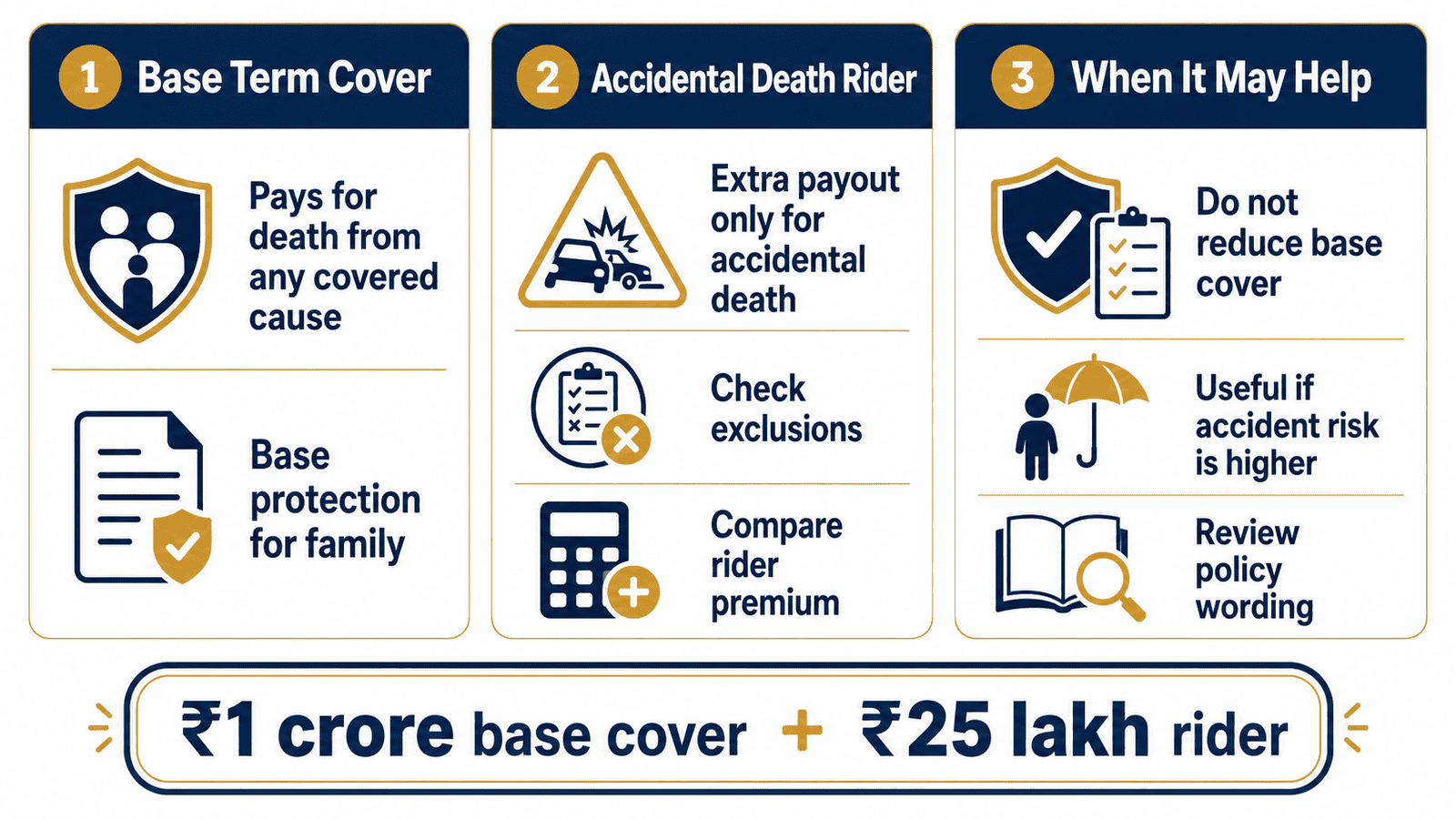
An accidental death benefit rider adds an extra payout to term insurance if death is caused by a covered accident. For example, a ₹1 crore base term plan plus ₹25 lakh rider can increase family protection, but it should not replace adequate base cover or careful policy-wording checks.
- The rider pays out only for deaths that qualify as accidental under the specific policy definition — illness, natural causes, and excluded events do not trigger it.
- It is not a substitute for a larger base term cover; always fix the base sum assured first.
- Rider exclusions and claim document requirements vary significantly across insurers — check the rider schedule, not just the brochure.
- If disability protection matters to you, a standalone personal accident policy may cover more ground than an ADB rider alone.
- Premiums and rider limits vary by insurer, age, and underwriting — always compare actual policy documents. According to IRDAI guidelines at irdai.gov.in, all rider terms must be disclosed in the policy schedule.
Key Takeaways
- An ADB rider pays an additional sum assured — typically ₹10 lakh to ₹1 crore depending on insurer rules — only when death is caused by a covered accident, not illness or excluded events.
- Base term insurance covers death from all causes including illness; the rider does not change this — it only supplements payout for the accidental death subset.
- Rider cost is generally lower than increasing base term cover by an equivalent amount, but the protection is narrower because it applies to only one cause of death.
- Standalone personal accident insurance typically offers broader coverage including permanent total disability, permanent partial disability, and accidental hospitalisation — the ADB rider usually does not.
- Exclusions matter more than marketing copy: aviation as passenger, self-inflicted injury, participation in hazardous activities, intoxication, and war are commonly excluded in Indian rider policies — verify with your insurer’s actual rider wording.
- If your base term cover is already insufficient for your family’s liabilities and income replacement need, increasing the base cover is almost always the right first step before adding any rider.
- Tax treatment of the rider premium and payout should be verified from incometax.gov.in before assuming deduction eligibility, as rules can change with each Budget.
Comparison: Base Term Insurance vs ADB Rider vs Standalone Accident Policy
Before diving into the details, this table gives you a side-by-side view of the three protection options a salaried buyer typically encounters. For a deeper look at accident and disability cover, see our guide on accident disability cover.
| Feature | Base Term Insurance | ADB Rider (added to term plan) | Standalone Personal Accident Policy |
|---|---|---|---|
| Payout trigger | Death from any cause (subject to policy exclusions) | Death from covered accident only | Accidental death, disability, hospitalisation (varies by plan) |
| Covers illness-related death | Yes | No | No |
| Disability benefit | No (unless separate disability rider added) | Usually No for ADB-only rider; some policies include PTD | Yes — permanent total and partial disability typically covered |
| Cost structure | Higher premium; broader protection | Lower incremental cost; narrower trigger | Separate annual premium; can be renewed independently |
| Portability | Tied to term plan term | Tied to base term policy; lapses if base policy lapses | Independent policy; portable across employers |
| Illustrative example | ₹1 crore payout on any covered death | ₹1 crore base + ₹25 lakh extra only on accidental death | Separate cover for accident-specific events independent of life policy |
| Claim document complexity | Death certificate + policy documents | Death certificate + FIR / post-mortem / accident proof as required by insurer | Similar accident documentation required |
Rider sum assured limits and actual premiums vary by insurer, age, and underwriting. Verify current terms from each insurer’s policy schedule and from IRDAI at irdai.gov.in before purchasing.
Key Facts at a Glance
| Parameter | Detail |
|---|---|
| What it is | An add-on rider that pays an additional sum assured if the policyholder dies due to a covered accident during the policy term |
| Who can add it | Typically at the time of buying a term plan; mid-policy addition depends on insurer rules — verify with your insurer |
| Payout logic | Base policy pays the base sum assured; rider pays additional rider sum assured only if death qualifies as accidental under the specific rider definition |
| Key documents for claim | Original policy bond, rider schedule, death certificate, FIR or police report, post-mortem report, hospital records where applicable |
| Common exclusions | Self-inflicted injury, intoxication, war, aviation other than as a fare-paying passenger (varies by insurer), pre-existing conditions contributing to accident death |
| Main risks to buyer | Paying for a rider when base cover is inadequate; misunderstanding exclusions; duplicate cover with employer or standalone accident policy |
| Governing authority | Insurance Regulatory and Development Authority of India (IRDAI) — irdai.gov.in |
What Is an Accidental Death Benefit Rider and How Does It Work?
A term insurance policy pays a death benefit — the base sum assured — to your nominee when you die during the policy term, regardless of the cause, as long as it is covered. An accidental death benefit rider is an add-on that promises an additional payout on top of this base sum assured, but only when the specific cause of death qualifies as accidental under the rider’s policy wording. Understanding what basic term cover includes is the essential first step before evaluating any rider on top of it.
Base Payout vs Rider Payout
Think of it as two separate triggers in the same policy envelope. If Ravi holds a ₹1 crore term plan with a ₹25 lakh ADB rider and passes away due to a cardiac arrest, his nominee receives ₹1 crore from the base policy. The ₹25 lakh rider does not pay — because cardiac arrest is not an accident. If Ravi dies in a road crash that qualifies as an accident under the rider definition, his nominee may receive ₹1.25 crore total, assuming no exclusion applies. That “assuming” is doing a lot of work in that sentence.
What “Accidental” Means in Policy Language
Insurers typically define an accident as a sudden, unforeseen, involuntary event caused by external, violent, and visible means. This definition excludes illness complications even if they result from a physical incident, death that occurs more than a certain number of days after the accident (commonly 180 days, but verify your policy), and deaths where the policyholder’s own action or negligence contributed. According to IRDAI, all rider terms and exclusions must be clearly stated in the rider schedule provided with the policy bond — not just in the brochure.
What the Rider Does Not Do
The ADB rider does not replace health insurance. It does not pay for hospitalisation, surgery, or treatment costs. It does not compensate for lost income if you survive an accident with a disability. It does not cover your home loan EMIs while you recover. These are common misconceptions that lead families to feel over-protected on paper but underprotected in reality.
Real Example: Rohit’s Buying Decision
Rohit is 34 years old, works as an IT manager in Pune, and earns ₹22 lakh per year. He is purchasing a ₹1 crore term plan for a 30-year term. His household has a ₹40 lakh outstanding home loan, one child aged 4, and his wife who currently works part-time.
His insurer offers a ₹25 lakh ADB rider. He is weighing two scenarios:
Scenario A — Death from illness: Rohit suffers a heart attack at 42 and passes away. His nominee receives ₹1 crore from the base term policy. The ADB rider pays nothing because this was not an accidental death. The family’s net position: ₹1 crore to cover ₹40 lakh home loan, several years of child education costs, and household living expenses for potentially 20+ years.
Scenario B — Death from a road accident: Rohit is involved in a serious road accident and dies. If the death qualifies under the rider definition, his nominee may receive ₹1.25 crore — ₹1 crore base plus ₹25 lakh rider. The extra ₹25 lakh is meaningful but does not change the family’s core financial position drastically.
The key insight: Rohit’s real protection gap is in Scenario A — and the rider does nothing there. Before adding the rider, Rohit should first consider whether ₹1 crore base cover is genuinely enough for his right insurance amount given his liabilities and income replacement need.
How to Calculate Whether the Rider or Higher Base Cover Makes More Sense
Protection Gap = Total Cover Needed − (Existing Cover + Employer Group Cover)
Once you know your protection gap, you can compare two options:
| Option | Cover Structure | What It Protects Against |
|---|---|---|
| Option A: Base + Rider | ₹1 crore base term + ₹25 lakh ADB rider | All covered deaths get ₹1 crore; accidental death gets ₹1.25 crore |
| Option B: Higher Base | ₹1.25 crore base term plan, no rider | All covered deaths — illness, accident, any cause — get ₹1.25 crore |
Option B protects your family against every covered cause of death at the higher amount. Option A concentrates the extra ₹25 lakh only on accidental deaths. For most salaried employees in India, illness-related deaths — heart disease, cancer, infections — account for the majority of claims. A higher base cover protects against all of them. Note: actual premium difference between the two options depends on insurer, age, health, and underwriting — do not assume one is always cheaper without checking real quotes. Use the term insurance cover calculator to estimate your base cover need first.
How to Decide What’s Right for You
Your base term cover is less than 10–15 times your annual income or does not fully cover your outstanding liabilities — THEN increase base cover first before considering any rider.
Your base cover is adequate and you commute daily on a two-wheeler, travel frequently by road, or work in a field with above-average accident risk — THEN the ADB rider may add meaningful supplementary protection at a relatively low incremental cost.
Your employer already provides a group personal accident cover of ₹25–50 lakh or more — THEN assess whether additional accident cover is genuinely needed before adding the rider.
You want protection against disability, loss of income, or hospitalisation costs from accidents — THEN a standalone personal accident policy with disability benefits may serve you better than an ADB rider alone.
Your budget is limited and you are still building emergency funds, health insurance, or adequate base term cover — THEN the rider is a lower priority; address the essential gaps first. See our guide on the right insurance amount to map your protection gaps.
You are a low-risk desk-based professional with a strong base term cover, existing group accident cover, and a standalone personal accident policy already in place — THEN the ADB rider likely adds duplicate cover with limited marginal value.
Do not add this rider as a shortcut if your primary problem is that your base term cover is too low — the rider does not fix the core protection gap that matters most to your family.
Common Mistakes to Avoid
Buying the Rider While Base Cover Is Too Low
The most expensive mistake is not the rider cost — it is buying a ₹1 crore base policy with a ₹25 lakh rider when your actual household need is ₹1.5–2 crore in base cover.
The rider only adds protection for accidental deaths. If you die of illness — the far more common cause for most working-age Indians — your family receives only the base sum assured. A low base cover with a rider attached does not compensate for this gap.
Calculate your total cover need first. Add the rider only when the base cover is right.
Assuming All Accident-Like Events Qualify
Not every event that feels like an accident triggers the rider. Death due to self-inflicted injury, death while under the influence of alcohol or drugs, death from participation in hazardous activities, or death that occurs after a defined survival window post-accident are commonly excluded.
A claim rejected on technical grounds leaves the family without the expected extra payout, often at the worst possible moment. Read the exclusions section of the rider schedule — not the brochure — before purchasing.
Ask your insurer in writing what documentation is required for an accidental death claim before you need to file one.
Ignoring Claim Documentation Requirements
An ADB rider claim typically requires more documentation than a standard life insurance claim — police FIR, post-mortem report, hospital records, and sometimes a coroner’s report. Families unfamiliar with this process may delay or lose claims.
Inform your nominee about the specific documents required. Keep a copy of the policy bond and rider schedule in a location your family can access.
Confusing the ADB Rider With Disability Income Protection
The accidental death benefit rider pays only on death. If you survive a serious accident but are permanently disabled, the rider typically does not pay out — you would need a separate accidental permanent total disability benefit or a standalone personal accident policy.
Many families discover this distinction only after a disability event. Read the accident disability cover guide to understand the full scope of accident-related insurance needs.
Buying Duplicate Cover Without Checking Existing Policies
Many salaried employees already have group personal accident cover through their employer — sometimes ₹25–50 lakh or more. Adding an ADB rider on top of this may create overlapping accident cover while leaving health insurance or critical illness cover gaps unaddressed.
Review your employer’s benefit statement before purchasing any accident-related rider. Direct that insurance budget toward gaps that actually exist.
Treating the Rider as the Primary Insurance Decision
An ADB rider is a secondary add-on decision. The primary decision — which term insurer, which base sum assured, which policy term, which premium payment mode — matters far more to your family’s financial security than whether you add a ₹25 lakh accident rider.
Do not let the rider’s low cost distract from the main policy decisions. Get the base policy right first.
When This May Not Be the Right Choice
Your base term cover is still insufficient. If your term cover does not cover your outstanding loans, at least 10 years of household income, and education costs for dependants, the rider is not the right next step. Increasing base cover protects against all causes of death — the rider protects against only one subset.
You already have strong accident and disability cover. If your employer provides group personal accident insurance and you separately hold a standalone personal accident policy with disability benefits, adding an ADB rider creates overlapping cover without meaningfully expanding your protection.
Your risk profile does not match the rider’s strength. If you work from home, do not commute on two-wheelers, and your lifestyle involves limited accident exposure, the statistical value of the additional payout is lower. That budget may be better deployed on a critical illness cover that pays on diagnosis of serious disease — which represents a more statistically likely risk for desk-based professionals.
Budget is limited and essential gaps exist. Emergency fund not built, health insurance inadequate, base term cover too low — these are higher-priority items than an accident rider. Address foundational gaps before adding supplementary layers.
If any of these apply to your situation, it may be worth exploring alternatives before committing.
Official Rules and Where to Verify
Insurance products in India are regulated by the Insurance Regulatory and Development Authority of India (IRDAI). All rider terms, exclusions, sum assured limits, premium structures, and claim processes are governed by IRDAI regulations and must be disclosed in the policy document and rider schedule provided to you at purchase.
Before purchasing any rider, verify the following directly from official sources:
- IRDAI — irdai.gov.in: Rider regulations, policyholder protection guidelines, grievance redressal process, and insurer registration status.
- Income Tax Department — incometax.gov.in: Current tax treatment of life insurance premiums and rider premiums under Section 80C and Section 10(10D), and payout taxability — these rules can change with each Budget.
- Your insurer’s policy bond and rider schedule: The only authoritative source for the specific exclusions, survival conditions, documentation requirements, and rider sum assured applicable to your policy.
- Check the claim settlement ratio and complaint data via IRDAI’s annual reports, and use our guide on claim settlement ratio to interpret the numbers correctly.
Rules, limits, and rates on this topic can change with each Budget or regulatory update. Always verify current figures directly from the official source before making any financial decision.
Expert Tips
- Do not let the rider’s low incremental cost distract you from evaluating whether ₹1.25 crore base cover — without any rider — would serve your family better than ₹1 crore base plus ₹25 lakh rider. The premium difference may be smaller than you expect, and the broader protection is significantly better.
- Compare the rider with a standalone personal accident policy before deciding. Standalone policies typically cover permanent total disability, permanent partial disability, and accidental hospitalisation — none of which an ADB rider usually covers. If disability risk matters to your income, the standalone policy may offer more value. Consider our guide on term versus endowment for the broader principle: keep protection products focused and simple.
- Inform your nominee about the specific claim documentation required for the ADB rider — FIR, post-mortem report, hospital records — before any event occurs. A nominee who knows what documents to gather immediately after an accidental death is far more likely to receive the claim without delay.
- Revisit your insurance structure after every major life event — marriage, the birth of a child, a home loan, or a significant salary increase. The rider amount that seemed meaningful at ₹22 lakh income may be insufficient when your income and liabilities double. Insurance decisions made at purchase are not permanent optimisations.
- If your employer group insurance already includes personal accident cover, get the exact sum assured in writing from your HR department. Many employees assume this cover is substantial — it is often ₹10–25 lakh, which may be lower than expected and lapses entirely on resignation or redundancy.
- For the actual rider premium and available sum assured options, get quotes from at least two to three insurer websites directly. Rider costs and caps vary more than most buyers expect, and the difference can inform whether Option A or Option B (higher base cover) is genuinely more cost-efficient for your age and health profile.
Frequently Asked Questions
What is an accidental death benefit rider?
An accidental death benefit (ADB) rider is an add-on to a life insurance or term insurance policy that pays an additional sum assured — over and above the base death benefit — if the policyholder dies due to an accident covered under the rider definition. The base policy still pays the base sum assured regardless of cause; the rider amount is additional and specific to accident-related deaths only.
Is an accidental death benefit rider worth it?
It depends on three things: whether your base term cover is already adequate, whether you have meaningful accident exposure in your daily life (commuting by two-wheeler, frequent road travel, physically demanding work), and whether you already hold group accident cover through an employer. If base cover is insufficient, fix that first. The rider may be a useful supplementary layer once the base is right — but it is not mandatory for every buyer.
Does term insurance already cover accidental death?
Yes. A standard term insurance policy covers death from any cause — including accidents — as long as the death is not excluded under the base policy terms. The ADB rider does not change this; it adds an extra payout amount specifically for accidental deaths, on top of the base cover that already applies.
What is the difference between an accidental death benefit rider and standalone personal accident insurance?
The ADB rider adds to your life insurance payout on accidental death only. A standalone personal accident policy typically also covers permanent total disability, permanent partial disability, accidental hospitalisation, and sometimes weekly income loss — and it operates independently of your life insurance. If disability or income replacement during recovery matters to you, a standalone accident policy covers more ground.
Is an accidental death rider better than personal accident insurance?
Not necessarily. The rider is simpler and typically cheaper to add if you only want additional payout on accidental death specifically. But if you want broader protection — disability, hospitalisation, income support — a standalone personal accident policy is usually more comprehensive. Depending on your needs, you may benefit from having both, or from prioritising one over the other based on your existing cover.
Can the accidental death rider claim be rejected?
Yes. A rider claim can be rejected if the death does not qualify under the rider’s specific definition of accident, if an exclusion applies (intoxication, self-harm, hazardous activity, aviation in non-fare-paying capacity), if the policyholder died more than the defined number of days after the accident, or if required documentation is not submitted. This is why understanding your rider’s exclusions before purchase — not after — is important.
Does the accidental death benefit rider cover disability?
A standard ADB rider typically covers only death from accident — not disability. Some insurers offer a combined accidental death and disability rider that includes permanent total disability as a payout trigger. Read the rider schedule carefully and confirm with your insurer in writing whether disability is covered and under what conditions.
Can I add the accidental death benefit rider after buying term insurance?
This depends on the insurer. Many insurers allow riders only at the time of policy issuance. Some permit addition at renewal or at specific life stage milestones. Verify directly with your insurer — do not assume mid-policy addition is available.
Is the premium paid for an accidental death benefit rider eligible for a tax deduction?
Tax treatment of rider premiums can be complex and changes are possible with each Budget. Verify the current position from the Income Tax Department at incometax.gov.in or consult a qualified tax professional before assuming deduction eligibility. Understanding your basic term cover and its tax treatment is a useful first step.
What documents does my nominee need to file an ADB rider claim?
Typically: the original policy bond and rider schedule, the death certificate, a police FIR or accident report, a post-mortem report where applicable, and hospital admission and treatment records. Exact requirements vary by insurer — obtain the full claim checklist from your insurer at the time of purchase and keep it with your policy documents.
Final Verdict
The accidental death benefit rider is a reasonable supplementary add-on — not a foundational insurance decision. For a salaried Indian professional with adequate base term cover, meaningful daily accident exposure, and no existing group accident insurance, the rider offers extra protection at a relatively modest additional cost. That is a reasonable trade-off.
But the rider should never be the reason a buyer feels their family is adequately protected. The base sum assured does the real work — covering death from illness, heart disease, cancer, and every other cause that statistically claims more Indian lives than accidents. A ₹1.25 crore base cover with no rider protects your family more reliably than a ₹1 crore base with a ₹25 lakh accident rider.
Compare real quotes for both options, read the exclusions in the actual rider schedule, check your employer’s group accident cover, and consider a standalone personal accident policy if disability protection matters. This is the right decision framework — not the checkout page nudge. Our complete guide on family insurance planning will help you map the full picture for your household.
Always verify the latest rules from official sources or consult a qualified professional before making any financial decision.
This article is for educational purposes only and should not be treated as personalised financial, tax, investment, insurance, or legal advice. Tax rules, interest rates, regulatory limits, and product features can change with each Budget or policy update. Please verify current rules from official government sources or consult a qualified and registered professional before making any financial decision. Insurance is a subject matter of solicitation. Please read the policy document carefully before purchasing.

Priya Nambiar writes about insurance concepts for Indian families, salaried employees, self-employed professionals, and first-time policy buyers. Her content focuses on helping readers understand coverage, exclusions, claim conditions, premiums, riders, and policy documents before buying or renewing insurance.
She covers topics such as term insurance, health insurance, family floater plans, riders, critical illness cover, employer insurance vs personal insurance, waiting periods, exclusions, deductibles, co-payment, no-claim bonus, claim settlement, premium comparison, renewal rules, and tax benefits linked to insurance.
Priya’s writing is careful, consumer-focused, and policy-document oriented. She explains why insurance should be understood as financial protection, not just a tax-saving tool or investment substitute. Her articles encourage readers to compare coverage, understand limitations, and ask better questions before buying a policy. Premiums, exclusions, claim rules, and benefits vary by insurer, age, health, sum insured, and product type. Insurance is a subject matter of solicitation, and readers should read the official policy document carefully before purchasing.