

You’ve paid the token amount, signed the builder-buyer agreement, and maybe even got the home loan sanctioned. But the flat is not legally yours yet. That happens only when the sale deed is registered at the sub-registrar office — and that single step involves a document checklist, state-specific fees, a physical appointment, and biometric verification that most first-time buyers underestimate badly.
The property registration process in India trips up buyers not because it is complicated, but because payment, possession, agreement, and registration are four separate events that happen at different times. Missing documents, wrong spellings, mismatched PAN details, or unprepared witnesses on registration day can delay or derail the entire process.
This guide gives you a practical buyer-side checklist covering documents, stamp duty and registration fees, the sub-registrar office process, common mistakes, and where to verify everything officially — before you walk in. If you are still weighing the buy decision itself, start with our real estate buying guide first. All state-wise rates mentioned here must be verified before payment — they change with each state budget.
Quick Answer: Property Registration Process in India
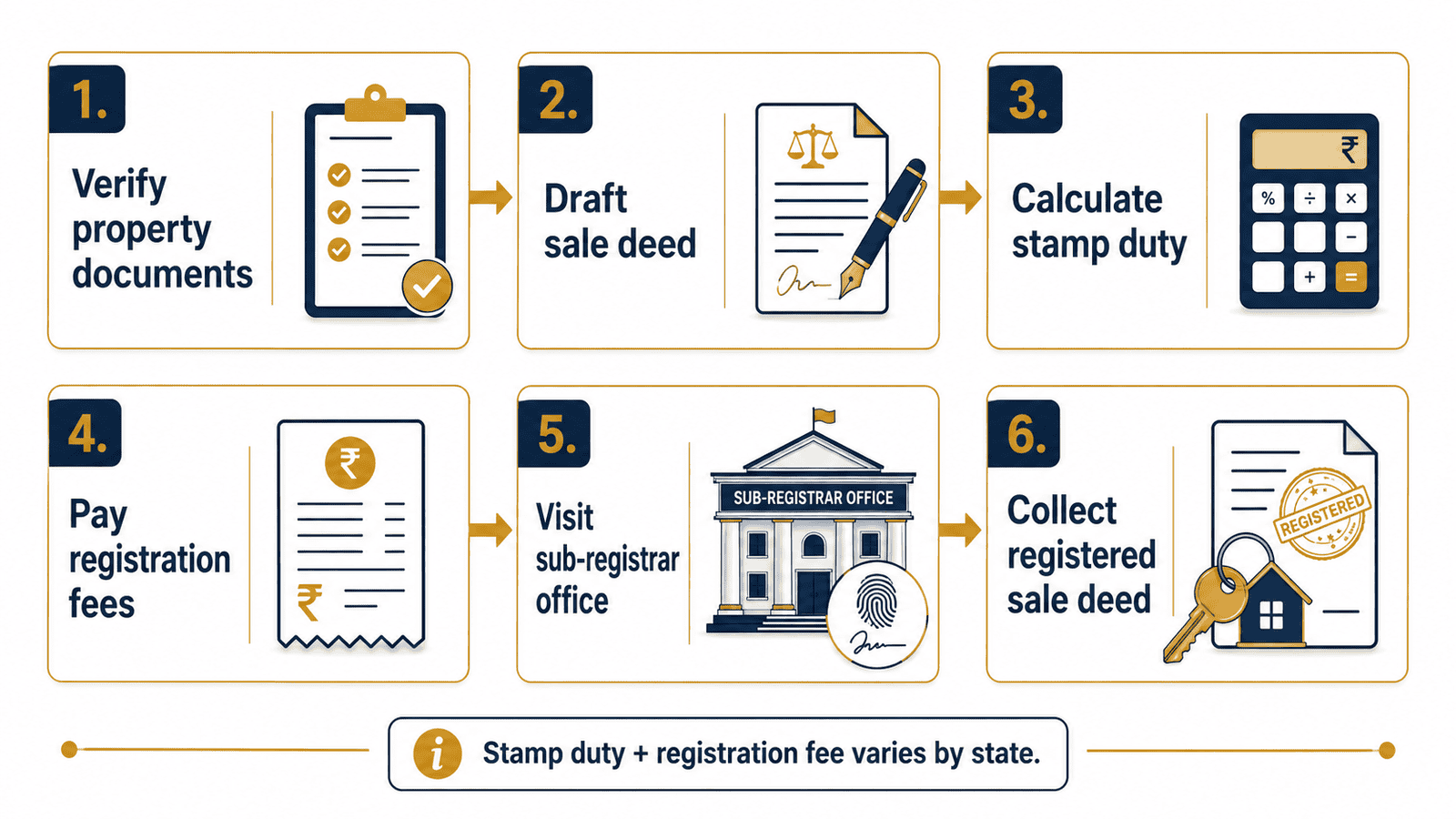
The property registration process in India is the legal step where a buyer pays stamp duty, registration fees, and registers the sale deed, generally within 4 months, at the sub-registrar office. Buyers need the sale deed, identity proof, PAN, address proof, payment receipts, property papers, and state-specific forms. Stamp duty and registration charges vary by state. Always verify current rates and document requirements from your state’s official registration portal before scheduling your appointment.
Key Takeaways
- Property registration at the sub-registrar office is the only step that legally records the ownership transfer in government records — possession or payment alone does not make you the legal owner.
- Stamp duty and registration charges vary significantly by state — what applies in Maharashtra may be very different from Karnataka, Delhi, or Tamil Nadu. Verify current rates from your state’s registration department portal before paying.
- Prepare documents in five groups: buyer KYC, seller KYC, property title papers, payment proofs, and bank/loan documents — missing even one category on registration day can cause rescheduling.
- For properties purchased above ₹50 lakh, TDS rules under the Income Tax Act may apply as a separate compliance step — this is not part of registration fees. Verify current threshold and rules at incometax.gov.in before your purchase.
- Post-registration actions — including property mutation, khata transfer, and society share certificate update — are separate steps that buyers must complete after receiving the registered deed.
- An agreement to sale is not a registered sale deed. Only a registered sale deed, executed and stamped at the sub-registrar office, creates legally enforceable ownership in India.
Key Facts at a Glance
| Parameter | Detail | Note |
|---|---|---|
| Document registered | Sale deed / conveyance deed | Prepared by seller’s lawyer or a document writer |
| Registering authority | Sub-registrar office in the property’s jurisdiction | Some states offer online pre-registration or appointment booking |
| Main charges | Stamp duty + registration fee + state-specific handling/scanning charges | Rates vary by state, property type, and value — verify before payment |
| Key buyer documents | PAN, Aadhaar/ID proof, address proof, photos, sale deed, payment receipts | Seller and witness documents also required on the day |
| Applies to | Flat, house, land, resale property, builder property | State-specific variations in process and documents may apply |
| Post-registration steps | Mutation, khata transfer, property tax update, society records update | Timeline and authority varies by state and municipality |
What Property Registration Means — and Why It Cannot Be Skipped
Property registration is the process under the Registration Act, 1908, by which the sale deed — the primary document transferring ownership of an immovable property — is executed, stamped, and recorded in the government’s official records at the sub-registrar office. Until this step is complete, the buyer does not hold legally defensible ownership, regardless of how much has been paid or whether possession has been handed over.
Why the Registered Sale Deed Matters
Banks will not disburse a home loan without a registered sale deed or at least a registered agreement to sell in certain states. Future sale of the property requires the registered title chain to be intact. In inheritance, dispute, or litigation, an unregistered deed has no evidentiary value under Indian law. According to the Registration Act, 1908, any document transferring immovable property above ₹100 in value must be compulsorily registered — the practical threshold today covers virtually every real estate transaction.
For a home loan buyer, understanding the home loan process in India is essential because the bank’s disbursement timeline, the original document custody arrangement, and the registration appointment often need to be coordinated together. Many buyers discover only at the sub-registrar office that the bank’s demand draft must be made in a specific format — which could have been confirmed weeks earlier.
Registration Is Not the Same as Possession, Agreement, or Mutation
These four events are legally distinct and happen at different points in the transaction timeline:
Agreement to sale is a preliminary document recording the intent to sell. It may be registered or unregistered depending on the state and transaction type. It does not transfer ownership.
Sale deed registration is the actual legal transfer of ownership. This is the mandatory step at the sub-registrar office that creates enforceable ownership in your name.
Possession is the physical handover of keys and property. This may happen before or after registration, depending on the builder agreement or resale negotiation. Possession without a registered deed does not create legal ownership.
Mutation or khata transfer is the update of the property’s ownership record in the municipal or revenue department records. This happens after registration and is a separate administrative process with its own forms and fees.
How State Rules Shape the Process
The property registration process in India is governed by both central law (Registration Act, 1908; Transfer of Property Act, 1882) and state-level stamp acts and registration rules. This is why stamp duty in Maharashtra, Karnataka, Delhi, Tamil Nadu, and Telangana differs. Document requirements, appointment systems, online portals, and post-registration mutation processes also vary. Always start at your state’s official registration department website — not third-party aggregators — for current rules.
Real Example: Rohit’s First Apartment Registration in Pune
Rohit Sharma, 36, is an IT manager in Pune earning ₹1.8 lakh per month. He is buying a 2BHK apartment for ₹75 lakh from a builder in a RERA-registered project. His home loan of ₹55 lakh has been sanctioned by his bank. Here is how his registration day sequence looks:
Step 1 — Sale deed preparation: The builder’s lawyer prepares the sale deed on stamp paper of the appropriate value. Rohit reviews every detail: his full name, PAN, address, the flat number, parking slot, undivided share of land, and the exact consideration amount — ₹75,00,000.
Step 2 — Stamp duty and registration fee payment: Rohit checks the Maharashtra stamp duty rate applicable to his property type and value. He pays the stamp duty as per current Maharashtra rules and the registration fee separately — both via demand draft or online payment as required by the state portal. He must verify exact rates from the Maharashtra registration department portal before payment, as rates can change.
Step 3 — Sub-registrar office appointment: Rohit books an online appointment at the Pune sub-registrar office. He brings the original sale deed, his PAN and Aadhaar, two passport-size photographs, address proof, payment receipts for the flat, and the bank’s demand draft. The seller’s authorised representative and two witnesses also attend.
Step 4 — Biometric verification and signing: At the office, both buyer and seller provide biometric verification (thumbprint scan). The deed is signed by both parties and witnessed. The sub-registrar stamps and records the document.
Step 5 — Registered deed collection: Rohit collects the registered sale deed — typically the same day or within a few working days depending on the state. He then initiates mutation with the Pune Municipal Corporation and updates his housing society’s share certificate. The bank retains the original registered deed as security for the loan.
The key insight: Rohit’s purchase involved at least five distinct steps — booking, agreement to sale, loan disbursement, registration, and post-registration mutation. Registration was step four, not step one.
How to Calculate Property Registration Cost
Total Registration Cost = Stamp Duty + Registration Fee + State-Specific Charges + Legal/Documentation Costs
No single national rate applies across India. Each component depends on your state’s current rules, your property type, and whether you are buying from a builder or in a resale transaction.
Stamp duty is typically calculated as a percentage of the higher of: the transaction value, the market value, or the government-set circle rate / guidance value / ready reckoner rate (the terminology varies by state). If you are paying ₹75 lakh for a flat but the circle rate values it at ₹80 lakh, stamp duty may be calculated on ₹80 lakh in some states.
Registration fee is typically a lower percentage — often around 1% in many states — but this must be verified from the official state portal before payment.
State-specific charges may include scanning fees, handling charges, infrastructure surcharges, or local body cess depending on the state.
For a ₹75 lakh property, the illustrative cost range looks like this:
| Cost Component | Illustrative Rate | Illustrative Amount (₹75 lakh base) |
|---|---|---|
| Stamp duty | Varies — typically 3–8% depending on state and buyer gender | ₹2.25 lakh to ₹6 lakh (illustrative range — verify) |
| Registration fee | Often ~1% of value — verify from state portal | ₹75,000 (illustrative — verify) |
| State-specific charges | Varies — scanning, handling, cess | ₹5,000–₹20,000+ (illustrative) |
| Legal/documentation costs | Lawyer, document writer, franking | ₹10,000–₹30,000+ depending on engagement |
All rates in this table are illustrative only. For current, verified state-wise stamp duty and registration charges, refer to our stamp duty charges guide. Always confirm from your state’s official registration portal before making any payment.
Additionally, if your property purchase value exceeds ₹50 lakh, TDS provisions under the Income Tax Act may apply. This is a separate tax compliance step — not part of the registration fee. Verify the current threshold and applicable TDS rate at incometax.gov.in.
Comparison: Key Property Registration Concepts
| Concept A | Concept B | Key Difference |
|---|---|---|
| Agreement to Sale | Sale Deed | Agreement records intent to sell; sale deed legally transfers ownership. Only the registered sale deed creates enforceable title. See our guide on sale deed difference for full detail. |
| Stamp Duty | Registration Fee | Stamp duty is a state tax on the transaction — typically the larger amount. Registration fee is the government charge for recording the deed — typically smaller. Both are mandatory. |
| Registration | Mutation / Khata | Registration records the ownership transfer in the sub-registrar’s books. Mutation updates the municipal or revenue records. Registration is legally mandatory; mutation is an administrative follow-up required for civic services and property tax. |
| Builder Property | Resale Property | Builder property may require RERA details, allotment letter, and builder-buyer agreement. Resale property requires the full title chain, previous sale deeds, and society NOC. Both require a registered sale deed at the sub-registrar office. |
| Online Pre-Registration | Physical Sub-Registrar Visit | Many states allow online appointment booking and document upload. However, physical biometric verification and signing at the sub-registrar office is still required in most states — a fully end-to-end online process is not yet available everywhere. |
How to Decide What’s Right for You
You are buying a resale flat — THEN gather the full title chain, previous registered sale deeds, society NOC, encumbrance certificate, and seller’s identity documents. Verify there are no disputes, mortgages, or unpaid dues attached to the property before registration day.
You are buying a builder flat in an under-construction or new project — THEN verify RERA registration details for the project and the promoter. Gather the allotment letter, builder-buyer agreement, payment receipts, and possession-related documents before scheduling registration.
You are buying land — THEN verify the title chain, survey/khasra number, land-use classification, encumbrance certificate, and conversion status (agricultural to residential where applicable) before proceeding. Land transactions may involve additional state-specific checks.
You are a home loan buyer — THEN coordinate your bank’s disbursement timeline, the demand draft format, and the bank’s original document custody arrangement before booking the sub-registrar appointment. Banks often retain the original registered deed.
Your property value is above ₹50 lakh — THEN verify current TDS rules at incometax.gov.in before registration. TDS compliance is a separate step from stamp duty and registration fee but must be completed around the same time.
If title documents are unclear, names do not match across records, or there is an unresolved encumbrance — do NOT proceed to registration. Pause, engage a qualified property lawyer to verify title, and resolve discrepancies before booking the appointment.
Common Mistakes to Avoid
Not Checking Title and Encumbrance Before Registration Day
Many buyers assume the builder or broker has cleared the title. An encumbrance certificate from the sub-registrar office reveals any existing mortgages, claims, or charges on the property.
If the seller has an existing home loan on the property, registration without NOC from that lender can create legal complications. The buyer effectively inherits a disputed title.
Request an encumbrance certificate covering at least 13–15 years before registering. A qualified property lawyer can interpret title chain gaps.
Assuming Stamp Duty Is the Same Across India
Stamp duty ranges from around 3% to 8% or more depending on the state, property type, buyer gender, and urban or rural location. Maharashtra, Karnataka, Delhi, and Tamil Nadu all apply different rates.
Paying the wrong stamp duty creates a shortfall that can be questioned at the sub-registrar office, delay registration, or attract penalties.
Always verify the current rate at your state’s official registration portal — not from a third-party real estate aggregator.
Ignoring TDS on Property Purchase Above ₹50 Lakh
Buyers purchasing property above ₹50 lakh are required to deduct TDS and deposit it with the Income Tax Department before completing the transaction.
Missing this step can result in tax notices for both buyer and seller. It is a separate tax compliance obligation — not part of the registration fee — and has its own due date and filing requirements. Read our guide on property purchase TDS before finalising any high-value purchase.
Verify the current TDS rate and threshold at incometax.gov.in before your transaction.
Confusing Agreement to Sale With Registered Sale Deed
Some buyers believe that a registered agreement to sale or a possession letter makes them the legal owner. It does not.
Only a registered sale deed executed at the sub-registrar office transfers legal ownership. Builders sometimes delay the sale deed registration for months after possession — this leaves the buyer in legal limbo.
Insist on a clear timeline for sale deed registration in your builder-buyer agreement and follow up proactively.
Mismatched Details Between Documents and Sale Deed
A mismatch between the buyer’s name on PAN and the name on the sale deed, or between the flat number in the agreement and the registered deed, can cause rejection at the sub-registrar office or legal problems later.
This has delayed registrations for weeks when discovered on the day of the appointment. Check every name, spelling, address, survey number, flat number, parking details, and payment amount before the appointment.
Bring both original and attested photocopies of every document — the sub-registrar’s requirements vary by state.
Not Budgeting for Total Registration Cost
First-time buyers often budget for stamp duty but forget registration fee, scanning charges, state-level infrastructure cess, legal fees, and documentation costs. On a ₹75 lakh property, these additional amounts can reach ₹1 lakh or more depending on the state.
Budget for the total cost, not just stamp duty, well before the registration appointment.
When This May Not Be the Right Choice
There are situations where a buyer should pause before proceeding to registration — even if everything seems to be moving forward.
Title documents are incomplete or unclear. If the seller cannot produce a clear, unbroken title chain — including previous registered sale deeds, original allotment letters, and an encumbrance certificate — registration should wait until these are in order.
The property is under litigation or has an unresolved encumbrance. Any active court case, unpaid mortgage, or legal notice attached to the property is a serious red flag. Registering despite these issues can bind the buyer to legal disputes that may take years to resolve.
The seller’s name does not match the title records. If the name on the proposed sale deed differs from the name in the government land or registration records, the document may be questioned or rejected. This requires legal correction before registration can proceed.
RERA details or builder approvals are not in order. For under-construction properties, if the project’s RERA registration has lapsed, approvals are incomplete, or the promoter has an adverse RERA record, registration should be paused pending verification.
If any of these apply to your situation, it may be worth exploring alternatives before committing.
Official Rules and Where to Verify
Property registration rules, stamp duty rates, document requirements, and appointment processes are governed at the state level. Before paying any fees or booking any appointment, verify the following directly from official sources:
- State Registration Department portal — for current stamp duty rates, registration fee, document checklist, appointment booking, and state-specific forms. Each state has its own portal (for example, Maharashtra’s IGR portal, Karnataka’s Kaveri portal). Search for your state’s official registration or stamps department website.
- State RERA portal — for verifying project registration, promoter details, and completion records for under-construction and builder-sold properties. Check the RERA buyer protection guide for what to look for. The national RERA portal (rera.gov.in) lists links to all state RERA authorities.
- Income Tax Department — incometax.gov.in — for TDS on property purchase rules, PAN-related compliance, Form 26QB, and related obligations for high-value transactions.
- Local municipal or revenue office — for mutation, khata transfer, property tax update, or land record verification after registration is complete.
Rules, limits, and rates on this topic can change with each Budget or regulatory update. Always verify current figures directly from the official source before making any financial decision.
Expert Tips
- Organise documents into four folders before registration day: Folder 1 — buyer KYC (PAN, Aadhaar, address proof, photos); Folder 2 — seller documents (seller’s ID, PAN, address proof); Folder 3 — property papers (sale deed draft, title documents, encumbrance certificate, RERA details, allotment letter, previous deeds); Folder 4 — payment proofs (bank receipts, demand draft, TDS payment confirmation). Keep originals and two sets of photocopies for each folder.
- Review the sale deed draft carefully before printing on stamp paper. Check every spelling, PAN number, address, flat number, survey number, undivided share of land, parking details, and exact consideration amount. Corrections after printing on stamp paper are expensive and time-consuming.
- Confirm witness requirements, appointment slot, and payment mode before the day. Most states require two witnesses with their identity documents. Some states accept only online payment; others may require a demand draft. Arriving with the wrong payment instrument can mean a missed appointment and rescheduling.
- Ask your bank in advance which original documents it will retain. If you have a home loan, the lender typically holds the original registered sale deed as mortgage security. Know this before registration day so you are not surprised when the bank collects the document after registration.
- Budget for post-registration costs separately. Mutation fees, society share certificate transfer, property tax name change, and khata transfer all involve separate applications, fees, and timelines. These do not happen automatically after registration — you need to initiate each one.
- Book your sub-registrar appointment early. In high-volume urban markets like Mumbai, Pune, Bengaluru, and Hyderabad, appointment slots can be booked weeks out. Confirm your bank disbursement date and then book the appointment around it — not the other way.
Frequently Asked Questions
What documents are required for property registration in India?
Buyer documents typically include: PAN card, Aadhaar or other government-issued ID, address proof, two passport-size photographs. Property documents include: the sale deed (prepared on stamp paper), previous title documents or allotment letter, encumbrance certificate, and property tax receipts. Payment documents include: bank receipts, demand draft, and TDS payment confirmation if applicable. Seller and witness identity documents are also required. The exact list varies by state — verify from your state’s official registration portal.
Is property registration online possible in India?
Many states allow online appointment booking, document upload, and stamp duty payment through their official portals. However, physical presence at the sub-registrar office for biometric verification and document signing is still required in most states. A fully end-to-end online registration process without any physical visit is not yet available across all states. Check your state’s registration department portal for current online facilities.
How much are property registration fees in India?
Property registration costs involve two main government charges: stamp duty (typically ranging from around 3% to 8% of the property value, varying significantly by state) and registration fee (often around 1% of the value in many states, with caps in some states). Additional state-specific charges such as scanning fees, infrastructure cess, and handling charges may also apply. Always verify current rates from your state’s official registration portal before payment, as these change.
Is sale deed registration mandatory in India?
Yes. Under Section 17 of the Registration Act, 1908, any document transferring immovable property worth more than ₹100 must be compulsorily registered. In practice, every residential flat, house, or land purchase must have the sale deed registered at the sub-registrar office for the transaction to be legally valid. An unregistered sale deed has no legal evidentiary value in a dispute.
Who pays stamp duty and registration charges?
By convention and in most states, the buyer pays stamp duty and registration charges. However, the specific legal obligation and any negotiated arrangement between buyer and seller is a matter of the sale agreement. In some transactions, both parties may share certain charges. Verify the applicable rules for your state before finalising the payment arrangement.
What happens after property registration?
After collecting the registered sale deed, the buyer needs to: apply for mutation or khata transfer at the local municipal or revenue authority (to update ownership records for property tax and civic purposes), update the housing society’s records and obtain a share certificate if applicable, inform the income tax department if TDS was deducted, and update the bank’s records if applicable. These steps vary by state and municipality.
Is registration different from mutation?
Yes. Registration records the ownership transfer in the sub-registrar’s official records under the Registration Act. Mutation updates the ownership record in the municipal or revenue department’s books — used for property tax and civic purposes. Registration is legally mandatory for a valid property transfer. Mutation is an administrative follow-up that does not substitute for registration.
Is TDS required for a property purchase above ₹50 lakh?
Under the Income Tax Act, buyers purchasing immovable property (other than agricultural land) above ₹50 lakh are required to deduct TDS at the applicable rate and deposit it with the Income Tax Department using Form 26QB. This is a buyer-side compliance obligation separate from stamp duty and registration fee. Verify the current threshold, applicable rate, and filing procedure at incometax.gov.in before your transaction.
Can I register a property without a PAN card?
PAN is a mandatory document for property registration, especially for high-value transactions. It is also required for TDS compliance on purchases above ₹50 lakh. In cases where a buyer does not hold a PAN, Form 60 may be applicable in some circumstances — however, this should be verified directly with the sub-registrar office and the income tax guidelines before proceeding.
What is an encumbrance certificate and why does it matter?
An encumbrance certificate is an official document issued by the sub-registrar office confirming whether a property has any registered mortgages, liabilities, or legal claims against it during a specified period. Buyers should request an encumbrance certificate for the full ownership period — or at minimum 13–15 years — before registering. It is one of the most important title-verification tools available and is also required by most banks when processing home loans.
Final Verdict
The property registration process in India is the step that turns a financial transaction into a legally recorded ownership transfer. Payment, possession, and agreement are important milestones — but none of them replaces a registered sale deed in the government’s official records. First-time buyers who treat registration as just another formality are often caught off-guard by the document preparation, fee calculation, appointment logistics, and post-registration follow-up it involves.
The safest approach: verify title before agreeing to buy, prepare documents in advance across all five categories, calculate your total registration cost from your state’s official portal, and complete TDS compliance on high-value purchases before registration day. Do not rely solely on builder assurances or broker guidance — especially for transactions involving resale properties, unclear title chains, or loans.
Always verify the latest rules from official sources or consult a qualified professional before making any financial decision.
This article is for educational purposes only and should not be treated as personalised financial, tax, investment, insurance, or legal advice. Tax rules, interest rates, regulatory limits, and product features can change with each Budget or policy update. Please verify current rules from official government sources or consult a qualified and registered professional before making any financial decision.

Neha Kulkarni writes about the financial side of home buying, renting, property decisions, and real estate costs in India. Her content helps readers think beyond the EMI and understand the total cost of owning or buying a home.
She covers topics such as rent vs buy, home loan planning, down payment, stamp duty, registration charges, brokerage, maintenance cost, property tax, furnishing cost, home insurance, builder payment plans, resale property checks, home loan affordability, total cost of ownership, and hidden costs in property decisions.
Neha’s writing is practical, family-focused, and cost-conscious. She uses Indian city examples, ₹ calculations, and decision checklists to help readers evaluate whether a property decision fits their income, savings, loan eligibility, and long-term plans. Her articles are useful for first-time home buyers, salaried couples, families, and people comparing rent with home ownership. Since property rules, stamp duty, registration charges, local taxes, home loan rates, and legal requirements vary by state and city, readers should verify current details from official state, lender, and legal sources.