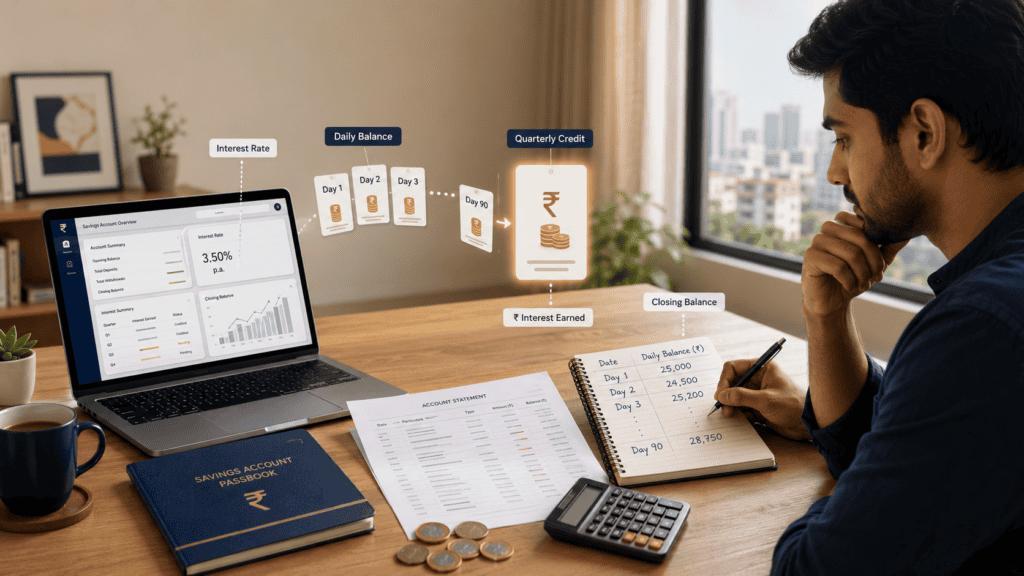
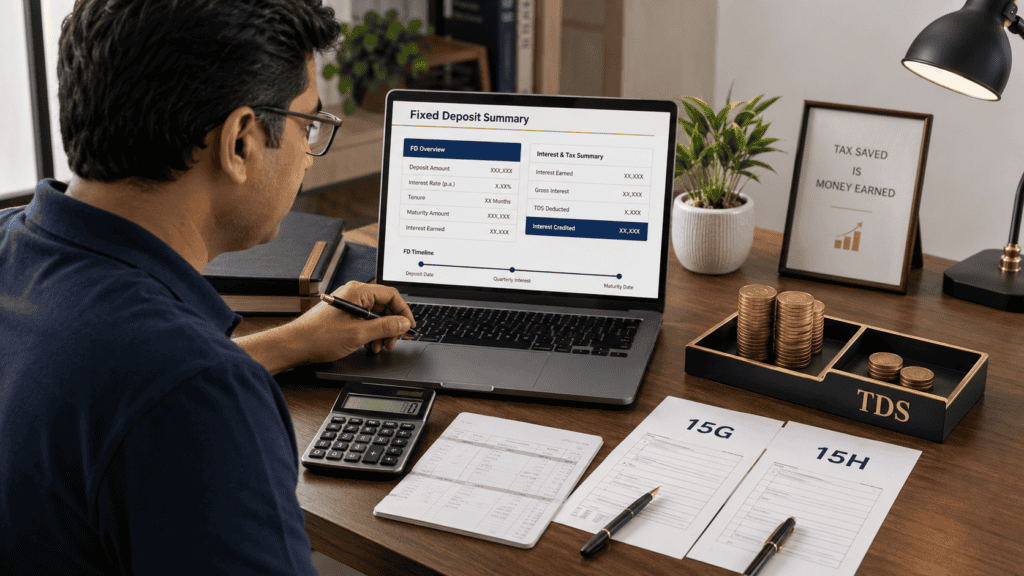
Your bank does not wait for you to file your ITR before collecting tax. The moment your fixed deposit interest crosses a certain limit in a financial year, the bank quietly deducts TDS and deposits it with the government — sometimes before you even realise interest has been credited. For FY 2025-26, this catches many depositors off guard, especially those who assumed Form 15G or Form 15H would make their FD interest completely tax-free.
It will not. TDS on FD interest is a withholding mechanism, not a tax exemption. This article explains when banks deduct TDS under Section 194A, who can submit Form 15G or Form 15H and what that actually means, how to handle TDS already deducted, and how to report FD interest correctly in your ITR. Limits and rules referenced here are subject to change with each Budget — verify current figures from incometax.gov.in before acting.
Quick Answer: TDS on FD Interest
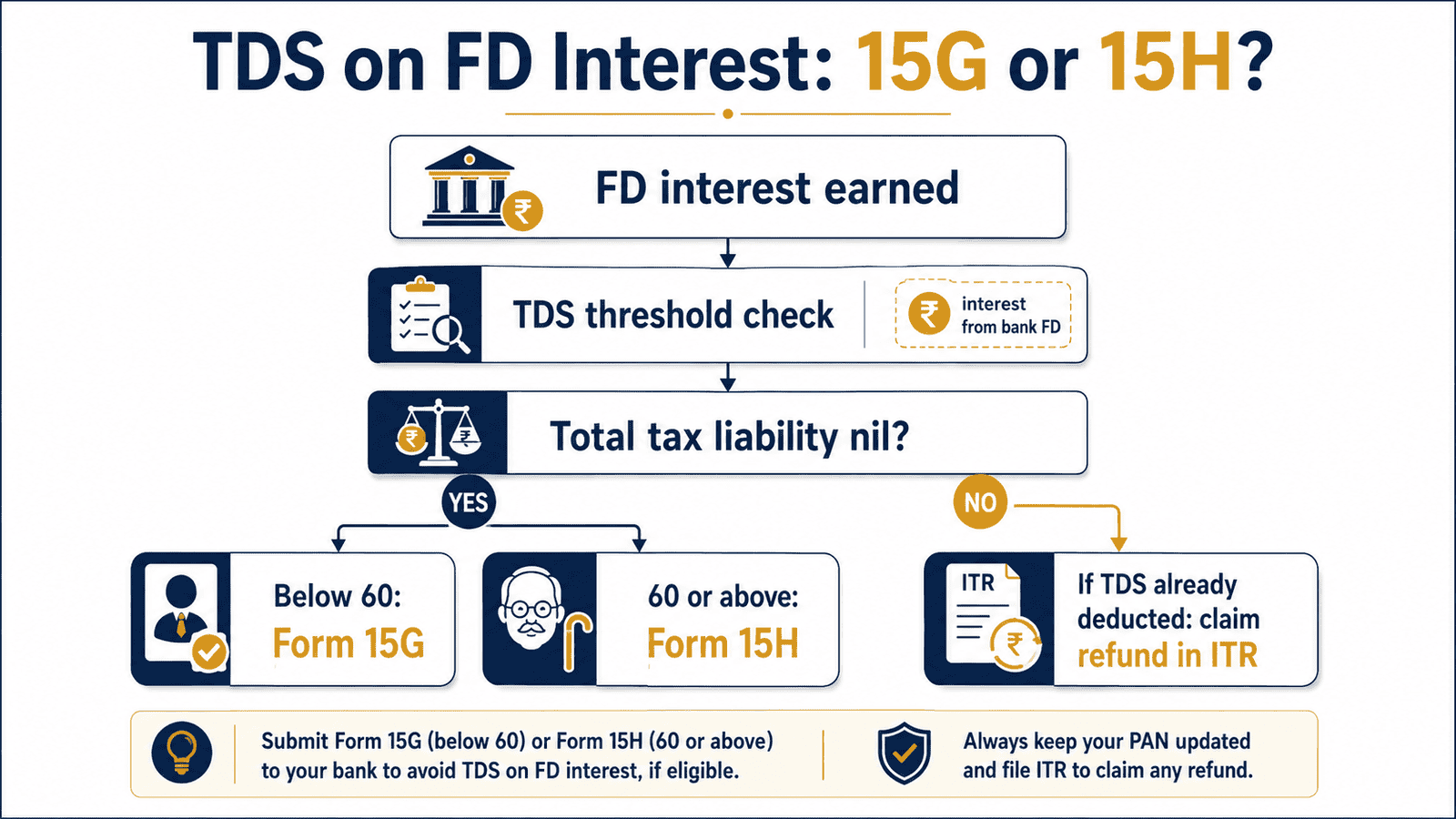
TDS on FD interest is deducted by banks when your fixed deposit interest crosses the applicable yearly limit, such as ₹50,000 [verify current threshold before publishing]. Form 15G or Form 15H can prevent deduction only if your estimated tax liability is nil. FD interest remains taxable and must be reported in ITR.
Key Takeaways
- Banks deduct TDS at 10% on FD interest under Section 194A once interest crosses the applicable threshold in a financial year — the rate rises to 20% if your PAN is not linked to the account.
- The threshold for regular taxpayers is ₹40,000 per bank per year; for senior citizens it is ₹50,000 — both figures must be verified before publishing as they are Budget-sensitive.
- Form 15G (for individuals below 60) and Form 15H (for senior citizens) prevent TDS deduction only if your total estimated income is below the basic exemption limit and your tax liability is nil.
- Submitting Form 15G or Form 15H does not make FD interest tax-free — you must still include it under “Income from Other Sources” in your ITR.
- If TDS is deducted and your final tax liability is lower, you can claim a refund by filing ITR — the deducted amount reflects in your Form 26AS and Annual Information Statement (AIS).
- Submit fresh forms at the start of every financial year — a submission made in April 2024 does not carry forward to FY 2025-26.
- Interest across all FDs held at the same bank is aggregated when checking the threshold, not calculated per FD.
Key Facts at a Glance
| Parameter | Detail | Source / Note |
|---|---|---|
| Governing section | Section 194A, Income Tax Act | incometax.gov.in — verify current provision |
| TDS rate (PAN provided) | 10% on interest above threshold | Verify current rate before publishing |
| TDS rate (no PAN) | 20% on interest above threshold | Verify current rate before publishing |
| Threshold — regular taxpayers | ₹40,000 per bank per financial year | Verify — Budget-sensitive figure |
| Threshold — senior citizens (60+) | ₹50,000 per bank per financial year | Verify — Budget-sensitive figure |
| Form to prevent TDS (below 60) | Form 15G — nil tax liability declaration | Eligible if total income below basic exemption |
| Form to prevent TDS (60+) | Form 15H — nil tax liability declaration | Eligible if total tax liability is nil |
| Where to verify TDS deducted | Form 26AS and AIS on incometax.gov.in | Check before filing ITR |
| ITR head for FD interest | Income from Other Sources | Mandatory — even if TDS not deducted |
How TDS on FD Interest Actually Works
When you open a fixed deposit, the bank does not simply credit interest and let you sort out the tax later. Under Section 194A of the Income Tax Act, banks and financial institutions are required to deduct tax at source on interest income paid or credited to a resident individual or Hindu Undivided Family — once that interest crosses the applicable threshold in a financial year.
The threshold is calculated per bank, not per FD. If you hold three FDs at the same bank and the combined interest across all three exceeds ₹40,000 in a year, the bank deducts TDS on the excess — not on each deposit individually. This catches many depositors who think each FD is evaluated separately.
When Does the Bank Deduct?
TDS is triggered at the time of credit or payment, whichever is earlier. If your FD compounds quarterly and interest is credited to your account in June, September, December, and March, the bank tracks cumulative interest across those credits. The moment the cumulative figure crosses the threshold, TDS is deducted on the amount above it. You do not get advance notice.
If your FD matures in the next financial year but interest accrues in the current one, many banks deduct TDS on accrual basis. This means TDS may show up in your Form 26AS for FY 2025-26 even though you have not received the maturity amount yet. Before you open a new FD, it helps to understand fixed deposit basics — specifically how interest is calculated and when it is credited.
TDS Is a Withholding — Not a Final Tax
This is the single most important point to understand. TDS is an advance collection mechanism. The bank does not decide your final tax on FD interest — that is determined when you file your ITR. Your actual tax on FD interest depends on your total income, applicable tax slab, and available deductions.
If your total income is low and the deducted TDS exceeds your actual tax liability, you are entitled to a refund. If your total income is high and TDS was not deducted (because interest stayed below the threshold), you still owe tax on that interest. The threshold only determines whether the bank deducts — not whether you are taxed.
PAN Linkage and Aggregation Rules
Always ensure your PAN is linked to every FD account. If PAN is not provided, the bank deducts TDS at 20% instead of 10% — double the standard rate. According to Income Tax Department guidelines, the bank aggregates all interest paid or credited across all branches to the same PAN-linked depositor when checking the threshold. So if you hold FDs across two branches of the same bank, the interest is pooled for threshold calculation.
FDs at different banks are not aggregated by the bank — each bank applies the threshold independently. However, for your final tax calculation when filing ITR, all FD interest from all banks must be reported as Income from Other Sources. The bank’s threshold does not change your total taxable income.
Real Example: Rohit’s ₹8 Lakh FD and the TDS Surprise
Rohit Sharma, 34, IT manager in Pune, earns ₹14 lakh per year from his employer. He has ₹8 lakh in a bank FD earning interest at an illustrative rate of 7% per year. His estimated annual FD interest works out to approximately ₹56,000 — above the ₹40,000 threshold (verify current threshold before publishing).
Rohit’s bank deducts TDS at 10% on the interest above the threshold. On ₹56,000 total interest, the bank deducts roughly ₹5,600 before crediting the remainder. Rohit sees the TDS amount in his Form 26AS and AIS when he logs in to incometax.gov.in.
Now for the tax calculation: Rohit’s total income is ₹14,00,000 salary plus ₹56,000 FD interest = ₹14,56,000. Given his income level, he falls in the 30% tax bracket (illustrative — verify applicable slab for AY 2026-27). His actual tax on ₹56,000 FD interest alone is approximately ₹16,800 — significantly more than the ₹5,600 TDS the bank deducted. Rohit owes the difference when filing ITR, not a refund.
Rohit uses a maturity value calculator to estimate his yearly interest figure before the financial year ends — allowing him to set aside the right amount for advance tax rather than being surprised at filing time.
The key insight: TDS was deducted on the interest crossing the threshold, but Rohit’s final tax on that interest was far higher because of his income level. He cannot submit Form 15G — his tax liability is not nil.
How to Calculate Your FD TDS and Refund Estimate
Estimated Annual FD Interest = Principal × Annual Interest Rate × (Tenure in days ÷ 365)
TDS Deducted by Bank = 10% × (Total FD Interest − Applicable Threshold)
Net Refund or Additional Tax = TDS Deducted − Actual Tax on FD Interest at Your Slab
Step 1 — Estimate yearly interest using your principal, rate, and tenure. Step 2 — Check if it exceeds ₹40,000 (regular) or ₹50,000 (senior citizen) — verify current figures. Step 3 — If it does, estimate TDS at 10% on the excess. Step 4 — Calculate your actual tax on that interest based on your income slab. Step 5 — If TDS exceeds actual tax, you have a refund claim. If actual tax exceeds TDS, you owe the difference.
| Scenario | Annual FD Interest / Total Income | Outcome |
|---|---|---|
| Low-income retiree, FD interest ₹44,000, total income ₹2.5 lakh | ₹44,000 interest — crosses ₹40,000 threshold (verify) | Bank deducts ~₹400 TDS; actual tax nil if income below exemption — full refund via ITR |
| Salaried employee, FD interest ₹56,000, total income ₹14.5 lakh | ₹56,000 interest — crosses threshold | Bank deducts ~₹5,600; actual tax on interest ~₹16,800 at 30% slab — Rohit owes more |
| Senior citizen, FD interest ₹48,000, total income ₹3.5 lakh | ₹48,000 — below ₹50,000 senior threshold (verify) | No TDS deducted by bank; interest still taxable based on total income |
Comparison: Form 15G vs Form 15H
| Parameter | Form 15G | Form 15H |
|---|---|---|
| Who submits it | Resident individual below 60 years of age; HUF | Resident individual aged 60 or above (senior citizen) |
| Core eligibility condition | Estimated total income must be below the basic exemption limit AND estimated tax liability must be nil | Estimated tax liability for the year must be nil |
| Income above exemption limit | Not eligible | May still qualify if deductions bring tax to nil |
| Effect on TDS | Bank does not deduct TDS if form accepted | Bank does not deduct TDS if form accepted |
| Effect on tax liability | Does not make interest tax-free | Does not make interest tax-free |
| Validity period | One financial year only — resubmit every April | One financial year only — resubmit every April |
| Risk if wrongly submitted | Misrepresentation — interest and penalty under Income Tax Act | Misrepresentation — interest and penalty under Income Tax Act |
| Where to submit | To the bank / deductor — not to the Income Tax Department | To the bank / deductor — not to the Income Tax Department |
Senior citizens should also explore senior citizen FD rates and tax rules before deciding whether to submit Form 15H or simply plan for TDS and claim a refund later. For a detailed side-by-side breakdown of both declarations, compare both forms in full.
How to Decide What’s Right for You
Your total estimated income for FY 2025-26 is below the basic exemption limit and your tax liability is nil — AND you are below 60 — THEN submit Form 15G at the start of the financial year so the bank does not deduct TDS.
You are 60 or above and your estimated tax liability for the year is nil — even if income exceeds the basic exemption limit due to higher senior thresholds — THEN submit Form 15H to prevent bank TDS deduction.
Your total income is above ₹7 lakh and you are in a tax-paying bracket — THEN do not submit Form 15G or Form 15H. Let the bank deduct TDS and adjust at ITR filing time.
TDS has already been deducted and your actual tax liability is lower — THEN verify the deduction in AIS and Form 26AS, then claim a refund by filing your ITR before the due date.
Your FD interest is below the applicable threshold — THEN the bank will not deduct TDS. However, you must still report the interest as Income from Other Sources in your ITR and pay tax at your applicable slab.
You are not certain whether your total income and tax liability qualify — THEN do not submit a declaration. Submitting a wrong Form 15G or Form 15H is a misrepresentation under the Income Tax Act and can attract interest and penalty.
Common Mistakes to Avoid
Thinking Form 15G Makes FD Interest Tax-Free
Submitting Form 15G only stops the bank from deducting TDS — it does not exempt FD interest from income tax.
If you submit Form 15G and your total income later turns out to be above the basic exemption limit or your tax liability is not nil, you have made a false declaration. The Income Tax Department can raise a demand for the tax owed along with interest under Section 234B and Section 234C.
Always calculate your estimated total income before submitting the form. If in doubt, skip the form and claim any excess TDS as a refund when filing ITR.
Submitting the Declaration Despite Having Taxable Income
Many salaried employees with employer income well above the basic exemption limit submit Form 15G for their FD accounts — believing it reduces their tax burden.
It does not. If your salary alone pushes you into a tax-paying bracket, you are not eligible for Form 15G regardless of your FD interest amount. Filing Form 15G in this situation is a compliance risk with potential penalties.
Check your total income estimate including salary, rental income, and any other sources before deciding on the form.
Forgetting to Submit at Multiple Banks
Form 15G and Form 15H must be submitted separately at every bank where you hold FDs. A submission at Bank A does not apply to Bank B.
Each bank applies its own threshold and deducts independently. If you hold FDs across three banks and only submit the declaration at one, the other two will deduct TDS if interest crosses the threshold. Collect acknowledgement slips from each bank or financial institution.
Not Resubmitting at the Start of Each Year
Both forms are valid for one financial year only. A Form 15G submitted in May 2024 expires on 31 March 2025.
If you do not resubmit at the start of FY 2025-26 — ideally in April 2025 — the bank will deduct TDS from the first interest credit that crosses the threshold. Resubmission is especially easy to miss for long-tenure FDs that auto-renew.
Set a reminder for the first week of April every year and resubmit at all banks and NBFCs where your deposits earn interest.
Ignoring FD Interest in ITR Because No TDS Was Deducted
Some depositors assume that if the bank did not deduct TDS, the income is not taxable. That is incorrect.
FD interest is taxable regardless of whether TDS was deducted. The bank’s threshold only determines whether a withholding is triggered — not whether you owe tax. If your interest is ₹35,000 at a bank and below the ₹40,000 threshold, no TDS is deducted — but the ₹35,000 must still appear in your ITR under Income from Other Sources. Omitting it can result in a mismatch with your AIS data and a notice from the Income Tax Department.
Not Claiming a Refund When TDS Was Over-Deducted
If TDS has been deducted but your final tax liability is lower — for example, if you are a low-income senior citizen — the excess is refundable.
Many depositors simply ignore the deducted amount, unaware that they can claim a tax refund by filing ITR. The refund is processed directly to your bank account after assessment. Failing to file ITR means the money stays with the government permanently.
Mismatching Interest Certificates With AIS Data
Your bank issues an interest certificate, but the AIS on incometax.gov.in may show a slightly different figure — especially for FDs that straddle financial years or where interest is accrued differently across quarters.
Always reconcile your bank’s interest certificate against your AIS before filing ITR. If there is a discrepancy, report the AIS figure and raise a feedback on the portal — do not simply ignore it, as it can trigger an automated mismatch notice.
When This May Not Be the Right Choice
Submitting Form 15G or Form 15H is not always appropriate — and filing it incorrectly carries real compliance risk.
If your total income — including salary, FD interest, rental income, and any other source — exceeds the basic exemption limit and results in a positive tax liability, you are not eligible for Form 15G. Submitting the form in this situation constitutes a false declaration under the Income Tax Act.
If you are below 60 and your FD interest alone is above the basic exemption limit (before any deductions are applied), Form 15G is not available to you regardless of deductions — the gross interest test must be passed.
If your income situation has changed during the year — for example, you received a large bonus, sold a property, or received arrears — the estimate you made in April may no longer be accurate. In such cases, it may be safer to let TDS be deducted and reconcile at ITR filing time.
If any of these apply to your situation, it may be worth exploring alternatives before committing.
Official Rules and Where to Verify
TDS rules on FD interest, applicable thresholds, form eligibility conditions, and tax slab rates change periodically with Union Budget announcements and Income Tax Department notifications. Rules, limits, and rates on this topic can change with each Budget or regulatory update. Always verify current figures directly from the official source before making any financial decision.
- Income Tax Department — incometax.gov.in: Section 194A provisions, Form 15G/15H submission, TDS rates, AIS, Form 26AS, and ITR filing.
- Your bank or NBFC: Each institution has its own process for accepting Form 15G and Form 15H — check the bank’s official website or visit a branch.
- RBI — rbi.org.in: Deposit regulations and guidelines applicable to scheduled commercial banks.
To verify whether TDS has been correctly deducted and credited, check your AIS details on the Income Tax portal before filing your ITR. Discrepancies between your bank’s interest certificate and AIS should be addressed before submission.
Expert Tips
- Estimate your FD interest in April, not March. At the start of the financial year, add up interest from all FDs across all banks. If any single bank’s FD interest is likely to cross the threshold, plan your TDS and advance tax accordingly — do not wait until maturity.
- Submit declarations before the first interest credit, not after. Form 15G and Form 15H should ideally be submitted in the first week of April. If the bank credits interest before receiving your form, TDS will be deducted for that quarter and may not be reversed.
- Always collect a written acknowledgement. When submitting Form 15G or Form 15H at a bank branch or via net banking, save or print the acknowledgement. If TDS is incorrectly deducted despite a valid declaration, the acknowledgement is your primary evidence for a correction request.
- Reconcile interest certificates with AIS before filing ITR. Log in to incometax.gov.in, check your AIS under the e-Filing portal, and compare each bank’s reported interest figure with your interest certificate. Even a ₹200 mismatch can trigger a notice — fix it before submitting your return.
- Use Section 80TTB if you are a senior citizen. Senior citizens can claim a deduction of up to ₹50,000 on interest income (from FDs, savings accounts, and post office deposits combined) under Section 80TTB — verify current limit before publishing. This is separate from the higher TDS threshold and applies to your final tax calculation, not to whether TDS is deducted.
- Split FDs across banks only for practical reasons — not to avoid TDS. Splitting deposits purely to keep each bank below the threshold does not change your total tax liability. All interest from all banks must be reported in ITR regardless.
- If your income is borderline, file ITR even if a refund looks small. A ₹2,000 TDS refund is real money. Many depositors skip filing because the refund seems minor — but filing also establishes an accurate income record and avoids scrutiny from AIS mismatch flags.
Frequently Asked Questions
Is FD interest taxable even if the bank does not deduct TDS?
Yes. TDS deduction depends on whether your interest crosses the bank’s applicable threshold. Your tax liability on FD interest depends on your total income and applicable slab rate. Even if the bank deducts nothing, you must include FD interest under Income from Other Sources in your ITR and pay tax accordingly.
Can a salaried person with income above ₹7 lakh submit Form 15G?
No. If your estimated total income exceeds the basic exemption limit and results in a positive tax liability, you are not eligible to submit Form 15G. Submitting it anyway constitutes a false declaration under the Income Tax Act and can result in interest and penalty demands.
What is the difference between Form 15G and Form 15H?
Form 15G is for resident individuals below 60 years of age (and HUFs) whose total income is below the basic exemption limit and whose estimated tax liability is nil. Form 15H is for resident individuals aged 60 or above whose estimated tax liability is nil — even if their total income exceeds the basic exemption limit. Senior citizens should use Form 15H only.
TDS has already been deducted from my FD. What should I do?
Check your Form 26AS and AIS on incometax.gov.in to confirm the deducted amount. When filing your ITR, include the FD interest as Income from Other Sources and claim the TDS amount as credit. If your actual tax liability is lower than the TDS deducted, the difference will be refunded to your bank account after processing.
Do I need to resubmit Form 15G every year?
Yes. Both Form 15G and Form 15H are valid for one financial year only. You must resubmit them at every bank and financial institution where you hold interest-bearing deposits at the start of each financial year — ideally in the first week of April.
What happens if I submit Form 15G but my income later crosses the limit?
If your actual income during the year exceeds the basic exemption limit or your tax liability is not nil, the declaration becomes false. The Income Tax Department can raise a demand for the tax that should have been deducted, plus interest under Sections 234B and 234C. Always estimate conservatively and correct your return promptly if your income changes significantly.
Is FD interest from post office deposits also subject to TDS?
Yes. Post office time deposits also attract TDS on interest above the applicable threshold under Section 194A. The same rules and thresholds apply. Submit the appropriate declaration to India Post if you are eligible and your estimated tax liability is nil.
Can I claim a deduction on FD interest income?
FD interest does not qualify for Section 80TTA (which covers savings account interest only). Senior citizens aged 60 and above can claim a deduction under Section 80TTB on interest from FDs, savings accounts, and post office deposits combined — subject to a limit. Verify the current Section 80TTB limit from incometax.gov.in before filing.
Where exactly does FD interest appear in ITR?
FD interest is reported under the head “Income from Other Sources” in your ITR form. When using ITR-1 or ITR-2, there is a specific field for interest income. Do not leave it blank even if the bank did not deduct TDS — your AIS will reflect the figure and any mismatch can trigger a notice.
What if my bank shows different interest in the certificate versus AIS?
Reconcile both before filing. Differences can occur due to timing — interest accrued in one quarter may be reported differently by the bank and the Income Tax portal. Report the higher figure to be conservative, and submit feedback on the AIS portal if you believe an entry is incorrect. Do not simply ignore the mismatch.
Final Verdict
TDS on FD interest is a withholding mechanism — not a tax exemption and not a final determination of your tax liability. When your FD interest crosses the applicable bank threshold, the bank deducts 10% and remits it to the government. Form 15G and Form 15H can prevent that deduction — but only if you genuinely qualify, meaning your estimated total income is within limits and your tax liability is nil. Submitting either form when you do not qualify is a compliance risk, not a tax strategy.
Whatever path you take, FD interest must be reported in ITR under Income from Other Sources. If TDS has been deducted and your actual tax is lower, file ITR and claim the refund. If TDS was not deducted but the interest is taxable at your slab, pay the tax and report it accurately. Always verify the deducted amount against your AIS on incometax.gov.in before filing, and ensure your interest certificates reconcile with the portal data.
Always verify the latest rules from official sources or consult a qualified professional before making any financial decision.
This article is for educational purposes only and should not be treated as personalised financial, tax, investment, insurance, or legal advice. Tax rules, interest rates, regulatory limits, and product features can change with each Budget or policy update. Please verify current rules from official government sources or consult a qualified and registered professional before making any financial decision.

Meera Iyer writes about banking, fixed deposits, recurring deposits, savings accounts, emergency funds, senior citizen deposits, and safe cash management for Indian readers. Her work is especially useful for families, retirees, conservative savers, and beginners who want to understand where to keep short-term or low-risk money.
She covers topics such as FD meaning, FD calculator, RD calculator, FD vs RD, simple interest vs compound interest, savings account interest, sweep-in FD, premature FD withdrawal, senior citizen FD rules, TDS on FD interest, Form 15G, Form 15H, joint account rules, zero balance accounts, minimum balance charges, small finance bank FDs, post office FD vs bank FD, and emergency fund planning.
Meera’s content focuses on safety, liquidity, taxation, and practical decision-making. She avoids hype and explains both benefits and limitations of banking products. Since deposit interest rates, TDS rules, penalty charges, DICGC coverage, and bank policies can change, readers should always confirm the latest details from their bank, RBI, DICGC, India Post, or relevant official sources before making decisions.