

You have ₹3 lakh sitting in a savings account earning around 3–4% interest. Someone mentions debt mutual funds as a smarter option — steadier than the stock market, better returns than a savings account. It sounds reasonable. But before you move that money, one question deserves a plain, honest answer: is a debt mutual fund actually safe, or can you lose what you put in?
Debt funds are not shares. They invest in fixed-income instruments — government bonds, corporate debt, treasury bills, money market securities. That alone makes many beginners assume they are as safe as a bank fixed deposit. They are not, and the difference matters. This article explains debt mutual fund meaning, how returns work, what risks exist, how they compare to FDs, and exactly when they make sense — and when they do not.
Quick Answer: Debt Mutual Fund Meaning
Debt mutual fund meaning is simple: it is a mutual fund that mainly invests in fixed-income instruments such as bonds, treasury bills, corporate debt and money market securities. A ₹1 lakh investment may feel steadier than equity funds, but it is not risk-free because returns can change with interest rates, credit quality and fund duration. Mutual fund investments are subject to market risks. Past performance does not guarantee future returns.
Key Takeaways
- Debt mutual funds pool investor money into fixed-income securities — government securities, corporate bonds, treasury bills, and money market instruments — not company shares.
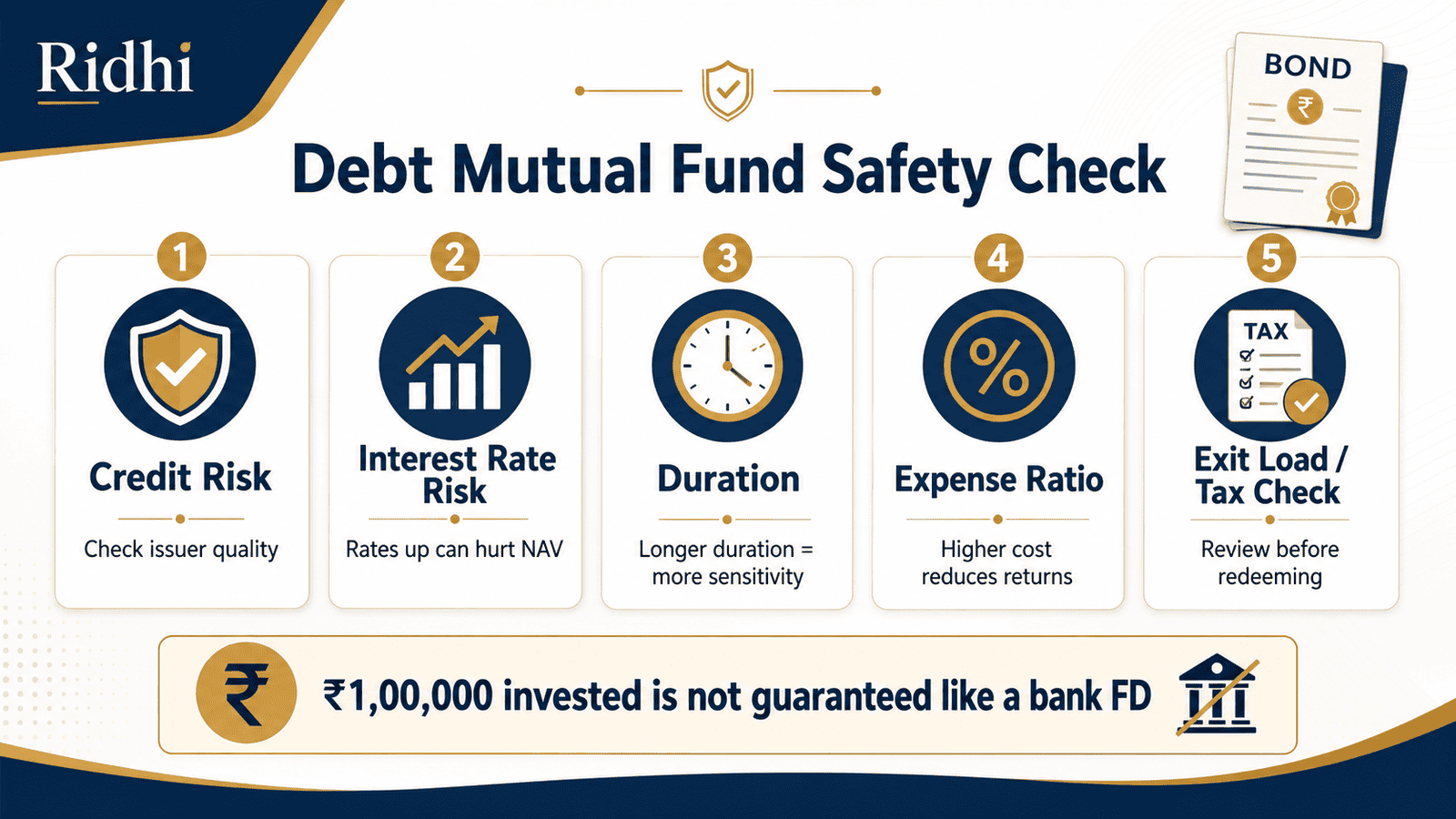
- They are not capital-guaranteed products. Your ₹1 lakh can technically be worth ₹99,500 tomorrow if NAV falls due to interest rate movement or credit events.
- The two main risks are credit risk (the bond issuer fails to pay) and interest rate risk (rising rates push existing bond prices down, lowering NAV).
- Shorter-duration, higher-credit-quality funds tend to show less NAV volatility — but they are still market-linked products, not bank deposits.
- Tax treatment on debt mutual fund gains has changed in recent years and must be verified from the Income Tax Department before investing, as it directly affects your net return.
- SEBI classifies debt funds into 16 categories — from overnight funds to credit risk funds — and each carries a different risk and return profile.
- Matching fund duration to your money’s time horizon is the single most practical step to reducing risk in debt fund investing.
Key Facts at a Glance
| Parameter | Debt Mutual Fund | Bank FD |
|---|---|---|
| What it invests in | Bonds, G-Secs, T-bills, corporate paper | N/A — your deposit earns a fixed rate |
| Capital guarantee | No — NAV can fall | Yes — up to ₹5 lakh per bank (DICGC) |
| Main risks | Credit risk, interest rate risk, duration risk | Bank default risk (rare, but exists) |
| Liquidity | High — redeem in 1–3 business days (most funds) | Penalty on premature withdrawal (usually) |
| Who regulates it | SEBI — sebi.gov.in | RBI — rbi.org.in |
| Taxation | Verify current rules at incometax.gov.in before investing | Interest taxed as per income slab |
| Exit load | Varies by fund and holding period — check SID | Premature withdrawal penalty applies |
What Is a Debt Mutual Fund? The Full Explanation
A debt mutual fund is a pooled investment vehicle that collects money from many investors and deploys it into fixed-income securities. When a government needs to borrow money, it issues a bond. When a company needs funds, it issues commercial paper or a corporate bond. Debt funds buy these instruments — and when you invest in a debt fund, you become a part-owner of that pool of fixed-income securities. To understand fund basics explained before going further, it helps to know that all mutual funds — equity, debt, or hybrid — work through this same pooling and NAV mechanism.
How NAV Movement Works in Debt Funds
Every debt fund has a Net Asset Value (NAV) — the per-unit price of the fund calculated daily. Unlike a fixed deposit where your balance only grows, a debt fund’s NAV can move up or down. When bond prices in the portfolio rise, NAV goes up. When bond prices fall — typically when interest rates rise — NAV goes down. Understanding how NAV works is essential before you invest, because this daily movement is where many beginners get surprised.
What Debt Funds Actually Hold
The portfolio of a typical debt fund may include:
- Government securities (G-Secs): Bonds issued by the central or state government. High credit quality, low default risk.
- Treasury bills (T-bills): Short-term government borrowing instruments maturing in 91, 182, or 364 days.
- Corporate bonds: Debt issued by companies. Higher yield potential, but credit risk depends on the company’s financial health and its credit rating.
- Commercial papers (CPs): Short-term instruments issued by corporations for working capital needs.
- Certificates of deposit (CDs): Issued by banks and financial institutions for short-term borrowing.
- Money market instruments: Short-term, highly liquid instruments that form the core of liquid and overnight funds.
The Two Core Risks You Must Understand
Credit risk is the risk that a bond issuer — a company or even a financial institution — fails to pay interest or repay principal on time. A debt fund holding bonds from a company that defaults will see its NAV drop sharply. According to SEBI guidelines, fund houses must disclose credit ratings of portfolio holdings, and a riskometer must be published for every scheme. Always check the riskometer before investing.
Interest rate risk works differently. When the RBI raises interest rates, the price of existing bonds in the market falls — because newer bonds now offer higher yields, making old bonds less attractive. A fund with high modified duration (long-maturity bonds) loses more NAV when rates rise. A short-duration fund with low modified duration is less sensitive to rate changes.
SEBI’s 16 Debt Fund Categories
According to SEBI’s mutual fund categorisation framework, there are 16 categories of debt mutual funds in India — from overnight funds (money placed overnight) to credit risk funds (minimum 65% in below AA-rated bonds). Each category has defined portfolio characteristics: maximum duration, minimum credit quality standards, and investment universe. The category you choose determines your risk exposure almost entirely. Picking a “debt fund” without checking which category it falls into is one of the most common beginner errors.
Real Example: Aarav’s ₹1 Lakh Debt Fund Experience
Aarav, 31, is a software engineer in Bengaluru earning ₹18 lakh per year. He has ₹1,00,000 sitting in his savings account and decides to invest it in a short-duration debt fund after reading that such funds are steadier than equity. He does not check the modified duration or credit quality — he simply looks at the fund’s 1-year return, which appears attractive.
Three months later, the RBI signals a rate increase. The fund’s bond portfolio loses some market value. Aarav’s NAV, which was ₹32.50 on the day he invested, is now ₹32.18. His ₹1,00,000 is now worth approximately ₹99,015. A small dip — but a dip he did not expect from a so-called “safe” product.
Six months later, as rates stabilise and the bond market recovers, his NAV has risen past his entry point. Aarav’s investment is back in the green. The lesson: the money was never lost permanently, but the short-term dip was real. If Aarav had needed that money in month three for an emergency, he would have redeemed at a small loss. To measure his actual return correctly, he should compare fund returns using XIRR, not just look at current NAV versus invested amount.
This is the core truth about debt mutual funds: they are not designed to lose money over sensible holding periods, but they are not designed to guarantee you won’t either.
How to Calculate Approximate Returns from a Debt Fund
Unlike a fixed deposit, a debt fund does not give you a maturity amount at the start. Your final value depends on how the NAV moves over your holding period, minus the expense ratio charged annually, minus any exit load if you redeem early, minus tax on gains.
Approximate Value = Invested Amount × (1 + Net Return %) − Exit Load (if any) − Tax on Gains
Using Aarav’s example with hypothetical figures for illustration only:
| Scenario | Key Inputs (Hypothetical) | Approximate Outcome |
|---|---|---|
| Stable rate environment, 1 year | ₹1,00,000 invested; 6.5% gross return; 0.30% expense ratio; no exit load | ~₹1,06,200 before tax |
| Rising rate period, 6 months | ₹1,00,000 invested; NAV dips 1% before recovering; 3% net annualised | ~₹1,01,500 before tax if held to recovery |
| Credit event in portfolio | ₹1,00,000 invested; one holding downgraded; NAV drops 3% | ~₹97,000 — below invested amount |
These figures are for illustration only. Actual returns are not guaranteed. Understanding how the expense ratio impact reduces your net return every year is important — even a 0.50% annual difference in expense ratio compounds meaningfully over 3–5 years. Tax treatment on debt mutual fund gains must be verified from the Income Tax Department at incometax.gov.in before investing, as rules have changed in recent years.
Comparison: Debt Fund vs FD vs Liquid Fund
| Parameter | Debt Mutual Fund (Short Duration) | Bank Fixed Deposit |
|---|---|---|
| Capital guarantee | No | Yes (up to ₹5L per bank, DICGC) |
| Returns | Market-linked; not fixed at start | Fixed rate locked at time of booking |
| Volatility | Low to moderate depending on duration | None — value only grows |
| Liquidity | High — T+1 to T+3 redemption | Premature withdrawal penalty applies |
| Taxation | Verify at incometax.gov.in — rules changed | Interest taxed as per income slab |
| Inflation hedge | Partial — market-linked | Fixed rate may fall below inflation |
| Documentation | KYC + scheme information document | Simple bank process |
One important clarification: a liquid fund is not a separate product category competing with debt funds. A liquid funds explained article covers this in detail, but the short answer is that liquid funds are one category within the debt mutual fund universe — designed for very short holding periods (typically up to 91 days), investing in money market instruments with low modified duration and high credit quality. They carry the lowest interest rate risk within debt funds, but they are still not guaranteed-return products.
How to Decide What’s Right for You
you need the money in under 7 days — THEN a liquid fund or savings account is more appropriate than a longer-duration debt fund where even small NAV movement could affect your redemption value.
you need capital certainty and can accept lower, fixed returns — THEN a bank FD from a well-rated institution may suit you better than any debt mutual fund.
your horizon is 3 months to 1 year and you want better liquidity than an FD — THEN a short-duration or low-duration debt fund with high credit quality (mostly AAA/sovereign) is worth reviewing — after reading the scheme information document.
you are willing to hold for 2–3 years and understand that NAV may dip in the short term — THEN a medium-duration or corporate bond fund could be considered — but only after reviewing the portfolio’s credit ratings and modified duration.
the fund’s riskometer shows “High” or “Very High” and you do not understand why — THEN do not invest until you do. A riskometer at that level in a debt fund usually means meaningful credit risk or very long duration.
you are not prepared to read the fund’s factsheet, check the credit rating mix, and monitor it annually — debt mutual funds are probably not right for you yet. A bank FD or recurring deposit requires far less monitoring.
Common Mistakes to Avoid
Choosing a debt fund purely by past 1-year return
A high 1-year return in a debt fund may mean the fund took on long duration during a falling rate period — which reverses when rates rise.
A fund that returned 9% last year could return 4% or less next year if the rate environment changes. Past return tells you what happened; it does not predict what will happen.
Instead, check modified duration, credit quality, and the fund category — then decide if the risk matches your need.
Assuming debt fund means no capital loss
This is the most common and costly misunderstanding. Debt funds are market-linked. NAV can and does fall — during credit events and rising rate cycles.
The Franklin Templeton debt fund episode in 2020 reminded Indian investors that even “conservative” debt funds can face liquidity freezes and mark-to-market losses when credit risk materialises in the portfolio.
Treat every debt fund as a product that can lose value — even if temporarily — and choose accordingly.
Ignoring the fund’s credit quality and issuer concentration
A fund holding 15–20% of its assets in a single low-rated issuer is very different from a fund holding sovereign bonds. Both are “debt funds.”
Always read the factsheet: what percentage is in AAA or sovereign instruments? Is any single issuer above 10% of the portfolio? Concentration in lower-rated paper amplifies credit risk significantly.
Check the credit rating mix before investing, not after.
Using long-duration debt funds for a 3-month goal
A long-duration or gilt fund with a modified duration of 7–10 years is extremely sensitive to interest rate changes. Its NAV can fall 5–8% if rates rise by 1%.
Parking money you need in 3 months in such a fund is a mismatch of risk and timeline. Use a liquid or ultra-short duration fund for money needed soon.
Match duration to your time horizon — this rule alone prevents most debt fund losses.
Overlooking the expense ratio and exit load
A debt fund returning 6.5% gross with a 0.80% expense ratio gives you 5.70% net — before tax. If a direct plan of the same fund charges 0.25%, you keep 6.25%. Over 3 years on ₹3 lakh, that difference compounds to a meaningful amount.
Understanding the expense ratio impact before choosing a fund or platform is not optional. Exit loads also reduce your effective return if you redeem early — always check the SID.
Not verifying current tax treatment before investing
Debt mutual fund taxation rules in India have changed in recent years and may change again. Not knowing the current tax treatment before investing means you cannot accurately calculate your post-tax return.
Always verify current rules at incometax.gov.in before committing capital. The tax impact on a ₹3 lakh investment held for 1 year can be significant depending on your income slab and applicable rules.
When This May Not Be the Right Choice
Debt mutual funds may not be suitable if you need the money within a very short window — say, 3 to 7 days — and even a small negative NAV movement at redemption time would be a problem. The T+1 to T+3 redemption cycle and any short-term NAV dip could mean you receive less than expected.
If you cannot tolerate any short-term mark-to-market loss — even a temporary ₹500 dip on a ₹1 lakh investment — a bank FD or RBI Floating Rate Savings Bond may provide the capital certainty you need.
If you are drawn to a debt fund primarily because its 1-year return is high, without understanding why — that is often a signal the fund took on credit or duration risk you may not be comfortable with.
Investors who prefer simple products and do not want to read scheme documents, check credit ratings, or track modified duration are better served by straightforward bank deposits until they are ready to engage with these details.
If any of these apply to your situation, it may be worth exploring alternatives before committing.
Official Rules and Where to Verify
Debt mutual funds in India are regulated by the Securities and Exchange Board of India (SEBI). Rules on fund categorisation, portfolio disclosure, riskometer, scheme information documents, and investor protections are available at sebi.gov.in.
For monetary policy, interest rate decisions, and banking-related regulations that affect bond markets, refer to the Reserve Bank of India at rbi.org.in.
Current taxation rules for debt mutual fund gains — including applicable rates, holding period thresholds, and indexation provisions — must be verified directly at the Income Tax Department website: incometax.gov.in. Tax rules for debt funds have changed in recent years and may change again with future Budget announcements.
- SEBI — sebi.gov.in (fund regulations, categorisation, scheme disclosures)
- RBI — rbi.org.in (monetary policy, banking regulations)
- Income Tax Department — incometax.gov.in (taxation of mutual fund gains)
- Fund house website — scheme information document (SID), key information memorandum (KIM), and monthly factsheet for each specific fund
Rules, limits, and rates on this topic can change with each Budget or regulatory update. Always verify current figures directly from the official source before making any financial decision.
Expert Tips
- Read the factsheet, not just the return figure. The monthly factsheet shows credit rating breakdowns, issuer-wise concentration, and modified duration. If more than 20% of the portfolio is in sub-AA instruments, the fund is taking credit risk — regardless of what the name suggests.
- Match modified duration to your time horizon before anything else. A fund with a modified duration of 4 years will lose approximately 4% of NAV if interest rates rise by 1%. If your money horizon is 6 months, that is a serious mismatch.
- Use direct plans where possible. Understanding direct versus regular plan differences is especially important in debt funds — where gross returns are already modest, saving 0.40–0.60% per year in expense ratio makes a proportionally larger difference than in high-return equity funds.
- Do not use a debt fund as your emergency fund unless you understand redemption timing. Most debt funds settle in T+1 to T+3 business days. In a genuine emergency, a liquid fund or savings account may serve you better than a longer-duration debt fund.
- Verify taxation before investing, not after. The tax treatment of debt mutual fund gains in India has evolved. Investing ₹5 lakh without knowing the current tax treatment means you cannot calculate your actual net return. Check incometax.gov.in or consult a tax professional first.
- Prioritise credit quality over yield. If two similar funds have an expense-adjusted yield gap of 0.8%, but the higher-yielding one achieves that by holding lower-rated paper, the gap may not be worth the credit risk. Conservative credit quality — AAA and sovereign-heavy portfolios — is not a weakness; it is a deliberate risk choice.
Frequently Asked Questions
Are debt mutual funds safe?
Debt mutual funds are generally less volatile than equity funds, but they are not safe in the sense of being capital-guaranteed. NAV can fall due to credit events, rising interest rates, or portfolio-level problems. The degree of safety depends on the fund’s category, duration, and credit quality — not the label “debt.”
Can debt mutual funds give negative returns?
Yes. Over short periods, debt fund NAVs can fall — especially long-duration or credit risk funds during rising rate cycles or credit events. Short-duration, high-quality debt funds are less likely to show extended negative periods, but it is still possible. No debt fund guarantees positive returns.
Is a debt fund better than an FD?
Neither is universally better. FDs offer fixed returns, capital certainty up to ₹5 lakh per bank (DICGC), and simplicity. Debt funds offer higher liquidity, market-linked returns, and potentially different tax treatment. The right choice depends on your time horizon, need for certainty, and tax situation — verify current taxation before comparing.
Which debt fund is safest?
Overnight funds and liquid funds (very short duration, money market instruments, high credit quality) are typically at the lower end of the debt fund risk spectrum according to SEBI’s riskometer. However, “safest among debt funds” does not mean risk-free. Even these funds carry some credit and liquidity risk.
What is credit risk in debt funds?
Credit risk is the possibility that a bond issuer in the fund’s portfolio fails to pay interest or repay principal. If that happens, the fund’s NAV drops — sometimes sharply. Funds holding lower-rated corporate bonds (below AAA) carry more credit risk. Check the credit rating distribution in the fund’s factsheet before investing.
What is interest rate risk in debt funds?
When interest rates in the economy rise, existing bonds become less attractive, and their market prices fall. This pushes down the NAV of funds holding those bonds. The higher the fund’s modified duration, the larger the NAV impact for every 1% rate change. Short-duration funds have less interest rate risk than long-duration or gilt funds.
How are debt mutual funds taxed in India?
Debt mutual fund taxation rules have changed in recent years and can change again with future Budget announcements. The applicable tax rate and whether indexation benefits are available depend on current rules. Always verify the latest position at incometax.gov.in or with a qualified tax professional before making any investment or redemption decision.
Is a liquid fund a debt fund?
Yes. A liquid fund is one of the 16 SEBI-defined categories within the debt mutual fund universe. It invests in money market and debt instruments with maturity up to 91 days. It is not a separate or competing product — it is a very short-duration subset of debt funds designed for parking money you may need at short notice.
How does debt mutual fund NAV work?
NAV is the per-unit value of the fund, calculated daily by dividing the total market value of the portfolio (minus expenses) by the number of outstanding units. Understanding how NAV works matters because it shows that your investment value changes every day — it does not accumulate interest like a fixed deposit balance.
Can I invest in debt funds via SIP?
Yes. You can invest in debt mutual funds via a Systematic Investment Plan (SIP) the same way you would with equity funds. SIPs in debt funds allow you to invest regularly in fixed-income instruments without timing the market. However, SIP does not eliminate the credit risk or interest rate risk of the underlying fund — the same evaluation applies.
Final Verdict
Debt mutual fund meaning, stripped to its core: a market-linked investment in fixed-income securities that is less volatile than equity but not free from risk. For an investor like Aarav — informed, patient, willing to read a factsheet and verify tax rules — a short-duration, high-credit-quality debt fund can be a rational choice for money he does not need for 6 months to a year. For someone who needs capital certainty or cannot tolerate any short-term dip, a bank FD remains the simpler and safer choice.
The key is not to treat “debt fund” as a synonym for “safe.” Match the fund’s duration to your time horizon. Check the credit quality. Understand the expense ratio. And always verify current tax treatment before committing. Always verify the latest rules from official sources or consult a qualified professional before making any financial decision.
This article is for educational purposes only and should not be treated as personalised financial, tax, investment, insurance, or legal advice. Tax rules, interest rates, regulatory limits, and product features can change with each Budget or policy update. Please verify current rules from official government sources or consult a qualified and registered professional before making any financial decision.

Arjun Kapoor writes about mutual funds, SIPs, ELSS, fund categories, investment returns, and beginner investing concepts for Indian readers. His focus is on education, not product promotion or fund recommendations. He helps readers understand how mutual funds work before they start investing or comparing schemes.
He covers topics such as mutual fund meaning, SIP meaning, SIP calculator, direct mutual funds vs regular plans, NAV, ELSS tax-saving funds, CAGR, absolute returns, XIRR, expense ratio, large cap vs mid cap vs small cap funds, flexi cap funds, index funds vs active funds, liquid funds, debt mutual funds, SIP pause vs SIP stop, lumpsum vs SIP, and how to start SIP in India.
Arjun’s writing is simple, risk-aware, and long-term oriented. He avoids guaranteed-return language and explains investment concepts using examples, timelines, and comparison tables. His articles remind readers that mutual fund investments are subject to market risks, and past performance does not guarantee future returns. Readers should verify scheme details from SEBI, AMFI, fund houses, and official scheme documents.