

You just received your annual bonus — ₹1,00,000 sitting in your savings account — and everyone seems to have a different opinion. Your colleague says put it all into a mutual fund now. A finance influencer says split it into monthly SIPs. Your father says wait for the market to fall first. If this sounds familiar, you are not alone. The lumpsum vs SIP debate is one of the most common questions for salaried Indian investors, and the honest answer is: it depends on your cash flow, your emotional comfort with volatility, and your goal timeline — not on which method produces a universally higher return.
This article compares both methods clearly, using a realistic Indian example and no guaranteed-return language. Neither SIP nor lumpsum is declared a winner here — because the better choice changes based on your situation.
Quick Answer: Lumpsum vs SIP
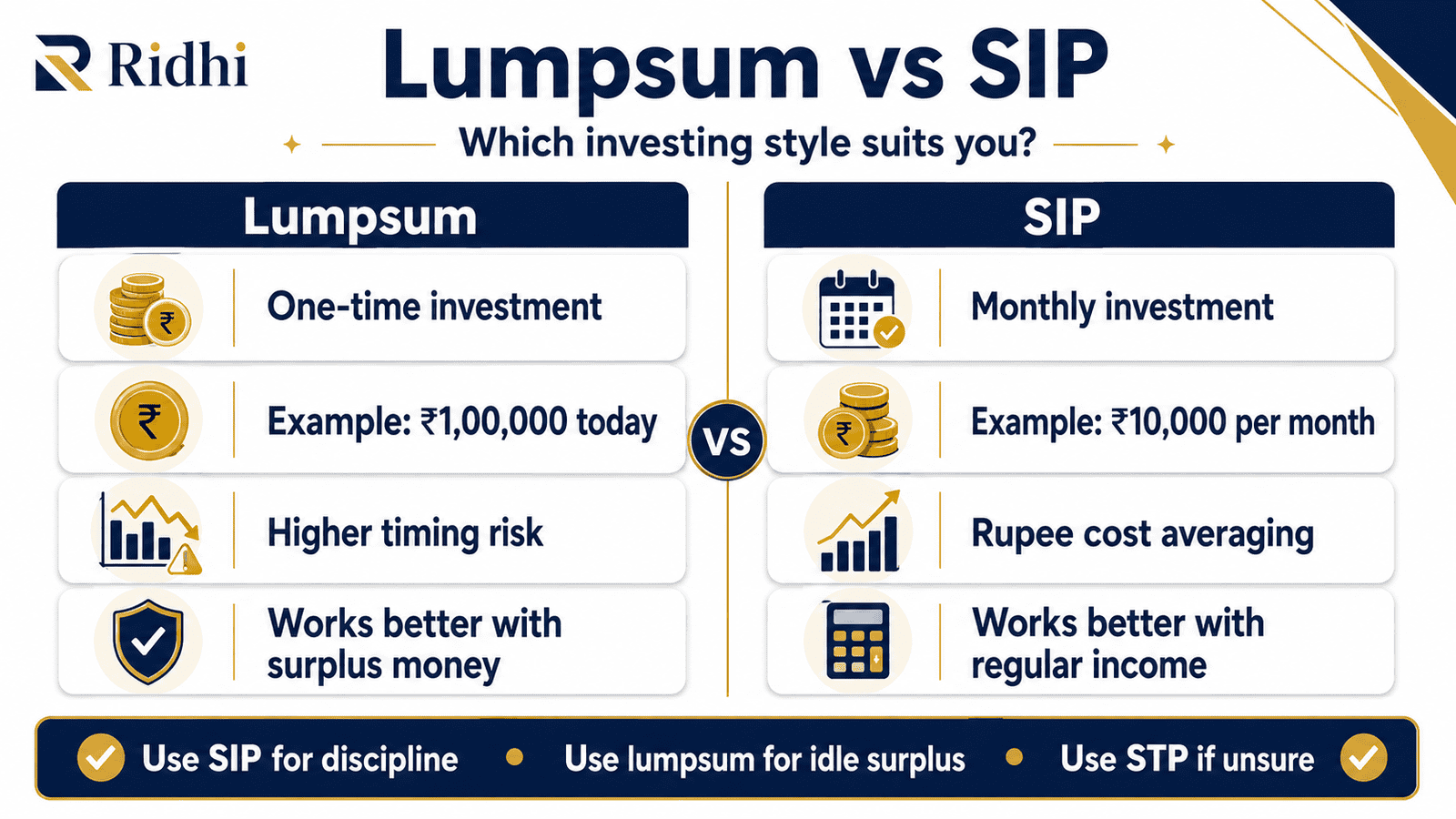
Lumpsum vs SIP is not about which method always gives higher returns. SIP suits regular income and reduces timing pressure, while lumpsum can work when you already have surplus money and a long horizon. For example, ₹1,00,000 can be invested at once or split into 10 monthly SIPs. Market risk remains present in both methods — mutual fund investments are subject to market risks and past performance does not guarantee future returns.
Key Takeaways
- SIP spreads your investment over time and reduces timing pressure — but it does not eliminate market risk. You can still see a negative return if markets fall consistently across your SIP period.
- Lumpsum investing means your full capital is exposed to market movement immediately — if markets fall after you invest, the paper loss feels larger than with SIP.
- A long investment horizon — typically 5 years or more in equity mutual funds — matters more than trying to perfectly time your entry date.
- If you earn a monthly salary and want to build an investing habit, SIP is usually the more practical and sustainable choice.
- Staggered deployment — investing your surplus in tranches over 3 to 6 months — can reduce timing anxiety without abandoning the goal of deploying the full amount.
- Before investing by either method, your emergency fund should already be in place. Read whether emergency fund or investment should come first before committing surplus money.
- The SEBI riskometer on every mutual fund factsheet tells you the fund’s risk level — check it before deciding which fund category suits your goal.
Lumpsum vs SIP: Side-by-Side Comparison
| Parameter | Lumpsum | SIP |
|---|---|---|
| Investment frequency | One-time, at a single NAV date | Fixed amount at regular intervals (monthly, weekly) |
| Best suited for | Investors with idle surplus — bonus, windfall, maturity proceeds | Salaried earners with regular monthly income |
| Timing risk | High at entry — full capital exposed immediately | Spread over time — entry price averages across multiple NAV dates |
| Behavioural comfort | Can be stressful if markets fall soon after investing | Easier to maintain — small amount feels less painful during dips |
| Return possibility | Can be higher if markets rise steadily after entry; can be lower if markets fall | Rupee cost averaging helps in volatile markets; may underperform in a sustained bull run |
| Flexibility | Decision is made upfront; cannot be reversed after units are allotted | Can be paused, modified, or stopped — more control |
| Discipline required | Single large decision — but harder to time well | Consistent monthly commitment — builds investing habit |
| Suitable for beginners | With caution — only with long horizon and clear goal | Yes — lower barrier and lower per-instalment amount |
Before investing in any mutual fund — by SIP or lumpsum — understand how mutual funds work for beginners in India so you know what you are actually buying.
Key Facts at a Glance
| Feature | SIP | Lumpsum |
|---|---|---|
| Minimum investment (typical) | ₹100 to ₹500 per month depending on fund | ₹1,000 to ₹5,000 per transaction depending on fund |
| Entry timing dependency | Low — spread across multiple dates | High — single NAV determines cost basis |
| Best market condition for entry | Any — timing matters less | Historically lower valuations may reduce risk, but cannot be predicted |
| Rupee cost averaging | Yes — lower NAV means more units bought in that instalment | No — fixed number of units allotted at entry NAV |
| Goal horizon compatibility | Short, medium, and long-term goals | Better suited for medium to long-term (5+ years for equity) |
| Tax treatment | Each instalment starts its own holding period for LTCG/STCG | Single investment date starts one holding period |
How SIP and Lumpsum Actually Work in Mutual Funds
When you invest in a mutual fund, you are buying units at the fund’s Net Asset Value — the NAV — on that day. The NAV changes every business day based on the market value of the fund’s underlying portfolio. This is true whether you invest ₹10,000 once or ₹1,000 monthly.
What SIP Does
A Systematic Investment Plan — SIP — automatically deducts a fixed amount from your bank account on a chosen date each month and buys units of your chosen fund at that day’s NAV. If the NAV is ₹50 this month and ₹40 next month, your fixed ₹1,000 buys 20 units one month and 25 units the next. Over time, this averaging effect — called rupee cost averaging — means your average cost per unit is pulled down by the months when NAV was lower.
SIP builds investing discipline. Because the amount is small and automatic, most investors find it easier to stay invested through market dips. Read the complete guide to monthly SIP basics to understand how the mechanism works before you compare it with one-time investing.
However, SIP does not remove risk. If markets fall across the entire duration of your SIP — which can happen, especially in the short term — even a well-maintained SIP can show negative returns at any given point. According to SEBI’s investor education guidelines at sebi.gov.in, mutual fund investments are subject to market risks and past performance does not guarantee future returns.
What Lumpsum Does
A lumpsum investment is a one-time purchase of mutual fund units. You invest your entire available amount on one day, at one NAV. If you invest ₹1,00,000 at NAV ₹100, you receive 1,000 units. From that day, the entire ₹1,00,000 is exposed to market movement — upward and downward.
Lumpsum increases your immediate exposure. If markets rise after your investment, your corpus grows faster than an equivalent SIP that was still building up. If markets fall sharply after you invest — as they did in March 2020 or during several budget-day corrections — a lumpsum investor sees a steeper paper loss than someone who was mid-SIP on the same fund.
Why Neither Method Is Inherently Superior
The academic research on SIP vs lumpsum in steadily rising markets tends to show lumpsum producing a slightly better outcome because the money is invested and compounding earlier. But Indian equity markets have historically been volatile — with sharp drawdowns followed by recoveries. In volatile conditions, rupee cost averaging from SIP can reduce the average cost per unit. The catch: no one can reliably tell you in advance which scenario applies to the next 12 months.
What matters more than method selection is: how long you stay invested, the quality of the fund category you choose, and whether you stay the course during a market correction rather than redeeming in panic.
Real Example: Rohan’s ₹1,00,000 Bonus Decision
Rohan, 31, is an IT professional from Pune earning ₹18 lakh per year. After his annual appraisal, he has ₹1,00,000 sitting in his savings account. He has already maintained a ₹1.5 lakh emergency fund separately. His goal is long-term wealth building — he does not need this money for at least 7 years.
Rohan has two clear choices. Option A: Invest the full ₹1,00,000 as a lumpsum into an equity mutual fund today. Option B: Transfer ₹10,000 per month into the fund via SIP over the next 10 months.
If markets rise steadily over the 10 months Rohan spreads his SIP, lumpsum would have earned more because the full amount was deployed earlier. But if markets fall for the first 6 months before recovering, Rohan’s SIP would have bought more units at the lower NAVs — bringing his average cost per unit below the lumpsum entry NAV.
The key insight: the correct choice for Rohan depends on what markets do after he invests — which he cannot know in advance. What he can know is that his 7-year horizon is long enough for either method, and that his emergency fund is intact regardless of which path he takes. For Rohan, the SIP option also reduces the psychological burden of watching ₹1,00,000 dip by 15% in a correction.
How to Compare SIP and Lumpsum Calculations
Estimated Lumpsum Future Value = P × (1 + r)^n
Where: P = Principal invested | r = Assumed annual return rate | n = Number of years
For SIP, the formula accounts for periodic investments. The future value of each instalment compounds separately from its own date of investment. This is why the same ₹1,00,000 split into ₹10,000 monthly SIPs over 10 months produces a different outcome than a single ₹1,00,000 lumpsum — even if the total invested amount is identical.
Using Rohan’s scenario with an assumed return of 12% per annum (not a guaranteed or expected return — used only for illustration):
| Scenario | Key Inputs | Illustrative 7-Year Outcome |
|---|---|---|
| Lumpsum: ₹1,00,000 today | Full ₹1,00,000 invested at assumed 12% p.a. for 7 years | Approx. ₹2,21,000 (illustrative only — assumed 12% p.a.) |
| SIP: ₹10,000/month for 10 months, then held | Each instalment invested at different dates; same assumed 12% p.a. | Slightly different from lumpsum depending on market path — cannot be predicted |
| Staggered lumpsum: ₹25,000 each quarter over 10 months | 4 tranches spread over 10 months at same assumed return | Between full lumpsum and monthly SIP — reduces single-entry risk |
These are illustrative figures only. Actual returns depend entirely on market performance. To model your own scenario, use the SIP calculator to estimate monthly investing outcomes and adjust inputs to match your situation.
How to Decide What’s Right for You
You earn a monthly salary and want to start investing without needing a large upfront amount — THEN SIP is likely the more practical and sustainable starting point.
You have a surplus amount — bonus, maturity proceeds, or inheritance — already sitting in your bank and your goal is 5 years or more away — THEN lumpsum may be suitable, provided your emergency fund is intact.
You have surplus cash but feel anxious about investing it all at once during uncertain market conditions — THEN staggered deployment over 3 to 6 months may reduce timing anxiety while still deploying your full amount.
Your goal is less than 2 years away and you need the money reliably — THEN equity mutual funds by either method may not be appropriate; consider debt or liquid options instead.
You already have a monthly SIP running and have received a bonus — THEN you can invest the bonus as a lumpsum in the same or a different fund; both methods can coexist in the same portfolio.
You are in a high-interest debt situation — personal loan, credit card outstanding — THEN paying off that debt first may give you a better risk-adjusted outcome than investing at current equity risk levels.
You do not yet have an emergency fund — do not invest this money as either lumpsum or SIP in equity funds. Emergency fund must come before wealth-building investments.
Common Mistakes to Avoid
Judging the Method by Last Year’s Returns
Investors often switch from SIP to lumpsum because they see a fund gave 35% last year and want to put in all their money now.
This is a form of return-chasing. High recent returns in equity funds often indicate elevated valuations — precisely when timing risk for lumpsum is higher. A fund that returned 35% last year may deliver negative returns the next year.
Instead, evaluate the fund on its long-term record, fund category, and how it fits your goal — not last year’s headline number.
Stopping SIP During a Market Fall
Many beginner investors pause or stop their SIP when markets drop 15–20%, interpreting the fall as a reason to exit.
This removes the core benefit of SIP. When NAV falls, each instalment buys more units — the exact scenario that benefits rupee cost averaging most. Stopping at a dip locks in the loss without allowing recovery units to reduce your average cost.
Unless your financial goal or income situation has genuinely changed, staying invested through a correction is usually better than exiting. Review the goal, not the short-term NAV.
Using Emergency Money for a Lumpsum Investment
It is tempting to invest a large portion of your savings as lumpsum when markets seem attractive.
If that savings included your emergency fund and markets fall by 25% right after investing, you may be forced to redeem at a loss to meet an unexpected expense — ₹1,00,000 invested could be worth ₹75,000 when you need it. This destroys both your investment and your financial cushion.
Keep your emergency fund in a liquid instrument. Only invest genuinely surplus money you do not need for at least 3 to 5 years.
Confusing CAGR and XIRR When Comparing Returns
Lumpsum returns are typically quoted as CAGR — Compound Annual Growth Rate. SIP returns are more accurately measured using XIRR because each instalment has a different start date.
Comparing a lumpsum’s 15% CAGR directly with a SIP’s 12% XIRR as if they measure the same thing leads to wrong conclusions. Understand how to compare fund returns using CAGR, absolute return, and XIRR before drawing any comparison between the two methods.
Ignoring Plan Type While Focusing Only on Timing
Investors spend significant time debating lumpsum vs SIP while investing in a regular plan instead of a direct plan — paying an extra 0.5% to 1% in annual expense ratio.
Over 10 years on ₹10,00,000, an additional 1% expense ratio can reduce your corpus by ₹1,50,000 or more — far more than any marginal timing advantage from picking the right entry month.
Get the plan type right first, then decide the investment method.
Treating Staggered Deployment as Indefinite Delay
Staggered deployment over 3 to 6 months is a reasonable strategy for reducing timing anxiety. But some investors extend this to 18 months or more — waiting for the “right moment.”
The longer money stays uninvested in a savings account at 3% interest while equity markets grow, the more this costs in opportunity. Staggering should reduce anxiety, not become a permanent reason to stay on the sidelines.
Investing Without Checking the Fund’s Risk Level
All SEBI-registered mutual funds display a riskometer — a visual indicator of the fund’s risk profile. A beginner investing a lumpsum in a small-cap or sectoral fund without understanding the risk level can face drawdowns of 40–50% in a sharp correction.
Check the riskometer and fund category before selecting where to deploy either lumpsum or SIP money.
When This May Not Be the Right Choice
Neither SIP nor lumpsum investing in equity mutual funds may be suitable in the following situations:
Your goal is less than 2 years away. Equity mutual funds — regardless of how you invest — can deliver negative returns over short periods. If you need the money for a flat down payment or wedding in 18 months, putting it into an equity fund carries meaningful capital risk. Consider liquid funds or short-duration debt funds instead.
You have no emergency fund. Without 3 to 6 months of expenses in a liquid account, any market downturn could force you to redeem an equity investment at a loss to cover an unexpected need. Check whether your emergency fund should come before investment before committing any amount to equity markets.
You are carrying high-interest debt. Personal loans at 14–18% or credit card outstanding at 36–42% per year represent a guaranteed negative return on your balance. No equity mutual fund can reliably beat that cost of debt on a risk-adjusted basis. Clearing this debt first is almost always financially more efficient than investing in parallel.
Market volatility causes serious anxiety. If a 20% portfolio drop would compel you to exit — regardless of your goal timeline — then equity mutual funds in their current form may not match your actual risk tolerance. Consider lower-volatility options like balanced advantage funds or short-duration debt while building familiarity with market behaviour.
If any of these apply to your situation, it may be worth exploring alternatives before committing.
Official Rules and Where to Verify
Mutual fund investing in India is regulated by the Securities and Exchange Board of India — SEBI. All mutual fund schemes must be registered with SEBI, and all AMCs (Asset Management Companies) operate under SEBI’s regulations for mutual funds.
Before investing — by SIP or lumpsum — always read the fund’s Scheme Information Document (SID) and Key Information Memorandum (KIM). These are the official documents that detail the fund’s investment objective, risk factors, charges, and redemption rules.
Official sources to verify before investing:
- SEBI — sebi.gov.in — for mutual fund regulations, investor circulars, and registered AMC list
- AMFI — amfiindia.com — for scheme NAV data, AMC contact details, and investor grievance information
- Fund AMC’s official website — for the latest Scheme Information Document, riskometer, and portfolio disclosures
Rules, limits, and rates on this topic can change with each Budget or regulatory update. Always verify current figures directly from the official source before making any financial decision.
Expert Tips
- Keep your goal timeline separate from market prediction. If your goal is 7 years away, the question is not “will markets fall this month?” but “will equity markets grow over 7 years?” — a very different probability. Stay focused on the time horizon, not the news cycle.
- Use SIP for habit-building, not just convenience. The discipline of committing ₹5,000 or ₹10,000 per month — regardless of market mood — compounds your behavioural edge alongside your financial returns. The investor who stays invested for 15 years beats the one who times perfectly for 10.
- Use lumpsum only after your emergency fund and short-term cash needs are fully covered. If your ₹1,00,000 bonus is also your only buffer, investing it as lumpsum is not the right move regardless of market conditions.
- Check whether you are in a direct or regular plan before adding more money. The difference between direct and regular mutual fund plans can reduce your cost by 0.5–1% per year — more impactful over 10 years than almost any timing decision.
- Review your overall asset allocation before adding new money. If equity already makes up 85% of your portfolio, adding more via SIP or lumpsum increases concentration risk. Ensure the new investment fits your overall asset mix — not just the individual fund’s appeal.
- Stagger if you must, but set a deadline. If timing anxiety pushes you to stagger a ₹1,00,000 lumpsum across 4 months, that is reasonable. But set a fixed date by which all four tranches will be invested — otherwise staggering becomes indefinite inaction.
- Both methods can coexist. A common and practical approach: run a monthly SIP from your salary, and invest bonuses or windfalls as lumpsum into the same or complementary fund. You do not have to pick one method for all of your investing.
Frequently Asked Questions
Is SIP always better than lumpsum?
No. In a steadily rising market, lumpsum tends to produce a better outcome because the full amount compounds from day one. SIP’s advantage shows in volatile or sideways markets, where rupee cost averaging reduces the average cost per unit. Neither method is universally superior — the right choice depends on your cash flow, goal timeline, and comfort with timing risk.
Can I invest using lumpsum and SIP in the same mutual fund?
Yes. You can make an additional lumpsum purchase in any fund where you already have an active SIP, and vice versa. These are tracked as separate folios or within the same folio depending on your AMC. Each lumpsum investment starts its own holding period for tax purposes, separate from your SIP instalments.
Is lumpsum investing risky in equity mutual funds?
Yes — all equity mutual fund investments carry market risk, and lumpsum investing concentrates that risk at a single entry point. If markets fall significantly after your lumpsum investment, the paper loss on your full amount is immediate. This is why lumpsum is generally more suitable for investors with a long horizon of 5 years or more and a genuine tolerance for short-term volatility.
What is rupee cost averaging and does it guarantee lower costs?
Rupee cost averaging is the effect that occurs when you invest a fixed amount at regular intervals. When the NAV is lower, your fixed investment buys more units; when NAV is higher, it buys fewer. Over time, this can result in an average cost per unit that is lower than the average NAV over the same period. However, it does not guarantee a profit or protect against loss if the fund’s NAV declines overall.
Should beginners always start with SIP?
For most beginners earning a monthly salary, SIP is the more practical starting point — the amount is manageable, the process is automatic, and the discipline builds gradually. If a beginner also has a lumpsum available (a gift, maturity payment, or bonus), they can invest that separately with a clear long-term goal. The key for beginners is to start — the method matters less than consistency and patience.
Can SIP give losses?
Yes. SIP does not protect against loss. If the fund’s NAV is lower at the time you redeem than your average purchase NAV across all instalments, you will receive less than what you invested. This can happen in a prolonged market downturn or if you redeem during a correction before the investment has had time to recover. Mutual fund investments are subject to market risks regardless of how they are made.
What is the minimum amount to start a SIP in India?
Most mutual fund schemes allow SIP investments starting from ₹100 to ₹500 per month, depending on the AMC and scheme. Some liquid and debt funds may have higher minimums. Check the specific scheme’s KIM or the AMC’s website for current minimums before starting.
Is there a tax difference between SIP and lumpsum?
Yes — the holding period for tax calculation differs. For lumpsum, the entire investment has one start date. For SIP, each instalment has its own start date. In equity mutual funds, Long Term Capital Gains (LTCG) tax of 12.5% applies on gains above ₹1.25 lakh per year if units are held for more than 12 months. Short Term Capital Gains (STCG) tax of 20% applies if units are redeemed within 12 months of each instalment’s purchase date. For SIP redemptions, it is important to track the holding period of each instalment separately to calculate the correct tax liability.
What does SEBI say about mutual fund investments?
SEBI — the Securities and Exchange Board of India — is the regulator for mutual funds in India. SEBI mandates that all mutual fund advertisements include the disclaimer: “Mutual fund investments are subject to market risks. Read all scheme related documents carefully.” SEBI also requires all funds to display a standardised riskometer on scheme documents. Investors can verify registered AMCs and scheme details at sebi.gov.in.
Can I switch from SIP to lumpsum or vice versa mid-way?
Yes. You can stop a SIP at any time and invest the remaining amount as a lumpsum — or you can start a SIP in a fund you previously invested in as lumpsum. Switching between methods does not trigger a tax event on its own; tax is only triggered when you redeem (sell) your units, not when you change your investment approach going forward.
Final Verdict
Lumpsum vs SIP is ultimately a question of your cash flow, timeline, and emotional relationship with market volatility — not a mathematical race to a fixed answer. For most salaried earners in India, SIP is the practical default: it fits a monthly income pattern, requires no market timing, and builds the discipline that matters most over a 10 to 15-year horizon. For investors with surplus cash and a long goal — a bonus, a maturity amount, an inheritance — lumpsum can make sense, particularly when the emergency fund is intact and the goal is genuinely distant.
What undermines both methods is behaviour: exiting during a correction, chasing last year’s top performers, or treating equity funds as a short-term parking space. The investor who picks a suitable fund, commits to a method, and stays invested through volatility will almost always outperform the one who picks the “right” method but exits at the first dip.
Mutual fund investments are subject to market risks. Past performance does not guarantee future returns. Always verify the latest rules from official sources or consult a qualified professional before making any financial decision.
This article is for educational purposes only and should not be treated as personalised financial, tax, investment, insurance, or legal advice. Tax rules, interest rates, regulatory limits, and product features can change with each Budget or policy update. Please verify current rules from official government sources or consult a qualified and registered professional before making any financial decision.

Arjun Kapoor writes about mutual funds, SIPs, ELSS, fund categories, investment returns, and beginner investing concepts for Indian readers. His focus is on education, not product promotion or fund recommendations. He helps readers understand how mutual funds work before they start investing or comparing schemes.
He covers topics such as mutual fund meaning, SIP meaning, SIP calculator, direct mutual funds vs regular plans, NAV, ELSS tax-saving funds, CAGR, absolute returns, XIRR, expense ratio, large cap vs mid cap vs small cap funds, flexi cap funds, index funds vs active funds, liquid funds, debt mutual funds, SIP pause vs SIP stop, lumpsum vs SIP, and how to start SIP in India.
Arjun’s writing is simple, risk-aware, and long-term oriented. He avoids guaranteed-return language and explains investment concepts using examples, timelines, and comparison tables. His articles remind readers that mutual fund investments are subject to market risks, and past performance does not guarantee future returns. Readers should verify scheme details from SEBI, AMFI, fund houses, and official scheme documents.