

A sudden job loss, a medical bill that your insurance doesn’t fully cover, a salary that gets delayed by three weeks, or a family emergency that requires you to travel across the country at short notice — these are not rare events for Indian households. They happen every year, to ordinary people with ordinary salaries. And when they happen, the difference between a family that handles it calmly and one that scrambles to arrange cash is almost always one thing: a dedicated emergency fund.
An emergency fund is not an investment. It is not a savings goal like a holiday or a new laptop. It is money set aside specifically for situations where your regular income is disrupted or a sudden essential expense arrives. The 6-month target is widely recommended because most job searches in India take between two and six months, and most financial recoveries — medical or otherwise — fall within that window.
This article covers how much to save, how to calculate your exact target, where to keep the money safely, what mistakes most people make, and how to start building the fund even if you can only set aside ₹5,000 a month.
Quick Answer: How to Build a 6-Month Emergency Fund in India
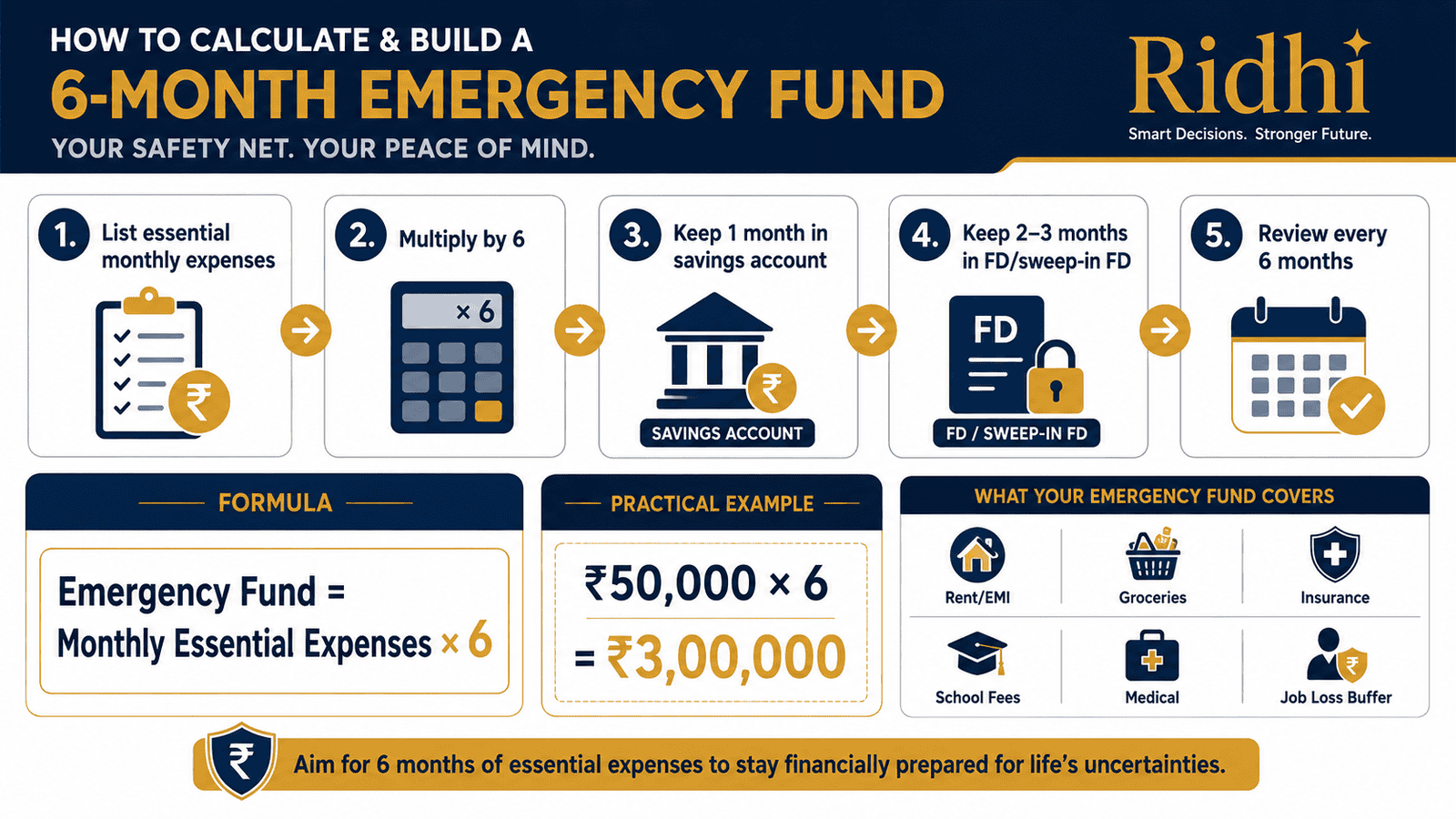
A 6-month emergency fund in India is money kept aside to cover six months of essential expenses such as rent, EMI, groceries, insurance, school fees and medical costs. If your monthly essentials are ₹50,000, your target emergency fund is ₹3,00,000, kept in safe and easily accessible options.
Key Takeaways
- Calculate your emergency fund from essential monthly expenses — not from your salary. A ₹95,000 salary with ₹50,000 in essentials means your target is ₹3,00,000, not ₹5,70,000.
- Six months is a practical starting target for salaried employees; single-income families or those with EMI-heavy budgets should consider a 9–12 month buffer.
- Keep emergency money in savings accounts, fixed deposits, sweep-in FDs, or cautious liquid fund allocations — not in equity, crypto, or any product with a lock-in period.
- A credit card limit, ELSS investment, or EPF balance does not count as an emergency fund — each comes with conditions, lock-ins, or market risk.
- Save ₹10,000 per month and you build ₹1,20,000 in 12 months. That covers two months of essentials — a meaningful start even before you reach the full target.
- Review and top up your fund after any salary change, new EMI, rent increase, school fee revision, or medical diagnosis that changes your monthly cost of living.
- Once you use the fund, refill it before resuming discretionary spending or investments — treat refilling as your first financial priority after recovery.
Key Facts at a Glance
| Factor | Details | Notes |
|---|---|---|
| Recommended target | 3–6 months for stable income; 6–12 months for single-income or variable income | Based on essential expenses, not gross salary |
| Calculation base | Monthly essential expenses only | Exclude lifestyle, entertainment, discretionary spends |
| Best use cases | Job loss, medical gap, family emergency, urgent home repairs, delayed salary | Not for planned expenses like vacations or gadgets |
| Where to keep it | Savings account, FD, sweep-in FD, cautious liquid fund allocation | Liquidity and capital safety matter more than returns |
| What not to count | Credit card limit, equity mutual funds, EPF, stocks, crypto, long lock-in FDs | These are not liquid or reliable in an emergency |
| Review frequency | Every 6–12 months or after any major life change | Salary hike, new EMI, child’s school fees, rent increase |
| Official oversight | Bank deposits regulated by RBI; mutual fund products regulated by SEBI | rbi.org.in; sebi.gov.in |
What Is a 6-Month Emergency Fund and Why Does It Matter?
An emergency fund is a dedicated pool of money set aside exclusively for financial emergencies. It is separate from your salary account, separate from your investments, and separate from your savings goals. The purpose is simple: if your income stops or a large unexpected expense arrives, you do not have to liquidate investments, borrow from family, take a personal loan, or max out a credit card.
The 6-month figure is not arbitrary. Most job searches in India take between two and five months, especially at mid-level and senior roles where notice periods are longer and the number of available positions is smaller. Medical recoveries, insurance claim settlements, and legal or family emergencies rarely resolve in under a month. Six months gives most households a realistic runway to recover without permanent financial damage.
Emergency Fund vs Savings vs Investment — They Are Not the Same
Many salaried employees confuse these three and treat their savings account balance as their emergency fund. That is a mistake. Here is the practical difference:
Savings is money set aside for a planned goal — a wedding, down payment, or travel. It is earmarked and can be a year or more away. Investments — equity mutual funds, stocks, PPF, NPS — are for long-term wealth building. They carry risk, lock-ins, and can lose value in the short term. Emergency money must be instantly accessible, must not lose value, and must not require you to pay a penalty or wait three days to access it.
A ₹2,00,000 balance in your equity mutual fund is not emergency money. In a market downturn — which often coincides with economic stress and job losses — that ₹2,00,000 could be worth ₹1,40,000. You would also need 1–3 working days to redeem it. An emergency does not wait for settlement timelines.
Understanding why your emergency fund should come before aggressive investing is one of the most important sequencing decisions in personal finance. Emergency savings before investing — read this before deciding how to allocate your next salary credit.
Who Needs a Larger Buffer?
The 6-month guideline fits many salaried employees, but not all situations equally. A salaried employee with two incomes in the household, a permanent government job, or employer-provided health cover faces less income disruption risk than a freelancer, a contract employee, or the sole earner supporting ageing parents and school-going children. The base calculation is the same — essential monthly expenses multiplied by a buffer period — but the buffer period should reflect actual recovery time if income stopped today.
Real Example: Rohit’s Household in Pune
Rohit is 32, works as an IT professional in Pune, and takes home ₹95,000 per month. He supports his spouse and one child. His wife is not currently employed. Here is a breakdown of their household’s essential monthly expenses:
| Expense Category | Monthly Amount |
|---|---|
| Home loan EMI | ₹22,000 |
| Groceries and household items | ₹8,000 |
| Utilities (electricity, water, gas, mobile) | ₹3,500 |
| Child’s school fees (monthly portion) | ₹5,000 |
| Health and term insurance premiums (monthly portion) | ₹4,500 |
| Medicines and routine medical | ₹2,000 |
| Transport (commute) | ₹3,000 |
| Minimum credit card payment (if any) | ₹2,000 |
| Total essential monthly expenses | ₹50,000 |
Rohit’s emergency fund target: ₹50,000 × 6 = ₹3,00,000.
He currently saves ₹10,000 per month specifically toward this fund. At that rate, he will reach ₹1,20,000 in 12 months and ₹3,00,000 in 30 months. To speed this up, he could redirect a bonus or reduce discretionary spending temporarily. The key insight here: the target is based on what the household must spend every month, not on what Rohit earns. His ₹95,000 income is irrelevant to the calculation.
How to Calculate Your Emergency Fund Target
Emergency Fund = Monthly Essential Expenses × 6
Follow these five steps to arrive at your number:
Step 1 — List essential monthly expenses. Include: rent or home loan EMI, groceries, utilities, school fees, insurance premiums (health, term, vehicle), medicines, transport, and any minimum debt obligations.
Step 2 — Exclude discretionary and lifestyle expenses. Do not include OTT subscriptions, restaurant meals, shopping, travel, gym memberships, or entertainment. These can be paused in an emergency; essentials cannot.
Step 3 — Multiply by 6. This gives you the standard 6-month target. For a household with ₹50,000 in essentials, the target is ₹3,00,000.
Step 4 — Adjust upward if needed. Add one or two extra months if you are the sole earner, have a variable income, carry heavy EMI obligations, have elderly dependents with medical needs, or work in a sector with high layoff risk.
Step 5 — Use a structured tool to verify. Calculate your safety amount using our emergency fund calculator, which walks you through each expense category systematically. For building the expense baseline, create your monthly budget first if you are not sure exactly where your money goes each month.
| Scenario | Monthly Essentials | 6-Month Target |
|---|---|---|
| Single person, rented flat, no dependents | ₹25,000 | ₹1,50,000 |
| Couple, no children, one home loan EMI | ₹40,000 | ₹2,40,000 |
| Family of three, school-going child | ₹50,000 | ₹3,00,000 |
| Family with elderly parents, higher medical needs | ₹65,000 | ₹3,90,000 |
Comparison: Where to Keep Your Emergency Fund
| Storage Option | Liquidity | Suitable for Emergency Fund? |
|---|---|---|
| Savings account | Instant — same-day access via UPI or ATM | Yes — core option |
| Fixed deposit (FD) | 1–2 working days; premature withdrawal may attract a penalty | Partial — for portion beyond 1 month |
| Sweep-in FD | Instant — sweeps back to savings account automatically | Yes — strong option for liquidity + structure |
| Liquid mutual fund | T+1 business days; subject to exit load if redeemed early | Cautious — possible for larger corpus, check terms |
| Cash at home | Immediate | Small amounts only — not full fund |
| Equity mutual fund / stocks | T+1 to T+3; market value fluctuates | No — market risk defeats the purpose |
| Credit card limit | Instant but creates new debt | No — borrowing is not a safety buffer |
| EPF / PPF | Days to weeks; partial withdrawal rules apply | No — lock-ins and conditions reduce reliability |
A practical split for a ₹3,00,000 emergency fund: keep ₹75,000–₹1,00,000 in your savings account for immediate access, place ₹1,50,000–₹2,00,000 in a sweep-in FD or regular FD ladder, and optionally keep a small portion in a liquid fund if you are comfortable with T+1 redemption. For more on fixed deposits as part of this structure, read use fixed deposits wisely and understand sweep-in deposits to see how the sweep-in structure gives you FD-like returns with instant access.
You are a salaried employee with stable dual income and no dependents — THEN 3–4 months of essential expenses may be a reasonable starting target, building toward 6 months over time.
You are the sole earner in a family with a home loan EMI, school fees, and no passive income — THEN target 6–9 months of essential expenses minimum.
You are a freelancer, contractual employee, or work in a sector with seasonal income — THEN target 9–12 months given the higher income interruption risk.
You have elderly parents or family members with chronic illness as dependents — THEN add a dedicated medical buffer of 1–2 months of extra essentials on top of your base target.
You have not yet identified your essential monthly expenses clearly — THEN build your monthly budget first before calculating the emergency fund target. Create your monthly budget step by step.
You are carrying high-interest personal loan or credit card debt — do NOT divert every rupee to the emergency fund. Build a starter fund of 1–2 months first, then split savings between debt repayment and fund building.
Common Mistakes to Avoid
Counting Your Credit Card Limit as Emergency Money
A credit card is a short-term borrowing facility, not a safety net. Using it in an emergency means you enter the next month with debt, interest charges, and a reduced credit limit — on top of whatever emergency you were dealing with.
A ₹1,00,000 credit limit used in a medical emergency can generate ₹3,000–₹4,000 in monthly interest if not cleared quickly. Your emergency fund replaces the need to borrow.
Keep your credit card for convenience purchases you clear every month — not as a financial fallback.
Investing Emergency Money in Equity or Crypto
Emergency money placed in equity mutual funds or stocks can lose 20–30% of its value in the same economic downturn that caused your job loss. You would need to redeem at a loss precisely when you need the money most.
The purpose of emergency money is capital preservation and instant access — not returns. Even a 1% higher return is not worth the risk of a 25% portfolio decline in a crisis.
Keep emergency money only in products where ₹3,00,000 today will still be ₹3,00,000 — or more — tomorrow.
Stopping After One or Two Months’ Coverage
Many people save one or two months of expenses and declare themselves covered. This is better than nothing, but it is not a 6-month fund. One medical hospitalisation or a three-month job gap will exhaust this in weeks.
Set up a standing instruction from your salary account to automatically move a fixed amount each month until you hit the full target.
Ignoring EMI, School Fees, and Insurance Premiums in the Calculation
These are non-negotiable monthly obligations. Missing an EMI affects your credit score. Missing a school fee creates stress at home. Missing an insurance premium can lapse your cover.
If your essentials calculation omits these, your target is understated. Rohit’s ₹50,000 includes his EMI, school fees, and insurance — that is the right way to count.
Using the Fund for Non-Emergency Expenses
Holidays, gadgets, weddings of friends, and festive shopping are not emergencies. Using the emergency fund for these leaves you exposed when a real emergency arrives.
If you need to use the fund, ask yourself: would this expense exist if I lost my job today? If yes, it may qualify. If no, it does not. Read more on what to do when you do face job loss at prepare for job loss.
Never Reviewing the Amount After Life Changes
A salary hike, a new home loan, a second child, a rent increase, or a parent becoming dependent on you changes your essential monthly expenses. A fund sized for your old life is no longer adequate.
Review your emergency fund target every 12 months or immediately after any major financial change.
When This May Not Be the Right Choice
A strict 6-month target may need adjustment in some situations. If you are carrying high-interest personal loans or credit card debt above 18% per annum, building a full 6-month fund first means paying heavy interest on debt for longer. In this case, building a 1–2 month starter fund and then splitting monthly savings between debt repayment and fund building may serve you better.
If your household has excellent dual income, employer-provided health insurance, gratuity, and no dependents, you may reach financial stability with a 3–4 month buffer while directing additional savings to investments sooner.
If you have no health insurance at all and a family with existing medical conditions, the 6-month emergency fund alone may not cover a serious hospitalisation. Building health insurance cover in parallel is a connected priority — understand what health insurance covers before deciding how much of your fund to allocate toward medical emergencies specifically.
If any of these apply to your situation, it may be worth exploring alternatives before committing.
Official Rules and Where to Verify
Emergency fund products sit within India’s regulated financial system. Here is where to verify key product terms:
- RBI — rbi.org.in: For savings account interest rates, fixed deposit regulations, sweep-in FD guidelines, and bank deposit insurance rules (up to ₹5,00,000 per depositor per bank under DICGC).
- SEBI — sebi.gov.in: For mutual fund product terms, liquid fund risk classifications, exit load norms, and investor education materials. Check the specific fund’s scheme information document before placing emergency money in any mutual fund.
- Your bank’s official site: For premature FD withdrawal penalties, sweep-in FD minimum balance requirements, and specific savings account terms. Rates and penalties vary significantly by bank.
Rules, limits, and rates on this topic can change with each Budget or regulatory update. Always verify current figures directly from the official source before making any financial decision.
Expert Tips
- Open a dedicated account for emergency money. A separate savings account — ideally at a different bank from your salary account — reduces the temptation to spend it. Even a zero-balance savings account at a second bank works well for this purpose.
- Automate the transfer on salary day. Set a standing instruction to move a fixed amount — say ₹8,000 or ₹10,000 — to the emergency fund account within 24 hours of your salary credit. Treat it like a non-negotiable EMI to yourself.
- Build in milestones: one month, then three, then six. Reaching ₹50,000 (one month of essentials) is a genuine milestone. Celebrate it, then target ₹1,50,000. Milestones prevent the fund from feeling like a distant abstract goal.
- Keep at least one month of essentials instantly accessible. Even if you place most of the fund in an FD for slightly better returns, keep a meaningful amount — at minimum one month of essentials — in a savings account or sweep-in FD that is accessible within hours, not days.
- Refill before resuming investments after a withdrawal. If you use ₹80,000 from the fund for a medical emergency, your first financial priority after recovery is refilling that ₹80,000 — before restarting SIPs, buying anything discretionary, or increasing investments.
- Use a bonus or tax refund to accelerate the build-up. An annual bonus or income tax refund is an opportunity to significantly shorten the time to reach your target. Directing even 30–40% of a windfall toward the emergency fund can cut build time in half.
- Do not count your EPF balance as emergency money. EPF partial withdrawals are governed by specific rules, require processing time, and are not reliably instant. Your emergency fund must be accessible independently.
Frequently Asked Questions
How much emergency fund should I have in India?
The standard guidance is 3–6 months of essential monthly expenses for most salaried employees. If you are a single earner, have dependents, carry heavy EMIs, or work in a variable income field, target 6–12 months. The base is always essential expenses — not your gross salary.
Is 6 months enough for a family with dependents?
For most families, 6 months covers the most common disruptions: a job gap, a medical emergency, or a temporary income loss. If your household has elderly parents with medical needs, young children, or only one earning member, consider building toward 9 months. The right number depends on how long it would realistically take your household to recover financially if income stopped today.
Should I keep my emergency fund in an FD or a savings account?
Ideally both. Keep 1–2 months of essentials in a savings account for same-day access. Place the remaining amount in a fixed deposit or sweep-in FD for slightly better returns while maintaining reasonable liquidity. A sweep-in FD is particularly useful because it sweeps unused balances into an FD automatically while keeping the money accessible if needed.
Can I keep emergency money in a liquid mutual fund?
Liquid funds offer better returns than a savings account and T+1 business day redemption for most. However, they are not completely without risk — they can have mild NAV fluctuations and may have exit loads if redeemed very quickly after investment. Liquid funds may work for a portion of a larger emergency corpus but are generally not ideal for the full amount. Check the scheme’s exit load terms and redemption timeline at the fund house’s official site before deciding.
Should I build an emergency fund before I start investing?
Yes, for most people. Starting SIPs or equity investments before you have any financial safety net means a job loss or medical event could force you to redeem investments at a loss — often at the worst possible market moment. A starter fund of even 1–2 months of essentials before beginning investments is a more resilient approach.
Is health insurance a replacement for an emergency fund?
No. Health insurance covers hospitalisation costs subject to policy terms, exclusions, waiting periods, and sub-limits. It does not replace your salary if you cannot work. It does not cover non-medical emergencies. It does not cover expenses your policy excludes. An emergency fund and health insurance serve different purposes and both are necessary.
What if I can only save ₹3,000 or ₹5,000 per month toward the fund?
Start anyway. ₹5,000 per month reaches ₹60,000 in 12 months — more than one month of essentials for many households. That is meaningfully better than nothing. Increase the monthly contribution when your income rises or when a discretionary expense ends. The key is consistency, not speed.
Can I use my emergency fund for a planned big expense?
No. A planned expense — a wedding, a vehicle purchase, a home renovation — should be saved for separately in a dedicated savings goal. Using the emergency fund for planned expenses leaves you exposed when an actual emergency arrives. If you use it anyway, treat refilling it as your first financial priority before any other non-essential spending.
Final Verdict
A 6-month emergency fund is one of the most practical and high-impact financial decisions a salaried Indian household can make. It is not glamorous — it earns modest returns and sits quietly in a savings account or FD. But it is the difference between handling a job loss or medical event from a position of stability versus panic-borrowing at high interest and disrupting long-term financial plans.
Calculate your fund from essential monthly expenses, not from your salary. Keep it safe, accessible, and completely separate from your investment portfolio. Start with whatever amount you can — even ₹5,000 per month — and build consistently toward the full target. Once you reach it, review it every year. The fund that covers your life in 2024 may no longer be sufficient in 2026 after a rent increase, a new EMI, or a change in family structure.
Your first action: list your essential monthly expenses, multiply by 6, and set a standing instruction for next month’s salary. Always verify the latest rules from official sources or consult a qualified professional before making any financial decision.
This article is for educational purposes only and should not be treated as personalised financial, tax, investment, insurance, or legal advice. Tax rules, interest rates, regulatory limits, and product features can change with each Budget or policy update. Please verify current rules from official government sources or consult a qualified and registered professional before making any financial decision.

Sanya Malhotra writes about everyday personal finance for Indian individuals and families. Her content focuses on budgeting, saving, emergency funds, debt control, net worth tracking, family money decisions, and practical habits that help readers manage money with more confidence.
She covers topics such as monthly budgeting, expense planning, saving habits, emergency fund behaviour, debt repayment, household financial planning, family discussions about money, financial mistakes, net worth tracking, short-term vs long-term goals, and beginner personal finance concepts.
Sanya’s writing style is warm, simple, and realistic. She avoids making personal finance feel intimidating and instead explains money decisions through relatable Indian examples, ₹ budgets, checklists, and step-by-step frameworks. Her articles are useful for students, freshers, couples, parents, and families who want to improve daily money habits. Her content is educational and does not provide personalised financial advice. Readers should adapt examples to their own income, family responsibilities, city, debt level, risk comfort, and financial goals.