
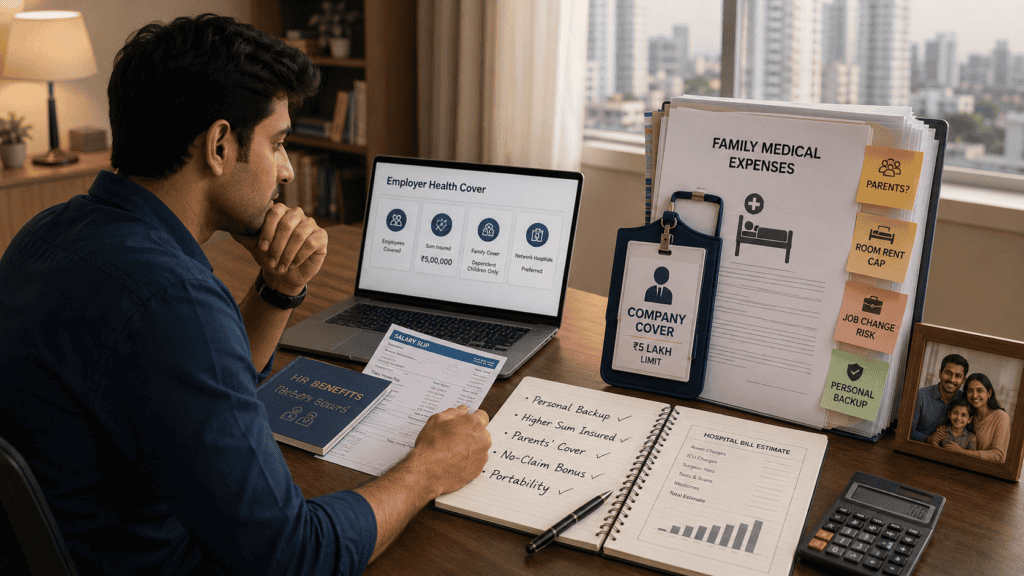
Your HR sends a welcome email on day one: “You are covered under our group health insurance policy.” You note it down, feel reassured, and move on. Most salaried employees in India do exactly this — and never look at the policy document again until a hospitalisation bill arrives. Group health insurance by employer is a genuine benefit. But when a ₹12 lakh cardiac surgery bill lands, a ₹3 lakh sum insured does not cover it. This article explains exactly what employer health cover includes, where it silently fails, and how to decide whether you need backup cover for yourself and your family.
Quick Answer: Group Health Insurance by Employer
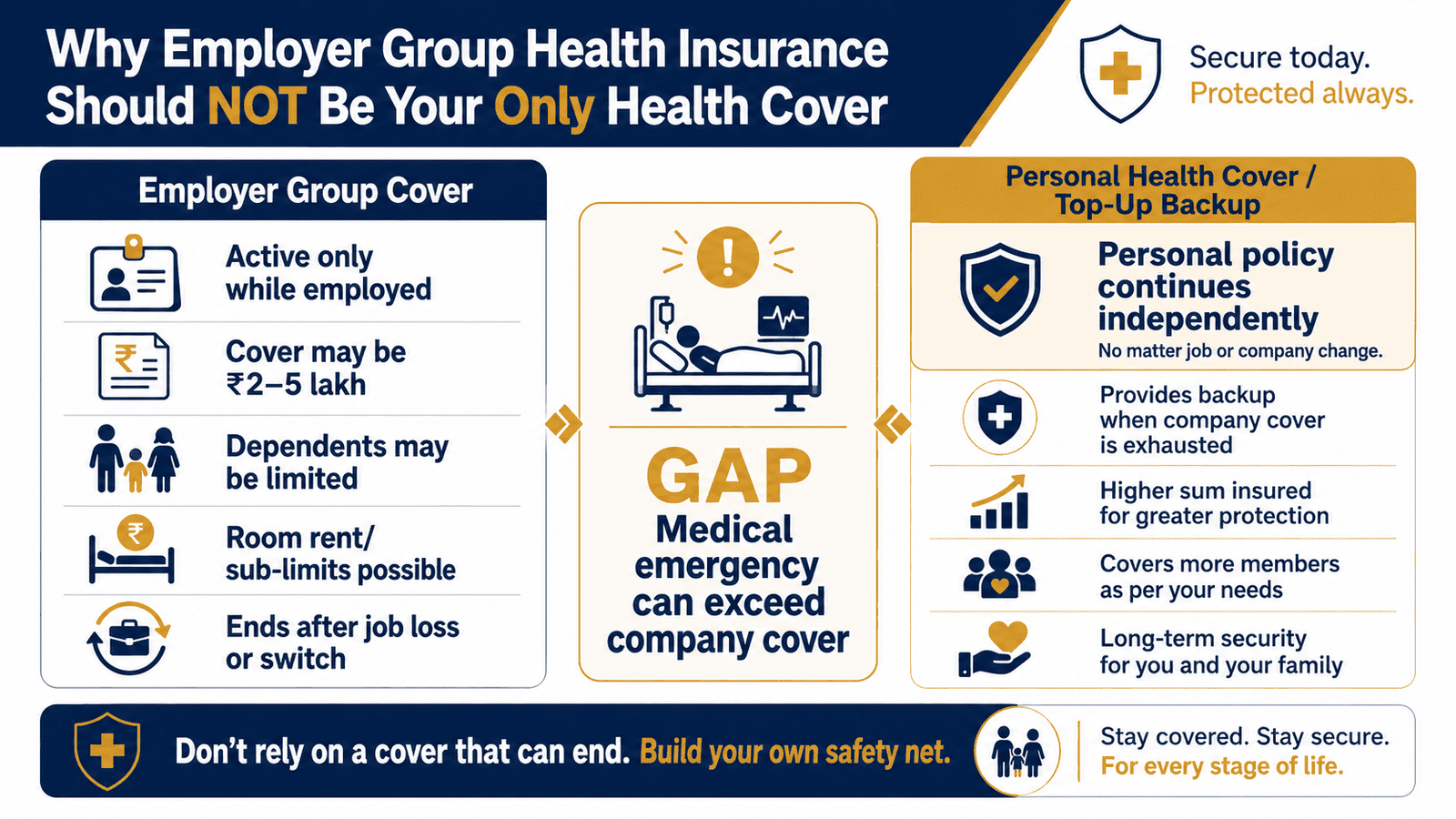
Group health insurance by employer is useful because it usually gives employees basic hospitalisation cover at low or no personal premium. But it may not be enough if the sum insured is only ₹2–5 lakh, dependents are limited, sub-limits apply, or the cover ends after job loss.
Key Takeaways
- Your employer group mediclaim policy is owned by your company — not you. It can change or end when you leave the job.
- Many employer policies cap sum insured at ₹3–5 lakh per family per year, which may not cover a single major hospitalisation in a metro city.
- Room rent sub-limits, co-payment clauses, and consumables exclusions can significantly reduce the actual claim amount you receive — even within the sum insured.
- Dependent parents may not be automatically included; where they are, co-pay and sub-limits are often stricter for senior-citizen dependents.
- Waiting periods for pre-existing diseases are sometimes waived or reduced in group policies — a real advantage to use while you are employed, but one you lose the moment you leave.
- Buying a personal or family floater policy while you are young and healthy locks in lower premiums and starts the waiting period clock early.
- A top-up or super top-up plan on top of employer cover can extend your effective coverage to ₹25–50 lakh at relatively low additional premium.
Key Facts at a Glance
| Feature | What Salaried Employees Should Check |
|---|---|
| Sum insured | Is it ₹3 lakh, ₹5 lakh, or higher? Does it apply per person or as a family floater? |
| Covered members | Are spouse, children, and parents included, or only the employee? |
| Room rent limit | Is it capped at 1% of sum insured per day? A lower-tier room limit can reduce the entire bill proportionally. |
| Co-payment clause | Do you pay 10–20% of every claim amount from your own pocket? |
| Pre-existing disease cover | Waiting period waived from day one, or is there still a waiting period? |
| Maternity benefit | Is it included? What is the waiting period and the sub-limit? |
| Continuity after job change | Does IRDAI portability apply? What is the conversion window? |
| TPA and cashless hospitals | Is your nearest hospital in the network? Does it process cashless claims? |
How Group Health Insurance by Employer Works in India
When a company offers group health insurance, it buys a single master policy from an insurer and adds eligible employees — and sometimes their dependents — as members. The employer is the master policyholder. You, the employee, are a covered member. This distinction matters far more than most employees realise.
Because the employer negotiates and renews the policy each year, terms can change at renewal — the insurer can be swapped, the sum insured adjusted, co-payment clauses added, or the list of covered dependents revised. You have no say in these decisions. The policy is an employer benefit, not a personal insurance contract.
What Group Cover Typically Includes
Most corporate health insurance policies cover inpatient hospitalisation for at least 24 hours, day-care procedures, pre- and post-hospitalisation expenses (within defined windows), and ambulance charges. Many group policies also offer cashless treatment at network hospitals, which makes the claim process significantly easier during a medical emergency.
Unlike individual policies, group mediclaim policies often cover pre-existing diseases from day one — with no waiting period. This is one of the strongest advantages of employer cover, especially for employees who have conditions like diabetes or hypertension. To understand what health insurance generally covers and excludes, read our guide on health cover basics.
What Group Cover Typically Excludes or Limits
Room rent is one of the most common sources of claim shock. If your policy has a room rent sub-limit — say 1% of sum insured per day — and you occupy a room above that limit, the insurer can proportionally reduce the entire associated bill, not just the room charges. On a ₹5 lakh policy, the daily room rent limit would be ₹5,000. Upgrading to a ₹10,000 room can trigger a 50% proportional deduction across surgeon fees, ICU charges, and other hospital costs.
Co-payment clauses mean you pay a fixed percentage of every eligible claim — often 10–20% — from your own pocket. Consumables such as gloves, syringes, and PPE kits are routinely excluded from group policies. In a post-pandemic hospitalisation, consumables alone can add ₹15,000–₹40,000 to a bill.
The Job-Linkage Problem
The cover exists only while you are employed with that company. Resign, get laid off, or switch to freelancing — and the cover ends, sometimes on the last working day itself. According to IRDAI guidelines, insurers must offer portability options, but exercising portability requires action within a specific window. Many employees miss this window entirely and find themselves without health insurance at the exact moment they are between jobs.
Real Example: Rohit’s ₹12 Lakh Hospital Bill
Rohit, 32, is a senior software engineer in Pune earning ₹22 lakh per year. His employer provides a group health insurance policy with a ₹5 lakh sum insured covering him, his wife, and their 4-year-old child. His father, 64, is listed as a dependent under the same policy with a 20% co-payment clause for senior citizens.
In October, his father is admitted for cardiac bypass surgery. The hospital bill comes to ₹12 lakh. Here is how the claim plays out: The ₹5 lakh sum insured is the family floater limit — already partially used earlier in the year for his child’s appendectomy (₹1.2 lakh). Remaining cover: ₹3.8 lakh. The 20% co-pay on his father’s claim means Rohit bears 20% of the eligible amount. The room rent sub-limit triggers a proportional deduction on the surgeon and ICU fees. After all adjustments, the insurer settles approximately ₹2.9 lakh. Rohit pays over ₹9 lakh out of pocket.
A personal family floater policy with a ₹15 lakh sum insured — or a super top-up plan above the employer cover deductible — could have absorbed much of that gap. One policy gap, one hospitalisation, and a year’s savings are gone.
How to Calculate Whether Your Employer Cover Is Enough
Coverage Gap = Estimated Serious Hospitalisation Cost − Usable Employer Cover
Work through this in five steps:
Step 1 — Note your employer sum insured. Check your HR benefits document. Is it ₹3 lakh, ₹5 lakh, or higher? Is it a floater (shared by family) or individual per member?
Step 2 — List covered members. Are your spouse, children, and parents included? What co-pay or sub-limits apply to each?
Step 3 — Estimate one major hospitalisation cost in your city. A cardiac bypass in a private hospital in a metro can cost ₹8–15 lakh. A knee replacement: ₹4–8 lakh. A premature birth with NICU: ₹5–12 lakh. These are rough planning estimates — actual costs vary by hospital, procedure, and complications.
Step 4 — Calculate the gap. Subtract the usable employer cover (after accounting for co-pay, room rent deductions, and amounts already used) from the estimated bill. The remainder is your out-of-pocket exposure.
Step 5 — Consider the backup. A top-up or super top-up plan kicks in above a deductible threshold and extends your effective coverage significantly. A personal base policy ensures continuity if you change jobs.
| Scenario | Employer Cover Available | Estimated Out-of-Pocket Gap |
|---|---|---|
| ₹5L floater, no top-up, cardiac surgery ₹10L | ~₹4L (after co-pay and sub-limits) | ~₹6L+ |
| ₹5L floater + ₹20L super top-up (₹5L deductible) | ₹5L employer + ₹15L top-up | Minimal to nil |
| ₹3L individual cover, family of 4, ortho surgery ₹7L | ~₹2.5L (after deductions) | ~₹4.5L+ |
Comparison: Employer Group Cover vs Individual/Family Health Insurance
| Parameter | Employer Group Cover | Personal Health Insurance |
|---|---|---|
| Ownership | Employer owns the master policy | You own the policy |
| Continuity | Ends with employment | Renewable independently |
| Sum insured | Company-decided; often ₹3–5 lakh | You choose; ₹5–50 lakh or more |
| Dependents | Company-defined list and terms | You define your family structure |
| Premium cost | Company pays or subsidises | You pay full premium |
| Pre-existing disease waiting | Often waived or reduced | Typically 2–4 years waiting period |
| Customisation | Limited; no add-on choice | Choose add-ons, deductibles, network |
| Policy terms | Can change at annual renewal | Stable unless you choose to change |
Neither option is universally superior. The best strategy for most salaried families is to use employer cover as the first layer and maintain a personal policy as the continuity and gap layer. For help choosing between individual and family floater structures for your personal backup cover, read our comparison of family floater choice.
How to Decide What’s Right for You
You are single, under 30, and your employer cover is ₹5 lakh or more with no dependents — THEN employer cover may be adequate for now, but buy a basic personal policy early to start the waiting period clock before any health conditions develop.
You are married with children and your employer floater is ₹3–5 lakh shared across the family — THEN the cover is likely insufficient for a major family hospitalisation; consider a separate family floater of ₹10–15 lakh or a super top-up plan.
Your dependent parents are added to the employer policy with a 20% or higher co-pay clause — THEN explore a separate senior-citizen health policy for them, as high co-pay can still leave you with significant out-of-pocket costs on large claims.
You are planning to switch jobs, move to a startup, or consider freelancing in the next 2–3 years — THEN a personal policy is not optional; buy it now, while you are in good health and have a clean medical history.
Your employer sum insured is ₹5 lakh and you want higher coverage without paying a full separate policy premium — THEN a super top-up with a ₹5 lakh deductible may extend your cover to ₹25–50 lakh at a fraction of the cost of a standalone policy. Explore top-up health cover options.
Your employer policy has room rent sub-limits below ₹5,000 per day and you live in a metro — THEN a hospitalisation at a mid-tier private hospital will likely trigger proportional deductions across the entire bill, not just room charges.
You have no dependents, excellent employer cover of ₹10 lakh or above, zero co-pay, and no family health history of chronic illness — personal cover is still advisable for continuity, but urgency is lower compared to families with dependents and limited employer cover.
Common Mistakes to Avoid
Assuming cover continues after resignation
Many employees believe their health insurance stays active for a grace period after leaving a job. In most group policies, cover ends on the last working day or the date of formal exit. This leaves a critical window — sometimes months — without any health protection while between jobs.
Buy a personal policy before resigning. Understand the IRDAI portability window so you can convert group cover to an individual policy if needed. Read about waiting period rules before assuming seamless continuity.
Not reading the room rent sub-limit
A room rent cap of 1% of sum insured per day sounds harmless. On a ₹5 lakh policy, that is ₹5,000 per day. But if you occupy a ₹9,000 room, the insurer applies a 44% proportional deduction across the entire associated bill — including surgeon fees and ICU charges — not just the room difference.
Check whether your policy has a room rent sub-limit. If it does, request hospitals to assign you a room within the eligible category, or accept that you will absorb the proportional deduction.
Adding parents without checking senior-citizen co-pay clauses
Adding dependent parents to the employer policy seems like a simple win, but many group policies apply a 20–30% co-pay specifically for senior-citizen dependents. On a ₹10 lakh claim for a parent, that co-pay means ₹2–3 lakh directly from your savings.
Compare the employer’s parent cover terms against a standalone senior-citizen mediclaim policy. In many cases, a separate policy with zero co-pay and higher sum insured works out more effectively despite the premium.
Waiting until a health condition develops
The most common and costly mistake is delaying personal health insurance until after a diagnosis. Once you have a condition like diabetes, hypertension, or cardiac history, personal policies will either exclude that condition, apply loading on premiums, or impose multi-year waiting periods.
Buy a personal policy in your 20s or early 30s. The premiums are lower, the underwriting is cleaner, and waiting periods complete before you typically need the cover most.
Ignoring the portability option at job change
IRDAI regulations allow policyholders to port health insurance — but portability from a group policy to an individual policy must be applied for within a specific window before the group policy expires. Missing this window means starting fresh with a new policy, losing continuity benefits, and restarting all waiting periods.
When switching jobs, immediately check the portability timeline and initiate the process with your insurer or a broker.
Treating employer cover as a complete financial protection plan
A ₹3–5 lakh group policy covering a family of four in a metro city is not adequate standalone protection. A single hospitalisation for a cardiac event, cancer treatment, or serious orthopaedic surgery can exhaust it entirely — and additional treatment costs and follow-up care fall entirely on you.
Think of employer cover as layer one in a multi-layer health protection plan, not as the final word on your family’s medical security.
When This May Not Be the Right Choice
Relying exclusively on employer group health insurance may not be sufficient in these specific situations:
You have dependents with chronic health conditions. If a parent or spouse has diabetes, hypertension, heart disease, or a history of major illness, a ₹3–5 lakh floater shared across the family is likely to be exhausted in a single hospitalisation year. Personal cover with higher sum insured provides the additional layer these situations require.
Your employer cover excludes or severely limits parent coverage. Many mid-size companies either exclude dependent parents entirely or include them with 20–30% co-pay. A senior citizen’s hospitalisation with these terms can still leave you paying ₹2–4 lakh out of pocket on a covered claim.
You are planning a career transition within 2–3 years. Switching employers, going freelance, starting a business, or taking a sabbatical all create a coverage gap. Employer cover evaporates the day you leave. If you wait until after the transition to buy personal cover, you may be older, potentially have new health conditions, and face higher premiums and waiting periods.
Your employer policy changes materially at renewal. Group policy terms are renegotiated every year. An insurer switch, sum insured reduction, or new co-pay clause can significantly change your protection — without any notice obligation to you as an employee member.
If any of these apply to your situation, it may be worth exploring alternatives before committing.
Official Rules and Where to Verify
The rules governing group health insurance in India — including portability rights, standardised exclusions, and claim settlement timelines — are set and updated by IRDAI. Tax deduction rules for premiums paid toward personal health insurance are governed by the Income Tax Department.
Always verify the following directly:
- IRDAI (irdai.gov.in) — for insurance regulation, consumer rights, portability rules, and standardised health insurance guidelines
- Income Tax Department (incometax.gov.in) — for current Section 80D deduction limits for health insurance premiums
- Your employer’s HR benefits portal or policy document — for your specific group policy terms, covered members, sub-limits, and TPA details
- Your insurer’s customer information sheet — for exclusions, room rent, co-pay, and claim procedures
- TPA cashless hospital network list — to confirm your nearest hospitals are empanelled for cashless claims; see how cashless claim process works
Rules, limits, and rates on this topic can change with each Budget or regulatory update. Always verify current figures directly from the official source before making any financial decision.
Expert Tips
- Ask HR for the complete policy wording — not just the benefits summary slide. The benefits presentation shows the headline sum insured. The actual policy document contains the room rent sub-limits, co-pay clauses, exclusion lists, and waiting period terms that determine real claim outcomes. Request the Customer Information Sheet or master policy copy from HR or your company’s insurer TPA.
- Buy personal health insurance while you are healthy — not when you need it. A 28-year-old with a clean medical history can get a ₹10 lakh individual policy at a fraction of what a 38-year-old with hypertension would pay. Waiting even 5 years typically means higher premium, possible loading, and possible exclusions.
- Use employer cover first when it has better waiting-period terms. If your group policy covers pre-existing diseases from day one, use it for eligible claims during employment — but keep your personal policy active simultaneously so waiting periods are running and continuity is maintained.
- A super top-up plan is cost-efficient gap cover for most salaried employees. If your employer provides ₹5 lakh cover, a super top-up with a ₹5 lakh deductible and ₹20 lakh cover kicks in after the employer policy is exhausted — typically at a lower premium than buying a standalone ₹20 lakh base policy.
- Keep an emergency fund for medical expenses that health insurance will not pay. Consumables, non-payable items, deductibles, and co-pay amounts are common out-of-pocket costs that no policy covers fully. An accessible emergency fund of ₹1–2 lakh prevents these from turning into debt.
- Check the 80D deduction benefit if you pay separate health insurance premiums. Section 80D of the Income Tax Act provides a deduction for health insurance premiums paid for self, spouse, children, and parents — subject to current limits. If you are paying for a personal or top-up policy, ensure you are claiming this benefit. See the detailed tax benefit rules for current limits and eligibility from the Income Tax Department at incometax.gov.in.
- Set a calendar reminder to review your employer policy at renewal. Group policies renew annually. If your employer switches insurer, changes TPA, or adjusts terms, you need to know before the next hospitalisation — not during it.
Frequently Asked Questions
Is employer health insurance enough in India?
For a single employee with no dependents, employer cover may be adequate for routine hospitalisation. For a family with children, dependent parents, or members with health conditions, a group policy with ₹3–5 lakh sum insured is typically insufficient for a major hospitalisation in a metro city. Most financial planners treat employer cover as a first layer and recommend a personal backup policy.
Does company health insurance cover parents?
It depends entirely on your employer’s policy terms. Some companies include dependent parents; others do not. Even where parents are covered, many group policies apply a higher co-payment — often 20–30% — specifically for senior-citizen dependents. Check your HR policy document for the exact terms before assuming parents are covered.
What happens to employer health insurance after resignation?
In most cases, cover ends on your last working day or the date your employment formally ceases. IRDAI regulations provide a portability option that allows you to migrate group cover continuity benefits to an individual policy, but this must be applied for within the defined window before the group policy lapses. If you miss the window, you start fresh with a new policy and new waiting periods.
Should I buy personal health insurance if my company already covers me?
Yes, for most salaried employees with families. Employer cover is employment-linked and can change at annual renewal. A personal policy ensures continuity, allows you to choose your sum insured and add-ons, and remains yours regardless of where you work. Buying early also locks in lower premiums and starts waiting period completion sooner.
Is corporate health insurance better than individual health insurance?
Not better or worse — they serve different purposes. Corporate health insurance is typically subsidised or free, covers pre-existing diseases with minimal waiting, and is easy to access. Individual health insurance is owned by you, portable across jobs, and customisable. The most practical approach for salaried families is to use both as complementary layers.
Can I port group health insurance to an individual policy?
IRDAI regulations include provisions for portability that may allow migration of continuity benefits from a group policy to an individual policy when transitioning. However, the specific process, timelines, and eligibility conditions depend on the insurer and the terms of your group policy. Check directly with your insurer well before your employment ends rather than after.
Does employer health insurance cover pre-existing diseases?
Many group mediclaim policies cover pre-existing diseases from day one without a waiting period, which is one of the major advantages of employer cover over most individual policies. However, this applies while you remain employed. If you move to a personal policy later, standard pre-existing disease waiting periods — typically 2–4 years — apply unless you port with continuity benefits intact.
Is the premium for employer-provided health insurance taxable as a perquisite?
The tax treatment of employer-paid group health insurance premiums can vary based on how the benefit is structured. This is subject to Income Tax rules that can be updated in each Budget. Check the current provisions at incometax.gov.in or consult a qualified tax professional for your specific situation.
What is a room rent sub-limit and how does it affect my claim?
A room rent sub-limit caps the daily hospital room charges your policy will pay — often 1% of the sum insured per day. If you occupy a room above this limit, insurers typically apply a proportional deduction across the entire associated hospital bill, including surgeon fees, ICU charges, and nursing costs — not just the excess room rent. This is one of the most underestimated claim reducers in group and individual health policies.
Can I claim an 80D tax deduction on my employer’s group health insurance?
If your employer pays the full premium and it is not deducted from your salary, you typically cannot claim 80D on it. However, if you pay an additional premium for dependent parents or for a personal top-up policy separately, that portion may be eligible for 80D deduction subject to current limits. Verify the exact rules at incometax.gov.in or with a tax professional, as thresholds can change with each Budget.
Final Verdict
Group health insurance by employer is one of the most valuable benefits a salaried job offers. It provides basic hospitalisation cover — often at zero personal premium — and frequently covers pre-existing diseases from day one. Use it. But do not mistake it for a complete health protection strategy.
The biggest risks are consistent: low sum insured for a family, employment-linkage that ends cover the day you leave, room rent and co-payment clauses that reduce actual payouts, and policy terms that change at every renewal without your input. Salaried employees with families — especially those with dependent parents or anyone planning a career change — should review their employer policy in detail and seriously evaluate a personal backup plan.
The right move for most people is to treat employer cover as layer one, buy or maintain a personal or family floater policy as layer two, and consider a top-up or super top-up as layer three. Start early: premiums are lower, waiting periods complete faster, and you are not scrambling at the worst possible moment.
Always verify the latest rules from official sources or consult a qualified professional before making any financial decision.
This article is for educational purposes only and should not be treated as personalised financial, tax, investment, insurance, or legal advice. Tax rules, interest rates, regulatory limits, and product features can change with each Budget or policy update. Please verify current rules from official government sources or consult a qualified and registered professional before making any financial decision.
Insurance is a subject matter of solicitation. Please read the policy document carefully before purchasing.

Priya Nambiar writes about insurance concepts for Indian families, salaried employees, self-employed professionals, and first-time policy buyers. Her content focuses on helping readers understand coverage, exclusions, claim conditions, premiums, riders, and policy documents before buying or renewing insurance.
She covers topics such as term insurance, health insurance, family floater plans, riders, critical illness cover, employer insurance vs personal insurance, waiting periods, exclusions, deductibles, co-payment, no-claim bonus, claim settlement, premium comparison, renewal rules, and tax benefits linked to insurance.
Priya’s writing is careful, consumer-focused, and policy-document oriented. She explains why insurance should be understood as financial protection, not just a tax-saving tool or investment substitute. Her articles encourage readers to compare coverage, understand limitations, and ask better questions before buying a policy. Premiums, exclusions, claim rules, and benefits vary by insurer, age, health, sum insured, and product type. Insurance is a subject matter of solicitation, and readers should read the official policy document carefully before purchasing.