

If you are a salaried professional paying ₹40,000–₹45,000 in rent every month and eyeing a ₹1+ crore flat, you have probably heard both sides. “Renting is throwing money away.” “Buying ties up all your capital.” Neither is completely right. The honest rent vs buy decision in India depends on a specific set of numbers — your EMI, your down payment, your city, your job stability, and how long you plan to stay put. This article breaks down every factor that matters: upfront costs, tax benefits, opportunity cost, property appreciation, and lifestyle trade-offs — using real Indian examples, clear calculations, and no vague advice. By the end, you will have a framework to make the call that actually fits your situation.
Quick Answer: Rent vs Buy
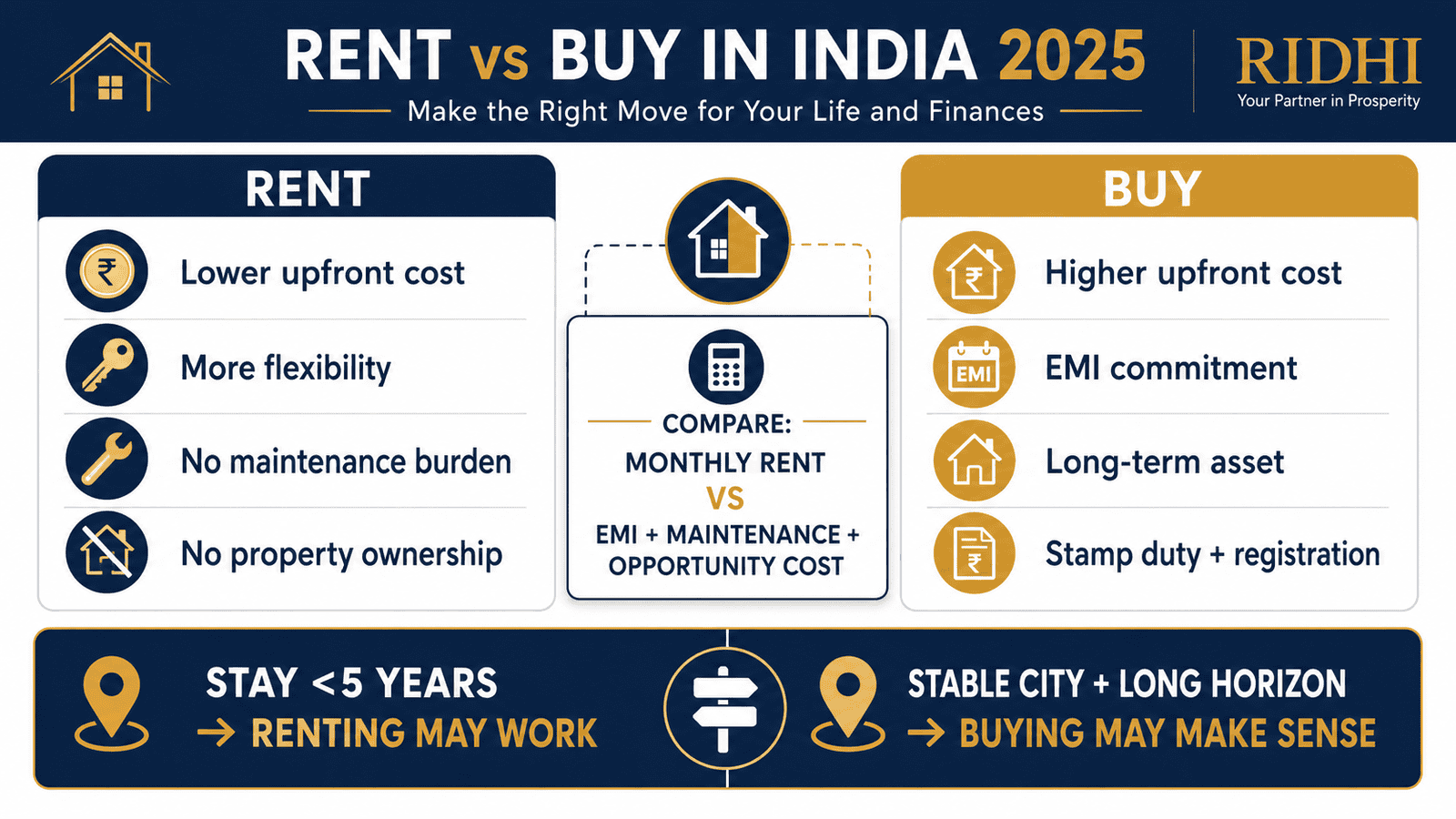
Rent vs buy depends on EMI affordability, city stability, down payment, rent, property price growth and opportunity cost. In India, buying may suit a family staying 7–10 years, while renting may work better if EMI is far higher than rent or your job location is uncertain.
Key Takeaways
- Buying a ₹1.2 crore flat with a 20% down payment at ~9% interest over 20 years results in an EMI of roughly ₹86,400 per month — more than double the typical ₹42,000 city rent for a comparable property in Bengaluru.
- Stamp duty and registration in most states add 5–8% to property cost upfront — that is ₹7.2 lakh or more on a ₹1.2 crore flat in Karnataka before a single EMI is paid.
- Section 24(b) and Section 80C deductions can reduce your effective home loan cost by up to ₹1,05,000 per year if you are in the 30% tax bracket and opt for the old tax regime.
- The ₹24 lakh down payment on a ₹1.2 crore flat, if instead invested at 8% CAGR, could grow to approximately ₹1.12 crore over 20 years — this is the silent opportunity cost most buyers ignore.
- Rental yields in India typically range from 1.5% to 3% per year — meaning a ₹1.2 crore flat ideally commands rent above ₹18,000–₹30,000 per month to justify its valuation.
- Buying rarely makes financial sense if you plan to stay for under 5 years; the break-even horizon in most Indian metros is 8–12 years when all costs are included.
- Renting preserves full liquidity and city flexibility — valuable if your career involves transfers, or if your income is growing and you could afford a better property in 3–4 years.
Comparison: Renting vs Buying a Home in India
| Factor | Renting | Buying |
|---|---|---|
| Upfront cash needed | Low 2–3 months deposit (₹84,000–₹1.26L at ₹42K/month) | High Down payment + stamp duty + registration = ₹31+ lakh on a ₹1.2Cr flat |
| Monthly outflow | Lower ₹42,000 rent (market-linked, can rise on renewal) | Higher ~₹86,400 EMI at 9% for 20 years on ₹96L loan |
| Tax benefit to occupant | None Tenant gets no direct income tax benefit (HRA applies only if employer provides it) | Yes Section 24(b): up to ₹2L/year on interest; Section 80C: up to ₹1.5L/year on principal |
| Flexibility to relocate | High Exit in 1–2 months with standard notice period | Low Selling takes months; prepayment and legal costs apply |
| Maintenance burden | Low Landlord handles major structural repairs | Full Society charges, property tax, all repairs — your responsibility |
| Wealth and equity building | None directly Surplus can be invested in stocks or mutual funds separately | Yes Builds equity with every EMI; benefits from property appreciation over time |
| Break-even advantage | Better If staying under 5–7 years in the city | Better If staying 8–12+ years in an appreciating location |
| Capital liquidity | Full No capital locked in property | Low ₹30+ lakh locked in upfront costs; difficult to exit quickly without loss |
Key Facts at a Glance
| Metric | Renting | Buying |
|---|---|---|
| Upfront cash required | 2–3 months deposit | 20% down payment + 5–8% stamp duty + ~1% registration |
| Home loan interest rate (floating) | Not applicable | ~8.5–9.5% p.a. depending on lender and RBI repo rate |
| Section 24(b) interest deduction | Not applicable | Up to ₹2 lakh per year (self-occupied property, old tax regime) |
| Section 80C principal deduction | Not applicable | Up to ₹1.5 lakh per year (principal repayment, old tax regime) |
| Typical rental yield in India | 1.5–3% of property value annually | Same — benchmark for evaluating if a property is priced fairly to rent |
| Standard deduction on rent received | 30% of gross annual rent (applies to landlord/owner) | 30% of gross rent if property is rented out |
| Typical break-even horizon | Favours renting if staying under 5 years | Favours buying after 8–12 years in most Indian metros |
What Does It Actually Cost to Buy a Home in India?
The advertised price of a property is never the full story. When you buy a ₹1.2 crore flat, you do not walk in with ₹1.2 crore. The real cost is meaningfully higher — and the gap matters enormously in the rent vs buy decision.
First, the down payment. Most banks and housing finance companies lend up to 75–80% of the property value, requiring you to arrange the remaining 20–25% yourself. On a ₹1.2 crore flat, that is ₹24–₹30 lakh in cash — money that leaves your hands the day you register the property, before your first EMI.
Next: stamp duty and registration. These are one-time government charges paid at the time of property registration. Stamp duty ranges from 4% to 8% depending on the state. In Karnataka, for example, the applicable rate works out to approximately 5%, which is ₹6 lakh on a ₹1.2 crore property. Registration adds roughly another 1%, or ₹1.2 lakh. That is ₹7.2 lakh in upfront government charges that have nothing to do with your loan or your monthly EMI.
Add interior costs, moving expenses, and a maintenance corpus for the first year, and the real upfront outlay on a ₹1.2 crore flat can easily exceed ₹35–₹38 lakh — before you pay a single EMI.
The Monthly Cash Flow Gap: EMI vs Rent
Once upfront costs are paid, the monthly burden begins. A ₹96 lakh home loan — after a 20% down payment on a ₹1.2 crore property — at 9% interest over 20 years generates an EMI of approximately ₹86,400 per month. A comparable flat in the same Bengaluru neighbourhood might rent for ₹42,000 per month. That is a gap of ₹44,400 every single month.
On top of the EMI, homeowners pay society maintenance charges (typically ₹3,000–₹8,000 per month depending on the complex), annual property tax, and repair costs not covered by the society. The true monthly cost of ownership in this example is closer to ₹90,000–₹95,000. That is more than twice the rent outflow — and the difference has to come from somewhere.
This does not mean buying is the wrong choice. It means the decision requires a clear plan for how this extra outflow is funded without straining your emergency savings or halting other investments.
Tax Benefits That Can Shift the rent vs buy Calculation
Homeowners in India get two income tax deductions that renters do not — and both are worth calculating carefully before finalising your rent vs buy call.
Under Section 24(b), you can claim a deduction of up to ₹2 lakh per year on home loan interest paid on a self-occupied property. If you are in the 30% tax bracket, this saves ₹60,000 per year — or ₹5,000 per month in effective tax reduction.
Under Section 80C, the principal repayment component of your EMI qualifies for deduction up to ₹1.5 lakh per year. If you have not already exhausted your ₹1.5 lakh 80C limit through EPF contributions, ELSS, or LIC premiums, this saves another ₹45,000 per year — or ₹3,750 per month.
Together, the maximum tax saving reaches ₹1,05,000 per year in the 30% bracket — a real and significant reduction to your effective EMI cost. There is one critical caveat: the new tax regime, which has been the default regime from FY 2023-24, does not allow either of these deductions. You must actively opt for the old tax regime to claim them, and this choice has broader implications for your overall tax outgo. For a full breakdown of how these deductions work in practice, see our guide on home loan tax benefits under Section 24(b) and 80C.
The Opportunity Cost of Your Down Payment
This is the number most buyers skip entirely. When you commit ₹24 lakh to a down payment, you are not just spending it — you are giving up everything that money could have earned elsewhere. This is called opportunity cost, and ignoring it makes buying look far cheaper than it actually is.
₹24 lakh invested in a diversified equity mutual fund at 8% CAGR over 20 years would grow to approximately ₹1.12 crore. That compounding return is the silent competitor to your property’s appreciation. If your flat appreciates at 5% per year, it would be worth around ₹3.18 crore in 20 years — but you would have paid roughly ₹2.07 crore in total EMIs over that same period, plus ₹7.2 lakh in upfront costs.
The comparison is not clean — you need somewhere to live, rent also costs money, and property provides stability and a tangible asset. But opportunity cost is real, and a complete rent vs buy analysis cannot exclude it.
Rental Yield: The Price Check That Tells You If You Are Overpaying
Rental yield is annual rent expressed as a percentage of the property’s market value. In India, residential rental yields typically range from 1.5% to 3%. In Bengaluru, Mumbai, and Delhi-NCR, most properties yield between 2% and 2.5%.
A quick check: a ₹1.2 crore flat at a 2.5% yield should rent for ₹30,000 per month. If the same flat rents for only ₹22,000, the property is overpriced relative to its rental value — and buying it becomes even harder to justify financially. Use rental yield as a sanity check: if the annual rent is more than 3% of the asking price, buying may offer relatively better value. If yield is under 2%, you are paying a premium for ownership that takes many years to recover.
Time Horizon Is Everything
Property carries high transaction costs at both ends: stamp duty, registration, brokerage, home loan processing fees, and eventual capital gains tax on resale. These costs are only worth bearing over a long holding period. In Indian metros, the financial break-even point — where buying becomes cheaper than renting in total cost terms — typically falls between 8 and 12 years. If you plan to change cities, upgrade to a larger flat, or have genuine career uncertainty within 5 years, renting almost always wins on pure numbers.
Real Example: Rohan’s Rent vs Buy Decision in Bengaluru
Rohan is 34, an IT manager in Bengaluru earning ₹22 lakh per year. He is married with one child, currently paying ₹42,000 per month for a 3BHK in Whitefield. His employer has been stable for three years and he expects to remain in Bengaluru for at least the next 10 years.
He is looking at a ready-to-move 3BHK flat in the same area priced at ₹1.2 crore. He has saved ₹33 lakh — enough to cover a ₹24 lakh down payment, stamp duty of approximately ₹6 lakh, registration of ₹1.2 lakh, and keep a small buffer. His loan requirement is ₹96 lakh over 20 years at approximately 9% interest.
Rohan’s EMI comes to roughly ₹86,400 per month — ₹44,400 more than his current rent. After accounting for Section 24(b) tax savings of approximately ₹5,000 per month and 80C savings of approximately ₹3,750 per month under the old regime, his net extra monthly outflow above rent is approximately ₹35,650.
Given Rohan’s confirmed 10-year stability horizon and a property in an area with historically consistent demand, his case for buying is reasonable — but only if his take-home salary comfortably covers the EMI without eliminating contributions to his emergency fund, PPF, or his child’s education corpus. The property buys him stability and equity; the question is whether the extra ₹35,650 per month is a cost he can sustain without financial stress.
How to Calculate the True Cost: Rent vs Buy
Monthly Cost of Buying = EMI + Maintenance − Monthly Tax Savings
True Rent vs Buy Gap = (Net Monthly Cost of Buying − Monthly Rent) + Opportunity Cost of Upfront Capital Per Month
Using Rohan’s figures step by step:
Step 1 — Monthly EMI: ₹96 lakh at 9% for 20 years = ₹86,400/month
Step 2 — Monthly tax savings (old regime, 30% bracket): Section 24(b) ₹5,000 + Section 80C ₹3,750 = ₹8,750/month
Step 3 — Net monthly cost of buying: ₹86,400 − ₹8,750 = ₹77,650/month
Step 4 — Monthly rent being paid: ₹42,000/month
Step 5 — Cash flow gap above rent: ₹77,650 − ₹42,000 = ₹35,650/month
Step 6 — Opportunity cost of ₹31.2 lakh upfront capital (down payment + stamp duty + registration) at 8% p.a.: ₹31,20,000 × 8% ÷ 12 = ₹20,800/month
True total monthly cost of buying over renting: ₹35,650 + ₹20,800 = ₹56,450/month
For buying to win financially, Rohan’s property must appreciate enough — and his equity must compound enough — to justify this ₹56,450 per month in excess cost over his holding period. Stamp duty and registration alone — totalling ₹7.2 lakh in this example — are non-recoverable day-one costs. For state-wise figures, see our guide on stamp duty and registration charges across India. You can also run your specific numbers using our rent vs buy calculator.
| Scenario | Key Assumptions | True Monthly Cost Over Rent |
|---|---|---|
| Conservative — new tax regime, no deductions | ₹86,400 EMI + ₹20,800 opportunity cost | ₹65,200/month |
| Moderate — old regime, full 24(b) and 80C savings | ₹77,650 net EMI + ₹20,800 opportunity cost | ₹56,450/month |
| Optimistic — rate at 8.5%, old regime savings | ~₹83,200 EMI − ₹8,750 tax + ₹20,800 opportunity cost | ₹53,250/month |
How to Decide What’s Right for You
Your projected EMI would be under 40% of your net monthly take-home pay and you have a stable income with no major career transitions planned — THEN buying is likely financially manageable. Review the safe EMI-to-income ratio for your salary before confirming.
You are confident about staying in the same city for at least 8–10 years and the property is in an area with consistent rental and resale demand — THEN buying is likely to build meaningful long-term wealth relative to renting.
Your EMI would exceed double your current rent and you do not have a 6-month emergency fund in liquid savings after paying all upfront costs — THEN buying now would put serious strain on your finances and renting is the safer path.
You have saved the full down payment, stamp duty, and registration amount without depleting your emergency fund — THEN you are in a genuinely ready financial position to proceed. Read through the home loan process in India step by step to understand exactly what comes next.
Your annual rent exceeds 3% of the asking price of the property — THEN the property is priced with a fair rental yield, and buying begins to make more financial sense relative to continuing to rent.
Your career is likely to involve a city move, a sabbatical, or a startup risk within the next 3–5 years — THEN renting is the financially sound choice until your life plan stabilises.
You have at least 6 months of living expenses in liquid savings after paying the down payment and all upfront costs — do NOT proceed with the property purchase yet. An EMI with no emergency buffer transforms a financial asset into a financial liability the moment your income dips.
Common Mistakes to Avoid
Comparing Only EMI and Rent — Ignoring Upfront Costs
Many buyers calculate the monthly EMI, compare it to rent, and declare buying the winner. This ignores ₹7–10 lakh in stamp duty and registration, interior fit-out, and a maintenance corpus — costs that can push the real break-even point out by two to three years.
Always include all upfront costs in the calculation, not just the monthly EMI, before declaring buying to be cheaper.
Forgetting the Opportunity Cost of the Down Payment
₹24 lakh locked in a down payment is not free money — it has a cost equal to what that capital could earn elsewhere. At 8% CAGR, ₹24 lakh doubles in roughly nine years. Ignoring this makes buying appear significantly cheaper than it actually is when compared over a 15–20 year horizon.
Factor in what your down payment would earn in a diversified investment portfolio over the same holding period before committing.
Assuming Property Will Always Appreciate
Indian real estate has seen flat or declining prices in several major micro-markets for extended periods — notably between 2013 and 2020. Buying with the assumption of guaranteed double-digit appreciation is financially risky, especially when carrying a high EMI that leaves no room for a flat market.
Build your rent vs buy calculation on conservative appreciation of 4–5% per year rather than peak broker estimates.
Buying Before Confirming City Stability
A forced sale within 3–5 years of purchase typically results in a net loss after stamp duty, registration, brokerage, and any applicable capital gains are accounted for. Buying before you have at least 8 years of confirmed city stability can be a ₹10–₹15 lakh mistake on an otherwise sound property.
Confirm your career and city plan for at least 8 years before committing to a purchase, especially in a new city or industry.
Maxing Out Loan Eligibility to Buy a Bigger Flat
A higher loan approval gets you a larger property — but if EMI crosses 50–55% of take-home pay, any job loss, salary gap, or family emergency can push you toward default or forced sale. The bank approves the loan; it does not assess your lifestyle costs.
Keep EMI within 35–40% of net monthly income and maintain a separate liquid fund covering at least 6 months of EMI payments.
Skipping Legal and RERA Verification
Buying a property without verifying RERA registration, title documents, or encumbrance status can freeze your capital in litigation for years. Many buyers skip due diligence to close quickly on a “good deal” — and end up with no possession and no recourse.
Verify the project’s RERA registration number and get a clean title search report from an independent lawyer before paying any booking amount.
When This May Not Be the Right Choice
Buying a home may not be the right financial decision right now if your projected EMI would exceed 45% of your net take-home pay. At that level, monthly cash flow leaves no meaningful room for emergencies, your children’s education savings, or retirement contributions — and you are effectively mortgaging your financial flexibility for the next two decades.
It may also not make sense if you are in the first three to five years of a career that could involve relocation, a startup venture, or industry shifts. And if you are weighing an under-construction project specifically, the risks around possession timelines and builder default are real — worth examining carefully against a ready-to-move option. Our guide on under-construction vs ready-to-move property covers this comparison in detail.
Additionally, if paying the down payment and all upfront costs would completely eliminate your emergency fund, this is not the right time — regardless of how attractive the property price looks at the moment.
If any of these apply to your situation, it may be worth exploring alternatives before committing.
Official Rules and Where to Verify
The rent vs buy calculation depends on figures that can change with every Union Budget, RBI policy decision, or state government circular. Before making any financial decision on this, verify current data directly from these official sources:
- Income Tax Department — incometax.gov.in — for current Section 24(b) and Section 80C deduction limits, applicable tax regimes (old vs new), and any budget-year amendments
- Reserve Bank of India — rbi.org.in — for the current repo rate and its effect on floating home loan interest rates
- State RERA portals — for project registration status, builder compliance history, and buyer protections applicable to the specific property you are considering. See our guide on RERA and how it protects home buyers in India for a full overview.
- State registration and stamp duty departments — for the exact stamp duty and registration rates currently applicable in your state and property category
Rules, limits, and rates on this topic can change with each Budget or regulatory update. Always verify current figures directly from the official source before making any financial decision.
Expert Tips
- Run the Price-to-Rent Ratio test before deciding: divide the property price by annual rent. A ratio above 20 generally favours renting; below 15 generally favours buying. Rohan’s ₹1.2 crore flat at ₹42,000 monthly rent gives a ratio of 23.8 — which mathematically leans toward renting, unless he has strong appreciation confidence and a 10+ year horizon.
- If you are in the 30% tax bracket and planning to opt for the old tax regime, calculate your actual post-tax EMI using Section 24(b) and 80C savings before comparing to rent. Your real EMI could be ₹6,000–₹9,000 per month lower than the headline figure.
- Do not borrow on the edge of your loan eligibility. Banks may approve a loan of 5× your annual salary, but that does not mean 5× is a comfortable burden. Borrow what keeps your EMI under 40% of net take-home — not what the lender approves.
- If you are renting and investing the surplus from a lower monthly outflow, compare your portfolio’s compounding returns every year against the estimated appreciation of the property you are eyeing. This exercise will tell you when the balance tips toward buying.
- Check the micro-market, not just the city. Property in Bengaluru’s Whitefield may appreciate very differently from Kanakapura Road — and broker city averages obscure this. Look at recent transaction data from the state registration department for the specific locality before deciding.
- Never pay a booking amount before verifying the project’s RERA registration number on the state RERA portal. Unregistered projects carry significant legal and delivery risk regardless of how attractive the price or the builder’s reputation appears.
- If you plan to move within five years, renting is almost always the better financial decision — even if the property “looks cheap” today. Transaction costs alone on a forced exit within five years will likely erase any short-term appreciation gained.
Frequently Asked Questions
Is renting really throwing money away?
Not necessarily. Rent pays for housing in exchange for a monthly outflow — exactly as EMI does, except EMI also builds equity. The real question is whether the additional cost of buying — EMI minus rent, plus opportunity cost of locked-up capital — is justified by the asset you are building. In Indian cities where rental yields are low and property prices are high, renting and investing the surplus can build comparable or superior wealth over 15–20 years.
What is a good price-to-rent ratio for buying to make sense in India?
A price-to-rent ratio (property price divided by annual rent) below 15–16 generally favours buying. A ratio above 20 generally favours renting. In most major Indian metros today, this ratio sits between 20 and 30 — which mathematically tilts toward renting in many cases, particularly in premium micro-markets.
Can I claim both HRA and home loan deductions at the same time?
Yes, in specific situations. If your employer provides HRA and you own a property in a different city from where you live and work on rent, you can claim both HRA exemption and home loan deductions simultaneously. However, if you own a property in the same city where you are renting and claiming HRA, the claim can attract scrutiny and may not be sustainable. Always consult a qualified tax professional for your specific case.
What happens to my EMI if home loan interest rates rise after I buy?
On a floating-rate home loan, a 1% increase in the interest rate on a ₹96 lakh loan can add approximately ₹5,500–₹6,000 to your monthly EMI or extend your loan tenure by two to three years, depending on your lender’s policy. Before locking in a high EMI at current rates, factor in a 1–2% rate sensitivity buffer to make sure your finances can absorb a rate increase without strain.
Is it better to buy under construction or ready to move?
Under-construction properties are usually priced 10–20% lower but carry delivery risk — delays, builder insolvency, or quality deviations. Ready-to-move properties cost more upfront but allow you to compare rent versus actual EMI from day one and eliminate possession uncertainty. The right choice depends on your timeline and risk tolerance. Our guide on under-construction vs ready-to-move property covers the key trade-offs and tax implications in detail.
How much down payment should I make?
Most lenders require 10–20% of property value as the minimum. A larger down payment of 25–30% significantly reduces your loan amount and EMI, and reduces total interest paid over the loan tenure. Avoid going below 20% if possible. However, never stretch your down payment to the point where you have no emergency fund remaining — that is a more dangerous risk than a slightly higher EMI.
What tax benefits does a home buyer get in India?
Under the old tax regime, you can claim up to ₹2 lakh per year in home loan interest under Section 24(b), and up to ₹1.5 lakh per year in principal repayment under Section 80C. These deductions are not available under the new tax regime, which has been the default from FY 2023-24. Your choice of tax regime directly affects the net financial case for buying — always calculate your total tax outgo under both regimes before deciding.
Should I rent vs buy when moving to a new city?
Renting for at least 12–24 months in a new city is almost always the right call. You need time to understand the city’s commute patterns, preferred neighbourhoods, resale demand by locality, and micro-market pricing before committing ₹30+ lakh in upfront costs. Buying too quickly in an unfamiliar market is one of the most common and expensive mistakes first-time homebuyers make — location errors in real estate are very hard to undo cheaply.
Can I use a calculator to compare rent vs buy for my specific numbers?
Yes. Generic calculations like the ones in this article are useful for understanding the framework, but your actual decision depends on your exact loan amount, interest rate, tax bracket, city, and time horizon. Use a dedicated tool to model your numbers precisely before finalising any decision.
Final Verdict
The rent vs buy debate has no single answer — and anyone who tells you otherwise is either selling property or ignoring your specific situation. For most salaried professionals in Indian metros, renting makes clear financial sense if your planned stay is under 7 years, your EMI would exceed 40–45% of take-home pay, or your down payment would exhaust your emergency savings. Buying makes sense when you have a confirmed 10-year horizon, a stable city, a comfortable EMI-to-income ratio, and a property in a market with genuine appreciation history. Before committing to either path, verify current home loan rates, stamp duty rates in your state, and applicable tax deduction limits from official sources — they can and do change with each Budget. Always verify the latest rules from official sources or consult a qualified professional before making any financial decision.
This article is for educational purposes only and should not be treated as personalised financial, tax, investment, insurance, or legal advice. Tax rules, interest rates, regulatory limits, and product features can change with each Budget or policy update. Please verify current rules from official government sources or consult a qualified and registered professional before making any financial decision.

Neha Kulkarni writes about the financial side of home buying, renting, property decisions, and real estate costs in India. Her content helps readers think beyond the EMI and understand the total cost of owning or buying a home.
She covers topics such as rent vs buy, home loan planning, down payment, stamp duty, registration charges, brokerage, maintenance cost, property tax, furnishing cost, home insurance, builder payment plans, resale property checks, home loan affordability, total cost of ownership, and hidden costs in property decisions.
Neha’s writing is practical, family-focused, and cost-conscious. She uses Indian city examples, ₹ calculations, and decision checklists to help readers evaluate whether a property decision fits their income, savings, loan eligibility, and long-term plans. Her articles are useful for first-time home buyers, salaried couples, families, and people comparing rent with home ownership. Since property rules, stamp duty, registration charges, local taxes, home loan rates, and legal requirements vary by state and city, readers should verify current details from official state, lender, and legal sources.