

Every month, your salary slip shows a PF deduction — but most salaried employees in India have no idea how that deduction translates into a retirement number. You see ₹5,000 or ₹6,000 going out, your employer supposedly adds a matching amount, and somewhere in the future there is a “corpus.” But what exactly is that corpus? An EPF calculator India gives you that answer: enter your basic salary, and it shows your monthly contribution, employer share, interest earned, and an estimated retirement balance.
The catch — and this matters — is that the output is an estimate. It depends on assumptions about the EPF interest rate, your salary staying constant, no mid-career withdrawals, and contribution rules that can change with each EPFO circular or Union Budget. This article explains how the calculator works, where the numbers come from, and how to read the results without mistaking a planning estimate for a guarantee. All rates and rules referenced here are based on EPFO guidelines and must be verified at epfindia.gov.in before you act on any figure.
Quick Answer: EPF Calculator India
EPF calculator India helps salaried employees estimate monthly provident fund contribution and retirement corpus using basic salary, employee share, employer share and EPF interest rate. For example, ₹50,000 basic pay can show how 12% employee contribution grows over years.
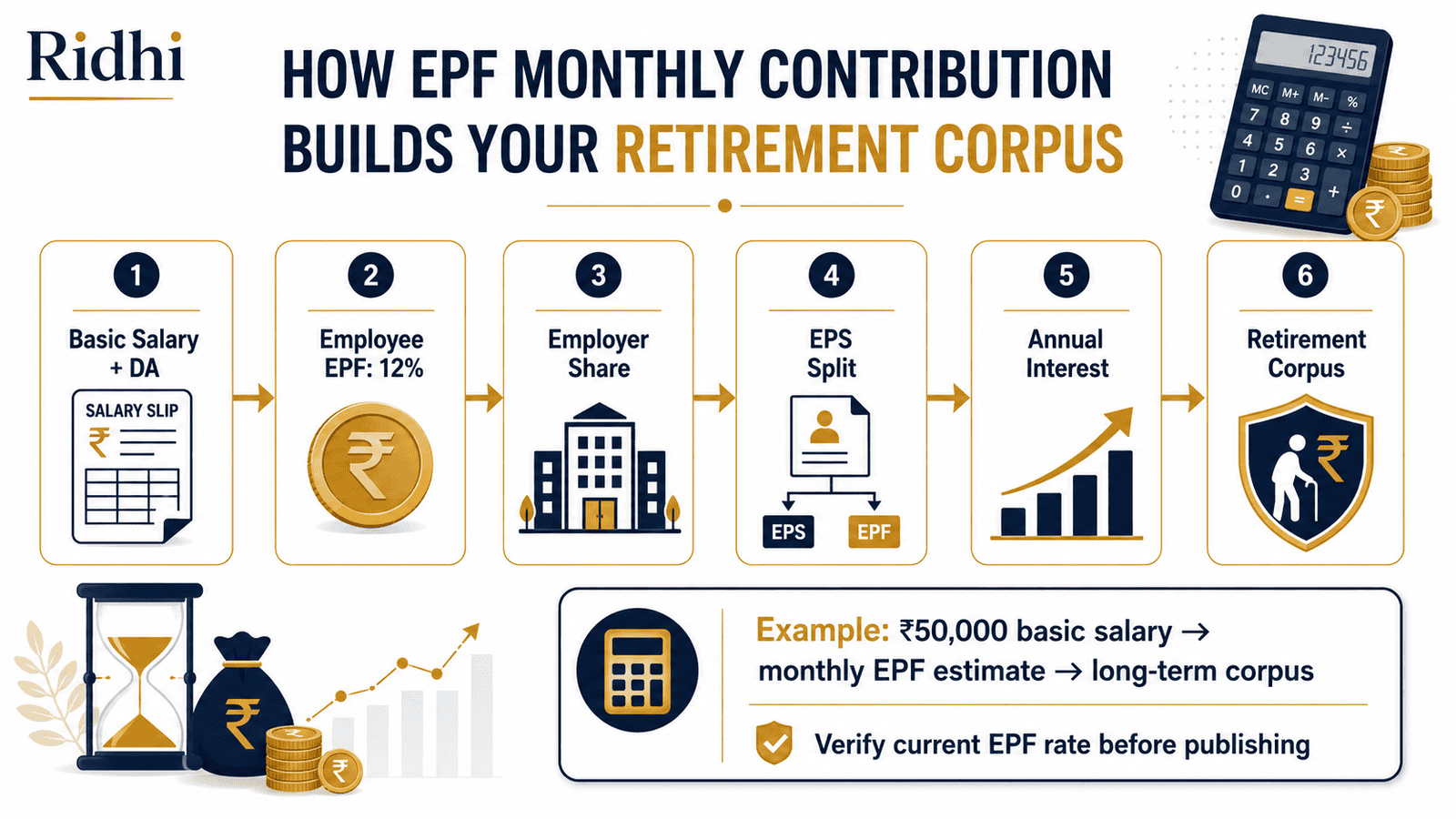
How to Calculate EPF Contribution and Retirement Corpus
The EPF calculator runs five steps. Each one depends on a figure that can change — so treat the output as a planning estimate, not a confirmed balance.
Step 1 — Find your basic salary + DA
Your EPF contribution is calculated on basic salary plus Dearness Allowance (DA) — not your gross salary or CTC. Check your salary slip for the line labelled “Basic” or “Basic + DA.” For Rohit in Bengaluru earning a ₹14 lakh CTC, basic salary is approximately ₹50,000 per month.
Step 2 — Employee contribution = 12% × (Basic + DA)
At ₹50,000 basic, the monthly deduction is 12% × ₹50,000 = ₹6,000. This appears as a deduction on the salary slip. The 12% rate is set by EPFO — verify the current rate at epfindia.gov.in before using it in your calculation.
Step 3 — Employer contribution and EPS split
The employer also contributes 12% — but not all of it enters the EPF corpus. A portion goes toward the Employees’ Pension Scheme (EPS). EPS contribution is capped at 8.33% of the statutory wage ceiling of ₹15,000 per month, which equals ₹1,250 per month. The remainder — ₹6,000 minus ₹1,250 = ₹4,750 — goes into the EPF account as the employer’s EPF share. Both the wage ceiling and EPS rate are subject to EPFO rules and must be verified.
Step 4 — Monthly EPF credit = Employee contribution + Employer EPF share
For ₹50,000 basic: ₹6,000 (employee) + ₹4,750 (employer EPF) = ₹10,750 per month credited to the EPF account. The ₹1,250 diverted to EPS does not appear in the EPF passbook balance — this is the exact reason many employees see a lower employer credit than expected.
Step 5 — Apply EPF interest rate over working years
EPFO credits interest annually on the EPF balance. The rate is declared by the government each financial year and is not fixed for life. Using the most recently declared rate as a planning assumption, the corpus compounds over time. The table below shows illustrative estimates at three salary levels — assuming constant salary, no withdrawals, and a fixed interest rate throughout. Verify the current rate at epfindia.gov.in before using these figures.
| Basic Salary (Monthly) | Monthly EPF Credit | Estimated Corpus (30 Years)* |
|---|---|---|
| ₹30,000 | ₹5,950 | ~₹83 lakh |
| ₹50,000 | ₹10,750 | ~₹1.50 crore |
| ₹80,000 | ₹17,950 | ~₹2.51 crore |
*Illustrative only. Assumes constant salary, no withdrawals, and a fixed annual EPF interest rate throughout. Actual corpus will differ based on salary growth, withdrawals, job changes, and the rate declared by EPFO each year. Verify the current interest rate at epfindia.gov.in before using these estimates for financial planning.
For a complete breakdown of how contributions are split between employee and employer, see our detailed guide on the employee and employer split.
Key Takeaways
- EPF is calculated on basic salary plus DA — not gross salary or CTC. Entering the wrong input can overstate the estimated corpus by 40% or more for employees with a high-allowance salary structure.
- The employee contributes 12% and the employer also contributes 12% — but the employer’s share is split between EPF and EPS. Only the EPF portion appears in your passbook; the EPS amount builds pension eligibility separately.
- At ₹50,000 basic, the monthly EPF credit is approximately ₹10,750 — not ₹12,000 — because ₹1,250 per month goes to EPS rather than the EPF account.
- The EPF interest rate is declared annually and is not fixed for life. A shift of 0.25% over 30 years can change the estimated corpus by several lakhs.
- Any mid-career withdrawal, job change without PF transfer, or period of unemployment reduces the compounding base — making any calculator output an overestimate for those with interrupted service.
- Always cross-check your calculator estimate against the actual EPFO passbook via UAN login. The passbook shows what has been credited, not what a model assumes.
Key Facts at a Glance
| Parameter | Rule or Value | Where to Verify |
|---|---|---|
| EPF contribution base | Basic salary + DA (not gross salary or CTC) | epfindia.gov.in |
| Employee contribution rate | 12% of basic + DA — verify current rate | epfindia.gov.in |
| Employer EPF share | 12% minus EPS portion — verify EPS ceiling | epfindia.gov.in |
| EPS wage ceiling | ₹15,000 per month — verify current ceiling | epfindia.gov.in |
| EPF interest rate | Declared annually by the government — verify current rate | epfindia.gov.in |
| Calculator output | Estimate only — not a guaranteed retirement balance | Cross-check against EPFO passbook via UAN |
How EPF Works — What the EPF Calculator India Is Actually Calculating
The Employees’ Provident Fund is governed by the Employees’ Provident Funds and Miscellaneous Provisions Act, 1952 and administered by the Employees’ Provident Fund Organisation (EPFO). For most salaried employees in establishments with 20 or more workers, EPF membership is mandatory. The contribution base is basic wages and dearness allowance — not the full CTC. Allowances like HRA, travel, or food coupons are excluded. Many employees discover this only when they first open their EPFO passbook and find a lower balance than they expected.
Understanding PF rules explained simply before using any calculator saves a lot of confusion — particularly around which salary component actually drives the contribution number.
Employee Contribution vs Employer Contribution
The employee contribution comes out of take-home pay — it is deducted before the salary is transferred. The employer contribution is an additional amount the company pays over and above the employee’s salary. Both go into the EPF system, but they are not credited identically.
Why the EPS Split Confuses So Many Employees
This is the most common source of passbook confusion. The employer contributes 12% of basic + DA. Of this 12%, a portion goes toward the Employees’ Pension Scheme (EPS) — but only on the first ₹15,000 of basic + DA (the statutory wage ceiling). For anyone earning above ₹15,000 basic, the EPS deduction is capped at ₹1,250 per month.
The remaining employer contribution — 12% of full basic minus the ₹1,250 EPS portion — is credited to the EPF account as the employer’s share. So an employee with ₹50,000 basic sees ₹4,750 from the employer in EPF, not ₹6,000. The EPS portion builds pension eligibility after 10 years of service, not EPF corpus. It is governed by separate rules and does not appear as a lump sum balance.
How Annual Interest Credit Works
According to EPFO guidelines at epfindia.gov.in, interest is calculated on the monthly running balance but credited once at the end of each financial year. This means a contribution made in March earns far less interest than one made in April for that same year. The rate is declared annually by the government — it is not fixed and has changed multiple times over the past decade.
Additionally, employer contributions that exceed the prescribed annual threshold under the Income Tax Act may be taxable in the hands of the employee. Verify current thresholds at incometax.gov.in before drawing conclusions from corpus estimates alone.
What the Calculator Cannot Factor In
A standard EPF calculator India assumes salary and interest rate remain constant across the entire working life. In practice, salary hikes increase monthly contributions each time they occur, job changes may interrupt continuity, partial withdrawals reduce the principal, and the EPFO interest rate can shift. Use the calculator for directional planning — not as a precise retirement balance figure.
Real Example: Rohit’s EPF Calculation in Bengaluru
Rohit, 29, is a software engineer in Bengaluru earning a ₹14 lakh CTC. His basic salary is ₹50,000 per month. Here is exactly what happens to his EPF each month.
Monthly employee contribution: 12% × ₹50,000 = ₹6,000 deducted from salary.
Monthly employer contribution: 12% × ₹50,000 = ₹6,000 paid by the company.
EPS deduction from employer share: 8.33% × ₹15,000 (statutory wage ceiling) = ₹1,250 per month toward the pension fund, not EPF.
Employer EPF credit: ₹6,000 − ₹1,250 = ₹4,750 per month credited to Rohit’s EPF passbook.
Total monthly EPF credit: ₹6,000 + ₹4,750 = ₹10,750.
Rohit’s annual EPF credit is ₹1,29,000. Without salary growth or any withdrawal, and using the most recently declared EPF interest rate as a steady-state planning assumption, his 29-year corpus estimate (to age 58) comes to approximately ₹1.50 crore — purely as an illustration. A 15% basic salary hike every three years would push that estimate materially higher. The key insight: the ₹1,250 monthly EPS diversion is precisely why Rohit’s passbook never shows the full ₹12,000 combined contribution.
Comparison: Calculator Output vs What You Actually See
| What It Is | Calculator Assumption | Reality and Where to Check |
|---|---|---|
| Contribution base | Basic + DA as entered by user | Salary slip — may differ from CTC structure significantly |
| Employee EPF credit | 12% of basic + DA | EPFO passbook — Employee Share column each month |
| Employer EPF credit | 12% minus EPS portion (approximately 3.67% or higher) | EPFO passbook — Employer Share column (lower than total employer contribution) |
| EPS contribution | Excluded from corpus estimate | Visible in passbook as EPS; builds pension eligibility, not EPF balance |
| Interest rate used | User-entered assumed rate | EPFO declares actual rate annually — verify at epfindia.gov.in |
| Estimated corpus | Assumes constant salary and zero withdrawals | Actual balance in EPFO passbook via UAN login |
How to Decide What’s Right for You
you want to build a retirement base without active management — EPF’s automatic monthly deduction makes it the simplest long-term savings mechanism available to salaried employees. Stay invested and do not withdraw early.
your EPF corpus estimate looks insufficient for retirement — consider topping it up through Voluntary Provident Fund (VPF). Read our guide on how to increase PF contribution via VPF, which credits to the same EPF account at the same declared interest rate with no upper ceiling on contribution.
you have recently changed jobs — transfer your PF balance immediately using your UAN. An untransferred balance earns no new contributions from your current employer and breaks the compounding the calculator assumes.
the calculator shows a large corpus but you have made one or more partial withdrawals — redo the estimate starting from your actual current EPFO passbook balance, not from your contribution start date.
you are within five to seven years of retirement — use the actual passbook balance as your planning number, not a calculator projection from salary alone. The passbook figure is what the corpus actually is today.
EPF alone is not a complete retirement plan — if you have no NPS, equity mutual funds, or other long-term savings, treating the EPF corpus estimate as sufficient may leave a significant gap at retirement, especially after accounting for inflation over 25–30 years.
Common Mistakes to Avoid
Using Gross Salary Instead of Basic + DA
The single most common error with any EPF calculator India.
EPF is calculated only on basic salary plus DA. Entering gross salary — which includes HRA, conveyance, and other allowances — inflates the contribution base substantially. For an employee with ₹80,000 gross but ₹40,000 basic, the estimated corpus would be nearly double the correct figure.
Check your salary slip carefully and enter only the “Basic” or “Basic + DA” line in the calculator.
Assuming the Full Employer Contribution Enters the EPF Account
The employer contributes 12%, but ₹1,250 per month goes to EPS for employees with basic + DA above ₹15,000.
If you expect ₹6,000 per month from your employer on a ₹50,000 basic but only ₹4,750 shows in your passbook, this EPS diversion is exactly why. Ignoring it overstates the corpus estimate by approximately 11% before compounding. Over 30 years, that gap compounds into a meaningful shortfall against your projection.
Use your EPFO passbook to see the actual employer EPF credit each month — not the CTC document.
Using an Outdated EPF Interest Rate
The EPF interest rate changes each financial year and must be confirmed with EPFO before running a long-term estimate.
Using a rate from even two years ago — a difference of 0.25% — can shift a 30-year corpus estimate by ₹5–10 lakh or more. Always enter the rate declared for the current financial year, verified at epfindia.gov.in. If the current year’s rate has not yet been announced, use the most recently declared rate and flag it as a planning assumption.
Not Checking the Actual EPFO Passbook
Many employees run a calculator and never compare it against their passbook.
The passbook shows actual credited amounts for every month of service — missed deposits by the employer, late credits, and any discrepancies become visible there. A calculator cannot catch these. Check PF balance via your UAN at member.epfindia.gov.in at least once a year and compare it against your running estimate.
Treating the Corpus Estimate as Guaranteed
No EPF calculator India produces a guaranteed retirement balance.
The output is only as accurate as the assumptions you enter. If the EPF interest rate falls by 0.5% over the next decade, the actual corpus will be lower. EPF is among India’s safest retirement instruments — but “safe” refers to credit risk, not to a fixed promised corpus. Present any calculator output as a directional estimate and build in a conservative margin.
Ignoring the Long-Term Cost of Early Withdrawal
A partial withdrawal does not just reduce the balance by the amount withdrawn.
Withdrawing ₹2 lakh at age 35 costs not ₹2 lakh but the full compound growth on ₹2 lakh over the next 20–25 years — which can be several times the original sum. Employees who withdrew during job changes or financial emergencies and then use a calculator starting from zero contribution date end up with an overestimate of their actual position.
When This May Not Be the Right Choice
The EPF calculator estimate may be unreliable or misleading in these specific situations:
- You have changed jobs multiple times without transferring your PF balance each time. The calculator assumes a single continuous account; your actual position may involve multiple scattered balances at different EPFO offices.
- You have made partial withdrawals — for marriage, education, medical treatment, or housing. Any withdrawal reduces the compounding base and makes the calculator estimate an overstatement of your real position.
- You are within five years of retirement. At this stage, the EPFO passbook balance is far more reliable as a planning figure than any projection from salary inputs alone.
- You are a contractual employee, have freelanced for periods, or have had extended gaps between salaried roles. Contributions stop during non-employment periods, but most calculators assume uninterrupted monthly deposits from day one.
Before resigning and withdrawing EPF, understand how withdrawal after resignation rules work and the long-term impact any withdrawal has on the corpus your calculator is projecting.
If any of these apply to your situation, it may be worth exploring alternatives before committing.
Official Rules and Where to Verify
EPF rules — including contribution rates, the statutory wage ceiling, EPS split, annual interest rate, withdrawal eligibility, and tax treatment — are set by EPFO and the Indian government. These change with each Union Budget or EPFO circular. The figures used in this article are illustrative. Before acting on any number, verify from these official sources:
- EPFO — epfindia.gov.in (contribution rates, annual interest rate, wage ceiling, withdrawal rules, EPS eligibility, passbook access via UAN)
- Income Tax Department — incometax.gov.in (tax treatment of EPF withdrawals, taxable employer contributions above prescribed limits, TDS on early withdrawal)
Rules, limits, and rates on this topic can change with each Budget or regulatory update. Always verify current figures directly from the official source before making any financial decision.
For the tax implications of withdrawals before and after five years of service, see our complete guide on PF tax rules.
Expert Tips
- Before running any EPF calculator, log into your UAN passbook at member.epfindia.gov.in and note your current actual balance. Enter that figure as your starting balance — not zero. A calculator that starts from zero produces a misleading number for anyone with gaps or prior withdrawals.
- Re-run the calculator after every salary revision. A ₹10,000 increase in monthly basic salary adds over ₹14,400 per year to your EPF credit — and that extra amount compounds over the remaining years of service, not just the current one.
- Check whether your employer is depositing the correct amount every month. Your EPFO passbook should show a credit for each month of active employment. Missed or delayed employer deposits are more common than most employees realise, and EPFO has an online grievance mechanism at epfindia.gov.in to raise a complaint.
- Do not treat the EPF corpus estimate as your complete retirement plan. EPF is a strong foundation — layer NPS, equity mutual funds, or other instruments alongside it. A ₹1.5 crore corpus projected over 30 years may represent significantly less purchasing power in real terms after inflation.
- If your employer offers a Voluntary Provident Fund (VPF) top-up option, it credits to the same EPF account at the same declared interest rate with no upper ceiling on contribution amount. Consider VPF before parking additional savings in lower-yielding instruments.
- Preserve your UAN across every job change. A new UAN at each employer fragments your EPF history, makes it harder to estimate a single consolidated retirement corpus, and complicates any future withdrawal or transfer request.
Frequently Asked Questions
What is an EPF calculator India?
An EPF calculator India is a tool that estimates your monthly EPF contribution and projected retirement corpus based on basic salary, employee contribution rate, employer contribution rate, and an assumed EPF interest rate. It helps salaried employees understand how monthly PF deductions may grow over a career — but does not produce a guaranteed figure.
Is EPF calculated on basic salary or CTC?
EPF is calculated on basic salary plus Dearness Allowance (DA) — not on gross salary or total CTC. Components like HRA, special allowance, and travel reimbursement are excluded. If you enter your CTC into the calculator, the output will be a significant overestimate.
What is the employee PF contribution?
The employee contributes 12% of basic salary plus DA to the EPF account each month. This amount is deducted from the employee’s take-home pay and deposited to the EPFO account by the employer. Verify the current contribution rate at epfindia.gov.in, as this is set by EPFO and can change.
What is the employer PF contribution?
The employer contributes 12% of the employee’s basic salary plus DA — an additional amount on top of the employee’s salary, not deducted from it. However, this 12% is split: a capped portion goes to EPS (up to ₹1,250 per month based on the statutory wage ceiling), and the rest goes to the EPF account. Only the EPF portion appears in the passbook as the employer’s EPF credit.
Why is the employer’s PF amount in my passbook lower than I expected?
Because a portion of the employer’s 12% contribution is diverted to the Employees’ Pension Scheme (EPS). For employees with basic + DA above the statutory wage ceiling of ₹15,000, this diversion is capped at ₹1,250 per month. The remaining employer contribution goes to EPF. Your passbook’s Employer Share column reflects only the EPF portion — not the EPS amount.
What EPF interest rate should I use in the calculator?
Use the rate declared by EPFO for the current financial year. This rate changes annually and must be verified at epfindia.gov.in. Using an outdated rate — even by 0.25% — can materially alter a long-term corpus estimate. If the current year’s rate has not yet been declared, use the most recently confirmed rate as a conservative proxy and note it as an assumption.
Can I use this calculator after changing jobs?
Yes, but adjust the inputs. If you transferred your PF balance to the new employer’s account, enter your current passbook balance as the starting amount and run the estimate from there. If you did not transfer, you may have multiple EPF accounts — consolidate them through the UAN merge process first, then run the calculation on the unified balance.
Does PF withdrawal affect the retirement corpus?
Yes — significantly. Any withdrawal reduces the principal that compounds over the remaining working years. Withdrawing ₹2 lakh at age 35 does not just cost ₹2 lakh; it costs the entire compound growth on that amount over the next 20–25 years, which can be several times the withdrawn sum. Treat EPF as a retirement fund rather than an emergency fund wherever financially possible.
Is the EPF maturity amount tax-free?
EPF withdrawals after five continuous years of qualifying service are generally tax-free. Withdrawals before five years are taxable and may attract TDS. Employer contributions exceeding the prescribed annual threshold under the Income Tax Act may also be taxable as income in the year they are contributed. Verify the current thresholds and conditions at incometax.gov.in, as these can change with each Budget.
Final Verdict
An EPF calculator India is the fastest way for any salaried employee to understand how monthly PF deductions can compound into a long-term retirement number. Used correctly — with basic salary rather than gross, the right contribution split, and a verified EPF interest rate — it gives a useful directional estimate for planning. Used loosely, with CTC figures and outdated rates, it creates false confidence in a number that will not materialise.
For anyone in Rohit’s position — early career, regular salary, no prior withdrawals — the calculator output is a reasonable starting point. Check the passbook, re-run after every raise, and treat the corpus estimate as a floor rather than a ceiling. EPF is a strong foundation for retirement savings but works best when you track it, preserve it across job changes, and complement it with other long-term instruments. Always verify the latest rules from official sources or consult a qualified professional before making any financial decision.
This article is for educational purposes only and should not be treated as personalised financial, tax, investment, insurance, or legal advice. Tax rules, interest rates, regulatory limits, and product features can change with each Budget or policy update. Please verify current rules from official government sources or consult a qualified and registered professional before making any financial decision.

Raghav Menon writes about employment-linked retirement benefits in India, including EPF, PF, UAN, gratuity, EPS pension, EDLI, VPF, superannuation, and NPS-related salary benefits. His content is designed for employees who see deductions and benefit components in their salary structure but do not fully understand how those amounts work over time.
He covers practical topics such as EPF contribution, employer PF, employee PF, PF withdrawal rules, PF transfer after job change, UAN activation, PF balance checks, EPFO claim status, multiple PF account merging, EPF nomination, gratuity calculation, EPS pension eligibility, EDLI benefits, and tax treatment of PF withdrawals. His articles are useful for freshers, job switchers, employees planning resignation, and families thinking about retirement-linked savings.
Raghav’s writing is rule-focused, patient, and structured around common employee doubts. He aims to simplify official processes without overpromising outcomes. Since EPFO procedures, interest rates, withdrawal rules, contribution limits, and tax treatment may change, readers should verify current rules from EPFO, Income Tax Department, and relevant official sources.