

If you have compared two health insurance quotes for your family and found a ₹30,000 gap between them, a health insurance premium calculator can show you exactly where that difference comes from. Premium is not a fixed number — it reacts to who is insured, where you live, how much cover you want, and what features the policy includes. A cheaper quote may carry a room rent limit, a co-payment clause, or a four-year waiting period on pre-existing diseases that renders it nearly useless at claim time.
Salaried employees face an added risk: most depend on employer group cover that stops the moment they change jobs or are between employers. Personal cover gives you continuity regardless of employment status. This article walks through how to use the calculator, how to read the results, and how to choose the right policy structure — not just the lowest number.
Quick Answer: Health Insurance Premium Calculator
A health insurance premium calculator estimates your annual family policy cost using age, city, sum insured, family members, deductible, health history, and add-ons. For example, choosing ₹10 lakh cover changes the premium estimate, but final quotes depend on insurer underwriting, GST, waiting periods, and policy terms.
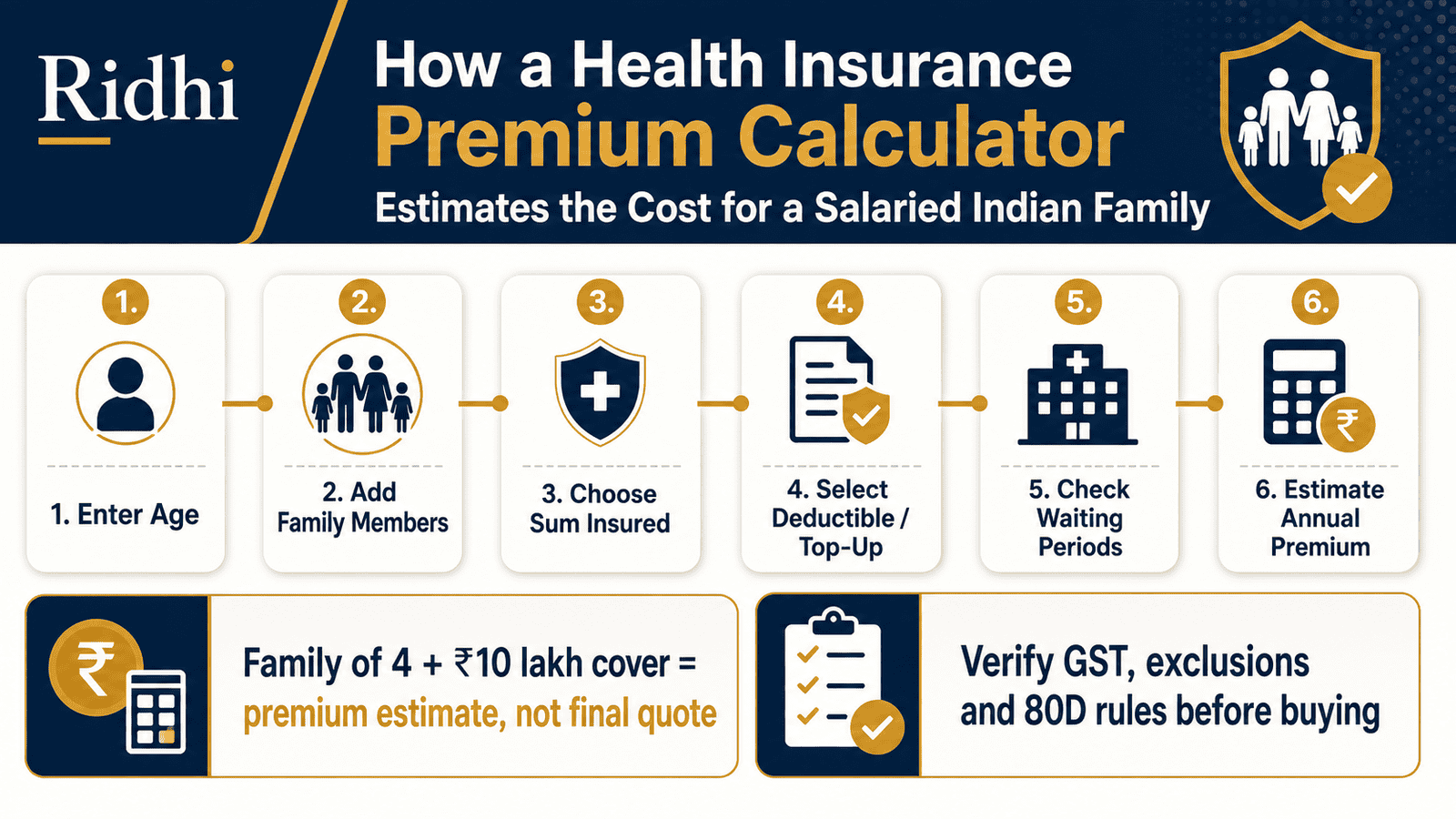
How to Calculate Your Health Insurance Premium
Annual Premium = (Base Premium × (1 + GST Rate)) + Add-on Rider Costs
The base premium is set by the insurer’s underwriting model using your specific inputs. Use these five steps to extract a useful estimate from any health insurance premium calculator:
Step 1 — Add all members with correct ages. Enter each adult and child individually. The age of the eldest insured member has the highest impact on the base premium. Parents aged 60 or above cost significantly more to insure than a couple in their early 30s — often doubling or tripling the floater premium.
Step 2 — Choose your sum insured. Common options are ₹5 lakh, ₹10 lakh, ₹15 lakh, and ₹25 lakh. For a metro family, ₹10 lakh is a reasonable starting point — a single serious hospitalisation in Pune, Mumbai, or Bengaluru can exceed ₹3–5 lakh without accounting for ICU charges.
Step 3 — Select city tier and add-ons. Tier-1 metro cities attract higher premiums because hospital costs are higher. Riders such as maternity cover, room rent waiver, and critical illness add to the total — each rider increases the premium but may be worth the cost depending on your family’s stage of life.
Step 4 — Add deductible or top-up if applicable. A super top-up plan with a ₹5 lakh deductible gives significantly higher total cover at a lower incremental premium than a standalone high-value policy. Always compare annual premium — not monthly installments — when evaluating cost.
Step 5 — Confirm GST and renewal assumptions. Health insurance premiums attract GST. Check whether the calculator includes GST in the quoted figure, and whether the estimate reflects first-year pricing or renewal premium. These can differ meaningfully.
You can use Ridhi’s health insurance premium calculator to run these steps with your actual family details and compare scenarios before approaching any insurer.
| Scenario | Family Composition | Indicative Annual Premium |
|---|---|---|
| Young couple, ₹10L floater | 2 adults, early 30s, metro city | ₹8,000–₹14,000 |
| Family of 3, ₹10L floater | 2 adults (mid-30s) + 1 child | ₹10,000–₹16,000 |
| Family with parents, ₹10L floater | 2 adults + parents (early 60s) + child | ₹40,000–₹65,000 |
| Base ₹5L + Super top-up ₹20L | Family of 3, ₹5L deductible | ₹12,000–₹22,000 combined |
These ranges are illustrative only. Final premiums depend on the insurer, individual health declarations, policy features, and underwriting. Get quotes from at least two or three insurers before deciding.
Key Takeaways
- Adding a parent aged 62 to a young family floater can raise the annual premium by ₹20,000–₹40,000 — often more than the cost of a separate senior citizen policy.
- A family floater is most efficient for a nuclear family under 45, but if one member exhausts the entire sum insured, no cover remains for others for the rest of that policy year.
- A super top-up plan can raise your effective total cover from ₹5 lakh to ₹25 lakh at a fraction of the standalone cost — the key is understanding how the deductible triggers.
- Section 80D may allow deductions on health insurance premiums for self, family, and parents — limits differ based on the age of the insured; verify current limits at incometax.gov.in before filing.
- Employer group health cover is job-linked — a personal policy is the only cover that stays with you regardless of employment status or job transition.
- Low premium is not a proxy for good cover — room rent limits, disease sub-limits, and co-payment clauses define what you actually receive at claim time, not the annual premium figure.
Key Facts at a Glance
| Calculator Input | What It Affects | Key Point |
|---|---|---|
| Age of eldest member | Base premium band | Separating older parents into their own policy protects the nuclear family’s premium rate |
| Sum insured | Coverage and annual cost | ₹10 lakh minimum for metros; use super top-up to extend further at lower incremental cost |
| Number of family members | Floater pool risk | Every member shares the pool — larger or older family means higher claim-exhaustion risk |
| City / Cost tier | Adequacy of cover | Medical inflation in metros is significant; review sum insured at every third renewal |
| Deductible / Top-up | Premium and claim trigger point | A ₹5L deductible on a super top-up sharply reduces the incremental cost of high cover |
What a Health Insurance Premium Calculator Can — and Cannot — Tell You
A health insurance premium calculator is a pre-purchase estimation tool — not a policy contract or underwriting decision. It generates a directional range based on the inputs you provide. The insurer’s underwriting team finalises the actual premium after reviewing medical declarations, health history, and risk factors that no online calculator can fully capture.
Many buyers treat a low calculator result as confirmation that a policy is affordable and adequate. The actual policy may cost more after underwriting, or cover less than the estimate implies. Family health cover basics explains in detail what a standard health policy includes and excludes — reading it before using the calculator helps you evaluate what the premium is actually purchasing.
The Three Layers of What You Pay
Every health insurance premium has three components. The base premium is set by the insurer based on your risk profile: age, city, sum insured, member count, and health declarations. GST is applied on the base premium — check whether the calculator figure you see includes this or not. Add-on rider costs cover optional features such as maternity cover, room rent waiver, and critical illness riders, each of which adds to the annual total.
At renewal, premiums typically increase — due to age progression, a claim in the previous year, insurer portfolio repricing, or broader medical inflation. Always ask the insurer what the expected renewal premium looks like in five years, not just the first-year rate.
What the Calculator Does Not Show You
The premium figure on a calculator will not show you room rent limits — many policies cap room rent at 1% of sum insured per day. On a ₹10 lakh policy, that is ₹1,000 per night. A hospital charging ₹4,000 per night means you pay ₹3,000 out of pocket every day, plus proportionate deductions on associated costs including doctor fees and nursing charges.
It also will not show you disease sub-limits (fixed claim caps on specific conditions regardless of sum insured), co-payment clauses (you bear 10–30% of each claim, especially common in senior citizen policies), or pre-existing disease waiting periods (conditions you have at the time of purchase may not be claimable for two to four years).
According to IRDAI guidelines, insurers are required to disclose all policy terms clearly in the policy document. Before purchasing, check whether the policy has a cashless hospital network that includes hospitals near your home and preferred facilities — a large network reduces the need to pay upfront and claim later. Reading the policy wording is the only way to know what you are actually buying.
Sum Insured Adequacy
Medical inflation in India consistently outpaces general consumer price inflation. A sum insured that feels adequate today may fall short in five years. For families in Tier-1 cities, ₹5 lakh as a standalone cover is insufficient for many serious procedures. Consider ₹10 lakh or above, or supplement a base policy with a super top-up plan to achieve higher total coverage at a lower combined premium.
Real Example: Rohit’s Family Cover Decision
Rohit, 34, is a software engineer in Pune earning ₹18 lakh per year. His wife Priya is 32, and they have a four-year-old daughter. His parents, aged 60 and 62, are financially dependent on him.
When Rohit enters all five members into a ₹10 lakh family floater calculator, the indicative annual premium comes to approximately ₹45,000–₹55,000 — largely driven by his parents’ age and health declarations.
When he restructures: a ₹10 lakh family floater for himself, Priya, and his daughter comes to approximately ₹12,000–₹15,000 per year. Separate individual policies for each parent add approximately ₹18,000–₹28,000 each, depending on their health history. The combined spend may be higher in total, but the nuclear family’s floater is protected from being exhausted by a parental hospitalisation.
He also evaluates a super top-up plan with a ₹5 lakh deductible to extend the nuclear family’s effective cover to ₹25 lakh at a relatively low incremental premium. The key insight: structuring cover correctly often costs less — and works better — than adding everyone to a single floater.
Comparison: Family Floater vs Individual Policy vs Employer Cover vs Super Top-Up
Understanding how different plan types compare helps you choose the right structure before using the calculator. For a detailed breakdown of when to choose a floater versus individual policies, see our guide on Floater or separate cover.
| Plan Type | Key Feature | Best Suited For |
|---|---|---|
| Family Floater | Shared cover pool; lower combined premium for young nuclear families | Families under 45 with similar age profile and low shared-claim risk |
| Individual Policy | Separate cover per person; no shared-pool risk or exhaustion | Mixed-age families; parents who need their own standalone cover |
| Employer Group Cover | Employer-funded; convenient but exits with employment | Supplement only — not a substitute for a personal policy |
| Super Top-Up Plan | High total cover above deductible; low incremental annual premium | Families who want ₹20–25 lakh total cover on a limited premium budget |
How to Decide What’s Right for You
You are a nuclear family with all members under 45 and no major pre-existing conditions — a family floater plan may suit your situation well and typically offers the lowest combined annual premium.
You want to include parents aged 55 or above — consider separate individual or senior citizen policies for parents rather than adding them to the family floater; this protects the nuclear family’s sum insured from being exhausted.
Your base cover is ₹5 lakh and your city’s hospital costs are high — consider adding a super top-up plan to extend effective total cover to ₹15–25 lakh at a lower incremental premium. Read Top-up cover meaning to understand exactly how the deductible works before buying.
You rely only on employer group cover and have no personal policy — a job change, layoff, or gap between roles leaves you uninsured; a personal ₹10 lakh policy is worth the added cost for continuity alone.
Your total premium budget is under ₹15,000 per year for a family of three — a ₹5 lakh base plan plus a super top-up with a ₹5 lakh deductible can bring your effective total cover to ₹20–25 lakh within that range.
You have a chronic condition, recent surgery, or pre-existing illness — a standard calculator result may significantly underestimate your actual post-underwriting premium, or miss exclusions specific to your situation; speak directly with the insurer or a licensed insurance advisor before purchasing.
Common Mistakes to Avoid
Comparing Only the Premium Number
The calculator gives you a price — not a policy evaluation. Two policies at the same premium can differ dramatically in room rent limits, sub-limits, and co-pay terms.
A 1% room rent cap on a ₹10 lakh policy means ₹1,000 per night. Most metro hospitals charge ₹3,000–₹6,000 or more for a standard room. Every night of hospitalisation generates an out-of-pocket gap — and associated costs like doctor visits and nursing are also reduced proportionately.
Compare coverage terms first, then price.
Adding Parents to a Young Family Floater
Including parents aged 55 or above in a shared floater raises the premium sharply and exposes the nuclear family to claim-exhaustion risk. If a parent’s hospitalisation uses ₹8 lakh of a ₹10 lakh floater, the rest of the family has ₹2 lakh left for the entire policy year.
Separate individual or senior citizen policies for parents often give better-tailored coverage and protect the floater for your nuclear family.
Ignoring Pre-Existing Disease Waiting Periods
A policy with a 4-year waiting period on pre-existing conditions cannot be used for those conditions for four years after purchase. Most buyers discover this only at claim time. Read Waiting period rules before finalising any policy — if you have a pre-existing condition, compare waiting periods across insurers, not just premiums.
Forgetting That Renewal Premiums Increase
The first-year premium shown by a calculator is rarely what you pay at 45, 50, or 55. Premium increases with age and claims experience. A policy costing ₹11,000 at age 34 may cost ₹25,000 or more at age 50.
Ask the insurer for the historical renewal premium trajectory before committing.
Evaluating Monthly Cost Instead of Annual Premium
Monthly installment options can make expensive policies look affordable. Always evaluate total annual premium against your budget — and confirm whether the policy lapses or becomes inactive if a monthly installment is missed.
When This May Not Be the Right Choice
A standard health insurance premium calculator may not give you accurate or complete guidance in the following situations:
- You or a family member has a recent surgery, chronic illness, or ongoing treatment — the actual post-underwriting premium and specific exclusions may differ significantly from the calculator estimate.
- You are buying cover for senior citizen parents — standard calculators often do not reflect the full range of co-pay requirements, room rent sub-limits, and disease-specific caps that appear in senior citizen policies.
- Your employer’s group cover has unclear exclusions or low sum insured — before treating it as your primary safety net, read the actual group policy document. See Employer health cover for what group policies typically leave out.
- You need maternity cover, critical illness cover, or treatment-specific coverage — these require separate, detailed evaluation beyond a standard premium estimate.
If any of these apply to your situation, it may be worth exploring alternatives before committing.
Official Rules and Where to Verify
Rules, limits, and rates on this topic can change with each Budget or regulatory update. Always verify current figures directly from the official source before making any financial decision.
- IRDAI (Insurance Regulatory and Development Authority of India) — irdai.gov.in: insurer registration, policy terms, exclusion rules, claim settlement guidelines, and consumer grievance redressal
- Income Tax Department — incometax.gov.in: Section 80D deduction rules for health insurance premiums. Current deduction limits stand at ₹25,000 for non-senior self and family, and ₹50,000 for senior citizen parents; a sub-limit applies within the overall cap for preventive health check-up expenses. Verify current limits before filing your return.
For a detailed Section 80D breakdown with salaried examples, see Health premium tax benefit.
Insurance is a subject matter of solicitation. Please read the policy document carefully before purchasing.
Expert Tips
- Compare premium per ₹1 lakh of usable cover — not just total annual premium. A ₹12,000 policy with a room rent cap may deliver less real value than a ₹16,000 policy with no cap and a wider cashless hospital network.
- Check three specific terms in every policy document before comparing premiums: room rent limit, disease sub-limits, and co-payment clause. These three determine what you actually receive at claim time.
- Use employer group insurance as a supplement — not your primary safety net. Group cover stops immediately when employment ends, with no grace period for personal continuity.
- Ask about the no-claim bonus — many insurers offer a 5–10% increase in sum insured for each claim-free year; over five years, this can meaningfully improve your effective cover without additional premium.
- Review your sum insured at every third renewal. A ₹5 lakh policy purchased in 2019 covers a significantly smaller proportion of metro hospital costs today.
- Do not over-optimise for Section 80D tax benefit. A policy chosen primarily to maximise the deduction may have inadequate coverage, sub-limits, or poor claim service. Health cover quality comes first — the tax benefit is secondary.
Frequently Asked Questions
Is a health insurance premium calculator accurate?
It gives a directional estimate — not a guaranteed quote. The final premium is set by the insurer after reviewing your health declarations and applying underwriting criteria specific to each policy. Use the calculator for budgeting and comparison, not as a confirmed figure.
What details do I need to calculate family health insurance premium?
Age of each member (particularly the eldest), city of residence, desired sum insured, number of family members, any existing health conditions, and add-ons or riders you want to include. The more accurate your inputs, the closer the estimate will be to your actual insurer quote.
Does Section 80D reduce the actual premium I pay?
No. Section 80D is a deduction from your taxable income — it reduces your tax liability, not the premium itself. If you are in the 30% bracket and pay ₹25,000 in premiums for self and family, the tax saving is approximately ₹7,500 — but you still pay the full ₹25,000 to the insurer.
Is a family floater cheaper than buying individual health insurance policies for each member?
For a young nuclear family with members of similar age and low health risk, a floater is typically cheaper than individual policies combined. However, if one member exhausts the entire floater sum insured, all other members have no cover left for that policy year — a risk that individual policies avoid entirely.
Should salaried employees buy personal health cover if employer cover already exists?
In most cases, yes. Employer group cover ends when employment ends — during job changes, layoffs, or notice periods. It also often carries lower sum insured and restricted hospital networks. A personal ₹10 lakh policy as a supplement gives continuity and control that no employer policy can provide.
What is the difference between a top-up and a super top-up plan?
A top-up plan triggers on a per-hospitalisation basis — each admission must individually exceed the deductible for the top-up to activate. A super top-up aggregates all hospitalisation costs across the year — once your cumulative claims exceed the deductible, the super top-up covers the rest. For most families, super top-up is more practical.
Can I add my parents to my existing family floater?
Most insurers allow it, but the premium increases significantly when parents aged 55 or above are included. If parents have pre-existing conditions, the increase can be steep. A separate senior citizen or individual policy often provides better-suited coverage and keeps your nuclear family floater premium lower.
What happens if I do not renew my health insurance policy on time?
Most insurers offer a grace period — typically 30 days for annual policies. If you miss the grace period, the policy lapses. A lapsed policy means no claim coverage and potential loss of accumulated waiting period credits. Reinstating a lapsed policy may require fresh underwriting, which can lead to new exclusions or higher premiums.
Final Verdict
A health insurance premium calculator is a useful starting point — it helps you budget, compare structures, and understand why premiums vary across family configurations. But the premium figure alone does not tell you whether a policy is right for your family. The quality of cover — what the policy actually pays, under what conditions, and with what exclusions — matters more than the annual premium.
For a salaried family, the practical approach is: run the calculator with accurate inputs, compare coverage terms not just price, separate parents if their age raises floater risk, and treat employer group cover as a supplement rather than your only protection. Premiums, tax rules, and policy terms can change — always verify before purchasing.
Always verify the latest rules from official sources or consult a qualified professional before making any financial decision.
This article is for educational purposes only and should not be treated as personalised financial, tax, investment, insurance, or legal advice. Tax rules, interest rates, regulatory limits, and product features can change with each Budget or policy update. Please verify current rules from official government sources or consult a qualified and registered professional before making any financial decision.

Priya Nambiar writes about insurance concepts for Indian families, salaried employees, self-employed professionals, and first-time policy buyers. Her content focuses on helping readers understand coverage, exclusions, claim conditions, premiums, riders, and policy documents before buying or renewing insurance.
She covers topics such as term insurance, health insurance, family floater plans, riders, critical illness cover, employer insurance vs personal insurance, waiting periods, exclusions, deductibles, co-payment, no-claim bonus, claim settlement, premium comparison, renewal rules, and tax benefits linked to insurance.
Priya’s writing is careful, consumer-focused, and policy-document oriented. She explains why insurance should be understood as financial protection, not just a tax-saving tool or investment substitute. Her articles encourage readers to compare coverage, understand limitations, and ask better questions before buying a policy. Premiums, exclusions, claim rules, and benefits vary by insurer, age, health, sum insured, and product type. Insurance is a subject matter of solicitation, and readers should read the official policy document carefully before purchasing.