You just got your first offer letter showing ₹10 LPA — and the first question that follows is almost always the same: how much of this will I actually take home? It is a fair question, and the answer is not a single number. Your tax on 10 LPA salary depends on which regime you choose, what deductions you claim, and how your salary is structured. This article walks through both the old and new tax regime calculations for a ₹10 lakh salary, shows you the exact numbers, and explains the deductions and rebate rules that determine what you actually owe.
Quick Answer: Tax on 10 LPA Salary
Tax on 10 LPA salary depends on the tax regime, deductions, and salary structure. Under the new regime, a salaried person with only ₹10 lakh salary may pay zero tax after standard deduction and Section 87A rebate. Under the old regime, tax depends heavily on 80C, HRA, 80D, and other deductions.
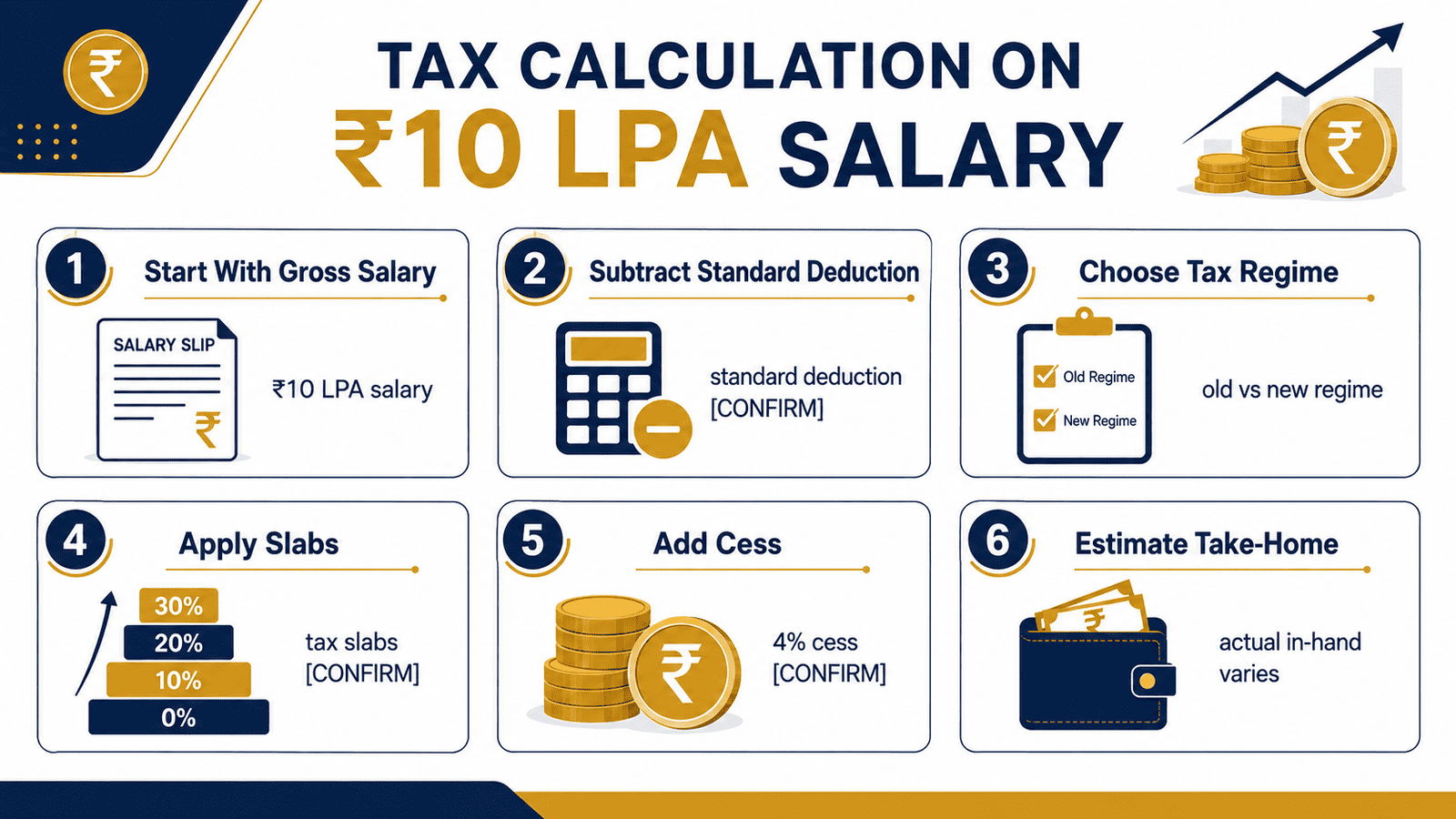
How to Calculate Tax on ₹10 LPA Salary
The calculation below assumes a gross salary of exactly ₹10,00,000 and uses the most common salary structure for a salaried employee in India. All figures reflect the rules applicable for FY 2025–26 (Assessment Year 2026–27). Verify with incometax.gov.in before filing.
Step 1: Determine Your Gross Salary
For this calculation, gross salary = ₹10,00,000. This is the figure on your offer letter. It is not the same as CTC, which may include PF, gratuity, and other employer contributions that do not reach your bank account.
Step 2: Apply Standard Deduction (Section 16)
Every salaried employee gets a flat standard deduction under Section 16 of the Income Tax Act — no bills, no proofs needed. Under the new regime for FY 2025–26, the standard deduction for salaried employees is ₹75,000. Under the old regime, it is ₹50,000.
| Step | New Regime | Old Regime |
|---|---|---|
| Gross Salary | ₹10,00,000 | ₹10,00,000 |
| Less: Standard Deduction | ₹75,000 | ₹50,000 |
| Income After Standard Deduction | ₹9,25,000 | ₹9,50,000 |
| Less: Chapter VI-A Deductions (80C, 80D, etc.) | Nil (not allowed) | Up to ₹2,00,000+ |
| Taxable Income (illustrative) | ₹9,25,000 | ₹7,50,000 |
The old regime figure above assumes ₹1,50,000 in Section 80C investments plus ₹25,000 in Section 80D health insurance premium — a common combination for salaried employees. Your actual taxable income will differ based on your deductions.
Step 3: Apply Tax Slabs
New Regime — Tax on ₹9,25,000 Taxable Income (FY 2025–26):
| Income Slab | Rate | Tax |
|---|---|---|
| Up to ₹3,00,000 | Nil | ₹0 |
| ₹3,00,001 – ₹7,00,000 | 5% | ₹20,000 |
| ₹7,00,001 – ₹9,25,000 | 10% | ₹22,500 |
| Total Tax Before Cess | ₹42,500 |
Section 87A Rebate — New Regime: If taxable income under the new regime does not exceed ₹12,00,000, a rebate of up to ₹60,000 applies, reducing tax to zero. At ₹9,25,000 taxable income, the rebate wipes out the ₹42,500 tax entirely. Tax payable under new regime = ₹0.
Old Regime — Tax on ₹7,50,000 Taxable Income (FY 2025–26):
| Income Slab | Rate | Tax |
|---|---|---|
| Up to ₹2,50,000 | Nil | ₹0 |
| ₹2,50,001 – ₹5,00,000 | 5% | ₹12,500 |
| ₹5,00,001 – ₹7,50,000 | 20% | ₹50,000 |
| Total Tax Before Rebate and Cess | ₹62,500 |
Section 87A Rebate — Old Regime: Under the old regime, the rebate applies only if taxable income does not exceed ₹5,00,000. At ₹7,50,000, no rebate is available. Tax remains ₹62,500.
Add Health and Education Cess at 4%: ₹62,500 × 4% = ₹2,500. Total tax payable under old regime = ₹65,000.
Step 4: Monthly TDS Impact
Your employer deducts TDS from your monthly salary based on your projected annual tax liability. If your tax under the new regime is ₹0, your employer should deduct nil TDS — meaning no monthly deduction. Under the old regime with ₹65,000 annual tax, TDS would be approximately ₹5,417 per month. This affects your in-hand salary directly.
Monthly TDS = Annual Tax Liability ÷ 12
Use the income tax calculator to check your exact liability after entering your actual salary components and deductions.
Key Takeaways
- Under the new regime for FY 2025–26, a ₹10 LPA salaried employee with no other income may pay zero tax after the ₹75,000 standard deduction and Section 87A rebate (applicable if taxable income is within ₹12 lakh).
- Under the old regime, the same employee pays approximately ₹65,000 in tax if claiming ₹1,50,000 under 80C and ₹25,000 under 80D — and more if deductions are lower.
- The ₹12,00,000 rebate threshold under the new regime is the single most important number for ₹10 LPA earners — breach it with perquisites or freelance income and tax kicks in immediately.
- Standard deduction under the new regime is ₹75,000 vs ₹50,000 under the old — a ₹25,000 difference that favours the new regime even before slabs are compared.
- Monthly TDS can be ₹0 under the new regime at ₹10 LPA, directly increasing your in-hand salary by up to ₹5,000–₹6,000 per month compared to the old regime.
- Health and Education Cess of 4% applies on top of tax — not on gross salary — and applies only if there is a tax liability to begin with.
- Your taxable salary is gross salary minus standard deduction minus valid Chapter VI-A deductions — not your CTC, and not your take-home.
Key Facts at a Glance
| Parameter | New Regime (FY 2025–26) | Old Regime (FY 2025–26) |
|---|---|---|
| Gross Salary | ₹10,00,000 | ₹10,00,000 |
| Standard Deduction | ₹75,000 | ₹50,000 |
| Chapter VI-A Deductions | Not available | Up to ₹2L+ (varies) |
| Illustrative Taxable Income | ₹9,25,000 | ₹7,50,000 |
| Tax Before Rebate/Cess | ₹42,500 | ₹62,500 |
| Section 87A Rebate | ₹42,500 (full wipeout) | Nil |
| Cess at 4% | Nil | ₹2,500 |
| Total Tax Payable | ₹0 | ₹65,000 |
| Approx. Monthly TDS | ₹0 | ~₹5,417 |
How Income Tax on Salary Actually Works
Before you can calculate your tax on 10 LPA salary, you need to understand what “taxable income” actually means — because it is almost never equal to your salary package.
CTC vs Gross Salary vs Taxable Income
Your CTC includes components that never reach your bank account — employer PF contribution, gratuity, and sometimes medical or food allowances paid in-kind. Your taxable salary meaning starts from gross salary (what is credited or reimbursed to you), not CTC. From gross salary, you subtract the standard deduction and any valid deductions to arrive at taxable income.
Standard Deduction Under Section 16
The standard deduction rules allow every salaried employee and pensioner to reduce taxable income by a flat amount — no investment proof, no rent receipt, nothing to submit. For FY 2025–26, this is ₹75,000 under the new regime and ₹50,000 under the old regime. If your gross salary is ₹10,00,000, you start your tax calculation at ₹9,25,000 (new) or ₹9,50,000 (old) — before any other deduction is applied.
Section 87A Rebate: The Zero-Tax Mechanism
The Section 87A rebate is a direct reduction in tax payable — not a deduction from income. Under the new regime for FY 2025–26, if your taxable income does not exceed ₹12,00,000, your entire tax liability is wiped out. This is why a ₹10 LPA salary (with taxable income of ₹9,25,000 after standard deduction) results in zero tax under the new regime. The rebate under the old regime is available only if taxable income is within ₹5,00,000 — a threshold that ₹10 LPA earners typically exceed even with deductions.
Chapter VI-A Deductions: Old Regime Only
If you choose the old regime, you can claim deductions under Chapter VI-A to reduce taxable income further. The most commonly used ones for a ₹10 LPA salaried employee are:
- Section 80C: Up to ₹1,50,000 for EPF contributions, PPF, ELSS mutual funds, LIC premium, home loan principal repayment, and more.
- Section 80D: Up to ₹25,000 for health insurance premium for self, spouse, and children (₹50,000 if parents are senior citizens).
- HRA Exemption: If your salary structure includes a House Rent Allowance component and you pay rent, a portion of HRA may be exempt from tax under Section 10(13A). The exempt amount depends on your HRA received, rent paid, and city of residence.
- LTA Exemption: Leave Travel Allowance, if part of your salary structure, can be claimed for actual travel expenses within India — twice in a block of four years.
These deductions do not apply at all under the new regime. According to the Income Tax Department (incometax.gov.in), the new regime under Section 115BAC offers lower slab rates in exchange for foregoing most exemptions and deductions.
Tax Slabs: New Regime vs Old Regime at a Glance
The new regime has more slabs at lower rates. The old regime has fewer, steeper slabs but allows deductions that compress taxable income. For a ₹10 LPA earner, the interplay between these two structures is what determines which regime actually costs less.
Real Example: Rohan in Pune
Rohan is 27 years old, works as a software engineer in Pune, and draws a gross salary of ₹10,00,000 per year. His salary includes basic pay, HRA, and special allowance. He contributes ₹60,000 per year to his Employee PF account and has a ₹25,000 health insurance policy for himself and his wife.
Under the new regime: Taxable income = ₹10,00,000 − ₹75,000 (standard deduction) = ₹9,25,000. Tax computed as per new regime slabs = ₹42,500. Section 87A rebate applies fully. Tax payable = ₹0. Monthly TDS = ₹0.
Under the old regime: Rohan also invests ₹90,000 in PPF and ₹60,000 goes to PF — total 80C = ₹1,50,000. He claims ₹25,000 for health insurance under 80D. Taxable income = ₹10,00,000 − ₹50,000 (standard deduction) − ₹1,50,000 (80C) − ₹25,000 (80D) = ₹7,75,000. Tax = ₹12,500 (up to ₹5L) + ₹55,000 (20% on ₹2,75,000) = ₹67,500. Add 4% cess = ₹2,700. Tax payable = ₹70,200. Monthly TDS ≈ ₹5,850.
Key insight: Rohan saves over ₹70,000 a year — and over ₹5,800 per month in take-home — by choosing the new regime at this salary level, even without factoring in HRA exemption under the old regime.
Comparison: New Regime vs Old Regime for ₹10 LPA
| Parameter | New Regime | Old Regime |
|---|---|---|
| Standard Deduction | ₹75,000 | ₹50,000 |
| 80C / 80D Deductions | Not available | Available |
| HRA Exemption | Not available | Available |
| Tax Slabs | Lower rates, more slabs | Higher rates, fewer slabs |
| 87A Rebate Threshold | ₹12,00,000 | ₹5,00,000 |
| Tax at ₹10 LPA (illustrative) | ₹0 | ₹65,000–₹70,000+ |
| Complexity | Simple | Requires tracking proofs |
| Best suited for | Most ₹10 LPA earners without large deductions | High-deduction earners with HRA, LTA, and full 80C use |
For a detailed breakdown of how to choose between regimes, read our guide on old vs new regime for salaried employees.
How to Decide What’s Right for You
your gross salary is ₹10 LPA and you have no HRA claim, minimal deductions (80C under ₹1 lakh, no 80D) — THEN the new tax regime will almost certainly result in lower or zero tax for you.
you pay significant rent in a metro city and your HRA component is large — THEN calculate the old regime with HRA exemption before switching to new, because HRA exemption alone can reduce taxable income by ₹1–₹2 lakh.
your total Chapter VI-A deductions (80C + 80D + other) exceed ₹2,00,000 AND you have HRA exemption — THEN the old regime may result in taxable income below ₹7 lakh, making both regimes competitive — run the numbers for your specific case.
you have any perquisites, bonus, or other income that pushes your gross beyond ₹10 LPA during the year — THEN recalculate before the year-end: crossing ₹12 lakh taxable income under the new regime triggers a sharp tax jump.
you are a first-time taxpayer with straightforward salary income and no complex deduction claims — THEN the new regime is simpler, cheaper at ₹10 LPA, and requires no proof submissions.
you do not have significant deductions or exemptions to claim — do not stay in the old regime out of habit. At ₹10 LPA with minimal deductions, the old regime costs you ₹65,000+ that the new regime eliminates entirely.
Common Mistakes to Avoid
Confusing CTC with Gross Salary
Your CTC on the offer letter is not your taxable income.
Employer PF contributions, gratuity provisions, and certain allowances form part of CTC but are not directly taxable in your hands. Using CTC as the starting point for tax calculation leads to an overestimate that causes unnecessary panic or wrong deduction planning.
Always start your tax calculation from gross salary — the amount your employer reports as salary income in Form 16.
Forgetting to Declare Regime Choice to Employer
Your employer deducts TDS based on the regime you declare at the beginning of the financial year.
If you do not declare your choice, the employer defaults to the new regime. If you wanted the old regime to claim HRA and 80C, but did not declare it, your Form 16 will not reflect those deductions and you will need to claim them manually when filing your ITR. This leads to a larger refund wait instead of zero TDS throughout the year.
Declare your regime in writing to HR or on the employer’s portal by April each year.
Assuming Zero Tax Means No ITR Filing Required
Even if your tax payable is ₹0 under the new regime, you are still required to file an Income Tax Return if your gross salary exceeds the basic exemption limit.
Skipping ITR when your income exceeds the threshold can attract notice from the Income Tax Department and disqualifies you from carrying forward losses. It also delays refunds if any excess TDS was deducted earlier in the year.
File your ITR every year on incometax.gov.in, even if no tax is due.
Ignoring TDS Discrepancy in the Second Half of the Year
If you receive a mid-year bonus, increment, or variable pay that was not factored into your initial TDS projection, your employer will recalculate and adjust TDS in subsequent months — sometimes resulting in a large one-time deduction.
A ₹1 lakh bonus mid-year can increase total salary to ₹11 LPA. Under the new regime, this crosses no threshold if taxable income stays below ₹12 lakh — but check. Under the old regime, it increases tax liability by approximately ₹20,000.
Review your salary TDS calculation on your monthly payslip every time your salary changes.
Claiming 80C Without Checking What Already Qualifies
Most employees do not realise that their own EPF contribution already counts towards the ₹1,50,000 Section 80C limit.
If you contribute ₹60,000 to EPF annually, you only need ₹90,000 more in PPF, ELSS, or LIC to max out 80C. Buying a new LIC policy on top of an already-full 80C bucket provides no additional tax benefit — just an unnecessary insurance premium.
Check your Form 16 Part B to see EPF already counted before investing for 80C.
Not Verifying Employer’s TDS with Actual Tax Liability
Your employer’s TDS calculation is based on the declaration you submit. Errors in declaration — such as a wrong HRA figure or a missed investment — lead to either excess TDS (which you get back as a refund after filing ITR) or short TDS (which you must pay as self-assessment tax).
Both situations are avoidable. Cross-check Form 16 against your own tax calculation before filing to catch discrepancies early.
Treating the ₹12 Lakh Rebate Threshold as a Hard Safe Limit
The Section 87A rebate under the new regime applies when taxable income (after standard deduction) is within ₹12,00,000. This does not mean your CTC can be ₹12 lakh — it means your taxable income must stay within that number.
If you have perquisites, employer-provided accommodation, or any other income (even ₹500 in bank interest added to salary), it counts. Crossing the ₹12 lakh threshold by even ₹1 restores the full tax liability without any rebate — a cliff-edge many earners miss.
Track all income heads before the financial year closes.
When This May Not Be the Right Choice
The new regime is not automatically the right answer for every ₹10 LPA earner.
If you live in Mumbai, Delhi, or Bengaluru, pay rent above ₹20,000 per month, and receive a significant HRA component — the HRA exemption under the old regime could reduce your taxable income by ₹1.5–₹2 lakh or more. Combined with full 80C utilisation, your old regime tax could fall below ₹25,000, making it competitive with the new regime.
If you are servicing a home loan on a self-occupied property and paying substantial principal and interest, the old regime allows deductions under Section 80C (principal) and Section 24(b) (interest up to ₹2 lakh). These together could tip the old regime in your favour.
If your employer offers significant perquisites or non-cash benefits that inflate your CTC well above ₹10 lakh without increasing your gross salary proportionately, the analysis changes further.
If any of these apply to your situation, it may be worth exploring alternatives before committing.
Official Rules and Where to Verify
Tax slabs, standard deduction amounts, Section 87A rebate limits, and cess rates can all change with the Union Budget. The figures in this article reflect the rules announced for FY 2025–26 and should be verified before filing your return.
- Income Tax Department: incometax.gov.in — for current tax slabs, Section 87A rebate limits, standard deduction rules, and ITR filing
- Central Board of Direct Taxes (CBDT) / Ministry of Finance: incometax.gov.in, pib.gov.in — for Budget announcements and official circulars
Rules, limits, and rates on this topic can change with each Budget or regulatory update. Always verify current figures directly from the official source before making any financial decision.
Expert Tips
- Before April 1 each year, run a quick comparison using your projected salary, HRA rent receipts, and expected 80C investment total. At ₹10 LPA, the new regime wins for most people — but run the numbers once, not on gut feel.
- If you contribute to EPF, check whether your own contribution plus any other 80C investments already max out the ₹1,50,000 limit before buying new tax-saving products. Every rupee beyond ₹1.5L in 80C under the old regime saves nothing in tax.
- Under the new regime, you lose HRA exemption — but if you can negotiate a higher special allowance or performance pay instead of HRA in your CTC structure, take-home can improve without affecting regime choice.
- If your variable pay, incentive, or bonus pushes your taxable income close to ₹12 lakh under the new regime, consider the impact before year-end. A ₹1,000 excess over the threshold triggers tax on the entire income, not just the excess. This is the single most important year-end check for ₹10 LPA earners.
- Download your Form 26AS and AIS (Annual Information Statement) from incometax.gov.in every March to verify that your employer’s TDS matches your actual liability. Discrepancies caught before filing are far easier to fix than mismatches that trigger notices post-filing.
- If your employer offers an NPS contribution of up to 10% of basic salary under Section 80CCD(2), this deduction is available even under the new regime — one of the few exceptions. At ₹10 LPA, employer NPS contribution of ₹50,000–₹80,000 can be a valuable add-on regardless of regime.
Frequently Asked Questions
Is there zero tax on 10 LPA salary under the new regime?
For most salaried employees with only salary income and no perquisites or other taxable income, yes — the new regime results in zero tax on ₹10 LPA after applying the ₹75,000 standard deduction and Section 87A rebate. Taxable income comes to ₹9,25,000, which is within the ₹12 lakh rebate threshold, and the tax computed (₹42,500) is fully offset by the rebate. However, any other income — rent, interest, freelance fees — adds to taxable income and may breach the threshold.
How much tax do I pay on 10 LPA under the old regime?
It depends on your deductions. With ₹50,000 standard deduction, ₹1,50,000 under Section 80C, and ₹25,000 under Section 80D, taxable income is ₹7,75,000. Tax works out to approximately ₹70,200 including 4% cess. With fewer deductions, taxable income rises and tax increases — crossing ₹10 lakh taxable income would push you into the 30% slab. Under the old regime, the actual tax on ₹10 LPA can range from around ₹50,000 to ₹1,00,000+ depending on deductions claimed.
What is my 10 LPA in-hand salary after tax?
Under the new regime with zero tax, your monthly gross salary from ₹10 LPA would be approximately ₹83,333 before PF deductions. Employee PF (12% of basic, typically ₹1,800–₹2,400/month for basic of ₹15,000–₹20,000) is also deducted. Without employer PF contribution counted in CTC, actual in-hand varies by salary structure. Under the old regime with ₹70,200 annual tax, in-hand reduces by roughly ₹5,850/month in TDS alone.
Can I switch between old and new regime every year?
Yes, salaried employees with no business income can switch between the old and new regime every financial year when filing their ITR. The regime you declare to your employer for TDS purposes during the year does not lock you in — you can change it at the time of filing. However, if you have business or professional income, once you opt out of the new regime, you can only switch back once in your lifetime.
What happens if my taxable income crosses ₹12 lakh under the new regime?
If your taxable income exceeds ₹12,00,000 under the new regime, the Section 87A rebate does not apply. Tax is calculated on the full taxable income at the applicable slab rates. The jump is steep — at ₹12,00,001, tax liability would be approximately ₹60,000 plus cess, compared to ₹0 at ₹12,00,000. There is a marginal relief provision for taxable income slightly above ₹12 lakh that caps the excess tax at the amount by which income exceeds ₹12 lakh — but this is a narrow band.
Is Section 87A a deduction or a rebate?
It is a rebate — a direct reduction in the tax payable amount, not a deduction from income. You first calculate taxable income, then compute tax on that income using slabs, and then subtract the rebate from the tax figure. If tax computed is less than the rebate limit, your net tax becomes zero. This distinction matters because deductions reduce income, while rebates reduce final tax — the effect at ₹10 LPA is the same (zero tax), but the mechanism is different.
Does Health and Education Cess apply even when tax is zero?
No. Health and Education Cess at 4% applies on the tax payable amount. If tax payable after rebate is zero, cess is also zero. Cess is not a flat charge on income — it is a percentage of actual tax liability. At ₹10 LPA under the new regime, with zero tax after rebate, cess is ₹0.
Is the standard deduction available under both regimes?
Yes — the standard deduction is available under both the old and new tax regimes for salaried employees. The amount differs: ₹75,000 under the new regime and ₹50,000 under the old regime for FY 2025–26. This is a flat deduction under Section 16 that requires no proof or paperwork.
What is Form 16 and how does it relate to tax on 10 LPA salary?
Form 16 is a TDS certificate issued by your employer at the end of the financial year. Part A shows TDS deducted and deposited with the government. Part B shows your salary breakup, exemptions, deductions, and final tax computation. When your tax at ₹10 LPA is zero, Form 16 will still be issued but will show nil TDS. You need Form 16 to correctly fill your ITR and cross-check that the employer’s computation matches yours.
Can I claim HRA if I live with my parents and pay them rent?
Yes, under the old regime, you can pay rent to your parents and claim HRA exemption — provided the rent payment is genuine, your parents own the property, and you have a formal rent agreement. Your parents must declare the rent as income in their own ITR. This is a legitimate tax arrangement, not an evasion strategy, but it requires documentation and proper disclosure by both parties. Under the new regime, HRA exemption is not available regardless of who you pay rent to.
Final Verdict
For most salaried employees earning ₹10 LPA in FY 2025–26, the new tax regime delivers a clear advantage: zero tax after standard deduction and Section 87A rebate, with no proofs to submit and no deduction tracking required. The tax on 10 LPA salary under the new regime is ₹0 for the majority of straightforward salary earners. The old regime only wins if you have large, provable deductions — specifically, HRA in a high-rent city, full 80C utilisation, and 80D premium — that together push taxable income well below what the new regime achieves after its ₹75,000 standard deduction and generous rebate threshold. If you are unsure which regime applies to your exact salary structure, use our income tax calculator to run both scenarios side by side before your employer’s April declaration deadline. Always verify the latest rules from official sources or consult a qualified professional before making any financial decision.
This article is for educational purposes only and should not be treated as personalised financial, tax, investment, insurance, or legal advice. Tax rules, interest rates, regulatory limits, and product features can change with each Budget or policy update. Please verify current rules from official government sources or consult a qualified and registered professional before making any financial decision.

Kavita Mehra writes and edits Ridhi.com’s income tax content for Indian taxpayers, with a special focus on salaried employees and beginners who find tax rules confusing. Her work explains complex tax topics in simple language, helping readers understand how income, deductions, exemptions, rebates, TDS, Form 16, ITR filing, and refunds connect in real life.
She covers topics such as old vs new tax regime, income tax slabs, standard deduction, Section 87A rebate, HRA exemption, 80C, 80D, 80E, 80G, TDS on salary, taxable income, Form 16, AIS, Form 26AS, advance tax, and ITR filing checklists. Her content aims to help readers become more informed before filing returns or discussing tax matters with a professional.
Kavita’s approach is careful, compliance-focused, and official-source oriented. Because Indian tax rules can change after Budgets, circulars, and policy updates, her articles encourage readers to verify current figures, filing deadlines, and rules from the Income Tax Department or a qualified tax professional before acting.