
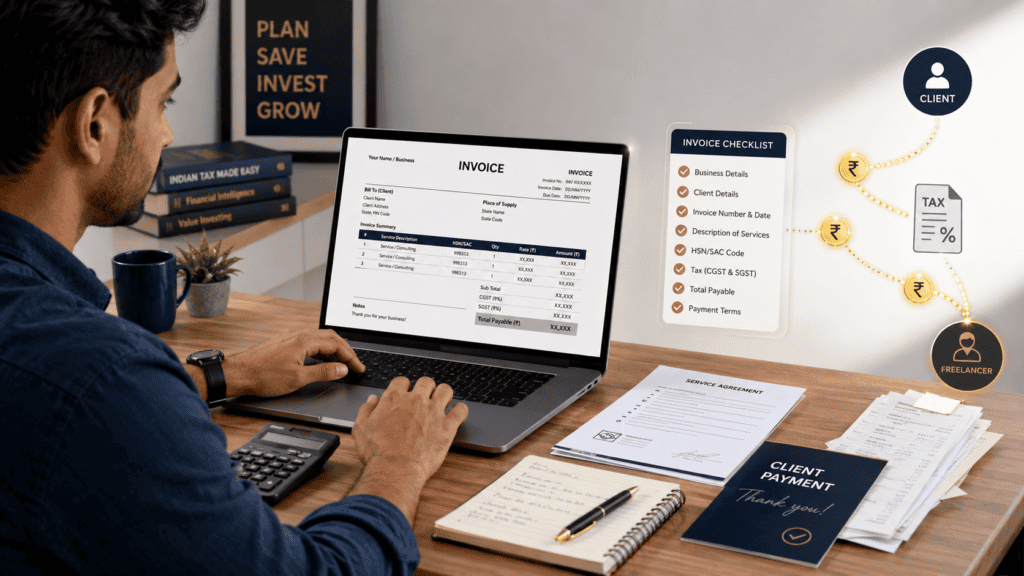
You have just finished a project, the client is happy, and now they say: “Send me an invoice.” Simple enough — until you open a blank document and wonder whether you need to add GST, what GSTIN goes where, whether to write CGST or IGST, and what “place of supply” even means. Most freelancers have been there. A missing field or a wrong one can delay your payment, trigger a GST mismatch, or create headaches at tax time. This guide walks through invoice meaning in plain terms, explains every field on a GST invoice for freelancers, and helps you understand the difference between a normal invoice, a GST tax invoice, and a bill of supply — so you can bill your clients professionally and stay on the right side of the rules.
Quick Answer: Invoice Meaning and GST Invoice for Freelancers
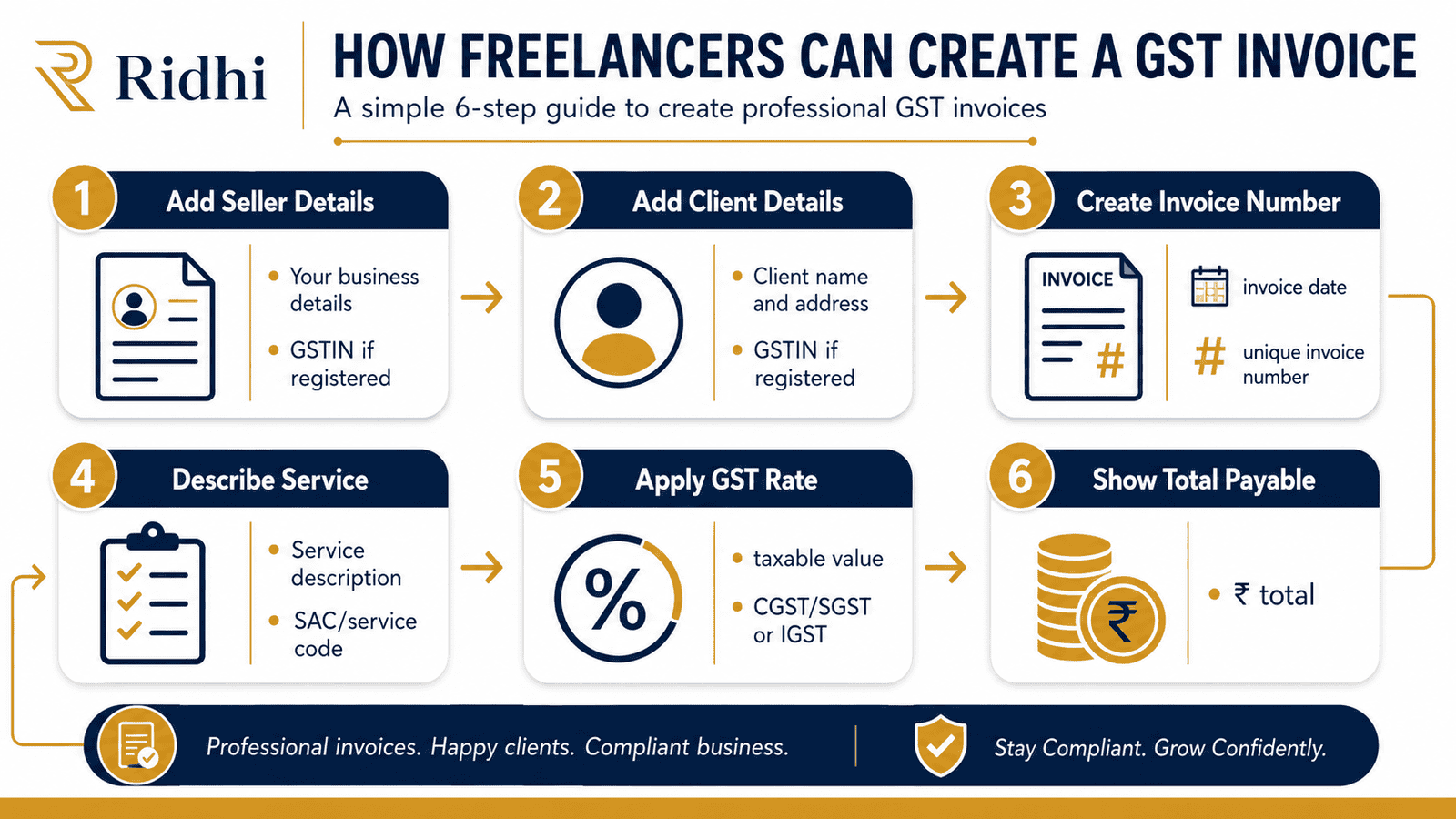
Invoice meaning is simple: an invoice is a formal bill a freelancer sends to a client for services provided. A GST invoice should include invoice number, date, freelancer and client details, GSTIN if applicable, service description, taxable value, GST breakup, place of supply, and total payable.
Key Takeaways
- A normal invoice records what service was done and how much is owed — it is a legal payment demand, not just a polite reminder.
- A GST tax invoice is required when a freelancer is GST-registered and the service is taxable under GST; issuing one without valid registration can attract penalties.
- Place of supply determines whether you charge CGST + SGST (same-state client) or IGST (different-state client) — getting this wrong creates a GST mismatch in GSTR-1.
- SAC codes (Service Accounting Codes) classify your service under GST; most freelance design, IT, and content services fall under SAC 998 series — verify the exact code before billing.
- Invoice number must follow a continuous sequential series within a financial year; gaps or resets mid-year can cause problems during a GST audit.
- TDS deducted by your client is not the same as GST — your invoice total and the amount you receive in the bank will differ, and both figures need to be tracked separately.
- GST invoice rules, e-invoicing thresholds, and registration requirements can change with each Budget or CBIC notification — always verify current rules at cbic-gst.gov.in before billing.
Key Facts at a Glance
| Concept | What It Means | Freelancer Relevance |
|---|---|---|
| Invoice meaning | A formal bill from service provider to client | Triggers payment obligation; part of tax records |
| GST tax invoice | Mandatory billing document under GST for taxable supplies | Required if you are GST-registered and service is taxable |
| Bill of supply | Issued instead of tax invoice when GST cannot be charged | Used for exempt services or by composition taxpayers |
| GSTIN on invoice | Your 15-digit GST Identification Number | Mandatory field if you are GST-registered |
| Invoice number | Unique sequential identifier per financial year | Cannot be repeated; gaps create audit risk |
| Place of supply | State where service is deemed to be consumed | Determines CGST+SGST vs IGST applicability |
| SAC code | Service Accounting Code classifying the type of service | Required on GST invoice; verify for your specific service |
| Time limit for service invoice | Invoice should generally be issued within 30 days of service completion | Late invoices can affect when GST liability arises |
What Invoice Meaning Really Covers — and Why GST Complicates It
Invoice vs Receipt vs Quotation: The Basics
An invoice is a formal demand for payment sent after work is done or agreed to be done. It is not the same as a receipt, which confirms payment has been received, or a quotation, which estimates what work will cost before it is done. A proforma invoice is a preliminary bill — often used to initiate a purchase order or wire transfer — and is not the same as a final tax invoice. Understanding these differences matters because using the wrong document can confuse your client’s accounts team and delay payment.
Under GST, two types of billing documents replace the ordinary invoice for registered taxpayers: the GST tax invoice (for taxable services) and the bill of supply (for exempt services or where tax cannot be charged). If you are not GST-registered, you issue a normal invoice without any GST fields. If you are registered, you are legally required to issue a tax invoice for taxable services — you cannot substitute a casual Word document for it.
When a Freelancer Issues a GST Invoice vs a Normal Invoice
Whether you need to issue a GST tax invoice depends first on whether you are registered under GST. Registration becomes mandatory once your aggregate annual turnover crosses a threshold — currently ₹20 lakh for services in most states, though this figure should be verified from the current rules at cbic-gst.gov.in. Some states and some categories have different thresholds. You can also register voluntarily below the threshold. If you are not registered, you should not charge GST on your invoice at all — doing so without a valid GSTIN is a compliance violation. Read our guide on GST registration rules for freelancers to understand when registration becomes mandatory before you send your first GST invoice.
Even if you are registered, some services may be exempt from GST or covered by special export rules. A freelancer doing work for an overseas client may be able to treat the supply as an export of service, which can carry a nil rate under certain conditions — but this requires a Letter of Undertaking (LUT) and proper documentation. Do not assume zero GST automatically applies to all foreign client invoices.
Mandatory Fields on a GST Invoice
According to CBIC guidelines under the CGST Act Section 31, a tax invoice for services must contain the following fields:
- Name, address, and GSTIN of the supplier — your details as the freelancer
- Invoice number — a unique consecutive serial number for the financial year
- Invoice date — date of issue
- Name, address, and GSTIN of the recipient — client details, including their GSTIN if they are also GST-registered
- Place of supply — the state where the service is deemed supplied
- Description of service — what you actually delivered
- SAC code — the Service Accounting Code for your type of service
- Taxable value — your fee before GST is added
- GST breakup — CGST + SGST (for intra-state) or IGST (for inter-state or export)
- Total amount payable — taxable value plus applicable GST
- Signature or digital authentication of the supplier
Why Invoice Number Sequence Matters
Invoice number meaning goes beyond just putting a number on a bill. The GST system expects a continuous, non-repeating series within a financial year. Many freelancers start a new series every month (e.g., INV-2025-001) or reset numbering mid-year without realising it creates a reconciliation problem when their GSTR-1 is filed. Your invoice numbers should follow a clear, unbroken pattern — whether alphabetic-numeric or purely numeric — and you should never reuse or skip a number. Keep a simple spreadsheet log if you are not using accounting software.
Why Place of Supply and CGST vs IGST Matter
Place of supply is one of the most misunderstood fields for new freelancers. The rule for services is broadly: if both you and your client are in the same state, the supply is intra-state and you charge CGST + SGST. If your client is in a different state, the supply is inter-state and you charge IGST. For overseas clients under export rules, a different treatment may apply. Getting this wrong means the wrong tax goes to the wrong government account — and the client cannot claim input tax credit on a wrongly charged component. This is not a minor formatting issue; it is a compliance error that requires a credit note to fix. See our detailed guide on freelancer tax basics for how invoicing fits into your overall tax picture.
Real Example: Aarav Bills a Mumbai Startup
Aarav, 29, is a freelance UI/UX designer in Bengaluru earning around ₹9 lakh a year from Indian startup clients. He has GST registration. He completes a UI redesign project for a Mumbai-based startup and charges ₹50,000 as his fee.
Here is how his invoice fields look conceptually:
- Invoice Number: INV-2025-26-007
- Invoice Date: 15 April 2025
- Supplier: Aarav Shah, Bengaluru — GSTIN: [his GSTIN]
- Client: Mumbai Startup Pvt Ltd, Mumbai — GSTIN: [client GSTIN]
- Service Description: UI/UX design services — website redesign project
- SAC Code: 998314 (or applicable SAC — verify before billing)
- Taxable Value: ₹50,000
- Tax Treatment: Aarav is in Karnataka; client is in Maharashtra — inter-state supply — IGST applies at the applicable rate (verify at cbic-gst.gov.in)
- Total Payable: ₹50,000 + applicable IGST
Because the client is in a different state, Aarav correctly applies IGST rather than CGST + SGST. If the same invoice were sent to a Bengaluru client, he would split the tax into CGST and SGST at equal halves instead. This one field — place of supply — changes the entire tax structure of the invoice.
How to Calculate Invoice Total, GST, and What You Actually Receive
Invoice Total = Taxable Value + GST (CGST + SGST or IGST)
Amount Received in Bank = Invoice Total − TDS Deducted by Client
Using Aarav’s example above with a hypothetical GST rate for illustration only — verify the actual rate applicable to your SAC code before billing:
| Scenario | Key Figures | Result |
|---|---|---|
| Service fee | Taxable value | ₹50,000 |
| GST (hypothetical 18% IGST) | 18% × ₹50,000 | ₹9,000 (verify actual rate) |
| Invoice total | ₹50,000 + GST | ₹59,000 (hypothetical) |
| TDS deducted by client (hypothetical 10%) | 10% × ₹50,000 | ₹5,000 (verify threshold and rate) |
| Amount received in bank | Invoice total − TDS | ₹54,000 (hypothetical) |
The key insight: TDS and GST are completely separate. TDS is a deduction from your taxable income — the client deducts it and deposits it with the Income Tax Department on your behalf. GST is a consumption tax that the client owes you and that you must remit to the government. Your invoice should show the full GST amount as payable; the client pays it to you in addition to your fee. They deduct TDS only from the base fee, not from the GST amount. Tracking this correctly every month prevents a nasty surprise at filing time. Read our detailed explainer on tracking freelance TDS and claiming refunds to reconcile these figures accurately.
Comparison: Billing Documents a Freelancer Should Know
| Document | When Used | GST Shown? |
|---|---|---|
| Normal invoice | Non-GST-registered freelancer billing for services | No |
| GST tax invoice | GST-registered freelancer billing for taxable services | Yes |
| Bill of supply | Registered freelancer supplying exempt services or composition taxpayer | No |
| Proforma invoice | Preliminary estimate before project confirmation or payment | Optional |
| Receipt / acknowledgement | Confirms payment received — issued after payment | No |
| Credit note | Issued to reduce an earlier invoice amount (e.g., correction or refund) | Reverses GST |
How to Decide What’s Right for You
You are GST-registered and the service is taxable — THEN issue a GST tax invoice with GSTIN, SAC code, place of supply, and tax breakup. A plain Word document is not enough.
You are not GST-registered and your turnover is below the mandatory threshold — THEN issue a normal invoice without any GST fields. Do not collect or mention GST.
Your client is in a different state from you — THEN check place of supply and use IGST, not CGST + SGST. Verify the applicable rate for your SAC code before billing.
Your client is overseas and you believe it qualifies as export of service — THEN verify LUT/export rules at cbic-gst.gov.in before billing at nil GST. Do not assume zero GST without confirming the export conditions.
Your client asks for a tax invoice with their GSTIN to claim input tax credit — THEN ensure you are actually registered; issuing a fake GST invoice to satisfy a client is a serious offence.
You bill both Indian and overseas clients regularly, or your annual income is growing rapidly — THEN review GST registration requirements at least once a year, not just at the point of first billing.
You are not confident about which SAC code applies, what rate is correct, or whether export rules apply to your overseas project — THEN do not guess. Ask a CA for a one-time review of your invoice template before sending. The cost is far less than a GST correction or penalty.
Common Mistakes to Avoid
Charging GST Without Valid Registration
Some freelancers add “GST: 18%” to their invoice without having a GSTIN, either to look professional or because a client asked for it.
Collecting GST without registration means you have collected tax you are not authorised to collect — and cannot remit it properly. The client cannot claim input tax credit on it. CBIC rules treat this as a serious compliance breach, not a formatting issue.
Only add GST fields to your invoice after your GSTIN is active. Until then, issue a plain invoice.
Missing or Incorrect Invoice Number
Freelancers often reuse invoice numbers, start a new series mid-year, or forget to number invoices entirely.
Your GSTR-1 outward supply statement must match your invoice records. A broken or duplicated series creates a reconciliation error that auditors flag. It also signals poor record-keeping to corporate clients who scrutinise vendor documents.
Set up a simple numbered series from INV-2025-26-001 at the start of each financial year and never reset it.
Wrong Place of Supply Leading to Wrong Tax
Applying CGST + SGST for a client in another state (or IGST for a same-state client) is one of the most common errors on freelancer invoices.
This causes a mismatch between the tax deposited and the client’s input tax credit claim. The client’s accounts team will flag it and may hold payment until a corrected invoice or credit note is issued.
Always check client address and state before issuing the invoice. Place of supply for services generally follows the recipient’s location — verify the specific rule for your service type.
Confusing TDS Deduction with GST
Many new freelancers see the amount deposited in their bank — which is lower than the invoice total — and assume GST was “not paid” or that there is a shortfall.
TDS is an income tax advance deducted by the client from your professional fee. GST is a separate tax the client owes you on top of your fee. These two do not cancel each other out and must be tracked in separate columns. Also see how to track and claim TDS refunds as a freelancer for a reconciliation walkthrough.
Keep a monthly invoice register that shows: invoice amount, GST charged, TDS expected, and bank receipt — all four columns separately.
Not Preserving Invoice Copies and Payment Proof
Losing invoice records is a common problem for freelancers who bill sporadically and do not use accounting software.
GST law requires registered taxpayers to maintain records for several years. A missing invoice means you cannot support your GSTR-1 filing, claim any disputed payment, or produce documentation during scrutiny.
Save every invoice as a numbered PDF, store a backup on cloud, and record the corresponding bank credit reference in your invoice log.
Copying a Random Template Without Compliance Review
Online templates vary wildly in accuracy — some include fields required only for goods, others omit SAC codes, and many have outdated GST rates hardcoded in cells.
Using a wrong template does not make your invoice compliant just because it looks professional. Fields like SAC code, place of supply, and the applicable GST rate need to be correct for your specific service and registration status.
Build your own base template using the mandatory fields listed in this guide, then have a CA or GST practitioner review it once before you use it commercially.
Ignoring E-Invoicing Applicability
Above certain annual turnover thresholds, GST-registered businesses are required to generate invoices through the government’s e-invoicing portal (IRP) and obtain an Invoice Reference Number (IRN).
Freelancers who grow their billing significantly may cross this threshold without realising it. An invoice issued outside the IRP system when e-invoicing is mandatory is non-compliant.
Verify current e-invoicing applicability limits at cbic-gst.gov.in at least once a year if your turnover is rising.
When This May Not Be the Right Choice
A standard GST invoice format may not cover your situation if you are not yet GST-registered — in that case, a plain invoice without tax fields is the correct document, and adding GST fields without a GSTIN creates a compliance risk rather than solving one.
If you are billing an overseas client, a standard domestic GST invoice is likely insufficient. Export of service rules, Letter of Undertaking requirements, and foreign exchange documentation add layers that go beyond a template — see our guide on how Indian freelancers are taxed on overseas earnings for what else needs attention.
If your service falls under an exempted category or a specific notification covers your work differently, a bill of supply may be the correct document rather than a tax invoice. Similarly, if your client’s procurement team requires a vendor-specific format for their ERP system, a standard invoice template may need to be adapted — always confirm with the client’s accounts department before billing a new corporate client.
If any of these apply to your situation, it may be worth exploring alternatives before committing.
Official Rules and Where to Verify
GST invoice rules, mandatory fields, e-invoicing applicability limits, and registration thresholds are governed by the CGST Act and CBIC notifications. These can change with each Budget or regulatory circular. Do not rely on templates or third-party articles — including this one — as your final compliance check. Always verify from the primary sources below before billing:
- CBIC — cbic-gst.gov.in: Official source for GST invoice rules, CGST Act provisions, e-invoicing requirements, SAC code classifications, and CBIC notifications
- GST Portal — gst.gov.in: For GSTIN verification, GSTR-1 outward supply reporting, LUT filing, and e-invoice generation through the IRP
- Income Tax Department — incometax.gov.in: For TDS rates applicable to professional payments, advance tax obligations, and income reporting rules for freelancers
Rules, limits, and rates on this topic can change with each Budget or regulatory update. Always verify current figures directly from the official source before making any financial decision. Once your invoicing records are in order, see our step-by-step guide on how to file ITR as a freelancer in India to connect your invoice trail to your annual tax return.
Expert Tips
- Run one invoice series per financial year, not per client or per month. Use a format like INV-FY26-001, INV-FY26-002 — this makes GSTR-1 reconciliation straightforward and looks professional to corporate clients who audit vendor records.
- Verify your client’s GSTIN before issuing any GST invoice. You can do this on the GST portal at gst.gov.in/searchtaxpayer. An inactive or wrong GSTIN means the client cannot claim input tax credit and may dispute your invoice.
- Save four items per invoice: PDF of invoice, editable source file, payment confirmation from bank, and any client purchase order. This set covers you for GST scrutiny, income tax assessment, and payment disputes simultaneously. See our guide on business expense records for self-employed Indians to extend this discipline to your expense side.
- Reconcile your invoice log against your bank account every month — not just at year-end. Match each invoice number, GST charged, TDS expected, and bank credit received. Doing this monthly takes 20 minutes; doing it in March for the whole year takes an uncomfortable weekend.
- Review your invoice template once at the start of each financial year. Check that SAC codes, GST rates, and your GSTIN are still correct, especially if CBIC has issued any notifications or your service mix has changed.
- If you use accounting software, do not skip understanding the underlying fields. Software automates calculations but cannot verify whether you are using the right SAC code, correct place of supply logic, or applicable tax rate for your specific service. Understanding the fields first means you can catch errors the software does not flag.
- For recurring corporate clients, share your invoice format with their accounts team before month one. Many large clients have vendor onboarding requirements; knowing their format expectations upfront prevents rejected invoices and payment delays that can stretch 45–90 days.
Frequently Asked Questions
What is invoice meaning in simple words?
An invoice is a formal document sent by a service provider to a client asking for payment for work completed. It lists what service was done, the amount charged, applicable taxes, payment terms, and both parties’ details. It is a legal record of the transaction, not just a reminder.
Can a freelancer issue an invoice without GST?
Yes. If you are not registered under GST, you should issue a normal invoice without any GST fields. You must not collect GST or add “GST charged” to an invoice unless you have a valid GSTIN. Once your annual turnover crosses the mandatory registration threshold, normal invoices are no longer sufficient for taxable services.
What is GSTIN on invoice?
GSTIN stands for Goods and Services Tax Identification Number. It is a 15-digit number assigned to you when you register under GST. It must appear on every tax invoice you issue. Your client’s GSTIN should also be included if they are GST-registered, so they can claim input tax credit. You can verify any GSTIN at gst.gov.in.
What is invoice number meaning?
Invoice number meaning refers to the unique identifier assigned to each invoice in a consecutive series within a financial year. It allows both you and your client to track, reference, and reconcile invoices against payments. Under GST, your invoice numbers must follow an unbroken series — you cannot reuse, skip, or reset them mid-year.
What is place of supply on a GST invoice?
Place of supply is the location (state) where the service is deemed to be supplied under GST law. It determines whether you charge CGST + SGST (if you and the client are in the same state) or IGST (if you are in different states). For most service transactions between Indian businesses, place of supply is the recipient’s location. Export of service has different rules.
What is SAC code for freelancers?
SAC stands for Service Accounting Code. It is a six-digit code that classifies your type of service under the GST system, similar to how HSN codes work for goods. Most IT, design, writing, and consulting services fall under the 998 series — but the exact six-digit code varies by service type. Verify the correct SAC code for your specific work at cbic-gst.gov.in before adding it to your invoice.
Is a quotation the same as an invoice?
No. A quotation is a pre-project document that estimates the cost of work before it is done; it is not a payment demand and has no legal binding unless accepted. An invoice is issued after work is done (or per agreed milestones) and formally demands payment. Never send a quotation as an invoice — the client’s finance team will reject it.
Should TDS appear on the invoice?
No. TDS is deducted by the client when they make payment to you — it does not appear as a line item on your invoice. Your invoice shows your fee, applicable GST, and total payable. The client will then deduct TDS from your professional fee (not from GST) when processing payment and deposit it with the Income Tax Department on your behalf. You can claim it as advance tax credit when you file your ITR.
What is the difference between CGST + SGST and IGST?
CGST (Central GST) and SGST (State GST) are charged together when you supply services to a client in the same state as you. IGST (Integrated GST) is charged when the supply is inter-state — that is, you and your client are in different states. The total tax burden is the same percentage in both cases; it is just split differently between central and state governments. The correct split depends on place of supply.
What is a bill of supply and when do I use it?
A bill of supply is issued by a GST-registered taxpayer in cases where they cannot charge GST — for example, when supplying exempt services, or when they are under the composition scheme. It looks similar to a tax invoice but explicitly states that GST is not being charged. If you issue a bill of supply, you cannot recover input tax credit on your business expenses related to that supply.
Final Verdict
Invoice meaning starts simple — a formal bill for services rendered — but for a GST-registered Indian freelancer, invoice meaning quickly expands into a compliance checklist: GSTIN, sequential invoice number, place of supply, SAC code, correct tax breakup, and preserved records. A professional invoice does three things simultaneously: it demands payment, creates a tax document, and builds your credibility with clients. Get the format wrong and you delay payment, create GST mismatches, or trigger scrutiny. The framework in this guide covers what each field means and why it matters — but the specific rates, thresholds, SAC codes, and registration rules applicable to your work must be verified from CBIC and the GST portal before you bill. Freelancers who combine clean invoicing with organised records will find tax filing significantly less stressful. Always verify the latest rules from official sources or consult a qualified professional before making any financial decision.
This article is for educational purposes only and should not be treated as personalised financial, tax, investment, insurance, or legal advice. Tax rules, interest rates, regulatory limits, and product features can change with each Budget or policy update. Please verify current rules from official government sources or consult a qualified and registered professional before making any financial decision.

Amit Verma writes about money management for Indian freelancers, consultants, creators, professionals, and self-employed workers. His content focuses on income planning, tax basics, GST awareness, cash flow, invoicing, business expenses, and financial stability for people who do not receive a fixed monthly salary.
He covers topics such as Section 44ADA, presumptive taxation, professional income, advance tax, GST basics, TDS for freelancers, invoice planning, business expense tracking, ITR filing for self-employed professionals, emergency funds, health insurance, retirement planning, and irregular income management.
Amit’s writing is practical, relatable, and built around the realities of independent work. He understands that freelancers often deal with delayed payments, uneven income, unclear tax deductions, missing employer benefits, and uncertainty around compliance. His guides help readers organise their financial life better, but they are educational and not a substitute for professional advice. Since tax rules, GST limits, filing requirements, and deduction treatment can change, readers should verify current rules from official sources or consult a qualified professional.