
A ₹5,000 welcome voucher sounds like a great deal — until you realise it expires in 90 days, works only at one merchant you never visit, and came attached to a ₹2,999 joining fee plus 18% GST. Welcome benefits are among the most advertised features in Indian credit card marketing, and they are also among the most misunderstood. Banks promote the headline number. They are far less enthusiastic about explaining the conditions, restrictions, and friction that determine whether you actually pocket that value. This article gives you a reusable formula to calculate real rupee value from any welcome benefit — so you can compare cards on what you will actually receive, not what the mailer promises. No card will be called definitively best here. What you will get is the tool to decide for yourself.
Quick Answer: Credit Card Welcome Benefits
Credit card welcome benefits are useful only when their cash value is higher than the joining fee and conditions. Add voucher value, reward point value and usable perks, then subtract fees, taxes and extra spending needed. For example, a ₹2,000 voucher minus a ₹999 fee gives only ₹1,001 real value. Verify current rates before applying, as welcome bonuses, fees and reward conversion rates change frequently.
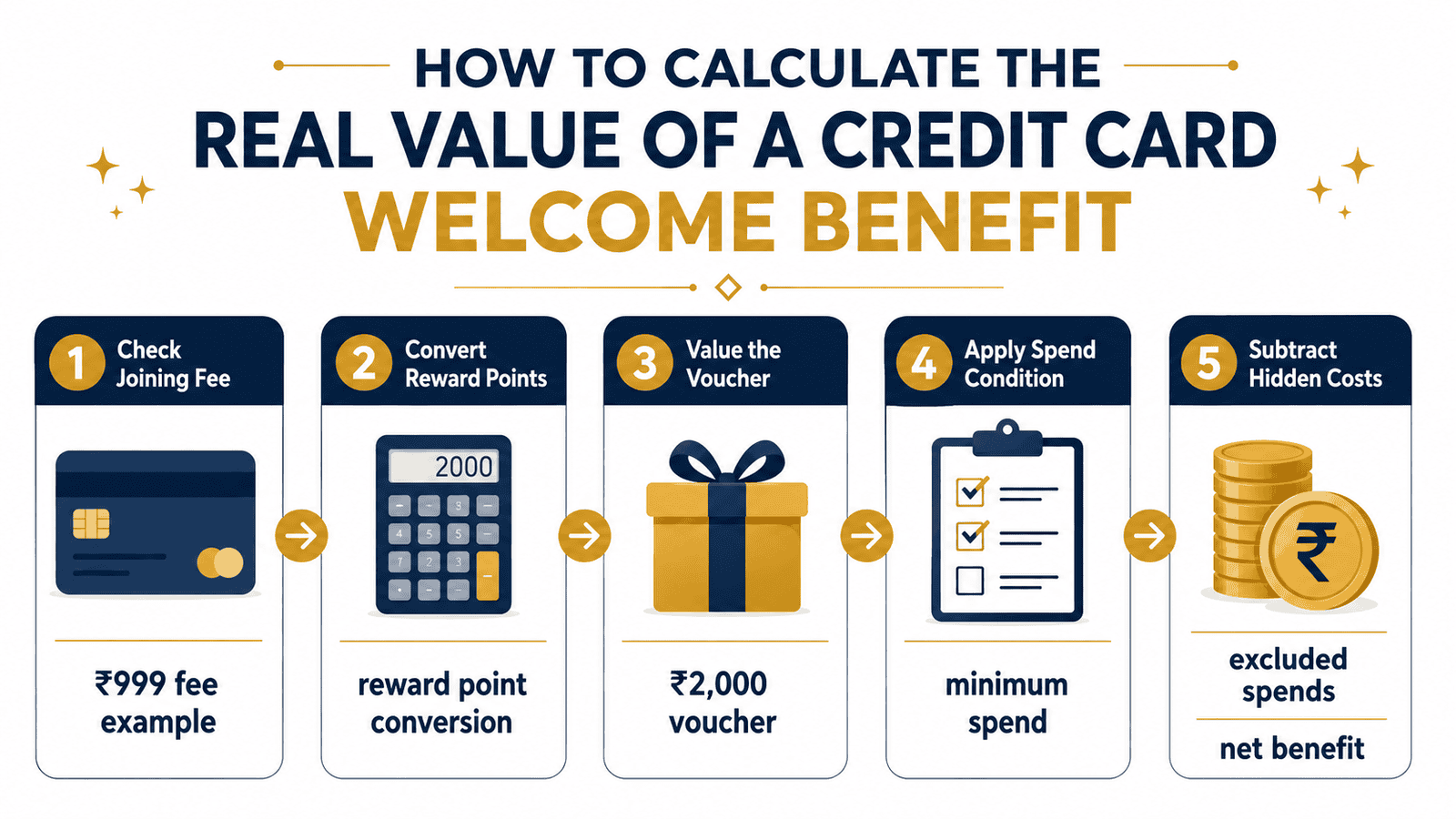
How to Calculate the Real Value of a Welcome Benefit
Real Value = Usable Welcome Benefit − Joining Fee − GST on Joining Fee − Extra Spend Cost − Redemption Friction
Each term in the formula matters. Here is what to plug in:
Usable Welcome Benefit — Not the advertised figure. Only count benefits you will realistically use before expiry. A ₹3,000 Myntra voucher is worth ₹0 to someone who never shops there.
Joining Fee — The one-time fee charged when you first get the card. Many cards waive this on first year; many do not. Confirm in the Schedule of Charges, not the marketing page.
GST on Joining Fee — GST at 18% applies to credit card fees. A ₹999 joining fee becomes ₹1,178.82 out of pocket. This is money you spend, not save.
Extra Spend Cost — Many welcome benefits unlock only after a minimum spend in the first 30, 60 or 90 days. If you would not have spent that money anyway, the incremental spend is a cost. A ₹10,000 minimum spend to unlock ₹1,500 reward points worth ₹300 is a loss, not a gain.
Redemption Friction — Reward points rarely convert 1:1 to rupees. A common ratio is 1 point = ₹0.25. So 5,000 points = ₹1,250, not ₹5,000. Some programmes require minimum redemption thresholds (e.g. 2,000 points minimum), charge redemption fees, or expire points after 12–24 months. All of this reduces real value. For more detail on comparing reward structures, see our guide to points or cashback.
Example A — Voucher Welcome Benefit
Card charges ₹999 joining fee. Welcome benefit: ₹2,000 Swiggy voucher usable within 60 days. You order Swiggy regularly.
Real Value = ₹2,000 − ₹999 − ₹179.82 (GST) − ₹0 (no spend condition) − ₹0 (no redemption friction) = ₹821.18
The headline was ₹2,000. You actually received ₹821.
Example B — Reward Points Welcome Benefit
Card charges ₹500 joining fee. Welcome benefit: 5,000 reward points. Conversion ratio: 1 point = ₹0.25. Minimum spend to unlock: ₹15,000 in 30 days. You would have spent ₹10,000 anyway — so ₹5,000 is incremental.
Reward points value = 5,000 × ₹0.25 = ₹1,250
Real Value = ₹1,250 − ₹500 − ₹90 (GST) − ₹5,000 (extra spend needed) = −₹4,340
A negative real value. The welcome benefit costs you money if the extra spend was not needed.
Example C — Statement Credit
Card charges ₹1,499 joining fee. Welcome benefit: ₹1,500 statement credit applied after first transaction. No spend condition.
Real Value = ₹1,500 − ₹1,499 − ₹269.82 (GST) = −₹268.82
Even a matching statement credit does not cover the GST cost. Slightly negative deal — but close enough that the card’s ongoing features might justify it.
Key Takeaways
- Welcome benefits are not free — if a joining fee is charged, the real value is always lower than the advertised benefit amount.
- GST at 18% on joining fees is a real cost: a ₹999 fee actually costs ₹1,178.82 out of pocket.
- Reward points typically convert at ₹0.20–₹0.50 per point — a 5,000-point welcome bonus is worth ₹1,000–₹2,500 in rupees, not ₹5,000.
- Minimum spend conditions can easily turn a positive welcome deal into a negative one — count only the incremental spend you would not make otherwise.
- Vouchers with short expiry windows, restricted merchants, or categories you rarely use should be valued at ₹0, not face value.
- Card terms — joining fees, reward ratios, voucher merchants — change frequently; always read the MITC document at application time.
Key Facts at a Glance
| Term | What It Means | What to Check |
|---|---|---|
| Joining Fee | One-time fee on card issuance | Schedule of Charges on bank website |
| Annual / Renewal Fee | Fee charged every year from Year 2 | Often different from joining fee — check both |
| GST on Fees | 18% GST applies to all card fees | Adds to your actual cost; appears on statement |
| Welcome Voucher | Discount code or gift voucher from a merchant | Expiry date, eligible merchants, minimum order value |
| Reward Points | Points earned on spend; need conversion | Conversion ratio, minimum redemption, expiry |
| Minimum Spend Condition | Spend threshold to unlock welcome benefit | Time window (30/60/90 days), excluded categories |
| Excluded Spends | Transactions that do not count toward the condition | Fuel, rent, EMI, wallet loads — often excluded |
| MITC | Most Important Terms and Conditions document | Mandatory RBI disclosure; binding on both parties |
What Are Credit Card Welcome Benefits?
Credit card welcome benefits are incentives banks offer to attract new customers at the time of card issuance. They typically take one of four forms: a merchant voucher (e.g. ₹2,000 off on Amazon), a reward point bonus (e.g. 5,000 bonus points on first transaction), a statement credit (e.g. ₹500 credited against your first bill), or a lifestyle perk (e.g. complimentary airport lounge access for a year). The advertised headline is always the gross value. The net value to you depends on three variables: what you actually pay in fees, what conditions you must meet, and how usable the benefit really is.
Why Advertised Value and Real Value Diverge
Banks are not being dishonest when they advertise a ₹5,000 welcome benefit on a ₹999 fee card. The ₹5,000 is technically the value they are offering. But that figure ignores GST on the fee, voucher restrictions, reward-point conversion losses, and minimum spend requirements. According to RBI credit card directions, issuers are required to disclose all key terms in the MITC document — but that document can be 20 pages long and is rarely read before applying. As a beginner choosing your first card choice, understanding this gap is more valuable than memorising any ranked list of cards.
The Four Benefit Types and Their Friction
Merchant vouchers are the most common welcome benefit in India. Their usable value depends entirely on whether you shop at that merchant, whether the voucher has a minimum order, and whether it expires quickly. A 30-day Zomato voucher is worth full face value to a frequent user. It is worth ₹0 to someone who cooks at home.
Reward points require an extra mental step — conversion. Most Indian card programmes value points at ₹0.25 to ₹0.50 per point for standard redemptions. Premium travel cards can offer higher rates, but only when redeemed for specific flights or hotels. The headline “10,000 welcome points” sounds large. At ₹0.25 per point, that is ₹2,500 — not ₹10,000.
Statement credits are the most transparent benefit type. If ₹1,500 is credited to your statement, you receive ₹1,500. The only friction is ensuring you meet the trigger condition (usually the first transaction within a set period).
Lifestyle perks like lounge access, concierge services, or insurance covers have value only if you travel enough to use them. A frequent flyer gains real value from complimentary lounge visits; a person who flies twice a year does not.
What the MITC Document Must Tell You
Under RBI guidelines, every credit card issuer must provide an MITC document at the time of card issuance. This document must state all fees, interest rates, reward programme terms, and conditions for benefits. The MITC is legally binding. If the welcome benefit terms you relied on differ from the MITC, the MITC governs. This is the document to read — not the marketing email, not the card comparison website, not the bank’s social media post. Terms on comparison aggregators are often outdated by the time you read them.
Real Example: Rohan’s Card Decision
Rohan is 29, works as a software engineer in Bengaluru, and earns ₹1.2 lakh per month. He is comparing two cards. Card A has a ₹999 joining fee and a welcome voucher worth ₹2,500 at a popular electronics retailer, valid for 45 days. Card B has a ₹1,499 joining fee and offers 6,000 reward points on first spend of ₹5,000 within 30 days; points convert at ₹0.25 each.
For Card A: Joining fee ₹999 + 18% GST = ₹1,178.82. Voucher value: Rohan buys gadgets regularly, so he values this at face value ₹2,500. Real value = ₹2,500 − ₹1,178.82 = ₹1,321.18. Positive deal.
For Card B: Joining fee ₹1,499 + 18% GST = ₹1,768.82. Points value = 6,000 × ₹0.25 = ₹1,500. He would have spent ₹5,000 on his card anyway (his monthly subscriptions alone total ₹3,500), so the minimum spend adds no incremental cost. Real value = ₹1,500 − ₹1,768.82 = −₹268.82. Slightly negative.
Card A wins for Rohan — even though Card B’s advertised benefit (6,000 points) sounds more impressive than a ₹2,500 voucher. The difference is the fee gap and the conversion loss on points. Rohan also notes that the billing cycle rules mean the ₹1,178.82 for Card A appears on his first statement — something to plan for before applying.
Comparison: Welcome Benefit Types — Advertised vs Real Value
| Benefit Type | Advertised Value | Typical Real Value After Fees and Friction |
|---|---|---|
| Merchant Voucher (usable merchant, short expiry) | ₹2,000 | ₹800–₹1,200 after fee and GST |
| Merchant Voucher (restricted merchant / long min order) | ₹2,000 | ₹0–₹400 if partially or fully unusable |
| Reward Points (standard conversion ₹0.25/pt) | 5,000 pts = ₹5,000 (implied) | ₹250–₹750 net after fee, GST and conversion |
| Statement Credit | ₹1,500 | ₹300–₹1,500 depending on fee size |
| Lounge Access (4 visits/year) | ₹6,000 (if ₹1,500/visit) | ₹0–₹4,000 depending on travel frequency |
| Annual Fee Waiver on Renewal | ₹1,499 saved | ₹0–₹1,499 — only if spend milestone is met |
All values above are illustrative. Actual joining fees, reward ratios and voucher merchants change frequently. For a deeper look at how annual fee waivers work in Year 2, read our guide on annual fee waiver.
How to Decide What’s Right for You
The usable benefit value (after conversion and restrictions) clearly exceeds the total joining fee plus GST — THEN the welcome benefit is genuinely additive and worth considering.
The benefit is a voucher for a merchant you use regularly and the expiry is 60 days or more — THEN count it at or near face value in your calculation.
The welcome benefit requires a minimum spend you would not naturally hit — THEN subtract the incremental spend cost from the benefit value; the deal may turn negative.
The card’s ongoing features (reward rate, fee waiver milestone, lounge access) are strong and suit your spending — THEN the welcome benefit is a bonus, not the primary reason to apply.
You prefer simplicity over tracking points and vouchers — THEN a cashback card with no joining fee may give you better long-term value than a high-fee welcome-benefit card.
If you carry an unpaid balance from month to month — do not evaluate welcome benefits without first understanding the interest rate, which can erode every rupee of welcome value within a single billing cycle.
Common Mistakes to Avoid
Valuing Reward Points at Face Value
Many applicants read “5,000 welcome points” and mentally note ₹5,000. At a typical conversion of ₹0.25 per point, those points are worth ₹1,250.
This gap causes people to overestimate the deal significantly and choose a higher-fee card than makes sense for their spend.
Always find the conversion ratio in the rewards programme document — not the marketing material — before doing your calculation.
Ignoring Voucher Expiry and Merchant Restrictions
A ₹3,000 welcome voucher that expires in 30 days at a single merchant can easily expire unused.
Banks set short expiry windows knowing that a percentage of customers will not redeem. Unredeemed vouchers cost the bank nothing.
Check expiry date and eligible merchants before counting any voucher in your real-value formula. If you are unsure you will use it, value it at 50% or less.
Forgetting GST on the Joining Fee
A ₹999 joining fee becomes ₹1,178.82 after 18% GST. A ₹2,999 joining fee becomes ₹3,538.82.
On a high-fee card, forgetting GST can shift the real-value calculation by several hundred rupees — enough to flip a marginally positive deal to a negative one.
Always compute total fee cost as joining fee × 1.18 in your formula.
Spending Extra to Unlock the Bonus
Spending ₹20,000 in 30 days to unlock a ₹2,000 reward-point benefit is only a good deal if you would have spent ₹20,000 anyway.
Forced or accelerated spending often results in purchases you did not need, wiping out the benefit entirely and potentially leaving you with a higher credit card balance.
Identify your natural monthly spend first, then check whether the threshold is within that range.
Ignoring Excluded Spend Categories
Most minimum spend conditions exclude fuel, rent payments, EMI transactions, and wallet loads. If your ₹20,000 monthly spend is heavily weighted toward these, your effective eligible spend may be far lower.
Read the excluded categories list in the MITC. Assuming all your spending counts is one of the most common beginner errors.
Evaluating Only Year-One Economics
A card that gives ₹2,000 in welcome benefits and charges ₹1,499 annually from Year 2 requires you to extract at least ₹1,768.82 in ongoing value every year just to break even.
Check whether the renewal fee has a waiver milestone, how achievable that milestone is, and what the card earns after the welcome period ends.
Trusting Comparison Website Figures
Aggregator websites — including major ones — frequently show outdated joining fees, reward ratios, and welcome offers. Banks update terms without notifying comparison sites.
Verify all figures directly on the card issuer’s official product page and in the Schedule of Charges before applying.
When This May Not Be the Right Choice
A welcome-benefit card may not be the right fit for you in several specific situations. If you currently carry an unpaid credit card balance, the interest rate risk from revolving debt — often 36–42% per annum on Indian credit cards — can wipe out months of welcome-benefit value within a single billing cycle. If the primary benefit is a voucher for a category you rarely spend in, the effective value is close to zero regardless of the advertised amount. If the card has a high joining fee and the annual fee waiver milestone is aggressive, you may end up paying more in fees over two years than you ever received as a welcome benefit. And if the welcome offer encourages a lifestyle spending pattern you cannot sustain — premium dining, frequent travel — the card’s ongoing costs may outweigh its rewards after the first year. If any of these apply to your situation, it may be worth exploring alternatives before committing.
Official Rules and Where to Verify
Credit card welcome benefit terms, joining fees, reward conversion rates, voucher merchants, and minimum spend conditions are not permanent. They are set by individual issuers and can change at any time — sometimes without prior notice to existing or prospective cardholders. Rules, limits, and rates on this topic can change with each Budget or regulatory update. Always verify current figures directly from the official source before making any financial decision.
- RBI — rbi.org.in: For credit card regulatory framework and consumer rights under RBI’s Master Direction on Credit and Debit Cards.
- Card Issuer’s Official Product Page: The only reliable source for current joining fee, annual fee, welcome benefit, and reward ratio.
- MITC Document: Download from the issuer’s website or request before applying. This is the binding document — not the marketing page.
- Schedule of Charges: Lists all fees including joining fee, renewal fee, and GST applicability.
- Rewards Programme Terms: A separate document that specifies conversion ratios, minimum redemption amounts, expiry, and excluded categories.
Once your card is issued, your card statement lines will show the joining fee charge, any GST applied, and any benefit credits — making it easy to verify whether what was promised was actually delivered.
Expert Tips
- Prefer welcome benefits that are easy to use: a statement credit or a widely-applicable cashback is worth more to most people than a restricted merchant voucher, even at a lower face value.
- Treat reward points conservatively in your calculation. Use ₹0.25 per point as a floor estimate. If the card actually gives you more on redemption, that is a bonus — not something to build your decision on.
- Calculate first-year and second-year economics separately. A card that makes sense in Year 1 because of the welcome benefit may be a poor deal from Year 2 if the renewal fee is high and your spend does not meet the waiver milestone.
- Screenshot or save the exact welcome benefit terms on the day you apply. Banks are not obligated to honour terms from a previous version of their product page if they have since changed them.
- If the card has a spend condition for the welcome benefit, set a calendar reminder for 10 days before the deadline. Missing a ₹15,000 spend window by ₹500 means losing the entire welcome benefit.
- Never apply for a card purely for the welcome offer. The card’s ongoing reward rate, fee structure, and your natural spend pattern are the real determinants of long-term value.
- If a card is marketed as lifetime free but carries a welcome voucher, read the fine print: some issuers charge a “processing fee” that functions like a joining fee, subject to GST, even on technically free cards.
Frequently Asked Questions
Are credit card welcome benefits really free?
Only if the card has no joining fee and no minimum spend condition. Most cards with attractive welcome benefits charge a joining fee plus 18% GST. After deducting these costs, the net value of the benefit is always lower than the advertised amount. A ₹2,000 voucher on a ₹999 fee card yields approximately ₹821 in real value once GST is included.
Is a voucher better than reward points as a welcome benefit?
It depends on how usable each is for you. A voucher for a merchant you use regularly, with a long expiry, is usually more valuable because it requires no conversion step. Reward points involve a conversion ratio that reduces their rupee value — typically ₹0.25–₹0.50 per point for standard redemptions. If you are unlikely to use a specific voucher merchant, reward points redeemable as statement credit may be more practical.
Should I pay a joining fee to get a welcome bonus?
Only if the real value of the welcome benefit — after fee, GST, conversion losses, and spend conditions — is clearly positive. Run the formula: Real Value = Usable Benefit − Joining Fee − GST − Extra Spend Cost − Redemption Friction. If the result is negative or near zero, the joining fee is not justified by the welcome offer alone. Consider whether the card’s ongoing features justify the fee instead.
What if the bank changes the welcome benefit after I apply?
Banks can change future welcome offers for new applicants, but the terms applicable at your application date — as documented in the MITC you received — should apply to your card. If the benefit is not credited as promised, raise a dispute through the bank’s grievance mechanism. If unresolved, escalate via the RBI Banking Ombudsman at rbi.org.in. Always save the MITC document from your application date.
Do excluded spends affect whether I receive a welcome bonus?
Yes. If the welcome benefit has a minimum spend condition, excluded categories — typically fuel, rent, EMI conversions, and wallet loads — do not count toward the threshold. If your spending is concentrated in excluded categories, you may not meet the condition even if you believe you spent enough. Read the excluded spend list in the MITC before applying.
Can I redeem welcome reward points for cash?
It depends on the card’s reward programme. Some programmes allow redemption as a statement credit (effectively cash). Others allow redemption only against specific merchants, travel bookings, or catalogue items. Cash redemptions often carry a lower conversion rate than travel or merchandise redemptions. Check the reward programme document for your specific card.
What is a joining fee reversal and should I expect it?
Some banks advertise a joining fee reversal — where the fee is refunded as a statement credit or reward points after a first transaction or a minimum spend. This is functionally similar to a fee-free card, but only if the reversal condition is simple and you actually meet it. If the reversal requires ₹30,000 in spend within 30 days, it may not be achievable for everyone. Treat the reversal as conditional, not guaranteed, until it appears on your statement.
Is GST charged on the welcome benefit value or just the fee?
GST at 18% applies to credit card fees — including joining fees and annual renewal fees — not to the value of vouchers or reward points you receive. So your cost increases by 18% of the fee, but the benefit value is not reduced by GST. However, some merchant vouchers have their own GST treatment at the point of redemption, which may affect the effective discount depending on the merchant’s billing approach.
What is the MITC and why does it matter?
MITC stands for Most Important Terms and Conditions. Under RBI directions, every credit card issuer must provide this document at issuance. It contains all fees, interest rates, reward programme terms, benefit conditions, and grievance procedures. It is the legally binding document. If any term in a bank’s advertisement conflicts with the MITC, the MITC governs. Reading the MITC before applying is the single most important step in evaluating a credit card’s welcome benefit.
Final Verdict
Credit card welcome benefits can genuinely add value — but only when you calculate real value, not advertised value. The formula is straightforward: usable benefit minus joining fee, GST, extra spend cost, and redemption friction. When the result is clearly positive and the card’s ongoing features also suit your spending pattern, a welcome-benefit card is a reasonable choice. When the result depends on hitting a high spend threshold, redeeming at a restricted merchant, or carrying a renewal fee you may not waive, the deal is weaker than it looks. The calculation in this article is reusable for any card you evaluate. Run it before you apply — not after the joining fee has already appeared on your statement. Always verify the latest rules from official sources or consult a qualified professional before making any financial decision.
This article is for educational purposes only and should not be treated as personalised financial, tax, investment, insurance, or legal advice. Tax rules, interest rates, regulatory limits, and product features can change with each Budget or policy update. Please verify current rules from official government sources or consult a qualified and registered professional before making any financial decision.

Nikhil Bansal writes about credit cards, billing cycles, card charges, rewards, cashback, credit utilisation, card EMI, BNPL, and responsible credit usage in India. His content is designed for readers who want to use credit cards wisely without falling into expensive repayment mistakes.
He covers topics such as how to choose a first credit card, credit card billing cycle, due date, grace period, minimum amount due, credit utilisation ratio, reward points vs cashback, lifetime free credit cards, annual fee waivers, credit card statement reading, add-on cards, cash advance charges, EMI on credit cards, credit card fraud reporting, BNPL vs credit card, and foreign transaction fees.
Nikhil’s writing is beginner-friendly, direct, and risk-aware. He explains how small mistakes such as paying only the minimum due, withdrawing cash from a credit card, missing due dates, or overusing credit limits can become costly. Since card fees, interest rates, reward rules, waiver conditions, and bank offers change often, readers should verify the latest Most Important Terms and Conditions from the card issuer.