

Most freelancers in India first encounter GST when a client emails asking: “Can you share your GSTIN?” That single question sets off a chain of confusion — is registration legally required? Does earning from a foreign client change anything? Is GST the same as the TDS the client already deducts? And what happens if income crosses ₹20 lakh mid-year?
GST registration for freelancers is governed by the CGST Act and related rules — and the answer is not always a simple yes or no. It depends on your total service turnover, where your clients are located, and whether specific compliance triggers apply. This article breaks down every scenario clearly, so you know exactly when registration becomes mandatory, when it remains optional, and what you must do once you register.
GST and income tax are entirely separate frameworks. Filing your ITR or claiming 44ADA presumptive tax has no bearing on your GST obligation. Both apply independently based on their own rules.
Quick Answer: GST Registration for Freelancers
GST registration for freelancers is mandatory when annual aggregate turnover from services crosses ₹20 lakh in most states or ₹10 lakh in special category states. It may also be needed for specific export, platform, or compliance situations, so freelancers should verify GST portal and CBIC rules before invoicing clients.
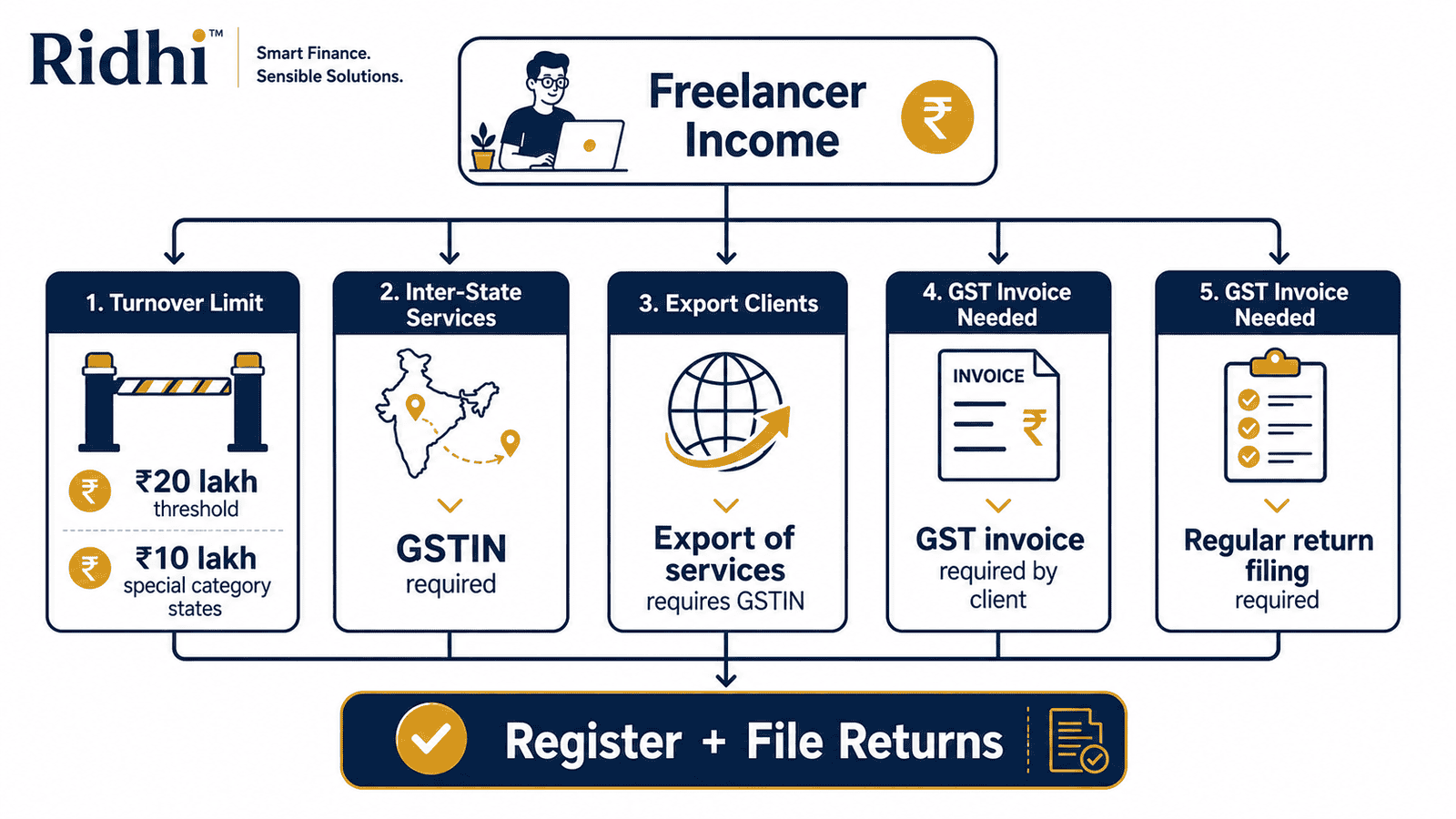
Key Takeaways
- GST registration is triggered by aggregate turnover — your gross receipts from all services under one PAN — not by net profit after expenses.
- The standard threshold for service providers is ₹20 lakh in most states; freelancers in special category states face a lower threshold of ₹10 lakh — verify current limits at gst.gov.in before relying on these figures.
- Filing an ITR, having TDS deducted by clients, or using the 44ADA presumptive scheme does not fulfil or replace your GST compliance obligation — they operate under entirely separate laws.
- Getting a GSTIN allows you to issue valid GST invoices but immediately creates a recurring return-filing obligation — GSTR-1 and GSTR-3B at minimum — that cannot be ignored without attracting late fees.
- Freelancers serving overseas clients need to understand how export-of-services treatment and the Letter of Undertaking work — the rules are different from domestic freelance billing and must be verified with a GST professional or CBIC guidance.
- A client asking for your GSTIN is a commercial request — it does not by itself mean the law requires you to register if your turnover is below the applicable threshold.
- Voluntary GST registration is possible but should not be taken casually: once registered, you must file returns regularly regardless of whether you collected any GST that month.
Key Facts at a Glance
| Question | Freelancer-Friendly Answer |
|---|---|
| When does GST registration become mandatory? | When aggregate turnover from services crosses ₹20 lakh/year in most states (₹10 lakh in special category states) — verify current thresholds at gst.gov.in |
| What counts as aggregate turnover? | Total value of all taxable supplies, exempt supplies, exports, and inter-state supplies in a financial year — not profit after expenses |
| What is GSTIN? | A 15-digit unique identification number issued after GST registration; clients use it to claim input tax credit on payments to you |
| Can I issue a GST invoice without GSTIN? | No. A valid GST invoice requires a registered GSTIN. Before registration, issue a regular services invoice without GST |
| What returns must a registered freelancer file? | At minimum, GSTR-1 (outward supplies) and GSTR-3B (summary return with payment) — frequency and exact forms depend on turnover; verify at gst.gov.in |
| Does filing ITR replace GST registration? | No. GST and income tax are entirely separate legal obligations |
| What is the GST rate on freelance services? | Most professional and creative services attract 18% GST — verify specific SAC codes and rates at cbic-gst.gov.in |
What GST Registration Actually Means for a Freelancer
GST — Goods and Services Tax — is a consumption tax collected by the supplier (you, the freelancer) and remitted to the government. When you register under GST, you receive a GSTIN, you begin charging GST on eligible invoices, you collect that GST from clients, and you deposit it to the government after claiming credit for any GST you paid on your own business purchases.
The key trigger for mandatory registration is not your job title, your industry, or whether you have a formal business entity. It is your aggregate turnover in a financial year. Under the CGST Act, aggregate turnover includes the total value of all taxable supplies, exempt supplies, zero-rated supplies (exports), and inter-state supplies computed on an all-India basis for the same PAN. It explicitly excludes GST itself.
This matters enormously for freelancers. If you earn ₹9 lakh from design projects, ₹6 lakh from content writing, and ₹5 lakh from consulting — all under your own PAN — your aggregate turnover is ₹20 lakh. That is the threshold at which registration typically becomes mandatory in most states for service providers.
GST Is Separate From Income Tax, TDS, and 44ADA
This is the single most important concept for beginners. Many freelancers assume that because their client deducts 10% TDS on payments, or because they file their ITR under Section 44ADA, their tax obligations are complete. That is incorrect.
Income tax — including 44ADA presumptive taxation — is governed by the Income Tax Act and administered by the Income Tax Department. GST is governed by the CGST Act and state GST Acts and administered by CBIC and the GST Portal. The two systems run in parallel. A freelancer earning ₹25 lakh a year must address both: file an ITR (potentially using freelancer income tax rules under the IT Act) and register and file GST returns under the GST framework.
TDS deducted by a client — typically 10% under Section 194J for professional services — is an advance against your income tax liability. It has nothing to do with GST. Your client may deduct ₹2,40,000 in TDS on ₹24 lakh of payments and still separately pay you GST (₹4,32,000 at 18%) on top, which you must then remit to the government.
What Changes After You Get a GSTIN
Once registered, you must add GST to every invoice for taxable services, collect it from clients, and file regular returns — at minimum GSTR-1 (details of outward supplies) and GSTR-3B (summary return with payment). Returns must be filed even for months with zero activity. Late filing attracts late fees and interest. According to CBIC guidelines, missing return deadlines repeatedly can also affect your GST compliance rating and create complications during any future refund claims.
Voluntary registration — registering even before crossing the threshold — is legally permitted. Some freelancers do this to appear credible to large corporate clients who want to claim input tax credit. But voluntary registration carries the same return-filing burden as mandatory registration. Many freelancers register voluntarily and then struggle with monthly compliance they were not prepared for.
Real Example: Four Freelancers, Four Different Situations
The best way to understand GST registration for freelancers is through realistic scenarios. Consider four freelancers, each with a different income and client profile.
Priya, 27, content writer, Pune. Priya earns ₹12 lakh a year entirely from Indian companies. Her aggregate turnover is ₹12 lakh — well below the usual ₹20 lakh services threshold in most states. GST registration is not mandatory for Priya under the standard threshold rule. She can issue regular invoices without GST. If a client asks for her GSTIN, she can explain she is not registered as her turnover is below the applicable limit.
Aarav, 29, UI designer, Bengaluru. Aarav earns ₹14 lakh from Indian startups and ₹10 lakh from US-based clients — aggregate turnover ₹24 lakh. Because his total exceeds ₹20 lakh, registration is mandatory based on the standard threshold. For his US clients, the services may qualify as export of services under the IGST Act — meaning they could be zero-rated — but Aarav still needs to verify his specific situation, including whether he needs to file a Letter of Undertaking, with a GST professional. He should also read up on 44ADA tax scheme rules separately, as those govern his income tax — not GST.
Ritu, 34, independent management consultant, Hyderabad. Ritu earns ₹26 lakh from domestic corporate clients. Her turnover is clearly above threshold. Registration is mandatory. She must charge 18% GST on invoices (verify applicable SAC code and rate at cbic-gst.gov.in), collect it from clients, and file returns.
Dev, 31, freelance developer, Jaipur. Dev earns ₹16 lakh a year but has one large client — a listed company — asking for his GSTIN to process payments. Dev is below threshold. The client’s request is commercially driven (they want input tax credit). Dev is not legally required to register. He can, however, voluntarily register if he decides the commercial benefit outweighs the compliance burden.
How to Calculate Your Aggregate Turnover for the GST Threshold
Aggregate Turnover = Sum of all taxable service receipts + exempt supplies + zero-rated supplies (exports) under the same PAN, across all states, in the financial year — excluding GST itself
Here is a step-by-step illustration using round figures:
| Income Stream | Annual Receipts | Counts Towards Turnover? |
|---|---|---|
| Design projects (domestic clients) | ₹8,00,000 | Yes |
| Content writing (domestic clients) | ₹7,00,000 | Yes |
| Consulting (domestic clients) | ₹6,00,000 | Yes |
| Aggregate Turnover | ₹21,00,000 | Crosses ₹20 lakh threshold |
This freelancer has crossed ₹21 lakh in aggregate turnover — above the standard ₹20 lakh limit — and registration would typically be required. Crucially, no expense deductions (office costs, software subscriptions, internet bills) reduce this figure. Aggregate turnover is calculated on gross receipts, not net profit. Expense deductions are relevant for income tax under Section 44ADA or regular computation — not for the basic GST threshold calculation.
Verify these thresholds at gst.gov.in before making any registration decision, as the GST Council has revised limits in the past and may do so again.
Comparison: Common Freelancer Situations and GST Position
| Situation | Likely GST Position | Practical Next Step |
|---|---|---|
| Below ₹20 lakh turnover, domestic clients only | Registration not mandatory under standard threshold — verify at gst.gov.in | Issue regular invoices without GST; monitor turnover monthly |
| Above ₹20 lakh turnover, domestic services | Registration likely mandatory — verify threshold and SAC code at cbic-gst.gov.in | Register on GST Portal; begin issuing GST invoices; file returns |
| Foreign clients, overseas payments | May qualify as export of services (zero-rated supply) — verify eligibility, LUT requirement, and conditions at cbic-gst.gov.in | Consult a GST professional; check LUT/refund procedure if registered |
| Client asks for GSTIN, below threshold | No legal obligation to register — client request is commercial, not legal | Explain your position; evaluate voluntary registration only if commercially justified |
| Voluntary registration, below threshold | Legally permitted; creates same return-filing obligations as mandatory registration | Weigh compliance burden carefully; seek professional advice before registering |
For detailed guidance on creating correct invoices once you have a GSTIN, see our guide on how to create freelance invoices.
How to Decide What’s Right for You
Your total annual receipts from all freelance services under your PAN are above ₹20 lakh in most states (or ₹10 lakh in special category states) — THEN GST registration is likely mandatory; verify current thresholds at gst.gov.in before proceeding.
You are below the threshold and all clients are domestic Indian companies or individuals — THEN registration is not legally required; issue regular invoices without charging GST and track your running turnover every month.
You receive payments from overseas clients in foreign currency — THEN your services may qualify as export of services under the IGST Act, which can be zero-rated; consult a GST professional to understand whether registration is triggered and how LUT or refund procedures apply to your situation.
You are approaching the ₹20 lakh mark mid-year and have large upcoming projects — THEN begin the registration process before crossing the threshold, not after; late registration can create compliance gaps.
A corporate client asks for your GSTIN but your turnover is clearly below threshold — THEN you are not legally required to register; explain your position to the client and evaluate voluntary registration only if the commercial benefit (access to that client’s work) clearly outweighs the ongoing compliance burden.
Your turnover is comfortably below the threshold, you have only domestic clients, and you are not prepared for monthly return filing — voluntary GST registration is not advisable; the compliance burden (returns, late fees, record-keeping) can outweigh any commercial gain.
Common Mistakes to Avoid
Assuming TDS Deduction Means GST Is Already Handled
TDS deducted by a client under Section 194J is an advance against your income tax liability — it is entirely separate from GST.
If you are GST-registered, your client owes you both: full service payment plus 18% GST (or the applicable rate). TDS is then deducted on the base payment amount. Many freelancers confuse these two deductions and either under-invoice or fail to collect GST they were entitled to.
Keep TDS tracking completely separate from your GST records. For help separating these, see our guide on how to track freelance TDS.
Counting Net Profit Instead of Gross Receipts
The GST registration threshold is based on aggregate turnover — gross receipts from services — not on your income after expenses.
A freelancer earning ₹22 lakh in receipts with ₹5 lakh in business expenses has an aggregate turnover of ₹22 lakh for GST purposes, even though taxable income under 44ADA might be ₹11 lakh. Miscounting this way means crossing the threshold without realising it — and potentially collecting no GST on invoices when you should have been.
Track gross invoiced amounts, not bank deposits or profits, when monitoring your GST threshold.
Registering Voluntarily Without Understanding Return Filing
Voluntary registration is allowed but creates an immediate and recurring filing obligation.
Many freelancers register to satisfy one large client, then discover they must file GSTR-1 and GSTR-3B every month or quarter — even for zero-activity periods. Late filing attracts late fees. Consistent non-filing can lead to notices from CBIC. Verify current late fee and penalty amounts at gst.gov.in before registering.
Only register voluntarily if you are prepared to maintain GST compliance throughout. Cancellation of registration has its own procedure and timeline.
Charging GST on Invoices Without a Valid Registration
Collecting GST without a GSTIN is not permitted — and depositing such collected amounts does not legalise the transaction retroactively.
If a client pays GST to an unregistered freelancer who has charged it informally, neither party can claim that amount properly. The freelancer may face penalties; the client cannot claim input tax credit. Issue only regular service invoices until you have a valid GSTIN.
Once registered, read the rules for valid GST invoices carefully — all mandatory fields must be present. Our article on how to create freelance invoices covers this in detail.
Ignoring Export-of-Services Documentation for Foreign Clients
Freelancers serving overseas clients often assume that zero-rating means zero compliance. That assumption is incorrect.
If registered under GST, exporting services without paying IGST typically requires filing a Letter of Undertaking before each financial year begins. Failure to maintain LUT documentation or to invoice in the correct format for exports can result in demand for IGST payment on those supplies. Verify the current LUT procedure and Form GST RFD-11 requirements at cbic-gst.gov.in.
Get the export documentation right from the first invoice to an overseas client.
Waiting Until After Crossing the Threshold to Register
Registration is required from the date on which aggregate turnover first exceeds the applicable threshold — not from the next financial year.
A freelancer who crosses ₹20 lakh in October must register and begin charging GST from that date. Invoices issued between crossing the threshold and eventual registration may create a retroactive liability. Monitor running turnover monthly, especially if you have a project-heavy second half of the year.
When This May Not Be the Right Choice
GST registration — particularly voluntary registration — may not be the right move in every situation. Consider the following scenarios carefully before registering.
If your annual freelance receipts are comfortably below the applicable threshold and all your clients are domestic Indian individuals or small businesses without input tax credit requirements, there is no legal compulsion and potentially no commercial benefit to registering. Adding monthly return filing to your workflow without a corresponding benefit is avoidable overhead.
If your freelance income is occasional or hobbyist — a few projects a year totalling well under ₹10 lakh — GST registration creates compliance obligations that almost certainly exceed any benefit for your situation.
If a client is asking for GSTIN purely because their accounts team has a standard template, explain that you are not registered as your turnover is below the legal threshold. Most finance teams at larger companies understand this position.
If your work involves foreign clients and complex payment arrangements — platforms that aggregate payments, royalties, mixed goods and services — the export-of-services rules can be complex enough that registering without professional advice may create more problems than it solves. For the tax implications of overseas income, read our article on foreign freelance income tax treatment in India.
If any of these apply to your situation, it may be worth exploring alternatives before committing.
Official Rules and Where to Verify
GST rules in India are set by the GST Council and administered by CBIC. Thresholds, rates, return filing frequencies, and compliance requirements have changed since GST was introduced in 2017 and may change again. No blog — including this one — should be your final source of truth for a registration or compliance decision.
Verify your position directly from these official sources:
- GST Portal — gst.gov.in: Registration, GSTIN application, return filing, LUT submission, and the official FAQ section for common taxpayer queries.
- CBIC — cbic-gst.gov.in: GST law, rules, circulars, notifications, SAC codes, applicable rates, and official clarifications on export of services and zero-rated supplies.
- Income Tax Department — incometax.gov.in: ITR filing for freelancers, Section 44ADA rules, and TDS credit reconciliation — entirely separate from GST but equally important for your overall compliance picture. See our step-by-step guide on how to file ITR as a freelancer.
Rules, limits, and rates on this topic can change with each Budget or regulatory update. Always verify current figures directly from the official source before making any financial decision.
Expert Tips
- Track your running aggregate turnover every month in a simple spreadsheet — total all invoices issued, not payments received, because GST is accrual-based. If you hit ₹18 lakh by November, begin the registration process immediately rather than waiting.
- Maintain a separate folder for each client: invoice copies, payment confirmation, TDS certificates, and client location (state and country). This takes 10 minutes per payment and saves hours during return filing or any scrutiny.
- Do not mix personal bank account statements with business income tracking. Freelancers who use personal accounts for everything often struggle to reconstruct accurate gross receipts at year-end — which affects both GST threshold monitoring and income tax computation.
- Before taking on a large foreign client, confirm with a GST professional whether the engagement qualifies as export of services, whether you need to file a Letter of Undertaking for the financial year, and what invoice format and payment documentation is required. Get this right before the first invoice — not after.
- If you are approaching the GST threshold, review your pricing. For domestic clients who can claim input tax credit, charging 18% GST on your invoices often has no net cost to them — they reclaim it. For end consumers or small businesses who cannot reclaim input tax credit, the 18% GST effectively raises your cost to them.
- Once registered, set a calendar reminder for every GSTR-1 and GSTR-3B due date. Late fees accumulate per return per day and missing multiple returns can result in the system blocking your ability to file subsequent returns until arrears are cleared — verify current late fee amounts at gst.gov.in.
- Keep your GST registration documents, GSTIN certificate, and LUT (if applicable) in a dedicated digital folder. Clients, platforms, and banks often ask for these at short notice.
Frequently Asked Questions
Is GST registration mandatory for freelancers earning below ₹20 lakh?
In most states, the GST registration threshold for service providers is ₹20 lakh in aggregate turnover per year. If your total receipts from all freelance services are below this limit and you have no other mandatory registration triggers, registration is not legally required. Verify the current threshold at gst.gov.in — it has been revised in the past and may change again.
Do freelancers with foreign clients automatically need GST registration?
Not automatically. If your aggregate turnover from all services (domestic and foreign combined) is below the applicable threshold, the standard exemption may still apply. However, if your turnover crosses the threshold and you serve foreign clients, those export services need to be handled correctly — typically as zero-rated supplies under the IGST Act, with LUT or refund procedures. Consult a GST professional if you regularly receive foreign client payments.
Can I issue a GST invoice without a GSTIN?
No. A GST invoice — with GST charged to the client — can only be issued by a registered taxpayer who holds a valid GSTIN. If you are not registered, issue a regular services invoice without any GST component. Charging GST without registration is not permitted.
Is GST different from income tax? Does paying income tax cover my GST obligation?
Yes, they are entirely separate. GST is an indirect tax collected from your clients and remitted to the government — it is not your own income. Income tax is a direct tax on your earnings. Paying income tax — including under the 44ADA presumptive scheme — has no bearing on your GST registration or filing obligation. Both must be addressed independently.
What happens after I get GST registration as a freelancer?
You must add GST to all eligible service invoices, collect it from clients, and remit it to the government by filing GSTR-3B. You must also file GSTR-1 detailing outward supplies. Returns must be filed on time even for months when you issue no invoices or collect no GST. Late filing attracts late fees — verify current amounts at gst.gov.in.
Does the 44ADA presumptive tax scheme remove my GST obligation?
No. Section 44ADA is an income tax provision that allows eligible professionals to pay tax on 50% of gross receipts as presumptive income. It has no effect on your GST obligation. If your aggregate turnover crosses the GST threshold, you need to register regardless of which income tax computation method you use.
What is a Letter of Undertaking and when does a freelancer need it?
An LUT (Letter of Undertaking) is a declaration filed by a registered GST taxpayer who wishes to export services without paying IGST. If registered and serving foreign clients, filing an LUT allows you to raise invoices for export without charging IGST — instead of paying IGST and then claiming a refund. The LUT is filed on the GST Portal before the start of each financial year. Verify the current procedure at gst.gov.in or cbic-gst.gov.in.
Can I voluntarily register for GST even if my turnover is below ₹20 lakh?
Yes, voluntary registration is permitted under the CGST Act. Some freelancers do this to appear more credible to larger corporate clients who want to claim input tax credit. However, voluntary registration creates the same return-filing obligations as mandatory registration. Consider whether the compliance burden is worthwhile before registering voluntarily.
What if my turnover crosses the GST threshold mid-year?
Registration must be obtained within 30 days of the date on which aggregate turnover exceeds the applicable threshold — verify the current timeline at gst.gov.in. You cannot wait until the next financial year. Invoices issued after crossing the threshold without a valid GSTIN create a retroactive liability risk.
Is GST applicable to all types of freelance services?
Most professional, creative, and technical services are taxable under GST at 18% — but the applicable rate depends on the specific SAC (Services Accounting Code) for your service type. Some categories of services may attract different rates or have specific exemptions. Always verify the applicable SAC code and rate for your specific service at cbic-gst.gov.in rather than assuming 18% applies universally.
Final Verdict
GST registration for freelancers is not a one-size-fits-all requirement. For most freelancers earning below ₹20 lakh in aggregate service turnover from domestic clients, it is not mandatory — and registering voluntarily without understanding the compliance obligations often creates more problems than it solves.
Once you cross the applicable threshold, registration becomes a legal obligation — not a choice. And if you serve foreign clients, the export-of-services framework adds another layer of rules that must be verified carefully, not assumed away.
The practical approach: track your gross receipts every month, know your running total against the ₹20 lakh mark, and begin the registration process before you cross it — not after. Separate your GST compliance picture from your income tax obligations, which run on entirely different rules.
Always verify the latest rules from official sources — gst.gov.in and cbic-gst.gov.in — or consult a qualified GST professional before making any financial decision.
This article is for educational purposes only and should not be treated as personalised financial, tax, investment, insurance, or legal advice. Tax rules, interest rates, regulatory limits, and product features can change with each Budget or policy update. Please verify current rules from official government sources or consult a qualified and registered professional before making any financial decision.

Amit Verma writes about money management for Indian freelancers, consultants, creators, professionals, and self-employed workers. His content focuses on income planning, tax basics, GST awareness, cash flow, invoicing, business expenses, and financial stability for people who do not receive a fixed monthly salary.
He covers topics such as Section 44ADA, presumptive taxation, professional income, advance tax, GST basics, TDS for freelancers, invoice planning, business expense tracking, ITR filing for self-employed professionals, emergency funds, health insurance, retirement planning, and irregular income management.
Amit’s writing is practical, relatable, and built around the realities of independent work. He understands that freelancers often deal with delayed payments, uneven income, unclear tax deductions, missing employer benefits, and uncertainty around compliance. His guides help readers organise their financial life better, but they are educational and not a substitute for professional advice. Since tax rules, GST limits, filing requirements, and deduction treatment can change, readers should verify current rules from official sources or consult a qualified professional.