

Most 30-year-olds buying term insurance for the first time face the same question: is ₹50 lakh enough, or should I stretch to ₹1 crore while I am still young and relatively healthy? The answer is not as simple as comparing two annual premium figures. Term insurance cost for 30 year old buyers depends on age, health, smoking status, occupation, policy term, riders, and the insurer’s own underwriting rules — and the right cover amount depends on your income, loans, dependents, and future goals. This article breaks down both options side by side, explains the decision logic, and gives you a framework to choose before you buy.
Quick Answer: Term Insurance Cost for 30-Year-Old
Term insurance cost for 30 year old buyers is usually lower than buying later, but ₹50 lakh vs ₹1 crore cover should not be chosen only by premium. Compare income replacement, loans, dependents, policy term, riders, health disclosures, and final insurer quote before deciding. Premium examples must be verified before purchase.
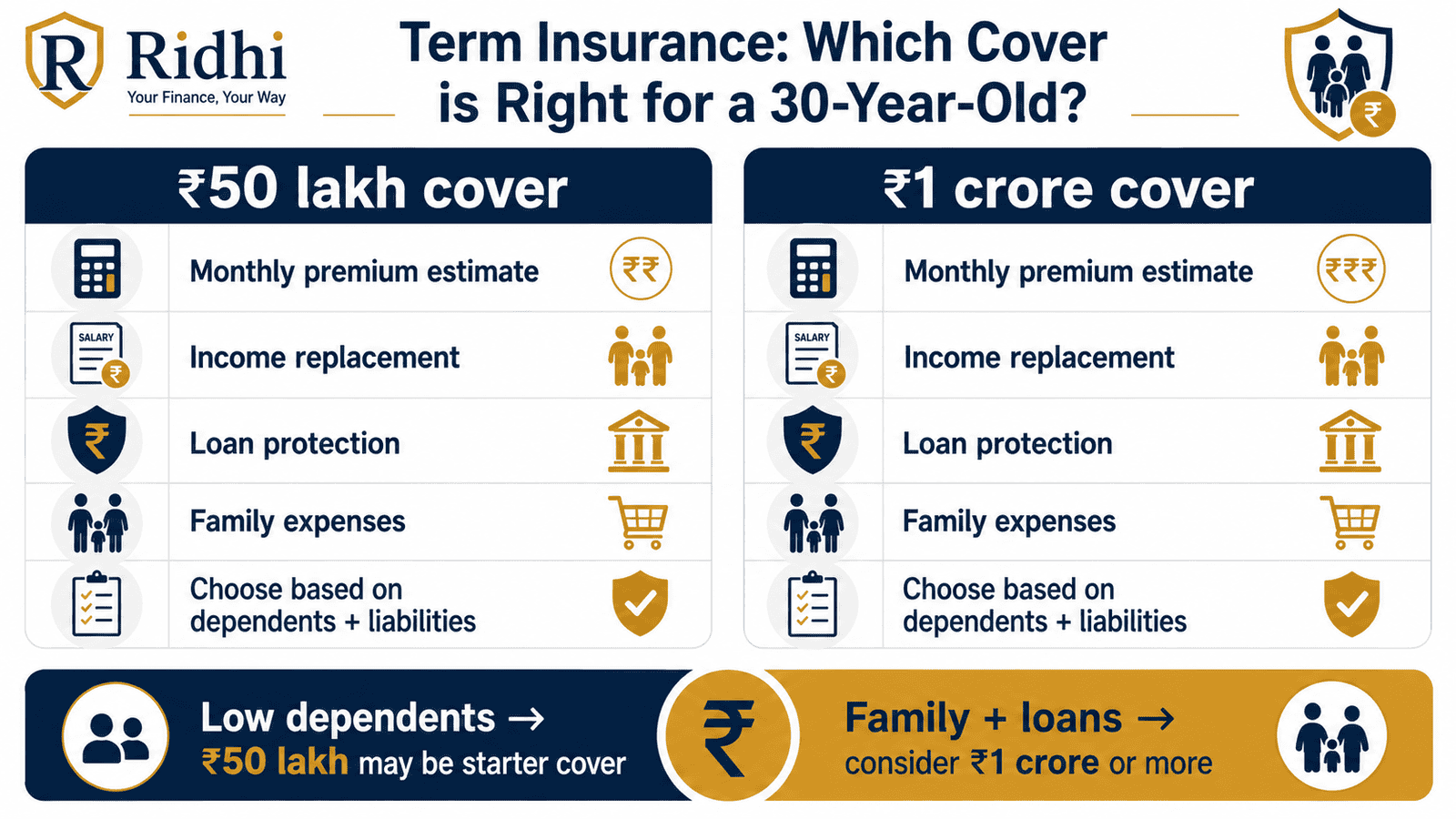
Key Takeaways
- ₹50 lakh cover may suit a young salaried person with no dependents, no home loan, and a tight budget — but it can fall short once family responsibilities grow.
- ₹1 crore cover is often more suitable if you have a spouse, children, a home loan above ₹30–40 lakh, or a single-income household that depends entirely on your earnings.
- The premium difference between ₹50 lakh and ₹1 crore is not always double — insurer pricing is not perfectly linear, making ₹1 crore better value per rupee of cover in many cases.
- Riders such as accidental death benefit and critical illness cover increase your premium and come with separate conditions — compare base plan first, then add riders selectively.
- Your final premium can change after medical underwriting — online indicative quotes are a starting point, not a guaranteed price.
- Section 80C deduction on term insurance premium is subject to conditions and annual limits — verify with the Income Tax Department before claiming.
₹50 Lakh vs ₹1 Crore Term Insurance: Side-by-Side Comparison
| Factor | ₹50 Lakh Cover | ₹1 Crore Cover |
|---|---|---|
| Sum assured | ₹50,00,000 | ₹1,00,00,000 |
| Typical annual premium (30-year-old non-smoker male, 30-year term — indicative only) | ₹6,000–₹10,000 approx. | ₹10,000–₹17,000 approx. |
| Income replacement (₹6 lakh/yr expenses) | Approx. 8 years | Approx. 16 years |
| Factor | ₹50 Lakh Cover | ₹1 Crore Cover |
|---|---|---|
| Home loan coverage (₹40 lakh loan) | Partial | Full + surplus |
| Child education goal (₹20 lakh) | Possible if no loan | Covered alongside loan |
| Single-income household risk | Higher underinsurance risk | Better cushion |
| Underinsurance risk over time | Higher as income grows | Moderate over 20+ years |
| Premium-to-protection value | Lower premium, lower cover | Better rupees-per-lakh ratio in many plans |
| Need to upgrade cover later | Likely — premiums rise with age | Less urgent at age 30 |
Indicative premium ranges are illustrative only. Actual premiums vary by insurer, health status, occupation, riders, premium payment mode, and underwriting. Verify current quotes directly with the insurer before purchasing.
Key Facts at a Glance
| Parameter | Detail |
|---|---|
| Product type | Pure term life insurance — no maturity benefit in standard term plans |
| Cover options compared | ₹50 lakh and ₹1 crore sum assured |
| Best suited for | Earning individuals with dependents, loans, or future financial liabilities |
| Key premium drivers | Age, gender, health, smoking status, income proof, occupation, cover amount, policy term, riders, premium payment mode |
| Tax angle | Premium may qualify under Section 80C subject to conditions and annual limits — verify at incometax.gov.in before claiming |
| Regulator | IRDAI — irdai.gov.in |
| Verify before buying | Final insurer quote, policy wording, exclusions, GST, and rider terms can change — confirm before purchase |
How Term Insurance Pricing Works for a 30-Year-Old Salaried Person
Term insurance is a pure protection product. You pay a premium every year (or monthly/quarterly); if you pass away during the policy term, the insurer pays the sum assured to your nominee. There is no maturity payout in a standard term plan — the premium covers only the risk. For an explanation of the basics, see term plan basics.
Why Age 30 Can Be a Cost-Efficient Entry Point
Insurers price premiums largely on mortality risk. At 30, most people are healthier, have fewer pre-existing conditions, and represent a lower short-term mortality probability than a 40-year-old buying the same cover. Buying at 30 locks in a relatively lower base premium for the entire policy term, whereas delaying to 35 or 40 typically means higher annual premiums for the same sum assured and term.
This does not mean premiums are uniformly low at 30. Smoking, elevated BMI, a family history of cardiac disease or diabetes, hazardous occupations, or income that cannot be documented adequately can all push premiums higher — or lead an underwriter to apply loadings or exclusions.
What Actually Drives Your Premium
According to IRDAI guidelines, insurers use actuarial risk assessment to price premiums. The main variables are:
- Age and gender: Younger buyers and female buyers typically attract lower base rates in most plans.
- Smoking and tobacco use: Smokers pay materially higher premiums than non-smokers — often 30–80% more depending on the insurer and cover amount.
- Health disclosures: BMI, blood pressure, diabetes, pre-existing conditions, and family medical history all affect underwriting.
- Occupation: High-risk occupations (mining, offshore, aviation) may attract loadings or coverage restrictions.
- Cover amount: Higher sum assured means higher absolute premium, but the rate per lakh of cover can be lower at higher cover amounts in many plans.
- Policy term: A 30-year term costs more annually than a 20-year term for the same cover, because the insurer carries risk over a longer period.
- Riders: Accidental death benefit, critical illness, waiver of premium, and disability riders each add to the base premium and carry their own conditions.
- Premium payment mode: Monthly premiums typically cost slightly more in aggregate than annual payment because of administrative and discount differences.
Does ₹1 Crore Cost Exactly Double ₹50 Lakh?
Not always. Many insurers use a pricing band structure where the per-lakh premium rate decreases as cover increases. This means that going from ₹50 lakh to ₹1 crore may cost less than exactly double the ₹50 lakh base premium. In practical terms, the incremental cost of the extra ₹50 lakh protection can be lower than buying a second ₹50 lakh policy separately — making ₹1 crore an arguably better value proposition if your actual cover need is ₹1 crore or more.
Online premium calculators give indicative quotes. The final premium is confirmed only after the insurer completes medical underwriting — including tests, questionnaire review, and income verification. Do not assume the online quote is your final price.
Real Example: Rohit’s Two Scenarios
Rohit is 30, a software engineer based in Pune, earning ₹12 lakh per year. He is a non-smoker with no pre-existing health conditions. He is considering a 30-year term policy.
Scenario A — Unmarried, no dependents, no loans: Rohit’s parents are financially independent. He has no home loan. His monthly expenses are roughly ₹35,000. In this scenario, ₹50 lakh cover may provide a basic level of protection. The payout could settle any short-term liabilities and support his parents for a few years if needed. A lower annual premium may feel easier to commit to.
Scenario B — Married, one child, home loan of ₹40 lakh: Rohit’s family depends entirely on his income. He has a ₹40 lakh home loan outstanding and wants to set aside at least ₹15–20 lakh for his child’s education. Total financial exposure is over ₹60–70 lakh — before accounting for monthly living expenses his family would need for the next 15–20 years. In Scenario B, ₹50 lakh cover leaves his family seriously underprotected. ₹1 crore provides a more realistic buffer to clear the loan, support education goals, and replace a portion of income.
The key insight: the same person, same age, same premium market — but a completely different cover need depending on family situation. The premium difference between ₹50 lakh and ₹1 crore may feel significant as an annual number, but measured against the protection gap it creates, the calculation often tips toward ₹1 crore for a family-dependent salaried earner.
How to Calculate Whether ₹50 Lakh or ₹1 Crore Is Enough
A basic cover estimation framework works in four steps. Use calculate required cover for a detailed walkthrough.
Required Cover = (Annual Household Expenses × Income Replacement Years) + Outstanding Loans + Future Goals − Existing Assets and Cover
Using Rohit’s Scenario B as an illustration:
| Component | Illustrative Figure | Notes |
|---|---|---|
| Annual household expenses × 15 years | ₹42 lakh (₹2.8L/yr × 15) | Illustrative — verify with your own expense figure |
| Home loan outstanding | ₹40 lakh | Add actual outstanding balance, not original loan |
| Child education goal | ₹20 lakh | Future value; adjust for inflation in a detailed plan |
| Total gross need | ₹1.02 crore | Sum of above three rows |
| Less: existing savings and cover | ₹10 lakh (assumed) | Subtract PF, FDs, existing group cover |
| Net cover required | Approx. ₹92 lakh | Closer to ₹1 crore than ₹50 lakh for this profile |
These are illustrative figures only. Your actual requirement depends on your household expenses, outstanding liabilities, assets, and dependents. Run the numbers for your own situation before deciding.
How to Decide What’s Right for You
You are single, have no dependents, no home loan, and a tight monthly budget — THEN ₹50 lakh may be a reasonable starting cover while you build financial stability.
You are married, have a child or plan to, and carry a home loan of ₹30 lakh or more — THEN ₹1 crore cover is likely the more suitable choice to avoid leaving your family underprotected.
Your household runs on a single income and your spouse or parents depend entirely on your earnings — THEN ₹1 crore or more may be worth the higher premium because the downside of underinsurance is far larger.
Your employer provides a group term cover — THEN do not count it as permanent personal protection; group cover ends when you change jobs. Check your actual individual cover need separately.
You choose ₹50 lakh now for budget reasons — THEN revisit your cover after marriage, childbirth, a home loan, or a significant salary increase; upgrading later will cost more because you will be older. Check insurer reliability using claim settlement ratio guidance before choosing a plan.
Your estimated cover need (from the formula above) works out to ₹80 lakh or more — THEN ₹50 lakh leaves a meaningful protection gap that could leave your family in financial difficulty.
If you have no dependents, no outstanding loans, strong liquid assets equivalent to several years of household expenses, and your income is not the sole support for anyone — ₹1 crore of term cover may not be an immediate priority. A smaller cover or a phased approach may be sufficient for now.
Common Mistakes to Avoid
Choosing the Cheapest Plan Without Checking Claims
Buying purely on premium is one of the most common mistakes in term insurance.
A plan that costs ₹1,500 less per year than a comparable option may have a lower claim settlement ratio, more restrictive exclusions, or a slower claims process. At the moment your nominee needs the payout most, a cheaper plan with a difficult claims track record creates real risk.
Compare claim settlement ratios, solvency ratios, and policy exclusions alongside premium — not instead of premium.
Picking ₹50 Lakh Only Because the Premium Looks Lower
A lower annual premium is only a benefit if the cover amount is actually adequate for your situation.
If your family needs ₹90 lakh to clear a loan, cover education expenses, and replace your income for 10 years, a ₹50 lakh payout creates a ₹40 lakh gap that savings may not cover. Paying a few thousand rupees more annually for ₹1 crore may be the significantly better financial decision.
Run the cover calculation first; then compare premiums within the cover amount that genuinely fits your need.
Treating Employer Group Cover as Permanent Personal Insurance
Many salaried employees assume their company’s group term cover eliminates the need for an individual policy.
Group covers are tied to employment — they end the day you resign, are laid off, or retire. A gap in cover, even of a few months, leaves your family exposed. A job change at 38 with a fresh health condition can make individual cover harder and more expensive to buy than it would have been at 30.
Buy an individual term policy independent of your employer, and treat group cover as a supplement only.
Hiding or Understating Health and Lifestyle Information
Non-disclosure of smoking, alcohol use, pre-existing conditions, family medical history, or hazardous hobby is a material misrepresentation on the proposal form.
Insurers investigate claims — particularly early claims — and a misrepresentation can lead to claim rejection or reduced payout, defeating the entire purpose of buying insurance. Disclose everything accurately at proposal stage; the insurer may load the premium or apply an exclusion, but your claim remains valid. According to IRDAI guidelines, insurers are required to process claims within defined timelines, but disputed material non-disclosures can extend this significantly.
Always disclose truthfully. A slightly higher premium is a far better outcome than a rejected claim.
Confusing Term Insurance With Investment Products
Term insurance is a pure risk cover with no maturity benefit in standard plans. It is not an investment.
Buying an endowment policy, money-back plan, or ULIP because it “returns something” means paying substantially higher premiums for lower cover and lower investment returns — the worst of both goals. See avoid savings confusion for a detailed comparison of why most financial planners prefer term over investment-linked products.
Keep insurance and investments separate. Buy adequate term cover; invest separately in mutual funds, PPF, or NPS.
Delaying Purchase Because “I’m Young and Healthy”
Age 30 is precisely when term insurance is most cost-efficient. Every year you delay, your age increases — and so does your annual premium for the same cover and term.
Waiting until 35 to buy a ₹1 crore, 30-year term policy will cost more annually than buying the same policy at 30, for every single year of the 30-year term. The cumulative extra cost over the life of the policy can be significant.
If your cover need is clear, buying sooner rather than later almost always works in your favour on premium.
When This May Not Be the Right Choice
A straight ₹50 lakh vs ₹1 crore comparison may be insufficient in some situations — not because term insurance is wrong, but because the cover requirement may need a different calculation entirely.
If your annual income is above ₹20–25 lakh and you carry a large home loan alongside family liabilities, ₹1 crore may itself be an underestimate. Cover requirements scale with income and liabilities, and a 10× income rule of thumb would point to ₹2 crore or more for higher earners.
If you have no dependents, low liabilities, and substantial liquid savings — your immediate cover need may genuinely be lower than ₹50 lakh, and a smaller cover with a clear plan to increase it after marriage or a home loan may be appropriate.
If you have a serious pre-existing health condition, you may find that underwriting adds a significant premium loading or excludes the condition — making cost and eligibility a different conversation from the standard comparison.
Business owners, freelancers, NRI employees, and those in hazardous occupations often require specialised underwriting and different income documentation, and the premium benchmarks for a standard salaried employee at 30 will not apply directly.
If any of these apply to your situation, it may be worth exploring alternatives before committing.
Official Rules and Where to Verify
Term insurance regulation in India is governed by IRDAI (Insurance Regulatory and Development Authority of India). Rules, limits, and rates on this topic can change with each Budget or regulatory update. Always verify current figures directly from the official source before making any financial decision.
- IRDAI — irdai.gov.in: Verify insurer registration status, consumer grievance processes, claim settlement data, policy wording guidelines, and buyer protection information.
- Income Tax Department — incometax.gov.in: Verify whether and to what extent term insurance premiums qualify for Section 80C deduction, and what conditions apply.
- Insurer’s official documents: Before purchasing any policy, read the benefit illustration, policy schedule, exclusion list, premium quote, rider terms, and free-look period details directly from the insurer. Do not rely solely on aggregator summaries.
- GST and premium frequency: Confirm applicable GST on your premium, the impact of monthly vs annual payment, and the grace period for late payment directly with the insurer at the time of purchase.
Expert Tips
- Lock in cover early, but disclose fully: Buying at 30 gives you a cost advantage over buying at 35 or 40 — but that advantage only holds if you disclose your health, smoking status, and medical history accurately at proposal stage. A loaded premium on a fully disclosed policy is better than a rejected claim later.
- Choose a policy term that covers your major liabilities: A 30-year policy term from age 30 takes you to age 60 — roughly the end of most people’s primary earning years. If your home loan runs until age 55, a 25-year term leaves a gap. Match the term to your longest financial liability.
- Compare base premium first, then layer riders: Add riders only after you are satisfied with the base plan’s claim settlement record, exclusions, and pricing. Riders such as accidental death benefit and critical illness cover have their own conditions. For accident and disability protection specifically, see add disability protection.
- Keep nominee details updated: A policy with an outdated nominee (a former employer, an estranged relative, or a deceased parent) can complicate and delay claims. Review and update nominee details after every major life event — marriage, childbirth, or bereavement.
- Review cover after major life events: Marriage, a new child, a home loan, a salary jump, or taking on dependent parents are all triggers to recalculate your cover need. Upgrading an existing policy later is possible with some insurers, but a new policy at an older age always means a higher premium.
- Do not over-rely on online calculators for final pricing: Indicative online quotes are useful for comparison, but your confirmed annual premium is the figure on your policy document after underwriting is complete — which may differ from the quote, sometimes meaningfully.
- Annual payment is usually more economical than monthly: Monthly premium installments often cost slightly more in aggregate over the year than a single annual payment. If budget allows, annual payment is typically the cost-efficient choice.
Frequently Asked Questions
Is ₹50 lakh term insurance enough for a 30-year-old?
It depends on your family situation and liabilities. For a single person with no dependents and no outstanding loans, ₹50 lakh may provide basic protection. For a married person with a home loan of ₹30–40 lakh and a dependent spouse or child, ₹50 lakh is likely to fall short of what your family would actually need. Use a cover calculation framework before deciding.
Is ₹1 crore term insurance too much for a salaried person earning ₹12 lakh per year?
Not necessarily. A widely referenced rule of thumb is 10–15 times your annual income as a starting point for cover need — which for a ₹12 lakh income would point to ₹1.2–1.8 crore. ₹1 crore may actually be a moderate estimate, not an excessive one, especially when you add home loan exposure and family dependents to the calculation.
Does ₹1 crore term insurance cost exactly double a ₹50 lakh plan?
Usually not. Many insurers apply a tiered pricing structure where the cost per lakh of cover decreases as the sum assured increases. In practice, moving from ₹50 lakh to ₹1 crore often costs less than double the ₹50 lakh premium, making ₹1 crore relatively better value per rupee of protection. The exact difference depends on the insurer and your individual underwriting profile.
Can I increase my term insurance cover later in life?
Some insurers offer options to increase cover at specific life events (marriage, childbirth) under certain policies — this is called a life-stage benefit or sum assured increase option. However, not all plans include this, and any increase in cover will be priced at your age at that time, not at your age when you first bought the policy. Buying adequate cover early remains the more cost-efficient approach for most people.
Do term insurance premiums change after medical tests?
Yes. The premium shown in an online quote is indicative and based on self-declared information. After the insurer reviews your medical test results, questionnaire, income documents, and other underwriting inputs, the final premium may be higher than the initial quote — particularly if tests reveal elevated risk factors such as high blood pressure, elevated blood sugar, or lipid abnormalities. In some cases, the insurer may decline cover or add specific exclusions.
Are term insurance premiums eligible for a tax deduction?
Term insurance premiums may qualify for deduction under Section 80C of the Income Tax Act, subject to conditions including the annual deduction limit and the ratio of premium to sum assured. The exact deduction amount and conditions can change and should be verified at incometax.gov.in or with a tax professional before you claim. This deduction is available under the old tax regime; its applicability under the new tax regime should be verified for the relevant financial year.
What is the difference in premium for a smoker vs a non-smoker at age 30?
Smokers typically pay materially higher premiums than non-smokers for the same cover and policy term — the difference varies by insurer but can range from 30% to over 80% more in many plans. Declaring smoker status accurately on the proposal form is mandatory. Declaring yourself a non-smoker when you smoke is a material misrepresentation that can result in claim rejection.
Can I buy two ₹50 lakh policies instead of one ₹1 crore policy?
Technically yes — holding multiple term policies from different insurers is permitted. However, buying one ₹1 crore policy is typically more cost-efficient than two ₹50 lakh policies because of the pricing band effect described earlier. Two separate policies also mean two sets of documentation, two premium payments, and two claims processes for your nominee in the event of a claim.
What happens if I miss a premium payment?
Most term insurance policies offer a grace period — typically 30 days for annual premium payment and 15 days for monthly payment — within which you can pay without losing cover. Missing the payment beyond the grace period typically causes the policy to lapse, meaning your family loses cover. Some insurers offer a revival window to reinstate a lapsed policy within a specified period, usually with payment of outstanding premiums and any applicable charges. Confirm your specific policy’s grace period and revival terms from the policy document.
What is a claim settlement ratio and why does it matter when choosing a term insurer?
The claim settlement ratio (CSR) is the percentage of death claims an insurer settled out of the total claims received in a financial year. A higher CSR indicates that the insurer settled a greater proportion of claims. IRDAI publishes annual claim settlement data. While CSR alone should not be the only selection criterion — volume of claims, time taken to settle, and policy exclusions also matter — it is a useful starting indicator of insurer reliability. Verify the most current CSR data at irdai.gov.in before choosing a plan.
Final Verdict
The term insurance cost for 30 year old buyers is often at its most competitive — but getting the cover amount right matters far more than saving a few thousand rupees on premium. ₹50 lakh may be a workable starting point for a young earner with no dependents and no significant liabilities, but it is likely to be inadequate for anyone with a home loan, a dependent spouse, children, or single-income household exposure. ₹1 crore offers meaningfully stronger protection and, in many plans, costs less than double the ₹50 lakh premium — making it the more suitable benchmark for most 30-year-old salaried earners. The cheapest premium is not the best decision if the cover amount leaves your family short. Use the cover calculation framework, compare verified insurer quotes, read policy documents carefully, and connect this decision to your broader financial plan using the age thirty checklist. Always verify the latest rules from official sources or consult a qualified professional before making any financial decision.
This article is for educational purposes only and should not be treated as personalised financial, tax, investment, insurance, or legal advice. Tax rules, interest rates, regulatory limits, and product features can change with each Budget or policy update. Please verify current rules from official government sources or consult a qualified and registered professional before making any financial decision. Insurance is a subject matter of solicitation. Please read the policy document carefully before purchasing.

Priya Nambiar writes about insurance concepts for Indian families, salaried employees, self-employed professionals, and first-time policy buyers. Her content focuses on helping readers understand coverage, exclusions, claim conditions, premiums, riders, and policy documents before buying or renewing insurance.
She covers topics such as term insurance, health insurance, family floater plans, riders, critical illness cover, employer insurance vs personal insurance, waiting periods, exclusions, deductibles, co-payment, no-claim bonus, claim settlement, premium comparison, renewal rules, and tax benefits linked to insurance.
Priya’s writing is careful, consumer-focused, and policy-document oriented. She explains why insurance should be understood as financial protection, not just a tax-saving tool or investment substitute. Her articles encourage readers to compare coverage, understand limitations, and ask better questions before buying a policy. Premiums, exclusions, claim rules, and benefits vary by insurer, age, health, sum insured, and product type. Insurance is a subject matter of solicitation, and readers should read the official policy document carefully before purchasing.