

You have ₹3 lakh sitting in a savings account. You might need it in nine months — maybe for a home down payment top-up, a medical buffer, or a car purchase. The savings account gives you 3–3.5% per year. A colleague mentions low duration debt funds and says they give “better returns.” But is that actually true for your time frame — and is it safe enough?
Low duration debt funds are not savings accounts. They are not fixed deposits. They carry interest-rate risk, credit risk, and mark-to-market valuation swings that can surprise a first-time investor. At the same time, they are not as risky as equity funds. The real question is whether that middle-ground risk profile actually suits a 6–12 month parking goal.
This article gives you a practical framework: what low duration debt funds are, how they compare with FD, liquid fund, ultra short duration fund, and savings account, and exactly when you should — and should not — use them for short-term parking.
Quick Answer: Low Duration Debt Funds for 6–12 Month Parking
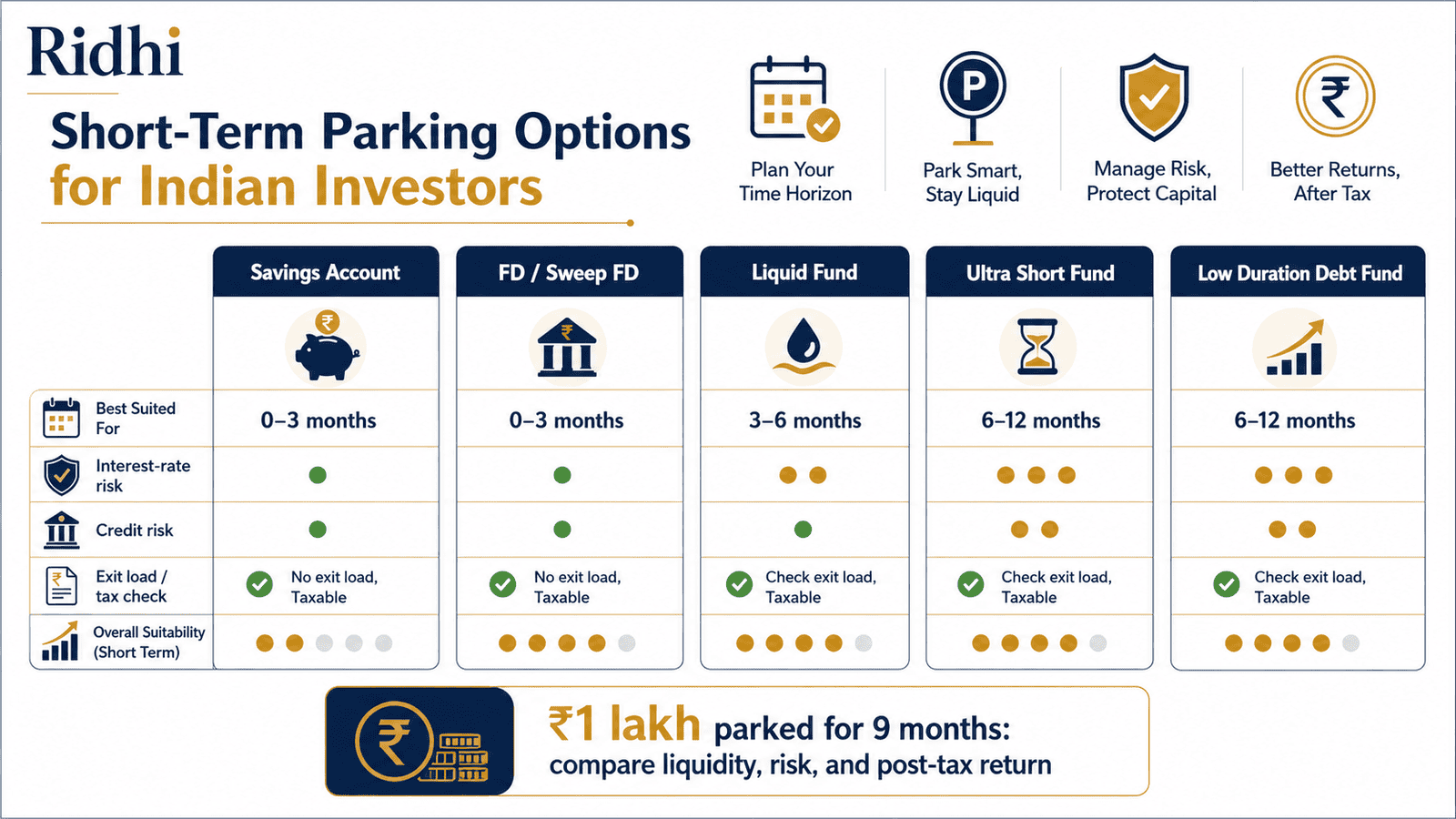
Low duration debt funds can suit 6–12 month parking only if you accept moderate interest-rate and credit risk. For ₹1 lakh parked for 9 months, compare expected post-tax return, exit load, liquidity, and safety against FD, liquid fund, and savings account before choosing.
Key Takeaways
- SEBI defines low duration funds as holding instruments with Macaulay duration of 6–12 months — making them structurally aligned to your parking window, but not risk-free.
- Expected gross yield-to-maturity for low duration funds typically falls in the 7–8% range, but your net return after expense ratio, exit load (if any), and tax can be meaningfully lower.
- Debt fund gains are now taxed as per your income tax slab regardless of holding period — following the 2023 amendment — so a 30% taxpayer keeps significantly less than the gross yield suggests.
- If you park ₹1 lakh for 9 months at 7.5% gross with a 30% tax slab, your post-tax return is roughly ₹4,218 — compare that with a 7% FD giving ₹3,938 post-tax for the same period.
- Low duration funds do not have a guaranteed NAV — an interest-rate spike or credit event can temporarily push returns below expectations.
- Liquid funds carry lower risk and more predictable short-horizon returns; low duration funds offer marginally higher yield potential in return for moderately more risk.
- If you need the money back within 3–5 months, a liquid fund or FD is a safer fit. Low duration funds make more sense closer to the 9–12 month end of your range.
Comparison: Low Duration Fund vs FD vs Liquid Fund vs Savings Account vs Ultra Short Duration Fund
| Parameter | Low Duration Fund | Liquid Fund | Ultra Short Duration Fund | Bank FD (6–12 M) | Savings Account |
|---|---|---|---|---|---|
| SEBI Macaulay Duration | 6–12 months | Up to 91 days | 3–6 months | N/A | N/A |
| Typical Gross Yield (indicative) | 7–8% | 6.5–7% | 7–7.5% | 6.5–7.5% | 3–3.5% |
| Interest-Rate Risk | Moderate | Low | Low–Moderate | Nil | Nil |
| Credit Risk | Moderate | Very Low | Low | Nil (DICGC up to ₹5L) | Nil (DICGC up to ₹5L) |
| Exit Load | Typically nil; confirm fund SID | Graded exit load up to 7 days | Typically nil | Premature penalty 0.5–1% | Nil |
| Taxation (current rules) | As per income slab | As per income slab | As per income slab | As per income slab (TDS 10%) | As per income slab (Section 80TTA deduction up to ₹10,000) |
| Liquidity (T+ settlement) | T+2 (next business day for most) | Instant up to ₹50,000; T+1 otherwise | T+1 | Premature break available | Immediate |
| NAV Guarantee | No | No | No | Yes | Yes |
| Best fit horizon | 9–12 months | 1 day–3 months | 3–6 months | 3–12 months | Ongoing buffer |
All yield figures are illustrative and subject to change. Verify current rates from fund fact sheets and bank rate cards before investing. See the Pre-Publish Verification Checklist below.
Key Facts at a Glance
| Parameter | Rule / Figure |
|---|---|
| SEBI category definition | Macaulay duration 6–12 months |
| Typical portfolio instruments | T-bills, CDs, CPs, short corporate bonds |
| AMFI risk-o-meter rating | Low-to-Moderate or Moderate (varies by fund) |
| Tax treatment (post Apr 2023) | Gains taxed at income slab rate; no indexation |
| Exit load (category norm) | Usually nil; always check individual fund SID |
| Minimum investment | ₹500–₹1,000 for most funds (direct plan) |
| Regulation | SEBI Circular on Mutual Fund Categorisation |
| Capital protection | Not guaranteed — mark-to-market valuation applies |
What Are Low Duration Debt Funds — and How Do They Actually Work?
SEBI defines low duration debt funds as open-ended debt schemes that maintain a Macaulay duration of 6–12 months across their portfolio. Macaulay duration is a weighted measure of the time it takes to receive cash flows from the bonds held — think of it as the portfolio’s sensitivity timer. The longer the duration, the more the fund’s NAV moves when interest rates change.
At a 6–12 month Macaulay duration, these funds sit in a middle band. They are more sensitive to interest-rate changes than liquid funds (duration under 91 days) but far less sensitive than medium or long-duration funds. A 1% rise in interest rates typically causes a 0.5–1% NAV dip in a low duration fund — recoverable over a few months if you stay invested.
What They Hold in Their Portfolio
Low duration funds typically invest in a mix of treasury bills, certificates of deposit (CDs), commercial papers (CPs), and short-maturity corporate bonds. The credit quality varies significantly across funds. Some funds hold only AAA-rated and government instruments; others dip into AA or lower-rated paper to chase higher yield. This is the credit risk variable you must check in the fund’s portfolio before investing.
For a first-time debt investor, understanding debt fund basics and their risk profile is essential before stepping into the low duration category.
Mark-to-Market: The NAV Can Dip
Unlike a fixed deposit, debt fund NAVs are calculated on a mark-to-market basis. The underlying bonds are revalued daily at market prices. If interest rates rise sharply — say by 50 basis points in a month — the market value of the bonds in the portfolio falls, and your NAV falls with it. You do not lose money permanently if you stay invested long enough for the portfolio to earn back via yield, but the short-term dip is real and can unsettle a first-time investor.
This is why the 6–12 month parking window matters. A very short window — say 3 months — gives you less time to recover from even a mild NAV dip.
Modified Duration vs Macaulay Duration
Fund fact sheets often show both Macaulay duration and modified duration. Modified duration tells you the approximate percentage change in NAV for a 1% change in interest rates. A modified duration of 0.8 means a 1% rate rise causes roughly a 0.8% NAV fall. Low duration funds typically have a modified duration of 0.5–1.0 — a manageable sensitivity band for a 9–12 month horizon.
Yield-to-Maturity and What It Means for You
The yield-to-maturity (YTM) figure on a fund fact sheet is the gross return the portfolio would earn if all instruments were held to maturity. It is before expense ratio. It is not a guaranteed return. If you see a YTM of 7.8% and the expense ratio is 0.3% (direct plan), the indicative net yield is roughly 7.5% — before tax. How your mutual fund returns are calculated and what CAGR vs XIRR means for short periods is worth understanding, because annualised figures can create unrealistic expectations for a 9-month window.
The 2023 Tax Rule Change That Changed Everything
Before April 2023, debt fund investors who held for more than 3 years benefited from indexation and a 20% long-term capital gains tax rate. The Finance Act 2023 removed this benefit. Now, all debt fund gains — regardless of holding period — are added to your income and taxed at your applicable slab rate. For a 30% taxpayer, this significantly narrows the post-tax advantage over a bank FD, which is also taxed at slab rate. The tax treatment is now identical in structure; the difference comes down to gross yield and TDS mechanics.
Direct vs Regular Plan: A Cost You Control
Most funds in this category have negligible or zero exit load. But the plan type — direct vs regular — determines your expense ratio. A direct plan of a low duration fund might have an expense ratio of 0.20–0.35%, while the regular plan may be 0.60–0.80%. On a ₹3 lakh investment over 9 months, that difference compounds. Understanding the impact of expense ratio on your net returns is especially important in debt funds where the gross yield margin is thin to begin with.
Real Example: Rahul Parks ₹3 Lakh for 9 Months
Rahul, 34, is a product manager in Bengaluru earning ₹24 lakh per year. He has ₹3 lakh that he plans to use for a home loan down payment top-up in approximately 9 months. He is in the 30% income tax bracket. He wants to evaluate whether a low duration fund makes sense versus a 9-month FD.
His bank is offering a 9-month FD at 7.0% per annum. A low duration fund he is looking at shows a current YTM of 7.8% and an expense ratio of 0.30% (direct plan), implying an indicative net yield of approximately 7.5% before tax.
On his ₹3 lakh principal:
- Low duration fund at 7.5% for 9 months: gross gain ≈ ₹16,875. Post 30% tax: ₹11,813.
- 9-month FD at 7.0%: interest ≈ ₹15,750. Post 30% tax (TDS 10% at source, balance at filing): ₹11,025.
The post-tax difference is approximately ₹788 on ₹3 lakh — real, but not transformative. The FD gives Rahul certainty of principal. The low duration fund gives him NAV movement risk. For a goal-linked corpus where he cannot afford a shortfall, the marginal extra return may not justify the risk. If instead Rahul’s horizon were 12 months and the rate spread were wider, the case for the low duration fund becomes stronger.
How to Calculate Your Post-Tax Return from a Low Duration Fund
Post-Tax Return (₹) = Principal × (YTM − Expense Ratio) × (Holding Months / 12) × (1 − Tax Slab Rate)
Step-by-step using ₹1 lakh, 9-month horizon, YTM 7.8%, expense ratio 0.30%, 30% tax slab:
- Net yield before tax = 7.8% − 0.30% = 7.5%
- Gross gain for 9 months = ₹1,00,000 × 7.5% × (9/12) = ₹5,625
- Tax at 30% = ₹5,625 × 0.30 = ₹1,688
- Post-tax gain = ₹5,625 − ₹1,688 = ₹3,938
- Post-tax return on ₹1 lakh = 3.94% absolute (or approximately 5.25% annualised)
| Scenario | Key Inputs | Post-Tax Gain on ₹1 Lakh (9 months) |
|---|---|---|
| Low Duration Fund — 30% slab | YTM 7.8%, ER 0.30%, 30% tax | ₹3,938 |
| Low Duration Fund — 20% slab | YTM 7.8%, ER 0.30%, 20% tax | ₹4,500 |
| FD at 7.0% — 30% slab | Rate 7.0%, 30% tax | ₹3,675 |
| Liquid Fund at 6.8% — 30% slab | YTM 6.8%, ER 0.20%, 30% tax | ₹3,528 |
| Savings Account at 3.5% — 30% slab (no 80TTA benefit for ₹1L gain) | Rate 3.5%, 30% tax | ₹1,838 |
All figures are illustrative. Actual returns depend on portfolio performance, not YTM alone. YTM is not a return guarantee.
How to Decide What’s Right for You
Your horizon is 9–12 months, you are comfortable with moderate NAV fluctuation, and you are in the 20% tax slab or below — THEN a low duration fund is likely the most tax-efficient short-term parking option available to you.
Your horizon is 9–12 months but you are in the 30% slab — THEN run the post-tax numbers before deciding. A high-yielding FD from a reputed bank may net nearly as much with zero NAV risk.
Your horizon is 3–6 months — THEN an ultra short duration fund or a liquid fund is a better fit. Low duration funds have a Macaulay duration of up to 12 months; a 3-month window leaves you with limited time to recover from even a small interest-rate-driven dip.
The money is linked to a critical, non-postponable goal (medical emergency buffer, home down payment, education fee) — THEN capital safety outranks return optimisation. Use an FD or a liquid fund for goal-linked short-term money.
You want to invest via direct plan and can tolerate some NAV movement — THEN a low duration fund (direct) is meaningfully cheaper than a regular plan and can outperform an FD on a 12-month view in a stable interest-rate environment.
The fund’s portfolio contains significant exposure to AA or lower-rated instruments — THEN the higher yield comes with real credit risk. Stick to funds with predominantly AAA/sovereign portfolios for short-term parking.
You cannot tolerate seeing your corpus temporarily drop in value on your app — low duration funds are NOT for you for short-term parking. Even a 0.3–0.5% temporary NAV dip can shake confidence and lead to premature exits at a loss. A fixed deposit is your better answer.
Common Mistakes to Avoid
Treating YTM as a Promised Return
The yield-to-maturity on a fund’s fact sheet is the portfolio’s theoretical gross yield if all instruments mature without default. It is not a return guarantee.
If the portfolio holds bonds that default, get downgraded, or if interest rates spike sharply, the actual return can fall well below YTM. Investors who assumed YTM equals guaranteed return have been caught off-guard by surprise NAV drops.
Use YTM as a benchmark comparison tool, not as a return commitment.
Ignoring the Expense Ratio on Short Horizons
A 0.5% difference in expense ratio between a regular and direct plan sounds small. On a ₹5 lakh investment over 9 months, it costs you approximately ₹1,875 in additional drag.
Debt fund yields are thin. Every basis point of expense ratio matters more here than in an equity fund where returns are several multiples higher. Always check the expense ratio before parking money in a debt fund. Always choose direct plan unless you have a specific reason not to.
Check the direct plan’s expense ratio on the AMFI or fund house website before investing.
Not Checking the Fund’s Portfolio Credit Quality
Two low duration funds can have the same Macaulay duration but wildly different credit profiles. One may hold 90% AAA/sovereign paper; another may hold 30% in AA-rated CPs to boost yield.
A credit event — even on one instrument — can drag the fund’s NAV by 1–3% overnight. For a short parking window, that loss is almost impossible to recover in time.
Check the fund’s portfolio on the fund house website or Value Research. Prioritise funds with predominantly AAA and sovereign exposure for 6–12 month parking.
Confusing Low Duration with Liquid Fund Safety
Liquid funds are the safest active debt category — they hold instruments with maturity under 91 days and follow strict SEBI valuation rules designed to protect capital.
Low duration funds are structurally riskier: higher duration, potentially lower credit quality. Treating them as equivalent to liquid funds underestimates the risk you are taking on.
If your requirement is liquid-fund-level safety, use a liquid fund — not a low duration fund.
Overlooking Taxation After the 2023 Amendment
Many investors still believe debt funds attract a lower tax rate after 3 years. That benefit was removed from April 2023. All debt fund gains are now taxed at your slab rate.
This changes the post-tax return math significantly for investors in the 30% bracket. A 30% taxpayer’s effective post-tax yield from a low duration fund at 7.5% gross is about 5.25% — not far from a well-rated FD at the same gross rate.
Run the post-tax comparison before assuming the mutual fund automatically wins.
Redeeming Within Days of a Rate Spike
When the RBI signals a rate hike, debt fund NAVs typically dip. Investors who panic and redeem immediately crystallise the loss.
If you have invested for 9–12 months, a short-term rate-driven dip usually reverses within weeks as the portfolio earns back through yield. Exiting in panic is the worst possible response — you book a loss and miss the recovery.
Decide your redemption timeline before investing. If you cannot commit to at least 6 months, do not enter a low duration fund.
Assuming No Exit Load Means No Cost to Exit Early
Most low duration funds carry zero exit load — that is correct. But exiting a debt fund within days of entry can mean you exit at a slightly lower NAV than the entry NAV if the market has moved adversely.
Zero exit load does not mean zero exit cost. The cost is in NAV movement, not in a fund-levied charge. Always check the specific fund’s Scheme Information Document (SID) for current exit load terms.
Treat the investment as locked in for your planned horizon. Do not rely on “I can exit anytime” as a substitute for planning.
Skipping a Comparison with an FD Before Investing
The post-tax return difference between a low duration fund and a 9-month FD from a reputed bank can be under ₹1,000 on ₹3 lakh. That gap narrows further if you are in the 30% slab.
Many investors skip the FD comparison entirely and assume mutual funds are always better. For short parking windows in a 30% slab, the guaranteed return of a fixed deposit can be the smarter choice after all factors are considered.
Run both numbers before deciding. The extra yield is real only when the rate spread is wide enough to justify the risk.
When This May Not Be the Right Choice
Low duration debt funds are not suitable for everyone parking money for 6–12 months. Specifically, consider alternatives if:
- You are in the 30% tax slab and the rate spread over FD is under 0.5%. After tax, the net gain difference may be under ₹500 on ₹1 lakh — not worth the NAV volatility for a goal-linked corpus.
- Your goal is non-negotiable and time-bound. A home loan registration payment, a college admission fee, or a medical procedure expense cannot wait for the NAV to recover after a dip. For these goals, capital guarantee matters more than return optimisation.
- You are new to mutual funds and will panic at NAV fluctuation. A 0.5% dip in your app can trigger emotional exits that cost more than any yield advantage. A fixed deposit or liquid fund is a better starting point.
- The fund’s portfolio has significant sub-AAA exposure. If a fund is chasing yield through lower-rated instruments, the credit risk is disproportionate for a 6–12 month window. Walk away.
If any of these apply to your situation, it may be worth exploring alternatives before committing.
Official Rules and Where to Verify
Low duration debt funds are governed by SEBI’s mutual fund categorisation framework. Tax rules for debt fund capital gains are governed by the Income Tax Act, as amended by the Finance Act 2023. RBI’s monetary policy directly influences debt market yields and fund returns.
Verify current rules, limits, and rates from these official sources:
- SEBI (categorisation, fund regulations) — sebi.gov.in
- Income Tax Department (capital gains, slab rates, TDS on mutual funds) — incometax.gov.in
- RBI (interest rate policy, monetary policy statements) — rbi.org.in
- AMFI (fund fact sheets, expense ratios, risk-o-meter ratings) — amfiindia.com
Rules, limits, and rates on this topic can change with each Budget or regulatory update. Always verify current figures directly from the official source before making any financial decision.
Expert Tips
- Match duration to your timeline, not just the category name. Check the fund’s current average maturity and modified duration on the fact sheet. A fund nominally in the “low duration” category may be closer to 10–11 months average maturity — appropriate for a 12-month horizon but riskier for a 6-month one. Prefer funds whose average maturity is noticeably shorter than your planned exit date.
- Use direct plan via a mutual fund app or AMC website. For a 9-month hold on ₹3 lakh, choosing a direct plan over a regular plan saves approximately ₹1,500–₹2,000 in expense drag at typical TER differentials. The difference between direct and regular plans matters most in low-yield categories like debt funds.
- Check the AMFI risk-o-meter before committing. SEBI requires all funds to publish a risk-o-meter rating. Low duration funds are typically rated “Low to Moderate” or “Moderate.” If you see a “Moderately High” rating, dig into the portfolio — the fund is likely holding significant sub-AAA or longer-maturity paper for higher yield.
- Ladder between liquid and low duration if your timeline is uncertain. If you are unsure whether you will need the money in 4 months or 10 months, split your corpus: 30–40% in a liquid fund for near-term flexibility, 60–70% in a low duration fund for the likely longer portion. This hedges both timing and yield.
- Track YTM vs expense ratio every quarter. Fund YTMs move as the portfolio turns over. A fund with a YTM of 7.8% today may be at 7.3% in three months if market yields compress. Recheck the fact sheet every 90 days and confirm the case for staying invested still holds.
- Never invest in a low duration fund money that you might need within 48 hours. Settlement is T+2 for most debt funds (some have T+1). Liquid funds offer instant redemption up to ₹50,000. For emergency or near-immediate access needs, stay in a liquid fund or savings account.
- For lumpsum parking, prefer entering on a stable rate day. Do not invest a large lumpsum immediately after an RBI rate hike or on a day with significant bond market volatility. A 1–2 day delay can avoid entering at a temporarily elevated NAV right before a small correction.
Frequently Asked Questions
What is the SEBI definition of a low duration fund?
According to SEBI’s mutual fund categorisation circular, a low duration fund is an open-ended debt scheme investing in instruments with Macaulay duration of 6–12 months. The fund manager must maintain this duration band across the portfolio at all times. This definition distinguishes it from liquid funds (under 91 days) and ultra short duration funds (3–6 months).
Is a low duration fund safe for parking 6 months’ worth of money?
Relative to equity funds, yes — it is considerably safer. Relative to a fixed deposit or liquid fund, no — it carries moderate interest-rate risk and credit risk, and the NAV can dip temporarily. For a strict 6-month horizon, an ultra short duration fund or a liquid fund is safer. Low duration funds are better suited to a 9–12 month window where you have more time to ride out any temporary NAV dip.
How are low duration fund returns taxed in India?
As of April 1, 2023 (following the Finance Act 2023 amendment), all capital gains from debt mutual funds — including low duration funds — are taxed as per your applicable income tax slab rate, regardless of how long you hold the investment. The earlier benefit of 20% tax with indexation after 3 years no longer applies to funds with less than 35% equity allocation.
What is the difference between a liquid fund and a low duration fund?
Liquid funds invest in instruments maturing within 91 days, have a much lower interest-rate sensitivity, and are the safest active debt category. Liquid funds are structured for near-zero NAV volatility and typically offer instant redemption up to ₹50,000. Low duration funds have a longer portfolio duration (6–12 months Macaulay), slightly higher yield potential, moderately more interest-rate and credit risk, and T+2 settlement. Liquid funds suit 1 day to 3 months; low duration funds suit 9–12 months.
Can I lose money in a low duration fund?
Temporary NAV dips are possible — caused by interest-rate rises or credit events in the portfolio. These are not permanent losses if you hold through the recovery. However, if a portfolio holding defaults, the NAV loss can be permanent for that portion. This is why credit quality matters enormously in fund selection. You are extremely unlikely to lose money in a predominantly AAA/sovereign low duration fund over a 12-month horizon — but it is not a zero-risk instrument.
What happens if I redeem my low duration fund before 6 months?
Most low duration funds have nil exit load, so there is no fund-levied penalty for early exit. However, you may exit at a lower NAV than your entry NAV if interest rates have risen since you invested. The tax treatment remains slab-rate taxation regardless of holding period. There is no minimum lock-in — you can redeem any time — but the shorter your hold, the less time the portfolio has to earn back any short-term dip.
Is a low duration fund better than an FD for 9 months?
It depends on your tax slab and the rate spread at the time. In the 20% slab, a low duration fund at 7.5% gross net yield typically outperforms a 7% FD after tax. In the 30% slab, the gap narrows significantly — the after-tax difference on ₹1 lakh over 9 months can be under ₹400. FD also offers principal guarantee and DICGC deposit insurance up to ₹5 lakh. For goal-linked money in the 30% slab, the FD is often the better practical choice unless the rate spread is at least 75–100 basis points.
What is Macaulay duration and why does it matter?
Macaulay duration measures the weighted average time (in years) for an investor to receive all cash flows from a bond or portfolio. A higher Macaulay duration means more sensitivity to interest-rate changes. For a low duration fund with a Macaulay duration of, say, 0.9 years, a 1% rise in interest rates causes approximately a 0.9% drop in NAV — which is meaningful over a 6-month horizon but manageable over 12 months if you stay invested.
What is the typical expense ratio for low duration funds in direct plan?
Direct plan expense ratios for low duration funds typically range from 0.15% to 0.40% per year. Regular plans can be 0.50–0.90%. The difference is significant in a category where gross yield is only 7–8% — every 0.10% in expense ratio reduces your net return by that much annually. Always invest via direct plan for short-horizon debt parking unless you have a specific reason to use an adviser-routed plan.
How do I select a good low duration fund for short-term parking?
Focus on four criteria: (1) Portfolio credit quality — prefer funds with 80%+ in AAA-rated and sovereign instruments; (2) Modified duration — choose funds closer to 6–8 months of modified duration if your horizon is 9 months; (3) Expense ratio — direct plan under 0.35%; (4) AMC track record — prefer established fund houses with a consistent history in the debt category. Check the fund’s monthly portfolio disclosure on the AMFI website or AMC website before investing.
Final Verdict
Low duration debt funds make sense for 6–12 month parking — but only under the right conditions. If you are in the 20% tax slab, comfortable with moderate NAV movement, and investing via direct plan in a high-credit-quality fund, a low duration fund will likely outperform an FD and far outperform a savings account on a post-tax basis. The structural alignment of the category’s Macaulay duration with your parking horizon is a genuine advantage.
If you are in the 30% slab, the post-tax edge over a comparable FD can be slim. For goal-linked, non-negotiable corpus — a down payment, a medical buffer — the certainty of an FD often justifies the marginally lower return. For investors entirely new to debt funds, a liquid fund is a better entry point before stepping into the low duration category.
Run the numbers. Check the portfolio. Choose direct. And understand that low duration funds are a tool — not a universal upgrade over FD for every 6–12 month use case. For the foundational understanding of how debt mutual funds work and whether they are safe, start there before you invest.
Always verify the latest rules from official sources or consult a qualified professional before making any financial decision.
This article is for educational purposes only and should not be treated as personalised financial, tax, investment, insurance, or legal advice. Tax rules, interest rates, regulatory limits, and product features can change with each Budget or policy update. Please verify current rules from official government sources or consult a qualified and registered professional before making any financial decision.

Arjun Kapoor writes about mutual funds, SIPs, ELSS, fund categories, investment returns, and beginner investing concepts for Indian readers. His focus is on education, not product promotion or fund recommendations. He helps readers understand how mutual funds work before they start investing or comparing schemes.
He covers topics such as mutual fund meaning, SIP meaning, SIP calculator, direct mutual funds vs regular plans, NAV, ELSS tax-saving funds, CAGR, absolute returns, XIRR, expense ratio, large cap vs mid cap vs small cap funds, flexi cap funds, index funds vs active funds, liquid funds, debt mutual funds, SIP pause vs SIP stop, lumpsum vs SIP, and how to start SIP in India.
Arjun’s writing is simple, risk-aware, and long-term oriented. He avoids guaranteed-return language and explains investment concepts using examples, timelines, and comparison tables. His articles remind readers that mutual fund investments are subject to market risks, and past performance does not guarantee future returns. Readers should verify scheme details from SEBI, AMFI, fund houses, and official scheme documents.