

You’ve shortlisted two term insurance plans. Both look similar on paper — same cover, similar premium, almost identical features. Then someone tells you: “Check the claim settlement ratio.” One insurer has 98.5%, the other has 96.2%. So the first one is safer, right?
Not necessarily. The claim settlement ratio is useful — but most buyers misread it. A single number tells you how many claims were settled. It tells you nothing about how much was actually paid, how many claims are still pending, or whether the insurer finds creative reasons to reject yours. This article explains what the claim settlement ratio really means, how to read it correctly, and how to use it as one part of a smarter insurer decision.
Quick Answer: Claim Settlement Ratio
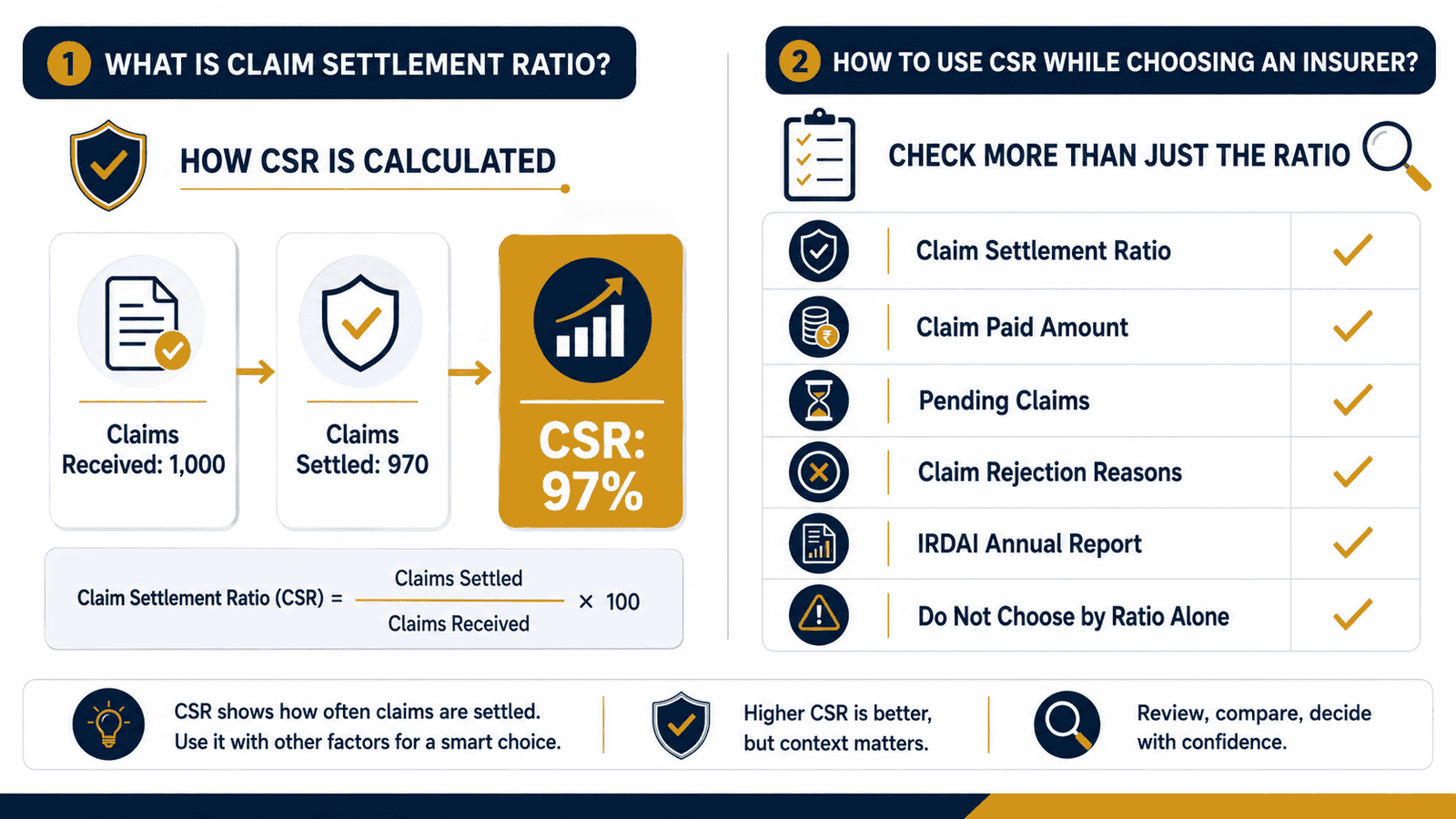
Claim settlement ratio shows the percentage of insurance claims an insurer settled during a reporting period. For example, if an insurer settled 970 out of 1,000 claims, its ratio is 97%, but you should also check claim amount paid, rejection reasons, pending claims, and policy terms.
Key Takeaways
- Claim settlement ratio (CSR) is calculated as: (Claims settled ÷ Total claims received) × 100. A ratio of 98% means the insurer settled 98 out of every 100 claims filed.
- IRDAI publishes claim settlement data for all licensed insurers every year in its Annual Report — this is the only verified source; insurer websites may show selectively favourable figures.
- CSR counts claims by number, not rupee value. An insurer that pays ₹50,000 on a ₹20 lakh claim is still counted as a “settled claim.”
- For term insurance, a CSR above 95% is broadly considered acceptable — but claim amount settlement ratio and pending claim percentage matter just as much.
- Health insurance claim settlement ratios can be lower than life insurance ratios because health policies have more grounds for partial payment, pre-existing exclusions, and waiting period rejections.
- A high CSR does not protect you if your own policy has exclusions that apply to your situation — read the policy document before purchasing.
- IRDAI regulations require insurers to settle or reject death claims within 30 days of receiving all required documents, or 45 days if an investigation is needed.
Key Facts at a Glance
| Metric | What It Measures | Where to Verify |
|---|---|---|
| Claim Settlement Ratio (CSR) | % of claims settled by number | IRDAI Annual Report — irdai.gov.in |
| Claim Amount Settlement Ratio | % of total claim amount actually paid out | IRDAI Annual Report — irdai.gov.in |
| Claims Pending Ratio | % of claims not yet decided at year-end | IRDAI Annual Report — irdai.gov.in |
| Claims Repudiated Ratio | % of claims rejected by the insurer | IRDAI Annual Report — irdai.gov.in |
| IRDAI Settlement Deadline | 30 days (standard) / 45 days (investigation) | IRDAI Regulations — irdai.gov.in |
| Grievance Redressal | IRDAI Bima Bharosa / Ombudsman / IGMS | irdai.gov.in |
What Is Claim Settlement Ratio — and Why It’s Misunderstood
Claim settlement ratio (CSR) is the percentage of insurance claims that an insurer pays out relative to the total number of claims it received in a financial year. IRDAI — the Insurance Regulatory and Development Authority of India — collects and publishes this data annually in its Insurance Statistical Handbook and Annual Report.
The formula is simple:
Claim Settlement Ratio = (Number of Claims Settled ÷ Total Claims Received) × 100
According to IRDAI guidelines, “claims received” includes claims brought forward from the previous year plus new claims filed during the year. “Claims settled” includes all claims paid and rejected — which is where many buyers get confused. Some insurers define settled as “decided” (paid or rejected), while others present only paid claims. Always check IRDAI’s own data, not the number printed on an insurer’s marketing brochure.
Why One Number Is Never Enough
Imagine two insurers. Insurer A settled 9,800 out of 10,000 claims — a CSR of 98%. Insurer B settled 980 out of 1,000 claims — also 98%. On the surface, identical. But Insurer A handled ten times more volume. Scale matters: an insurer that processes tens of thousands of death claims a year has a more statistically meaningful track record than one processing a few hundred.
Now add the claim amount dimension. If Insurer A paid ₹85 out of every ₹100 claimed (claim amount settlement ratio of 85%), it may be routinely settling claims at partial values — hospital bills partially reimbursed, death claims with deductions for policy conditions. A high CSR with a low claim amount settlement ratio is a warning sign, not a reassurance.
For term insurance basics, the stakes are especially high. Your family will file a claim during a crisis — you want to know not just that the insurer pays, but that it pays the full sum assured promptly.
Life Insurance CSR vs Health Insurance CSR
These two ratios are not comparable, and most buyers make the mistake of applying the same benchmark to both.
Life insurance death claims are relatively binary: the policyholder died, the nominee files a claim, the insurer verifies documents and pays or rejects. There are fewer legitimate grounds for partial payment. A CSR above 97% is common among established life insurers in India.
Health insurance claims are far more complex. A single hospitalisation can involve multiple claim components — room rent, surgeon fees, diagnostics, medicines. Insurers can apply room rent sub-limits, co-payment clauses, disease-specific caps, and waiting period exclusions. So a health insurer with a CSR of 90% might still be a strong performer if its average claim amount settlement is high and its pending claims are low. For a full picture of what your health policy actually covers, read about health policy coverage before comparing insurers.
What Claims Repudiated and Claims Pending Mean
IRDAI’s data breaks insurer performance into four categories: claims settled (paid), claims repudiated (rejected), claims pending (undecided at year-end), and claims withdrawn (by the claimant). A low CSR can mean either a high repudiation rate or a high pending rate — and these are very different problems.
A high repudiation rate suggests the insurer frequently rejects claims — possibly due to strict underwriting, fraud detection, or aggressive exclusion use. A high pending rate may indicate slow processing, document disputes, or operational problems. Both deserve scrutiny. IRDAI publishes all four figures. Check all of them.
Real Example: Rohit’s Insurer Shortlist in Bengaluru
Rohit Sharma, 34, a senior software engineer in Bengaluru earning ₹22 lakh per year, is buying a ₹1.5 crore term plan for his family. He has shortlisted two insurers — let’s call them Insurer P and Insurer Q.
Insurer P: CSR of 98.7%, claim amount settlement ratio 92%, pending claims 0.8%, repudiation rate 1.5%, 45,000+ death claims processed last year.
Insurer Q: CSR of 99.1%, claim amount settlement ratio 78%, pending claims 2.2%, repudiation rate 0.7%, 4,200 death claims processed last year.
On CSR alone, Rohit would pick Insurer Q. But looking at the full picture: Insurer Q pays out only ₹78 per ₹100 claimed — that 21% gap suggests systematic partial settlements or deductions. Insurer P processes ten times more claims with a higher payout rate. For cashless claim process quality and full payout reliability, Rohit’s data points to Insurer P as the stronger choice — despite its lower headline CSR.
The key insight: always read the claim amount settlement ratio alongside the headline CSR. Volume and payout rate matter more than a fraction of a percentage point difference in settlement count.
How to Calculate and Compare Claim Settlement Ratio
CSR = (Claims Settled During the Year ÷ Claims Available for Settlement) × 100
Using Rohit’s Insurer P as the example:
Claims brought forward from last year: 350. New claims received: 44,650. Total claims available for settlement: 45,000. Claims settled (paid): 44,415. Claims repudiated: 675. Claims pending at year-end: 360. Claims withdrawn: 150.
CSR = (44,415 ÷ 45,000) × 100 = 98.7%
| Scenario | Key Inputs | What It Signals |
|---|---|---|
| High CSR + High Claim Amount Settlement | CSR 98%+, amount ratio 90%+ | Strong performer — reliable for large claims |
| High CSR + Low Claim Amount Settlement | CSR 98%+, amount ratio below 80% | Pays many claims but often at partial value |
| Moderate CSR + Low Pending | CSR 95–97%, pending under 1% | Acceptable — fast decisions, low backlog |
| High CSR + High Pending | CSR 98%+, pending above 3% | Slow processing — headline looks better than reality |
Comparison: Claim Settlement Ratio vs Claim Amount Settlement Ratio
| Parameter | Claim Settlement Ratio | Claim Amount Settlement Ratio |
|---|---|---|
| What it measures | Number of claims settled | Rupee value of claims paid |
| Published by | IRDAI Annual Report | IRDAI Annual Report |
| Risk of misreading | Medium — ignores partial pays | Lower — shows actual payout |
| More relevant for | Quick insurer shortlisting | Large cover term / health claims |
| Affected by small claims | Yes — small claims inflate ratio | No — weighted by amount |
| Benchmark (life insurance) | Above 95% broadly acceptable | Above 85% broadly acceptable |
| Can be gamed by insurer? | Yes — by settling small claims first | Harder to manipulate |
How to Decide What’s Right for You
You are buying term insurance with a cover of ₹50 lakh or more — THEN prioritise claim amount settlement ratio and claims pending ratio over headline CSR. A full payout on a large sum assured matters more than a 0.5% CSR difference.
You are buying health insurance — THEN also check the insurer’s network hospital list, cashless approval speed, and room rent sub-limits. CSR alone does not tell you whether your city’s best hospital is empanelled.
Two insurers have CSRs within 1–2% of each other — THEN look at claim volume processed, grievance redressal ratio, and solvency margin instead of treating the CSR difference as decisive.
Your chosen insurer has a CSR above 97% but a high pending claims ratio (above 3%) — THEN this is a processing speed red flag. Your family may wait months for a decision during the most difficult time.
You want to estimate how much term cover your family needs alongside comparing insurers — THEN use the right cover amount guide to size your policy correctly before shortlisting insurers.
You are comparing a family floater choice across health insurers — THEN weight CSR alongside co-payment terms, pre-existing disease waiting periods, and restoration benefit before deciding.
You should not rely on CSR as your sole insurer metric if the insurer is new (under 5 years old) — small claim volumes make any percentage figure statistically unreliable. Choose an insurer with at least 5 years of IRDAI-reported claim data.
Common Mistakes to Avoid
Using the Insurer’s Own Website as the Source
Insurer websites often display their claim settlement ratio prominently — sometimes showing their best-ever year or cherry-picked data.
IRDAI publishes independently verified figures. An insurer quoting 99.2% on its homepage may be showing data from a year with unusually low claims volume or a definition of “settled” that includes rejections.
Always cross-check with IRDAI’s Annual Report at irdai.gov.in before trusting any number on a marketing page.
Ignoring Claim Volume
A CSR of 98% based on 200 claims is statistically meaningless compared to 98% based on 50,000 claims.
A new insurer with a perfect 100% CSR on 150 claims tells you almost nothing about how it will behave when you file a ₹1.5 crore death claim ten years from now. Small sample sizes produce misleading ratios.
Look for insurers that have processed at least 10,000+ claims per year consistently.
Treating Life and Health CSRs as Comparable
A health insurer with a 91% CSR is not necessarily worse than a life insurer with 98%.
Health claims are far more complex — sub-limits, co-payments, network restrictions, and disease-specific caps all affect settlement. Comparing CSRs across insurance categories misleads buyers into dismissing strong health insurers.
Compare life CSRs with life CSRs, and health CSRs with health CSRs, using the same year’s IRDAI data.
Overlooking Claims Pending Ratio
An insurer can have a 98% CSR while leaving 4% of claims stuck in processing at year-end.
These pending claims may eventually be settled or rejected — but your family would wait months. For term insurance where financial urgency is highest after a death, a slow insurer is a real hardship even if it eventually pays.
Check the pending ratio. Anything above 2–3% warrants caution.
Skipping the Claim Amount Settlement Ratio
This is the most overlooked metric. An insurer can settle every single claim — and pay only 70% of the total amount claimed.
For a ₹20 lakh hospitalisation, that 30% gap is ₹6 lakh out of your own pocket. For a ₹1 crore term claim, even small deductions can create disputes for your nominee.
IRDAI publishes this figure too. Always read it alongside CSR.
Not Reading the Waiting Period Rules
Many health claim rejections are valid — the claimant simply did not know about waiting periods. A 2-year waiting period for pre-existing diseases, or a 30-day initial waiting period, means your claim is rejected even with a 97% CSR insurer.
Read about waiting period rules for your policy before assuming your claim will be accepted.
Understand every exclusion before purchasing. A rejected claim because of a clause you missed is not the insurer’s failure — it is an avoidable buyer mistake.
Ignoring Grievance Redressal Data
IRDAI also publishes grievance redressal ratios — how many complaints an insurer receives per 10,000 policies issued.
An insurer with a high CSR but a high grievance ratio may be settling claims only after policyholders escalate. Fast payment without complaints is far better than eventual payment after a fight.
Check grievance data alongside CSR for the most complete insurer picture.
Not Verifying Whether Your Policy Has the Relevant Exclusion
Even the best insurer cannot protect you if your specific claim type is excluded in your policy document.
Adventure sports injuries, certain critical illnesses, and non-disclosure of pre-existing conditions are common grounds for rejection that have nothing to do with insurer quality. A 99% CSR insurer will still reject a claim that falls under a valid policy exclusion.
Read the policy document carefully before purchasing. This is not optional.
When This May Not Be the Right Choice
Using claim settlement ratio as your primary insurer metric may not be the right approach in these situations:
When you are comparing a brand-new insurer: Insurers with under 5 years of operations have too few claims processed for any CSR figure to be statistically meaningful. A perfect 100% CSR on 300 claims tells you very little about behaviour at scale or during a catastrophic claims year.
When premium savings are extreme: If two insurers have CSRs within 1%, but one offers the same cover for ₹8,000 less per year, optimising purely on CSR may not be worth the premium cost — especially if other metrics are comparable.
When policy exclusions are the real risk: If your medical history includes conditions that several insurers exclude, the insurer’s CSR is less relevant than whether your specific condition is covered. A 99% CSR insurer that excludes your pre-existing condition will reject your claim regardless.
When health insurance network hospitals matter more: For a cashless health claim, hospital empanelment in your city may be more critical than a 1–2% CSR difference. An insurer with a 94% CSR but your city’s top hospital in its network may serve you better than a 97% CSR insurer with no cashless facility nearby.
If any of these apply to your situation, it may be worth exploring alternatives before committing.
Official Rules and Where to Verify
Claim settlement ratio data for all licensed insurers in India is published by:
- IRDAI (Insurance Regulatory and Development Authority of India) — irdai.gov.in. Publishes the Annual Report and Insurance Statistical Handbook with CSR, claim amount settlement ratio, pending claims, and repudiation data for every licensed life and health insurer.
- Individual insurer annual reports — mandatory filings with IRDAI. Available on insurer websites but should always be cross-checked against IRDAI’s own published data.
Rules, limits, and rates on this topic can change with each Budget or regulatory update. Always verify current figures directly from the official source before making any financial decision.
Expert Tips
- Download the IRDAI Annual Report directly from irdai.gov.in and compare all four metrics side by side: CSR, claim amount settlement ratio, pending ratio, and repudiation ratio. A five-minute comparison prevents years of regret.
- When shortlisting term insurers, filter first by claim volume (above 10,000 death claims per year), then by CSR (above 95%), then by claim amount settlement ratio (above 85%). This sequence eliminates small, statistically unreliable insurers before you compare percentages.
- For health insurance, call the insurer’s toll-free number before buying and ask: “Does your cashless network include [your nearest hospital]?” A 30-second call reveals more than a CSR percentage about real-world usability.
- Check the grievance redressal ratio in IRDAI data — complaints per 10,000 policies. An insurer with a high CSR but high grievance ratio is one where customers only get paid after fighting for it. You want a low grievance ratio too.
- Use IRDAI’s IGMS (Integrated Grievance Management System) or Bima Bharosa portal if your insurer delays or rejects a claim you believe is valid. You have a regulatory escalation path — know it before you need it.
- For term insurance, note that IRDAI regulations require insurers to settle or reject a death claim within 30 days of receiving all documents — or 45 days if an investigation is required. If your insurer exceeds this, escalate immediately.
- Never buy insurance — term or health — without reading Section 4 (exclusions) and Section 6 (conditions) of the policy document. Even a 99% CSR insurer legitimately rejects claims that fall under stated exclusions.
Frequently Asked Questions
What is a good claim settlement ratio for term insurance in India?
A CSR above 95% is generally considered acceptable for term insurance. Most established life insurers in India report CSRs between 96% and 99%+ according to IRDAI data. However, do not use CSR in isolation — also check claim amount settlement ratio, claims pending, and the volume of claims processed. An insurer with 97% CSR processing 50,000 claims annually is more reliable than one with 99% CSR processing 500 claims.
Where can I find verified claim settlement ratio data for Indian insurers?
The authoritative source is IRDAI’s Annual Report, published at irdai.gov.in. IRDAI publishes this data for every licensed life and non-life insurer in India. Insurer websites also display CSR figures, but these may use different definitions or time periods — always cross-check with IRDAI’s published numbers.
Is claim settlement ratio different for life insurance and health insurance?
Yes. Life insurance death claim CSRs tend to be higher (often 96–99%+) because the claim trigger — death — is binary and well-defined. Health insurance CSRs are typically lower due to partial payments, sub-limits, co-payment clauses, waiting period exclusions, and network restrictions. Do not compare life and health CSRs directly. Use the same metric for the same insurance category.
What is the difference between claim settlement ratio and claim paid ratio?
These terms are often used interchangeably, but there is an important distinction. Claim settlement ratio counts the number of claims settled relative to claims received. Claim paid ratio (or claim amount settlement ratio) measures the total rupee amount paid relative to total amount claimed. An insurer can have a high settlement count ratio but a lower rupee payout ratio if it routinely settles claims at partial value. Both figures are published by IRDAI.
Can an insurer reject my claim even if it has a 98% claim settlement ratio?
Yes. A 98% CSR means the insurer rejected approximately 2% of claims — and your claim could be in that 2%. Common valid rejection reasons include non-disclosure of pre-existing conditions, policy exclusions, lapsed policy at the time of claim, waiting period not met, and fraudulent documentation. A high CSR does not override a valid exclusion in your policy document. Reading the exclusions section before purchasing is essential.
What happens if my insurer delays settling my claim beyond 30 days?
Under IRDAI regulations, insurers must settle or reject a death claim within 30 days of receiving all required documents. If an investigation is required, this extends to 45 days. Beyond this, the insurer is liable to pay interest on the claim amount. If your insurer delays beyond these limits, you can raise a complaint through IRDAI’s Bima Bharosa portal or IGMS at irdai.gov.in, or approach the Insurance Ombudsman.
Is it better to choose a newer insurer with a higher CSR or an older one with a slightly lower CSR?
Generally, prefer an established insurer with a meaningful claims volume. A newer insurer may show a very high CSR simply because it has processed very few claims — often under 1,000 in its first years. Statistically, 99% on 300 claims is unreliable. Choose an insurer that has processed at least several thousand claims consistently over multiple years. Volume and consistency matter more than a 1–2% CSR advantage for a newer entrant.
What is the claims repudiated ratio and should I worry about it?
Claims repudiated ratio is the percentage of claims that an insurer formally rejected. A high repudiation ratio (above 5% for life insurance) is a concern — it suggests the insurer frequently finds grounds to deny claims. A low repudiation ratio combined with a high CSR indicates the insurer pays most claims without dispute. IRDAI publishes this figure for every insurer in its Annual Report.
Does a high claim settlement ratio mean I do not need to read the policy document?
No. A high CSR reflects the insurer’s overall behaviour — it does not guarantee your specific claim will be paid. Your claim is governed by your specific policy’s exclusions, conditions, and waiting periods. A 99% CSR insurer can legitimately reject a claim if you did not disclose a pre-existing condition, the waiting period was not met, or the claim falls under a standard exclusion. Always read the policy document carefully before purchasing. Insurance is a subject matter of solicitation.
What should I check beyond CSR when comparing health insurers?
For health insurance, check: (1) cashless hospital network in your city, (2) room rent sub-limits as a percentage of sum insured, (3) co-payment clause — especially for senior citizens, (4) waiting period for pre-existing diseases (typically 2–4 years), (5) claim amount settlement ratio, (6) restoration benefit, and (7) grievance redressal ratio from IRDAI data. CSR is just one of seven meaningful parameters for a health insurer decision.
Final Verdict
The claim settlement ratio is a useful starting point — not a finishing line. For any term insurance purchase above ₹50 lakh, also look at claim amount settlement ratio, pending claims percentage, grievance redressal ratio, and claims volume before shortlisting an insurer. For health insurance, pair CSR with hospital network quality and waiting period terms. The insurer with the highest headline CSR is not automatically the best choice for your family.
Use IRDAI’s Annual Report at irdai.gov.in as your data source — not insurer marketing pages. Compare the same metrics across the same year’s data. And once you have the right insurer, make sure you have the right cover size — the term insurance basics guide explains what to look for when you buy. Always verify the latest rules from official sources or consult a qualified professional before making any financial decision.
Insurance is a subject matter of solicitation. Please read the policy document carefully before purchasing.
This article is for educational purposes only and should not be treated as personalised financial, tax, investment, insurance, or legal advice. Tax rules, interest rates, regulatory limits, and product features can change with each Budget or policy update. Please verify current rules from official government sources or consult a qualified and registered professional before making any financial decision.

Priya Nambiar writes about insurance concepts for Indian families, salaried employees, self-employed professionals, and first-time policy buyers. Her content focuses on helping readers understand coverage, exclusions, claim conditions, premiums, riders, and policy documents before buying or renewing insurance.
She covers topics such as term insurance, health insurance, family floater plans, riders, critical illness cover, employer insurance vs personal insurance, waiting periods, exclusions, deductibles, co-payment, no-claim bonus, claim settlement, premium comparison, renewal rules, and tax benefits linked to insurance.
Priya’s writing is careful, consumer-focused, and policy-document oriented. She explains why insurance should be understood as financial protection, not just a tax-saving tool or investment substitute. Her articles encourage readers to compare coverage, understand limitations, and ask better questions before buying a policy. Premiums, exclusions, claim rules, and benefits vary by insurer, age, health, sum insured, and product type. Insurance is a subject matter of solicitation, and readers should read the official policy document carefully before purchasing.