

Here is a question that trips up most new investors: if one stock trades at ₹3,000 and another at ₹300, is the first company ten times bigger? Not necessarily — and understanding why is the first thing you need to know before you buy a single share or choose an equity mutual fund. The answer lies in market cap meaning, one of the most fundamental concepts in the stock market basics that every Indian investor must understand. Market capitalisation tells you the total market value of a company — not the price of one share, but the value of all its shares put together. Once you understand this, the labels large cap, mid cap, and small cap stop being jargon and start making real sense as shorthand for size, stability, and risk.
Quick Answer: Market Cap Meaning
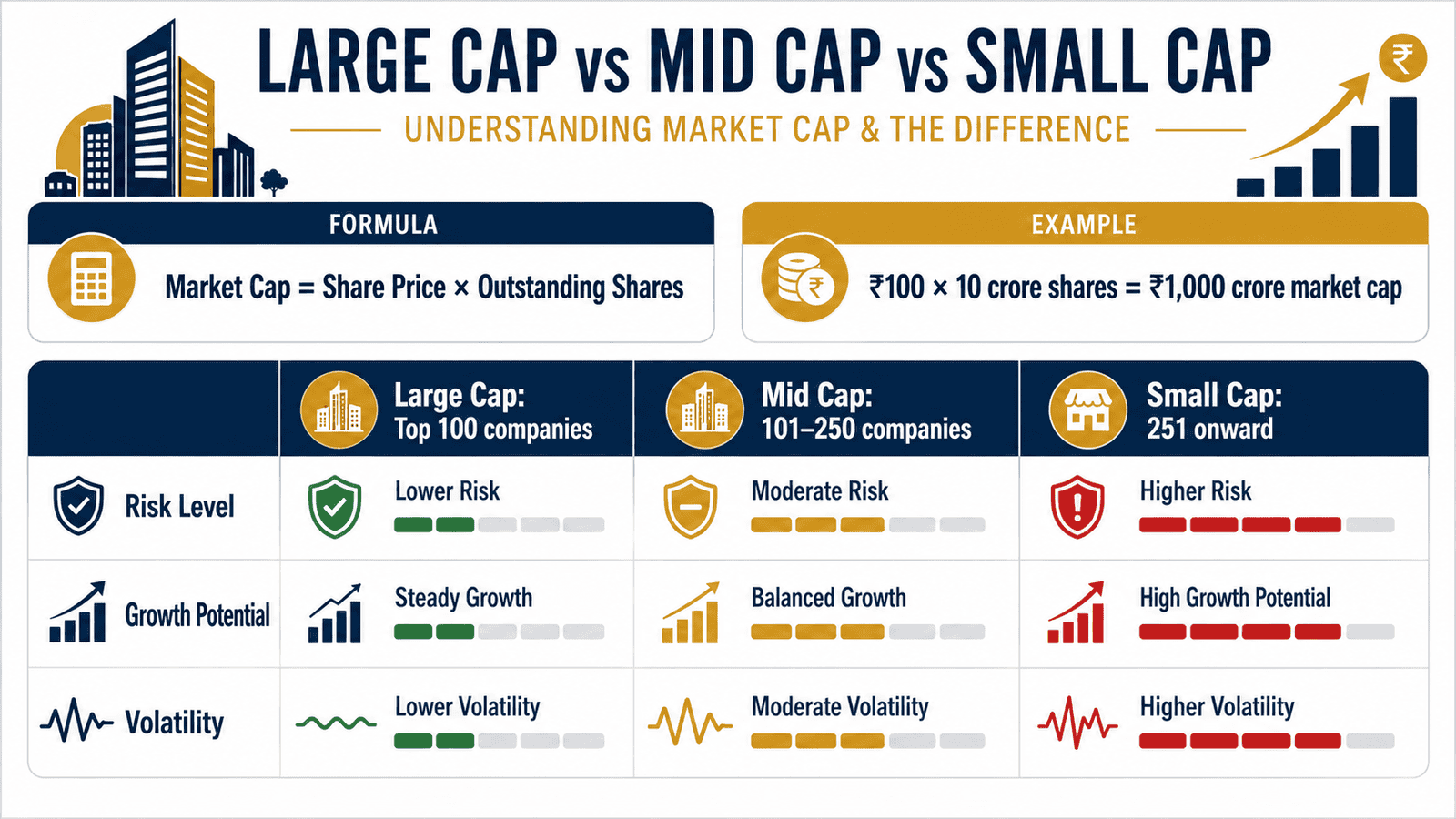
Market cap meaning is the total market value of a listed company’s outstanding shares, calculated as current share price × total outstanding shares. For example, if a company has 10 crore shares and each trades at ₹100, its market cap is ₹1,000 crore. Investors use it to compare company size and risk.
Key Takeaways
- Market cap measures the total market value of a company’s outstanding shares — not its revenue, assets, or profit.
- A ₹3,000 stock can belong to a smaller company than a ₹300 stock if the first company has far fewer shares outstanding.
- Large cap companies are generally ranked in the top 100 by market capitalisation on Indian exchanges; mid cap spans 101st to 250th; small cap covers 251st onward.
- Market cap changes every trading day as share prices move — a company’s category can change over months or years.
- Large cap companies typically offer more stability; small cap companies typically carry higher volatility and liquidity risk.
- Market cap is a useful starting point — but not enough alone for any investment decision.
- Mutual fund schemes are categorised by SEBI using the AMFI large, mid, and small cap list, which is reviewed every six months.
Comparison: Large Cap vs Mid Cap vs Small Cap
| Parameter | Large Cap | Mid Cap | Small Cap |
|---|---|---|---|
| SEBI ranking (by market cap) | Top 100 companies | 101st to 250th companies | 251st company onward |
| Typical company profile | Large, established businesses with long track records | Growing businesses — some well-known, some emerging | Smaller, newer, or niche businesses |
| Volatility | Lower | Moderate to High | High |
| Growth potential | Steady, usually moderate | Higher than large cap | Highest potential — but also highest risk |
| Liquidity (ease of buying/selling) | High | Moderate | Lower — can be hard to exit quickly |
| Information availability | Extensively researched and covered | Moderate analyst coverage | Limited research; higher information risk |
| Beginner suitability | Higher | Moderate | Lower for beginners |
| Mutual fund category (SEBI) | Large Cap Fund | Mid Cap Fund | Small Cap Fund |
For investors who want to explore how these categories translate into mutual fund choices, large and small funds explains the differences at the scheme level in detail.
Key Facts at a Glance
| Concept | Detail |
|---|---|
| Market cap meaning | Total market value of all outstanding shares of a listed company |
| Formula | Current Share Price × Total Outstanding Shares |
| Example | ₹100 share price × 10 crore shares = ₹1,000 crore market cap |
| Large cap ranking | 1st to 100th company by market cap (SEBI/AMFI definition) |
| Mid cap ranking | 101st to 250th company by market cap |
| Small cap ranking | 251st company onward |
| How often rankings change | AMFI reviews the categorisation list every six months |
| Where to verify official list | amfiindia.com and sebi.gov.in |
What Market Cap Meaning Really Is — And What It Is Not
Start With Outstanding Shares
Every listed company has issued a certain number of shares. These are called outstanding shares — the total count of all shares held by promoters, institutional investors, and retail investors combined. Understanding what a share means at its most basic level will help you make sense of this concept immediately.
When you multiply the total number of outstanding equity shares by the current market price per share, you get the company’s market capitalisation. It is essentially: what would it cost for someone to buy every single share of this company at today’s price?
Why Market Cap Changes Every Day
Share prices move every trading day based on demand, supply, earnings announcements, news, and broader market conditions. Since market cap = share price × outstanding shares, any movement in share price directly changes the company’s market cap — even if nothing has changed inside the business itself.
A company with ₹10,000 crore in market cap on Monday could be at ₹9,500 crore by Friday if its share price fell 5%. The number of outstanding shares has not changed — only the price did.
Market Cap Is Not the Same as Revenue, Profit, or Assets
This is where many beginners get confused. Market capitalisation is a market-driven number — it reflects what investors collectively believe the company is worth right now. It is not the company’s annual revenue. It is not its total assets. It is not its profit. A loss-making company with strong growth expectations can have a very high market cap, while a profitable but slow-growing business may have a lower one.
Enterprise value is a related concept that adds debt and subtracts cash from market cap to give a fuller picture of what acquiring a company would actually cost — but that is a more advanced topic. For beginners, market cap is the right starting point for comparing company size.
Why Market Cap Matters When Comparing Listed Companies
Because all listed companies trade on exchanges like NSE and BSE, you can line up any two companies by market cap and immediately understand which one the market values more highly. This is why market cap in stock market discussions is used as the first filter when classifying equity — not share price, not revenue, not employee count.
Opening opening a demat account is the practical first step before you can actually buy any of these shares, whether large cap, mid cap, or small cap. But understanding what you are buying — in terms of size and risk — comes first.
Full Market Cap vs Free-Float Market Cap
You may sometimes see the term free-float market capitalisation. This counts only the shares available for public trading — excluding shares held by promoters, governments, or locked-in institutional investors. Indices like Nifty 50 use free-float market cap to calculate index weights, which is why a company’s index weight is not always proportional to its full market cap. For classifying companies as large, mid, or small cap, SEBI and AMFI use full market capitalisation, not free-float.
Real Example: Two Companies, Two Very Different Sizes
Rohit, 29, works as a software tester in Pune and earns ₹85,000 per month. He is looking at two stocks on his trading app. Company A is priced at ₹100 per share. Company B is priced at ₹500 per share. His first instinct is that Company B must be a bigger business. Let us check.
Company A: Share price ₹100 × 10 crore outstanding shares = Market Cap ₹1,000 crore
Company B: Share price ₹500 × 1 crore outstanding shares = Market Cap ₹500 crore
Company A has a market cap of ₹1,000 crore. Company B’s market cap is ₹500 crore. Despite Company B’s share price being five times higher, Company A is twice as large by market capitalisation. The number of outstanding shares makes all the difference.
This is exactly why Rohit — and every new investor — needs to stop reading share price as a proxy for company size. The companies that make up broad indices tracked through Sensex and Nifty are selected and weighted using market cap, not share price — which is why the index moves are driven by the largest companies, not the highest-priced ones. Data on listed company market values can be checked directly at nseindia.com.
How to Calculate Market Cap
Market Cap = Current Share Price × Total Outstanding Shares
Here is how the calculation works in practice.
Example 1: Share price ₹100 × 10 crore outstanding shares = ₹1,000 crore market cap.
Example 2: Share price ₹250 × 50 crore outstanding shares = ₹12,500 crore market cap.
In Example 2, even though the share price is only 2.5 times higher than in Example 1, the market cap is 12.5 times larger — because there are five times as many shares outstanding.
| Scenario | Key Inputs | Market Cap |
|---|---|---|
| Small company, low price | ₹50 × 2 crore shares | ₹100 crore |
| Mid-size company | ₹100 × 10 crore shares | ₹1,000 crore |
| Larger company | ₹250 × 50 crore shares | ₹12,500 crore |
Where to find these numbers: the share price is visible on any trading app or exchange website. Total outstanding shares are disclosed in company filings, available on bseindia.com, and shown in most stock screeners. Market cap is usually displayed directly on trading platforms, so you rarely need to calculate it manually. Once you understand it, though, you will read every stock listing differently.
If you plan to act on this knowledge by actually buying shares, your first step is opening a demat account — that is where purchased shares are held electronically.
How to Decide What’s Right for You
You are a first-time equity investor who wants relatively lower volatility — large cap stocks or large cap mutual funds may be a more suitable starting point, as these companies are generally more established and widely tracked.
You are comfortable with moderate-to-high price swings and have a time horizon of at least five years — mid cap stocks or funds may offer higher growth potential than large caps, along with correspondingly higher risk.
You have a long investment horizon of seven years or more, a high risk tolerance, and can handle periods of significant portfolio drawdown — small cap exposure may be considered as part of a diversified portfolio, not as the core of it.
You prefer not to pick individual stocks — diversified equity mutual funds offer exposure across large, mid, and small cap companies, managed by fund managers, without requiring you to evaluate each company’s market cap yourself.
You already hold large cap stocks and want to consider broader exposure — adding mid cap or multi-cap funds may help balance portfolio diversification by market cap over time.
You are new to equity investing and are drawn to small cap stocks only because they appear cheap in terms of share price — market cap, not share price, determines company size. Small cap stocks carry meaningfully higher volatility and liquidity risk than large cap alternatives, and are generally not suitable as a beginner’s primary holding.
Common Mistakes to Avoid
Confusing Share Price with Company Size
A ₹4,000 share does not mean a bigger company than a ₹40 share.
A company with a ₹4,000 share price but only 50 lakh outstanding shares has a market cap of ₹2,000 crore. A company at ₹40 with 200 crore outstanding shares has a market cap of ₹8,000 crore — four times larger. Using share price alone to judge company size leads directly to poor investment comparisons.
Always check market capitalisation, not just the price on your screen.
Treating Large Cap as Risk-Free
Large cap means larger and more established — not zero risk.
Large cap stocks can fall 30–50% during market downturns, as seen across multiple Indian market corrections. The category lowers relative volatility compared to small caps, but equity investment always carries market risk. Treating large cap as a substitute for a fixed deposit or savings account is a fundamental mistake.
Understand that large cap reduces volatility relative to other categories — it does not eliminate it.
Assuming Small Cap Always Delivers Higher Returns
Small cap stocks have the potential for higher returns — but also the highest risk of permanent capital loss.
Many small cap companies have weak fundamentals, low liquidity, and limited analyst coverage. A stock that falls 70% requires a 233% gain just to recover. Chasing small cap stocks based on past performance alone, without evaluating business quality, is one of the most common errors among new Indian investors.
Use small cap exposure as part of a diversified strategy, not as the whole portfolio.
Ignoring Liquidity Risk in Small Cap Stocks
Low liquidity means you may not be able to sell a small cap stock quickly at a fair price.
When markets fall sharply, small cap stocks can become nearly impossible to sell without accepting a steep discount. This is different from large cap stocks, where millions of shares trade daily. Liquidity risk is separate from business risk — and often hits harder in a crisis.
Check the average daily trading volume before entering any small cap position.
Not Knowing When AMFI Reclassifies Companies
AMFI updates the large, mid, and small cap list every six months.
A company that was mid cap six months ago may now be large cap — which affects how mutual funds holding it must be categorised under SEBI rules. Investors who rely on outdated categorisations may misunderstand the risk profile of their fund’s holdings. Check amfiindia.com for the current official list.
Using Market Cap as the Only Investment Filter
Market cap tells you company size — not whether it is a good investment.
A large market cap company can still be overvalued, carry high debt, or have declining earnings. Valuation ratios, earnings growth, debt levels, and management quality all matter alongside market cap. Buying a stock purely because it is “large cap” without checking fundamentals is a category-label mistake, not an investment decision.
When This May Not Be the Right Choice
When comparing companies across very different sectors: A ₹50,000 crore software company and a ₹50,000 crore bank have the same market cap but operate under entirely different business models, capital requirements, and risk drivers. Market cap alone does not make them comparable for investment purposes.
When debt levels are high: A company with a large market cap but significant borrowings may look bigger than a lower-cap, debt-free company — but the debt-heavy company’s enterprise value tells a very different story. Equity investors bear residual risk, not just market cap risk.
When profitability, cash flow, or governance is weak: Market cap can remain high on expectations alone. A company trading at a very high market cap relative to its actual earnings or cash flow may be overvalued regardless of its category label.
When you are a short-term trader: Technical factors, momentum, and daily liquidity matter more than market cap category in short-term trading decisions. Market cap is a structural, long-term lens — not a short-term trading signal.
If any of these apply to your situation, it may be worth exploring alternatives before committing.
Official Rules and Where to Verify
Market cap categorisation in India is governed by SEBI and implemented through the AMFI list. Here are the official sources to verify current definitions, rankings, and data:
- SEBI (sebi.gov.in) — Regulatory framework for equity scheme categorisation, investor education resources, and SEBI circulars on mutual fund classification.
- AMFI (amfiindia.com) — Publishes the official list of large cap, mid cap, and small cap companies reviewed every six months. This is the list mutual funds are required to follow.
- NSE (nseindia.com) — Live market cap data, listed company details, and index constituents including Nifty 50.
- BSE (bseindia.com) — Listed company filings, outstanding share data, and real-time market cap information.
If you buy or sell shares based on market cap analysis, note that capital gains tax applies. The rules are explained clearly at stock market tax rules.
Rules, limits, and rates on this topic can change with each Budget or regulatory update. Always verify current figures directly from the official source before making any financial decision.
Expert Tips
- Use market cap to understand size, not quality. A large market cap signals that the market values the company highly today — not that the business is inherently better, safer, or more profitable than a smaller one. Always pair market cap with earnings, debt, and valuation ratios.
- Compare companies within the same sector. A ₹10,000 crore consumer goods company and a ₹10,000 crore infrastructure company are both mid cap by ranking — but their risk profiles, margins, and growth drivers are completely different. Sector context matters.
- Check the AMFI list before assuming a fund’s category exposure. If you hold a mid cap fund and the market has had a strong run, some of its holdings may have shifted to large cap territory after the six-monthly AMFI review — changing the fund’s risk profile without you changing anything.
- For beginners, diversified equity funds are often easier than picking individual small caps. A multi-cap or flexi-cap mutual fund gives you exposure across size categories, managed professionally, without requiring you to evaluate each company’s market cap, liquidity, and fundamentals individually.
- Watch portfolio drift over long bull markets. A small cap stock that has grown 400% over five years may now be a mid cap or even a large cap — and the risk characteristics of your portfolio have changed accordingly. Review allocation periodically.
- Market cap is your first filter — not your only filter. After you classify a company as large, mid, or small cap, the next step is checking P/E ratio, return on equity, debt-to-equity ratio, and earnings growth. Stopping at market cap is like knowing someone’s job title but not whether they are any good at their job.
Frequently Asked Questions
What is market cap in simple words?
Market cap is the total market value of all the shares a listed company has issued. If a company has 5 crore shares and each share trades at ₹200, the market cap is ₹1,000 crore. It tells you how large the market considers the company to be at that moment.
What is the market cap formula?
Market Cap = Current Share Price × Total Outstanding Shares. Both numbers are publicly available — the share price on any trading app and the outstanding share count in company filings on NSE or BSE.
Is market cap the same as company value?
Not exactly. Market cap reflects what investors are willing to pay for all equity shares today. It does not include the company’s debt. Enterprise value — which adds debt and subtracts cash — gives a more complete picture of what it would actually cost to take over the company. For most comparison purposes, market cap is a useful and widely accepted shorthand for company size.
Is large cap safer than small cap?
Large cap companies are generally more stable and have more analyst coverage, better liquidity, and longer operating histories — which tends to reduce day-to-day price swings. However, large cap is not risk-free. All equity investments carry market risk, and large cap stocks can fall significantly in bear markets. Mutual fund investments are subject to market risks. Past performance does not guarantee future returns.
Can a company move from small cap to mid cap?
Yes. As a company’s share price rises over time and its market cap increases, it can move from the 251+ range to the 101–250 range and be reclassified as mid cap on the next AMFI review. The reverse is also true — a mid cap company that loses market value can be reclassified downward. AMFI updates this list every six months.
Does a stock split change market cap?
No. In a stock split, the number of shares increases but the share price falls proportionally. For example, in a 2-for-1 split, a ₹200 share becomes two shares at ₹100 each. The market cap (price × shares) stays the same immediately after the split. Market cap only changes when the share price moves due to actual buying and selling in the market.
What is the difference between market cap and enterprise value?
Market cap = share price × outstanding shares. Enterprise value = market cap + total debt − cash and cash equivalents. Enterprise value is used when comparing companies with different debt levels, particularly in acquisition analysis. For basic size comparisons between listed Indian companies, market cap is the standard starting point.
Where does SEBI define large cap, mid cap, and small cap?
SEBI issued a circular on categorisation and rationalisation of mutual fund schemes that defined large cap as the top 100 companies, mid cap as the 101st to 250th companies, and small cap as the 251st company onward by full market capitalisation. AMFI publishes the specific list of companies in each category every six months at amfiindia.com.
Final Verdict
Market cap meaning is one of the first concepts every new Indian investor should get right — and most get it wrong simply because they confuse share price with company size. Market cap (share price × outstanding shares) is the correct measure of a listed company’s market value, and it directly determines whether a company is classified as large cap, mid cap, or small cap under SEBI’s framework.
Large cap means the top 100 companies by market cap — relatively more stable, more liquid, and more suitable as a starting point for most beginners. Mid cap covers the 101st to 250th — higher potential, higher risk. Small cap is 251st onward — highest potential and the highest risk of all three categories, with real liquidity concerns in falling markets.
Use market cap as your first lens for understanding company size and broadly classifying risk. Then go deeper — look at valuation, earnings, debt, and your own risk appetite and time horizon. Market cap alone never makes a complete investment case. Always verify the latest rules from official sources or consult a qualified professional before making any financial decision.
This article is for educational purposes only and should not be treated as personalised financial, tax, investment, insurance, or legal advice. Tax rules, interest rates, regulatory limits, and product features can change with each Budget or policy update. Please verify current rules from official government sources or consult a qualified and registered professional before making any financial decision.
Mutual fund investments are subject to market risks. Past performance does not guarantee future returns. For regulatory guidance on equity mutual fund categorisation, refer to SEBI (sebi.gov.in).

Devika Shah writes about stock market basics for Indian beginners who want to understand equity investing before taking financial risk. Her content is educational and does not provide stock tips, trading calls, price predictions, or personalised investment advice.
She covers topics such as demat account meaning, trading account basics, IPOs, dividends, brokerage charges, delivery vs intraday trading, market orders, limit orders, stock indices, blue-chip stocks, capital gains tax, stock market terminology, risk management, and the difference between long-term investing and short-term speculation.
Devika’s writing is clear, balanced, and risk-conscious. She helps readers understand how the stock market works, what accounts and documents are needed, what charges may apply, and what mistakes beginners should avoid. Her articles are suitable for students, salaried employees, and first-time investors who want a foundation before investing. Since market rules, tax treatment, brokerage fees, IPO processes, and regulatory requirements can change, readers should verify current information from SEBI, exchanges, brokers, and official tax sources.